
Last updated 2026-07-10
TL;DR
Most infrared saunas run 25 to 50 watts per square foot of cabin floor space. Far-infrared panels usually land at 25 to 35 W/sq ft; full-spectrum and near-infrared systems push toward 40 to 50 W/sq ft. A 2-person cabin (about 25 to 30 sq ft) draws 1,200 to 1,800 watts total. Insulation, ambient temperature, and panel placement matter more than floor area alone.
What is the standard wattage per square foot for an infrared sauna?
The industry benchmark is 25 to 50 watts per square foot of interior floor space, and where you land depends on the heater type and where the sauna lives. Far-infrared (FIR) panel saunas, the most common residential type, sit toward the low end at 25 to 35 W/sq ft, because the panels aim energy straight at your body instead of heating the air [1]. Full-spectrum units, which stack near-infrared and mid-infrared emitters onto the far-infrared panels, usually run 35 to 50 W/sq ft.
Those numbers aren't arbitrary. Infrared heaters warm bodies through radiant absorption, not convection. A correctly sized system reaches an effective core-temperature stimulus at lower air temperatures, typically 120°F to 150°F versus the 170°F to 200°F of a traditional Finnish sauna [2]. Undersize it and you never get there. The session feels lukewarm and the preheat drags.
For a quick anchor: a 1-person sauna with roughly 16 to 18 sq ft of floor space draws 800 to 1,000 watts. A 2-person cabin at 25 to 30 sq ft draws 1,200 to 1,800 watts. A 4-person unit at 55 to 65 sq ft often needs 2,400 to 3,200 watts [3]. Those ranges assume a properly insulated cedar or hemlock cabin indoors at 65°F to 70°F ambient.
How does wattage per square foot differ between far-infrared, near-infrared, and full-spectrum saunas?
The heater technology changes the math, and most buyers don't catch it until they're staring at two spec sheets side by side.
Far-infrared panels (ceramic rods, carbon fiber, or carbon-crystal emitters) radiate in the 7 to 14 micrometer band, which matches human tissue absorption well [4]. They run at low surface temperatures (around 150°F to 200°F at the heater face) and spread heat across large panel surfaces. That's why 25 to 35 W/sq ft is enough for an effective session. Carbon fiber panels distribute heat so evenly that a tight, well-insulated 1-person box can sometimes work at 22 to 25 W/sq ft.
Near-infrared saunas (traditionally incandescent heat lamps, now often LED NIR panels) concentrate energy in a tight beam at 0.7 to 1.4 micrometers. They heat skin fast and barely touch the cabin air. A solo NIR tent setup might pull 250 to 500 watts total, which reads low per square foot but makes sense because you're bathing the body directly instead of warming a room. These resist a clean W/sq ft comparison [5].
Full-spectrum systems layer all three bands. They need more total wattage because they're delivering near-IR, mid-IR, and far-IR at once. Expect 40 to 50 W/sq ft, sometimes higher. A 2-person full-spectrum cabin draws closer to 2,000 to 2,400 watts, where a comparable FIR unit would use 1,400 to 1,600 watts.
Here's the shortcut. If two 2-person saunas draw 1,400 W and 2,400 W, that gap is almost always heater type, not cabin quality.
How do you calculate the wattage you need for your specific sauna size?
The calculation is simple: multiply the interior floor area in square feet by your target watts-per-square-foot figure for your heater type.
Watts needed = floor area (sq ft) × W/sq ft target
For a far-infrared sauna indoors in a conditioned space:
| Cabin size | Floor area (sq ft) | W/sq ft target | Total watts |
|---|---|---|---|
| 1 person | 16 to 18 | 30 | 480 to 540 |
| 2 person | 25 to 30 | 30 | 750 to 900 |
| 3 person | 40 to 45 | 28 | 1,120 to 1,260 |
| 4 person | 55 to 65 | 28 | 1,540 to 1,820 |
| 6 person | 80 to 95 | 25 | 2,000 to 2,375 |
The W/sq ft target drops a little as cabins get larger because bigger spaces have proportionally lower surface-area-to-volume ratios and lose less heat per cubic foot.
Garage or outdoor structure where winter lows hit 40°F or below? Add a 20 to 30% buffer. A 2-person FIR sauna that needs 900 watts indoors may need 1,100 to 1,200 watts in a cold garage to hit session temperature without a 45-minute preheat [6].
Check panel placement too. A sauna with panels on only two walls can need more total wattage than a unit with panels on three or four walls at the same rating, because uneven coverage leaves cold spots.
| 1-person (16–18 sq ft) | 900 |
| 2-person (25–30 sq ft) | 1,500 |
| 3-person (40–45 sq ft) | 1,800 |
| 4-person (55–65 sq ft) | 2,100 |
| 6-person (80–95 sq ft) | 2,400 |
Source: Consumer Reports, sauna buying guide (citation 3); EIA electricity data (citation 9)
What electrical circuit does infrared sauna wattage require?
People forget this until they're on the phone with an electrician. Most residential infrared saunas run on one of three circuit setups.
Saunas under 1,500 watts (1-person and small 2-person FIR units) can run on a standard 120V/15A circuit if the manufacturer confirms it. At 120V, 15A gives 1,800 watts of capacity, but the National Electrical Code caps continuous loads at 80% of ampacity, so the practical limit is about 1,440 watts [7]. Many compact saunas are built to plug straight into a wall outlet for exactly this reason.
Saunas from 1,500 to 2,400 watts typically need a dedicated 120V/20A circuit. The NEC 80% rule limits continuous draw to 1,920 watts there [7].
Saunas above 2,400 watts, which covers most 3-person and larger cabins plus nearly all full-spectrum units, require a 240V circuit. At 240V/20A the continuous capacity is 3,840 watts. Larger units usually ship with a 4-prong NEMA 14-30 or 14-50 plug, the same kind an electric dryer or range uses.
NEC Article 422 covers fixed appliances and is the code section that applies to hardwired sauna units [7]. Many jurisdictions also require a permit and inspection for a new 240V circuit. Budget $200 to $600 for the electrical work depending on panel distance and whether you need a subpanel. Rates swing hard by region.
If you're eyeing a home sauna and the listing says "plug and play," that means 120V standard outlet. It makes installation a non-event but limits you to smaller FIR cabins.
Does higher wattage mean a better infrared sauna?
No. More watts buys faster heat-up and better performance in cold rooms. It does not buy better infrared output or a more therapeutic session on its own.
The metric that matters is irradiance, measured in milliwatts per square centimeter (mW/cm²) at the body surface, not total wattage draw [4]. A well-designed carbon-crystal FIR panel at 30 W/sq ft can put more irradiance on your skin than a cheap ceramic panel at 45 W/sq ft, if the ceramic unit is poorly aimed or has uneven emitters.
Brands that publish EMF test results next to wattage are generally the ones worth trusting. The International Commission on Non-Ionizing Radiation Protection (ICNIRP) publishes reference levels for electromagnetic fields from consumer devices [8]. Responsible sauna makers cite these or provide independent third-party EMF measurements, usually confirming fields well below 2 mG at seating distance.
So when you compare two saunas, look at three things: watts per square foot to confirm it lands in the 25 to 50 W/sq ft range for your heater type, panel placement and coverage, and independently tested EMF levels. Wattage is a floor check, not a quality score.
How does wattage per square foot affect heat-up time?
Heat-up time tracks the ratio of wattage to the thermal mass of the cabin. Higher W/sq ft means a shorter preheat.
A well-insulated 2-person FIR sauna at 30 W/sq ft (900 watts total) reaches 130°F in 15 to 25 minutes in a 68°F room [3]. A full-spectrum unit at 45 W/sq ft in the same cabin often hits temperature in 10 to 15 minutes, because the higher wattage outruns heat loss.
Outdoor saunas and units in unconditioned spaces take longer no matter the wattage. A sauna in a 30°F shed might need 35 to 50 minutes even at 35 W/sq ft, because heat loss through the walls and floor is far higher [6].
Want faster heat-up without paying for a bigger heater? Insulate the floor (a layer of plywood or foam board under the base) and weatherstrip the door. Both cut preheat noticeably. Floor insulation alone can shave 5 to 8 minutes off heat-up in a cold room. Nobody talks about it. It works.
For outdoor builds, the outdoor sauna guide covers weatherproofing and insulation in more detail.
What wattage per square foot do outdoor infrared saunas need?
Outdoor infrared saunas need more wattage per square foot than indoor units, full stop. How much more depends on your climate.
Mild climates (winter lows above 40°F) usually need a 15 to 20% bump over the indoor estimate. Cold climates (lows between 10°F and 30°F) call for 25 to 35% more. Sub-zero climates sometimes need 50% more wattage, or a separate wall heater to pre-condition the room.
The math: an indoor 2-person FIR sauna specs at 1,200 watts at 30 W/sq ft. That same cabin outdoors in a Minnesota January might need 1,500 to 1,800 watts to reach temperature in a reasonable time. Some manufacturers sell "outdoor-rated" cabins with higher wattage and better insulation, often 1.5-inch or 2-inch double-wall construction instead of the standard 1.25-inch single-wall cedar.
You can run a standard indoor cabin outdoors. It works, but you pay for it in longer preheats and higher power bills. The smarter move is a unit built for outdoor use, or at minimum adding floor insulation and weatherstripping the door.
Electricity cost scales with wattage, so this is a real operating-cost decision, more than a comfort preference [9].
How much does it cost to run an infrared sauna based on wattage?
This one is easy to pin down. The formula:
Cost per session = (watts × hours) / 1,000 × electricity rate ($/kWh)
Using the U.S. residential average of about 16 cents per kWh as of 2024 [9], and a 45-minute session plus a 20-minute preheat (65 minutes total at full power):
| Sauna type | Total watts | kWh per session | Cost at $0.16/kWh |
|---|---|---|---|
| 1-person FIR | 800 | 0.87 | $0.14 |
| 2-person FIR | 1,400 | 1.52 | $0.24 |
| 3-person FIR | 1,800 | 1.95 | $0.31 |
| 4-person FIR | 2,800 | 3.03 | $0.49 |
| 2-person full-spectrum | 2,200 | 2.38 | $0.38 |
Those are running costs per session, not per hour. Infrared saunas rarely run at 100% the whole session because the thermostat cycles the heaters. Real-world consumption averages 60 to 70% of rated wattage across a full session [3].
Run a 2-person FIR sauna every day and you add roughly $7 to $9 a month to your bill. That's cheap for what it does. Even the largest 6-person units, at $18 to $25 a month for daily use, cost far less to run than a gas-heated traditional sauna or a hot tub.
Rates vary a lot by state. Hawaii averages around 39 cents/kWh and Louisiana around 11 cents/kWh [9], so run your own numbers.
How do you read an infrared sauna spec sheet to confirm wattage per square foot?
Most spec sheets hand you total wattage and interior dimensions. You do the W/sq ft math yourself.
Step 1: Find the interior floor dimensions. Multiply length by width to get square feet. A cabin listed at 47" × 39" is 3.92 ft × 3.25 ft = 12.7 sq ft.
Step 2: Find total wattage. It might be listed as "heater output," "total power," or as amperage and voltage (amps × volts = watts).
Step 3: Divide watts by sq ft. That 12.7 sq ft cabin drawing 1,000 watts gives 78.7 W/sq ft, which sounds high. But small 1-person cabins run a higher ratio, because you can't drop wattage below a functional minimum no matter how small the box is.
So the 25 to 50 W/sq ft rule applies most cleanly to cabins in the 2-to-4-person range, roughly 25 to 65 sq ft. Very small saunas land higher. Very large saunas (commercial 6-person cabins, barrel saunas over 100 sq ft) can drop below 25 W/sq ft, because thermal mass and insulation efficiency work in your favor.
Also look for: number of heater panels and their placement (rear, side, floor, ceiling), whether the panels are carbon fiber or ceramic, and the listed heat-up time. Cross-checking heat-up time against wattage and ambient assumptions is a solid sanity test [1].
If a listing hides interior floor dimensions or total wattage, ask before buying. Missing that data is a yellow flag.
SweatDecks publishes full spec breakdowns on its sauna collection pages, including heater type, total wattage, and interior dimensions, so you can run this math before you add to cart.
Is there a wattage per square foot minimum below which an infrared sauna won't work well?
Yes. Below about 20 W/sq ft in a typical FIR sauna, you'll struggle to reach effective session temperatures in a reasonable time, and in cool rooms you may not reach them at all.
The practical floor is around 22 to 23 W/sq ft for a tightly built, well-insulated 1-to-2-person FIR cabin used indoors. Some budget saunas from mass-market retailers sit right at this threshold. They technically work, but heat-up takes 35 to 45 minutes and a cold day can feel underwhelming.
The research on infrared sauna cardiovascular and recovery effects, including a 2018 review in Mayo Clinic Proceedings, rests on sessions that raise core body temperature [10]. That doesn't happen if your sauna can't reach 120°F or higher within a reasonable preheat. An underpowered unit leaves you sitting in a warm box instead of getting a real physiological stimulus.
The ceiling is softer. Very high wattage (60+ W/sq ft) can turn uncomfortable, because air temperature climbs faster than the radiant warming cycle and the cabin starts to feel like a conventional steam room. The sweet spot for most FIR users is 28 to 38 W/sq ft, which balances heat-up speed against session comfort.
Curious how infrared heat stacks up against traditional high-temperature sessions? The sauna vs steam room breakdown covers the temperature and humidity differences.
How does heater placement affect effective wattage per square foot?
Total wattage means nothing if the panels face the wrong way or cover the wrong surfaces. Placement is arguably more important than the raw W/sq ft number.
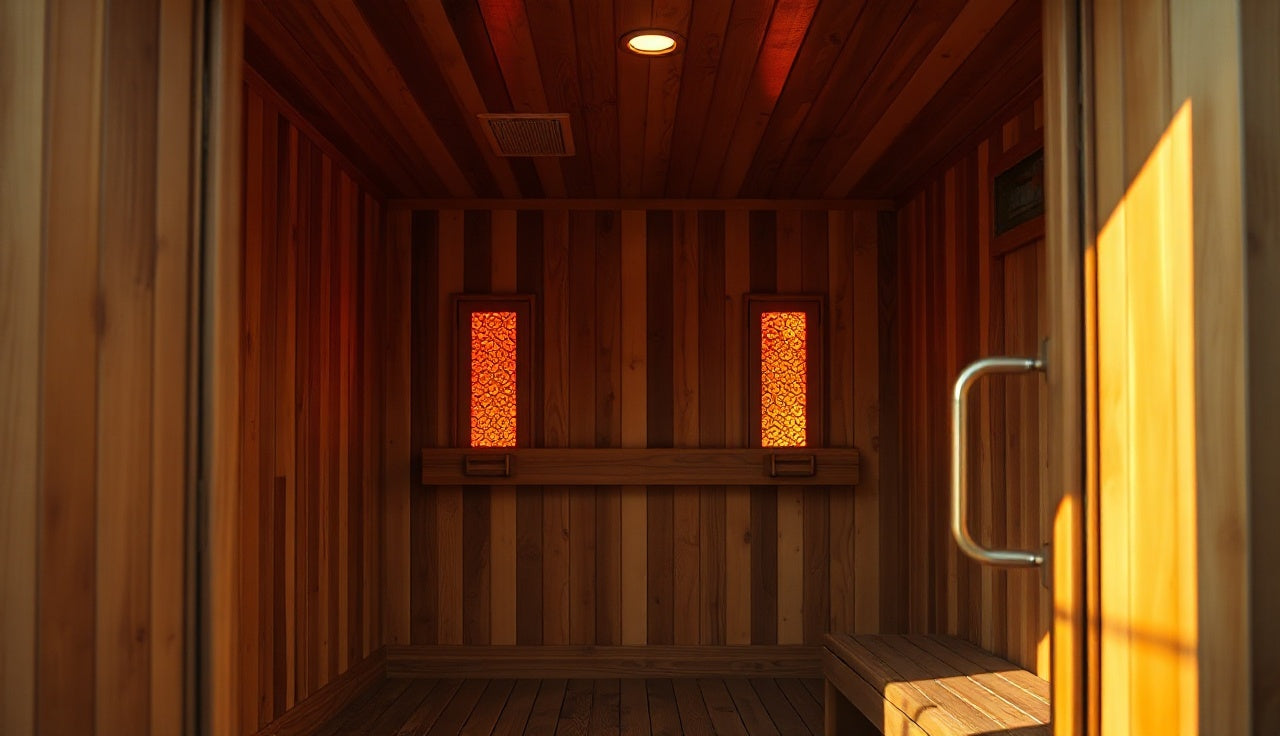
Back panels are the most common in residential FIR saunas and cover the largest emitter surface relative to occupant exposure. A cabin with one big rear carbon panel at 800 watts feels different from a cabin running 800 watts split across rear, side, and calf panels, because the second setup surrounds your body from several angles at once.
Floor and calf-level panels warm the lower body and even out the heat. Roof panels are less common in FIR saunas (they show up more in traditional rock designs), but some high-end units add them for overhead radiant warmth.
A useful check: multiply each panel's rated wattage by its effective view factor, meaning the geometric fraction of its radiation that actually reaches you. A panel angled 45 degrees away from the bench delivers less effective W/sq ft than one facing the seat directly. Most manufacturers handle this in the design. Cheap units sometimes place panels where they look good rather than where they work.
The practical take: a cabin bragging about 12 panels with low total wattage and tiny emitters is often worse than 4 large high-density carbon panels placed well. Count watts, not panels.
What's the wattage per square foot for portable and tent-style infrared saunas?
Portable infrared saunas, the fabric-tent kind where your head sticks out the top, play by different rules. They typically run 600 to 1,000 watts for a single person, but the interior is only 8 to 12 sq ft of floor area [11].
That works out to 55 to 100+ W/sq ft on paper, but the number misleads. A fabric enclosure has almost no thermal mass and terrible insulation. The wattage is doing double duty: building the radiant field and fighting massive heat loss through thin nylon or polyester walls.
Portable units also vary wildly in heater type. Many use carbon fiber panels like cabin saunas. Some use far-infrared heating pads built more like electric blankets. A few use steam generators entirely, which makes them steam boxes rather than infrared saunas at all. Check what's actually inside before you assume you're getting FIR therapy.
If you want the metabolic and relaxation payoff of a session without the space or cost of a cabin, a portable unit is a reasonable start. The portable sauna guide covers the trade-offs in depth. But use one regularly and start wanting more, and a real 1-person FIR cabin at 25 to 35 W/sq ft will be a meaningfully better experience.
How do infrared sauna wattage requirements compare to traditional saunas?
Traditional Finnish saunas use electric heaters that run much hotter, typically 120 to 240°F air temperature, and they need far more wattage to heat both the air and the rock mass. The standard rule for a traditional electric sauna heater is 1 kW per 45 cubic feet of interior volume [12].
For a 2-person traditional sauna at roughly 6 ft × 4 ft × 7 ft ceiling (168 cubic feet), you'd need about 3.7 kW (3,700 watts) minimum, which is almost always a 240V install.
Infrared saunas, heating bodies by radiation rather than convection, need only 1,200 to 1,800 watts for that same 2-person footprint. That's a 50 to 60% cut in power draw. Over daily use for a year, the difference adds up to $40 to $80 in electricity savings depending on your rate.
That efficiency gap is one reason infrared saunas have caught on with home buyers who want a sauna but don't want to wire a 240V 30-amp circuit or manage water and steam. A 2-person FIR sauna under 1,500 watts often plugs into a standard 120V outlet, turning installation into an afternoon project instead of an electrician's job.
For a fuller comparison of the two experiences (more than the power specs), the sauna benefits article covers what the research actually says about each.
Frequently asked questions
What wattage per square foot is good for a 2-person infrared sauna?
For a 2-person far-infrared sauna (roughly 25 to 30 sq ft of floor space), aim for 28 to 35 watts per square foot, or 700 to 1,050 total watts for an indoor install. Full-spectrum units in the same cabin often run 40 to 50 W/sq ft, meaning 1,000 to 1,500 watts total. Below 22 W/sq ft, the sauna may struggle to reach 130°F in reasonable time, especially in cooler rooms.
Can a 1-person infrared sauna run on a regular 120V outlet?
Yes, if total wattage stays under about 1,440 watts, the NEC 80% continuous-load limit on a 15A/120V circuit. Most 1-person FIR saunas draw 800 to 1,000 watts and ship with a standard plug. Confirm the spec sheet first; some 1-person full-spectrum units draw 1,500+ watts and need a dedicated 20A circuit or a 240V outlet.
How many watts does a 4-person infrared sauna use?
A 4-person FIR cabin with 55 to 65 sq ft of floor space typically draws 1,500 to 2,000 watts at 28 to 32 W/sq ft. Full-spectrum 4-person units can run 2,400 to 3,000 watts. Most need a dedicated 240V circuit. Real-world average draw during a session is usually 60 to 70% of rated wattage because the thermostat cycles the heaters.
Does more infrared sauna wattage mean more EMF exposure?
No, not automatically. EMF levels from infrared panels depend on heater design and shielding more than on wattage. Carbon fiber panels generally test lower in EMF than older ceramic rod heaters at the same wattage. Look for independent third-party EMF test results in milligauss at occupant distance rather than treating wattage as a proxy for safety.
How long does it take a 1,500-watt infrared sauna to heat up?
In a well-insulated indoor cabin at 65 to 70°F ambient, a 1,500-watt FIR sauna reaches 130 to 140°F in roughly 15 to 25 minutes. A cold garage or outdoor install at 40°F ambient can take 30 to 40 minutes at the same wattage. Adding floor insulation under the cabin base shaves several minutes off preheat in cold environments.
What circuit do I need for a 2-person infrared sauna?
It depends on wattage. FIR units under 1,440 watts run on a standard 120V/15A outlet. Units drawing 1,440 to 1,920 watts need a dedicated 120V/20A circuit. Anything above 1,920 watts (most full-spectrum 2-person units and all larger cabins) needs a 240V circuit. NEC Article 422 governs fixed appliance wiring, and most jurisdictions require a permit for a new 240V run.
Is it cheaper to run an infrared sauna than a traditional sauna?
Yes, by a lot. A 2-person FIR sauna draws 1,200 to 1,800 watts versus 3,000 to 4,500 watts for a traditional electric sauna of the same capacity. At the U.S. average of $0.16/kWh, a 65-minute FIR session costs roughly $0.20 to $0.30, against $0.50 to $0.75 for a traditional session. Over daily use that adds up to $40 to $80 saved per year.
Do outdoor infrared saunas need more wattage than indoor ones?
Yes. Outdoor saunas face higher heat loss through uninsulated floors and walls plus wider ambient swings. Budget a 20 to 35% wattage bump over the indoor estimate for mild climates, and up to 50% more where winter lows drop below 20°F. Some installers add a separate supplemental wall heater instead of buying a higher-rated sauna.
How do I convert infrared sauna amps to watts?
Multiply amps by volts. A sauna drawing 12.5 amps at 120V uses 1,500 watts. A unit drawing 10 amps at 240V uses 2,400 watts. Manufacturers sometimes list only amperage on the spec label, so always multiply by the supply voltage to get the wattage you can compare against the W/sq ft benchmarks.
What wattage per square foot does a barrel sauna need?
Barrel saunas are usually traditional or hybrid heater designs, not strictly infrared. If fitted with infrared panels, the round interior makes floor area approximate; use interior diameter to estimate the floor circle. Expect similar 25 to 35 W/sq ft for the flat bench area. Most barrel saunas over 6 ft long use a traditional electric heater at 1 kW per 45 cubic feet of interior volume.
Can I add more heater panels to an underpowered infrared sauna?
Sometimes, but it depends on the control board and wiring. Most residential FIR saunas have a controller rated to a specific wattage load, and adding panels beyond that rating can trip the controller or create a fire hazard. Contact the manufacturer before any modification. In most cases, if your sauna feels underpowered, adding insulation and fixing door seals is safer and often more effective.
Does infrared sauna wattage per square foot affect the health benefits?
Indirectly, yes. The cardiovascular and recovery effects in the research literature, including the 2018 Mayo Clinic Proceedings review, require reaching a meaningful core body temperature rise. An underpowered sauna that never gets above 110°F may not generate that stimulus. Once you're in the 25 to 35 W/sq ft range for a properly sized FIR cabin, more wattage adds convenience (faster preheat) more than physiological benefit.
How much does it cost to run a 1,500-watt infrared sauna every day?
At 65 minutes per session (20-minute preheat plus a 45-minute session) and the U.S. average of $0.16/kWh, a 1,500-watt sauna costs about $0.26 per session at full power. Real-world draw averages 60 to 70% of rated wattage due to thermostat cycling, so actual cost runs closer to $0.16 to $0.20 per session, roughly $5 to $6 a month for daily use.
What is the best wattage for a sauna in a cold climate?
For a 2-person FIR cabin in a climate with winter lows below 20°F, target at least 40 to 45 W/sq ft, or roughly 1,500 to 1,800 watts for a 30 sq ft cabin. If the space is uninsulated (unheated garage, outdoor shed), floor and wall insulation around the cabin cuts the required wattage meaningfully. Full-spectrum units in this range also hold temperature more steadily through a long session.
Sources
- Sunlighten, "Infrared sauna heater technology overview": Far-infrared panels radiate at 7–14 micrometer wavelengths matched to human tissue absorption and operate at heater surface temperatures of roughly 150–200°F, enabling effective sessions at lower air temperatures than traditional saunas.
- Hannuksela M, Ellahham S. "Benefits and risks of sauna bathing." American Journal of Medicine, 2001: Traditional Finnish saunas operate at 170–200°F air temperature; infrared saunas produce effective core-temperature stimulus at 120–150°F air temperature.
- Consumer Reports, "Infrared saunas: buying guide and specifications": Typical 2-person infrared saunas draw 1,200–1,800 watts and heat up in 15–25 minutes in conditioned indoor spaces; real-world energy draw averages 60–70% of rated wattage during a session due to thermostat cycling.
- Vatansever F, Hamblin MR. "Far infrared radiation (FIR): Its biological effects and medical applications." Photonics & Lasers in Medicine, 2012. PMID 23833705: Far-infrared radiation in the 7–14 micrometer range is well absorbed by human tissue; effective irradiance at the body surface (mW/cm²) is the meaningful performance metric, not total wattage consumption.
- NIH National Center for Complementary and Integrative Health, "Sauna": Near-infrared wavelengths (0.7–1.4 micrometers) penetrate skin differently than far-infrared; single-person NIR setups can deliver meaningful thermal exposure at 250–500 watts total.
- U.S. Department of Energy, "Insulation" (Energy Saver): Heat loss through uninsulated floors and walls in cold ambient conditions substantially increases the energy needed to reach and hold temperature; adding insulation reduces heat loss and required heater output.
- National Fire Protection Association, NFPA 70: National Electrical Code, Article 422 (Appliances) and Article 210: NEC requires continuous loads to not exceed 80% of circuit ampacity; Article 422 governs fixed appliances including sauna heaters; 15A/120V circuits support up to 1,440W continuous; 20A/120V supports 1,920W continuous; 240V circuits are required above those thresholds.
- International Commission on Non-Ionizing Radiation Protection (ICNIRP), "Guidelines for limiting exposure to electromagnetic fields": ICNIRP publishes reference levels for far-infrared and electromagnetic field exposure from consumer devices; responsible sauna manufacturers use these guidelines to validate low-EMF heater designs.
- U.S. Energy Information Administration, "Electricity: State electricity profiles": U.S. residential average electricity rate was approximately $0.16/kWh as of 2024; Hawaii averages roughly $0.39/kWh and Louisiana roughly $0.11/kWh, creating wide regional variation in sauna operating costs.
- Laukkanen T et al. "Cardiovascular and other health benefits of sauna bathing." Mayo Clinic Proceedings, 2018. DOI 10.1016/j.mayocp.2018.04.008: The 2018 Mayo Clinic Proceedings review found cardiovascular and recovery benefits of sauna bathing are associated with sessions that produce meaningful core body temperature elevation; sessions that do not reach sufficient temperature may not generate the same physiological stimulus.
- Lifepro, "Portable sauna tent product specifications": Typical portable infrared sauna tents run 600–1,000 watts for a single occupant in 8–12 sq ft of interior floor area, yielding 55–100+ W/sq ft on paper, but thin fabric walls cause high heat loss that most of that wattage compensates for.
- Finnleo / TyloHelo, "Traditional sauna heater sizing guide": The standard sizing rule for traditional electric sauna heaters is 1 kW per 45 cubic feet of interior sauna volume, placing a typical 2-person sauna cabin at 3.5–4.5 kW, far above the 1.2–1.8 kW needed for an equivalent infrared sauna.

Share:
Infrared heater panel placement for even heat distribution
Infrared heater panel placement for even heat distribution