
Last updated 2026-07-09
TL;DR
Infrared saunas for sale run from about $200 for a foldable tent to $10,000 or more for a full cedar cabin with near-, mid-, and far-infrared heaters. The decisions that matter most are heater type, cabinet size, EMF levels, and the circuit you have available. Most homeowners land between $1,500 and $4,500 for a solid 1-2 person indoor unit.
What types of infrared saunas are actually for sale right now?
The market splits into three real categories, and they do not do the same job.
The first is portable infrared saunas: a fabric or nylon tent with a folding chair and a foot heater pad. Brands like SereneLife, Durherm, and Radiant Saunas sell these for $150 to $400 on Amazon and at mass retailers. They move easily, need no dedicated circuit, and get someone curious about heat therapy started on a tight budget. The drawback is obvious. You sit with your head poking out, so a big chunk of your body never absorbs infrared at all.
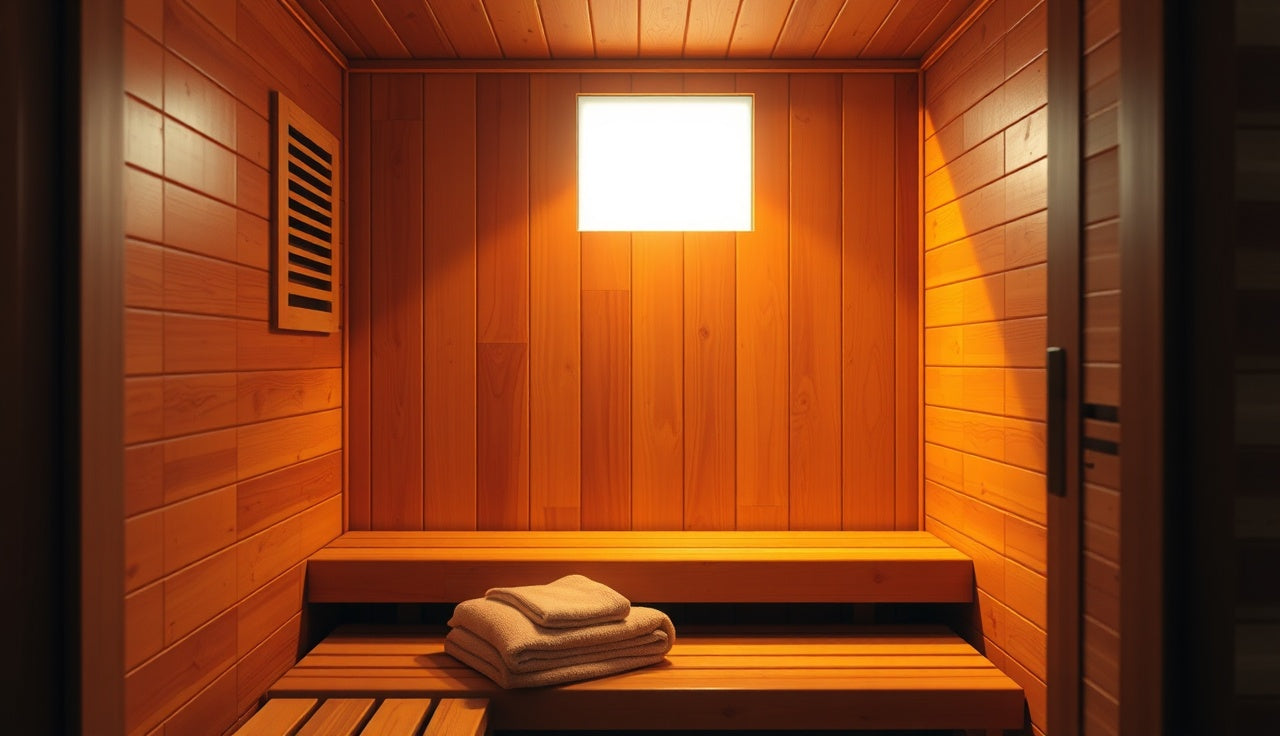
The second category is prefab cabin units. These are real wooden boxes (hemlock, cedar, or basswood are common) with panel heaters on the walls and sometimes the floor. They ship flat-pack and take two people about two to four hours to assemble. This is where most buyers land. A 1-person unit runs $1,000 to $2,500, a 2-person runs $1,500 to $4,000, and a 3-4 person unit can reach $6,000 before you even look at premium brands [1].
The third category is custom or semi-custom cabins, often from Clearlight, Sunlighten, Health Mate, or Finnleo. These start around $4,000 and can run past $10,000 with upgrades. They use low-EMF heaters, Bluetooth sound systems, chromotherapy lighting, and solid-wood construction. For a daily-use sauna you plan to keep for a decade, this tier makes sense. For a casual user, it is overkill.
There is a fourth option people forget: outdoor barrel or cabin saunas with infrared heaters instead of a traditional wood or electric stove. If you want something that looks like a real sauna outside your house, read the outdoor sauna guide before you commit to an indoor prefab. The assembly and weatherproofing specs are a different animal.
How much does an infrared sauna cost in 2025 and 2026?
The honest range is $200 to $12,000, and that span means almost nothing without context. Here is how the numbers stack up by tier.
| Category | Typical Price Range | Who It's For |
|---|---|---|
| Portable tent (1 person) | $150 to $400 | Tight budgets, renters, testers |
| Prefab cabin, 1-person | $900 to $2,500 | Solo users, small spaces |
| Prefab cabin, 2-person | $1,500 to $4,000 | Couples, home gyms |
| Prefab cabin, 3-4 person | $3,000 to $6,500 | Families, frequent users |
| Premium/semi-custom, 1-2 person | $4,000 to $8,000 | Daily users, health-focused |
| Full custom or premium 4-person | $8,000 to $12,000+ | High-end home installations |
Those prices are for the unit alone. Delivery freight on a 300-400 lb cabin adds $200 to $600 depending on where you live. If you need an electrician to run a dedicated 20-amp or 30-amp circuit, budget another $150 to $500 depending on your panel situation and local labor rates [2]. Most 1-person units plug into a standard 120V/15-amp outlet, but anything larger almost always needs a 240V/20-amp or 240V/30-amp circuit.
Sales cycles are worth tracking. Black Friday, Memorial Day, and July 4th regularly bring 15 to 25 percent off on prefab brands. Waiting for a sale on a $3,000 unit can save you $500 to $750 with zero sacrifice on quality.
What is the difference between near-, mid-, and far-infrared saunas?
This is the spec that trips up the most buyers, and it genuinely matters.
Far-infrared (FIR) is what most saunas for sale actually use. Far-infrared wavelengths (roughly 5 to 15 microns) penetrate soft tissue a few centimeters and raise core body temperature, which is what produces sweat and most of the studied physiological effects. The majority of panel-style saunas in the $1,000 to $5,000 range are purely far-infrared.
Near-infrared (NIR) runs at shorter wavelengths (around 0.7 to 1.4 microns) and shows up in photobiomodulation research. Some studies suggest near-infrared light may support skin health and cellular energy production [3], though the evidence is less settled than for FIR heat therapy. NIR heaters also run hotter at the surface because they use incandescent or halogen bulbs rather than carbon or ceramic panels.
Mid-infrared (MIR) sits in between. Some brands include it as part of a full-spectrum claim. In practice, most full-spectrum saunas pair FIR panels for heat with NIR lamps for light therapy. They cost more, usually $3,500 and up, and the marketing tends to outrun the science.
For most buyers, a quality far-infrared sauna is the right call. The research base for FIR is stronger. A 2018 systematic review in Complementary Medicine Research found consistent evidence for FIR sauna use improving cardiovascular function and quality of life in small but real patient populations [4]. Near-infrared adds a layer of interest, not a necessity.
| Portable tent (1-person) | $275 |
| Prefab cabin, 1-person | $1,700 |
| Prefab cabin, 2-person | $2,750 |
| Prefab cabin, 3-4 person | $4,750 |
| Premium/semi-custom 1-2 person | $6,000 |
| Full custom or premium 4-person | $10,000 |
Source: Consumer Reports, Home Sauna Buying Guide; SweatDecks market survey 2025
What EMF levels should you look for in an infrared sauna?
EMF (electromagnetic field) exposure from infrared sauna heaters is a real thing to check, more than marketing noise. The short version: look for third-party test reports showing under 3 milligauss at seated distance, and treat anything above 50 milligauss as a reason to walk away.
Carbon panel heaters, common in mid-range saunas, can emit elevated ELF-EMF (extremely low frequency electromagnetic fields) if the manufacturer has not engineered them down. Premium brands publish third-party EMF testing and often advertise levels below 3 milligauss at normal seated distance. The International Commission on Non-Ionizing Radiation Protection (ICNIRP) sets reference levels for EMF exposure; for the general public the limit is 200 milligauss for ELF fields [5]. Most saunas, even budget ones, stay well below that threshold, so the number brands actually point to is their own low-EMF certification, not the ICNIRP limit.
The level that should worry a buyer is anything above 50 milligauss at seated distance, which some cheap unshielded heaters do produce. If a brand will not share an independent EMF test report, that silence tells you something.
Ceramic heaters tend to produce lower EMF than carbon panels at equivalent output, though they heat less evenly. That is worth knowing if you are shopping the lower-budget segment and EMF matters to you. Clearlight and Sunlighten publish Stetzerizer and Gaussmeter test results independently, and Health Mate does the same. For budget brands, look for FCC compliance documentation at minimum.
Is a portable infrared sauna actually worth buying, or is it a compromise?
A portable infrared sauna is absolutely a compromise. The real question is whether the compromise fits your situation.
The SereneLife portable infrared sauna (the SLISAU35BK and similar models) is one of the best sellers in this class. It folds flat, uses a foot heating pad plus a handheld controller, reaches about 140°F (60°C), and costs $150 to $250 depending on the retailer. You sit inside a fabric tent with your head out, which means your head, neck, and shoulders get ambient room air, not infrared.
That design limit is not trivial. Much of the cardiovascular load from sauna use comes from the body's thermoregulatory response to full-body heat. With a portable unit you get some core heating, some sweating, and some of the relaxation effect, but probably less physiological stimulus than a proper cabin delivers at the same session length.
Still, portables earn their place for renters who cannot install anything, people testing heat therapy before committing thousands, travelers using them in hotel rooms, and anyone in a very small space. Read the portable sauna breakdown before buying one just because it is cheap. There are structural quality differences between brands that photos do not show.
One honest recommendation. If you can afford $1,200 and you have a standard outlet, a 1-person prefab cabin will do more for you than any portable tent. The heat distribution gap is large.
What wood type is best for an infrared sauna cabin?
Wood matters more than most buyers expect, for durability and for off-gassing.
Canadian hemlock is the most common wood in mid-range saunas. It is light, dimensionally stable, and affordable. It has no strong natural antibacterial properties but holds up fine indoors if you wipe it down after sessions.
Western red cedar is the traditional choice. Its natural oils resist moisture, bacteria, and cracking. Cedar also has a distinctive smell that many users love and a few find overwhelming. Premium brands like Health Mate often use clear-grade cedar with no knots, which cuts the chance of resin bleed at high temperatures.
Basswood is gaining ground with users who have chemical sensitivities. It is nearly odorless, hypoallergenic, and low in resin. Sunlighten uses basswood in several units for exactly this reason.
Thermo-modified or Euro white spruce shows up in some European brands (Finnleo, for example). The heat modification removes resins and improves stability, and these woods hold up well over time.
What to avoid: particleboard or MDF inner linings that some budget units slip between structural and facing layers. These can off-gas formaldehyde when heated. The EPA notes that formaldehyde emissions from composite wood products increase with temperature [6], which is bad news in a sealed, hot, enclosed space. Look for solid wood construction, and CARB (California Air Resources Board) Phase 2 certification or better on any composite components.
Where can you buy an infrared sauna, and which channel is best?
You have five main channels, each with real trade-offs.
Amazon and mass retail (Costco, Walmart, Home Depot) carry portables and some entry-level cabins. The convenience is hard to beat and returns are easy. The selection leans budget and mid-range. Costco periodically carries Clearlight and similar brands at notable discounts; the costco sauna page tracks what they typically stock.
Manufacturer-direct sites (Sunlighten, Clearlight, Finnleo, Health Mate) give you the widest model selection, financing, and the option to customize panels and wood. Pricing is usually MSRP, though sales happen. Customer service is generally better here because you are talking to people who know the product.
Specialty wellness retailers carry a smaller selection but often have staff who have actually used the products and can advise on installation, circuit requirements, and returns. SweatDecks carries a curated set of infrared cabins with detailed spec comparisons, which helps if you want to line up EMF ratings and heater types side by side before buying.
Facebook Marketplace and Craigslist carry used saunas. The savings can be real (40 to 60 percent below retail is common) but you have to verify the heaters and control board actually work, because replacement parts get expensive and hard to source on discontinued models. Bring a multimeter, or a friend who owns one.
Big-box home improvement stores occasionally stock a narrow selection of prefab infrared cabins in-store. Assembly support is usually nonexistent and inventory is thin, but you get to see the wood quality in person first.
What electrical and space requirements do you need to plan for?
This is where buyers get surprised after the box arrives.
1-person units (usually under 1,000 watts) run on a standard 120V, 15-amp outlet. Plug them in anywhere in a finished room. Read the spec sheet, though, because some brands sell 1-person units that draw 1,500 to 1,700 watts and need a dedicated 120V/20-amp circuit.
2-person and larger units almost always need 240V service, which means a dedicated circuit from your panel. The National Electrical Code (NEC) Article 424 covers fixed electric space heating equipment and requires a dedicated branch circuit for equipment above certain wattage thresholds [7]. You are calling an electrician. Budget $150 to $500 for the work depending on how far your panel sits from the install spot and local permit rules.
Space planning is simpler. Add 6 inches on each side and 12 inches behind the unit for airflow and control-panel access. Most 2-person cabins are roughly 47 to 55 inches wide, 36 to 47 inches deep, and 75 to 78 inches tall. Measure your doorways before assembly day, because a fully assembled cabin will not fit through a standard 32-inch doorway.
Floor protection matters too. Infrared saunas produce no steam, so they sit safer on wood floors than traditional steam saunas, but the exterior gets warm and sweating users drip. A rubber mat under the unit and a removable interior floor mat are both worth it.
For a home gym, garage, or basement install, factor in ceiling height (most units need 78 to 84 inches of clearance), ventilation (airflow yes, direct drafts no), and proximity to a GFCI-protected outlet if you are running a lower-wattage plug-in model.
What health benefits does the research actually support for infrared sauna use?
Be honest with yourself here. The marketing in this category is aggressive and the science is more cautious.
What the research does support: regular sauna bathing is associated with reduced risk of cardiovascular events in observational studies. A large Finnish cohort published in JAMA Internal Medicine followed 2,315 middle-aged men for about 20 years and found that men who used a sauna 4 to 7 times per week had a significantly lower risk of sudden cardiac death and all-cause mortality than once-weekly users [8]. That study was traditional Finnish sauna (high heat, steam), not infrared, but the cardiovascular mechanism (heat stress raising heart rate and improving endothelial function) is shared.
For far-infrared specifically, a 2015 study in the Journal of the American College of Cardiology Supplements found that FIR sauna use improved vascular function and reduced blood pressure in a small population with coronary risk factors [9]. The authors called the effect modest and asked for larger trials.
For musculoskeletal pain and relaxation, the evidence is softer but points the same direction. Several small trials report reduced pain and improved quality of life in fibromyalgia and chronic fatigue patients after a course of FIR sauna sessions [4].
What is not established: claims that infrared saunas produce meaningful detoxification, weight loss, or cancer treatment effects. Sweating excretes small amounts of some heavy metals, but the volumes are not clinically significant next to renal excretion [10]. The weight you drop right after a session is water, and it comes back when you rehydrate.
For the full sauna benefits picture, including what the Finnish data actually shows and where the temperature and duration thresholds sit, that article goes deeper. And if you are thinking about pairing sauna with cold, the cold plunge benefits page covers how the contrast protocol is studied.
Which brands make the best infrared saunas, and which ones have quality problems?
No invented opinions here, but a few things are observable from consumer reports, verified owner reviews, and documented warranty claims.
At the premium end, Sunlighten and Clearlight both have strong track records for heater longevity and customer service. Sunlighten's mPulse series uses full-spectrum heaters and a proprietary carbon/ceramic blend they call SoloCarbon, and the company has sponsored some of the published clinical research on FIR [9]. Clearlight's Sanctuary series is popular among practitioners who recommend sauna use, partly because its EMF shielding has been independently verified. Health Mate, a Belgian company with US distribution, has built saunas since 1979 and uses Tecoloy ceramic heaters with low EMF output.
In the mid-range, Dynamic Saunas (sold at Costco periodically and through their direct site) offers decent build quality for $1,500 to $3,000. JNH Lifestyles and Golden Designs sit in a similar tier. These brands get the job done, but customer service is uneven and heater-replacement parts get scarce once the warranty ends.
At the budget end, Radiant Saunas and SereneLife are fine for portables. Their cabin units are more of a gamble. The control board is the most common failure point, and they tend to use cheaper carbon panel heaters with no low-EMF certification.
The most consistent quality problem across every brand is control board failure in years 3 to 7. If a brand cannot confirm parts availability for at least 10 years, that matters. Ask before you buy.
For the broader picture of home sauna options, both infrared and traditional, the home sauna guide covers installation, comparison with steam rooms, and cost of ownership.
Can you use an infrared sauna for contrast therapy with cold plunges?
Yes, and more buyers are purchasing both specifically for this protocol.
Contrast therapy, alternating heat and cold, has a longer research history than either modality alone for muscle recovery. A 2017 meta-analysis in the British Journal of Sports Medicine found that contrast water therapy (alternating warm and cold immersion) reduced delayed onset muscle soreness more effectively than passive rest [11]. Applying that to sauna-plus-cold-plunge is biologically plausible, since the mechanism is alternating vasodilation and vasoconstriction, though direct sauna-specific contrast studies are fewer.
Most coaches and physical therapists recommend heat first, cold second. A typical protocol runs 15 to 20 minutes at 120 to 150°F in the infrared cabin, then 3 to 5 minutes in cold water at 50 to 59°F, cycled 2 to 4 times depending on tolerance and goals.
The cold plunge guide handles the equipment side. If you are buying both, spatial planning matters: keep the plunge within a short walk of the sauna exit so the transition happens fast, which is where most of the physiological effect concentrates.
One thing worth knowing. Finishing with cold may blunt some of the hypertrophic adaptation from strength training. A 2015 study in the Journal of Physiology found that cold water immersion after resistance training suppressed muscle protein synthesis pathways [12]. If you train primarily for strength and size, cold-last may not be optimal on lifting days. Heat-last is the safer bet then.
For ice bath specifics on temperature, duration, and timing, that article goes deeper on the cold side.
What should you look for in the warranty before buying an infrared sauna?
Warranty terms vary more than you would expect, and some of the differences cost real money.
The heaters are the priciest component to replace and the most likely to fail. A good warranty covers heaters for at least 5 years, ideally lifetime. Clearlight and Sunlighten both offer lifetime heater warranties on their flagship models. Mid-range brands typically offer 1 to 3 years on heaters, which means you are on your own if one dies at year 4.
The control board (the electronics that run temperature and time) is the second most common failure point. Look for at least 3 years of coverage on electrical components. Some warranties cover parts only, not labor, so you might pay a technician's time even inside the window.
The wood structure warranty matters less because wood rarely fails in normal use. But some budget brands warrant the structure for only 1 year, a sign they are not confident in their joinery.
Residential versus commercial coverage matters if you plan to use the sauna hard. Daily use by several people stresses heaters and control boards faster. Some manufacturers void the warranty if they decide the unit was used commercially or in a shared facility.
Always read the exclusions. Common ones: damage from improper electrical hookup, use on a non-level surface, water damage from outside sources, and normal wear on accessories like backrests, benches, and lighting. Get the warranty terms in writing before you order, not after the box shows up.
Frequently asked questions
What is the best infrared sauna for the money in 2025?
For most buyers, the $2,000 to $3,500 range (JNH Lifestyles, Dynamic Saunas, or Health Mate at entry level) hits the best price-to-quality ratio. Stretch to $4,000 to $5,000 and Clearlight or Sunlighten give you verified low-EMF heaters and much stronger warranties. Below $1,500 for a cabin, control board quality drops noticeably. For portables, SereneLife is a reasonable $200 entry point with realistic expectations.
How long does it take an infrared sauna to heat up?
Most infrared cabins reach operating temperature (120 to 150°F) in 15 to 30 minutes from a cold start. That is slower than a traditional high-temp Finnish sauna, which can hit 185°F in 30 to 45 minutes with a powerful stove. Some users step into the infrared cabin during warm-up to start absorbing radiant heat before air temperature peaks, which is a valid approach.
Is a 1-person or 2-person infrared sauna better for home use?
If you will use it solo 90 percent of the time, a 1-person unit is cheaper, uses less power, and fits tighter spaces. A 2-person unit costs 20 to 40 percent more and needs a dedicated circuit, but gives you room to stretch out or add a guest. Most owners of 1-person units wish they had gone one size up. The extra 24 to 30 inches of length matters more than people expect.
Can you put an infrared sauna outdoors?
Most prefab infrared cabins are built for indoor or covered outdoor use only. They are not weatherproofed for rain or direct sun. For a true outdoor infrared sauna, look for models rated for exterior installation, which use weather-treated wood and sealed electrical enclosures. Barrel and cube formats from brands like Almost Heaven or Dundalk LeisureCraft sometimes offer infrared heater options for outdoor use. The outdoor sauna guide covers this in detail.
How often should you use an infrared sauna to see benefits?
The Finnish cohort research showing the strongest cardiovascular associations involved 4 to 7 sessions per week, but most small FIR clinical trials showing improvement used 3 to 5 sessions per week for 4 to 8 weeks. Two to three sessions per week is a reasonable starting point. Daily use is fine for most healthy adults. If you have a cardiovascular condition, check with your physician first.
Do infrared saunas help with weight loss?
The weight you lose right after a session is water from sweating, and it comes back the moment you rehydrate. No credible study shows sustained fat loss from infrared sauna use as a standalone intervention. Caloric burn during a session is modest, roughly a light walk. Anyone selling infrared sauna as a weight loss tool is overstating the evidence by a wide margin.
What is the difference between infrared and traditional Finnish sauna?
Traditional Finnish saunas run at 170 to 195°F with steam from water thrown on heated rocks. Infrared saunas typically run at 110 to 150°F with dry air; the heat comes from infrared radiation your body absorbs directly rather than hot air heating you from outside. Many users tolerate infrared better at longer durations. The physiological overlap is real but not complete, and the Finnish epidemiology data was all collected on traditional sauna users.
Is a portable infrared sauna like the SereneLife worth it?
For someone who wants to try heat therapy before spending $2,000 or more, yes. The SereneLife produces genuine infrared heat and will make you sweat. The catch is that your head stays outside the tent, so you get less of the full-body heat load a cabin provides. At $150 to $250 the risk is low. Use it regularly for three months and still want more, and that is a good signal to upgrade to a cabin.
What circuit do I need for a 2-person infrared sauna?
Most 2-person infrared saunas need a dedicated 240V/20-amp circuit, though some lower-wattage models run on 120V/20-amp. Check the spec sheet for exact amperage draw before buying. Installing a new 240V circuit costs $150 to $500 in most US markets depending on panel location and local labor. NEC Article 424 requires a dedicated branch circuit for this type of fixed heating equipment.
How do you clean and maintain an infrared sauna?
Wipe wood surfaces with a lightly damp cloth after each session. Skip chemical cleaners on the interior wood, because most finishes are minimal and chemicals soak into the grain. Lightly sand the bench with 120-grit paper if sweat stains build up. Clean heater panels with a dry cloth only. Leave the door open for 30 minutes after a session to let moisture escape. Most infrared saunas need nothing else.
Can infrared saunas be used during pregnancy?
The American College of Obstetricians and Gynecologists advises pregnant women to avoid raising core body temperature significantly, especially in the first trimester. Saunas of any type carry a hyperthermia risk in pregnancy, and ACOG lists hot tubs and saunas as activities to approach cautiously or avoid [13]. Any pregnant person considering sauna use should get explicit clearance from their OB or midwife first, and most practitioners will advise against it.
What is a full-spectrum infrared sauna and is it worth the premium?
Full-spectrum saunas combine near-, mid-, and far-infrared emitters in one unit. The far-infrared handles most of the heat therapy. The near-infrared adds photobiomodulation, which has separate and less settled evidence for skin and cellular effects. Full-spectrum units cost $1,000 to $3,000 more than comparable far-infrared-only cabins. If the photobiomodulation research interests you, it may be worth it. If you mainly want heat and sweat, far-infrared alone is enough.
How do I compare infrared sauna EMF levels between brands?
Ask each brand for an independent third-party EMF test report, not their own marketing claim. The reading should be taken at seated distance from the heater panels, typically 6 to 12 inches. Look for under 3 milligauss ELF-EMF at that distance. Clearlight and Sunlighten publish these reports publicly. If a brand cannot or will not share one, treat that as a red flag and move on.
Can I finance an infrared sauna purchase?
Most major infrared sauna brands offer financing through third-party lenders like Affirm, Klarna, or Wells Fargo at checkout. Terms run from 6-month interest-free to 36-month installment plans; APR on the longer plans is typically 10 to 30 percent depending on credit. Some specialty retailers offer financing too. On a $3,000 to $5,000 unit, compare the total financing cost against waiting and saving, because interest on a 24-month plan can add $300 to $600.
Sources
- Consumer Reports, Home Sauna Buying Guide: Prefab infrared cabin saunas range from roughly $900 for a 1-person unit to $6,500 and above for 3-4 person models from premium brands
- Angi, Electrician Cost Guide: Installing a dedicated electrical circuit for a sauna typically costs $150 to $500 depending on panel location and local labor rates
- Photobiomodulation, Photomedicine, and Laser Surgery, PubMed (NIH): Near-infrared wavelengths are associated with photobiomodulation effects in skin and cellular energy research
- Complementary Medicine Research, systematic review of FIR sauna therapy, 2018: A 2018 systematic review found consistent evidence for far-infrared sauna use improving cardiovascular function and quality of life in small patient populations
- International Commission on Non-Ionizing Radiation Protection (ICNIRP), EMF Guidelines: ICNIRP sets the general public ELF-EMF reference level at 200 milligauss for frequencies in the typical sauna heater range
- U.S. Environmental Protection Agency, Formaldehyde page: The EPA notes that formaldehyde emissions from composite wood products increase with temperature, making CARB Phase 2 certification relevant for heated enclosures
- National Fire Protection Association, NFPA 70 (National Electrical Code) Article 424: NEC Article 424 requires a dedicated branch circuit for fixed electric space heating equipment above certain wattage thresholds
- JAMA Internal Medicine, Laukkanen et al., 2015: Finnish cohort study of 2,315 men found sauna use 4-7 times per week associated with significantly lower risk of sudden cardiac death and all-cause mortality compared to once-weekly use
- Journal of the American College of Cardiology Supplements, FIR sauna and vascular function, 2015: FIR sauna use improved vascular function and reduced blood pressure in a small population with coronary risk factors; authors called for larger trials
- Archives of Environmental Contamination and Toxicology, sweat excretion of heavy metals: Sweating excretes small amounts of some heavy metals but volumes are not clinically significant compared to renal excretion
- British Journal of Sports Medicine, contrast water therapy meta-analysis, Higgins et al., 2017: Contrast water therapy reduced delayed onset muscle soreness more effectively than passive rest in a 2017 meta-analysis
- Journal of Physiology, Roberts et al., 2015: Cold water immersion after resistance training suppressed muscle protein synthesis pathways, potentially blunting hypertrophic adaptation
- American College of Obstetricians and Gynecologists (ACOG): ACOG advises pregnant women to avoid raising core body temperature significantly and lists saunas and hot tubs as activities to approach with caution or avoid

Share:
Home sauna kit: everything you need to know before buying
Backyard sauna: everything you need to know before you build or buy