
Last updated 2026-07-09
TL;DR
A home sauna kit is a pre-cut or modular package that includes the walls, heater, and hardware to build a sauna yourself. Kits start around $1,500 for a small indoor barrel and run past $12,000 for a large outdoor cabin. The right choice depends on your space, budget, and whether you want dry Finnish heat, infrared, or steam.
What exactly is a home sauna kit?
A home sauna kit is a package of pre-fabricated or pre-cut components that lets you build a functional sauna without starting from raw lumber. The kit typically arrives with tongue-and-groove wood panels (usually Western red cedar, hemlock, or Nordic spruce), a heater, a control unit, a door with a glass panel, and the hardware to assemble everything. Some kits include benches; others treat them as add-ons.
What a kit is not: it is not a fully assembled unit dropped into your yard. You still need a level surface, an appropriate electrical circuit, and a few hours of assembly time. The trade-off is that kits cost significantly less than custom-built saunas and can be moved if you sell your house.
The category breaks into a few broad types. Indoor room kits fit into an existing bathroom or spare room. Outdoor cabin kits stand on their own foundation or deck. Barrel sauna kits are cylindrical, drain rain naturally, and have become genuinely popular over the past decade for backyard use. Infrared sauna kits skip the traditional heater entirely and use radiant panels instead.
If you want a deeper primer on the whole home sauna category before getting into kits specifically, that context helps frame what you're shopping for.
What types of home sauna kits are there?
The four types you'll actually encounter are: traditional steam (Finnish-style), infrared, barrel, and hybrid. Each works differently and suits different buyers.
Traditional Finnish-style kits use an electric or wood-burning heater loaded with rocks. You pour water on the rocks to create steam (called löyly). Temperatures typically run 150°F to 200°F (65°C to 93°C) [1]. These kits need a heater rated for the room's cubic footage, usually 1 kW per 45 cubic feet as a rough rule.
Infrared kits use carbon or ceramic panels that heat your body directly rather than heating the air. Cabin temperatures stay lower, typically 120°F to 150°F (49°C to 65°C), which some people prefer. The panels run on standard 120V or 240V circuits. Infrared kits are generally easier to install because there are no heater rocks, no water, and no need for a vapor barrier in every case. The scientific literature on infrared vs. traditional sauna outcomes is thinner than on Finnish-style saunas, so health claims for infrared specifically should be read with some skepticism.
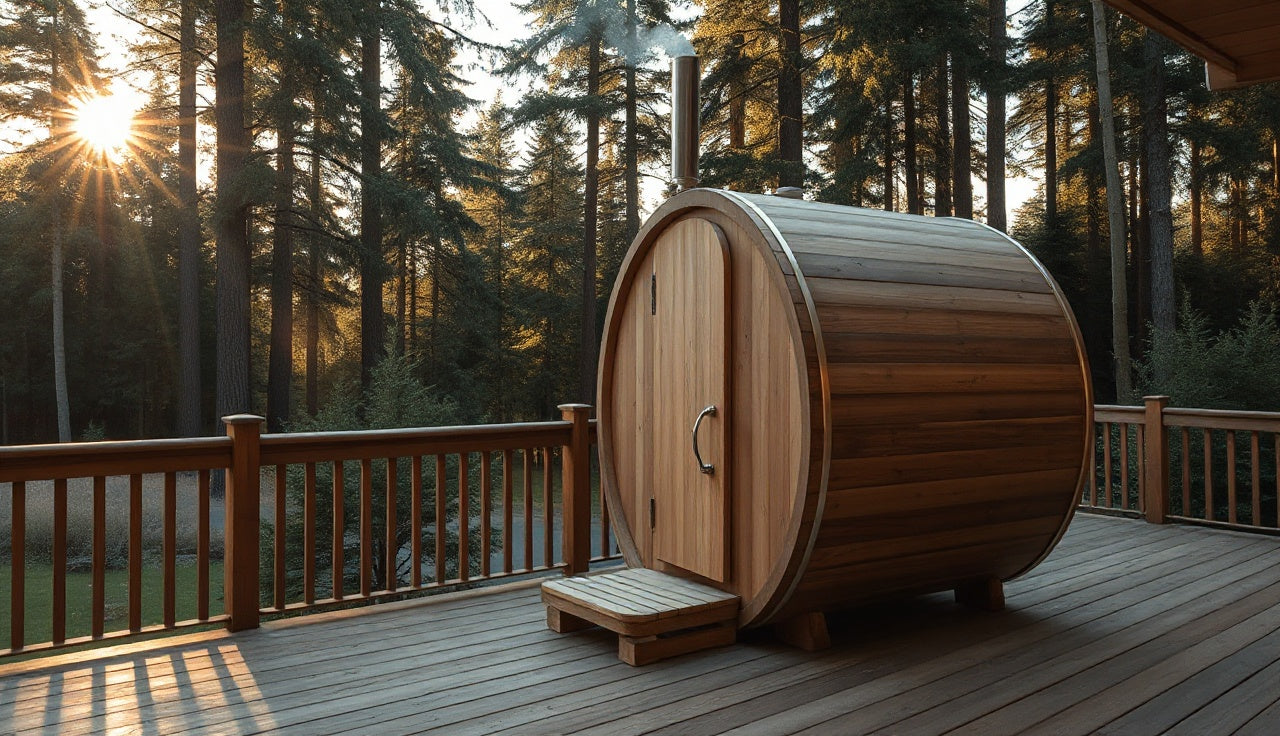
Barrel sauna kits are the outdoor option most people have seen on Instagram. The cylindrical shape is structurally self-supporting and sheds rain without a peaked roof. A standard home barrel sauna is 6 to 8 feet in diameter and 6 to 8 feet long. A 6x6 barrel seats two people comfortably, a 7x8 fits four. Cedar is the most common wood because it resists moisture and insects naturally.
Hybrid kits combine a traditional heater with infrared panels. They're more expensive and the theoretical benefits of combining both heat types aren't well established in research, so I'd skip them unless you have a specific reason.
| Kit Type | Temp Range | Typical Circuit | Starting Price |
|---|---|---|---|
| Traditional Finnish | 150-200°F | 240V, 30-60A | ~$2,500 |
| Infrared | 120-150°F | 120V or 240V | ~$1,500 |
| Barrel (outdoor) | 150-185°F | 240V, 30-40A | ~$2,800 |
| Wood-burning barrel | 150-195°F | None | ~$3,200 |
| Large outdoor cabin | 150-200°F | 240V, 40-60A | ~$6,000+ |
How much does a home sauna kit cost?
The honest range is $1,500 to $15,000 depending on size, wood type, heater quality, and brand. Here is how the price bands actually break down.
At the low end, $1,500 to $3,000 buys you a two-person indoor infrared kit or a small barrel kit in hemlock or economy-grade cedar. These work, but the wood quality, door seals, and control panels are noticeably thinner than mid-range options.
$3,000 to $6,000 is the most competitive range. You get Western red cedar or Nordic spruce, a reputable heater (Harvia, Finnleo, or Huum are well-regarded Finnish brands), and better construction tolerances. A six-foot barrel with a proper Harvia Cilindro heater typically lands here.
Above $6,000 you're getting larger cabins (six-person+), premium wood grades, panoramic glass doors, or custom sizes. At $10,000+ you're essentially funding a bespoke build.
Installation adds cost. Electrical rough-in for a 240V, 40A circuit runs $300 to $800 depending on how far the panel is from the sauna location and local labor rates [2]. If you need a concrete pad or deck framing for an outdoor barrel, budget another $500 to $2,000. Permit fees vary by municipality but are typically $50 to $200 for a residential accessory structure.
The sauna itself is usually the smallest share of the total project if you're starting from a bare backyard. A realistic all-in budget for a quality two-person outdoor barrel with electrical work and a gravel pad is $5,500 to $8,000.
One thing worth knowing: heater quality matters more than most buyers realize. A cheap heater in a beautiful cedar box will frustrate you. A good heater, like the Harvia KIP series or a Huum Drop, will last 15 to 20 years with basic maintenance.
| Infrared (2-person) | $1,500 |
| Traditional Finnish (2-person indoor) | $2,500 |
| Barrel (6ft, electric, 2-person) | $2,800 |
| Barrel (7ft, wood-burning, 4-person) | $3,200 |
| Outdoor cabin (4-6 person) | $6,000 |
| Premium/large cabin (6+ person) | $10,000 |
Source: SweatDecks market survey of major kit retailers, 2024-2025
Are home sauna kits worth the health benefits?
I'll be careful with language here, because the research is genuinely interesting but the marketing around saunas often overstates it.
The strongest evidence comes from the Kuopio Ischemic Heart Disease Risk Factor Study, a long-running Finnish cohort of 2,315 middle-aged men. The investigators found that men who used a sauna four to seven times per week had a significantly lower risk of fatal cardiovascular events compared to once-weekly users [3]. The study was observational, so causation isn't proven, but the association held up strongly and has been cited widely in peer-reviewed literature.
A 2018 review in Mayo Clinic Proceedings concluded that "regular sauna bathing is associated with a reduction in the risk of vascular diseases such as high blood pressure, cardiovascular disease, and neurocognitive diseases" but also noted that randomized controlled trials are still limited [4]. That's the honest summary: associated with, not proven to cause.
For muscle recovery, the heat stress from a sauna session increases growth hormone levels transiently and raises core temperature enough to increase blood flow to muscles [5]. The data on whether this meaningfully speeds recovery compared to rest alone is mixed. Many athletes swear by it. The controlled studies are smaller and shorter than the Kuopio work.
If you already use a sauna regularly at a gym and find it helps, a home kit removes the friction and likely increases how often you go. That frequency effect is probably the most practical benefit of owning one.
Read the sauna benefits article for a much deeper look at the literature before making health-related decisions about buying.
What size home sauna kit do you actually need?
Most people buy too small, then wish they had gone bigger. A two-person sauna is genuinely tight for two adults lying down on the upper bench; it's comfortable for one person and reasonable for two sitting upright. Four-person kits are where the experience noticeably opens up.
For indoor installs, measure your available square footage before looking at kits. A standard two-person indoor kit occupies roughly 4 by 4 feet (16 square feet). A four-person kit is typically 5 by 7 feet or 6 by 6 feet. These need clearance around the door and space for the control panel on an exterior wall.
For barrel saunas outdoors, diameter and length are the key numbers. A 6-foot diameter barrel with a 6-foot barrel section gives you about 170 cubic feet of interior space. A 7-foot diameter, 8-foot barrel is close to 300 cubic feet and fits four adults with room for a changing area at one end if the barrel has an extension.
Heater sizing is directly tied to volume. Manufacturers publish tables, but the general guide is approximately 1 kW per 45 cubic feet for a well-insulated room. Under-powering the heater is the most common kit assembly mistake: the sauna takes 45 minutes to reach temperature and never quite gets there.
Ceiling height matters for traditional saunas: the upper bench should sit 36 to 42 inches below the ceiling so you're in the hottest air layer. Most kits are designed around a 7-foot interior height, which works well.
How hard is it to install a home sauna kit yourself?
Harder than assembling furniture, easier than framing a room. If you can build a deck or follow IKEA instructions for large flat-pack pieces, you can assemble a barrel or indoor room kit over a weekend.
A barrel sauna kit typically arrives on a pallet in numbered sections. Assembly goes: lay the cradle rails, roll the stave rings together, insert the end caps, install the door, run the heater flue if it's wood-burning or wire the electric heater. Manufacturers like Almost Heaven and Dundalk Leisurecraft publish detailed assembly videos. Most two-person barrel kits take 4 to 8 hours with two people.
Indoor room kits are more involved because you're working inside an existing space. You typically need to frame the corner if the room is not already enclosed, install the pre-cut panels in sequence, set the vapor barrier, run the heater wiring, and hang the door. Budget a full day for a confident DIYer.
Electrical work is the part most people should not DIY unless they are licensed. A 240V, 40A circuit requires proper wire gauge (typically 8 AWG for 40A), a dedicated breaker, and a GFCI disconnect located within sight of the sauna per NEC Article 424 and manufacturer requirements [6]. In most jurisdictions, this work requires a permit and inspection. Skipping this step is both a safety hazard and an insurance risk.
Wood-burning barrel kits sidestep the electrical complexity but introduce flue clearances, spark arrestors, and local fire code considerations. Check with your local building department before ordering.
A portable sauna is another option if DIY assembly feels like too much: these plug into a standard outlet and require no tools.
What are the best barrel sauna kits for home use?
I'll be direct: there are maybe five or six brands making barrel kits worth serious consideration, and the differences come down to wood source, assembly tolerances, and heater options.
Dundalk Leisurecraft (Canadian manufacturer) is consistently well-regarded for cedar quality and clean tongue-and-groove milling. Their Tranquility and Clarity series are widely available in North America. Assembly instructions are detailed.
Almost Heaven Saunas (West Virginia, US-made) uses North American white cedar and offers good heater bundles. Their entry-level barrels are competitive on price. Customer service is domestic, which helps if something arrives damaged.
ALEKO is the budget option. The wood quality and hardware are noticeably lighter than the above two. If you're on a strict budget and treat it as a three-to-five year product rather than a ten-year investment, it can work.
Harvia (Finnish brand, widely distributed in the US) makes barrels but is better known for their heaters. Pairing any cedar barrel with a Harvia heater is a common and sensible choice.
For a best barrel sauna kits for home use roundup with hands-on notes, the outdoor sauna guide covers the category in more depth.
Things to look for regardless of brand: stave thickness (2 inches or thicker holds heat better than 1.5 inches), stainless steel banding (not galvanized, which rusts), tempered glass in the door, and whether the heater is included or extra. Many attractive list prices exclude the heater, which adds $500 to $1,500.
At SweatDecks, the barrel sauna selection includes options across this range, including kits that ship with a matched heater so you're not guessing at compatibility.
Do you need a permit for a home sauna kit?
Usually yes, at least for the electrical work. Whether the structure itself requires a permit depends on your municipality and whether it's indoor or outdoor.
For outdoor barrel saunas, many jurisdictions treat structures under a certain footprint (often 120 to 200 square feet) as accessory structures exempt from a building permit, but the rules vary enormously [11]. Some counties require permits for any permanent structure. Call your local building department before you pour a pad.
For indoor sauna rooms, the electrical work (240V circuit, breaker, disconnect) almost always requires a permit and inspection. The room itself may trigger a permit if you're adding interior framing, though a kit dropped into an existing finished room sometimes falls under cosmetic improvement thresholds.
The National Electrical Code (NEC) governs the electrical requirements at the federal level, but enforcement is at the local level. NEC Article 424 covers fixed electric space-heating equipment, which includes sauna heaters. Local codes may be more restrictive [6].
If you're in a neighborhood with an HOA, check the CC&Rs before ordering. Many HOAs restrict outbuildings or require specific setbacks from property lines.
The practical advice: budget $50 to $200 for permits and a few weeks for scheduling the inspection. Unpermitted electrical work can affect your homeowners insurance coverage and complicate a future home sale.
How does a home sauna kit compare to a custom-built sauna?
Custom-built saunas cost roughly two to four times more than equivalent kit saunas for the same interior size. A custom four-person indoor sauna built by a specialty contractor typically runs $8,000 to $20,000 depending on materials and region. A comparable room kit is $3,000 to $7,000 before installation labor.
What you gain with custom: you can use non-standard dimensions to fit an awkward space, choose any wood species, add panoramic glass walls, or integrate radiant heat in the floor. You also get a contractor who handles permits and electrical coordination.
What you lose: portability and speed. A kit can be assembled in a weekend and disassembled and moved when you sell. A custom sauna is generally a permanent fixture. Resale data on whether a built-in sauna adds home value is inconsistent; a 2021 NARI remodeling cost study did not specifically isolate sauna additions, so hard ROI numbers are not available [7].
For most homeowners, the kit wins on value unless the space genuinely requires custom dimensions. The wood quality gap between a premium kit and a custom build is smaller than builders will admit.
What should you look for in a home sauna kit before buying?
After sorting through the marketing, these are the actual specifications that matter.
Wood species and grade. Western red cedar is the benchmark: it's naturally antibacterial, resists warping, and smells good when heated. Clear-grade cedar (no knots) is worth paying for on bench surfaces where you're sitting against the wood. Hemlock is a budget alternative that performs reasonably well but doesn't have the same natural oils.
Stave or panel thickness. For barrels, 1.75 inches is the minimum you want; 2 inches holds heat noticeably better in cold climates. For room kits, look for 1.5-inch tongue-and-groove panels with a proper vapor barrier specification.
Heater quality and warranty. Finnish heaters (Harvia, Huum, Narvi) are the gold standard. Look for a five-year minimum warranty on the heater. Element replacements should be available domestically.
Door construction. Tempered glass is non-negotiable for safety. The door should have a magnetic or spring latch that cannot lock from the inside. Most quality kits meet this standard, but check.
Hardware. Stainless steel bands on barrels, stainless hinges on doors, stainless screws throughout. Galvanized hardware rusts within two or three seasons in outdoor use.
Assembly documentation. Numbered components, clear diagrams, and ideally video instructions. Kits from brands that have been sold for more than five years tend to have refined their instructions based on customer feedback.
Shipping and damage policy. Barrel kits ship on pallets via freight. Inspect every piece before signing the delivery receipt. Damage that isn't noted at delivery is hard to claim later.
Pairing a sauna with a cold plunge for contrast therapy is increasingly common. If you're planning both, think about your outdoor layout before the sauna ships.
How do you maintain a home sauna kit after installation?
Maintenance is genuinely low. That's one of the practical arguments for owning one.
For the wood: wipe down benches with a damp cloth after sessions. Avoid soap, which penetrates cedar and smells unpleasant when heated. A light sanding of the bench surface every year or two restores the natural wood. Do not seal or stain interior wood; it needs to breathe and will off-gas chemicals when hot if sealed.
For the heater: inspect the rocks (for traditional saunas) annually. Rocks crack over time from thermal cycling and should be replaced every three to five years depending on use frequency. Harvia sells replacement kiuas stones. For infrared panels, wipe with a dry cloth; there are no consumable parts beyond the heating elements, which typically last 5,000 to 8,000 hours.
For outdoor barrels: the exterior will silver naturally if left untreated (like a cedar fence). You can apply a UV-resistant exterior oil or stain to maintain the color, typically once every two to three years. Keep the drain (if present) clear. In heavy snow areas, check that the stainless banding hasn't loosened from freeze-thaw cycles.
For electrical: have a licensed electrician inspect the disconnect and wiring connection at the heater every five years. This is especially relevant for wood-burning units where heat exposure near the flue can degrade wire insulation over time.
The Consumer Product Safety Commission has published guidance on residential sauna safety that covers temperature limits (maximum air temperature of 194°F or 90°C is the generally cited upper safe limit) and ventilation requirements [8].
Can you use a home sauna kit for contrast therapy with cold water?
Yes, and the combination is increasingly what buyers are planning for. The protocol, moving between heat and cold exposure in alternating rounds, has a long history in Nordic countries and is getting serious research attention now.
A 2021 review in the International Journal of Environmental Research and Public Health examined available evidence on contrast water therapy and noted improvements in delayed-onset muscle soreness markers compared to passive recovery, though the optimal protocol (temperatures, durations, number of cycles) remains unsettled [9].
For home use, a sauna kit paired with an ice bath or dedicated cold plunge tub creates a practical contrast setup. The typical protocol used in research and by practitioners is roughly 10 to 15 minutes in the sauna, 2 to 5 minutes in cold water (50°F to 59°F or 10°C to 15°C), repeated two to four cycles with a brief rest between. Nobody has perfect data on the optimal numbers; these are working estimates from the available studies.
Physically, place the cold plunge within easy walking distance of the sauna. You want the transition to take under 30 seconds without navigating stairs or slippery surfaces. Many buyers put a cold plunge tub on the same deck or pad as the barrel sauna.
People with cardiovascular conditions, those who are pregnant, or anyone on medications that affect temperature regulation should talk to their physician before starting any heat-cold protocol. This is not a disclaimer for its own sake: the hemodynamic shifts from moving between extreme heat and cold are real and meaningful.
The cold plunge benefits article goes deeper on what the cold side of the equation actually does physiologically.
Frequently asked questions
What is included in a typical home sauna kit?
Most kits include pre-cut or pre-fabricated wall and ceiling panels, benches, a door with tempered glass, a heater (sometimes sold separately), a control unit, and all assembly hardware. Outdoor barrel kits also include the cradle rails that keep the barrel off the ground. Insulation materials, electrical wiring, and the permit are your responsibility and are never included.
How long does it take to assemble a home sauna kit?
A two-person barrel sauna kit takes most people 4 to 8 hours with two adults working together. An indoor room kit can take a full day, especially if you're also framing a corner. Wood-burning kits add time for flue assembly and clearance checks. Budget a full weekend to do it without rushing and to test heat-up before declaring it done.
What electrical requirements does a home sauna kit need?
Most electric sauna heaters require a dedicated 240V circuit. A 4 to 6 kW heater typically needs a 30A circuit; 8 to 10 kW heaters need 40A to 60A. NEC code requires a GFCI-protected disconnect switch within sight of the heater. A licensed electrician should do this work. Infrared kits under 4 kW sometimes run on 120V, 20A circuits, which are much simpler to install.
How much does it cost to run a home sauna per month?
A 6 kW electric heater running 45 minutes to heat up plus a 30-minute session uses roughly 4 to 5 kWh per session. At the US average residential electricity rate of 16 cents per kWh (as of 2024 EIA data), that's about 65 to 80 cents per session. Four sessions per week adds roughly $10 to $14 per month to your electric bill. Wood-burning saunas cost less to operate but require cord wood.
Can a home sauna kit be installed indoors?
Yes. Indoor room kits are designed specifically for spare rooms, basements, or large bathrooms. You need adequate ventilation (most kits specify an air gap at the door base and a vent near the floor), a 240V circuit, and a floor that can handle moisture from people entering and exiting wet. Tile or waterproof vinyl under and around the sauna is the safest floor choice for indoor installs.
How long does a home sauna kit last?
A well-maintained cedar sauna should last 15 to 25 years. The heater is usually the first component to need attention, with elements typically rated for 5,000 to 10,000 hours. Outdoor barrels are exposed to UV and weather, so the exterior weathers faster, but the structural integrity holds for decades if the banding stays tight and the cradle keeps the wood off wet ground.
Does a home sauna add value to your house?
The evidence is mixed. A permanent, well-built indoor sauna room may add modest value in markets where buyers expect that amenity (Pacific Northwest, upper Midwest, luxury segments). A portable or barrel kit is personal property and can go with you. No large-scale resale study specifically isolates sauna additions, so specific ROI figures circulating online are not based on reliable data.
What wood is best for a home sauna kit?
Western red cedar is the most popular choice and for good reason: it resists moisture, doesn't get uncomfortably hot to touch, has a pleasant aroma when heated, and lasts well. Nordic spruce is common in European kits and is slightly denser. Hemlock is a budget option that performs adequately but lacks cedar's natural antimicrobial oils. Avoid pressure-treated or chemically sealed wood entirely; both off-gas when heated.
Is a barrel sauna or a cabin-style sauna better for a backyard?
Barrel saunas drain rain naturally, require no roof framing, and are generally cheaper for the same interior volume. They're harder to expand and don't offer a separate changing room unless you buy a barrel with an extension. Cabin-style kits give you a more traditional layout with a separate antechamber, are easier to insulate in very cold climates, and look more architecturally permanent. For most buyers who want simplicity, a barrel wins.
How hot does a home sauna kit get, and how long does it take to heat up?
Traditional Finnish-style saunas reach 150°F to 195°F (65°C to 90°C). Heat-up time depends on heater wattage and room volume: a well-matched 6 kW heater in a properly sized room typically reaches target temperature in 30 to 45 minutes. Infrared saunas heat up faster, often 15 to 20 minutes, but to lower air temperatures of 120°F to 150°F because they heat bodies rather than air.
What is the difference between an infrared sauna kit and a traditional sauna kit?
Traditional kits heat the air to 150°F to 195°F using a heater with rocks; you add water for steam. Infrared kits use radiant panels to heat your body directly at lower air temperatures, 120°F to 150°F. Traditional saunas have far more research behind them for cardiovascular and recovery outcomes. Infrared kits are cheaper to install, easier to wire, and heat up faster. The choice is mostly preference unless health research drives your decision.
Can you put a home sauna kit on a deck?
Yes, with caveats. The deck must be structurally rated for the sauna's weight: a fully assembled 7x8 barrel with two adults inside can weigh 2,000 to 3,500 lbs. Have a structural engineer or experienced contractor confirm your deck framing can handle the load before placing a barrel on it. The deck surface should be non-slip composite or pressure-treated wood, and drainage around the sauna helps prevent moisture damage to the deck boards.
Do home sauna kits come with a warranty?
Most reputable brands offer a one-year warranty on the complete kit and a separate longer warranty (three to five years) on the heater. Some manufacturers like Almost Heaven and Dundalk offer two-year structural warranties on the wood components. Read the fine print: warranties typically exclude damage from improper installation, water intrusion from missing sealant, or heater damage from using incorrect rock types.
What is the minimum space needed for a home sauna kit?
The smallest indoor room kits occupy a 4x4 foot footprint (16 square feet). For a meaningful experience that fits two people comfortably, 4x6 feet is a practical minimum. Barrel saunas start at about 5 feet in diameter and 4 feet in barrel length for a true one-person unit. Budget at least 18 to 24 inches of clearance around an outdoor barrel for maintenance access and airflow.
Sources
- Finnish Sauna Society, Sauna Temperature Guidelines: Traditional Finnish sauna air temperature typically ranges from 65°C to 93°C (150°F to 200°F)
- U.S. Bureau of Labor Statistics, Electricians Occupational Outlook: Residential electrical circuit installation costs and licensed electrician labor rate context
- JAMA Internal Medicine, Kuopio Ischemic Heart Disease Risk Factor Study (Laukkanen et al., 2015): Men using a sauna 4-7 times per week had significantly lower risk of fatal cardiovascular events compared to once-weekly users in a cohort of 2,315 Finnish men
- Mayo Clinic Proceedings, Sauna Bathing and Cardiovascular Health Review (Laukkanen et al., 2018): Review concluded that regular sauna bathing is associated with reduced risk of vascular diseases including high blood pressure and cardiovascular disease, while noting limited randomized controlled trials
- Growth Hormone & IGF Research, Heat Stress and Growth Hormone Response (Christensen et al., 2017): Heat stress from sauna sessions transiently increases growth hormone levels and raises core temperature, increasing muscle blood flow
- National Fire Protection Association, NFPA 70 National Electrical Code, Article 424 (Fixed Electric Space-Heating Equipment): NEC Article 424 governs fixed electric space-heating equipment including sauna heaters, requiring dedicated circuits and a disconnect within sight
- National Association of the Remodeling Industry (NARI), Cost vs. Value Report 2021: NARI remodeling cost studies do not specifically isolate sauna additions as a line item for ROI analysis
- U.S. Consumer Product Safety Commission, Residential Sauna Safety: Maximum safe sauna air temperature is generally cited at 194°F (90°C); CPSC publishes guidance on residential sauna ventilation and temperature safety
- International Journal of Environmental Research and Public Health, Contrast Water Therapy Review (Bieuzen et al., 2021): Review found contrast water therapy associated with improvements in delayed-onset muscle soreness markers compared to passive recovery; optimal protocol temperatures and durations remain unsettled
- U.S. Energy Information Administration, Electric Power Monthly, Average Retail Electricity Prices 2024: US average residential electricity rate approximately 16 cents per kWh as of 2024
- International Code Council, International Building Code Accessory Structure Permit Thresholds: Many jurisdictions exempt accessory structures under 120-200 square feet from building permits, though local rules vary

Share:
Renu cold plunge review: what you actually get for the price
Infrared sauna for sale: what to know before you buy