
Last updated 2026-07-09
TL;DR
A sauna is dry heat: 150 to 195°F at 10 to 20% humidity from a wood stove or electric heater. A steam room is moist heat: 110 to 120°F at 100% humidity from a boiler unit. Both raise core temperature and make you sweat, but they feel nothing alike, suit different goals, and cost very different amounts to build. Neither wins outright. It depends on your body and your budget.
What is the basic difference between a sauna and a steam room?
Humidity is the whole story. A traditional sauna runs at 10 to 20 percent relative humidity and 150 to 195 degrees Fahrenheit [1]. A steam room sits at 100 percent humidity and a much cooler 110 to 120 degrees Fahrenheit [2]. That gap looks small on a thermometer. It does not feel small on your skin.
In a sauna, the air is so dry that sweat evaporates off you almost the moment it forms. That evaporation is what cools you down. In a steam room, the air is already saturated, so your sweat has nowhere to go. You drip. You feel hotter than the thermometer says. Both raise your core temperature, which is the mechanism behind most of the reported benefits, but they get there by opposite routes.
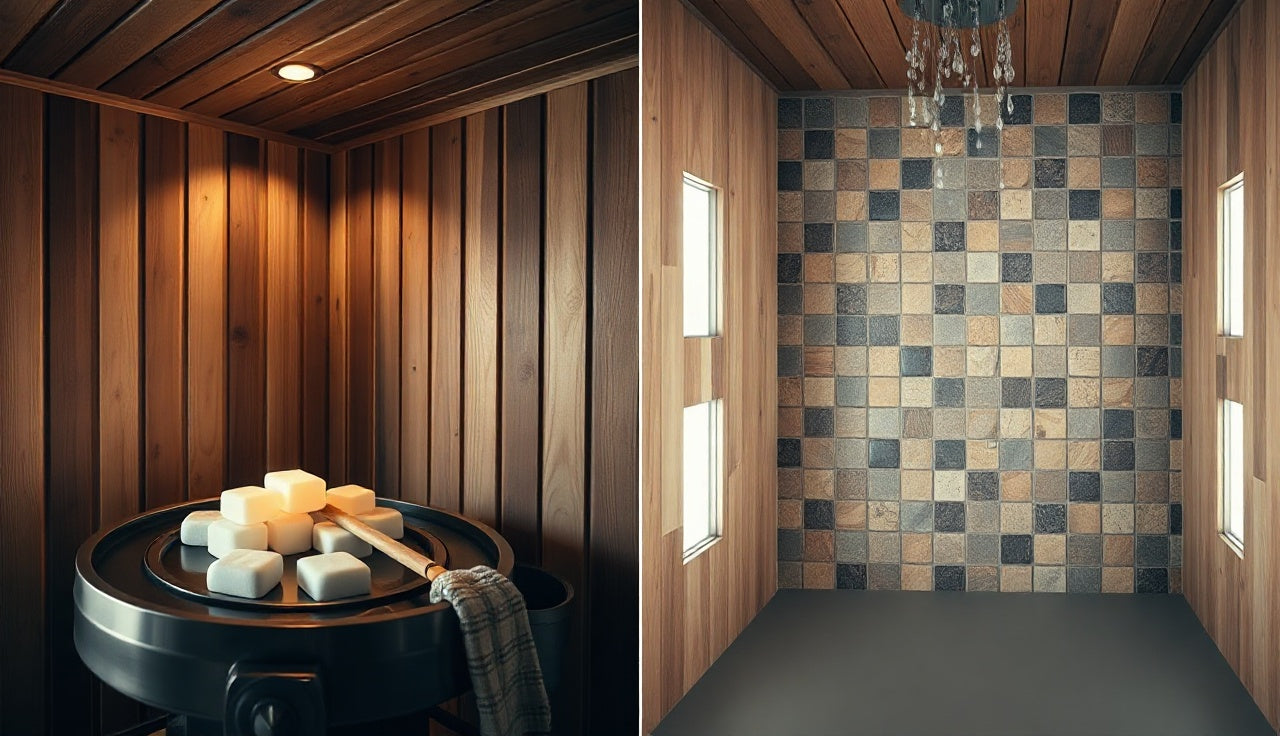
The heat source splits them too. Saunas heat the air and the rocks with a wood-fired kiuas (the Finnish word for a sauna stove), an electric heater, or an infrared emitter [3]. Steam rooms pump wet vapor into a sealed tiled space from a steam generator, which is really just a boiler. The materials follow from that. Saunas are wood (cedar, hemlock, aspen), which breathes and stays cool enough to touch. Steam rooms are tile, glass, or acrylic, because wood rots inside a couple of years at 100 percent humidity.
If you want the ground floor on what a sauna actually is before you compare, start there.
How do the temperatures actually compare?
A sauna runs 40 to 80 degrees hotter than a steam room on the thermometer, yet the steam room can feel just as brutal. Here's the side-by-side so the numbers sit in one place:
| Feature | Traditional Sauna | Steam Room |
|---|---|---|
| Air temperature | 150 to 195°F (65 to 90°C) | 110 to 120°F (43 to 49°C) |
| Relative humidity | 10 to 20% | 100% |
| Typical session length | 10 to 20 minutes | 10 to 20 minutes |
| Heat source | Wood stove, electric heater, or infrared | Steam generator (boiler) |
| Primary material | Wood (cedar, hemlock, aspen) | Tile, glass, or acrylic |
| Perceived heat | Dry, breathable | Wet, enveloping |
Wet air moves heat to your skin faster than dry air, so a steam room at 115°F can hit as hard as a sauna at 160 to 170°F. Perceived exertion lines up even though the actual air temp is much lower [2].
Infrared saunas are a third category worth flagging here. They run cooler still, usually 120 to 140°F, but they warm your body directly with infrared radiation instead of heating the air first [1]. The sauna benefits guide breaks down the research on each type if you want the detail.
What does each one actually do to your body?
Both trigger what researchers call passive heat exposure: core temperature climbs, your heart rate rises to shed the heat, and you sweat hard. A 2018 study in Mayo Clinic Proceedings found regular sauna use (4 to 7 sessions per week) was linked to a 50 percent lower risk of cardiovascular mortality versus once-weekly use, though the authors flagged this as observational data, not proof of cause [4].
Steam rooms share that engine (heat stress, faster heart rate, vasodilation) and add a respiratory angle a dry sauna doesn't quite match. Warm, humid air can loosen a stuffy nose and calm some airway irritation. The American Lung Association notes that warm mist can loosen mucus, while stopping well short of calling steam a treatment for lung disease [5]. Asthma is a coin flip: some people find the moist heat soothing, others find hot humid air sets off symptoms. Ask your doctor first if breathing conditions are in play.
Muscle recovery is another shared strength. Heat pushes more blood into skeletal muscle, which may speed clearance of metabolic waste after hard training. Nobody has a clean head-to-head trial pitting sauna against steam room for recovery. The closest evidence sits on the sauna side, with a 2021 review in the Journal of Athletic Training finding that post-exercise sauna bathing can cut delayed-onset muscle soreness [6]. Whether steam performs as well is an honest unknown.
Skin diverges too. Steam room humidity can leave your skin feeling more hydrated right after a session. A sauna's dry heat opens pores and drives sweating but can feel drying to some skin types. Neither effect is dramatic or lasting, but it's real if skin is your priority.
| Sauna – max air temp (°F) | 195 |
| Sauna – min air temp (°F) | 150 |
| Steam room – max air temp (°F) | 120 |
| Steam room – min air temp (°F) | 110 |
| Sauna – max humidity (%) | 20 |
| Steam room – humidity (%) | 100 |
Source: CDC Healthy Water; Finnish Sauna Society (citations 2, 3)
What's the difference in how they're built and installed?
Installation is where these two split hardest for homeowners. A sauna is a wood box with a heater. A steam room is a sealed, waterproofed, drained tile chamber with a boiler.
A home sauna is wood panels assembled inside a room or as a freestanding outdoor structure. The wood itself insulates. You need a heat source (electric heaters lead residential installs, drawing 4 to 8 kilowatts depending on room size), a ventilation gap at floor and ceiling so oxygen circulates, and a GFCI-protected circuit. Plenty of people assemble prefab kits themselves over a weekend. Outdoor builds want some waterproofing at the foundation, but the structure itself stays dry. The home sauna and outdoor sauna guides cover the specifics.
A steam room demands a fully sealed enclosure. Every wall, floor, and ceiling gets a continuous waterproof membrane before any tile goes down. The steam generator, usually wall-mounted, ties into a cold water supply and a drain, and the room has to slope so condensate runs off. A standard residential generator draws 2 to 15 kilowatts depending on room volume [7]. Any wood inside (benches, trim) has to be a rot-resistant species, and even then it wears out. A home steam room almost always costs more to build than a comparable sauna, thanks to waterproofing labor and the generator.
Maintenance favors the sauna, and it isn't close. A wood sauna wants periodic cleaning and bench treatment. A steam room wants regular generator descaling (mineral scale is the main failure mode), grout upkeep, and constant mold watch at every corner and joint. On hard water, descaling can turn into a monthly chore.
For a lower-commitment start, a portable sauna skips construction entirely.
Which costs more to buy and run?
Saunas cost less to buy, less to run over time, and far less to maintain. Home sauna kits range wide. A basic 2-person prefab indoor kit starts around $1,500 to $2,500. A quality 2-person traditional sauna with a Finnish-style electric heater runs $3,000 to $6,000 installed. A custom outdoor barrel or cabin build can reach $10,000 to $20,000 or more depending on size and finish [8].
Steam rooms start with the generator, $500 to $3,000 for a residential unit (MrSteam, Kohler, and Thermasol dominate the category). Add waterproofing, tile labor, and plumbing, and a full steam room retrofit in an existing bathroom usually lands at $3,500 to $10,000 or more depending on room size and local labor rates [7].
Running costs ride on your electricity rate and how often you use it. A 6-kilowatt sauna heater running one hour costs roughly $0.72 at the U.S. average residential rate of about 16 cents per kWh in 2024 [13]. A 6 kW steam generator costs about the same per hour, but steam rooms reach temperature faster (10 to 15 minutes versus 30 to 45 for a sauna), so shorter warm-ups can trim the bill. Neither breaks the bank daily; figure $20 to $50 a month with regular use for either.
The honest take: over 10 years, total cost of ownership almost always favors a sauna. Lighter maintenance, fewer parts that fail, wood structures that last decades on basic care. A steam generator typically needs major service or replacement every 5 to 10 years, and grout and waterproofing failures are a recurring line item.
What's better for weight loss, detox, or skin?
Weight loss claims deserve a hard eyeroll. You will weigh less right after a session, but it's water you sweated out, and it returns with your next glass of water. A 2019 review in Evidence-Based Complementary and Alternative Medicine found no evidence that sauna use reduces body fat directly. Heat stress burns a few extra calories, but the number is small [9]. Anyone selling a sauna or steam room as a weight loss machine is overselling it.
Detox is murkier. Your liver and kidneys do the real work. Sweat does carry trace heavy metals (nickel, lead, cadmium), and a 2012 study in the Journal of Environmental and Public Health measured toxic elements in sweat, suggesting sweat could be a secondary elimination route for some compounds [10]. That's a real, peer-reviewed finding. It does not mean a sauna or steam room cures anything or meaningfully clears everyday environmental exposure. Interesting data, read it carefully.
Skin is where steam rooms have a modest edge. The steady humidity keeps the stratum corneum (the outer skin layer) hydrated through the session, and some dermatologists suggest warm, humid air may briefly improve how well topical products absorb afterward. Saunas drive sweat and open pores, which feels cleansing. Both are pleasant for skin. Neither replaces a real skincare routine.
For congestion, steam rooms have the better case. Breathing warm, moist air is an old home remedy for a stuffy head, and the mechanism (thinning mucus) holds up. Saunas can ease breathing too, but dry air is less directly helpful for the airways.
Are there any safety differences between them?
Both carry real risk if you're careless, and the biggest one is the same for both: alcohol. The most consistent finding across sauna research is that alcohol and heat are a dangerous mix. A Finnish review of sauna-related deaths found alcohol involved in a majority of cases [11]. Same logic in a steam room: impaired judgment plus extreme heat plus dehydration ends badly in either place.
Dehydration trips up everyday users most. Drink water before you go in, take breaks, and never push through dizziness or nausea. Most health authorities say cap sessions at 15 to 20 minutes and cool down fully before another round [2].
Pregnancy is a specific concern. The American College of Obstetricians and Gynecologists advises pregnant women to avoid raising core body temperature above 102.2°F, and both a sauna and a steam room can get you there fast [12]. Anyone pregnant should clear it with a doctor first.
Cardiovascular conditions need individual medical guidance. Healthy adults with well-controlled hypertension are generally considered safe, but unstable heart disease, a recent heart attack, or severe aortic stenosis all call for clearance first. The strain of passive heat is real, close in some studies to light-to-moderate aerobic exercise [4].
One practical split: at 100 percent humidity, a steam room can feel harder to breathe if you're not used to it. Some people find the dry air of a sauna easier to take, at least at first. It's genuinely personal.
Which one should you actually choose for your home?
Buy the sauna. If you're purchasing once and want the most durable, lowest-hassle, most versatile heat therapy for a home, that's the call. The build is simpler, the maintenance is lighter, the research base for cardiovascular and recovery benefits is stronger, and the ritual of a Finnish sauna (pouring water over hot rocks, the löyly) is hard to fake in a steam room. A wood-fired or electric sauna can run 20 to 30 years on basic care.
A steam room earns its keep in narrower cases: you're already gutting a bathroom, your main goal is a spa-like shower, you have respiratory issues that respond well to humid heat, or you flat-out prefer wet heat. Budget for the higher install and the ongoing upkeep.
You don't have to pick one, exactly. Some hybrid units add a steam function to a sauna enclosure, though the wood limits how much humidity they can sustain before it starts eating the material.
SweatDecks carries traditional and infrared saunas if you're ready to compare real models. The sauna and home sauna pages are the best entry points for product research.
If contrast therapy (heat, then cold) is your thing, a sauna pairs better with a cold plunge or ice bath than a steam room does, because the protocol wants a big, controlled temperature swing. See cold plunge benefits for what the research actually supports on that combination.
Can you get the same benefits from both if you do contrast therapy?
Yes. For contrast therapy, a steam room can stand in for a sauna without losing much. Contrast therapy alternates heat and cold, and it's one of the more popular recovery protocols in endurance sport and pro athletics. The heat phase runs 10 to 20 minutes in a sauna or steam room, followed straight away by cold water immersion (a cold plunge, ice bath, or cold shower) and then rest. Many people cycle 2 to 3 times.
Physiologically, both formats do the same job: raise core temperature and open up peripheral blood vessels. The cold phase then clamps those vessels shut, and cycling between the two is thought to pump the vasculature and speed waste removal from muscle.
The evidence is promising, not settled. A 2022 meta-analysis in the British Journal of Sports Medicine found cold water immersion beat passive rest for reducing muscle soreness and fatigue, though the review didn't isolate the sauna or steam room warm-up phase [6]. Short version: a steam room can anchor contrast therapy as well as a sauna, but most people doing this at home use a sauna, because the install is simpler and a sauna plus a dedicated cold plunge tub is easier to manage than a steam room plus a plunge.
For the cold side, the ice bath and cold plunge guides cover water temperature targets, timing, and what the evidence backs.
Do gyms and spas use them differently?
Commercial gyms almost always run both, and each room pulls a different crowd. The dry sauna draws people who want a longer, quieter session, often 15 to 20 minutes after training. The steam room pulls people who want a short, intense sweat, often 5 to 10 minutes, plus anyone who likes it for skin or breathing.
On the facility side, commercial steam rooms cost noticeably more to run and maintain than saunas. Constant humidity, heavy foot traffic, and shared surfaces make hygiene a fight. Most commercial steam rooms get cleaned several times a day, and generators in busy gyms often need service every year or two.
Luxury hotel spas tend to offer both inside a thermal suite, often adding a cold plunge pool or contrast shower to round out the circuit. The European spa tradition (German and Scandinavian especially) leans dry sauna. Mediterranean and Turkish traditions favor steam (the hammam). Neither is more scientifically valid. They reflect different cultural relationships with heat bathing.
One thing at any shared facility: sit on a towel. That's hygiene, more than manners.
What questions should you ask before buying or building either?
Answer these five before you spend a dollar. They decide the format, the budget, and whether you build at all.
How much space do you actually have? A 2-person sauna needs roughly 4 by 4 feet of interior floor at minimum. A steam room needs a fully waterproof enclosure, so converting an existing tiled shower is often the cheapest path.
What's your electrical panel capacity? A 6 to 8 kW sauna heater usually needs a dedicated 240V, 40-amp circuit. A steam generator in that range needs similar power. Older homes may need a panel upgrade, which adds real cost.
How often will you honestly use it? A portable sauna tent ($150 to $400) might serve a twice-a-week user better than a $5,000 built sauna that turns into furniture. The portable sauna article is a good gut check here.
Do you have hard water? High-mineral water scales a steam generator fast. A whole-house softener or a point-of-use filter at the generator inlet belongs in the budget.
What's your primary goal? Cardiovascular health and recovery point to a traditional or infrared sauna, which has more direct research support. Respiratory comfort and a spa-like shower point to a steam room. Want both? Budget accordingly and plan the space carefully.
SweatDecks' team can walk you through sizing and electrical requirements for a home sauna, and the product pages list specs so you can match heater output to room volume before you buy.
Frequently asked questions
Is a sauna or steam room better for sore muscles?
Saunas have the stronger research record. A 2021 review in the Journal of Athletic Training found post-exercise sauna bathing reduced delayed-onset muscle soreness. Steam rooms produce the same core heat stress and are likely comparable, but the direct evidence is thinner. Either works for the basic goal of driving more blood into muscle after hard training.
Which is better for skin, sauna or steam room?
Steam rooms give skin a short-term hydration bump because the air already sits at 100 percent humidity, so your skin doesn't lose moisture to evaporation during the session. Saunas drive heavy sweating and open pores, which feels cleansing. Neither is dramatically better long-term. It mostly comes down to whether you prefer dry or moist heat.
Can you use a sauna if you have asthma?
Some people with asthma find dry sauna air easier to tolerate than the saturated air of a steam room. Others have the opposite reaction. Neither is universally recommended or ruled out for asthma. The American Lung Association notes that individual responses vary a lot. Check with your doctor first, especially if your asthma isn't well-controlled.
How long should you stay in a sauna vs. a steam room?
Most health guidance caps sessions at 15 to 20 minutes with a full cooldown between rounds. Steam rooms feel intense faster because wet air transfers heat to skin more efficiently, so some users hold steam sessions to 10 to 15 minutes. Both carry real dehydration risk with long sessions. Drink water before, between, and after.
Do saunas or steam rooms help with weight loss?
Neither causes meaningful fat loss. The weight you drop after a session is water from sweating, and it comes back when you rehydrate. A 2019 review in Evidence-Based Complementary and Alternative Medicine found no direct evidence that sauna use reduces body fat. Heat stress burns a few extra calories, but the amount is small next to actual exercise.
Is a steam room more humid than a sauna?
Yes, by a lot. A traditional sauna runs at 10 to 20 percent relative humidity. A steam room runs at 100 percent. That's why the two feel so different even though the steam room is cooler in absolute temperature. You can spike sauna humidity by pouring water on the rocks (löyly), but it drops back quickly.
Which is cheaper to build at home, sauna or steam room?
Saunas, almost always. A prefab 2-person indoor sauna kit starts around $1,500 to $2,500 for a handy homeowner. A steam room needs full waterproofing, tile work, plumbing, and a generator, pushing most home installs to $3,500 to $10,000 or more. Ongoing maintenance also favors saunas, since steam generators need descaling and periodic replacement.
Can I turn my bathroom shower into a steam room?
Yes, if your shower enclosure is fully sealed (glass door, tiled walls, waterproof ceiling) and your electrical panel can support a steam generator (typically 240V, up to 15 kW for larger spaces). You add a generator with a dedicated water supply and drain line. A plumber and electrician are usually required. The enclosure has to be completely sealed for steam to build.
What's the difference between an infrared sauna and a steam room?
An infrared sauna uses infrared radiation to warm your body directly, usually at 120 to 140°F and low humidity. A steam room uses wet vapor at 100 percent humidity and 110 to 120°F. Infrared is the driest of the three formats; steam is the most humid. People with heat sensitivity often prefer infrared because the lower air temperature feels more manageable.
Is it safe to use a sauna or steam room every day?
Healthy adults generally tolerate daily use well. Finnish research on regular sauna bathing followed cohorts using saunas 4 to 7 times per week with no adverse effects in healthy populations. Daily steam room use is less studied but looks similarly safe for healthy adults who stay hydrated and keep sessions to 15 to 20 minutes. Anyone with a heart or other condition should get individual guidance.
Do saunas or steam rooms help with colds or congestion?
Steam rooms have the more direct mechanism: warm, moist air can loosen mucus and briefly ease nasal congestion. The American Lung Association acknowledges warm mist may soothe airways. Dry saunas may help too, via a higher core temperature that some research suggests can slow viral replication. Neither treats illness, and using public facilities while sick is inconsiderate to other users.
What are the main health risks of saunas and steam rooms?
Dehydration, overheating, and falls from dizziness are the most common risks for otherwise healthy people. Alcohol sharply raises risk in either environment. Pregnancy needs medical clearance because raising core temperature above 102.2°F poses fetal risk. People with unstable cardiovascular conditions should ask a doctor first. Both are generally safe for healthy adults who use them sensibly.
What's better for contrast therapy, sauna or steam room?
Both work, because the goal is raising core temperature before a cold plunge. Saunas are the more common pairing with cold plunge setups in home installs, since the construction is simpler and the temperature swing is easier to control. A steam room is a legitimate alternative if that's what you already have, but most purpose-built contrast setups use a traditional sauna.
How do I choose between a sauna and a steam room for my home?
Start with your goals and your appetite for maintenance. Sauna: lower cost, lower maintenance, stronger recovery and cardiovascular research, easier install, outdoor-friendly. Steam room: better for respiratory comfort, more spa-like shower, higher build and upkeep cost. Genuinely unsure? A sauna with a steam injection option is a fair compromise, though it won't fully replicate a dedicated steam room.
Sources
- CDC, Healthy Swimming / Environmental Health: Steam rooms operate at approximately 110–120°F and 100% relative humidity; session limits of 15–20 minutes recommended
- Finnish Sauna Society, What Is a Sauna: Traditional sauna heat source is a kiuas (stove) with rocks; water poured on rocks (löyly) temporarily raises humidity
- Laukkanen et al., Mayo Clinic Proceedings, 2018 – Cardiovascular and Other Health Benefits of Sauna Bathing: Regular sauna use 4–7 times per week associated with 50% lower cardiovascular mortality vs once-weekly use; heat stress comparable to light-to-moderate aerobic exercise
- American Lung Association, Humidifiers and Lung Health: Warm mist can loosen mucus secretions and temporarily ease nasal congestion; individual responses vary for asthma
- British Journal of Sports Medicine, 2022 meta-analysis on water immersion recovery; Journal of Athletic Training review on post-exercise sauna: Cold water immersion superior to passive rest for reducing muscle soreness; post-exercise sauna bathing reduces delayed-onset muscle soreness
- MrSteam, Residential Steam Generator Sizing Guide: Residential steam generators run 2–15 kW depending on room volume; generators require periodic descaling due to mineral buildup
- HomeAdvisor / Angi, Cost to Build a Sauna: Home sauna kits start at $1,500–$2,500 for 2-person prefab; custom outdoor saunas can reach $10,000–$20,000+
- Hussain & Cohen, Evidence-Based Complementary and Alternative Medicine, 2019 – Clinical Effects of Regular Dry Sauna Bathing: No evidence that sauna use directly reduces body fat; cardiovascular calorie burn is modest
- Genuis et al., Journal of Environmental and Public Health, 2012 – Blood, Urine, and Sweat Study: Sweat contains measurable concentrations of toxic elements including nickel, lead, and cadmium, suggesting sweat may be a secondary elimination route
- Hannuksela & Ellahham, American Journal of Medicine, 2001 – Benefits and Risks of Sauna Bathing: Alcohol involvement found in a majority of sauna-related deaths in Finnish studies
- American College of Obstetricians and Gynecologists, FAQ on Exercise During Pregnancy: Pregnant women advised to avoid raising core body temperature above 102.2°F; saunas and steam rooms can reach this threshold quickly
- U.S. Energy Information Administration, Electricity data: U.S. average residential electricity rate approximately 16 cents per kWh (2024)
Share:
Renu cold plunge review: what you actually get for the price
Renu cold plunge review: what you actually get for the price