
Last updated 2026-07-09
TL;DR
Ice baths for sale range from a $30 stock tank or inflatable tub up to $10,000-plus for a plumbed chiller unit. The right pick depends on budget, space, and how often you plan to use it. Most home users land between $200 and $1,500 for a decent standalone tub, with a separate chiller adding $1,000 to $5,000 more.
What kinds of ice baths are actually for sale?
The market breaks into four broad categories, and the differences between them are more than cosmetic. They decide how cold you can go, how long you stay there, and how much work you do between sessions.
First, you have inflatable or soft-shell tubs. These are purpose-built cold plunge tubs made from insulated nylon or TPU, shaped for a seated or reclined soak. Prices run roughly $100 to $600. They hold temperature reasonably well if you pack them with ice, but they rely on you buying ice every session.
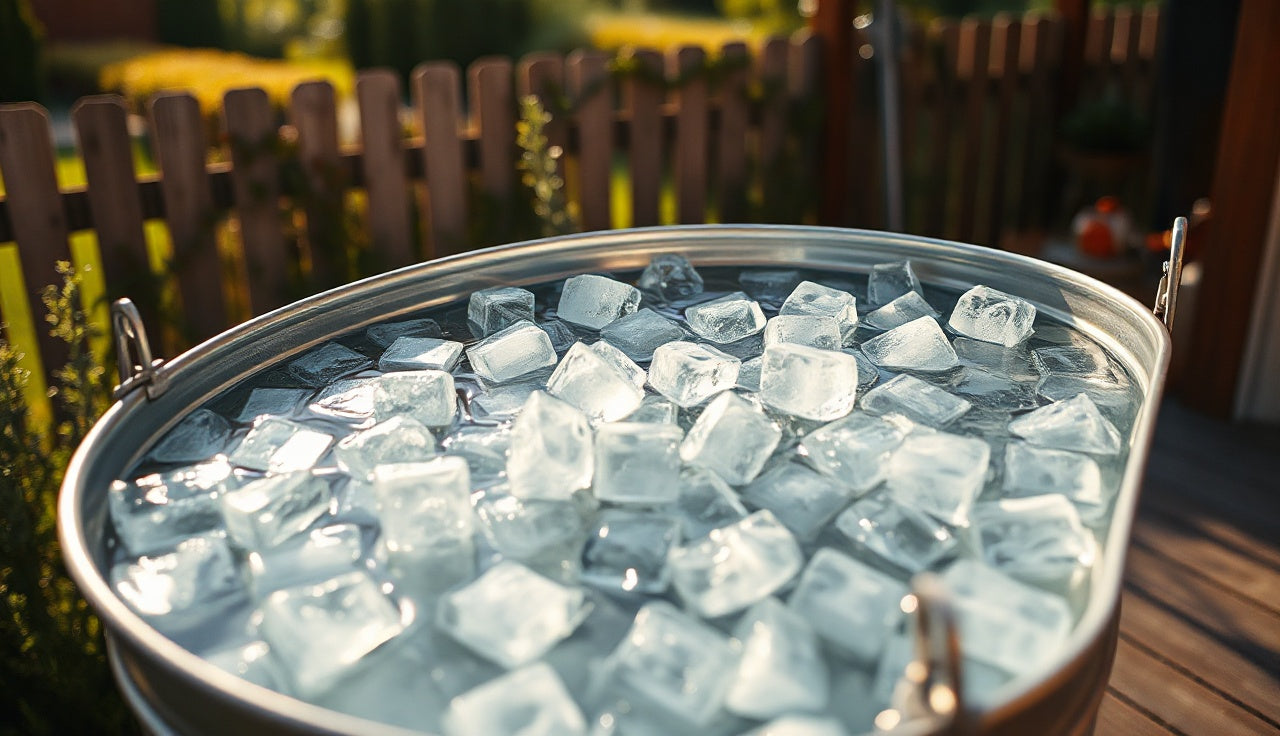
Second, there are rigid stock tanks and galvanized metal tubs. A standard 100-gallon galvanized livestock tank from a farm supply store costs about $100 to $200 and has been the DIY gold standard for years. Durable, cheap, and completely unsexy.
Third, purpose-built cold plunge tubs with insulated shells. These look like small hot tubs, hold shape well, and many are sold as standalone units meant to be paired with a separate chiller. Prices range from $500 to $3,000 for the shell.
Fourth, integrated cold plunge systems with a built-in or bundled chiller and filtration. This is the category that gets expensive fast: $2,500 to $10,000-plus depending on the chiller power and whether it can hit sub-50°F reliably [1]. Some high-end units go below 39°F.
There is also a fifth, often-overlooked option: a chest freezer conversion. A used chest freezer ($100 to $300) lined with a vinyl pool liner becomes a very effective cold plunge that can hold water at near-freezing temps year-round for roughly $2 to $4 per month in electricity. It is ugly and requires some setup, but it beats most sub-$500 "cold plunge tubs" on actual temperature control.
For a deeper look at what the cold exposure research actually supports, see cold plunge benefits.
How much does an ice bath cost?
Honest answer: anywhere from $30 to over $10,000, and the gap in experience between the bottom and the middle of that range is much bigger than the gap between the middle and the top.
Here is a realistic breakdown by tier:
| Type | Price Range | Chiller Needed? | Notes |
|---|---|---|---|
| DIY stock tank (galvanized) | $100, $200 | No (ice only) | Proven, ugly, cold-only |
| Inflatable cold plunge tub | $100, $600 | No (ice only) | Portable, weaker insulation |
| Rigid purpose-built tub (no chiller) | $500, $3,000 | Optional | Nicer shell, pairs with add-on chiller |
| Chest freezer conversion | $150, $400 | No (self-chilling) | Excellent temp control, DIY effort |
| Tub + standalone chiller | $1,500, $6,000 | Yes (bundled) | Best everyday usability |
| Integrated all-in-one system | $3,000, $10,000+ | Built in | Plug-and-play, filtration included |
The single biggest cost trap is buying a nice-looking inflatable tub for $500 and then spending $15 to $30 per session on bagged ice. If you plunge three times a week, that is $2,000 to $4,500 per year on ice alone. A chiller pays for itself quickly.
A 0.5-horsepower chiller capable of cooling 150 to 200 gallons down to around 50°F typically costs $1,000 to $2,000. A 1-horsepower unit that can hold water in the low-40s costs $2,000 to $4,500. Electricity to run a chiller averages $20 to $60 per month depending on ambient temperature and how cold you set it [2].
If you are buying your first ice bath and your budget is under $400, get the stock tank. If your budget is $1,500 to $3,000, get a decent tub plus a mid-range chiller and you will have a setup that works every day without hauling ice.
What features should you look for in an ice bath for sale?
Temperature range is the first thing to check. The research on cold water immersion uses temperatures from roughly 50°F to 59°F (10°C to 15°C) in most recovery studies [3]. Some protocols go lower. Know what temperature range you actually want, and confirm the unit or chiller can hold it reliably.
Insulation matters more than most listings admit. Thicker insulation means you use less ice to maintain temperature, or your chiller runs less frequently. For an ice-only setup, look for at least 2 inches of foam insulation in the shell walls.
Filtration and sanitation is the feature that gets ignored until the water turns green. Any tub you plan to use more than twice a week needs some form of filtration. Purpose-built integrated systems include UV sanitation or ozone systems as standard. If you buy a standalone tub and chiller separately, budget an extra $100 to $300 for a small cartridge filter and a sanitizer (bromine or ozone), or plan to dump and refill frequently.
Dimensions and interior volume: a tub needs to submerge you to at least the top of your abdomen when seated. Most adults need at least 60 inches of interior length for a reclined position, or a tub deep enough (24 inches minimum) for an upright seated soak. Check the internal measurements, not the external footprint.
Drain placement and drainage. Ground-level drains are convenient if you are draining into a garden bed or yard. Make sure the drain connection is standard sizing or you will be ordering an adapter.
Cover quality. A well-fitted insulating cover can cut chiller electricity costs by 30 to 50% by reducing evaporation and ambient heat gain. If a unit comes without a cover, account for the cost of one.
For context on how cold plunges compare to sauna use and how people combine the two, cold plunge has a full breakdown.
| DIY stock tank (ice-based) | $1,700 |
| Inflatable tub (ice-based) | $2,100 |
| Chest freezer conversion | $470 |
| Rigid tub + mid-range chiller | $3,200 |
| All-in-one integrated system | $6,500 |
Source: NIH PubMed (protocol data), DOE Energy Saver (electricity estimates), market pricing research 2024-2025
What is the best ice bath for home use?
There is no universally best answer, but there are best answers for specific situations.
For the person who wants to try cold plunging without committing hundreds of dollars, a galvanized stock tank from a farm supply store and 40 to 60 pounds of ice per session is a perfectly legitimate starting point. Total cost: under $200.
For a serious athlete or anyone who wants daily cold plunging without buying ice, the practical minimum is a purpose-built insulated tub paired with a chiller. At this tier, look for a chiller rated for your tub volume with at least 10% to 15% extra capacity headroom so it is not straining to hold temperature in summer.
For someone with a deck or backyard and a budget around $3,000 to $5,000, an all-in-one unit with built-in chiller and filtration makes the most practical sense. The upfront cost is higher but the ongoing friction is nearly zero, which matters a lot for whether you actually use the thing three to four times a week.
For a garage setup with a very tight budget, the chest freezer conversion is hard to beat. Buy a used 7 to 10 cubic foot chest freezer, add a pool liner, install a STC-1000 temperature controller so it does not freeze solid, and you have a cold plunge that holds 38°F to 45°F indefinitely for pennies per day. The build takes about two to three hours.
Nobody should pay $5,000 for a tub that cannot hold temperature consistently or lacks filtration. Check third-party reviews on Reddit communities like r/coldplunge before buying any unit above $1,000.
Where can you buy an ice bath?
Ice baths are sold through several channels, each with real tradeoffs.
Specialty cold plunge and wellness retailers carry curated selections with knowledgeable customer service. If you have questions about chiller compatibility or sizing, this is where you want to shop. SweatDecks carries a range of ice bath options with shipping included on most units.
Amazon and general e-commerce marketplaces have a wide inflatable and budget tub selection. The tradeoff is that return logistics for a 200-pound chiller unit are a real headache, and customer support for technical questions is often nonexistent.
Farm and ranch supply stores (Tractor Supply Company, Rural King) sell galvanized stock tanks in-store or online for $100 to $200. These are the same tanks that competitive athletes and fitness coaches have used for a decade. No shame in this option.
Direct from the manufacturer is worth considering for higher-end integrated systems. Brands like Ice Barrel, Plunge (formerly ColdLife), and Edge Theory Labs sell direct, which often means better warranty support and the ability to talk to someone who actually knows the product.
Used marketplaces: Facebook Marketplace and Craigslist regularly have cold plunge units and chest freezers listed at 30 to 60% below retail. Inspect the chiller compressor and the tub liner before buying anything used.
Big-box home improvement stores (Home Depot, Lowe's) sometimes stock galvanized tanks seasonally and occasionally carry hot tub-adjacent products that work as cold plunge shells.
What temperature should an ice bath be?
Most peer-reviewed cold water immersion research uses water temperatures between 50°F and 59°F (10°C to 15°C) [3][4]. That is cold enough to produce meaningful physiological responses without being dangerous for most healthy adults.
A 2021 meta-analysis of cold water immersion studies published in Sports Medicine found that immersion at temperatures between 10°C and 15°C for 10 to 20 minutes was the most common protocol studied for post-exercise recovery, with the strongest evidence for reduced muscle soreness in the 24 to 48 hours after exercise [4].
The "colder is better" belief is not well supported by the evidence. Going to 40°F versus 55°F probably does not produce dramatically different recovery outcomes for most people. What it does do is increase discomfort and the physiological stress response significantly, which may not always be desirable.
For cardiovascular safety, the American Heart Association has flagged that rapid cold water immersion causes an immediate spike in heart rate and blood pressure, and people with underlying cardiac conditions should consult a physician before using cold plunges regularly [5].
Practically: aim for 50°F to 59°F as your target range. Most people find this achievable and sustainable. Sub-45°F is for people who have built tolerance over months and have no contraindicated health conditions. Never go below 39°F (4°C) without expert guidance.
For a full comparison of cold and heat therapy protocols, including pairing an ice bath with sauna use, see sauna benefits.
How long should you stay in an ice bath?
The research does not point to one magic number, but the most studied protocols run between 10 and 20 minutes at 50°F to 59°F [4]. Most practical guidance for beginners is to start at 2 to 3 minutes and add time gradually over weeks.
Hypothermia risk is real. Core body temperature can start dropping meaningfully after 30 minutes in water below 60°F, especially in leaner individuals with less insulating body fat [11]. The U.S. Coast Guard defines cold water as anything below 70°F (21°C) and notes that cold incapacitation can occur within minutes in very cold water [6]. For a controlled home plunge at 50°F to 59°F, 10 to 20 minutes is a reasonable ceiling for most people.
If you get shivering that you cannot control, exit immediately. That is your body telling you it is losing the thermal battle.
A common mistake is staying in past the point of numbness and comfort because it "feels fine." Numbness means your thermal sensors are offline. It is not a green light for more time.
Are ice baths actually good for recovery?
The short answer: yes, with real caveats.
The evidence for post-exercise muscle soreness reduction is probably the strongest area. Multiple randomized controlled trials and meta-analyses have found that cold water immersion reduces delayed-onset muscle soreness (DOMS) in the 24 to 72 hours after resistance or endurance exercise compared to passive rest [4][7].
The caveat that gets less coverage: cold water immersion immediately after resistance training may blunt some of the anabolic signaling that drives muscle hypertrophy. A 2015 study in the Journal of Physiology found that cold water immersion after strength training reduced long-term gains in muscle mass and strength compared to active recovery [7]. The study's stated conclusion was that "cold water immersion attenuated the acute anabolic response in skeletal muscle and attenuated the training-induced increase in muscle mass and strength."
Translation: if your goal is building muscle, cold plunging immediately after every lifting session might not be optimal. If your goal is recovery for performance in the next session (endurance athletes, team sport players, fighters), the evidence is more favorable.
For mental health and mood, the evidence is promising but thinner. Norepinephrine and dopamine spikes following cold exposure have been documented in lab settings [8], but nobody has good data yet on whether regular home cold plunging produces meaningful long-term mental health outcomes at a population level.
The closest rigorous evidence base is for immersion post-exercise in competitive contexts. Everything else is extrapolation from that research plus plausible mechanisms.
What are the risks of using an ice bath at home?
Most healthy adults tolerate cold water immersion at 50°F to 59°F well. But the risks are real and worth knowing before you spend money on equipment.
Cardiac risk: cold water triggers the cold shock response, including sudden hyperventilation, a sharp rise in blood pressure, and in rare cases, cardiac arrhythmia [5]. People with heart disease, high blood pressure, or a history of arrhythmia should get medical clearance before cold plunging. The risk is highest in the first 30 seconds of immersion, before you stabilize.
Hypothermia: unlikely in a controlled 10 to 15 minute session at 50°F, but possible if you fall asleep or stay in too long. Never use an ice bath alone if you are new to it.
Hyperventilation and drowning risk: the cold shock response causes uncontrolled breathing. Do not submerge your head, especially in the first minute.
Skin and nerve damage: prolonged immersion below 40°F can cause localized frostbite-like injury to fingers, toes, and ears. This is more relevant to open-water cold swimmers than tub users, but it is worth knowing.
Pregnancy: cold water immersion is generally not recommended during pregnancy. The American College of Obstetricians and Gynecologists advises avoiding extreme temperature exposures during pregnancy [9].
If you have Raynaud's phenomenon, peripheral vascular disease, or diabetes with neuropathy, cold water immersion carries additional specific risks and requires physician input.
How do you set up an ice bath at home?
The setup depends on which type you buy, but a few universal considerations apply.
Location first. A cold plunge tub full of water weighs 800 to 1,500 pounds. Ground-level concrete or a reinforced deck is fine. An interior floor above a crawlspace or wood-framed upper floor is probably not fine without a structural assessment. Outdoors in a shaded spot is the most practical setup for most homes.
Water source and drainage. You need a garden hose connection nearby to fill the tub and a drain path that can handle 100 to 200 gallons of water. Many people drain onto grass or into a garden bed. Check local municipal code if you plan to drain to a sewer cleanout.
Power for a chiller. A standard residential 120V 15-amp or 20-amp circuit works for most 0.5 to 1 HP chillers. Larger units may need a dedicated 240V circuit. Hire an electrician if you are not certain.
For an ice-only setup, the process is literally: fill with water, add ice, check temperature with a thermometer, get in. Total time: 20 minutes.
For a chest freezer conversion, you need: a chest freezer, a vinyl pool liner that fits the interior, a STC-1000 or Inkbird temperature controller wired between the freezer and the outlet, and a bromine or ozone sanitizer. A few YouTube build guides walk through the wiring in detail if you are comfortable with basic electrical work.
For integrated units, manufacturers typically include step-by-step setup guides. Most can be operational within one to two hours of delivery.
If you are also exploring heat therapy as part of a recovery setup, home sauna covers what to look for on that side of the equation.
How does an ice bath compare to a cold plunge tub?
The terms are used almost interchangeably in the market, but there is a practical difference worth knowing.
"Ice bath" technically refers to any tub you fill with ice and water. The ice does the cooling, the cooling is temporary (water warms over 30 to 60 minutes as the ice melts), and you need fresh ice every session.
"Cold plunge tub" in the retail market usually refers to a purpose-built vessel designed to work with a chiller that mechanically cools and circulates water continuously. The water stays cold indefinitely without ice.
In terms of the physiological experience, identical water temperatures produce identical effects. Your body does not know whether the 55°F water around it came from ice or a chiller compressor.
The real difference is convenience and ongoing cost. Ice-based setups have higher recurring costs if used frequently but lower upfront cost. Chiller-based setups have a high upfront cost but near-zero ongoing cost beyond electricity.
For daily use, chillers win on total cost of ownership past roughly the 12 to 18 month mark, depending on local ice prices.
For occasional use (once or twice a week), ice is perfectly reasonable and keeps the upfront cost minimal.
SweatDecks carries both ice-ready tubs and chiller-integrated cold plunge systems if you want to compare options side by side.
What should you watch out for when buying an ice bath online?
The ice bath market has grown faster than its quality controls. A few patterns worth watching for.
Inflated temperature claims: some listings claim units can reach 34°F to 37°F with chillers that in practice struggle to get below 50°F in an ambient 70°F environment. A chiller's rated temperature is typically measured in controlled lab conditions, not a hot garage in July. Ask the retailer or manufacturer what temperature the unit holds at your expected ambient temperature.
Missing filtration: a beautiful $2,000 tub with no filtration system means you are either dumping and refilling every few days or bathing in murky water. Budget filtration add-ons if not included.
Shipping damage and return policies: a chiller unit shipped by freight can arrive damaged. Document the exterior of the crate before signing for delivery. Read the return policy for large items before you buy; many are final sale.
Vague warranty language: "one-year warranty" that only covers manufacturing defects but not the chiller compressor (the part most likely to fail) is not a meaningful warranty. Get specifics on what the compressor warranty covers and for how long.
Materials for the interior contact surface: food-grade materials matter for a tub you sit in. Medical-grade thermoplastic, fiberglass with gel coat, or galvanized steel are all legitimate. Some budget inflatables use materials that degrade in UV or with cold water chemicals. Check the product specs.
For a broad look at the cold plunge purchase decision, ice bath covers the full context of use, protocols, and what the research actually shows.
Frequently asked questions
What is the cheapest ice bath setup that actually works?
A 100-gallon galvanized stock tank from a farm or ranch supply store costs $100 to $200 and works exactly as well as any inflatable at cooling your body. Add 40 to 60 pounds of bagged ice per session. Total startup cost is under $250. The ongoing ice cost is the only real downside. For regular use, consider a chest freezer conversion as your next step up.
Can I use a regular bathtub as an ice bath?
Yes, a standard bathtub works fine for occasional cold plunging. Fill it with cold water and add ice until you reach your target temperature (50°F to 59°F). The limitations are that bathtubs are not insulated so ice melts fast, and the reclined position may not submerge your full torso easily. It is a legitimate starting point before committing to dedicated equipment.
How much ice do I need for an ice bath?
A typical session in a 100-gallon tub requires 40 to 80 pounds of ice to bring tap water (around 60°F to 70°F) down to 50°F to 59°F. The exact amount depends on your starting water temperature and ambient air temperature. Bagged ice from a convenience store runs $1.50 to $3 per 10-pound bag, so expect $6 to $24 per session on ice alone.
Do I need a chiller for an ice bath?
No, you do not need a chiller to get effective cold plunges. Ice works perfectly well. But if you plan to plunge more than two to three times per week, a chiller saves significant money over a year or two compared to buying ice constantly. For daily use, a mid-range chiller typically pays for itself within 12 to 18 months depending on local ice prices.
What is the difference between an ice bath and a cold plunge?
"Ice bath" usually means a tub cooled with actual ice, producing temporary cold. "Cold plunge" in the retail market usually refers to a tub paired with a mechanical chiller that holds temperature continuously without ice. The physiological effect at the same water temperature is identical. The practical difference is convenience and running cost.
How long does it take for an ice bath to get cold?
With ice: immediately, once you add enough ice. With a chiller: most consumer chiller units take 2 to 6 hours to bring 100 to 200 gallons from room temperature down to 50°F to 55°F on initial fill. After that, the chiller maintains temperature continuously, so subsequent sessions are instant. Plan for a long initial cooldown period when first filling.
Is an ice bath safe for everyday use?
For healthy adults without cardiac conditions or other contraindications, daily cold plunging at 50°F to 59°F for 10 to 20 minutes is generally considered safe based on available evidence. One caveat: daily cold plunging immediately after strength training may reduce muscle growth gains over time, per research published in the Journal of Physiology. Consider limiting post-lifting cold plunges to two to three times per week if muscle building is a priority.
What size ice bath do I need?
For a seated soak, you need a tub at least 24 inches deep and wide enough to seat your hips comfortably, typically 24 to 30 inches interior diameter. For a reclined position, you need at least 60 inches of interior length. Most adults find 100 to 150-gallon capacity adequate for a seated cold plunge. Measure yourself in a comfortable seated position before buying.
Can an ice bath help with anxiety or stress?
Cold water immersion triggers a norepinephrine response that some research has associated with improved mood and reduced anxiety symptoms. Lab studies have documented significant norepinephrine increases after cold exposure. However, clinical evidence for cold plunging as a treatment for anxiety disorders is limited, and it should not replace professional mental health care. The mood improvement most users report is real but the mechanism and durability are still being studied.
How do I keep my ice bath water clean without a filtration system?
The simplest approach is to shower before each plunge, add a small amount of hydrogen peroxide (about 1 cup per 100 gallons) or a non-chlorine shock product, and change the water every 1 to 2 weeks with heavy use. Without filtration, water will degrade quickly in warm conditions. Budget $100 to $300 for a cartridge filter and sanitizer if you plan to hold water more than a few days.
Do ice baths help with weight loss?
There is some evidence that repeated cold exposure activates brown adipose tissue and increases calorie expenditure through non-shivering thermogenesis. A 2014 study in the Journal of Clinical Investigation found that repeated cold exposure increased brown fat activity in humans. However, the caloric effect is modest and cold plunging is not a weight loss strategy by itself. It is a recovery tool.
What is the best ice bath for an outdoor setup?
For outdoors, prioritize UV-resistant materials, a tight-fitting insulating cover, and drainage that works in your yard. Galvanized steel tanks are weather-resistant and inexpensive. Purpose-built fiberglass or thermoplastic tubs handle outdoor conditions well. Avoid PVC inflatables in direct sun over long periods as they degrade faster. A shade cover or canopy helps maintain water temperature and extends equipment life.
Are inflatable ice baths worth buying?
Inflatable cold plunge tubs are worth buying if you need portability, have limited outdoor space, or want a low-commitment way to start cold plunging. For less than $400, they are a legitimate entry point. The downsides are weaker insulation than rigid shells and a higher risk of puncture over time. They are not ideal as a long-term daily driver if you have space for something sturdier.
Can I use an ice bath after a sauna session?
Yes, and this is one of the most popular protocols in Scandinavian wellness traditions. Moving from a hot sauna to a cold plunge triggers a strong cardiovascular response as blood vessels rapidly constrict. Most practitioners wait 1 to 2 minutes after leaving the sauna before entering cold water to let breathing stabilize. Start with shorter cold exposures (1 to 3 minutes) when combining with sauna heat. See sauna benefits for more on the contrast therapy approach.
Sources
- Healthline, Cold Plunge Tubs Overview: Integrated cold plunge systems with chiller and filtration range from $2,500 to $10,000-plus at retail.
- U.S. Department of Energy, Energy Saver: Electricity costs for refrigeration equipment averaging $20 to $60 per month depending on ambient temperature and load.
- National Institutes of Health, PubMed Central: Cold Water Immersion Review: Most cold water immersion research protocols use water temperatures between 10°C and 15°C (50°F to 59°F).
- Sports Medicine, 2021 Meta-Analysis: Cold Water Immersion and Muscle Soreness: Cold water immersion at 10°C to 15°C for 10 to 20 minutes reduces delayed-onset muscle soreness in the 24 to 48 hours following exercise.
- American Heart Association, Cold Water and Cardiovascular Risk: Rapid cold water immersion causes an immediate spike in heart rate and blood pressure, with risk for people with underlying cardiac conditions.
- U.S. Coast Guard, Cold Water Boot Camp / Cold Water Safety: The U.S. Coast Guard defines cold water as anything below 70°F and notes cold incapacitation can occur within minutes in very cold water.
- Journal of Physiology, 2015: Cold Water Immersion and Muscle Hypertrophy: Cold water immersion attenuated the acute anabolic response in skeletal muscle and attenuated the training-induced increase in muscle mass and strength.
- NIH / PubMed: Norepinephrine and dopamine response to cold exposure (Srámek et al.): Lab studies have documented significant norepinephrine and dopamine increases following acute cold water immersion.
- American College of Obstetricians and Gynecologists, Exercise During Pregnancy: ACOG advises avoiding extreme temperature exposures including hot and cold water immersion during pregnancy.
- Journal of Clinical Investigation, 2014: Brown Adipose Tissue and Cold Exposure: Repeated cold exposure increased brown fat metabolic activity in adult humans in a controlled study.
- National Institute for Occupational Safety and Health (NIOSH), Cold Stress: Core body temperature can begin declining meaningfully with prolonged exposure to water below 60°F, with hypothermia risk increasing over time.

Share:
Are infrared saunas good for you? What the research actually shows
R3 spa sauna cold plunge: what it is and whether it's worth it