
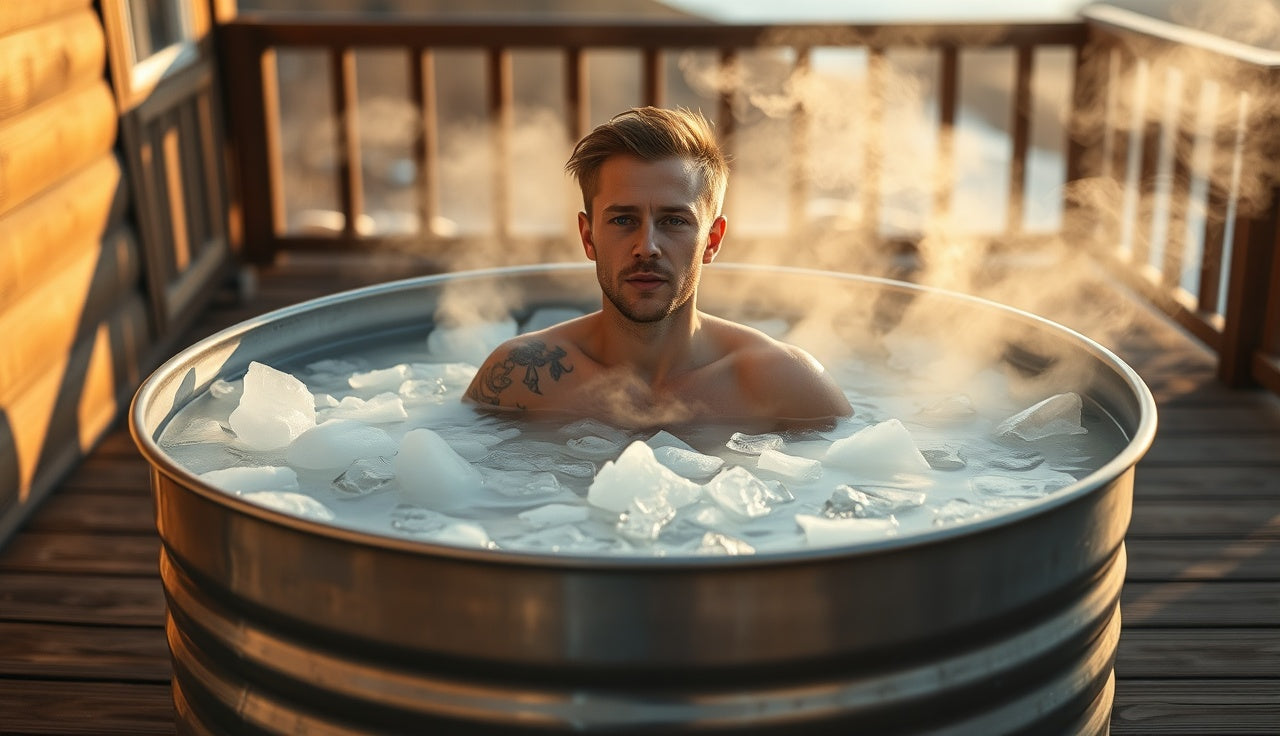
Last updated 2026-07-09
TL;DR
Most sports science research points to 11 to 15 minutes of total cold-water immersion per week, split across sessions of roughly 2 to 10 minutes each, at water temperatures between 10 to 15°C (50 to 59°F). First-timers should start at 2 to 3 minutes. Going past 15 minutes in one session adds hypothermia risk with almost no extra benefit.
What does the research actually say about ice bath duration?
The practical window is 5 to 15 minutes per session, and most recreational athletes land around 10 minutes. A 2022 meta-analysis by Hedley et al. in the British Journal of Sports Medicine found that immersion sessions of roughly 11 to 15 minutes at 10 to 15°C produced the most consistent reductions in perceived muscle soreness and fatigue after exercise [1]. That same analysis noted that shorter sessions under 5 minutes showed weaker effects, while sessions past 20 minutes offered no measurable additional benefit and raised the risk of cold-related harm.
Ten minutes isn't a magic number. It's just where the benefit-to-risk curve looks best across the trials we have.
The research is honest about its limits. Effect sizes swing a lot depending on water temperature, the type of exercise you did beforehand, and your own cold tolerance. Nobody has clean data on the single perfect duration for every person. The closest thing to a consensus is that 10 to 15 minutes at 10 to 15°C is a reasonable starting target for most healthy adults.
What temperature should the ice bath be, and how does that change timing?
Temperature and time are inseparable. The colder the water, the shorter your session needs to be to get a real physiological response, and the faster you reach the danger zone.
Here's how the ranges stack up based on what the immersion literature and cold-water safety research describe [1][2]:
| Water Temp (°C) | Water Temp (°F) | Recommended Session Duration |
|---|---|---|
| 5 to 8°C | 41 to 46°F | 2 to 5 minutes max |
| 10 to 12°C | 50 to 54°F | 5 to 10 minutes |
| 13 to 15°C | 55 to 59°F | 10 to 15 minutes |
| 16 to 18°C | 60 to 64°F | 15 to 20 minutes (cold plunge range) |
Most commercial ice baths and cold plunges sit around 10 to 15°C by default, because that range is where the research clusters. If you're using a basic tub filled with tap water and ice, you're often at 8 to 12°C depending on how much ice you add, so err toward the shorter end.
The Royal Life Saving Society notes that cold shock response, which can cause uncontrolled gasping and cardiac stress, can be triggered almost immediately in water below 10°C, especially for people unaccustomed to cold immersion [2]. That's the case for not rushing to the coldest setting on day one.
If you're thinking about a dedicated cold plunge unit with a chiller, those let you dial in temperature precisely, which makes it easier to find your personal sweet spot and stay consistent.
How long is too long in an ice bath?
More than 15 minutes in a single session below 15°C is where the risk calculus shifts. You won't extract more recovery benefit after that window, but your core temperature keeps dropping.
Hypothermia begins when core body temperature falls below 35°C (95°F). The U.S. Centers for Disease Control and Prevention notes that cold water pulls heat from the body roughly 25 times faster than cold air at the same temperature, which means even healthy adults can reach early hypothermia stages within 30 minutes in water at 10°C [3].
Watch for these signs: shivering you can't stop, slurred speech, confusion, or an odd urge to stay in because you've stopped feeling cold (paradoxical undressing is a late warning). If any show up, get out.
Set a timer. Don't freestyle it. The feeling of "I'm fine, just a little longer" is unreliable once you've been in cold water for several minutes, because cold impairs judgment right along with everything else.
| 5–8°C (41–46°F): ice bath, very cold | 5 |
| 10–12°C (50–54°F): standard ice bath | 10 |
| 13–15°C (55–59°F): cold plunge range | 15 |
| 16–18°C (60–64°F): cool water immersion | 20 |
Source: British Journal of Sports Medicine, Hedley et al. 2022; Royal Life Saving Society cold water guidance
How long should beginners sit in an ice bath?
Two to three minutes. That's the whole first session.
This isn't timid advice. Cold immersion produces a real stress response: heart rate spikes, blood pressure jumps, and breathing turns rapid and shallow in the first 30 to 90 seconds. For people with undiagnosed cardiac conditions or high blood pressure, that initial response carries genuine risk. The American Heart Association recommends that people with cardiovascular disease consult a physician before cold-water immersion [4].
For healthy beginners with no known conditions, the short first session does a specific job: it teaches your nervous system that cold immersion is survivable. The cold shock response is partly conditioned, and repeated short exposures reduce the intensity of that initial gasp over time. Research from the University of Portsmouth found that six short cold-water immersion sessions across a month significantly blunted cold shock responses in participants [5].
From there, add time gradually. A reasonable progression:
- Sessions 1 to 2: 2 to 3 minutes
- Sessions 3 to 5: 4 to 6 minutes
- Sessions 6+: 8 to 12 minutes, based on comfort
Nobody needs to white-knuckle 15 minutes in week one. The benefits accumulate with consistent practice, not heroic single sessions.
Does ice bath timing change for muscle recovery vs. other goals?
Yes, and the distinction matters more than most people realize.
For post-exercise muscle soreness (delayed onset muscle soreness, or DOMS), the meta-analysis above found that sessions of 11 to 15 minutes at 10 to 15°C produced the strongest reductions in soreness 24 to 96 hours after exercise [1]. Cold immersion seems to work here mostly by reducing inflammatory signaling and slowing nerve conduction velocity, which temporarily lowers pain perception.
For performance recovery between training bouts (a second workout the same day, or a game the next), shorter, colder sessions may fit better. Some sports physiologists use 5 to 10 minutes at temperatures as low as 8°C for rapid turnaround between heats or matches, accepting the short duration because athletes need to warm back up quickly.
For mood or stress, the data is thinner and the ideal timing less clear. A small 2018 randomized controlled trial in PLOS ONE reported self-reported mood improvements after cold water protocols, but that study looked at open water swimming, and it doesn't translate cleanly to precise immersion timing [6]. If mood or alertness is your main goal, even 2 to 3 minute sessions appear to be enough based on the limited evidence.
One place where longer ice baths probably backfire: right after strength training, if your goal is muscle growth. A 2015 study in the Journal of Physiology found that regular post-exercise cold-water immersion reduced long-term muscle gains compared to active recovery, with participants showing lower satellite cell activity and blunted anabolic signaling [7]. In a heavy muscle-building phase, skip the ice bath on hard lifting days, or hold it to the 5-minute range.
What's the best time of day for an ice bath, and does that affect duration?
Time of day and session length are mostly separate questions, but a few practical points help.
Morning cold immersion gets attention because the norepinephrine release linked to cold exposure can sharpen alertness (much of Andrew Huberman's coverage of this is review-based rather than primary trials, so treat it as a reasonable hypothesis, not settled fact). Morning sessions of 2 to 5 minutes are popular for this. That's short, and it's probably fine. The alerting effect doesn't need 15 minutes.
Evening sessions before bed are more debated. Cold exposure lowers core body temperature, which is one signal your body uses to start sleep. Some people find a short 5 to 10 minute evening soak improves sleep onset. Others find the norepinephrine spike too stimulating to settle down after. The honest answer is that this varies person to person, and no large trial has settled it.
For post-workout recovery, when you get in matters more than the hour on the clock. The usual guidance is to enter cold water within 30 to 60 minutes of finishing exercise to catch the acute inflammatory window. Morning or evening doesn't change the 10 to 15 minute target.
How does ice bath duration compare to cold plunge duration?
People use these terms interchangeably, but the practical difference is temperature. An ice bath usually means a tub, cooler, or barrel filled with water and ice, which often lands in the 5 to 12°C range. A cold plunge, especially a purpose-built unit with a chiller, usually sits at 10 to 15°C and holds that temperature.
That difference shifts the recommended duration. At 8°C (a well-iced bath), a 5-minute target session works for most people. At 13°C (a typical chiller setting), 10 to 15 minutes is appropriate.
For recovery outcomes, the meta-analysis literature suggests both approaches produce similar DOMS reductions when temperature and total time are matched [1]. So a 5-minute ice bath at 8°C and a 10-minute cold plunge at 13°C likely produce overlapping effects. They're not identical, but you don't need a controlled study to choose. Pick the one you'll actually do consistently.
If you're comparing options, SweatDecks has a rundown of cold plunge benefits and dedicated cold plunge units that make temperature control much easier than the bag-of-ice approach.
For contrast therapy that pairs cold with heat, the ice bath guide covers how to structure those sessions.
How long should you let eggs sit in an ice bath? (Yes, this is a different question)
Different topic, but it gets searched alongside cold immersion constantly, so here's the clean answer.
For hard-boiled eggs, the standard food-science guidance is to move them straight from boiling water to an ice bath and leave them for at least 10 to 15 minutes [8]. The ice bath stops carryover cooking, which otherwise continues for several minutes after the egg leaves the heat. It also pulls the egg white slightly away from the shell membrane, which is what makes peeling so much easier.
The USDA recommends cooling cooked eggs quickly to prevent bacterial growth, and an ice bath is one of the approved rapid-cooling methods [9]. Fifteen minutes in a proper ice bath (a bowl with both ice and cold water, not ice alone) brings a large egg from boiling temperature down to a safe holding range.
You can leave eggs in the ice bath past 15 minutes, up to about an hour, without harming them. After that, they should go to the refrigerator. If you're not peeling them right away, refrigerate them unpeeled in their shells.
One practical note: the ice bath works because of the water more than the ice. Ice alone conducts heat poorly compared to ice water. Give the bowl enough water for the eggs to actually be submerged, with ice mixed in to hold the temperature near 0°C.
Is there a weekly total for ice bath time that matters?
Roughly 11 to 15 minutes of total cold immersion per week, spread across sessions, is where the muscle-soreness benefits showed up most consistently in the Hedley et al. meta-analysis [1]. That's not much. Three sessions of 4 to 5 minutes, or two sessions of 7 to 8 minutes, would hit it.
More is not automatically better. The body adapts to cold over time, which can blunt some of the acute responses that seem to drive the benefits. Cold-water swimmers and triathletes who log very high volumes (sometimes 30 to 60+ minutes per week) often report diminishing returns on soreness and recovery, though they also build much higher cold tolerance.
If you're starting out, aim for 2 to 3 sessions per week at 5 to 10 minutes each. That gives you a weekly dose of 10 to 30 minutes, which covers the studied benefit range without piling on. There's no good evidence that daily ice baths beat every-other-day sessions for recovery.
Who should not sit in an ice bath, regardless of duration?
Some people genuinely should not use cold-water immersion no matter how short the session. This isn't overcaution. The physiological stress is real.
The American Heart Association specifically flags people with uncontrolled hypertension, recent cardiac events, and Raynaud's disease as groups facing elevated risk from cold immersion [4]. The sudden vasoconstriction and cardiac demand spike at entry can be severe.
Pregnant people should avoid cold immersion without specific physician guidance. Children and older adults have reduced thermoregulation, meaning they reach dangerous core temperatures faster than healthy younger adults.
People on certain medications, especially beta-blockers (which blunt the heart rate response to cold), antihypertensives, or sedatives, may not read the warning signs of overcooling correctly.
If you have any chronic condition or take regular medications, check with your doctor before starting cold immersion. That's not legal boilerplate. It's useful, because the risk profile changes meaningfully based on your underlying health.
What should you do after an ice bath, and for how long?
Get warm, but don't force it artificially. The rewarming phase is part of the protocol.
Passive rewarming (drying off, putting on warm clothes, moving around) is generally preferred over jumping straight into a hot shower. Some researchers think the afterdrop (core temperature continues to fall for several minutes after you exit) and the slow rewarming that follows may contribute to some of the adaptive benefits of cold exposure. The evidence here is less settled, but it's why many practitioners stick with passive rewarming.
If you're doing contrast therapy, alternating heat and cold, you'd go directly to a sauna or hot tub after the ice bath. That's a different protocol with its own timing. A sauna session of 10 to 15 minutes after a cold plunge is the most common contrast pairing, and the sauna benefits research covers what heat adds.
Expect to feel cold for 10 to 20 minutes after a standard 10-minute session. That's normal. Shivering is your thermogenic system doing its job. If shivering is severe or drags past 30 minutes, the session was too cold or too long.
Eat something. Cold immersion raises energy expenditure modestly, and a blood sugar dip can amplify the post-immersion fatigue some people feel. A small snack with protein and carbohydrates helps most people bounce back faster.
How do you make an ice bath at home, and does setup affect timing?
The simplest setup is a bathtub filled with cold water and ice. Fill the tub with cold tap water first, then add ice to bring the temperature into your target range. A bag or two of ice (usually 10 to 20 lbs each) in a standard bathtub will typically drop water from around 15 to 18°C down to 10 to 12°C, depending on your tap water and how much ice you use.
A thermometer matters. You can't guess water temperature reliably by feel, especially once you're in. A cheap waterproof cooking thermometer works fine. Get the water to your target range before you climb in.
For a more structured setup, many people use a stock tank, a large cooler, or a dedicated tub. SweatDecks carries options across all of these if you want to compare purpose-built units against DIY.
One thing setup does affect: consistency. In a bag-of-ice tub, temperature rises while you sit, so the last 5 minutes of a 10-minute session may be several degrees warmer than the first 5. A purpose-built cold plunge with a chiller holds temperature flat. Neither is wrong, but if you're trying to follow specific duration and temperature targets from the research, a chiller gives you more control.
If you also want to pair cold with heat, a home sauna can sit alongside a cold plunge tub in a garage or basement for full contrast therapy at home.
Frequently asked questions
How long should you sit in an ice bath for the first time?
Two to three minutes is the right starting point. Your body goes through a real stress response in the first 30 to 90 seconds of cold immersion: heart rate spikes, breathing accelerates, and blood pressure rises. Starting short lets your nervous system adapt. After 2 to 3 successful sessions, extend to 5 minutes, then build toward 10 minutes over several weeks.
Is 10 minutes in an ice bath enough?
Yes. A 2022 meta-analysis in the British Journal of Sports Medicine found 10 to 15 minutes at 10 to 15°C produced the strongest consistent reductions in post-exercise muscle soreness. Ten minutes sits squarely in that window for most people. Going longer doesn't add meaningful benefit and increases hypothermia risk, so 10 minutes is a smart ceiling for most sessions.
Can you sit in an ice bath for 30 minutes?
You physically can, but you shouldn't. Thirty minutes in water at 10 to 12°C is enough to drive core body temperature toward hypothermia range, which starts below 35°C. The CDC notes cold water pulls heat from the body roughly 25 times faster than cold air. At 30 minutes, you're stacking risk with no added recovery benefit over the 10 to 15 minute window.
How cold does an ice bath need to be?
Research clusters around 10 to 15°C (50 to 59°F) for recovery-focused immersion. Below 10°C, the cold shock response gets more intense and the safe session duration shortens sharply. Above 15°C, you're in cold plunge territory and need longer sessions to get a similar response. Use a thermometer. Guessing temperature by feel is unreliable once you're already in cold water.
Should you ice bath every day?
Probably not necessary. The meta-analysis literature suggests 2 to 3 sessions per week of 5 to 10 minutes each covers the studied recovery benefits. Daily use may blunt adaptive responses over time and adds cumulative cold stress. If your main goal is post-workout recovery, every-other-day sessions aligned with hard training days make more practical sense than daily immersion.
Does an ice bath help with sore muscles?
Yes, with caveats. Cold-water immersion consistently reduces perceived muscle soreness in research trials, with benefits peaking 24 to 96 hours after exercise. The mechanisms likely include slower nerve conduction velocity and lower inflammatory signaling. But if hypertrophy is your goal, a 2015 study in the Journal of Physiology found regular post-lifting cold immersion reduced long-term muscle gains, so context matters.
How long should eggs sit in an ice bath after boiling?
At least 10 to 15 minutes. The ice bath stops carryover cooking, which continues for several minutes after eggs leave boiling water, and pulls the egg white slightly from the shell membrane, making peeling easier. The USDA recommends rapid cooling of cooked eggs to prevent bacterial growth. You can leave eggs in the ice bath up to about an hour before refrigerating.
What happens if you stay in an ice bath too long?
Core body temperature drops below safe levels. Early signs include intense shivering, confusion, and slurred speech. The CDC classifies hypothermia as a core temperature below 35°C, and cold-water immersion can drive you there surprisingly fast, especially below 10°C. If shivering becomes uncontrollable, or you feel confused or oddly warm after extreme cold, get out and warm up immediately.
Should you breathe slowly in an ice bath?
Yes. Slow, controlled breathing is the most effective way to manage the cold shock response in the first 30 to 90 seconds of immersion. The initial gasp and rapid breathing are involuntary, but consciously slowing your exhale helps activate the parasympathetic nervous system and reduces the intensity of the stress response. Nasal breathing, if you can manage it, helps further.
Is an ice bath better before or after a workout?
After, for recovery. Cold immersion before exercise can reduce muscle power output and interfere with your warm-up. Post-workout is when the anti-inflammatory and soreness-reducing effects matter most. The general guidance is to let heart rate settle somewhat after exercise, then immerse within 30 to 60 minutes to catch the acute inflammatory window.
How long should you wait between ice bath sessions?
At least 24 hours, and ideally 48 hours if sessions run at the longer or colder end of the range. Back-to-back daily sessions at maximum duration and minimum temperature stack cold stress without clear additive benefit for recovery. Most research protocols space sessions every other day or line them up with recovery days after hard training.
Can you get sick from sitting in an ice bath?
Cold immersion itself does not cause illness. Infections come from pathogens, not temperature. But prolonged cold exposure suppresses some immune functions temporarily and adds physical stress, which can leave you more susceptible if you're already run-down. Keeping sessions within the 5 to 15 minute range, warming up properly afterward, and skipping cold immersion when already sick reduces those risks.
How do ice baths compare to cold showers for recovery?
Immersion is more effective than showers for recovery based on available evidence. Full-body immersion creates uniform hydrostatic pressure and cools a larger body surface area than a shower, producing a more consistent physiological response. Cold showers need much less setup and are easier to do daily, which may matter more in practice for people without a tub or dedicated cold plunge.
Sources
- British Journal of Sports Medicine, Hedley et al. 2022, 'Effects of cold-water immersion on post-exercise recovery': Sessions of 11–15 minutes at 10–15°C produced the most consistent reductions in perceived muscle soreness and fatigue after exercise; sessions over 20 minutes showed no additional benefit.
- Royal Life Saving Society, Cold Water Shock and Drowning prevention guidance: Cold shock response including gasping and cardiac stress can be triggered almost immediately in water below 10°C, especially in unaccustomed individuals.
- Centers for Disease Control and Prevention (CDC), Natural Disasters and Severe Weather: Hypothermia: Cold-water immersion causes heat loss approximately 25 times faster than cold air at the same temperature; hypothermia begins when core body temperature falls below 35°C (95°F).
- American Heart Association, Exercise and Cardiovascular Health guidance: People with uncontrolled hypertension, recent cardiac events, and Raynaud's disease face elevated risk from cold-water immersion due to vasoconstriction and cardiac demand spikes.
- University of Portsmouth, Tipton et al., research on cold shock habituation via repeated cold-water immersion: Six short cold-water immersion sessions across one month significantly blunted cold shock responses in participants.
- PLOS ONE, van Tulleken et al. 2018, 'Open water swimming as a treatment for major depressive disorder': Self-reported mood improvements were observed after cold water exposure protocols in a small randomized controlled trial.
- Journal of Physiology, Roberts et al. 2015, 'Post-exercise cold water immersion attenuates acute anabolic signalling and long-term adaptations in muscle to strength training': Regular post-exercise cold-water immersion attenuated long-term muscle gains compared to active recovery, reducing satellite cell activity and blunting anabolic signaling.
- American Egg Board, Egg Safety and Handling guidance: Hard-boiled eggs should be transferred immediately to an ice bath and left for at least 10–15 minutes to stop carryover cooking and ease peeling.
- USDA Food Safety and Inspection Service, Shell Eggs from Farm to Table: The USDA recommends rapid cooling of cooked eggs using an ice bath as an approved method to prevent bacterial growth.
- National Institutes of Health (NIH), National Center for Complementary and Integrative Health, Cold and Flu fact sheet: Cold exposure itself does not cause infections; infections are caused by pathogens, though physical stress from extreme cold can affect immune function.

Share:
Top rated home saunas: how to find the right one for your space
IR sauna for home: everything you need to know before you buy