
Last updated 2026-07-09
TL;DR
A home infrared sauna heats your body directly with infrared light instead of heating the air. Units run 120 to 150°F, well below traditional sauna temps, and fit in a spare bedroom or garage. Prices go from about $800 for a one-person portable to over $8,000 for a full-spectrum two-person cabin. The evidence backs modest cardiovascular, recovery, and relaxation benefits with consistent use.
What is an infrared sauna and how does it work?
An infrared sauna uses light panels to heat your skin and the tissue underneath directly. The air stays relatively cool, usually 120 to 150°F, against the 160 to 200°F of a traditional Finnish sauna. Your body absorbs the radiant energy, your core temperature climbs, and you sweat without sitting in a blast furnace.
The technology splits into three types by wavelength. Near-infrared runs roughly 700 to 1400 nm and penetrates the shallowest, about 1 to 2 mm into tissue. Mid-infrared (1400 nm to 3 µm) goes a bit deeper and may raise tissue temperature more effectively. Far-infrared, which most home units rely on, runs 3 to 100 µm and is absorbed mainly at the skin surface, producing the core heating and sweating effect most buyers want [1].
Full-spectrum saunas combine all three. Whether that extra complexity earns the price bump is genuinely debated. The bulk of published research uses far-infrared units, so if you're shopping with the clinical literature in mind, far-infrared is the type most studied.
One thing worth understanding: the word 'sauna' is regulated in some countries but not meaningfully in the U.S. consumer market, so manufacturers use it freely. What you're buying is an insulated wood cabin with electric infrared emitter panels mounted on the walls.
What does the research actually say about infrared sauna benefits?
The evidence is promising but not settled. Most studies are small, short-term, and funded in ways that introduce bias. A few findings hold up across multiple papers anyway.
Cardiovascular effects are the most replicated. A 2018 review in Mayo Clinic Proceedings pooled observational and intervention data and concluded that "regular sauna bathing is associated with reduced cardiovascular mortality," while noting most data came from traditional Finnish saunas and that infrared-specific evidence was limited [2]. A small but well-run 2015 study in the Journal of the American College of Cardiology found that far-infrared sauna sessions improved flow-mediated dilation, a marker of arterial flexibility, in patients with coronary risk factors [3].
Muscle recovery gets real attention too. Heat increases blood flow, and infrared sauna after exercise has shown some signal for reduced delayed-onset muscle soreness in a handful of trials, though effect sizes stay modest. Nobody should buy an infrared sauna mainly for recovery and expect a dramatic improvement. The effect is real but probably small.
Relaxation and sleep are less studied but consistently self-reported. Your core temperature rises, then drops after you exit a warm environment, and that drop appears to trigger sleepiness, a mechanism studied on its own outside any sauna context [4].
What the research does not support, at least not yet: weight loss through sweating (you're mostly losing water), detoxification in any clinical sense, or dramatic immune effects. Those claims fill marketing copy. Be skeptical.
How much does a home infrared sauna cost?
The range is wide. Here's the breakdown by category.
| Category | Typical price range | Capacity | Notes |
|---|---|---|---|
| Portable/tent IR sauna | $100 to $400 | 1 person | Fabric shell, one or two panels; no wood cabin |
| Entry-level cabin (1 person) | $800 to $1,800 | 1 person | Hemlock or basswood; basic far-IR panels |
| Mid-range cabin (1 to 2 person) | $1,800 to $4,000 | 1 to 2 person | Better panel quality, Bluetooth, chromotherapy |
| Premium full-spectrum cabin | $4,000 to $8,000 | 2 to 3 person | Full spectrum (near/mid/far), app control, better wood |
| Luxury / custom built-in | $8,000 to $20,000+ | 2 to 4 person | Custom millwork, medical-grade components |
The portable tent category is where a lot of buyers start because the price is low. A portable sauna works, but sitting with your head poking out of a fabric bag for 30 minutes is a meaningfully worse experience than a real cabin. Most people who want regular use end up upgrading.
Installation costs on top of the unit depend on whether you need an electrician. A 1-person unit typically runs on a standard 120V 15-amp circuit, so you might plug it into an outlet you already have. Two-person and larger units usually need a dedicated 240V 20 to 30 amp circuit, adding $200 to $600 in electrical work depending on your panel and location [5].
Don't forget delivery. Most cabin saunas ship freight and arrive in flat-pack sections. Delivery alone can run $150 to $400, and some retailers charge separately for threshold versus room-of-choice drop-off.
| Portable / tent | $250 |
| Entry cabin (1-person) | $1,300 |
| Mid-range cabin (1-2 person) | $2,900 |
| Premium full-spectrum | $6,000 |
| Luxury / custom | $14,000 |
Source: SweatDecks market survey of major U.S. IR sauna retailers, 2024
What should you look for when buying a home IR sauna?
EMF levels matter more than marketing lets on. Infrared panels emit electromagnetic fields, and while there's no established harm from the levels in consumer saunas, many buyers want low-EMF units for peace of mind. Look for actual third-party test data in the product listing, not a 'low EMF' badge. Some brands publish measurements taken 6 inches from the panel; the threshold most sources cite is below 3 milligauss at body distance [6]. Ask the retailer for the test report, not the claim.
Wood type affects durability and off-gassing. Western red cedar, hemlock, and basswood are the common ones. Cedar is naturally antimicrobial and handles moisture well. Hemlock is cheaper and lighter in color. Avoid wood treated with glues or finishes that off-gas in heat. Look for clear documentation that the wood is untreated or finished only with sauna-specific low-VOC coatings.
Heater type and placement shape the experience. Carbon fiber panels heat a large surface area at a lower surface temperature, which most people find comfortable. Ceramic rod heaters run hotter at the surface and can feel more intense but cover less area. Neither is definitively better. It's a preference question, though carbon panels dominate the mid-range for good reason.
Panel coverage gets undersold in most buying guides. A cheap 1-person unit might have two small panels. A quality unit wraps panels around more of the cabin, including the back wall and sometimes the floor or ceiling. More coverage means faster, more even heat.
UL or ETL listing is non-negotiable. These are the electrical safety certifications that matter in the U.S. If a unit carries neither mark, don't buy it, whatever the price. Plenty of cheap units on Amazon lack them.
Warranty structure tells you a lot. Heater panels are the part most likely to fail. A credible manufacturer gives at least 5 years on panels and 1 to 2 years on electrical components. Lifetime warranties on wood are mostly marketing.
Where in your home can you put an infrared sauna?
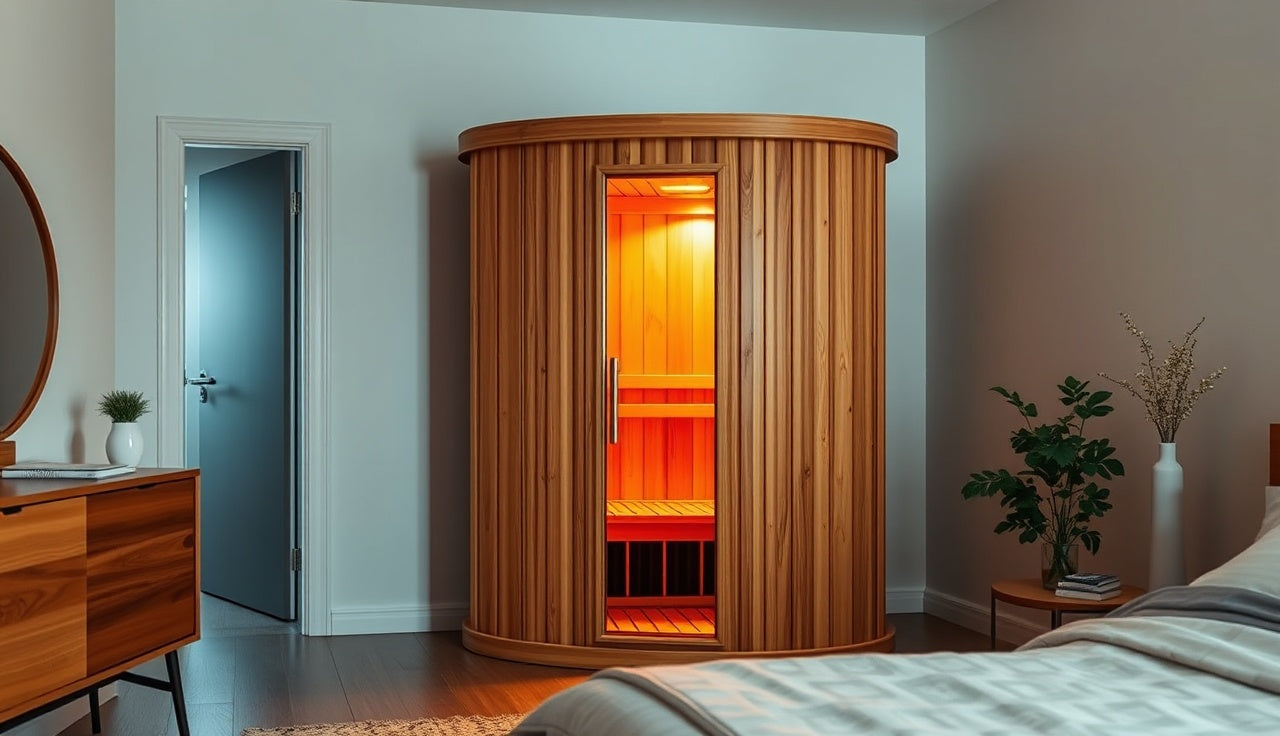
Almost anywhere you have a flat floor, the right outlet, and ceiling clearance. Infrared saunas need no plumbing, no floor drain, and no special ventilation the way steam rooms do. That makes them genuinely flexible.
Bedrooms, finished basements, and garages are the most common spots. A 1-person cabin is typically around 36" x 36" x 78" tall, so it fits in most spare rooms. A 2-person cabin runs closer to 48" x 48" or larger. Measure your doorway clearance before buying, because the sections have to get inside.
Garages work well if they're climate-controlled or at least insulated. Extreme cold makes the unit work harder and take longer to preheat. Uninsulated garages in cold climates can stress cheaper units.
Outdoor placement is possible, but you need a unit rated for outdoor use, usually with a weather-treated exterior. Most indoor consumer units are not waterproof and will fail if rain hits them. If outdoor is the goal, look at purpose-built outdoor sauna options instead.
Apartment installation is technically possible if you have the square footage and a dedicated circuit, but check your lease and building rules first. Some buildings ban high-draw electrical appliances without landlord approval.
Floor protection is a practical detail that gets overlooked. Saunas get hot on their floor panels. A rubber mat under the unit protects hardwood or tile and keeps the whole setup cleaner.
How does an infrared sauna compare to a traditional sauna?
This comes up in almost every buying conversation, so here's the direct comparison.
Temperature is the headline difference. Traditional saunas run 160 to 200°F with high humidity (from water on rocks) that makes them feel hotter. Infrared saunas stay at 120 to 150°F with low humidity. New users almost always find infrared more comfortable, especially in early sessions.
Sweat output runs higher in traditional saunas for most people, at least by subjective feel. Infrared's radiant heat produces a good sweat, but if maximizing sweat volume is the goal (some athletes care about this for pre-competition weight cuts), traditional wins.
Build and cost at home: traditional saunas need either a pre-built electric heater with a rock bed or a wood stove, proper ventilation, and in many cases a floor drain. They also take longer to preheat, typically 30 to 45 minutes against 10 to 20 minutes for infrared.
The research base skews toward traditional. The large Finnish cohort studies that show cardiovascular mortality associations used traditional Finnish saunas, not infrared [2]. Infrared has its own smaller body of evidence. Neither is 'proven' in a clinical sense. Both have plausible mechanisms.
For a fuller breakdown, see the sauna vs steam room comparison, which also covers humidity differences in more depth.
My take: if you're comparing a budget traditional sauna against a same-price infrared unit, infrared usually wins for home use, thanks to easier installation, faster heat-up, and lower ambient temperature. But a quality traditional sauna gives an experience infrared doesn't fully replicate.
How long should you stay in a home infrared sauna per session?
Start at 10 to 15 minutes and work up to 20 to 40 minutes as you acclimate. That's what most manufacturers and practitioners suggest. The ceiling in virtually every clinical protocol is 45 minutes per session.
The Finnish cardiovascular cohort data tied benefits to sessions of roughly 15 to 20 minutes, two to three times per week [2]. That's a reasonable target for someone buying a home unit for general wellness.
Preheat the cabin fully before you get in. Most units need 10 to 20 minutes to reach working temperature. Climbing in early because the box feels 'warm enough' just wastes your first 10 minutes at too low a temp.
Hydrate before, during if sessions run long, and after. Sauna use is a real sweat stimulus. A reasonable guideline is 16 to 24 oz of water around each session. Anyone with a medical condition that affects fluid balance should clear sauna use with a doctor first.
For contrast therapy, a common protocol is sauna session, cold exposure, rest. The cold plunge temperature and duration follow separate guidelines, but many people find the hot-to-cold transition is where the experience pays off most. See cold plunge benefits for detail on the cold side.
Skip alcohol before or during sauna sessions. This is not a minor caution. Heat-induced vasodilation plus alcohol's cardiovascular effects raises accident and arrhythmia risk. The Finnish beer-in-the-sauna image doesn't hold up medically.
Are home infrared saunas safe? Who should be careful?
For most healthy adults, infrared sauna use at recommended temperatures and durations is safe. The adverse event profile in the clinical literature is thin. The main documented risks are dehydration, orthostatic hypotension on standing (lightheadedness), and, rarely, heat-related illness from staying in too long.
Some groups should be careful or get medical clearance first.
People with cardiovascular disease. Heat raises heart rate and dilates blood vessels. Most guidelines, including those from the American Heart Association, describe regular sauna use as generally safe for clinically stable heart patients but not for those with unstable angina or poorly controlled hypertension [7]. Individual medical guidance matters here.
Pregnant women. There's no good human data on infrared sauna during pregnancy. Given the known risks of core temperature elevation in early pregnancy and hyperthermia from any cause, the conservative call is to avoid it [8]. The FDA cautions pregnant women against hot tub use for the same reason.
People on medications that affect sweating or cardiovascular response: anticholinergics, beta blockers, diuretics, some antipsychotics. Any of these can change how your body handles heat stress.
Children. Kids thermoregulate less efficiently than adults and should not use adult-temperature settings.
If you have an implanted medical device (pacemaker, cochlear implant, metal orthopedic hardware), check with your cardiologist or surgeon. Most modern implants aren't affected by the EMF or temperatures in infrared saunas, but 'most' is not 'all.'
What are the best infrared sauna brands for home use?
Naming specific models is tricky. Product lines change faster than articles get updated, and I won't recommend a unit I can't verify is currently sold with current specs. What I can do is give you the brand-tier landscape honestly.
At the premium end, Clearlight (now owned by Health Mate), Sunlighten, and High Tech Health have been in the market longest, publish EMF test data, use quality wood, and back their panels with long warranties. Expect $3,500 to $10,000 for their core lineup.
The mid-range is dominated by Radiant Health, Dynamic Saunas, and Finnleo's infrared line, typically $1,500 to $4,000. Build quality varies more at this tier, so reading third-party owner reviews over at least 12 months beats any single comparison article.
Budget brands flood Amazon and warehouse club sites. Some are perfectly fine. Some have UL compliance issues or panel failures inside two years. Checking Costco-sold saunas is a reasonable shortcut, because their vetting and return policy filter out some of the worst options. See the costco sauna breakdown for what they currently stock.
SweatDecks carries a vetted selection of home infrared cabins and publishes panel EMF test results for every unit it sells, which speeds up comparison shopping if you'd rather skip the manufacturer's own marketing. Worth a look if you're cross-referencing options.
Wherever you buy, cross-reference the unit's ETL or UL listing on the certification body's own database before you pay. That's free and takes two minutes.
Can an infrared sauna help with recovery and athletic performance?
The recovery case is real but sometimes oversold. Here's what the evidence shows.
Post-exercise heat raises blood flow to fatigued muscle and may speed clearance of metabolic byproducts. A 2015 study in the Journal of Science and Medicine in Sport found far-infrared sauna use after exercise cut delayed-onset muscle soreness scores against control at 72 hours, though the effect size was moderate and the sample small [9].
There's a heat acclimation angle too. Repeated heat exposure, even at infrared sauna temperatures, can trigger adaptations including increased plasma volume and better cardiovascular efficiency under heat load. These adaptations are well documented in exercise physiology [10], and some athletes use infrared sauna specifically to get heat-acclimation benefits without training in hot environments.
Contrast therapy, alternating sauna heat and cold water immersion, has caught on in endurance and strength sports. The theory is that thermal cycling speeds parasympathetic recovery. The evidence is mixed. Some studies show benefit for soreness; others show cold exposure blunts post-strength-training hypertrophy if done too close to the session [11]. Timing and temperature matter more than the average marketing copy admits.
For general home recovery, pairing an infrared sauna with a cold plunge or ice bath is a legitimate protocol with some evidence behind it. Just stay realistic about the size of the effect.
How do you maintain a home infrared sauna?
Maintenance is genuinely low against other home wellness gear. No water chemistry, no filter changes, no plumbing.
The main task is wiping down the interior after sessions. Sweat is mildly corrosive to unfinished wood over time. A dry or slightly damp cloth after each use keeps the interior clean and prevents bacterial buildup. Skip chemical cleaners, which can off-gas the next time the wood heats up.
Sand the bench periodically, every few months for heavy users, to remove sweat stain buildup and keep the surface fresh. Fine-grit sandpaper (120 to 180 grit) followed by a dry cloth does it.
Inspect the panels once or twice a year for discoloration or dimming of the emitters. Carbon panels last 10 to 15 years under normal use. Ceramic rods have a similar lifespan but can crack from mechanical shock (slamming the door, for example).
Ventilate after sessions. Leave the door open 20 to 30 minutes to let moisture and residual heat escape. This prevents mildew, especially if the unit lives in a basement or a room with limited airflow.
Check electrical connections annually. Make sure the power cord isn't pinched or abraded. If anything looks worn, have an electrician look before the next use.
Is an at-home infrared sauna worth it financially?
Let's do the math instead of hand-waving it.
A quality 1-person cabin at $2,500 plus $300 for an electrician to run a dedicated circuit is $2,800 upfront. Run it 30 minutes a day, five days a week, at roughly 1.5 kWh per session (typical for a mid-range 1-person unit) and the 2024 national average rate of about $0.17/kWh [12], and you're paying around $0.26 per session, about $67 a year in electricity.
A commercial infrared sauna at a spa typically runs $35 to $60 per session. Use your home unit twice a week and that's 100+ sessions a year. At $40 per avoided session, you save $4,000 a year, which pushes the payback under a year and keeps the savings coming.
Most people don't use their home sauna 100 times a year, though. Honest usage patterns for home wellness equipment sit at 1 to 3 sessions per week for committed users, with a chunk of buyers going less often than they planned. At 60 sessions a year and $40 avoided each, that's $2,400 in avoided costs. Still solid math at that rate.
If your real question is 'will I actually use it?' the answer is: put it somewhere convenient. Saunas that make you trek to the garage in winter get used less. Saunas in a spare room off the bedroom get used more. Location drives usage far more than the spec sheet.
For a broader financial and practical look at home sauna options, the home sauna guide covers the full decision tree.
Frequently asked questions
What is the best temperature for a home infrared sauna?
Most users find 120 to 140°F comfortable and effective. Clinical protocols in far-infrared research typically set temperature at 140°F (60°C). Starting lower, around 110°F, makes sense for new users. Going above 150°F in an infrared sauna offers no documented added benefit and just increases discomfort. The infrared dose matters more than hitting a specific air temperature, because the panels heat tissue directly.
How long does it take a home infrared sauna to heat up?
Most 1-person infrared cabins reach working temperature in 10 to 20 minutes. Larger or full-spectrum units may take 20 to 30 minutes. That's much faster than traditional saunas, which need 30 to 45 minutes. Cold ambient conditions (an uninsulated garage in winter) add 5 to 10 minutes. Always let the unit fully preheat before you start your session timer.
Do infrared saunas use a lot of electricity?
A 1-person infrared sauna draws roughly 1.0 to 1.5 kWh per 30-minute session. At the 2024 national average rate of about $0.17/kWh, that's around $0.17 to $0.26 per session. A 2-person unit drawing 2.0 kWh runs about $0.34 per session. At three sessions a week, expect $25 to $55 a year in electricity, well below commercial spa fees.
Can I put an infrared sauna in a bedroom?
Yes. Infrared saunas need no plumbing, no floor drain, and no special ventilation. A 1-person cabin, typically 36 inches square, fits in most bedrooms with a standard 120V outlet or a dedicated 15-amp circuit. Measure your door clearance before ordering; flat-pack sections still have to fit through doorways. Leave the sauna door open after sessions to air out the room.
What is the difference between near, mid, and far infrared sauna?
Near-infrared (700 to 1400 nm) penetrates 1 to 2 mm and is the shallowest. Mid-infrared (1400 nm to 3 µm) reaches deeper into soft tissue. Far-infrared (3 to 100 µm) is absorbed mainly at the skin surface and drives the sweating and core heating effect. Most infrared sauna research uses far-infrared units. Full-spectrum saunas combine all three but cost more, and the added benefit over far-only isn't clearly established.
Are infrared saunas safe to use every day?
Daily use at 20 to 30 minutes per session appears safe for healthy adults based on current evidence. No published data shows harm from daily infrared sauna at normal temperatures in healthy people. That said, most clinical protocols use two to four sessions per week, and rest days let your body recover from heat stress. Daily use is fine as long as you stay hydrated and feel well between sessions.
Can an infrared sauna help with weight loss?
Not in any meaningful direct way. The calorie burn during a 30-minute session is modest, roughly the same as light walking, and most of the weight lost right after is water that returns when you rehydrate. There's no credible published evidence that infrared sauna use drives fat loss independent of diet and exercise. Claims about 'burning 600 calories per session' aren't supported by controlled research.
What wood is best for a home infrared sauna?
Western red cedar is the traditional choice: naturally antimicrobial, moisture-resistant, and aromatic. Hemlock is lighter in color, cheaper, and odor-neutral, which some people prefer. Basswood is the least allergenic option, good for people sensitive to cedar's oils. Avoid saunas with plywood panels, MDF, or treated wood. Whatever the species, confirm there are no glues or chemical finishes that off-gas when heated.
How do I know if an infrared sauna has low EMF?
Ask for a third-party EMF test report showing measurements taken at body distance from the panel, not a 'low EMF' badge. The commonly cited threshold is below 3 milligauss at 6 inches from the panel surface. Reputable brands like Clearlight, Sunlighten, and High Tech Health publish these reports. If a retailer can't provide actual test data, treat the low-EMF claim as unverified.
Do home infrared saunas require a special electrical outlet?
One-person units typically run on a standard 120V 15-amp outlet, so no electrical work is needed if you have a compatible outlet nearby. Two-person and larger units usually need a dedicated 240V 20 to 30 amp circuit, which requires a licensed electrician and costs $200 to $600 depending on panel distance and local rates. Verify the unit's electrical requirements before purchase and have the circuit installed before delivery.
How is an infrared sauna different from a steam room?
Infrared saunas use dry radiant heat at 120 to 150°F with very low humidity. Steam rooms use wet heat at 100 to 115°F with near-100% humidity. The experience is completely different: infrared feels like sitting in warm sunlight; steam feels like a hot fog. Neither wins in every case. People with respiratory conditions sometimes prefer steam. People who find high humidity claustrophobic prefer infrared. See the sauna vs steam room comparison for more detail.
What size infrared sauna do I need for a home?
A 1-person cabin, about 36 by 36 inches, is enough if you'll use it solo most of the time. A 2-person cabin (48 by 48 inches or larger) gives more room to stretch and suits couples or anyone who wants to lie down. Larger is better for the experience but harder to place and pricier to run. Measure the room and doorways before ordering any cabin-style unit.
Sources
- National Institutes of Health, National Library of Medicine: 'Infrared and Skin: Friend or Foe' (Darvin et al., Journal of Biophotonics, 2010): Infrared wavelength ranges and tissue penetration depths: near-IR 700-1400 nm (~1-2 mm), mid-IR 1400 nm to 3 µm, far-IR 3-100 µm absorbed primarily at skin surface
- Mayo Clinic Proceedings: 'Cardiovascular and Other Health Benefits of Sauna Bathing' (Laukkanen et al., 2018): Regular sauna bathing is associated with reduced cardiovascular mortality; most data from traditional Finnish saunas; sessions of ~15-20 minutes 2-3x/week associated with benefit
- Journal of the American College of Cardiology: far-infrared sauna and flow-mediated dilation in coronary risk patients (Imamura et al., 2015): Far-infrared sauna sessions improved flow-mediated dilation (a marker of arterial flexibility) in patients with coronary risk factors
- National Institutes of Health, National Library of Medicine: sleep and body temperature regulation review (Harding et al., Current Biology, 2019): Core temperature drop following heat exposure is linked to sleep onset; mechanism is separate from sauna context but explains post-sauna sleepiness
- U.S. Department of Energy, Energy Saver: home electrical system upgrades and circuit installation cost guidance: Dedicated 240V 20-30 amp circuit installation costs vary by panel distance and local rates, typically $200-$600
- World Health Organization: 'Electromagnetic Fields and Public Health: Extremely Low Frequency Fields' fact sheet: Commonly referenced EMF exposure guideline context; 3 milligauss cited as a low-exposure threshold in consumer wellness product marketing
- American Heart Association: heat and cardiovascular safety guidance (Circulation, Lavie et al. commentary, 2018): Regular sauna use generally safe for clinically stable heart patients; caution for unstable angina or poorly controlled hypertension
- U.S. Food and Drug Administration: 'Hot Tubs and Pregnancy' safety guidance: FDA cautions pregnant women against hot tub use due to core temperature elevation risk; same mechanism applies to sauna heat exposure in pregnancy
- Journal of Science and Medicine in Sport: far-infrared sauna and DOMS post-exercise (Mero et al., 2015): Far-infrared sauna use post-exercise reduced delayed-onset muscle soreness scores vs control at 72 hours; moderate effect size, small sample
- Journal of Applied Physiology: heat acclimation, plasma volume expansion, and cardiovascular adaptation (Lorenzo et al., 2010): Repeated heat exposure triggers heat acclimation adaptations including increased plasma volume and improved cardiovascular efficiency under heat load
- Journal of Physiology: cold water immersion after resistance exercise blunts long-term hypertrophy and strength gains (Roberts et al., 2015): Cold exposure too close to strength training sessions may blunt post-exercise hypertrophy; timing matters in contrast therapy protocols
- U.S. Energy Information Administration: Average Retail Price of Electricity, 2024: National average U.S. residential electricity rate approximately $0.17/kWh as of 2024

Share:
How long should you sit in an ice bath? The honest answer
Blue Cube ice bath: full review and buyer's guide