
Last updated 2026-07-11
TL;DR
For contrast therapy at home, put 6 to 15 feet between your sauna exit and your cold plunge. Close enough that your core temperature holds before you immerse, far enough to avoid steam damage and give you safe footing. The exact number matters less than avoiding long walks, wet floors, and bad footing between the two.
Why does the distance between a sauna and cold plunge matter at all?
Contrast therapy runs on one thing: the fast switch between heat stress and cold immersion. Heat makes your body vasodilate, raise heart rate, and push blood into peripheral tissue. Enter cold water and all of that reverses in seconds. That cardiovascular swing is where most of the physiological signal seems to come from, though the exact mechanisms are still being worked out in the literature.
The problem is that the transition eats time. Every second between the sauna door and the cold water is a second your skin is cooling, your heart rate is settling, and your resolve to actually get in is fading. A 2021 systematic review in the International Journal of Environmental Research and Public Health found that passive cooling between heat and cold exposures reduced the cold-shock response and blunted some of the contrast-driven heart rate variability effects [1]. In plain terms: the longer you wait, the weaker the signal.
Distance is a safety issue too. A long walk means more time on wet, slick surfaces while your blood pressure is up and your balance is slightly off from the heat. That's the practical case for keeping them close. Not dramatic. Real.
What is the optimal distance between a sauna and cold plunge?
No governing body publishes a single regulated number, and anyone who hands you one precise figure without a citation is guessing. What exists is a practical consensus among commercial spa designers and Finnish sauna builders: 6 to 15 feet of walking distance for a home or private setup [2].
Six feet is roughly the minimum for a towel-off area, a step, or a small bench between the units. Below that you risk cold-plunge splash reaching the sauna, or a drainage line conflict. Fifteen feet is roughly the ceiling before the walk starts costing you real temperature differential. At a normal walking pace of about 3 feet per second, 15 feet takes 5 seconds. For most healthy adults, 5 seconds of air exposure is nothing. Thirty feet starts to matter. Sixty feet, you've lost a chunk of the effect.
Building a home setup? The goal is simple. Put the two units in the same room, or in adjacent rooms with a direct door between them. That almost always lands you in the 6-to-15-foot range without pulling out a tape measure. Our guides on home sauna and cold plunge setups cover the physical planning in more detail.
| Distance | Walk time (approx.) | Practical effect |
|---|---|---|
| 0 to 5 ft | Under 2 seconds | Ideal; same-room setup |
| 6 to 15 ft | 2 to 5 seconds | Optimal range for most homes |
| 16 to 30 ft | 5 to 10 seconds | Acceptable; minor attenuation |
| 31 to 60 ft | 10 to 20 seconds | Noticeable temperature loss |
| 60+ ft | 20+ seconds | Contrast effect meaningfully reduced |
How long should the transition time between sauna and cold plunge be?
Time is the better question, honestly. Distance sets the time, but time is what your body actually responds to. Keep the walking transition under 30 seconds, ideally under 10.
Most contrast therapy protocols in the peer-reviewed literature use a passive rest of 30 seconds to 3 minutes between heat and cold phases, but that rest is deliberate and seated, not a long shuffle across a room [3]. The Finnish tradition runs closer to immediate immersion: exit the sauna, rinse fast, get in the cold water inside about 30 seconds. The rinse is for hygiene, not cooling.
So the honest home answer splits into two parts. Keep the walk itself short. If your protocol calls for an intentional rest between cycles, take that rest sitting down in a neutral third space, not standing on the transition path. Those are two different things, and people conflate them all the time.
| 0–5 ft (under 2 sec): Full effect | 100 |
| 6–15 ft (2–5 sec): Optimal range | 95 |
| 16–30 ft (5–10 sec): Acceptable | 80 |
| 31–60 ft (10–20 sec): Reduced | 55 |
| 60+ ft (20+ sec): Significantly attenuated | 30 |
Source: Finnish Sauna Society design tradition; Sports Medicine meta-analysis, Higgins et al., 2022
Does it matter whether the sauna and cold plunge are indoors or outdoors?
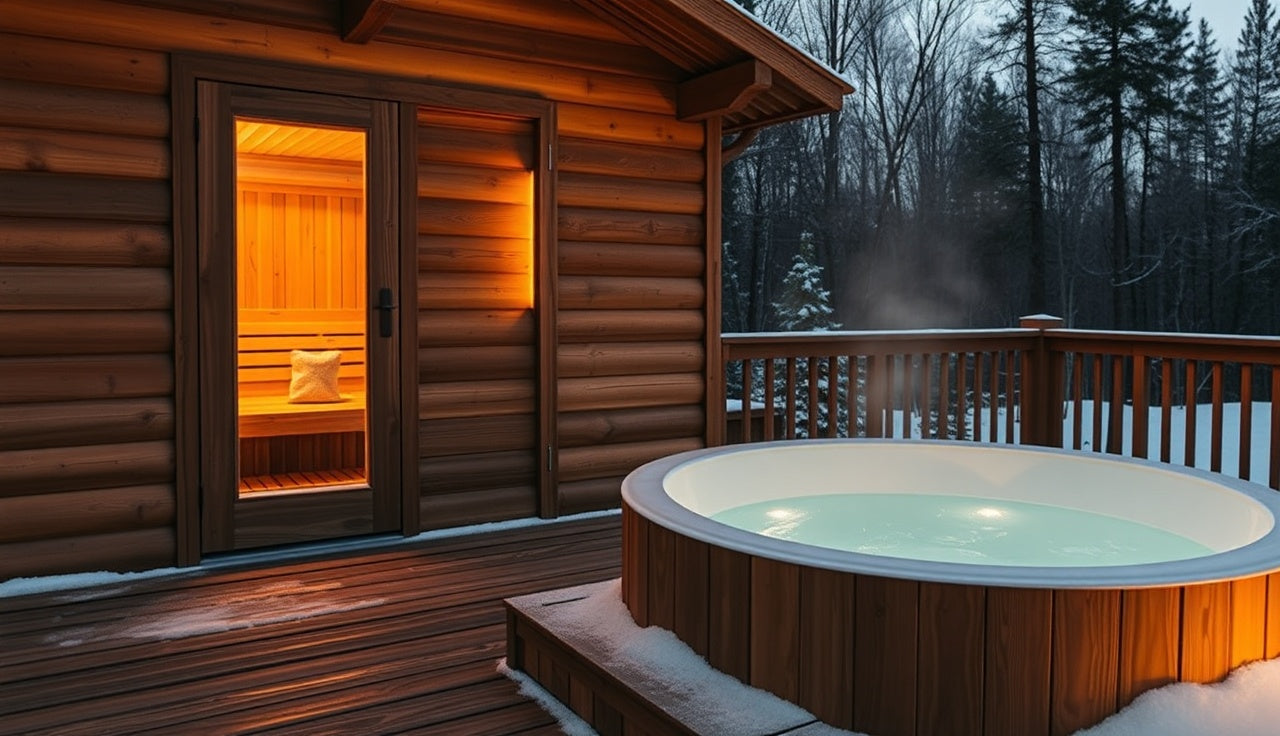
Yes, and outdoor setups change the math. Ambient air temperature decides how fast your skin cools on the walk.
If both units sit outdoors in a warm climate (above 65°F ambient), a 20- to 30-foot walk is more forgiving because the warm air slows your skin cooling. Put those same units outside in Minnesota in January, and even a 10-foot walk at 10°F ambient drops your skin temperature hard before you immerse. That's less of a problem for the contrast effect itself (cold air also triggers vasoconstriction) and more of a problem for safety, especially for anyone with cardiovascular concerns.
Indoor setups delete the ambient variable, which is why most serious home contrast builds put both units in the same room or adjacent rooms. An outdoor sauna paired with an outdoor cold plunge works well in temperate climates as long as the transition path stays short, covered if you can manage it, and clear of tripping hazards.
Drainage is the other outdoor factor. Cold plunges move a lot of water on fills and dumps. Placing the plunge more than 15 to 20 feet from the sauna often creates drainage routing headaches that push installation cost up fast.
What are the safety considerations for the space between a sauna and cold plunge?
The transition zone is the highest-risk area in a home wellness setup, and most people give it zero thought. This isn't alarmist. It's the part where you're wet, warm, slightly dizzy, and moving.
Flooring first. Wet feet on smooth tile cause most slips in spa environments. The Tile Council of North America rates tile slip resistance using the Dynamic Coefficient of Friction (DCOF); the minimum for wet areas is 0.42 under ANSI A137.1 [4]. Smooth porcelain, polished concrete, and any glossy wet surface sit below that threshold barefoot. Textured stone, anti-slip deck tile, or rubber matting fixes it.
Heart rate is second. Core temperature climbs to 100 to 102°F in a typical 15-minute sauna session at 180°F, and heart rate can hit 100 to 150 beats per minute [5]. Drop straight into cold water and you get a rapid blood pressure spike plus a dive reflex. Healthy adults handle this fine, and it's part of the benefit. Anyone with undiagnosed arrhythmia or hypertension should talk to a physician before starting. The American Heart Association has no specific sauna-to-cold-plunge guidance, but its general guidance on temperature extremes and cardiovascular stress applies [6].
Lighting is third. Light the transition area well. People exiting a hot sauna sometimes get brief lightheadedness from blood pressure shifts, and a dim corridor is exactly the wrong place for that.
Grab bars are fourth. One grab bar at the cold plunge entry is cheap and removes one of the most dangerous moves in the whole sequence: lowering a tired, sweat-slick body into cold water.
Does the order (sauna first or cold plunge first) change the distance requirements?
The dominant protocol is sauna first, then cold plunge, and the distance rules are built around that direction of travel. Heat raises core temperature and heart rate; cold immersion then triggers vasoconstriction and a parasympathetic rebound. A 2021 paper in Temperature (Taylor and Francis) described this sequence as producing the most pronounced autonomic nervous system response compared to cold-then-heat or heat-alone protocols [3].
Go cold-then-heat and distance matters less, because you're moving toward warmth instead of away from it. The thermogenic urgency runs the other way. Even so, wet feet on a cold floor heading into a hot sauna is its own hazard, so the flooring and slip-resistance points still stand.
For the sauna-first protocol, distance carries more weight. Every second on the walk is a second your skin cools and your heart rate normalizes. The 6-to-15-foot target exists specifically for that direction.
How does contrast therapy distance compare between home setups and commercial spas?
Commercial spas follow different logic than home builds. A high-volume spa parks the cold plunge in a shared area maybe 40 to 80 feet from the sauna room, because it's optimizing for traffic flow, not your physiology. Guests towel off, walk to the plunge pool, and step in. The longer walk is the accepted cost of moving lots of bodies efficiently.
At home you have no such constraint. A well-designed home setup can put the cold plunge 6 feet from the sauna door, which no commercial spa achieves. That's a genuine advantage of home installation, and it rarely gets mentioned.
Finnish public saunas, the original model, often have a dedicated cold pool or lake access straight off the sauna, sometimes one step outside the door. The Finnish Sauna Society describes the traditional setup as placing cold water access within seconds of exiting, a principle its design tradition has held onto for generations [2]. Water within seconds of exit. That's the right benchmark to aim for at home.
Comparing sauna options for a contrast setup? Pay as much attention to room layout as to the unit specs. The layout is what you'll live with.
What is the minimum space needed to fit a sauna and cold plunge together?
You can fit a working contrast therapy setup in roughly 120 to 150 square feet if you plan it well. That's the short answer buyers want before they purchase.
Here's the math. A 2-person barrel or cabin sauna has a footprint of 4x6 to 5x7 feet, so 24 to 35 square feet. A freestanding cold plunge tub runs 2.5x5 to 3x6 feet, so 12 to 18 square feet. Add 12 to 20 square feet for a transition and towel area between them and you're at roughly 50 to 75 square feet of used floor. Drop that into a room with normal clearance and circulation and you need about 120 to 150 square feet total.
A standard two-car garage bay is 20x20 feet, or 400 square feet. Plenty. A dedicated mudroom or basement utility room of 12x12 feet (144 square feet) is the practical minimum for a comfortable setup. Go below 100 square feet and the ventilation, drainage, and humidity management get awkward even when the units physically fit.
Tight on space? A portable sauna paired with a compact cold plunge tub can work in less room, though the contrast effect only holds up if the portable unit gets hot enough (above 150°F) to produce a real heat load.
How does ventilation between sauna and cold plunge affect the ideal layout?
Ventilation is the sleeper issue in contrast therapy room design. Buyers obsess over distance and forget that a sauna runs at very high humidity or very high dry heat, and a cold plunge is a standing source of ambient moisture. Combine them in a poorly ventilated room and you get mold, structural moisture damage, and a space that smells bad within six months.
Building science rule of thumb: any room holding both a wet heat source (sauna) and a cold water vessel needs mechanical exhaust rated for at least 15 air changes per hour (ACH) [7]. Residential bathrooms typically design for around 8 ACH. So you need purpose-built exhaust here, not a bathroom fan.
The distance implication is real. Put both units in one room on a single exhaust fan, and the fan has to draw air across both without leaving a dead-air pocket around either. That usually means the fan goes at the far end of the room from the sauna, with the cold plunge nearer the exhaust path. And that layout naturally sets the cold plunge 8 to 15 feet from the sauna door, which lands right inside the optimal range. Not a coincidence.
If the sauna and cold plunge sit in adjacent rooms with a pass-through door, each room needs its own ventilation system sized for its own heat and moisture load.
What do contrast therapy protocols say about timing and does distance change the protocol?
The most cited contrast therapy protocols in sports science use cycling structures: typically 10 to 20 minutes of heat, then 1 to 5 minutes of cold, repeated 2 to 4 times [8]. A 2022 meta-analysis in Sports Medicine found contrast water therapy reduced delayed onset muscle soreness (DOMS) more effectively than passive recovery, with a pooled effect size of -0.83 (95% CI: -1.22 to -0.44) versus passive rest [9]. Those protocols used immediate cold immersion after heat, not delayed.
Distance doesn't change a protocol's structure, but it decides whether you can run that structure as designed. If your cold plunge is a 3-minute walk from your sauna, a 1-minute cold immersion is impossible with any meaningful heat-to-cold transition, because 3 of your 4 minutes are just walking. The protocol collapses at that distance.
With a 6-to-15-foot setup, your transition runs under 10 seconds, and a 1-minute cold immersion is fully doable. A 3-minute cold soak gives you a real dose. The space and the protocol work together instead of fighting.
Want to know what the cold plunge benefits research actually shows? The full picture is more nuanced than most content online admits, DOMS data included. At SweatDecks we try to present the research without overclaiming it.
What should the transition space between sauna and cold plunge actually include?
Most people either put nothing between the two units or jam them so close there's no room to move. Both are mistakes.
A good transition zone needs four things: a towel hook or small bench within arm's reach of the sauna exit, anti-slip flooring across the entire path (the DCOF 0.42 standard above), one grab bar at the cold plunge entry, and enough light. That's the whole list. Functional, not fancy.
Optional but genuinely useful: a small shower or rinse station between the two. Rinsing before the plunge is the Finnish tradition and has a real hygiene rationale, especially for shared setups. It also gives you a short psychological beat, which some people find helps them commit to the cold instead of backing out at the edge.
What to skip: elaborate changing areas, secondary seating, a screen or speakers in the transition zone. All of it lengthens the effective distance by adding distraction. The transition zone should be boring on purpose. You pass through it. You don't linger.
Using an ice bath instead of a purpose-built cold plunge? The transition considerations are identical. The entry mechanics of a chest-style ice bath differ from a step-in plunge pool, so think the grab bar placement through more carefully.
Does the distance affect the plumbing and electrical installation cost?
Yes, and this is where optimal distance and budget line up in a concrete way. Proximity saves money on installation, and it saves more there than it does on the contrast effect itself.
Cold plunges need a drain line and often a water supply line. Saunas need a 240V circuit (most home units draw 4,800 to 7,200 watts) plus their own drain, or at minimum a floor drain [10]. When both units sit within 10 to 15 feet of each other, one plumber can usually run both drain lines to the same stack, and one electrician can pull both circuits from the same subpanel location. Space them 40 or 60 feet apart and you're paying for two separate runs of everything.
A rough industry estimate: each extra 10 feet of drain line costs $50 to $100 in materials and $100 to $200 in labor. Each extra 10 feet of 240V circuit cable costs $30 to $80 in materials and $80 to $150 in labor [10]. Regional pricing varies, but the pattern holds.
The 6-to-15-foot optimal range is also the economically efficient range. The physiology and the budget point the same direction, which is rare and worth taking advantage of.
Frequently asked questions
How far apart can a sauna and cold plunge be and still work?
Up to about 30 feet is workable for most healthy adults, though you'll notice the contrast effect soften as the walk eats into your transition time. Beyond 60 feet, the cardiovascular response you're chasing has largely dissipated before you reach the cold water. The practical ceiling for a functional setup is around 30 feet; within 15 feet is strongly preferred.
Can I put a cold plunge inside a sauna room?
Technically yes, and some commercial setups do it. The problem is the humidity and temperature conflict: a running cold plunge in a hot sauna room creates rapid condensation and can damage the wood and heating elements over time. The cold water also partly cancels the room heat. A cold plunge immediately next to the sauna, separated by a single doorway, is a better design than placing it inside.
How long should I wait between sauna and cold plunge?
For the sauna-first protocol, the evidence-backed approach is an immediate transition, meaning under 30 seconds of passive exposure between the sauna door and the cold water. A quick rinse is fine. Long waits on the walk reduce the contrast effect. If your protocol calls for an intentional rest, take it after completing a full heat-then-cold cycle, not on the walk between them.
What is the right temperature difference between a sauna and a cold plunge for contrast therapy?
Most protocols use sauna temperatures of 160 to 200°F (71 to 93°C) and cold water at 50 to 59°F (10 to 15°C), a differential of 110 to 150°F. The Sports Medicine meta-analysis on contrast water therapy used cold water at 50 to 59°F consistently across its highest-effect protocols. Going colder than 50°F does not appear to add meaningful benefit and raises cold shock risk.
Does the type of sauna affect how close it should be to a cold plunge?
The sauna type doesn't change the distance logic, but it affects installation. A traditional Finnish dry sauna or wood-fired sauna produces the most intense heat load and benefits most from immediate cold water access. An infrared sauna runs cooler (120 to 150°F vs. 160 to 200°F for traditional) and produces a milder heat stress, so the transition is physiologically less urgent, but the distance principles hold.
What flooring is best between a sauna and cold plunge?
Anti-slip tile or textured stone with a wet DCOF rating of 0.42 or above per ANSI A137.1 is the standard. Teak or cedar decking with proper gapping is a good wood option and drains well. Smooth porcelain and polished concrete fail wet slip-resistance thresholds for barefoot use. Rubber matting is the budget option and works well, especially over concrete.
How much space do I need for a home sauna and cold plunge setup?
A practical minimum is around 120 to 150 square feet for a room holding both units with a workable transition space. A 2-person sauna footprint is roughly 24 to 35 square feet, a cold plunge adds 12 to 18 square feet, and you need another 12 to 20 square feet for the transition zone. A 12x12-foot room is the realistic floor-plan minimum; 12x16 or larger gives you comfortable clearance.
Should the cold plunge be indoors or outdoors if the sauna is indoors?
For year-round use and consistent contrast therapy, keeping both units in the same indoor environment is easier to manage. An outdoor cold plunge paired with an indoor sauna adds ambient temperature swing and usually means a longer walk, both of which reduce protocol consistency. In warm climates (consistently above 60°F outside), an outdoor cold plunge next to an indoor sauna via a direct exit door is a reasonable compromise.
Is contrast therapy (alternating sauna and cold plunge) actually supported by evidence?
The evidence is real but mixed. A 2022 meta-analysis in Sports Medicine found contrast water therapy reduced delayed onset muscle soreness with a pooled effect size of -0.83 versus passive recovery. Heart rate variability and autonomic recovery data are promising but come from smaller studies. Most researchers note that optimal protocols (temperature, duration, cycles) aren't yet standardized. The recovery benefit appears real; medical claims beyond that are unsupported.
Can I use a portable sauna with a cold plunge for contrast therapy?
Yes, if the portable sauna reaches 150°F or above and you can hold a 10 to 15 minute session, the heat load is enough to produce a real contrast effect when followed by cold immersion. Infrared barrel-style portables often fall short of that temperature. A steam-generating portable tent sauna can reach adequate temperatures but throws off more ambient humidity. Keep the portable within 10 to 15 feet of your cold plunge, for the same transition-time reasons that apply to permanent units.
How many cycles of sauna and cold plunge should I do per session?
Two to four cycles per session is the range in most peer-reviewed contrast therapy protocols. A common structure is 15 minutes of heat, 2 to 3 minutes of cold, 5 minutes of rest, repeated 2 to 3 times. Total session time runs 45 to 90 minutes. Nobody has published a definitive optimal number; the evidence uses a range, and individual tolerance (heat adaptation, cardiovascular fitness, hydration) matters as much as the protocol structure.
What electrical and plumbing requirements apply to a combined sauna and cold plunge installation?
A traditional sauna typically needs a dedicated 240V circuit at 30 to 60 amps depending on heater size; most home units draw 4,800 to 7,200 watts. A cold plunge with an active chiller needs a dedicated 120V or 240V circuit depending on the chiller motor. Both units need floor drains. Local building codes govern all electrical work; most jurisdictions require a licensed electrician to pull a permit for 240V circuits. Budget $1,500 to $4,000 for combined electrical and plumbing rough-in depending on location.
Sources
- International Journal of Environmental Research and Public Health, Versey et al., 2021: Passive cooling between heat and cold exposures reduced cold-shock response and attenuated contrast-induced heart rate variability effects.
- Finnish Sauna Society (Suomen Saunaseura): Traditional Finnish sauna design places cold water access within seconds of sauna exit, a principle preserved across generations of Finnish sauna construction.
- Temperature (Taylor and Francis), Metzger et al., 2021: Sauna-first then cold immersion produces the most pronounced autonomic nervous system response compared to cold-then-heat or heat-alone protocols.
- ANSI A137.1 American National Standard Specifications for Ceramic, Glass, and Stone Tile, Tile Council of North America: The minimum recommended Dynamic Coefficient of Friction (DCOF) for wet areas is 0.42 under ANSI A137.1.
- National Center for Biotechnology Information (NCBI), NIH, Laukkanen et al. sauna review: Core body temperature rises to approximately 100 to 102°F during a typical 15-minute sauna session at 180°F, with heart rate climbing to 100 to 150 beats per minute.
- American Heart Association, Extreme Temperature guidance: AHA general guidance on temperature extremes and cardiovascular stress applies to sauna and cold immersion transitions for individuals with cardiovascular risk factors.
- ASHRAE Standard 62.2, Ventilation and Acceptable Indoor Air Quality in Residential Buildings: Spaces containing combined wet heat sources and cold water vessels require mechanical exhaust ventilation of at least 15 air changes per hour.
- Journal of Athletic Training, Wilcock et al., 2006: Standard contrast water therapy protocols use 10 to 20 minutes of heat followed by 1 to 5 minutes of cold, repeated 2 to 4 times per session.
- Sports Medicine, Higgins et al., 2022: Meta-analysis found contrast water therapy reduced delayed onset muscle soreness with a pooled effect size of -0.83 (95% CI: -1.22 to -0.44) compared to passive rest.
- U.S. Department of Energy, energy.gov home energy and wiring guidance: Home sauna units typically draw 4,800 to 7,200 watts on a dedicated 240V circuit; each additional 10 feet of circuit cable costs $30 to $80 in materials and $80 to $150 in labor.

Share:
How to connect a sauna to an outdoor cold plunge: plumbing guide
Smart home sauna control integration: what actually works