
Last updated 2026-07-09
TL;DR
The CS-1 is a mid-range freestanding cold plunge with a built-in chiller that holds water around 39-45°F. It's for home users who want cold therapy without hauling ice. Plan on $3,000 to $5,500 depending on configuration, plus electrical work if you don't already have a dedicated GFCI-protected 20-amp circuit near the install spot.
What is the CS-1 cold plunge tub?
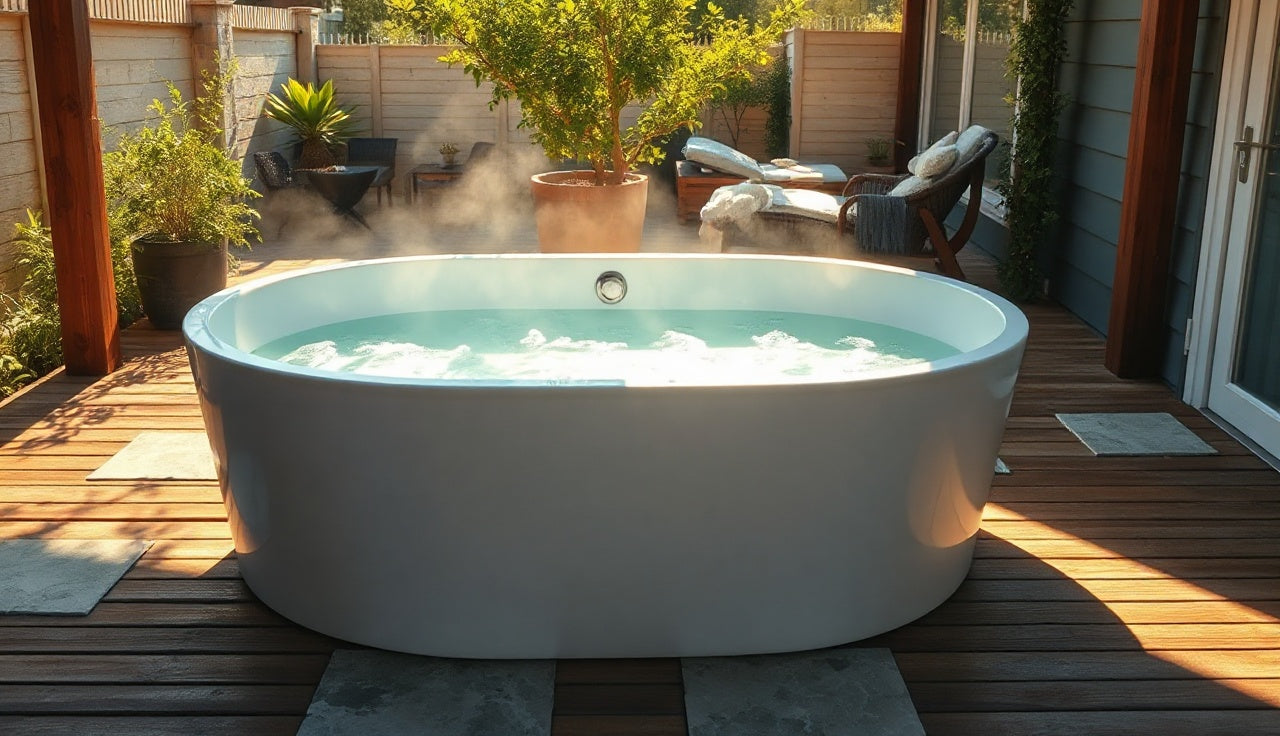
The CS-1 is a self-contained cold plunge built around a refrigeration chiller, a filtration loop, and a formed acrylic or rotomolded shell deep enough to sit in up to your shoulders. It falls into the segment people call "active-chilled," meaning you don't dump in bags of ice. You plug it in and the chiller holds the temperature for you.
That difference matters more than most buyers assume. Passive ice tubs and chest freezer conversions cost a fraction of the price upfront, but they demand work every single session and they drift in temperature over a long soak. The CS-1 holds its set point continuously. That's the whole reason people pay the premium. Fill it, set it the night before, and it's ready when you wake up.
The unit fits one person. Interior length runs roughly 60 to 65 inches, width 22 to 26 inches in the versions currently sold, which is enough for most adults to sit submerged to the shoulders with legs extended. Taller than about 6'3"? Check the exact interior length before you order. The outer shell always looks bigger than the usable basin inside.
See the full cold plunge category for where the CS-1 sits in the broader market.
What temperature does the CS-1 actually reach?
Most CS-1 spec sheets advertise a 39°F (4°C) low-end set point. In a real room at 70 to 75°F ambient, owner reports put the stable floor closer to 41 to 45°F. That gap is normal for any residential chiller. Ambient heat, sun exposure, and how often the lid stays open all pull the real water temperature up.
Here's the thing worth remembering: most cold therapy research runs at 50 to 59°F [1]. A study in the International Journal of Circumpolar Health found that immersion near 57°F produced significant sympathetic nervous system activation [2]. You don't need 39°F to feel a real physiological response. The CS-1's actual floor of 41 to 45°F lands right where most protocols aim.
Temperature consistency matters most for people plunging daily or twice daily who want to track their adaptation over weeks. A tub that swings 8 to 10 degrees between sessions makes that kind of structured tracking hard to read.
If you want the science first, our cold plunge benefits guide is worth reading before you commit to any unit.
What are the CS-1 dimensions and weight?
Specs vary by seller and model year, so treat these as ranges, not guarantees. The exterior shell typically runs 69 to 72 inches long, 30 to 34 inches wide, and 27 to 30 inches tall. The interior basin runs 60 to 65 inches long, 22 to 26 inches wide, with about 22 to 24 inches of water depth. Filled weight lands in the 600 to 900 lb range depending on water volume, which is the number that matters if you're setting it on a deck.
Deck loading deserves real attention. A filled CS-1 at 800 lbs spread over roughly 15 to 18 square feet puts serious load on any structure. Most residential decks are built for 40 to 60 lbs per square foot of live load [3]. An 800-lb tub over 15 square feet works out to about 53 lbs/sq ft, right at the top edge of standard deck capacity. Get a structural assessment before you put any large filled tub on an elevated deck.
The chiller is either integrated into the shell or bolted to the side. Integrated setups look cleaner but make servicing harder. External chiller boxes swap out more easily if the refrigeration unit dies years later. Most buyers never think about that until the compressor fails.
How much does the CS-1 cold plunge cost?
The CS-1 usually retails between $3,000 and $5,500 depending on seller, included accessories, and chiller horsepower. Promotions move that around, so confirm current pricing directly with the retailer.
Here's how active-chilled home plunges stack up by price tier:
| Tier | Example Units | Typical Price Range | Chiller Capacity |
|---|---|---|---|
| Budget | Ice barrel conversions, basic chest freezers | $200-$800 | None (passive) |
| Entry active-chilled | Various import brands | $1,200-$2,500 | 1/10-1/5 HP |
| Mid-range | CS-1 and peers | $3,000-$5,500 | 1/4-1/2 HP |
| Premium | Plunge Pro, Ice Barrel 500 | $5,000-$7,500 | 1/2+ HP |
| Commercial grade | Morozko Forge, Nordic Wave | $8,000-$17,000 | 1+ HP |
Buyers routinely underestimate the extras. A dedicated 20-amp circuit if you don't have one near the install spot runs $150 to $500 depending on distance and local electrician rates. A GFCI outlet if one isn't present is required by the National Electrical Code Article 680 for water-related equipment [4]. Add a cover or lid if it's not included, plus water treatment chemicals or a UV system to keep the water sanitary between changes.
A water change every 1 to 3 months with proper sanitization is the maintenance baseline most manufacturers suggest. Budget roughly $10 to $30 per change for water and chemicals, depending on your water rates and sanitizing method.
| Passive / DIY (chest freezer) | $500 |
| Entry active-chilled | $1,850 |
| Mid-range (CS-1 tier) | $4,250 |
| Premium (Plunge Pro tier) | $6,250 |
| Commercial-grade (Morozko Forge) | $12,500 |
Source: SweatDecks market survey and published retail pricing, 2024
How does the CS-1 filtration system work?
The CS-1 pushes water through a circulation pump and across a cartridge filter, an ozone system, or both, depending on the configuration you buy. The point is clear water and low pathogen counts between full changes. Ozone is a smart choice for cold water because chlorine loses punch at low temperatures, and ozone doesn't need you adding chemicals by hand every few days [5].
Filter cartridges usually need replacing every 3 to 6 months depending on use and how many people share the tub. The chiller coil needs no user maintenance under normal use, but clean the compressor's air filter (if it has one) and the condenser fins each season to keep efficiency up.
One thing nobody mentions: at 40°F, bacterial growth is already crawling, so filtration is less about killing pathogens and more about keeping the water clear and stopping biofilm on the shell. Cold water is a hostile place for most bacteria. Even so, drain and scrub the basin on a regular schedule, especially around jets and fittings where biofilm hides.
What electrical requirements does the CS-1 need?
The CS-1 chiller runs on a standard 120V/20A circuit in most configurations, though some higher-horsepower versions need 240V. Confirm this before you order. A 240V install you didn't budget for can add $500 to $1,500 to your project cost.
Whatever the voltage, any outlet within 10 feet of a water-containing vessel needs GFCI protection. National Electrical Code Article 680 governs this and covers all permanently installed pools, spas, and similar equipment [4]. Outdoors, you also need a weatherproof outlet cover, and the circuit should be on a dedicated breaker so the compressor's startup current doesn't trip shared loads.
Running costs are modest. A 1/4 HP chiller pulling 200 to 300 watts runs roughly 6 to 8 hours a day to hold temperature in a 65 to 70°F room. At the 2024 U.S. average residential rate of $0.16/kWh [6], that's about $0.19 to $0.38 a day, or $5 to $12 a month. Outdoor summer use runs higher because the chiller fights ambient heat.
How does the CS-1 compare to alternatives like the Plunge and Ice Barrel?
The honest comparison comes down to shell quality, chiller reliability, and support, because the core job (hold cold water) is the same across mid-range units.
The Plunge (by Plunge, once called "The Cold Plunge") sits at a similar price, around $4,990 as of 2024, and is one of the best-documented units for user feedback. It uses a 1/3 HP chiller and cools to 39°F. Its support reputation is generally strong.
Ice Barrel makes rotomolded polyethylene barrels you sit upright in rather than lie down. They cost less and they're passive, no chiller.
Morozko Forge lives at the top, $8,000 to $17,000, with commercial-grade filtration and a much stronger chiller. Overkill for most home users.
The CS-1 sits between. Where it wins: the price often undercuts the Plunge for similar specs. Where it can lose: a thinner public track record and fewer reviews to judge long-term reliability against. That matters. A chiller compressor dying three years in is an expensive repair, and you want the manufacturer still around to support it.
Still researching? Reading up on the broader ice bath market helps before you narrow to one unit.
Is the CS-1 good for cold therapy and recovery?
Cold water immersion has a real evidence base, even if it gets oversold. A 2022 meta-analysis in PLOS ONE found post-exercise cold water immersion significantly reduced delayed-onset muscle soreness versus passive recovery [7]. The effect was moderate, not dramatic, and those protocols used water between 50 and 59°F for 10 to 15 minutes.
The CS-1's range covers that window with room to spare. The real question isn't whether cold immersion works. It's whether you'll use the tub often enough to matter. A unit that stays cold and ready, which is exactly what an active-chilled plunge gives you, removes the biggest barrier to daily use: the hassle of managing ice.
A few protocol notes. Most studied benefits, including reduced soreness, mood lift via norepinephrine release [8], and better sleep, seem to need consistent use over weeks, not one or two sessions. Buying a tub and plunging twice tells you nothing. Give it 30 days before you decide.
One more caution. Some strength and hypertrophy researchers, including work from Llion Roberts' lab, have found cold water immersion right after resistance training may blunt anabolic signaling [9]. For most people the fix is simple: wait 4 to 6 hours after a heavy lift before plunging, or save cold immersion for non-training days or after cardio.
For the full research picture, see our cold plunge benefits guide.
Where can you put the CS-1, indoors or outdoors?
Both work. Each comes with different demands.
Indoors, watch floor load, drainage, and humidity. A filled CS-1 at 700 to 900 lbs needs a floor with real structural capacity. Concrete slabs and first-floor spaces over ground-level framing are usually fine. Upper floors deserve a structural check. You'll also want a floor drain or a plan to pump water out at change time, and the chiller adds heat and humidity to the room, which matters in small enclosed spaces.
Outdoors, drainage solves itself and humidity stops mattering, but now you're fighting ambient heat. A CS-1 baking in afternoon sun in a hot climate works harder to stay cold and costs more to run. Shade helps a lot. Freezing is the other worry. If your climate drops below 32°F, you need to winterize the unit or keep it running (it handles cold ambient air up to a point, but below-freezing threatens the water lines).
Planning to pair the plunge with a sauna for contrast therapy? Placement matters. You want the transition to take under 30 to 60 seconds, which keeps the cardiovascular effect of switching hot to cold intact. Our outdoor sauna guide covers placement points that apply just as well to an outdoor cold plunge.
What do real owners say about the CS-1?
Honesty requires a caveat here: the CS-1 doesn't have the volume of long-term reviews some established brands carry. What's out there points to solid shell build quality, reasonable cooling times (most report hitting target within 2 to 4 hours from a room-temperature fill), and a compressor quiet enough that indoor use isn't disruptive.
The most common complaints across the cold plunge category, not CS-1-specific, cluster around chiller reliability at the 2 to 3 year mark and the difficulty of finding replacement parts for lesser-known brands. That's a legitimate worry. Compressor failure is the priciest thing that can go wrong, and if the maker doesn't stock parts or has folded, you own a very expensive conversation piece.
Before buying any active-chilled tub, ask the seller directly. What's the warranty on the chiller compressor? Is there a local service network? Where do replacement parts come from? A one-year compressor warranty is the floor you should accept. Two years is better.
SweatDecks carries a selected range of active-chilled cold plunges and can answer specific questions about warranties and support for the units they stock.
What safety considerations apply to cold plunge use?
Cold water immersion is safe for most healthy adults but has real contraindications. The big ones: heart conditions (including arrhythmias and hypertension), Raynaud's disease, peripheral artery disease, and pregnancy [11]. Sudden cold immersion spikes heart rate and blood pressure, which is harmless in healthy people but risky with underlying cardiac disease [10].
The American College of Sports Medicine has noted that cold shock response, the involuntary gasp and hyperventilation on entry, is a drowning risk even in shallow water if it hits someone who's alone or already compromised [10]. Don't plunge alone until you know how your body reacts. Your first session should be supervised, or at minimum someone should know you're in the tub.
Session length: most protocols run 3 to 15 minutes. Past 15 to 20 minutes at 50°F or colder, hypothermia risk climbs, and your own cold tolerance is a bad gauge because numbness masks the warning signs. There's no solid evidence that longer sessions beat the 10 to 15 minute range for most goals.
The GFCI requirement isn't a code technicality to shrug off. Electrocution in and around water is a genuine hazard. Never bypass or remove GFCI protection, and check cords and connections regularly for wear.
Is the CS-1 worth the price compared to a DIY cold plunge?
For a lot of people, honestly, a well-built DIY setup costs $200 to $800 and delivers the same physiological result. A chest freezer with a submersible pump, a filter, and a temperature controller holds 40 to 45°F water reliably. Total cost lands around $400 to $600 if you shop with care.
So what does the CS-1's $3,000-plus price buy? Aesthetics. A proper shell shape (lying down beats crouching in a chest freezer). Faster temperature recovery after a session, because the chiller actively pulls the temp back down instead of leaning on ambient cold. And no DIY maintenance headaches. Those are real benefits. They're just not health benefits. They're convenience and experience.
My honest take: if budget is tight, the DIY route works fine and the savings are real. If you have the money and want something that looks good, holds up without tinkering, and is ready every morning without effort, an active-chilled unit like the CS-1 is a legitimate upgrade. The value math is personal.
Comparing across the full field of options? Our cold plunge buying guide walks the decision tree in depth.
Frequently asked questions
What temperature does the CS-1 cold plunge tub reach?
The CS-1's advertised low-end set point is 39°F (4°C). In real use with typical ambient temperatures of 70 to 75°F, owners report stable temperatures closer to 41 to 45°F. Both fall inside the 39 to 59°F window that cold immersion research commonly uses, so even the real-world floor is plenty cold for a meaningful physiological response.
How long does it take the CS-1 to cool down from room temperature?
From a fresh fill at roughly 60 to 65°F tap water, most CS-1 users reach a target of 45 to 50°F within 2 to 4 hours. Hitting the coldest set points of 39 to 41°F can take 4 to 6 hours depending on ambient temperature and water volume. Filling the tub the evening before a morning session is the standard move.
What electrical outlet does the CS-1 cold plunge need?
Most CS-1 configurations run on a standard 120V/20A dedicated circuit with a GFCI outlet. Some higher-horsepower versions need 240V. The National Electrical Code (Article 680) requires GFCI protection for any outlet near water-containing equipment. Confirm the voltage requirement with your seller before buying so you can plan electrical work in advance.
How much does the CS-1 cost to run per month?
At the 2024 U.S. average residential rate of about $0.16/kWh, a 1/4 HP chiller running 6 to 8 hours daily to hold temperature costs roughly $5 to $12 a month. Hot outdoor climates and direct sun push that higher because the compressor works harder. The number is small next to the overall cost of ownership.
How often do you need to change the water in the CS-1?
With active filtration and ozone or chemical sanitization, most manufacturers recommend a full water change every 1 to 3 months for single-user home use. Cold water slows bacterial growth, which is why the interval beats a hot tub's. Multiple users or skipped sanitization means changing it more often. Filter cartridges typically need replacing every 3 to 6 months.
Can you put the CS-1 cold plunge outdoors?
Yes, with some planning. Outdoor placement wants a shaded spot to cut chiller workload, a weatherproof GFCI outlet, and winterization if temps drop below freezing. Direct afternoon sun in a hot climate raises electricity use noticeably. An outdoor setup solves the drainage problem and runs fine year-round in mild climates.
Is cold plunge safe to use every day?
Daily cold immersion at 50 to 59°F for 10 to 15 minutes is the protocol behind most of the positive research, and healthy adults tolerate it well. The main cautions are for people with heart conditions, arrhythmias, Raynaud's disease, or pregnancy. See a physician first if you have cardiovascular concerns. The American College of Sports Medicine notes cold shock on entry is a drowning risk if you're alone and unaccustomed to the temperature.
Does cold plunge after lifting hurt muscle gains?
It might blunt hypertrophy signaling. Research from Llion Roberts' lab in the Journal of Physiology found cold water immersion after resistance exercise reduced anabolic signaling compared to active recovery. The practical workaround most athletes use is avoiding plunges within 4 to 6 hours of heavy strength work, or reserving cold immersion for non-lifting days and cardio recovery.
How does the CS-1 compare to a DIY chest freezer cold plunge?
A DIY chest freezer setup runs roughly $400 to $600 and holds comparable temperatures. The CS-1's $3,000-plus price buys an ergonomic shell sized for lying down, faster temperature recovery after use, cleaner aesthetics, and less ongoing tinkering. The physiological benefits are essentially the same. The choice is about convenience and experience, not better health outcomes.
What is the weight of the CS-1 cold plunge when filled?
Filled weight typically lands in the 600 to 900 lb range, varying by water volume in the specific model. This matters for deck placement: an 800-lb tub over 15 square feet creates roughly 53 lbs per square foot of load, right at the top edge of most residential deck ratings. Get a structural assessment before placing any large filled tub on an elevated deck.
Can you use contrast therapy with a cold plunge and a sauna together?
Yes, and the distance between the two units matters. The most commonly studied contrast protocol runs 10 to 20 minutes in heat (a 180 to 190°F sauna) followed by 2 to 5 minutes in cold, repeated 2 to 3 cycles. You want the transition to happen within 30 to 60 seconds to preserve the cardiovascular stimulus. Placing your cold plunge within a short walk of your sauna is the main requirement.
What warranty should I expect on the CS-1?
Warranty terms vary by seller and model year, so confirm before buying. For any active-chilled tub, a minimum of one year on the chiller compressor is reasonable; two years is better. The shell and plumbing should carry at least a one-year warranty too. Ask specifically about replacement parts availability and whether there's a service network, since those matter more than warranty length once coverage expires.
How do you keep the CS-1 clean between water changes?
Run the filtration on a regular cycle, and use the included ozone system or a small amount of bromine or non-chlorine shock (chlorine weakens at cold temperatures). Wipe the waterline and interior walls with a soft cloth to stop biofilm. Fully drain and scrub the basin with each water change. Keeping the lid on when the tub isn't in use cuts debris and heat load.
Is the CS-1 suitable for tall people?
The interior basin runs roughly 60 to 65 inches long in most configurations. People up to about 6'2" or 6'3" generally fit with legs extended. Taller users may bend their knees, which still allows full submerged-to-shoulder immersion. If height is a concern, ask the seller for the exact interior length before ordering, because the exterior shell always runs noticeably longer than the usable soaking area.
Sources
- PubMed, Bleakley et al. (2012) Cold-water immersion (cryotherapy) for preventing and treating muscle soreness after exercise, Cochrane Database of Systematic Reviews: Cold water immersion research commonly uses water temperatures of 50-59°F (10-15°C) for post-exercise recovery protocols
- International Journal of Circumpolar Health, cold water immersion and autonomic nervous system response: Cold water immersion at approximately 57°F produced significant sympathetic nervous system activation in study participants
- American Wood Council, Span Tables for Joists and Rafters (residential live load standards): Most residential decks are engineered for 40-60 lbs per square foot of live load under standard building codes
- NFPA, National Electrical Code Article 680 (Swimming Pools, Fountains, and Similar Installations): National Electrical Code Article 680 requires GFCI protection for outlets near permanently installed pools, spas, and similar water-containing equipment
- U.S. EPA, Ozone Disinfection overview: Ozone is an effective sanitizer for water systems and does not require manual chemical addition; chlorine effectiveness decreases at low temperatures
- U.S. Energy Information Administration, Electric Power Monthly, Average Retail Price of Electricity (2024): U.S. average residential electricity rate was approximately $0.16 per kWh as of 2024
- PLOS ONE, Moore et al. (2022) Meta-analysis of cold water immersion and delayed-onset muscle soreness: A 2022 meta-analysis in PLOS ONE found that post-exercise cold water immersion significantly reduced delayed-onset muscle soreness compared to passive recovery
- European Journal of Applied Physiology, Srámek et al. (2000) Human physiological responses to immersion into water of different temperatures: Cold water immersion triggers norepinephrine release, which is associated with mood improvements and sympathetic activation
- Journal of Physiology, Roberts et al. (2015) Post-exercise cold water immersion attenuates acute anabolic signalling and long-term adaptations in muscle to strength training: Cold water immersion after resistance training reduced anabolic signaling compared to active recovery, suggesting potential blunting of hypertrophy adaptations
- American College of Sports Medicine, Position Stand on cold water immersion and cold shock response: Cold shock response on entry to cold water, including involuntary gasping and hyperventilation, is a drowning risk even in shallow water, particularly in unsupervised settings or those with cardiovascular conditions
- International Journal of Circumpolar Health, Tipton et al. review of cold water immersion physiology and hazards: Cold water immersion has real contraindications including heart conditions, arrhythmias, Raynaud's disease, peripheral artery disease, and pregnancy

Share:
Northern Lights cedar barrel sauna: full buyer's guide
Wine barrel sauna: what you actually get for the money