
Last updated 2026-07-09
TL;DR
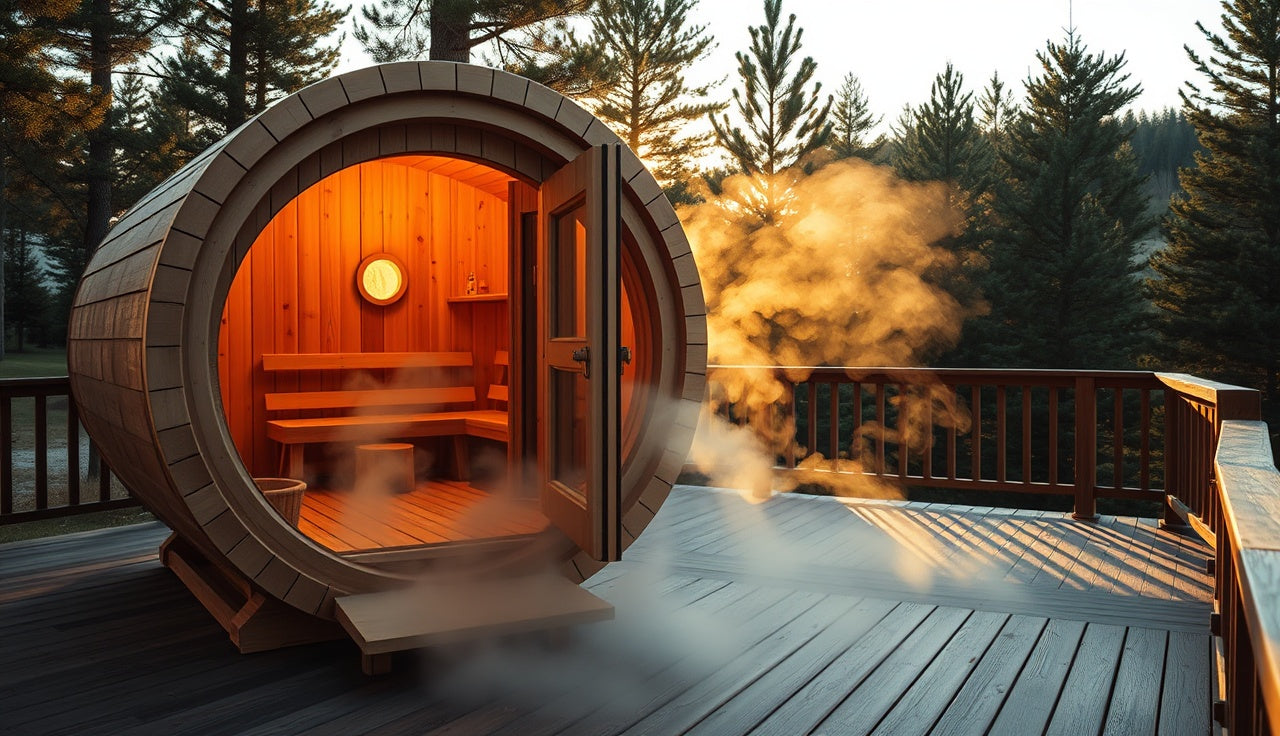
A wine barrel sauna is a round outdoor sauna built to look like an oversized wooden wine barrel, usually 4 to 7 feet in diameter. Quality units cost $3,000 to $9,000, seat 2 to 6 people, and hit temperature in 30 to 45 minutes. You need a level pad plus a 240V circuit or a wood-stove flue. They look great and work well in moderate climates, less so in deep cold.
What exactly is a wine barrel sauna?
A wine barrel sauna is an outdoor sauna shaped like an oversized barrel, with curved wooden staves running the full length and a rounded or D-shaped cross section. It borrows the joinery of cooperage (the craft of building wine and whiskey barrels) but scales it up to fit one to six adults.
The shape does real work. A round cross section spreads heat more evenly than a rectangular box because there are no cold corners where warm air stalls. The curved walls also add rigidity, so the wood can be thinner without flexing as it expands and contracts through heat cycles.
Most barrel saunas run 4 to 7 feet in diameter and 6 to 10 feet long [1]. They rest on two or more curved wooden cradles that lift the unit off the ground and let air move underneath, which matters enormously for wood life in wet climates. The standard orientation is horizontal, like a barrel laid on its side, with doors at one or both flat ends.
They're a subcategory of outdoor sauna, and the look is the main reason people pick them over a rectangular cabin unit. If you want something that belongs in a vineyard or a craftsman backyard instead of a gym locker room, the barrel gives you that. A boxy cedar cabin never will.
How much does a wine barrel sauna cost?
A quality wine barrel sauna costs $3,000 to $9,000 before installation, with entry-level imports starting around $2,500 and custom artisan builds crossing $12,000. Entry-level units from overseas manufacturers run $2,500 to $3,500, but the wood quality is inconsistent and the heater is often undersized for the volume [2]. Mid-range units from established Canadian or Finnish brands land between $4,500 and $7,000. High-end custom builds in old-growth Western red cedar or Scandinavian spruce run $8,000 to $12,000 or more.
Here's a rough breakdown by category:
| Category | Price Range | What you get |
|---|---|---|
| Budget (import) | $2,500 to $3,500 | Thinner staves, weaker heater, limited warranty |
| Mid-range | $4,500 to $7,000 | Quality cedar or spruce, 6 to 9 kW heater, 3 to 5 yr warranty |
| Premium | $7,000 to $12,000 | Thick clear-grade wood, custom sizing, premium heater |
| Custom/artisan | $12,000+ | Bespoke dimensions, premium heater brand, installation included |
Installation adds $500 to $2,000 depending on site prep, electrical work, and whether you need a concrete pad. Running a 240V electric heater usually means a licensed electrician charges $400 to $800 for the panel work and conduit, though regional prices swing hard [3].
Wood-burning versions cost less to install (you just need a clear area and a proper flue) but you have to source and split firewood, keep the chimney clean, and follow local burn rules. Check those before you buy.
Shipping is the cost people forget. A 6-foot barrel sauna weighs 800 to 1,200 pounds. Freight from Canada or Europe commonly adds $400 to $1,200, and some companies quote it separately after you've already committed.
What are the best wood choices for a barrel sauna?
Western red cedar is the most common material in North American barrel saunas, and it earns the spot. It resists rot naturally, stays dimensionally stable through repeated heat and humidity cycles, and gives off a warm resinous scent when hot [4]. Pay for clear-grade cedar (no knots) on interior surfaces. Knots ooze sap above 180°F, leaving dark stains that can irritate skin.
Nordic spruce (Picea abies) is the standard in Scandinavian-made saunas. It's denser than cedar, slower to soak up moisture, and lower in aromatic oil, which some people prefer for a cleaner smell. Finnish manufacturers like Harvia and Sauna360 typically spec Nordic spruce or aspen for their barrel interiors.
Thermowood, regular softwood heat-treated near 400°F to drive out moisture and sugars, shows up in more barrel designs every year. It's more stable and more rot-resistant than untreated wood, but it's darker and feels slightly brittle next to cedar. Some buyers like the deep tone. Others find it too dark.
Douglas fir and hemlock turn up in cheaper units. They're structurally fine but less resistant to moisture and more likely to warp as the barrel cycles through wet and dry seasons.
One thing to watch. Some budget barrels use finger-jointed lumber (short pieces glued end to end) to cut waste. That's fine for framing a house but a problem in a sauna, where repeated thermal stress attacks every glue joint. Ask whether the staves are solid or finger-jointed before you buy.
| Budget (import) | $3,000 |
| Mid-range | $5,750 |
| Premium | $9,500 |
| Custom/artisan | $14,000 |
Source: Manufacturer pricing surveys and HomeAdvisor cost data, 2024
How hot does a barrel sauna get and how long does it take to heat up?
A properly sized barrel sauna reaches 150°F to 195°F (65°C to 90°C) in 30 to 45 minutes with an electric heater, and in 45 to 90 minutes with a wood stove, depending on outside temperature and heater output [1]. The round cross section helps. Heat rises off the stove, hits the curved ceiling, and rolls back down the sides instead of pooling flat at the top, so bench-level temperature evens out faster than in a rectangular box.
Typical heater sizing for barrel saunas:
| Barrel Diameter | Interior Volume | Recommended Heater |
|---|---|---|
| 4 ft | ~85 cubic ft | 4 to 6 kW electric |
| 5 ft | ~130 cubic ft | 6 to 8 kW electric |
| 6 ft | ~185 cubic ft | 8 to 10 kW electric |
| 7 ft | ~250 cubic ft | 10 to 12 kW electric |
A 4.5 kW heater in a 6-foot barrel is a red flag. The sauna will technically heat, but you'll fight to get above 160°F in cold weather and recovery time between sessions drags.
The Finnish Sauna Society recommends a bench-level temperature of 80°C to 100°C (176°F to 212°F) for traditional sauna use [5]. Most barrel sauna owners settle into the 170°F to 185°F range, which is comfortable for 15 to 20 minute sessions.
Löyly, the steam burst from pouring water on hot rocks, works fine in a barrel. The curved ceiling pushes steam back down around you instead of letting it all escape overhead, which can make the humidity feel more intense than in a flat-ceiling cabin.
What size barrel sauna do you actually need?
This is the call most people get wrong. The listed capacity ("seats 4") almost always means four people sitting bolt upright on a single bench. Real comfort cuts that number roughly in half once anyone wants to stretch out or lie down.
One or two regular users? A 4-foot diameter, 6-foot barrel works but runs tight. You'll both be seated with knees close, fine for a quick session and cramped past 20 minutes.
Two to four users? A 5-foot diameter, 7 to 8-foot barrel is the sweet spot. You get a proper upper and lower bench, room for one person to recline, and enough airspace that the heat feels immersive instead of suffocating.
Four to six users, or anyone who wants the full lounge? A 6 to 7-foot diameter unit earns its cost. At 7 feet you can fit L-shaped benches and run a genuinely social session. Heater requirements jump, so budget for it.
Length drives bench layout. Many barrel saunas offer a second door or a changing-room vestibule on one end. A changing room is nice in cold climates (undress without standing in the snow) but it adds 2 to 3 feet to the footprint and is hard to retrofit later.
A home sauna with a larger interior and rectangular layout makes more sense if you regularly host more than four people. Barrel saunas are social but not spacious.
Can you install a wine barrel sauna yourself?
The sauna itself, yes. The electrical, no. Most barrel saunas ship pre-assembled or in sections that bolt together on site, and two people with basic mechanical skills can put a mid-size barrel together in half a day to a full day. The manual gives you the torque sequence for tightening the stave bands, which matters for an even seal.
The wiring is a different story. A 240V, 30 to 60 amp circuit for an electric heater is not a DIY job in most places. The National Electrical Code covers this: Article 680 governs wet locations and Article 422 covers fixed appliances including sauna heaters [6]. Most municipalities require a permit and a licensed electrician inspection before you energize the circuit. Skip that and you can void your homeowner's insurance and own a liability problem if anything goes wrong.
For a wood-burning barrel sauna, check local ordinances on open or semi-open combustion appliances. Many suburban areas restrict outdoor wood burning under air quality rules [7]. California's South Coast Air Quality Management District, for example, restricts or prohibits wood burning during certain weather conditions [7].
Site prep requirements:
- A level surface. The cradles tolerate a few degrees of grade. More than that and the door won't seal and water pools inside.
- Concrete pad, gravel, pavers, or compacted decomposed granite. The cradles don't care about the material as long as it's stable.
- Clearance from structures: most manufacturers want at least 24 inches on all sides. Your local fire code may want more.
- Overhead clearance: no overhanging branches. A hot flue and dry wood overhead is a fire waiting to happen.
How long does a barrel sauna last?
A quality cedar barrel sauna with proper maintenance lasts 15 to 25 years. Cheaper units with thin staves or inferior wood can show real warping and joint failure in 5 to 8 years, especially where freeze-thaw cycles hammer the joints [2].
Three things drive longevity: wood thickness, species, and drainage. Staves thicker than 1.75 inches (44mm) hold up dramatically better than 1.25-inch staves under thermal cycling. The barrel should slope slightly toward one end or have a drain, so condensation doesn't sit and rot the floor boards from below.
Maintenance that actually matters:
- Treat the exterior annually with a UV-resistant penetrating oil (teak oil, linseed oil, or a product rated for sauna exteriors). Paint traps moisture and speeds up rot.
- Sand and re-oil interior bench surfaces every two to three years. Benches soak up sweat salts that darken and harden the wood over time.
- Inspect the stave bands (the metal hoops holding the barrel together) each spring and tighten any that have loosened. Loose bands let the staves splay under heat, opening gaps that leak heat and let moisture in.
- Check the door gasket annually. A failed gasket drops efficiency you can feel and lets rain inside.
Electric heaters from established brands (Harvia, Finnleo, HUUM) commonly carry 2 to 5 year warranties on heating elements and 1 to 3 years on controls [8]. A good element usually lasts 10 to 15 years with normal use.
Wood-burning versions have fewer failure points, but the chimney thimble and flue pipe need a check for creosote buildup and joint integrity every season. Creosote is a fire hazard in any wood-burning appliance.
What are the health benefits of using a barrel sauna?
The research on sauna use is one of the more interesting bodies of evidence in recreational wellness, but almost all of it comes from studies on traditional Finnish saunas, not barrel saunas specifically. A barrel sauna produces the same dry heat (or wet heat with löyly) at the same temperatures, so the physiological response should be equivalent.
The most cited study is a 2015 prospective cohort published in JAMA Internal Medicine, which followed 2,315 Finnish men over an average of 20 years. It found that frequent sauna bathing (4 to 7 sessions per week) was associated with a statistically significant reduction in cardiovascular mortality versus once-weekly use [9]. The authors wrote: "Increased frequency of sauna bathing is associated with a reduced risk of sudden cardiac death, fatal coronary heart disease, fatal cardiovascular disease, and all-cause mortality." That's an association, not proof of cause, and the group was Finnish men, so read the extrapolation carefully.
Acute effects are better established. Core body temperature climbs 1°C to 2°C during a typical 15 to 20-minute session. Heart rate rises to 100 to 150 bpm, similar to moderate aerobic exercise. Skin blood flow jumps, and blood pressure generally drops in the hours after a session [9].
For recovery, there's reasonable evidence that heat exposure can reduce delayed onset muscle soreness (DOMS) after exercise, likely through better circulation and lower inflammatory signaling [10]. The effect is modest but real. A sauna benefits read covers the evidence in more depth.
Who should be cautious: people with uncontrolled hypertension, active heart conditions, pregnant women, and anyone on medications that impair sweating or thermoregulation. Most medical organizations say talk to your doctor before starting regular sauna use if you have cardiovascular disease [9].
Stay hydrated. A 15 to 20-minute session can produce 0.5 to 1 liter of sweat [1]. Drink water before and after. Alcohol plus sauna carries real documented risks: dehydration, low blood pressure, and worse judgment around heat tolerance.
How does a barrel sauna compare to other outdoor sauna styles?
The main competitors are traditional cabin-style outdoor saunas, pod saunas, and shed-style kit saunas. Here's where the barrel wins and where it doesn't.
| Feature | Barrel Sauna | Cabin/Shed Sauna | Pod Sauna |
|---|---|---|---|
| Aesthetics | Distinctive, vineyard-style | Traditional, blends in | Modern, sculptural |
| Heat-up time | 30 to 45 min | 30 to 60 min | 30 to 45 min |
| Interior space | Limited, curved walls | Flat walls, more usable | Varies |
| Cost | $3,000 to $9,000 | $4,000 to $15,000 | $6,000 to $20,000 |
| DIY assembly | Moderate | Moderate to hard | Hard |
| Longevity | 15 to 25 years (quality) | 20 to 30 years | 15 to 25 years |
| Cold climate performance | Good, slightly less insulation | Best | Good |
The barrel's curved walls eat into usable bench space compared to a rectangular room of the same footprint. A 6x8-foot cabin sauna has more flat bench than a 6-foot-diameter barrel of equal length. That matters if you want to stretch out or seat four comfortably.
In very cold climates (sustained below zero), cabin saunas with flat insulated walls usually hold heat better than barrels. The thin staves on a budget barrel can struggle to stay above 175°F when it's minus 20°F outside. Better manufacturers offer insulated barrels with a second layer of wood, which helps a lot.
The barrel wins on price against a comparable-quality cabin. It's also easier to move. You can unbolt the cradles, take off the end caps, and relocate it, which is close to impossible with a built-in cabin sauna.
Sauna vs steam room is a different question. Barrel saunas run dry heat. Steam rooms operate at 100% humidity near 110°F. Different experiences, different builds.
Is a wine barrel sauna worth it, or is there a better option for the money?
For most people who want a good-looking outdoor sauna they can assemble themselves and use year-round, a mid-range barrel at $5,000 to $7,000 is a solid buy. The form is genuinely beautiful, the heat quality is real, and the longevity holds up if you choose quality wood. That's my honest take.
Where it's not the right pick:
If your winters regularly drop below minus 10°F, spend the extra money on a cabin sauna with insulated walls. You'll fight to get a barrel to full temperature and fight harder to keep it there.
If you want a social sauna for six-plus people on a regular basis, the curved walls hold you back. A rectangular cabin with two opposing benches is just more practical at that scale.
If you're buying at the low end to save cash, ask whether the $2,800 import is actually cheaper over ten years than a $5,500 mid-range unit that lasts twice as long. Usually it isn't.
A portable sauna is the obvious alternative if space or budget is tight. They're much cheaper (often under $500) and they do produce heat, but it's not the same experience and they don't hold value the way a real wood barrel does.
SweatDecks carries a selection of outdoor barrel saunas if you want to compare brands and heater configurations side by side instead of guessing from manufacturer marketing.
One thing most buyers skip: pairing the sauna with a cold plunge. Contrast therapy (heat, then cold immersion, then heat again) has the most interesting recovery and autonomic nervous system data behind it. A cold plunge a few steps from your barrel is a real upgrade, more than a good-looking one.
What permits and codes apply to a backyard barrel sauna?
This varies more than most guides admit, and the honest answer is to check with your local building department before you buy. In most U.S. jurisdictions, a freestanding outdoor structure under a certain square footage (commonly 120 to 200 sq ft, but it varies by municipality) doesn't require a building permit as a structure [11]. A 5-foot diameter barrel at 8 feet long covers roughly 40 square feet, so it usually clears that threshold. The electrical work almost always needs a separate electrical permit regardless of structure size.
Homeowner's association rules can be tighter than municipal codes. Many HOAs restrict outdoor structures by street visibility, height, material, or color. Read your CC&Rs before ordering.
For wood-burning barrel saunas, the codes to watch:
- Local air quality rules on outdoor combustion (call your county air quality management district)
- Setback requirements from property lines and structures (commonly 5 to 10 feet)
- Fire codes around combustibles near the chimney
In a wildland-urban interface (WUI) zone, outdoor wood-burning appliances face much stricter scrutiny. California, Colorado, Oregon, and parts of Washington all have WUI zones where open or semi-open combustion is heavily regulated or banned [7].
The IRS lets you add permanent sauna equipment to your home's cost basis for capital gains purposes when you sell, though that doesn't create a current-year deduction for most homeowners [12]. If you're adding a sauna as a documented medical necessity (with physician records), narrow deduction arguments exist under IRC Section 213, but the rules are tight and the IRS scrutinizes them.
Frequently asked questions
How much does a wine barrel sauna cost to run per month?
An electric barrel sauna with a 6 to 9 kW heater running 1-hour sessions four times a week costs roughly $15 to $30 a month at the U.S. average residential rate of about $0.16 per kWh. Wood-burning models cost almost nothing electrically (maybe a small interior light) but factor in firewood at $200 to $400 per cord depending on region. Total monthly fuel cost lands roughly the same either way.
Can a barrel sauna stay outside in winter?
Yes, most quality barrel saunas are built for year-round outdoor use. The main winter risks are water getting into loose joints during freeze-thaw cycles and trouble reaching full temperature in sustained extreme cold. If temps regularly drop below minus 10°F, insulated double-wall barrels hold heat much better. Drain the unit if you leave it unused for weeks in a hard freeze, and crack the door slightly to prevent condensation buildup inside.
What foundation does a barrel sauna need?
The simplest option is two or four treated lumber sleepers or concrete blocks, level and spaced to match the cradle width. Concrete pads, compacted gravel, or interlocking pavers all work. The surface needs to be level within about 1 degree and stable enough not to shift under a 900 to 1,200-pound load. Avoid setting the cradles on bare soil, which compresses unevenly and traps moisture against the wood.
How many people fit in a barrel sauna?
A 4-foot diameter barrel seats 2 people comfortably. A 5-foot barrel fits 3 to 4. A 6 to 7-foot diameter barrel can seat 4 to 6, but real comfort usually falls short of the listed capacity once you want bench space to stretch. Curved walls reduce usable bench area versus a rectangular cabin of the same length, so if you regularly want 6 people at once, look at a larger cabin-style outdoor sauna instead.
Do barrel saunas need ventilation?
Yes. Fresh air exchange is both a health requirement and a structural one. Most barrel saunas have a lower fresh-air intake vent near the heater and an upper exhaust vent near the peak. The intake sits below or beside the heater; the exhaust sits near bench level on the opposite end. Poor ventilation causes oxygen depletion during longer sessions and traps humidity that rots the wood. Don't block or remove the factory vents.
Can I convert a real wine barrel into a sauna?
Technically possible, practically a headache. Standard wine barrels (225-liter Bordeaux style) are about 35 inches in diameter, too small to sit inside. Larger 500-liter formats are bigger but still undersized and not built for thermal cycling at sauna temperatures. The wood is thinner than sauna-grade lumber, the staves aren't sealed for human occupancy, and the interior carries wine residue. A purpose-built barrel sauna is designed to resemble a barrel, not repurposed from one.
What heater is best for a barrel sauna: electric or wood-burning?
Electric heaters are more convenient (app control, precise temperature, no smoke) and better suited to areas with air quality rules on outdoor burning. Wood-burning stoves produce a heat many traditionalists prefer, get the rocks hotter for richer löyly steam, and don't need grid power. If you have reliable firewood access and no burn ordinances, wood is an experience worth having. Otherwise, electric is simpler and more practical for most suburban installs.
How do you maintain the wood on a barrel sauna exterior?
Apply a penetrating UV-resistant oil once a year, typically in spring before peak sun. Products rated for exterior wood and sauna use (teak oil, pure tung oil, or commercial sauna exterior oils) work well. Never paint or stain the exterior with a film-forming product; it traps moisture inside the wood and speeds up rot. Spot-treat any gray weathering or surface cracks. Interior benches get a light 120-grit sanding and re-oiling every 2 to 3 years.
Is a wine barrel sauna good for muscle recovery?
Heat therapy has reasonable evidence for reducing delayed-onset muscle soreness after exercise, likely through better blood flow and lower inflammatory signaling. Several small trials point to improved subjective recovery and reduced soreness markers. It won't replace sleep, nutrition, or active recovery, but a post-workout barrel sauna session followed by a cold plunge is one of the more defensible recovery protocols in recreational athletics. See our sauna benefits guide for the full evidence breakdown.
How do barrel saunas compare to indoor home saunas?
Indoor home saunas offer more insulation, work without going outside (valuable in winter), and fit into a bathroom or basement layout. Barrel saunas are almost always outdoor-only and need site prep plus an electrical run. Outdoor barrels tend to cost less than equivalent indoor builds and carry a distinct look. If you have the yard space and don't mind a quick cold walk, an outdoor barrel is often the better value. Indoor builds win when exterior space is limited or the climate is extreme.
What is the best wood for a barrel sauna interior vs exterior?
Clear-grade Western red cedar or Nordic spruce are the top interior choices. Skip knotty wood inside because knots ooze sap at sauna temperatures. Aspen and alder are also popular interior picks because they stay cooler to the touch when it's hot. The exterior can use the same cedar or spruce but needs an annual oil treatment against UV and rain. Thermowood shows up more on exteriors for its rot resistance and needs oiling less often.
Do you need to season a new barrel sauna before first use?
Most manufacturers recommend running the sauna at low temperature (around 150°F) for two or three short sessions before a full-heat session. This lets the wood acclimate gradually, tightens the stave joints as the wood expands, and burns off manufacturing residue on the heater elements. It also lets you catch air gaps or door seal issues before the wood fully cures. Treat it like breaking in a cast iron pan: go slow the first few times.
Are wine barrel saunas good for cold climates?
Fine for moderate cold, less ideal for extreme cold. Single-wall barrels lose heat faster than insulated cabin saunas once ambient temps drop below minus 10°F to minus 20°F. Double-wall or insulated barrel models close most of that gap. If you're in Minnesota, northern Ontario, or comparable climates, ask specifically about the R-value of the wall construction and get a heater at the top of the recommended range for your barrel size. Budget for longer preheat times in deep winter.
Can you use a barrel sauna for contrast therapy with a cold plunge?
Yes, and it's one of the most popular home wellness setups. A typical contrast protocol runs 15 to 20 minutes in the sauna at 170°F to 185°F, then 2 to 3 minutes in a cold plunge at 50°F to 59°F, repeated 2 to 3 cycles. The outdoor setting makes it practical to put a cold plunge within a few steps of the barrel. Some users just use a cold outdoor shower or a stock tank in winter. Our cold plunge guide covers the physiology behind the protocol.
Sources
- Almost Heaven Saunas, Barrel Sauna Product Specifications: Barrel saunas typically range 4–7 feet in diameter and 6–10 feet in length; sessions produce 0.5–1 liter of sweat in 15–20 minutes
- Treehugger, 'How Long Does a Sauna Last?': Quality cedar barrel saunas last 15–25 years; cheap units with thin staves may fail in 5–8 years
- HomeAdvisor, Electrician Cost Guide: Licensed electrician charges $400–$800 for a 240V circuit installation, varying by region
- USDA Forest Service, Forest Products Laboratory, Wood Handbook: Wood as an Engineering Material: Western red cedar is naturally rot-resistant and dimensionally stable under repeated moisture and temperature cycling
- Finnish Sauna Society, Sauna Guidelines: The Finnish Sauna Society recommends bench-level sauna temperature of 80°C to 100°C (176°F to 212°F) for traditional sauna use
- National Fire Protection Association, NFPA 70 National Electrical Code (Article 422 fixed appliances, Article 680 wet locations): NEC Article 422 governs fixed appliances including sauna heaters; Article 680 covers wet and damp locations requiring licensed installation
- South Coast Air Quality Management District, Wood-Burning Rules: California's South Coast AQMD prohibits or restricts outdoor wood burning during certain weather conditions
- Harvia, Sauna Heater Warranty and Product Documentation: Harvia electric sauna heaters carry 2–5 year warranties on heating elements and 1–3 years on electronic controls
- Laukkanen et al., JAMA Internal Medicine, 2015 — 'Association Between Sauna Bathing and Fatal Cardiovascular and All-Cause Mortality Events': Frequent sauna bathing (4–7 sessions/week) was associated with significantly reduced cardiovascular mortality over 20 years; the study stated: 'Increased frequency of sauna bathing is associated with a reduced risk of sudden cardiac death, fatal coronary heart disease, fatal cardiovascular disease, and all-cause mortality'
- Bleakley C, Bieuzen F, Davison GW, Costello JT. Open Access Journal of Sports Medicine, 2014 (thermal therapy and recovery): Heat exposure can reduce delayed onset muscle soreness after exercise through improved circulation and reduced inflammatory signaling
- International Code Council, International Residential Code Section R105 — Permits: Most jurisdictions exempt freestanding accessory structures under 120–200 sq ft from building permits, though electrical work requires a separate permit
- IRS, Publication 523 — Selling Your Home (capital improvements to basis): Permanent home improvements including sauna equipment can be added to the home's cost basis for capital gains calculation purposes when selling

Share:
CS-1 cold plunge tub: full review and buyer's guide
The Plunge original cold plunge tub: full review and specs