
Last updated 2026-07-10
TL;DR
Cold plunge tubs are moving fast in 2025 and 2026. Chillers are becoming standard rather than premium, soft-sided tubs are losing ground to hard acrylic and steel, smart controls are trickling into mid-range models, and the market is growing around 7-9% a year. Entry prices have dropped hard while high-end units now cost like a small car payment.
What is the cold plunge tub market doing in 2025 and 2026?
The cold plunge tub market is booming, and the numbers back that up. Market research from Grand View Research estimates the global cold plunge and ice bath market at roughly $2.1 billion in 2023, with a compound annual growth rate somewhere between 7% and 9% through 2030, putting projections above $3 billion by the end of the decade [1]. That is not hype math. It reflects real consumer behavior: Google Trends data shows search interest in "cold plunge" tripled between 2021 and 2023, and it has held near those elevated levels into 2025.
What is driving it? A few things running together. Social media normalization played a big part, with athletes and health-focused influencers making cold immersion look accessible rather than extreme. Peer-reviewed research on cold water immersion's effects on recovery and mood regulation has also grown, even if the evidence base is still building [2]. And the hardware got better: three years ago, an at-home chiller that could hold 39°F reliably cost well over $5,000. Today you can find credible options closer to $2,500.
For 2025 and 2026 specifically, the trend lines point toward consolidation at the top (a handful of brands are pulling away), more competition in the $1,500-$3,500 middle tier, and genuine price compression at the entry level. The market is still fragmented, which means buyers hold real bargaining power right now.
What are the biggest cold plunge technology changes in 2025?
The single biggest shift in 2025 is that active chilling has moved from luxury add-on to expected baseline. Two or three years ago, a "cold plunge" might have meant a glorified stock tank you filled with ice. That is still an option, but consumers shopping at even the $2,000 price point now expect a built-in chiller that cycles water down to somewhere around 37-45°F without manual ice loading.
Filtration is the second technology story. Early consumer units borrowed lightly from hot tub engineering and often came with systems that struggled to keep water clean between daily sessions. The 2025 wave of tubs uses ozone generators, UV-C light sterilization, and better circulation pumps in combination. Some units now advertise water change intervals of 30 to 90 days, though your actual results vary by body load and how often the tub is used. Independent testing on water quality claims is still thin, so treat manufacturer numbers as a starting point.
App control and smart integrations are real but still early. You can now set your target temperature remotely, schedule pre-cooling before a morning session, and in some units track session duration and water temperature over time. The data logging side is mostly useful for habit tracking, not clinical monitoring. If you expect meaningful integration with a Garmin or Apple Watch, you will be disappointed for now. Most "smart" features are really just Wi-Fi-connected thermostats. Useful, not magic.
Chiller noise is getting meaningfully better. 2023 units were often 55-65 decibels under load. Several 2025 models from established manufacturers are testing at 45-52 dB, comparable to a quiet dishwasher. If you are putting a unit on a back patio near a bedroom, this actually matters.
How much does a cold plunge tub cost in 2025 and what should you expect at each price?
Prices have stratified into four tiers, and knowing what each tier actually delivers saves a lot of regret.
| Price Range | What You Get | What You're Missing |
|---|---|---|
| Under $300 | Soft-sided barrel or liner, no chiller, ice-dependent | Temperature control, filtration, durability |
| $800-$1,800 | Hard acrylic or steel shell, basic chiller (40-50°F floor), simple filter | Strong insulation, app control, quiet motor |
| $2,000-$4,500 | Dedicated chiller to ~37°F, UV or ozone filtration, insulated shell | Often: app features, third-party service network |
| $5,000-$15,000+ | Commercial-grade chiller, full smart control, stainless or fiberglass shell, warranty depth | Marginal benefits over $3,500 tier for home use |
For most homeowners doing daily or near-daily plunges, the $2,000-$4,500 tier is the honest sweet spot in 2025. You get reliable temperature control, decent filtration, and a unit that will last more than two seasons. The sub-$1,000 market has improved but is still mostly built for people who want to test the habit before committing, not people who plan to plunge seriously.
The high end is interesting. Units at $8,000-$15,000 are genuinely excellent, but the jump from $4,000 to $10,000 does not buy you a proportionally better cold water experience. You are paying for materials (medical-grade stainless, custom fiberglass shapes), branding, and a service infrastructure. If you run a wellness studio or want something that looks architecturally intentional in your backyard, the premium makes sense. For a garage or back porch, probably not.
Note that these ranges shift by a few hundred dollars depending on retailer and timing. The market is competitive enough that seasonal sales (Black Friday, early spring) have consistently moved prices 10-20% off MSRP [3].
| 2023 | $2.1 |
| 2024 | $2.27 |
| 2025 | $2.45 |
| 2026 | $2.65 |
| 2027 | $2.86 |
| 2028 | $3.09 |
| 2029 | $3.33 |
| 2030 | $3.6 |
Source: Grand View Research, Cold Plunge Pool Market Report 2023
What are the most popular cold plunge tub styles and designs right now?
Hard-shell tubs dominate the 2025 market in a way they did not in 2022. There are a few clear form factors.
Freestanding acrylic or fiberglass oval and round tubs are the best sellers across most retailers. They look clean, they insulate reasonably well, and they fit most adults comfortably for a seated immersion to shoulder level. Most run 60-68 inches long and 28-34 inches deep. Depth matters more than most buyers realize: getting water to your shoulders in a seated position takes roughly 24-28 inches of usable water depth.
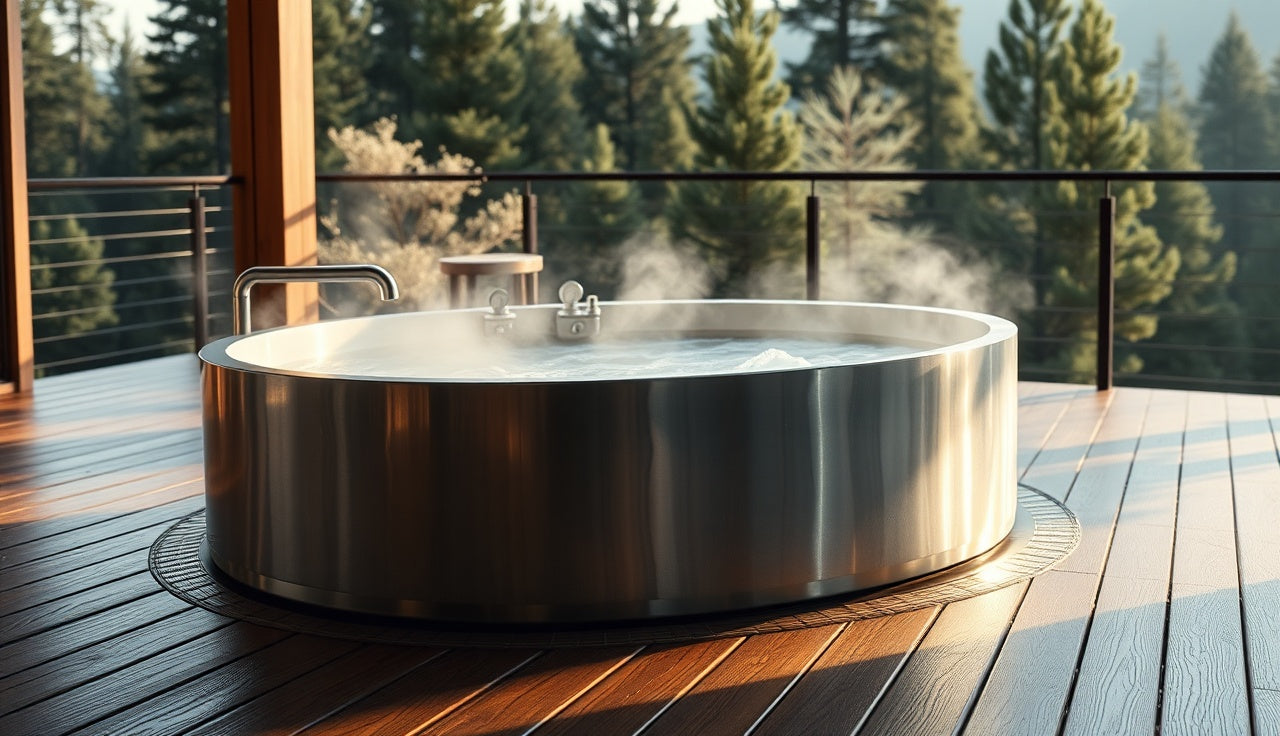
Stainless steel cylinders (often called "barrel" style but made from steel rather than wood) have built a real following among buyers who want something that looks intentional outdoors and handles weather without babying. Powder-coated steel is also popular. The aesthetic is different from the spa-look acrylic units, more industrial. They hold cold well too, because metal moves heat into and out of the water efficiently when paired with a chiller.
Wood-paneled units, typically cedar or teak over a fiberglass liner, are trending for outdoor spaces where the tub is a visual feature. They need more maintenance than acrylic or steel, and the wood paneling is cosmetic more than functional. Expect to oil or seal exterior wood every 1-2 seasons depending on your climate.
Soft-sided inflatable and fabric tubs are losing market share relative to 2022 but still sell well as entry-level options. Their main problem is insulation: without serious insulation, a chiller works much harder to maintain temperature, driving electricity costs up and shortening chiller life. If you are buying one just to use with ice while you figure out whether cold plunging is your thing, that is a fine approach.
For anyone looking at the full landscape of cold plunge options, the form factor decision comes down to three things: where the tub lives, how often you will use it, and whether looks matter in that space.
What does the research actually say about cold water immersion benefits in 2025?
The evidence for cold water immersion is more nuanced than either the enthusiasts or the skeptics admit, and it has gotten a bit richer in the past two years.
The most replicated finding is reduced delayed-onset muscle soreness (DOMS) after exercise. A 2022 Cochrane review of 52 trials found that cold water immersion reduced muscle soreness compared to passive rest in the short term [4]. The same review noted the evidence quality is moderate, not high, and that optimal temperature and duration protocols remain uncertain. Most studied protocols use water between 50-59°F (10-15°C) for 10-20 minutes.
The mood and mental health angle is drawing more research attention. A small but cited 2023 study in the journal Biology found that brief cold water immersion (14°C for 20 seconds to 2 minutes) significantly increased self-reported mood and decreased tension, with effects lasting hours [5]. The sample was modest (49 participants), and the authors were careful not to overclaim. Promising, not proven.
Norepinephrine release is probably the most cited physiological mechanism. Research on human physiological responses to cold water has found norepinephrine increases in the range of 200-300% from cold exposure [6]. Norepinephrine affects attention, focus, and mood. The translation from that biochemical response to specific clinical outcomes is still being worked out.
The "blunts muscle adaptation" concern is real and worth knowing. A 2015 paper in the Journal of Physiology found that post-exercise cold water immersion attenuated long-term strength and muscle gains compared to active recovery [7]. If your primary goal is hypertrophy, daily post-training cold plunges may work against you. Separating cold exposure from resistance training by several hours is the practical workaround most coaches now suggest.
For a closer read on what the studies show, the cold plunge benefits breakdown is the most thorough overview we have.
How are smart controls and connectivity changing cold plunge tubs?
App connectivity went from a top-tier-only feature in 2022 to something available across the mid-range in 2025. The practical value is real but limited.
What works well: remote temperature setting, scheduling pre-cool cycles, and session logging. If you want your tub at 40°F when you wake up at 6am, you can set it to start chilling at 4am from your phone the night before. That is genuinely useful and saves energy compared to running the chiller continuously.
What does not work well yet: real integration with fitness wearables, health data portability, and anything that needs open APIs. Most brands run proprietary apps that do not talk to Apple Health, Google Fit, or training platforms in any meaningful way as of mid-2025. Some manufacturers have announced integrations that have not shipped. Treat those claims with skepticism until actual users confirm them.
A handful of brands are experimenting with guided protocols inside their apps: timed breathing exercises synced to the plunge countdown, session difficulty progressions, and habit streaks. Whether that gamification actually improves adherence is not known, but it costs nothing to include and buyers seem to respond to it in purchase research.
Energy monitoring is a feature worth asking about specifically. Chillers running continuously in a warm garage can add $30-$80 per month to an electricity bill depending on ambient temperature, insulation quality, and target temp [8]. Units with smart scheduling and eco-modes cut that load meaningfully. If your unit will live somewhere with high ambient temps (an unconditioned garage in Texas, for example), the efficiency spec matters more than it might seem.
How does outdoor versus indoor placement affect which cold plunge tub you should buy?
Placement is probably the most underweighted factor in the purchase decision, and it drives a lot of returns and regrets.
Outdoor placements need UV-resistant shells, weather-rated chillers, and drainage plans. Most acrylic tubs are not rated for continuous UV exposure and will fade or degrade over 2-4 years in direct sunlight without a cover. Covers are almost always sold separately, and a good insulated cover matters a lot for both energy use and debris. If you are in a climate with freezing winters, check whether the chiller has freeze protection built in. Some do, some do not.
Indoor placements have different problems: drainage, ventilation (chillers throw off heat and some humidity), and floor load. A filled cold plunge tub holds 100-250 gallons of water depending on size. Water weighs 8.34 pounds per gallon [9]. A 150-gallon tub plus hardware can put 1,400+ pounds on a small floor footprint. Most residential floors are built for 40 pounds per square foot, but a point load of that weight concentrated under four small feet can be a problem. Get a structural read on your floor before placing anything indoors on an upper level or over a basement.
Garages are the most popular placement for good reason: level concrete floor, drain access or acceptable floor drainage, no UV exposure issues, and temperatures that stay out of extreme ranges in most climates. The downside is that cold winter air means the chiller barely needs to run (or may short-cycle), while hot summers make it work hard.
For buyers considering a broader home sauna and cold plunge setup, the placement decisions interact: the ideal pairing is adjacent units with a short walk between them, so you get the contrast therapy cycle without a real temperature re-warm.
How is the cold plunge market different from the ice bath market in 2025?
"Cold plunge" and "ice bath" get used interchangeably in casual talk but have started to diverge in product terms.
An ice bath in product listings generally means a vessel designed to be filled manually with ice and cold water, no active chiller, often cheaper and more portable. These range from $30 barrel liners to $800 hard-shell tubs. They work fine if you have reliable ice access or can pre-chill with well water. The experience is real cold water immersion; you are not missing some physiological effect the chiller provides.
A cold plunge tub in the 2025 market usually implies a self-contained chilling unit. The appeal is consistency: you set 40°F and it stays at 40°F whether it is Monday or Saturday, whether you filled it last week or yesterday. That consistency matters for building a habit and for holding a specific temperature protocol if you are following a recovery or research-based program.
The ice bath category is also seeing innovation at the low end, with purpose-built recovery tubs that are more ergonomic than a literal bathtub but stop short of a chiller. For athletes on a budget or people who travel, these make real sense.
For 2026, the line is likely to blur further: chillers keep getting cheaper and smaller, so whether to include one becomes less of a budget barrier and more of a space and installation question.
What should you look for in a cold plunge tub in 2025 to avoid buying the wrong one?
Once the price tier is settled, the specs that actually matter for daily use are minimum temperature, filtration, insulation, warranty depth, and service support.
Minimum temperature. Most research protocols use 50-59°F, and some of the strongest mood and recovery responses in studies use water around 57°F. If your goal is habit formation and general wellness, a unit that gets to 45-50°F is plenty. If you want to go colder (39-41°F range), you need a chiller rated for that, and they cost more. Cold tolerance also climbs over time, so many people who buy the coldest possible unit end up using it at 50°F anyway.
Filtration. Ask specifically: ozone, UV, or both? What is the recommended water change interval? Is there a micron rating on the filter? A 50-micron filter is meaningfully different from a 10-micron one. You are sitting in this water for 5-15 minutes repeatedly, so hygiene is not a side concern.
Insulation. An uninsulated tub in a 75°F garage will see water temperature rise 1-3°F per hour with the chiller off. An insulated unit might hold temperature for 6-10 hours. That difference translates directly to electricity cost and chiller wear.
Warranty and service. The chiller is the most failure-prone component. Look for at least a 2-year warranty on the chiller specifically, longer than the shell. More important: who services it? Brands that sell through local dealers or run a national service network are worth much more when something fails at month 14 than a brand with chat-only support.
At SweatDecks, the cold plunge collection is filtered for units that hit meaningful minimums on all four of those specs, which cuts a lot of the lower-tier noise in the market right now.
One more thing: read actual owner reviews on platforms where verified purchase is required. The cold plunge space has enough marketing noise that brand-hosted reviews are not reliable. Forum communities and subreddits (r/coldplunge has active discussion) are where the real durability and service data lives.
How does contrast therapy (sauna plus cold plunge) factor into cold plunge buying decisions in 2025?
Contrast therapy, alternating between heat and cold exposure, is probably the single biggest driver of dual-unit purchases right now. Someone buying a cold plunge tub in 2025 is nearly as likely to already own a sauna as to be buying the plunge on its own.
The physiological logic runs through the alternating vasoconstriction (cold) and vasodilation (heat) effect on the circulatory system. The research here is less mature than for either modality alone, but observational data from Finnish studies on cardiovascular outcomes is intriguing [10]. The Finnish tradition of sauna followed by cold water immersion has existed for centuries, which at minimum tells you a large population tolerates the practice well.
For buyers planning a pairing, the practical stuff: physical proximity of the two units (you want a short path, not a 200-foot walk in winter), timing of sessions (most common protocols run 10-20 minutes in the sauna, 2-5 minutes in the cold, repeated 2-3 cycles), and electrical load (a sauna and a chiller running at once can pull 30-40+ amps; check your panel).
If you are starting from scratch and want both, buying the sauna first is usually the right sequence. It is the harder installation, it needs more structural planning (ventilation, electrical, often a permit), and once you have it, adding a cold plunge alongside is relatively straightforward. The reverse works fine too, but the sauna install is where things go sideways more often.
For the sauna benefits that factor into this decision, and for what a home sauna setup actually involves, both are worth reading before you budget for either.
What cold plunge trends are expected to carry into 2026?
A few trend lines from 2025 will accelerate, and a couple of things that look like trends probably are not.
What keeps growing: chiller-inclusive units at lower price points, better filtration standards across the industry, and more outdoor-oriented designs built to weather year-round. The market is pulling toward integration. Buyers want the cold plunge to feel like a designed part of their home, not a piece of gym equipment dropped in the backyard.
Smart home integration will improve but slowly. The limiting factor is not hardware, it is software and the fact that the cold plunge category is still too small for Apple, Google, or Fitbit to prioritize a native integration. Third-party middleware (Home Assistant, IFTTT) already lets technically inclined users build some connections. Native first-party support is probably 2-3 years out at the earliest.
Clinical and physical therapy settings are adopting purpose-built cold plunge systems faster, which pushes commercial-grade engineering (precise thermostat control, hospital-grade filtration, programmable session timers) into the residential market. That is good for buyers: what physical therapists specify tends to be durable and calibrated.
What probably is not a lasting trend: extremely cheap ($150-$400) disposable soft tubs. They spiked in 2022-2023 as everyone wanted to try cold plunging. Return rates were high, water quality problems were common, and the chiller-less experience did not keep enough users around. That category will persist at a smaller scale but is not the future of the market.
Regulatory attention is coming. The CPSC had not issued specific cold plunge safety standards as of mid-2025, but the combination of electrical components, water, and no established safety standard is a gap consumer product regulators tend to close eventually [11]. Look for units that are ETL or UL listed for electrical safety regardless of whether it is currently required.
How do you actually maintain a cold plunge tub so it lasts?
Maintenance is the thing most buyers underestimate and most sellers undersell. Here is what actually happens in practice.
Water chemistry is the main ongoing job. Cold water slows some bacterial growth (pathogens multiply more slowly below 50°F than in a hot tub), but it does not eliminate it. Most cold plunge manufacturers recommend a low chlorine residual (1-3 ppm) or bromine or non-chlorine shock oxidizer in combination with ozone or UV. Test strips are cheap, and checking twice a week is realistic. Letting chemistry slide leads to biofilm in the plumbing, which is both a hygiene problem and a filtration problem.
Filter cleaning. Most units use a cartridge filter that needs rinsing every 1-2 weeks and replacement every 3-6 months depending on use frequency. A dirty filter makes the pump work harder and cuts circulation efficiency, which shows up as slower recovery to target temperature.
Covers. Always use a cover when the tub is idle. Covers keep debris out, reduce evaporation (which matters more than people think, evaporative cooling is real but so is the water loss that forces you to top up), and drop the chiller's workload sharply.
Winter care. If you are in a climate that drops below freezing and the tub is outdoors, either drain it for winter or confirm the unit has freeze protection built into the chiller controls. Freeze damage to plumbing and the chiller housing is usually not covered under warranty because it counts as user error.
A full water change (draining and refilling completely) is typically every 1-3 months for a residential unit used by 1-2 people. More users, more frequent drains. Budget an hour for a full drain, clean, and refill.
Frequently asked questions
What is the best cold plunge tub to buy in 2025?
There is no single best answer because placement and budget change it. For most home users spending $2,500-$4,500, a hard-shell unit with an integrated chiller rated to at least 40°F, UV or ozone filtration, and a 2-year warranty on the chiller is the practical choice. Look for ETL or UL electrical listing. Read owner reviews outside the brand's own site before buying.
Are cold plunge tubs actually worth it for recovery?
The evidence for reduced muscle soreness after exercise is moderately strong, supported by a 2022 Cochrane review of 52 trials. Mood and mental wellbeing benefits have smaller but consistent research support. The caveat for strength athletes is real: cold water immersion immediately after resistance training may blunt long-term muscle gains, per a 2015 Journal of Physiology study. For general recovery and habit-based wellness, most users find the investment worth it if they will actually use it consistently.
How cold should a cold plunge be?
Most research protocols use 50-59°F (10-15°C). Temperatures in that range produce the physiological responses studied for recovery and mood. Going colder (39-45°F) is not more beneficial for most goals and raises discomfort significantly. Start toward the warmer end of that range and drop the temperature as tolerance builds. Water temperature matters less than actually getting in and staying in for the protocol duration.
How much does it cost to run a cold plunge tub per month?
Electricity cost depends heavily on ambient temperature, insulation quality, and target temperature. In a conditioned space or mild climate, a well-insulated unit typically runs $20-$45 per month. In a hot unconditioned garage in summer, costs can reach $60-$90. Some users report higher figures with poor insulation or continuous operation without a cover. Smart scheduling and a good insulated cover are the two highest-impact ways to cut operating cost.
Do I need a permit to install a cold plunge tub at home?
Usually no permit is required for a freestanding plug-in cold plunge tub placed outdoors or in a garage. If the unit needs a dedicated electrical circuit (many 240V models do), that electrical work typically requires a permit and licensed electrician in most U.S. jurisdictions. Check your local building department. Zoning setback rules may apply for permanent outdoor structures in some municipalities.
What is the difference between a cold plunge tub and an ice bath?
In product terms, an ice bath is typically a vessel without an active chiller that you fill with ice or cold water manually. A cold plunge tub in the 2025 market usually includes an electric chiller that holds a set temperature automatically. Both provide cold water immersion. The chiller version costs more but delivers consistent temperature without ice buying or prep. Ice baths are fine for testing the habit or for athletes with ice access.
Can I use a cold plunge tub in winter outdoors?
Yes, but it requires a unit with freeze protection built into the chiller. If ambient temps drop below 32°F, unprotected plumbing and chiller housings can crack. Most quality units built for outdoor use have freeze protection modes that keep water from sitting static in exposed lines. Confirm this spec before buying if you plan outdoor winter use. A well-insulated cover is also essential for energy efficiency when ambient temps swing widely.
How long should you stay in a cold plunge?
Most studied protocols run 10-20 minutes for muscle recovery benefits. Shorter sessions (2-5 minutes) appear enough for mood and norepinephrine effects. The practical starting point for beginners is 2-3 minutes at a comfortable cold temperature (around 55-58°F), building duration and temperature over weeks. No research shows that longer or colder sessions produce proportionally better outcomes, and extended cold exposure in very cold water carries risk for less-adapted individuals.
Does contrast therapy (sauna plus cold plunge) work better than either alone?
The research specifically on alternating protocols is thinner than research on either modality alone. Observational data from Finnish populations, who have practiced sauna followed by cold exposure for generations, shows associations with favorable cardiovascular markers. Mechanistically, alternating vasoconstriction and vasodilation has plausible circulatory benefits. Most practitioners recommend 2-3 cycles of heat then cold within a session. The experience is also simply more enjoyable for many people, which matters for adherence.
What cold plunge brands are gaining market share in 2025 and 2026?
The market is still fairly fragmented. A handful of brands that started in the premium segment (Ice Barrel, Plunge, BlueCube) have kept name recognition while mid-range players have entered with competitive chiller specs. New brands from traditional hot tub manufacturers have also entered with better service networks than startup brands. Brand consolidation is likely in 2026-2027 as the market matures. Service network and parts availability matter more than brand prestige for long-term ownership.
Are cold plunge tubs safe for everyone?
Cold water immersion carries real contraindications. People with cardiovascular disease, Raynaud's syndrome, cold urticaria, or uncontrolled hypertension should consult a physician before using a cold plunge. The cold shock response, which includes rapid breathing and potential cardiac stress, is most pronounced in the first 30 seconds of immersion. Never plunge alone if you are a beginner or have known cardiovascular concerns. Healthy adults without contraindications tolerate the practice well in research populations.
How do I keep the water clean in my cold plunge tub?
Maintain a low chlorine residual (1-3 ppm) or equivalent bromine level, test twice a week, rinse filter cartridges every 1-2 weeks, and do a full drain and refill every 1-3 months depending on use frequency. Units with UV or ozone filtration need less chemical input but still need testing. Always use the cover when idle. Shower before entering to reduce organic load, which is the main driver of water quality degradation.
What is the projected market size for cold plunge tubs in 2026?
Grand View Research estimated the global cold plunge and ice bath market at roughly $2.1 billion in 2023 with a 7-9% CAGR through 2030. At that growth rate, the market reaches approximately $2.7-$3 billion by 2026. The North American residential segment is the fastest-growing portion. Market consolidation among brands is expected to accelerate as the category matures and early entrants either scale or exit.
Is it better to buy a cold plunge tub or build one yourself?
A DIY chest freezer conversion (adding a submersible pump and filter to a chest freezer) costs $300-$700 in parts and reaches very cold temperatures. The tradeoffs are significant: no warranty, no purpose-built filtration, ergonomics designed for frozen food not human bodies, and chiller units not designed for continuous wet operation. It works and has a real community behind it. If budget is the main constraint, it is a legitimate approach. If reliability, filtration, and ergonomics matter, a purpose-built unit is worth the premium.
Sources
- Grand View Research, Cold Plunge Pool Market Report 2023: Global cold plunge and ice bath market estimated at approximately $2.1 billion in 2023 with 7-9% CAGR projected through 2030
- PubMed / National Library of Medicine, search: cold water immersion recovery: Growing peer-reviewed research base on cold water immersion effects on recovery and physiological markers
- Consumer Reports, Seasonal Retail Pricing Patterns: Seasonal sales events (Black Friday, spring) have historically delivered 10-20% discounts on major home wellness equipment
- Cochrane Database of Systematic Reviews, Bleakley et al., Cold water immersion (cryotherapy) for preventing and treating muscle soreness after exercise, 2022: A Cochrane review of 52 trials found cold water immersion reduced muscle soreness compared to passive rest in the short term, with moderate-quality evidence
- Biology (MDPI), Yankouskaya et al., Short-Term Head-Out Whole-Body Cold-Water Immersion Facilitates Mood State and Decreases Stress, 2023: Brief cold water immersion at 14°C significantly increased self-reported mood and decreased tension in a study of 49 participants
- PubMed, Šrámek et al., Human physiological responses to immersion into water of different temperatures, European Journal of Applied Physiology, 2000: Cold water immersion associated with norepinephrine increases of 200-300% versus baseline
- Journal of Physiology, Roberts et al., Post-exercise cold water immersion attenuates acute anabolic signalling and long-term adaptations in muscle to strength training, 2015: Post-exercise cold water immersion attenuated long-term strength and muscle gains compared to active recovery
- U.S. Energy Information Administration, Residential Electricity Use and Appliance Energy Consumption: Basis for estimating monthly electricity costs of $30-$80 for continuously operating chiller units in varying ambient temperatures
- U.S. Geological Survey, Water Density and Weight: Water weighs approximately 8.34 pounds per gallon at typical temperatures
- Mayo Clinic Proceedings, Laukkanen et al., Sauna bathing and systemic inflammation, 2018: Finnish observational studies on sauna use show associations with favorable cardiovascular markers; the traditional practice includes cold water immersion as part of the protocol
- U.S. Consumer Product Safety Commission, Swimming Pools, Spas, Hot Tubs and Whirlpools Safety Standards: CPSC has established electrical safety standards for hot tubs and spas; specific cold plunge standards had not been issued as of mid-2025, creating a regulatory gap
- International Association of Plumbing and Mechanical Officials, Uniform Swimming Pool, Spa, and Hot Tub Code: Model code basis for local permit requirements for water-containing vessels with electrical components
Share:
Sauna temperature gauge: what you actually need to know
Building a barrel sauna: the complete guide from kit to first session