
Last updated 2026-07-10
TL;DR
Building a barrel sauna runs $2,500 to $12,000 all-in, driven by kit versus scratch build, wood species, and heater choice. Most people with basic carpentry skills assemble a prefab kit in a weekend. This guide walks through site prep, permits, wood and heater picks, ten build steps, foundation options, and what your first session feels like.
What is a barrel sauna and why do people build them?
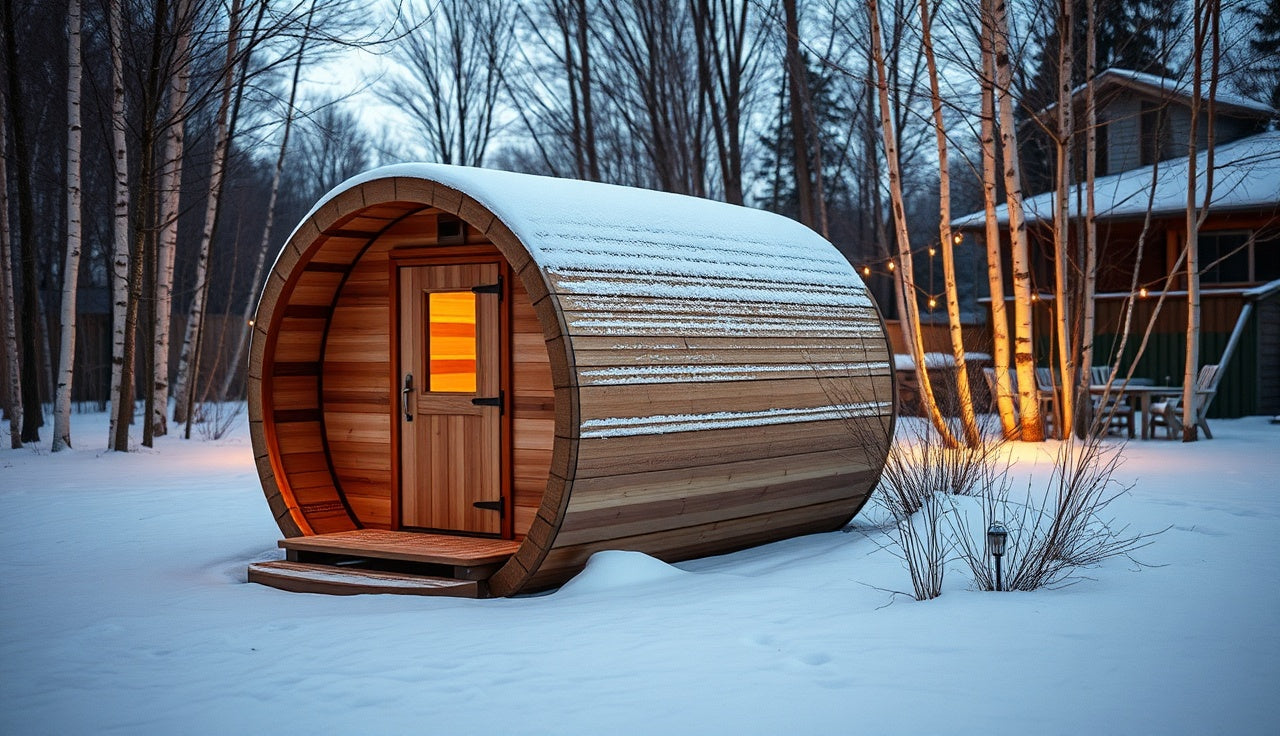
A barrel sauna is a cylindrical wood structure, usually built from cedar, hemlock, or pine staves, that works like a traditional Finnish dry sauna. The round shape is more than for looks. Curved walls pull cool air off the floor toward the heater at the center, then push hot air across the ceiling and back down. That convection loop heats the space faster and more evenly than a rectangular box of the same volume. Less air volume also means a smaller heater and a lower electric bill.
The design comes from Scandinavia, where circular and oval wood structures go back centuries. Modern versions use tongue-and-groove stave construction, the same idea as a wine barrel, so the wood locks itself together under tension without glue. The structure self-seals and takes outdoor freeze-thaw cycles better than most framed outbuildings.
People build rather than buy finished units for three reasons: cost, customization, and the plain satisfaction of doing it yourself. A prefab barrel sauna kit from a reputable supplier runs $2,500 to $6,000 for the shell. A finished, delivered, fully assembled unit from a dealer can hit $8,000 to $15,000 for the same footprint. The gap mostly pays for labor and dealer margin. If you own a drill, a rubber mallet, and a free weekend, the kit path makes sense.
For how barrel saunas stack up against other formats, see our overview of home sauna options.
How much does it cost to build a barrel sauna?
The honest range is wide. A bare-bones DIY build with a basic hemlock kit, a wood-burning heater, and few accessories lands around $2,500 to $3,500 all-in. A mid-range Western Red Cedar kit with a quality electric heater, a proper base, and a few accessories runs $5,000 to $8,000. A premium build (Nordic spruce or clear-grade cedar, a high-end Finnish electric heater, a solid deck, professional electrical work) pushes $10,000 to $14,000 or more [1].
Here is a rough breakdown of where the money goes:
| Component | Budget range | Mid range | Premium range |
|---|---|---|---|
| Barrel kit (shell only) | $2,000, $3,000 | $3,500, $5,500 | $6,000, $10,000+ |
| Heater (electric or wood) | $300, $600 | $700, $1,200 | $1,500, $3,000 |
| Stones | $40, $80 | $80, $150 | $150, $300 |
| Foundation / base | $0, $200 (gravel) | $300, $800 (pavers) | $1,000, $3,000 (concrete) |
| Electrical work | $0 (wood burner) | $500, $1,500 | $1,500, $3,500 |
| Permit fees | $50, $150 | $100, $300 | $200, $500 |
| Accessories (benches, lights) | Included in kit | $100, $400 | $400, $1,000 |
The heater and the electrical run are the two lines people underestimate most. Go electric and if your panel needs a new 240V circuit, a licensed electrician will charge $500 to $1,500 for the run depending on distance and local labor. That money is well spent. A double-pole 240V circuit for a sauna heater is not a DIY-safe project unless you hold the license yourself.
Wood-burning heaters skip the electrical cost but add ongoing wood and produce smoke, which matters in neighborhoods with air quality rules or HOA restrictions. They also need chimney clearance, commonly 18 inches from combustibles per most heater manufacturers, so factor that in [2].
Permit fees are real and variable. Many jurisdictions treat a barrel sauna as an accessory structure, so it falls under the same local codes as sheds and outbuildings. The permit might cost $50 to $300, but the requirement can trigger setback rules, inspections, and a separate electrical permit that add time and money. Check before you pour a foundation.
Do you need a permit to build a barrel sauna in your backyard?
Usually yes, and this is the step people skip at their peril. Most U.S. municipalities classify a barrel sauna as an accessory structure, and accessory structures almost always need a permit once they pass a size threshold or carry electrical or plumbing connections [3].
The rules vary by city and county. In many jurisdictions any structure over 120 square feet needs a building permit. A typical 6-foot-diameter, 8-foot-long barrel sauna covers roughly 47 square feet, which puts it under that line in a lot of places. But add a deck, a changing room, or an electrical connection and you often trigger permit requirements no matter the size.
Electrical work almost always needs its own permit. The National Electrical Code covers fixed electric space heating under Article 424 and wet and damp locations under related articles, and local inspectors apply these differently. Ask your building department directly rather than guessing which article they cite.
HOA rules are a separate layer. Even if the city does not require a permit, your HOA covenants may ban outbuildings, restrict colors, or demand architectural review. Pull your CC&Rs before you buy anything.
Here is the practical move. Call your local building department, describe the build (dimensions, electric or wood-burning, attached to anything or freestanding), and ask what permits and setbacks apply. The call takes ten minutes and can save you a demolition order.
| Barrel kit (shell) | $4,500 |
| Electric heater | $950 |
| Electrical installation | $1,000 |
| Foundation (pavers/gravel) | $500 |
| Permit fees | $200 |
| Accessories and stones | $300 |
Source: Angi Cost Guide and Harvia Sizing Documentation, 2024
What is the best wood for a barrel sauna?
Wood choice drives cost, durability, aroma, and how the sauna looks five years out. The main options are Western Red Cedar, Nordic spruce (sometimes called Finnish spruce), hemlock, and white pine.
Western Red Cedar is the most popular choice in North American kits, and for good reason. Natural oils resist moisture and decay, it stays dimensionally stable through repeated heat cycles, it splinters less than most species, and it smells great. The catch is cost. Clear-grade Western Red Cedar runs well above hemlock or pine [4].
Nordic spruce is the wood in most traditional Finnish saunas. It is tight-grained, low in resin, and slow to conduct heat, so benches and walls stay comfortable to touch even when the air sits at 185 degrees F. It lacks cedar's natural rot resistance, so it has to dry out between sessions or it will mold. For an outdoor barrel, cedar edges out spruce on longevity.
Hemlock is the budget option. Stable, light in color, takes heat well. It has none of cedar's natural oils, so outdoor exposure ages it faster without periodic treatment or a good roof overhang. Plenty of entry-level kits use hemlock, and they hold up fine with reasonable care.
White pine is cheap and everywhere, but it carries more resin than the others. Heat it and that resin can bleed out into sticky spots on the benches. It is the least preferred interior sauna wood.
For an outdoor barrel sauna, Western Red Cedar is the practical pick for most people. For a covered or indoor install where rot resistance matters less, Nordic spruce gives you the most authentic Finnish feel.
How do you choose the right size barrel sauna?
Barrel saunas are sold by diameter and length. Common diameters are 4, 5, 6, and 7 feet. Length runs 6 to 8 feet on standard models, with some makers offering 10-foot or custom lengths.
A 4-foot diameter is genuinely cramped for two adults. You can seat two on side benches, but you will bump knees. Call it a solo unit, a couple at a stretch. A 5-foot diameter is the sweet spot for two and comfortable for three. A 6-foot diameter seats four and fits two people lying flat, which matters for long recovery sessions. A 7-foot diameter is a social sauna that holds five or six.
Length sets bench area and heater placement. In a standard layout the heater sits on the floor at one end, benches run along the curved walls on both sides, and the door is at the far end. An 8-foot length gives you meaningfully more bench than a 6-foot length and allows a small changing area or a vestibule.
If you plan to pair the sauna with a cold plunge, reserve some outdoor square footage for the plunge near the sauna exit. Contrast therapy works best when the switch from heat to cold takes ten seconds, not a walk across the yard.
For most families of two to four, a 6-foot diameter by 8-foot length barrel is the right call. Comfortable enough to actually use, small enough to heat in 30 to 45 minutes, and it fits most backyards.
What heater should you use in a barrel sauna?
The two real options are electric and wood-burning. Each has a legitimate case, and neither wins across the board.
Electric heaters are the practical choice for most homeowners. Cleaner, easier to control, legal in more places, and compatible with timers and remotes that preheat the sauna before you step outside. Sizing is simple. The common rule of thumb is 1 kW of heater power per 45 cubic feet of sauna volume, though manufacturers vary on the exact figure. A 6-foot diameter by 8-foot length barrel holds roughly 180 cubic feet inside (the curve cuts air volume versus a rectangular box of the same dimensions), so a 4 kW heater sits on the low end and a 6 kW gives you comfortable headroom [5].
Finnish brands like Harvia, Helo, and SAWO have strong reputations and good parts availability. IKI and Narvi sit at the higher end. All of them have been building sauna heaters for decades. For a home barrel, a Harvia or Helo unit in the 4 to 8 kW range is a proven pick.
Wood-burning heaters give you the real Finnish experience: the crackle of a fire, a different quality of heat, no electric bill for the heater itself. They heat faster in cold weather than electric units and reach higher peaks. The tradeoffs are real. You need a chimney permit in many jurisdictions, local air rules may ban wood burning, you tend the fire by hand, and cleanup takes more work. Live rurally with access to wood and this becomes a legitimate, often deeply satisfying choice.
One hard rule: never run a propane or gas heater inside a barrel sauna. The carbon monoxide risk is real and documented. Electric or wood only [6].
How do you build a barrel sauna step by step?
This assumes you are working from a prefab kit, which is how most DIY barrel saunas actually get built. A kit includes pre-cut, pre-dried staves, metal bands, a door and hardware, interior benches, and usually a vent.
Step 1: Site selection and prep. The barrel needs a level, load-bearing surface. A concrete slab is ideal but pricey. Pressure-treated 4x4 runners on compacted gravel work well and cost far less. Never set the barrel on bare soil, since the wood will wick up ground moisture and rot. Leave at least 2 feet of clearance on all sides for airflow and access. Running a wood-burning heater? Confirm chimney clearances before you lock in the position.
Step 2: Set the cradle or base runners. Most kits include two or four curved cradle pieces that support the barrel on either side, like a wine barrel on a rack. These go down first, leveled carefully with a spirit level. Budget one to two hours here and do it slowly. A level base makes everything after it easier.
Step 3: Lay the floor staves. Many kits start with a flat floor section inside the barrel. These staves join with tongue-and-groove. Tap them together with a rubber mallet, not a hammer. Do not force a joint. If it is stiff, check for debris or a misaligned piece.
Step 4: Build up the wall staves. Starting from the floor, add wall staves one at a time, working around the curve. Slide the metal bands over as you go but leave them loose until every stave is in place. This is the slow part, usually three to five hours for two people.
Step 5: Tighten the metal bands. Draw the bands tight with the provided hardware. Work in a cross-pattern, tightening each band a little at a time instead of maxing one before the next. The barrel starts to feel rigid as the staves compress against each other. That compression is what creates the moisture seal.
Step 6: Install the door and end panels. Most kits ship pre-hung door assemblies. Follow the manufacturer's sequence here, because the order determines whether the end panels seat flush.
Step 7: Mount the heater and vent. Set the electric heater on the wall or floor per the manual, holding required clearances (typically 4 to 6 inches from the wall for a wall-mount, but read your manual). The vent goes near the floor at the opposite end from the heater to keep air circulating.
Step 8: Run electrical (electric heater). Unless you are a licensed electrician, hire one for this. A sauna heater needs a dedicated 240V circuit on a properly rated breaker. The National Electrical Code requires ground-fault protection in wet locations, and saunas qualify [7].
Step 9: Add benches and accessories. Install benches, backrests, a bucket and ladle for loyly (pouring water on the stones), plus a thermometer and hygrometer. Pre-drill bench screw holes if the kit calls for it, to avoid splitting the wood.
Step 10: Season the wood with a first burn. Before your first real session, run the heater at medium heat (around 150 degrees F) for 30 to 45 minutes with the door cracked. That dries out shipping moisture and lets the wood off-gas any surface treatment. Ventilate well. After this burn, the sauna is ready.
Total shell time for two people with basic tools runs one to two days, plus electrician scheduling and foundation prep.
What foundation do you need under a barrel sauna?
A barrel sauna does not need a poured concrete slab, though you can pour one if you want. The common, practical foundations, ordered by cost and permanence, look like this.
Compacted gravel with pressure-treated 4x4 runners. Excavate 4 to 6 inches, fill with compacted crushed stone, and set two or four pressure-treated 4x4s flat on the gravel. Level them carefully. Materials run $100 to $300 and drainage is excellent. This is the right choice for most backyard installs.
Concrete pavers on a gravel base. Swap the wood runners for 12x12 or 16x16 concrete pavers. Cost is similar to the 4x4 approach, a bit more permanent, and easy to level with a rubber mallet and sand.
Poured concrete slab. A 4-inch slab is overkill for a barrel alone but makes sense if you are building a full outdoor sauna area with a deck. Budget $1,000 to $3,000 depending on size and location. A permit is required in most jurisdictions.
Decking on a frame. To fold the sauna into an existing deck or a new one, pressure-treated or composite decking on a properly built frame works. Confirm the frame is rated for the load. A 6x8 barrel weighs roughly 800 to 1,200 pounds empty, more with occupants and a stone-loaded heater.
What you cannot do is set the barrel on bare soil or grass. The bottom staves will pull ground moisture, rot, and fail. Even six months of direct soil contact can start it.
How long does a barrel sauna take to heat up, and how hot does it get?
A properly sized electric heater in a 6-foot diameter barrel reaches 150 to 170 degrees F in roughly 30 to 45 minutes at an outdoor temperature near 50 degrees F. Colder winter weather adds 10 to 20 minutes. Wood-burning heaters often heat faster in the cold because the fire throws more radiant heat, and a well-stoked fire can bring a 6x8 barrel to temperature in 20 to 30 minutes.
Traditional Finnish saunas run 80 to 100 degrees C (176 to 212 degrees F) at the upper bench, with relative humidity from 10 to 20 percent in a dry session up to 40 to 60 percent right after water hits the stones [8]. Most American users settle in the 150 to 185 degrees F range. The barrel shape holds heat well. Because the rounded ceiling sits closer to the upper bench than in a tall rectangular room, the hottest air layer lands right where you sit.
The Finnish Sauna Society suggests 10 to 20 minute rounds with cooling breaks. Medical literature consistently reports that sessions at these temperatures are well-tolerated in healthy adults who are not dehydrated or on medications that impair heat regulation [9]. Anyone with a heart condition, a pregnancy, or a blood-pressure medication should talk to a doctor before regular sauna use. Honest framing matters here. The studies show an association between sauna use and lower cardiovascular risk. They do not prove your barrel sauna will change your specific health outcomes.
For a fuller read on what the research actually says, the sauna benefits page covers the clinical evidence without inflating it.
How do you maintain and care for a barrel sauna?
Maintenance is simpler than most people expect, but skip it and you buy expensive repairs.
After each session, leave the door and vent open for 30 to 60 minutes to dry the interior. Moisture is the enemy of interior wood. Wipe up any standing water on the floor, and dump leftover water from the pouring bucket.
Monthly, wipe down interior surfaces with a damp cloth and no soap. Check the metal bands for rust, especially in humid climates. Light surface rust on galvanized bands is cosmetic. Deep rust on the band hardware means it is time to tighten or replace the fasteners.
Twice a year, sand rough or splintery bench spots with 120-grit paper and apply a water-repellent finish to the exterior. Never treat the interior with oil, paint, or stain. Interior wood seasons and develops a patina on its own, and anything applied will off-gas when heated and can irritate your lungs. The exterior takes a water-repellent finish or silvers naturally, which is a legitimate and traditional look for cedar.
Annually, inspect the roof panel (if your barrel has one) for damage or gaps. Check every electrical connection and the heater element. Clean the heater stones every one to two years. Sauna stones fracture over time from thermal cycling, and the fragments can chew up the heater element, so replace stones once they start to crumble [10].
If gaps open between staves during dry summer months, that is normal. Wood shrinks in low humidity, and the gaps usually close when moisture returns. In very dry climates, running the sauna with a little more water on the stones helps keep the wood conditioned.
Can you build a barrel sauna from scratch without a kit?
Yes, but it is much harder than it looks. Stave construction needs wood milled to precise angles, typically an 11.25-degree stave angle for a 16-stave barrel (360 degrees divided by 16, then halved for the bevel on each edge), or different angles for different stave counts. You need a tablesaw set up for repeatable compound bevels and access to properly kiln-dried, sauna-grade lumber [4].
The end panels are the next wall. Cutting a circular end panel from solid wood and fitting it so it seals against the staves takes careful work. Most scratch builders reach for a router and a circle jig, then test-fit and trim.
The metal banding that holds the barrel under tension requires custom fabrication or salvage from old barrels. This is the part DIY builders underestimate most.
Scratch builds make sense if you have serious woodworking chops, a good tablesaw setup, and time. Material cost may run slightly under a kit, but not by much once you count waste, the premium for sauna-grade lumber over standard stock, and the learning curve. For most people, a kit is the better value because the milling is already done.
Going scratch-built anyway? Your best resources are Finnish sauna building guides and the room-construction documentation from Finnish heater companies. The Finnish Sauna Society publishes construction guidelines worth reading before you mill a single board [8].
Is a barrel sauna worth the money compared to other sauna types?
Against a pre-built indoor sauna room at a similar price, a barrel sauna usually wins on heating efficiency and outdoor looks. The cylinder heats faster and more evenly, and it reads well in a backyard where a rectangular box often does not.
Against an indoor traditional sauna, a barrel loses on maximum bench space and loses on longevity if you neglect it, but wins on install simplicity. You skip framing, insulating, and finishing a room.
Against a portable sauna, a barrel wins on nearly every experiential metric: heat capacity, authentic feel, durability, and resale value. The portable costs less upfront, but it is a different category of product.
Here is the honest case. Want a real outdoor sauna that heats properly, looks good, and lasts 15 to 25 years with reasonable care? A barrel sauna in the $5,000 to $9,000 all-in range is a genuinely good buy. It adds real enjoyment to a backyard, and cedar barrels keep resale appeal in markets that value outdoor wellness amenities.
At SweatDecks we stock barrel sauna kits and accessories alongside cold plunge units because the two pair naturally. The right answer for you still depends on your yard, your budget, and how seriously you plan to use it. A sauna you climb into three times a week is worth far more than an expensive one that turns into yard art.
For a wider view of outdoor sauna options and what separates good builds from regrettable ones, the outdoor sauna guide covers the full field.
Frequently asked questions
How long does it take to build a barrel sauna from a kit?
Most prefab barrel sauna kits take two people one to two days to assemble the shell, not counting foundation work or electrical. Foundation prep adds a half day to a full day. Scheduling a licensed electrician for the 240V circuit is usually the longest lead time, often one to three weeks depending on your area. Budget a full weekend for the physical build.
What size barrel sauna do I need for two people?
A 5-foot diameter by 6- or 7-foot length barrel comfortably fits two adults. Want to lie down on the benches or occasionally add a third person? Step up to a 6-foot diameter by 8-foot length. The 6x8 is the most popular size for a reason: it heats fast, fits most yards, and seats two to four people without feeling cramped.
Can a barrel sauna stay outside year-round?
Yes. Barrel saunas are built for outdoor use and handle temperature extremes well. Cedar naturally resists moisture and decay. In cold climates, drain any water after each session and keep the vent cracked to prevent moisture buildup. The wood may open small gaps during dry months, which is normal and not structural. A roof panel protects the barrel from direct UV and rain and adds meaningful years.
Do I need to treat the wood inside a barrel sauna?
No. Never apply oil, paint, stain, or sealant to interior sauna wood. Any treatment off-gasses when the wood gets hot, producing fumes that are unpleasant at minimum and potentially harmful. Interior wood stays raw and seasons on its own. The exterior takes a UV-resistant wood finish, or you can let it weather to gray, which cedar does gracefully.
What is loyly and how do you do it in a barrel sauna?
Loyly (roughly 'LOY-loo') is the Finnish practice of pouring water on the hot stones to make a burst of steam. Use a long-handled wooden ladle and pour a small amount, about a quarter cup at a time, directly onto the stones. The steam spikes humidity and creates a short, intense wave of heat. You can add essential oils like eucalyptus for aroma, though pure water is traditional.
How much does it cost to run a barrel sauna electrically each month?
A 6 kW electric heater running one hour costs roughly $0.60 to $1.20 per session at the U.S. average residential rate of about $0.13 per kWh as of 2024 [11]. Four sessions a week works out to $10 to $25 a month. Actual cost swings with heater wattage, session length, outdoor temperature, and your local rate. A wood-burning heater drops the electricity cost but adds firewood.
Can I put a barrel sauna on a wood deck?
Yes, if the deck is rated for the load. A 6x8 barrel weighs roughly 800 to 1,200 pounds empty, and that weight concentrates on two to four cradle contact points. Have a contractor confirm your deck joists and framing can handle concentrated point loads before you set the sauna down. Spreading load with a platform or extra framing under the contact points is a common, cheap fix.
What is the best way to pair a barrel sauna with cold therapy?
The most effective contrast protocol, drawn from Finnish sauna culture and exercise recovery research, is 10 to 20 minutes in the sauna followed by 1 to 3 minutes in cold water, repeated two to four rounds. A cold plunge tub or ice bath set close to the sauna exit makes it easy. The ice bath guide covers cold water temperature ranges and timing if you want the detail.
How often should I replace the sauna stones?
Sauna stones typically last one to three years with regular use before they fracture and crumble from repeated thermal cycling. Inspect them annually. Crumbling or porous stones can fall onto the heater element and damage it. Replace with proper sauna-grade igneous rock such as olivine, vulcanite, or peridotite. Skip river rocks and granite, which can crack and splinter dangerously when heated.
Does a barrel sauna increase home value?
Formal appraisal data on barrel saunas specifically is limited, but real estate agents increasingly cite outdoor sauna and wellness amenities as desirable in markets that value outdoor living space. A well-built cedar barrel on a proper foundation photographs well and appeals to buyers. A neglected, rotting unit does the opposite. Maintenance matters more than the initial install for perceived value.
What permits do I need to build a barrel sauna?
Requirements vary by municipality. Most classify a barrel sauna as an accessory structure and require a building permit for any electrical connection or for structures over a size threshold, often 120 square feet. A separate electrical permit is almost always required for a new 240V circuit. Some areas also require mechanical or fire permits for wood-burning heaters with chimneys. Call your local building department before buying anything.
Is cedar or hemlock better for a barrel sauna?
Cedar is better for outdoor barrels exposed to weather. Its natural oils resist moisture and decay far better than hemlock and hold up through repeated wet-dry cycles. Hemlock costs less and does fine in a sheltered outdoor or indoor spot. With a good roof and a relatively dry climate, hemlock is a reasonable budget choice. In wet climates or fully exposed locations, pay for cedar.
Can children use a barrel sauna?
Children can use saunas at lower temperatures and shorter durations than adults, but the medical guidance is cautious. The American Academy of Pediatrics has not issued sauna-specific rules, and most heat tolerance data comes from adult studies [12]. Finnish tradition includes children at lower temperatures from a young age. If you bring kids in, keep it below 150 degrees F, limit sessions to 5 to 10 minutes, keep them hydrated, and let them exit freely whenever they want.
What tools do I need to assemble a barrel sauna kit?
Most kits need a rubber mallet, a drill with bits, a socket set or wrench for the band hardware, a level, and a tape measure. Some kits include all hardware and need no power tools at all for the shell. You will want standard carpentry tools for any foundation or decking work. Read the kit's tool list first, since many manufacturers spell out the full list in their instructions.
Sources
- HomeAdvisor / Angi, Sauna Installation Cost Guide: Barrel sauna installed costs typically range from $2,500 to $12,000+ depending on size, wood species, and heater type
- U.S. Consumer Product Safety Commission, Chimneys, Fireplaces, and Wood Stoves Safety: Wood-burning heaters and stoves require minimum clearances from combustible materials, commonly cited as 18 inches for many appliances
- International Code Council, International Building Code (IBC) Accessory Structures: Accessory structures including saunas are typically subject to local building code permit requirements, with many jurisdictions setting the threshold at 120 square feet
- USDA Forest Service, Wood as an Engineering Material (Agriculture Handbook 72): Western Red Cedar has natural extractives that provide superior decay resistance compared to hemlock and pine, making it preferred for moisture-exposed applications
- Harvia Sauna Heater Sizing Guide (Harvia Group, Finland): Harvia recommends approximately 1 kW of heater power per 45 cubic feet of sauna room volume as a baseline sizing guideline
- U.S. Centers for Disease Control and Prevention, Carbon Monoxide Poisoning Prevention: Combustion appliances including gas and propane heaters must not be used in enclosed spaces without proper ventilation due to carbon monoxide risk
- NFPA 70, National Electrical Code (NEC), Article 424 and 680: The NEC requires dedicated circuits and ground-fault protection for fixed electric heating equipment and special locations including wet and damp environments such as saunas
- Finnish Sauna Society, Sauna Construction and Usage Guidelines: Traditional Finnish saunas are heated to 80-100°C at the upper bench with relative humidity ranging from 10-20% dry to 40-60% immediately after löyly
- Laukkanen et al., JAMA Internal Medicine, 2015: Association Between Sauna Bathing and Fatal Cardiovascular and All-Cause Mortality Events: The study found that frequent sauna bathing (4-7 times per week) was associated with reduced cardiovascular mortality in a Finnish cohort over 20 years of follow-up
- Harvia Care and Maintenance Instructions for Sauna Heaters: Sauna stones should be inspected annually and replaced when they begin to crack or crumble, as broken stones can damage heater elements
- U.S. Energy Information Administration, Average Retail Price of Electricity: The U.S. average retail electricity price was approximately $0.13 per kWh for residential customers as of 2024
- American Academy of Pediatrics, Healthy Children Resource Library: The AAP advises caution regarding heat exposure in children and recommends supervision and limited duration for any heat-based activity
Share:
Cold plunge tub trends for 2025 and 2026: what's actually changing
Aquavoss cold plunge & hot tub model 2 review: is it worth it?