
Last updated 2026-07-10
TL;DR
A sauna temperature gauge (thermometer/hygrometer combo) tells you whether your sauna is running in the therapeutic range, typically 150 to 195°F (65 to 90°C) for traditional Finnish saunas and 120 to 140°F for infrared. Mount it 4 to 5 feet off the floor on the wall opposite the heater. Analog bi-metal gauges cost $20 to 60 and outlast most digital units in high heat.
What does a sauna temperature gauge actually do?
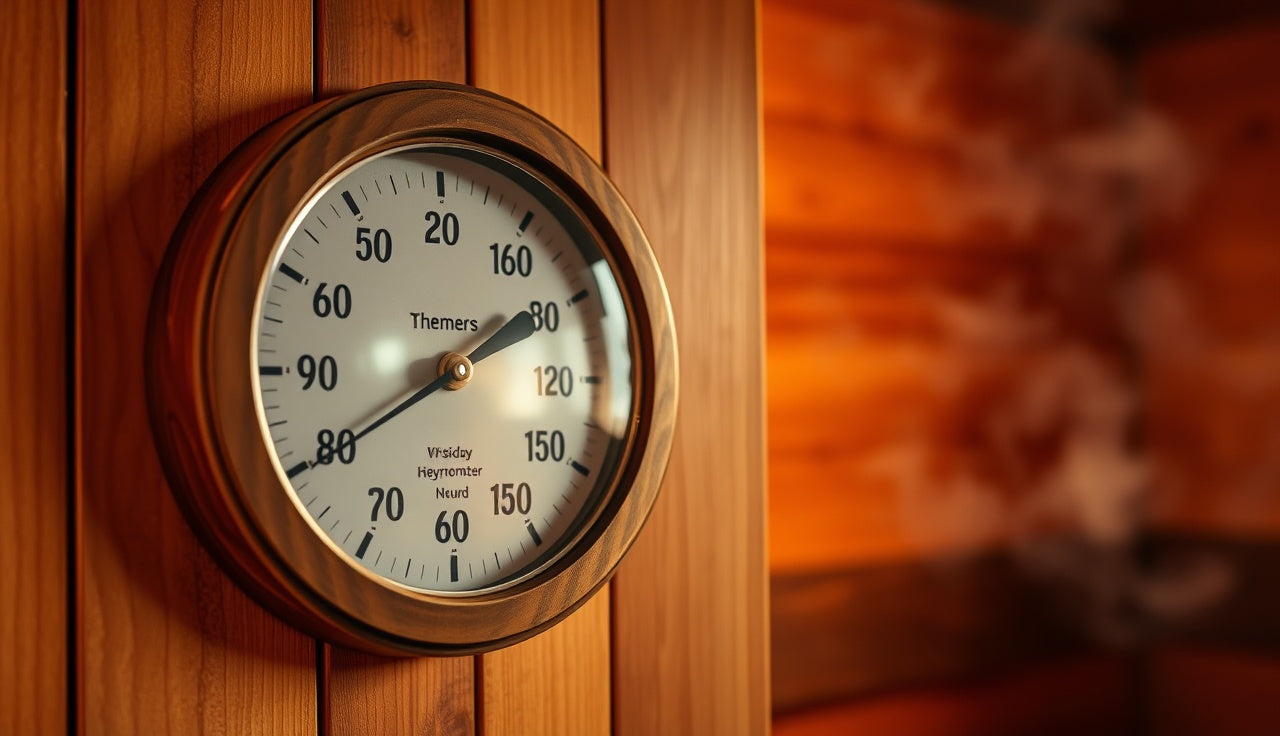
A sauna temperature gauge measures the air temperature inside your cabin and, in most combo units, the relative humidity too. That second number matters because humidity is what makes a given temperature feel punishing or gentle. A Finnish sauna at 185°F with 15% relative humidity feels nothing like a steam room at 110°F and 100% humidity, even though the steam room is technically cooler.
The gauge controls nothing. It is a read-only instrument. Your heater thermostat sets the temperature; the gauge tells you whether the thermostat is doing its job. That sounds obvious. But plenty of sauna owners run for years trusting their built-in digital controller, then set a calibrated thermometer inside and find it reading 20 to 30°F high or low.
You use the gauge for three plain jobs: confirm you have hit your target before getting in, track temperature drift during a session, and catch problems like a heater struggling in winter or a door seal that is leaking heat.
What temperature should a sauna be, and why does it matter for picking a gauge?
Traditional Finnish-style saunas run 150 to 195°F (65 to 90°C) at bench height. Most experienced users sit in the 170 to 185°F range. Infrared saunas run cooler, typically 120 to 140°F (49 to 60°C), because the radiant energy heats your body directly instead of heating the air first. Steam rooms sit at 110 to 120°F but at nearly 100% relative humidity [1].
The range drives your purchase because not every thermometer survives the full Finnish heat. Cheap plastic-cased digital thermometers fail or read erratically above 140 to 150°F. A traditional electric or wood-burning sauna needs a gauge rated to at least 220°F (104°C) for headroom. An infrared-only setup can get away with a standard digital unit.
The Finnish Sauna Society, the oldest organized authority on sauna culture, puts the therapeutic range for most adults in a traditional sauna at 80 to 100°C (176 to 212°F) at upper bench level [2]. That is your upper bound. A gauge topping out at 140°F is useless in that room.
For a deeper look at what those temperatures do for your body, the sauna benefits guide covers the research.
What are the different types of sauna thermometers?
Three types show up in real saunas.
Analog bi-metal thermometers use two bonded metal strips that expand at different rates with heat, moving a needle across a dial. No batteries, no electronics, nothing to corrode. Quality versions from Harvia or Finnleo hit plus or minus 2 to 5°F and are rated to 250°F or higher. They cost $20 to 60 and will usually outlast your heater. This is what most Scandinavian sauna owners run.
Combination analog hygrometer/thermometer units add a hair-tension hygrometer to read relative humidity. The sensor uses human or synthetic hair that stretches with moisture. Accuracy is reasonable in the mid-humidity range you actually care about (20 to 60% RH) but drifts at the extremes. These run $30 to 80.
Digital thermometers with remote probes put a wired sensor inside the sauna and the display outside. Handy for checking preheat without opening the door, but the probe wire needs a heat rating and the display housing has to stay outside the cabin or it fails. Accuracy often beats analog, typically plus or minus 1 to 2°F, but battery life drops fast in high heat. Plan on new batteries every few months if the unit lives inside.
Infrared and Bluetooth smart sensors exist too. Most are not rated for traditional sauna temperatures, and the wireless signal behaves strangely through cedar walls. Skip them unless you have an infrared sauna and want app logging.
| Type | Temp Range | Accuracy | Battery | Price Range |
|---|---|---|---|---|
| Analog bi-metal | Up to 250°F+ | ±2 to 5°F | None | $20 to 60 |
| Analog combo (temp + humidity) | Up to 230°F | ±3 to 5°F, ±5% RH | None | $30 to 80 |
| Digital with remote probe | Up to 212°F typical | ±1 to 2°F | Yes | $25 to 70 |
| Smart/Bluetooth sensor | Usually 140°F max | ±1 to 2°F | Yes | $50 to 150 |
| Traditional Finnish (electric) | 180 |
| Traditional Finnish (wood-burning) | 190 |
| Infrared sauna | 130 |
| Steam room | 115 |
| Portable/tent sauna (infrared) | 125 |
Source: Finnish Sauna Society, 2023; Amerec sauna guidelines
Where should you mount a sauna thermometer for an accurate reading?
Mount it on the wall opposite the heater, at upper bench height, roughly 4 to 5 feet (120 to 150 cm) off the floor. That puts the sensor in the air zone where your head sits when you recline on the top bench. Placement is where most people get this wrong, and a badly placed gauge is worse than no gauge because it hands you false confidence.
The air near the ceiling in a traditional sauna can run 40 to 50°F hotter than the air at foot level, because hot air rises and stratifies sharply [3].
Do not mount it directly above the heater. The radiating heat reads artificially high. Do not mount it near the door, where cold air pulls the reading down every time someone enters. Do not mount it at floor level unless you specifically want to know what temperature your feet are at (you probably do not).
If you have a two-bench sauna, some people add a second gauge at lower bench height to read the gradient. Optional, but genuinely interesting the first time you see a 50°F spread between bench levels in one room.
How accurate are sauna thermometers, and how do you calibrate one?
Factory accuracy for a quality analog sauna thermometer runs plus or minus 3 to 5°F (about 2 to 3°C). That is fine for practical use. You are not doing lab work. You are confirming you sit in the 170 to 185°F zone, and a 5°F error changes nothing about your session.
Digital units with calibrated probes are more accurate out of the box, often plus or minus 1 to 2°F, but they drift over time and the probe takes damage from repeated thermal cycling.
The easiest field check uses ice water and boiling water. Put the probe in a proper ice bath (ice plus water, more ice than water) and confirm it reads 32°F (0°C). Then put it in boiling water at your altitude and confirm it reads the expected boiling point (212°F at sea level, about 203°F at 5,000 feet). If both ends of the scale are right, the middle is right too. Most analog bi-metal gauges have a small adjustment screw on the back for zeroing.
Nobody calibrates their sauna thermometer on a schedule. That is honest. But if you buy a used unit, or your gauge readings stop matching how the session feels, run a quick ice-water check before you assume the heater is broken.
Are there safety temperature limits you should know about?
This is where the gauge earns its keep. The American College of Sports Medicine, in its guidance on exertional heat illness, treats core body temperature above 40°C (104°F) as heat stroke territory and notes that heat illness risk climbs sharply for unacclimatized people in hot, humid conditions [4].
That does not make a Finnish sauna at 185°F dangerous for a healthy adult. The low humidity lets sweat evaporate and cool you even as the air stays very hot. It does mean that pushing past 200°F with high humidity, or staying in far longer than your body can regulate, is a real risk.
A 2018 study in JAMA Internal Medicine following Finnish men over decades found that frequent sauna use (4 to 7 times per week) was associated with lower cardiovascular mortality, but the authors were careful to note this was observational and could not establish causation [5]. The saunas in that data sat in the 80 to 100°C (176 to 212°F) range, the standard Finnish protocol.
Your gauge keeps you inside that studied range and flags temperatures that creep higher than you meant. If you are building a home sauna, NFPA 86 covers industrial ovens rather than residential saunas, but local building codes often reference maximum heater output and minimum clearances that effectively cap the temperature ceiling of a code-compliant installation [6].
For how this fits the rest of the build, the home sauna guide walks through heater sizing and ventilation.
What should you look for when buying a sauna thermometer?
Five things actually matter.
First: temperature rating. Buy one rated to at least 220°F (104°C) for a traditional sauna. Anything lower and you are gambling on plastic degrading or the sensor drifting at the top of your range.
Second: material. The housing should be wood (aspen, cedar, or pine) or stainless steel. Plastic housings crack and off-gas through repeated heat cycles. A good Finnish or German analog unit uses wood and glass. Cheap online units use ABS plastic and last one or two seasons.
Third: readability. You are reading this from a bench with your eyes half closed. The dial should be at least 4 inches across, with clear markings in both Fahrenheit and Celsius. Most quality European units label both.
Fourth: mounting hardware included. A simple screw mount is fine. Make sure it attaches to cedar or pine without cracking the wood.
Fifth: whether you want humidity included. If you throw water on the rocks and care about the humidity experience, get a combo unit. If you run a dry sauna and only want temperature, a simpler analog dial is more reliable because it has fewer parts to drift.
Price-wise, $30 to 60 buys a solid analog combo unit that lasts years. Spending $100 or more does not buy meaningfully better performance for this job.
Does the type of sauna change what gauge you need?
Yes, meaningfully.
A traditional electric or wood-burning Finnish sauna needs the full-range analog unit described above. These saunas hit 170 to 195°F at bench height and the gauge has to take that without failing. Wood-burning saunas can spike higher if you load the firebox hard, so a unit rated to 250°F gives you a real margin [7].
An infrared sauna, running 120 to 140°F, works with almost any thermometer. The range is comfortable for consumer electronics. Humidity is close to a non-factor in most infrared cabins (they run very dry), so a humidity gauge adds little. A simple digital remote-probe unit is fine, and plenty of people just read the built-in panel and never buy a separate gauge. The portable sauna category often uses the same lower-temperature infrared elements, so the same logic applies.
A steam room needs a unit rated for very high humidity (near 100% RH) rather than high temperature. Most standard sauna thermometers are not tested for 100% RH, and the humidity sensor fails or reads erratically. A purpose-built steam room gauge, or a digital probe unit with a waterproof-rated sensor, is the right call. The sauna vs steam room comparison covers how these two environments differ in practice.
Outdoor saunas add one wrinkle. The gauge face is often read through a small window or checked before entering, so UV resistance and weatherproofing of the housing matter if it sits near an exterior wall or window. The outdoor sauna guide has more on outdoor-specific choices.
How do you install a sauna thermometer correctly?
Installation takes about ten minutes. You need a drill, a bit matched to your mounting screws, and a level if you care about the look.
Step one: pick the spot using the placement rules above (opposite the heater, upper bench height, away from the door). Mark it with a pencil.
Step two: pre-drill pilot holes. Cedar and pine split easily, especially after many heat cycles. A pilot hole slightly smaller than the screw diameter prevents cracks.
Step three: mount the bracket or the unit directly, snug but not overtight. Wood expands and contracts with heat, and an overtightened screw eventually cracks the surrounding material.
Step four: run a session and check the reading against your heater's thermostat display. A 10 to 20°F gap is common because the thermostat sensor usually sits near the heater, not at bench height. The thermometer shows what your body actually experiences.
One thing people miss: a combo hygrometer needs 20 to 30 minutes to acclimate before it stabilizes. Check humidity mid-session, not right after startup.
What's a reasonable temperature log to keep, and does it help?
A temperature log sounds more formal than it needs to be. For most home owners it is a note in a phone app or a small pad on a hook by the door: date, preheat time, temperature at session start, any observations.
Why bother? It surfaces trends. If your sauna used to reach 180°F in 30 minutes and now takes 50 minutes to hit 165°F, something changed. The heater elements may be degrading, the door seal may be failing, or you added mass to the room. A written record makes that pattern obvious instead of a thing you vaguely sense.
Athletes running structured heat protocols (some base theirs on reviews of Finnish population data [8]) use a log to confirm they are hitting their temperature and duration targets. The research that shows cardiovascular and recovery benefits used specific temperature ranges. To replicate a protocol, you have to know what temperature you are actually sitting in.
SweatDecks carries thermometer and hygrometer combos built for this, with large dials you can read from the top bench without leaning in. Any quality analog unit with a wood housing will serve you well regardless of where you buy it.
How does humidity affect what your thermometer is telling you?
Temperature alone is an incomplete picture. The heat stress your body feels depends on both temperature and humidity, the same relationship the National Weather Service formalizes in its heat index [9]. In a sauna, the principle holds.
At 180°F and 10 to 20% relative humidity (a typical dry Finnish sauna), sweat evaporates fast and your body regulates well. At 180°F and 40 to 60% relative humidity (after several ladles on the rocks), evaporative cooling gets less efficient and the session feels much more intense. Most people hit their limit faster at higher humidity.
This is why experienced users manage humidity actively, choosing when and how much to ladle (löyly). Your hygrometer shows where you sit on that dial. Some people want a very dry, high-heat sauna. Others prefer a wetter, slightly cooler room. Neither is wrong. The gauge lets you be deliberate.
No one has published a rigorous randomized controlled trial comparing health outcomes at different sauna humidity levels. The honest answer is that most observational data on sauna benefits comes from Finnish populations using traditional löyly protocols, so moderate humidity is baked into the baseline.
What do sauna thermometers typically cost, and are expensive ones worth it?
The market breaks into three bands.
Under $25: almost always plastic-housed units from unbranded suppliers. They work at infrared temperatures. In a traditional sauna, expect the housing to yellow and crack within one or two seasons and the accuracy to drift. Not recommended above 150°F.
$25 to 60: the sweet spot. Harvia, Amerec, and Finnleo make wood-and-glass analog combo units here that are rated for full Finnish temperatures and built to last a decade or more. This is where I spend money.
$60 to 150: you are mostly paying for looks. Nicer wood, a larger dial, decorative finishes, or a digital display with remote monitoring. The accuracy gain over a quality $40 analog unit is marginal for practical sauna use.
Above $150: unless you are instrumenting a commercial sauna for regulatory compliance or something equally unusual, this is not a better tool. It is a more expensive one.
One product type earns the premium: a digital unit with a remote probe that lets you watch preheat from outside the room. If you have a large barrel or outdoor sauna with a long preheat (45 to 60 minutes is common for a big wood-burning unit [10]), checking the temperature from your kitchen instead of walking out repeatedly is genuinely convenient. Expect $40 to 70 for a decent version.
Frequently asked questions
What temperature should my sauna thermometer read at bench height?
For a traditional Finnish sauna, aim for 150 to 195°F (65 to 90°C) at upper bench height. Most users find 170 to 185°F the most comfortable therapeutic range. Infrared saunas run cooler at 120 to 140°F. Mount the thermometer where your head sits when reclining on the top bench, not at floor level or near the ceiling.
Can I use a regular kitchen or outdoor thermometer in a sauna?
A standard kitchen thermometer is usually rated to 220 to 250°F and will technically read the temperature, but the housing may not survive repeated heat cycles and the probe is not built for sustained high heat. Outdoor thermometers top out around 140°F and fail or read inaccurately in a traditional sauna. Buy a thermometer rated for sauna use with a wood or stainless housing.
Why does my sauna thermostat read a different temperature than my separate thermometer?
Almost certainly because the thermostat sensor sits near the heater at a different height than your thermometer. Heater-mounted sensors read the air right around the element, which is hotter than the air at bench level. A 15 to 30°F gap between the control panel and a properly mounted bench-height thermometer is normal. Trust the separate thermometer for what you actually experience.
Where exactly should I mount a sauna thermometer?
Mount it on the wall opposite the heater at upper bench height, roughly 4 to 5 feet (120 to 150 cm) off the floor. Avoid the wall directly above the heater (reads high), the area near the door (reads low from cold drafts), and floor level (much cooler than bench level). This position gives you the air temperature your body experiences during a session.
Do I need a hygrometer in my sauna, or just a thermometer?
If you throw water on rocks (löyly), a hygrometer adds real value because humidity dramatically changes how intense a session feels. If you run a dry sauna and never add water, a simple thermometer is enough. Steam room users need a unit rated for near-100% humidity, since standard sauna hygrometers are not designed for that extreme. For infrared saunas, humidity is rarely a factor and a thermometer alone works.
How long does a sauna thermometer last?
A quality wood-and-glass analog bi-metal thermometer from a reputable brand (Harvia, Amerec, Finnleo) can last 10 years or more with no maintenance. The bi-metal mechanism has no electronic parts to fail. Cheap plastic-housed units often last only one to two seasons before the housing cracks or the dial fogs. Digital units last three to seven years on average; the battery contacts and probe wire are the usual failure points.
What is the maximum safe temperature for a home sauna?
Most health guidance and Finnish tradition place the upper practical limit around 100°C (212°F) at bench height for healthy adults. Above that, heat stress risk climbs. The Finnish Sauna Society targets 80 to 100°C for standard use. Local building codes often limit residential heater output in ways that cap effective air temperature. These ranges assume healthy adults with no contraindications like cardiovascular disease, pregnancy, or certain medications.
How do I calibrate a sauna thermometer at home?
For a quick two-point check: place the probe in an ice-water slurry (more ice than water) and confirm it reads 32°F (0°C). Then place it in boiling water and confirm it reads 212°F at sea level (subtract about 1°F per 500 feet of elevation). If both points are accurate, the middle range is reliable. Most analog units have a small calibration screw on the back for zeroing an offset.
Can a sauna thermometer be used outdoors or in a barrel sauna?
Yes, but look for a UV-resistant finish on the wood housing if it will sit near a window or catch sunlight before sessions. Barrel saunas and outdoor saunas have the same interior temperature requirements as indoor traditional saunas, so you still need a unit rated to 220°F or higher. A remote-probe digital unit is especially useful for outdoor saunas with long preheat, letting you monitor temperature from indoors.
Is there a difference between a sauna thermometer and a sauna hygrometer?
A thermometer measures temperature only. A hygrometer measures relative humidity only. Most products sold as sauna gauges are combination units that read both. The thermometer element uses a bi-metal strip; the hygrometer uses a hair or polymer tension mechanism that changes length with humidity. Both usually sit in the same wooden case with separate dials. You can buy them separately or as one combo unit.
Do infrared saunas need a thermometer?
Infrared saunas are less temperature-dependent than traditional saunas because the radiant energy heats your body directly rather than through the air. Still, a thermometer confirms the cabin is actually reaching the 120 to 140°F range the heater is rated for, which helps with troubleshooting. Standard digital thermometers work fine at infrared temperatures, and you do not need the high-rated analog units required for Finnish-style saunas.
What brands make the best sauna thermometers?
Harvia and Amerec are the most commonly recommended names in the North American market, both Finnish-heritage brands making wood-and-glass analog combo units rated for full traditional sauna temperatures. EOS and Tylo are also well-regarded European options. On a budget, any analog unit with a wooden housing (aspen or pine) and a rating above 220°F performs well. Avoid unbranded plastic units from generic online sellers.
How does sauna temperature compare between different sauna types?
Traditional Finnish electric or wood-burning saunas run 150 to 195°F (65 to 90°C) at bench height. Infrared saunas run 120 to 140°F (49 to 60°C). Steam rooms run 110 to 120°F (43 to 49°C) but at near-100% humidity. Perceived heat stress can be similar across all three despite the temperature spread, because humidity governs how well your body sweats and cools. Match the gauge to the environment: high-rated analog for Finnish, standard digital for infrared, humidity-rated units for steam.
Sources
- Finnish Sauna Society, sauna usage guidelines: Traditional Finnish sauna temperatures run 80–100°C (176–212°F) at upper bench level; steam rooms operate near 100% relative humidity at lower temperatures.
- Finnish Sauna Society, official sauna guidelines: The Finnish Sauna Society recommends 80–100°C as the standard therapeutic temperature range at upper bench height in a traditional sauna.
- ASHRAE, Thermal Comfort Standard 55: Hot air stratifies strongly in enclosed heated spaces; temperature gradients of 40–50°F between floor and ceiling level are physically consistent with known thermodynamics of heated enclosures.
- American College of Sports Medicine, position stand on exertional heat illness: Core body temperature above 40°C (104°F) defines heat stroke; risk of heat illness rises substantially with high ambient temperature and humidity combinations.
- JAMA Internal Medicine, 'Association Between Sauna Bathing and Fatal Cardiovascular and All-Cause Mortality Events', 2018: Frequent sauna use (4–7 times per week) was associated with significantly lower rates of cardiovascular mortality in a long-term Finnish cohort study; the study was observational and could not establish causation.
- National Fire Protection Association, NFPA 86 Standard: Local building codes referencing NFPA standards govern heating equipment clearances and maximum output ratings that implicitly set ceiling temperatures for code-compliant residential sauna installations.
- Harvia, sauna heater and accessory specifications: Quality Finnish sauna thermometers are rated to 250°F or higher to accommodate temperature spikes in wood-burning saunas during heavy firebox loading.
- National Center for Biotechnology Information (NIH), review of sauna bathing and health effects: Peer-reviewed reviews indexed at NIH summarize Finnish population data showing sauna benefits in studies where sauna temperature was consistently in the 80–100°C range.
- National Weather Service, Heat Index explanation: The National Weather Service heat index formalizes the relationship between air temperature and relative humidity in determining apparent heat stress on the human body.
- Amerec, sauna heater sizing and preheat guidelines: Large wood-burning barrel saunas typically require 45–60 minutes of preheat time to reach therapeutic temperatures at bench height.

Share:
Do portable saunas work? An honest look at the evidence
Cold plunge tub trends for 2025 and 2026: what's actually changing