
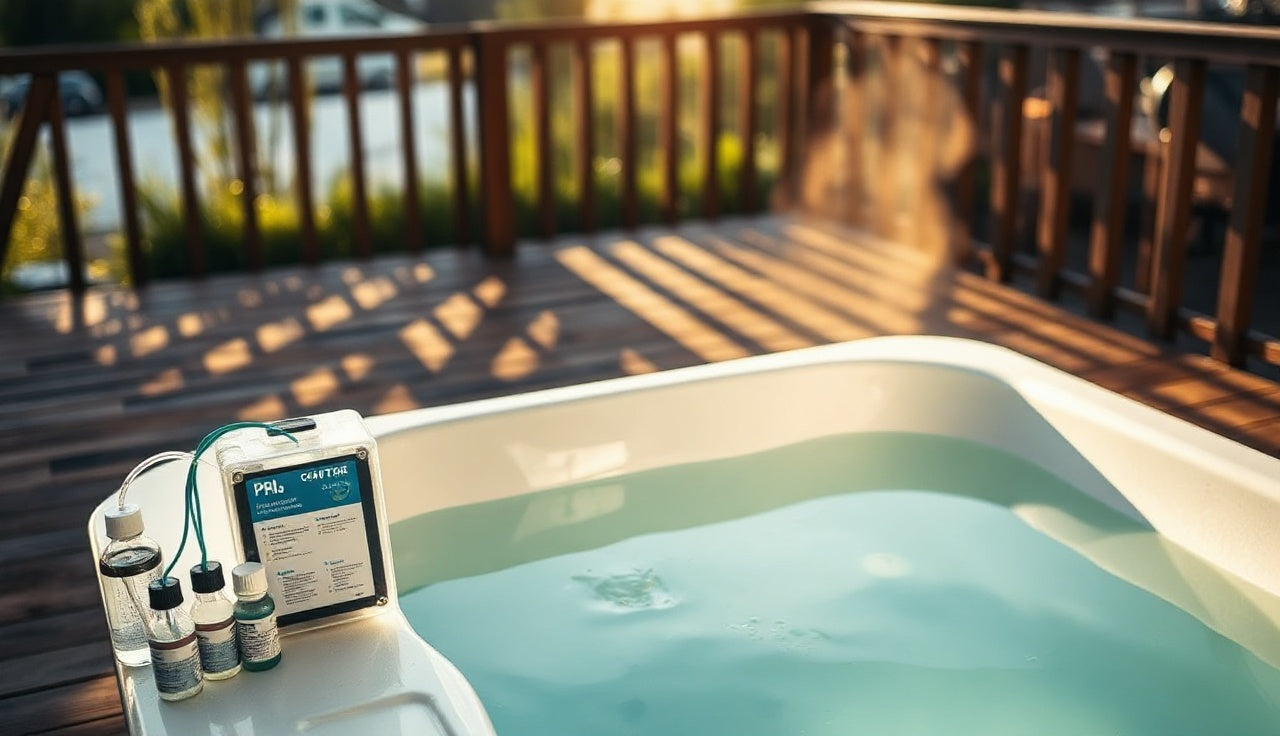
Last updated 2026-07-10
TL;DR
Keep cold plunge water between pH 7.2 and 7.8, with 7.4 to 7.6 as the sweet spot. Below 7.2 the water turns corrosive and stings eyes and skin. Above 7.8 your chlorine or bromine stops killing bacteria. Test at least twice a week, daily in heavy use or hot weather.
What is the correct pH range for a cold plunge?
Keep cold plunge water between 7.2 and 7.8, and aim for 7.4 to 7.6 [1]. That narrow middle is where sanitizer still works and your equipment stops taking damage. Most water chemistry pros treating small-volume recreational water settle there for a reason.
pH runs on a logarithmic scale from 0 to 14. Pure water sits at exactly 7.0, which is neutral. The human eye sits around 7.4, which is one reason that target feels comfortable during immersion and barely irritates.
A cold plunge is not a hot tub, but the water chemistry rules are identical. The CDC's Model Aquatic Health Code, which governs public aquatic venues and gets referenced by residential equipment makers, recommends a pH of 7.2 to 7.8 for treated recreational water [1]. That range balances two fights at once: low enough for chlorine or bromine to sanitize, high enough to spare your metal fittings, pumps, and acrylic shell.
If you own or are shopping for a cold plunge, dialing in pH before you ever drop the temperature is the highest-leverage water quality move you can make.
Why does pH matter so much in a cold plunge?
Cold water holds dissolved chemicals longer than warm water. That sounds like a win, but it means imbalances sit and build instead of off-gassing away. Two problems show up at opposite ends of the scale.
Low pH (below 7.2) turns the water acidic. Acidic water corrodes copper plumbing, eats at stainless fittings, and degrades pump seals. It also produces chloramines faster, and chloramines are the compounds behind that sharp chemical smell people blame on "too much chlorine." On skin and eyes, water at pH 6.5 or below stings. If your plunge burns your eyes, check pH before you reach for more sanitizer.
High pH (above 7.8) flips the problem. Chlorine's killing power falls off a cliff as pH climbs. At pH 8.0, only about 20 to 25 percent of your free chlorine is in its active hypochlorous acid form, versus roughly 75 percent at pH 7.0 [2]. So you can dose on schedule and still leave bacteria alive. High pH also drops calcium out of solution, which is the white cloudy scale you find on surfaces.
Cold plunges run at 45 to 60 degrees Fahrenheit. Even short sessions dump organic material into the water: sweat, skin oils, dead skin cells, all of it food for bacteria. Cold slows growth. It does not stop it. Low temperature plus organic load means your sanitizer actually has to work, and it only works if pH is right first.
See also: cold plunge benefits for why people use these units hard enough that water chemistry becomes a real chore.
What happens if the pH is too low in a cold plunge?
Below 7.2 the water goes mildly acidic, and the damage stacks up fast.
First, chlorine gets aggressive. Hypochlorous acid, the sanitizing form, is plentiful at low pH, but it also burns off faster and irritates mucous membranes and sensitive skin at normal doses.
Second, metal corrosion speeds up. Cold plunges with copper heat exchangers or stainless fittings are the most exposed. Corrosion byproducts (dissolved copper, iron, zinc) stain the shell or liner and, at high enough levels, become a mild health concern for daily users.
Third, acrylic and fiberglass shells turn rough and chalky after repeated acidic exposure. That rough texture then traps biofilm.
The fix is pH increaser, which is almost always sodium carbonate (soda ash). Add it in small amounts, roughly half a pound per 500 gallons, run circulation for 30 minutes, then retest. Never try to correct a big swing in one dose. Overshoot into high pH and you need acid to walk it back, and now you're chasing the number in circles.
| pH 6.5 | 96% |
| pH 7.0 | 75% |
| pH 7.2 | 66% |
| pH 7.4 | 55% |
| pH 7.6 | 41% |
| pH 7.8 | 28% |
| pH 8.0 | 21% |
| pH 8.5 | 9% |
Source: WHO Guidelines for Safe Recreational Water Environments, Vol. 2
What happens if the pH is too high in a cold plunge?
Above 7.8 you get a different problem, and it's the scary one: sanitizer failure.
The chemistry is worth learning once. Chlorine in water splits into two forms, hypochlorous acid (HOCl, the active killer) and hypochlorite ion (OCl-, mostly useless). At pH 7.0, roughly 75 percent sits in the HOCl form. At pH 8.0 that drops to around 20 percent. At pH 9.0 it's basically nothing [2]. Run your plunge at pH 8.2 while dosing chlorine on schedule and you can still have a real bacteria problem, because almost none of that chlorine is in usable form.
High pH also pushes calcium hardness out of solution. That's the cloudy white water and the scale on heater elements, which then die early.
For bathers, high pH water isn't acutely dangerous to skin. It does leave a slippery, soapy feel and can cause mild eye discomfort over repeated sessions.
To lower pH, use muriatic acid (hydrochloric acid) or dry acid (sodium bisulfate). Dry acid is safer to store and easier to dose in a small volume. Add it with circulation running, dilute it first if you can, and retest after 30 minutes. Gloves and eye protection are not optional.
How often should you test the pH in a cold plunge?
Twice a week is the floor for a regularly used cold plunge. Use it daily, test daily. Added any chemical in the last 48 hours? Test before you add anything else.
The CDC's Model Aquatic Health Code recommends pH testing at public venues at least every two hours during peak operation [1]. Home plunges don't need that pace, but the principle holds: test before you trust the water.
Things that push your testing higher:
- Heavy use. One 10-minute session dumps roughly the organic load of a few minutes in a pool. Several users in a day can move pH on their own.
- Rain or fresh fill water. Tap water pH swings by municipality and season. Well water swings more. Every top-off or full refill can shift your starting pH.
- Temperature spikes. A chiller running warm, or the unit baking in direct sun, drives off CO2 and pushes pH up.
- Recent chemical additions. After any acid or base, confirm the correction landed before you touch anything else.
For tools, liquid drop kits (the Taylor K-2006 is the reference) give the most accurate results [3]. Test strips are convenient but sloppier, especially in cold water where reagents react slowly. A regularly calibrated digital pH pen lands between the two on both accuracy and hassle.
Ice bath users who refill from the tap after every session start fresh each time, but you still want to know your fill water's baseline pH before adding any sanitizer.
How does temperature affect pH readings in a cold plunge?
Temperature moves pH readings two ways. The water's actual chemistry shifts a little, and your meter may read differently.
Cold water reads slightly higher pH than the same water at room temperature, because of how dissolved CO2 behaves when it's cold. Water at 50 degrees Fahrenheit can read about 0.1 to 0.2 pH units higher than the same sample tested at 77 degrees Fahrenheit [4]. That's real chemistry, not a broken meter.
In practice: if your water tests 7.6 at 50 degrees, it might read closer to 7.4 at room temperature. Neither number is wrong. Just test at the same temperature every time, or write down the water temp with each reading, so you're comparing like against like over the weeks.
Digital pH pens with automatic temperature compensation (ATC) correct for this on their own, and they're worth it over a basic non-ATC pen for cold water. A good ATC pen runs about $30 to $80, which is nothing next to replacing a corroded pump.
Liquid drop kits like the Taylor K-2006 are calibrated for a standard range but read reliably in cold water if you let the sample warm a little first, or just note the offset.
What chemicals do you use to adjust pH in a cold plunge?
Two standard adjusters do the work: pH increaser and pH decreaser. The chemistry is simple.
pH increaser is sodium carbonate, often sold as soda ash. One pound raises pH in roughly 10,000 gallons by about 0.1 units, but a cold plunge holds 100 to 500 gallons, so you're working with tiny amounts. Start with a tablespoon dissolved in a cup of water, add it with circulation running, wait 30 minutes, retest.
pH decreaser is either sodium bisulfate (dry acid) or muriatic acid (hydrochloric acid). Sodium bisulfate is safer at home. Same small-dose rule: use a quarter of what any pool calculator suggests, retest, add more only if you need it. Small-volume water punishes big additions.
Chemicals to skip:
- Baking soda (sodium bicarbonate) raises total alkalinity, not pH directly. It has a job in water chemistry, but it's no substitute for soda ash when you need to move pH quickly.
- Vinegar can lower pH in theory, but it's impractical at scale and adds organic compounds that feed biofilm.
- Pool-scale doses of anything are dangerous in a plunge. A pool holds 10,000 to 20,000 gallons. Your plunge holds 100 to 500. The math matters.
The EPA's Office of Pesticide Programs registers sanitizers for recreational water, including which products are cleared for small-volume use [5]. Stick to products registered for spa or small recreational water, never agricultural or industrial acids.
What is total alkalinity and how does it relate to pH in a cold plunge?
Total alkalinity (TA) is the water's ability to resist pH change. Think of it as a buffer. High alkalinity locks pH in place and fights your adjustments. Low alkalinity lets pH swing wildly on tiny doses.
The recommended total alkalinity range for recreational water is 80 to 120 parts per million (ppm) [1]. Stay in that band and your pH corrections stick instead of bouncing back overnight.
If pH keeps drifting low no matter how you correct it, low alkalinity is usually the culprit. Fix it with sodium bicarbonate (baking soda), added slowly to bring TA toward 100 ppm before you try to stabilize pH.
If pH sits stubbornly high and shrugs off acid, high TA is the likely cause. Muriatic acid lowers both TA and pH at once, so the correction strategy shifts.
The rule: always test pH and total alkalinity together. Fixing pH without checking TA is like patching a tire without checking the pressure. The Taylor K-2006 liquid kit tests both, which is why it's the reference tool for serious water chemistry [3].
For the bigger picture on cold water immersion, the cold plunge benefits article covers the context behind these protocols.
How does chlorine or other sanitizers interact with pH in a cold plunge?
Sanitizer effectiveness and pH are inseparable. You can't judge one without the other.
Chlorine-based sanitizers (sodium hypochlorite, calcium hypochlorite, trichlor tablets) all need a pH window to work. CDC guidance for treated recreational water recommends free chlorine of 1 to 3 ppm at a pH of 7.2 to 7.8 [1]. Step outside those pH bounds and the same chlorine concentration protects you far less.
Bromine, a common spa and plunge alternative, holds up more evenly across a wider pH range than chlorine. It stays effective up to about pH 8.0, which buys a little headroom. Even so, the same 7.2 to 7.8 target applies.
Alternative systems (ozone, UV, mineral) get marketed for cold plunges as lower-chemical options. They work, but most still need a residual chemical sanitizer as backup. Ozone systems typically want a low chlorine or bromine residual of 0.5 to 1.0 ppm to cover the gaps between treatment cycles. pH still matters there, just at lower sanitizer levels.
We get asked constantly whether you can skip chemical sanitizers in a cold plunge. Honest answer: you can cut chemical load a lot with ozone or UV, but you can't drop basic water chemistry monitoring, pH included. Cold doesn't sterilize water.
pH targets vs. other cold plunge water chemistry parameters at a glance
Cold plunge water chemistry has several parameters that lean on each other. Here's a reference table drawn from the CDC Model Aquatic Health Code and standard pool and spa industry guidance [1][6].
| Parameter | Ideal Range | Action Range | Why It Matters |
|---|---|---|---|
| pH | 7.4 to 7.6 | 7.2 to 7.8 | Sanitizer effectiveness, corrosion, comfort |
| Free Chlorine | 1 to 3 ppm | 0.5 to 5 ppm | Kills bacteria and pathogens |
| Total Alkalinity | 80 to 120 ppm | 60 to 180 ppm | pH stability buffer |
| Calcium Hardness | 200 to 400 ppm | 150 to 1000 ppm | Prevents corrosion and scaling |
| Total Dissolved Solids | Under 1500 ppm | Under 5000 ppm | General water quality indicator |
| Water Temperature | 45 to 59°F | 40 to 65°F | Therapeutic range, affects all chemistry |
The pH row governs every other row. Get pH right first, then fine-tune chlorine, calcium hardness, and TDS.
Building a full recovery setup with both heat and cold? The home sauna guide covers the maintenance on the heat side, which runs different but is worth knowing alongside this.
How do you establish the right pH routine for a cold plunge?
A workable routine for most home cold plunge owners looks like this.
On first fill, test pH and total alkalinity of your tap or well water before adding anything. Know your starting point. Fill water at pH 8.1 means you'll always adjust down. At 6.9 you'll always adjust up. That one piece of baseline knowledge saves you time and money for months.
Week one: test daily. Learn what your water does on its own over 7 days. Does pH drift up or down, and by how much per day? Most home plunges settle into a predictable drift once the shell and fittings stabilize.
Ongoing: test twice a week, daily if you use it hard. Log every reading. A notes app works: date, water temperature, pH, chlorine, and anything you added. That log earns its keep the moment something goes wrong, because you can trace exactly what changed.
Full water change: most home owners swap water every 1 to 3 months depending on use. After each change, restart the week-one daily cadence.
The learning curve is real but short. After a month of steady testing, you'll feel your plunge's chemistry without much thought.
Still in the buying phase? The cold plunge buying guide covers what to look for, including filtration that cuts how often you adjust chemicals by hand.
Does pH matter differently for outdoor versus indoor cold plunges?
Yes, and it's a real difference.
Outdoor plunges face variables indoor units mostly dodge. Rain arrives with its own pH, usually between 5.6 and 6.0 across most of the US thanks to dissolved CO2 and mild atmospheric acids [7]. A heavy rain can add enough volume to drag your plunge pH toward acidic. Pollen, leaves, bird droppings, and airborne debris all add organic load and nudge pH.
Sunlight burns off chlorine. Unstabilized chlorine loses roughly 75 to 90 percent of its potency after a few hours of direct UV [8], so outdoor plunges usually need cyanuric acid as a stabilizer, which then changes your pH adjustment chemistry.
Indoor plunges are steadier but not immune. CO2 from breathing in a closed room dissolves into the water and lowers pH slightly during use. Sweat carries lactic acid and other compounds that acidify the water over time.
The testing frequency above applies to both, but outdoor plunges need more attention during heavy pollen season, after rain, and through summer, when algae pressure rises even in cold water.
Frequently asked questions
What pH should a cold plunge be?
Keep a cold plunge between pH 7.2 and 7.8, with 7.4 to 7.6 as the practical ideal. That range keeps chlorine or bromine working, protects metal fittings and pump parts from corrosion, and stays comfortable on eyes and skin. Test at least twice a week and adjust with pH increaser (soda ash) or pH decreaser (sodium bisulfate) in small doses.
What happens if the pH in my cold plunge is too low?
Low pH (below 7.2) makes the water acidic. It corrodes metal fittings, pump seals, and heat exchanger parts. It also irritates eyes and skin during immersion and produces excess chloramines, the source of that sharp chemical smell. Fix it with small additions of sodium carbonate (soda ash), retesting after 30 minutes each time to avoid overshooting.
What happens if the pH in my cold plunge is too high?
High pH (above 7.8) badly cuts sanitizer effectiveness. At pH 8.0, only about 20 to 25 percent of chlorine sits in its active form, so bacteria can survive even when you're dosing on schedule. High pH also causes calcium scaling on surfaces and heater elements. Lower it with sodium bisulfate (dry acid) in small amounts, retesting after 30 minutes.
How do I raise the pH in a cold plunge?
Use sodium carbonate, sold as soda ash or pH increaser. For a typical 100 to 500 gallon plunge, start with about one tablespoon dissolved in a cup of water. Add it with the circulation pump running, wait 30 minutes, then retest. Repeat if needed. Don't add large amounts at once, since small volumes react quickly and overshoot is easy.
How do I lower the pH in a cold plunge?
Use sodium bisulfate (dry acid, sold as pH decreaser) or muriatic acid. Dry acid is safer to store and handle at home. For a 100 to 500 gallon plunge, start small, roughly a tablespoon of dry acid diluted in water first. Add it with circulation running, wait 30 minutes, retest. Always wear gloves and eye protection with any acid product.
How often should I test the pH in my cold plunge?
Twice a week minimum for regular use. Use it daily or with multiple people, test every day. Test after any chemical addition, after a full water change, and after heavy rain if the unit is outdoors. Consistent logging makes it far easier to spot patterns and correct small imbalances before they turn into bigger problems.
Can I use the same pH test strips as for a swimming pool?
Yes, pool and spa pH strips work for cold plunges, but their accuracy drops in cold water because reagents react more slowly. Liquid drop kits (like the Taylor K-2006) read more accurately. A digital pH pen with automatic temperature compensation is even more reliable for cold-water testing, and good ones cost $30 to $80.
Does cold water affect pH differently than warm water?
Yes. Cold water holds dissolved CO2 more efficiently than warm water, which can make pH read slightly higher (by about 0.1 to 0.2 units) at 50 degrees Fahrenheit than the same water at room temperature. Test at the same temperature every time for clean comparisons, or use a pH pen with automatic temperature compensation to handle the difference for you.
What is total alkalinity and do I need to test it in my cold plunge?
Total alkalinity measures your water's ability to resist pH change. Keep it between 80 and 120 ppm. Low alkalinity lets pH swing wildly on small doses. High alkalinity locks pH in place and fights adjustment. Test it alongside pH on every full chemistry check. Raise it with baking soda, lower it with muriatic acid. Skip this test and pH management gets much harder.
Can I skip sanitizer if my cold plunge water stays very cold?
No. Cold slows bacterial growth but doesn't stop it. Pseudomonas aeruginosa, which causes hot tub rash (folliculitis), can survive and grow down to about 41 degrees Fahrenheit. Biofilm on surfaces is a real risk in unsanitized cold water too. A low residual sanitizer, even 0.5 to 1.0 ppm free chlorine paired with a UV or ozone system, is still necessary.
How does pH affect chlorine levels in a cold plunge?
pH and chlorine effectiveness are directly linked. At pH 7.4, roughly half your free chlorine sits in its active hypochlorous acid form. At pH 8.0, that drops to around 20 to 25 percent. So the same concentration sanitizes far less at high pH. Always get pH into the 7.2 to 7.8 range before you judge whether your chlorine level is adequate.
How often should I completely change the water in my cold plunge?
Every 1 to 3 months for regular single-user use, more often with multiple people or if total dissolved solids climb above 1500 ppm. After each full change, test pH and total alkalinity of the fresh fill water before adding sanitizer, since tap and well water pH varies a lot by location and season. Set your new baseline, then start your regular testing routine.
Does the material of my cold plunge (acrylic, stainless steel, wood) affect how I should manage pH?
Yes. Stainless steel is most vulnerable to low-pH corrosion, so keep pH above 7.2 consistently if your plunge has stainless fittings or a stainless shell. Wood plunges (cedar, redwood) are more sensitive to high pH and chemical overdosing, which dries and cracks the wood. Acrylic shells handle the 7.2 to 7.8 range well but roughen with extended exposure to pH below 7.0.
Is pH management different for a cold plunge versus a hot tub?
The target range is the same (7.2 to 7.8), but behavior differs. Hot tubs off-gas CO2 fast from the heat, which tends to push pH up over time. Cold plunges hold CO2 in solution longer, so pH stays steadier day to day. Hot tubs also burn through sanitizer faster from heat. Cold plunges are easier on sanitizer depletion but still need regular chemistry checks.
Sources
- CDC, Model Aquatic Health Code (MAHC): Recommended pH range of 7.2 to 7.8 and free chlorine of 1 to 3 ppm for treated recreational water; testing frequency guidance
- WHO, Guidelines for Safe Recreational Water Environments, Vol. 2: Swimming Pools and Similar Environments: Relationship between pH and the proportion of active hypochlorous acid in chlorinated water; at pH 8.0 approximately 20-25% of chlorine is in active HOCl form
- Taylor Technologies, K-2006 Complete Water Analysis Kit: Industry-standard liquid drop test kit for accurate measurement of pH, free chlorine, total alkalinity, and other parameters in recreational water
- USGS, Water Science School: pH and Water: Temperature affects pH readings; colder water naturally produces slightly higher pH readings due to changes in dissolved CO2 behavior
- EPA, Office of Pesticide Programs: Antimicrobial Pesticide Registration: EPA registers sanitizing chemicals for recreational water use, including small-volume aquatic applications
- Pool & Hot Tub Alliance (PHTA), Water Chemistry Guidelines: Standard industry parameters for recreational water: total alkalinity 80-120 ppm, calcium hardness 200-400 ppm, TDS under 1500 ppm
- EPA, What is Acid Rain?: Normal rainwater pH is approximately 5.6 due to dissolved CO2 forming carbonic acid; acid rain ranges even lower
- CDC, Healthy Swimming: Cyanuric Acid: Unstabilized chlorine loses 75-90% of its potency under direct UV sunlight within a few hours; cyanuric acid is used as a UV stabilizer
- WHO, Guidelines for Safe Recreational Water Environments, Vol. 2: Pseudomonas aeruginosa and other pathogens can survive and grow in cold recreational water; sanitizer residuals are necessary regardless of temperature
- USGS, Water Science School: Hardness of Water: Calcium hardness and alkalinity interact with pH to determine scaling or corrosion tendency in treated water systems

Share:
Cold plunge tub biofilm removal: how to find it, kill it, and prevent it
Cold plunge tub biofilm removal: how to find it, kill it, and prevent it