
Last updated 2026-07-11
TL;DR
The best outdoor cold plunge and sauna enclosures pair a heated cabin with a cold tub 10 to 15 feet away, under a shared roof or pergola, on a concrete or composite deck with real drainage. Budget from about $8,000 for a basic setup to $40,000 or more for a purpose-built Nordic structure. Permits are almost always required.
Why put a cold plunge right next to the sauna?
Contrast therapy lives or dies on the transition between heat and cold. The classic Finnish rhythm is simple: heat until you're uncomfortable, step out to cool fast, repeat. A 2018 meta-analysis in the European Journal of Applied Physiology found that alternating heat and cold exposure reduced perceived muscle soreness more than either one alone [1]. Put the plunge inside while the sauna sits outside, or separate the two by a long walk, and you bleed heat and time. The protocol gets weaker.
Ten to fifteen feet is the sweet spot. Close enough that you go straight from one to the other. Far enough that steam and humidity off the sauna don't keep the plunge area wet and turn it into a slip hazard or a mold problem.
Outdoors solves several problems at once. You have room. Drainage runs easier than it ever will inside a house. And a structure built for the pair becomes a place you actually walk to, not a damp corner of the garage you avoid.
What enclosure types actually work for a sauna and cold plunge combo?
Five enclosure approaches show up again and again, and they split hard on cost, permanence, and how good they look after a decade outside.
Shared roof pergola or pavilion. A timber-frame pergola or steel pavilion covers both the sauna cabin and the plunge tub. The sauna sits in its own insulated cabin under the structure, the plunge a few feet away under the same roof. This is the most popular approach because it looks deliberate and keeps rain off you on the walk between the two. Plan on $4,000 to $12,000 for the pergola structure alone, separate from the sauna and plunge equipment [2].
Freestanding cabin with an adjacent deck. You buy or build an outdoor sauna cabin (barrel, cabin-style, or pod), then build a deck around and in front of it. The plunge sits on the deck to one side of the door. A railing or privacy screen cuts it off from the rest of the yard. This is the most common DIY path. Installed cost swings a lot, but $12,000 to $25,000 is realistic depending on deck size and sauna quality.
Nordic-style bathhouse building. A purpose-built small building, roughly 200 to 400 square feet, holds the sauna room and plunge inside one shell with a changing room, shower, and lounge. Nicest option, priciest too. A custom build runs $40,000 to $100,000 or more depending on your contractor and where you live [2].
Privacy screen or fence structure. The budget move. Cedar or composite screening walls off an outdoor room around your existing gear, with nothing overhead beyond a shade sail or a polycarbonate panel. Fine in mild climates. Rough in rain or snow country.
Greenhouse or garden room conversion. Some people use an aluminum or timber greenhouse kit as the outer shell, drop a sauna cabin inside, and set the plunge next to it. Heat is the catch: greenhouse glazing holds almost none of it in winter. It works if you add interior insulation panels, but that changes the math.
For most homeowners, a shared pergola over a well-built deck hits the best mix of cost, looks, and function. Our outdoor sauna guide shows what that looks like in practice.
What materials hold up outdoors year-round?
This is where the expensive mistakes happen. Weather is brutal on the wrong materials, and water makes it worse.
Sauna cabin. Nordic white spruce, Western red cedar, and thermally modified aspen are the standard three. Cedar is the easiest to find and rots slowly on its own. Thermally modified wood (heat-treated to pull out moisture) lasts longer and cracks or warps less through freeze-thaw cycles, but it costs about 30 to 50% more. Keep pressure-treated lumber out of the sauna interior. You don't want those chemicals off-gassing at 180 to 200 degrees F.
Deck substrate. Poured concrete is the most durable base for the whole thing. A 4-inch reinforced slab costs roughly $6 to $12 per square foot installed in most U.S. markets [3]. Composite decking over a treated lumber frame works well and is friendlier to DIY. Untreated wood decking in the wet zone around the plunge rots. Skip it.
Cold plunge tub. Acrylic shells, rotomolded polyethylene, fiberglass, and stainless steel all survive outdoors. Stainless lasts longest and cleans easiest, and it costs the most (typically $3,000 to $10,000 for a quality unit). Rotomolded poly tubs are the workhorses of the market: impact-resistant, UV-stable, usually $1,500 to $5,000 [4]. Our cold plunge guide breaks down every tub type.
Roofing. Corrugated metal (Corten or galvanized steel) looks sharp and lasts decades. Polycarbonate panels pass light, which is a gift in winter, but they yellow after 10 to 15 years of UV. Cedar shingles match the sauna aesthetic but want maintenance every 5 to 7 years.
Hardware. Stainless or hot-dipped galvanized fasteners, everywhere, no exceptions. Standard zinc screws rust and streak your cedar with rust stains inside two winters.
| Barrel sauna + poly plunge on existing patio | $10,000 |
| Cabin sauna + quality plunge on new deck | $26,000 |
| Custom Nordic bathhouse with both | $51,000 |
| High-end purpose-built structure | $72,500 |
Source: Angi Cost Guides and market pricing, 2025
How should you handle drainage for an outdoor cold plunge?
Drainage is the detail people ignore until they're standing in a puddle. A typical 2-person cold plunge holds 200 to 400 gallons. You need a plan for where that water goes when you drain it to clean (usually every 1 to 4 weeks depending on filtration), plus a plan for overflow from splashing and rain.
The simplest setup is a deck drain that runs to a dry well or ties into a municipal storm drain. Call your municipality first. Many jurisdictions restrict chemical discharge even from clean plunge water if you use sanitizers [5].
A dry well (a gravel-filled pit, typically 3 to 4 feet deep and 3 feet wide) can swallow a plunge drain in most soils. Clay-heavy soil won't percolate fast enough, and you'll flood the area instead.
For permanent structures, the cleanest answer is a floor drain tied into your home's sewer lateral through a proper trap. That needs a licensed plumber in most jurisdictions and counts as a plumbing permit item.
The sauna needs floor drainage too, since it makes condensation and people pour water on the rocks. A floor slope of 1/4 inch per foot toward a drain point handles it. Run that drain into the same system as the plunge.
One rule to never break: don't dump high-volume saltwater or heavily chlorinated plunge water onto grass or garden beds again and again. It kills plants over time.
Do you need a permit for an outdoor sauna and cold plunge enclosure?
Almost certainly yes for anything permanent. This surprises people who think a sauna cabin is backyard furniture. It isn't.
Most U.S. municipalities classify any structure over 120 to 200 square feet as needing a building permit. Anything with electrical (sauna heater, plunge chiller) needs an electrical permit and inspection. Anything with plumbing (drains, water supply) needs a plumbing permit. For a full installation that's typically three separate permits [6].
Setbacks matter too. Most residential zoning codes push accessory structures at least 5 feet off property lines, and some jurisdictions want 10 feet or more. Read your local zoning code. The International Residential Code Section R302 covers accessory structure separation as a baseline, but local amendments vary widely [7].
HOA rules are a separate fight. Plenty of HOAs restrict visible outdoor structures, dictate approved materials and colors, or ban tubs visible from the street. Read your CC&Rs before you buy a single thing.
Electrical for a typical sauna heater is 240V at 30 to 60 amps depending on heater size. That's a dedicated circuit off your panel, which means a licensed electrician in most states. Cold plunge chillers run on 120V or 240V depending on the compressor [8].
Here's the practical advice: pull the permits. Unpermitted structures complicate home sales, void homeowner's insurance coverage for related damage, and can force costly removal if a code officer finds them.
What does a realistic budget look like for different setups?
Here's an honest cost breakdown based on 2025 to 2026 market pricing for installed setups in the continental U.S. Prices move with region. Labor runs 30 to 50% cheaper in the Midwest than in coastal metro areas.
| Setup Type | Sauna | Cold Plunge | Enclosure/Deck | Electrical/Plumbing | Total Range |
|---|---|---|---|---|---|
| Basic barrel sauna + poly plunge on existing patio | $3,000-$6,000 | $1,500-$3,000 | $0-$2,000 | $1,500-$3,000 | $6,000-$14,000 |
| Cabin sauna + quality plunge on new composite deck | $6,000-$12,000 | $3,000-$6,000 | $5,000-$12,000 | $3,000-$5,000 | $17,000-$35,000 |
| Custom Nordic bathhouse with both | $20,000-$50,000 | $5,000-$12,000 | Included | $5,000-$10,000 | $30,000-$72,000 |
| High-end purpose-built structure | $15,000-$30,000 | $8,000-$20,000 | $15,000-$40,000 | $5,000-$12,000 | $43,000-$102,000 |
The tub itself is usually a smaller line than people expect next to the enclosure and electrical work. A good outdoor sauna and plunge space is mostly a construction project with wellness gear sitting inside it.
At the entry level, a barrel sauna on an existing concrete patio, a rotomolded plunge next to it, and a new dedicated circuit is genuinely doable under $15,000 for someone in a moderate-cost market. That's a real setup, not a compromise.
SweatDecks carries cold plunge tubs and outdoor sauna cabins across price points if you want to price the equipment side on its own.
How do you design the layout so the flow between sauna and plunge actually works?
Good design is really about sequencing. A typical contrast session goes: heat in the sauna 10 to 20 minutes, exit, plunge 1 to 3 minutes, rest and recover, repeat. That means you'll walk from the sauna door to the plunge edge dozens of times in one session. Every step matters.
A few principles that make the whole thing better:
Put the plunge in the sauna door's sightline. You should see the plunge from inside the sauna. Psychologically it helps. The path should need zero navigation: door opens, three steps, plunge.
No stairs if you can avoid them. Wet feet plus stairs equals a fall. If you need a level change, use non-slip composite or teak grating on a gentle slope.
Keep a small rest area. A couple of teak Adirondack chairs or a bench between the two is where the recovery phase happens. It's not a luxury. The rest phase (usually 5 to 10 minutes) is part of the protocol.
Point the sauna door away from prevailing wind. In winter you want to exit into still air, not a 20-mph gust that strips your core temperature before you've chosen to enter the plunge.
Plan the supply lines. The sauna wants water nearby, for the rocks and for rinsing. The plunge wants a supply and a drain. Running both from one utility connection point keeps plumbing costs down.
Privacy. If neighbors can see in, a screen or fence panel fixes it without walling off the whole structure. Cedar lattice, horizontal cedar slats, and black aluminum slat panels all look good and last outdoors.
For a closer look at sauna types that suit outdoor use, see our home sauna guide.
What temperature should the cold plunge be, and how do you maintain it outdoors?
The research on cold water immersion most often uses 50 to 59 degrees F (10 to 15 C). A 2022 review in the International Journal of Environmental Research and Public Health found water in the 10 to 15 C range produced the strongest acute physiological responses, including norepinephrine release and perceived recovery [9]. Most people find 50 to 55 degrees F intense enough to feel the effect without being dangerous for a healthy adult.
Outdoors, holding that temperature is impossible in summer without help and trivially easy in a cold winter. In most U.S. climates you need a dedicated chiller to use the plunge reliably year-round at therapeutic temperatures.
A chiller-equipped plunge holds temperature automatically and circulates water through a filter, which keeps it clean between full drains. Chillers typically pull 500 to 1,500 watts, and a dedicated 20-amp 240V circuit is standard [8].
Winter flips the problem. Now you're protecting the plunge from freezing. Your options: a fitted insulating cover, running the circulation pump nonstop (moving water resists freezing), or draining the tub in an extreme cold snap. Most quality outdoor units are rated to roughly 20 to 30 degrees F ambient if you keep the system running, but check your tub's specs.
On cleaning: with a UV or ozone filter, do a full drain every 2 to 4 weeks. Without filtration, weekly drains are more hygienic. Bromine stays more stable than chlorine at cold temperatures, which is why most cold plunge makers recommend it over chlorine if you sanitize chemically [10].
Our cold plunge benefits article covers what the research actually says about temperature and duration.
What are the best privacy and aesthetic options for an outdoor sauna and plunge space?
Looks matter here because you'll use the space more if it feels like a destination. A few approaches that work without draining the budget:
Cedar or black steel privacy screen. Horizontal cedar slats on a steel frame look modern and age well. Black powder-coated steel slat panels ask for less maintenance. Either buys you privacy while letting air move through.
Living walls or bamboo. Clumping bamboo in a raised planter along the perimeter grows into a soft green wall in 2 to 3 seasons. It's not cheap to install, but ongoing care is minimal. Never plant running bamboo. It spreads through your whole yard.
String lights and outdoor fixtures. Real lighting makes the space usable after dark and warm in photos. Use IP65-rated fixtures built for wet locations. Warm white (2700 to 3000K) beats cool white here every time.
Stone or composite patterns. Mixing large-format concrete pavers with composite deck boards defines zones cleanly: sauna side, plunge side, rest area.
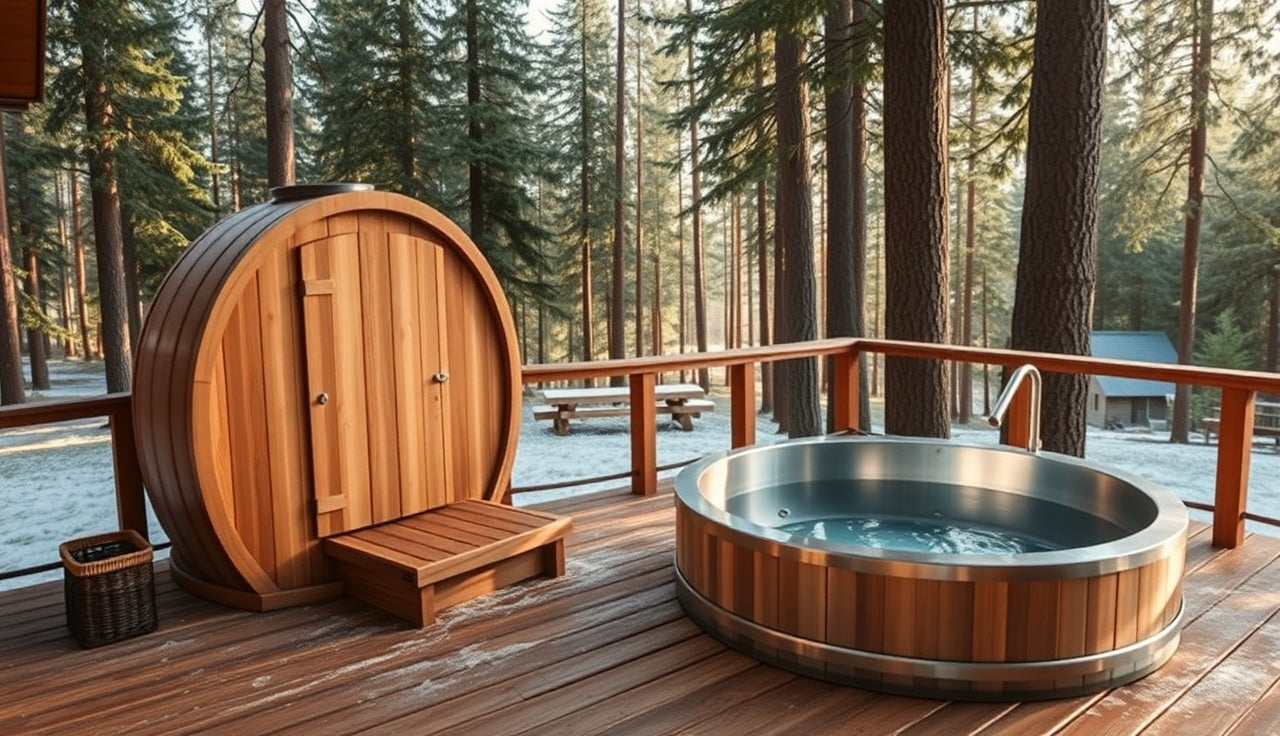
Barrel sauna aesthetics. The barrel form reads as intentional and rustic without trying too hard. A cedar barrel paired with a round stainless plunge, ringed by natural stone, holds together visually for years.
Scandinavian minimalism. If you want clean lines, a rectangular cabin in dark-stained thermally modified wood (a gray-brown tone), a rectangular plunge, and a plain poured concrete deck reads as architectural. It pairs naturally with the steel pergola roof.
The worst mistake is treating the plunge as an afterthought and dropping it wherever's convenient. Plan both from day one, give them equal visual weight, and you get a coherent outdoor room instead of a sauna with a tub parked awkwardly beside it.
Is a cold plunge and sauna combination safe to use, and who should be cautious?
For most healthy adults, contrast therapy is safe and well tolerated. There are also real groups for whom rapid temperature swings carry genuine risk.
The biggest concern is cardiovascular. Cold water immersion sets off an immediate autonomic response: heart rate dips briefly, then surges, and blood pressure spikes. Finnish medical research and the Finnish Sauna Society have documented sauna-related cardiac events as rare but real, most often in men over 50 with existing cardiovascular disease who combine sauna with alcohol [11]. The plunge adds its own cardiovascular load on top.
The American Heart Association states in published guidance that "patients with cardiovascular disease should consult their physician before using saunas" [12]. The same caution covers cold water immersion. If you have known heart disease, arrhythmia, uncontrolled hypertension, or are pregnant, talk to your physician before building a protocol around this.
Healthy adults should ease in. Start with shorter sauna sessions (10 minutes, not 20), warmer plunge temperatures (60 degrees F, not 50), and never do a first session alone. Have someone present until you know how your body responds.
Keep a clear way to exit the plunge without help. Slippery entry steps are a real hazard. Non-slip tread strips cost almost nothing and stop actual falls.
Never plunge after heavy drinking. Cold water immersion impairs the body's ability to rewarm and has been linked to drowning risk in cases involving alcohol [13].
Our sauna benefits article gives a referenced look at the health research on sauna use.
What are the best sauna styles to pair with an outdoor cold plunge?
Not every sauna type belongs outdoors. Here's the honest read:
Barrel saunas. The cylinder sheds rain and snow on its own, heats efficiently because there's less dead air in the corners, and looks right outdoors. Sizes run 2-person through 6-person. A solid mid-range barrel from a reputable maker runs $3,000 to $8,000 for the cabin kit. Easiest entry point for a DIY outdoor setup.
Cabin-style (rectangular) saunas. More flexible interior, room for a changing bench or small anteroom, better for groups. They cost more to build or buy because the rectangular form eats more material. These are the standard for Nordic bathhouse designs.
Pod saunas. Curved or egg-shaped, popular for looks. Usually smaller (1 to 2 people), pricier per square foot than barrels, and striking to look at. Good for small yards where the sauna doubles as a focal point.
Infrared saunas. These work differently from traditional Finnish saunas, running at lower temperatures (120 to 150 degrees F versus 160 to 210 for traditional). They can go outdoors with weatherproofing, but the electronics are more temperature-sensitive, so they're generally a worse outdoor bet. Some makers do sell outdoor-rated infrared units. Traditional saunas (wood-fired or electric with rocks) pair better with an outdoor plunge because the higher heat and steam suit the contrast protocol.
Our sauna guide compares every type in detail.
Wood-fired saunas deserve a mention for off-grid builds: no electrical hookup for the heat. You still need power for the plunge chiller unless you're in a cold climate and can ride ambient temperatures.
What are the biggest mistakes people make with outdoor sauna and cold plunge setups?
After looking at a lot of real installations, the same mistakes keep surfacing.
Skipping the permit. An unpermitted structure can trigger forced removal, fines, and insurance denial. The permit process is annoying and adds 4 to 12 weeks to your timeline, but it's real protection.
Underbuilding the foundation. A filled cold plunge weighs 1,700 to 3,300 pounds depending on size. A sauna cabin adds another 2,000 to 6,000. The deck or slab has to be engineered for that. A standard residential deck rated for 40 pounds per square foot live load may not cut it without modification. Have a structural engineer confirm your foundation plan before you set either on an elevated deck.
No shade over the plunge. A plunge baking in summer sun fights its chiller constantly and costs more to run. A roof or pergola over the water keeps the ambient heat load in check.
Cheap electrical. Sauna and chiller together can pull 50 to 80 amps. Undersized wire, a panel already near capacity, or a non-GFCI outlet in a wet zone are all real hazards. Outdoor wet-area electrical must use GFCI protection. The National Electrical Code requires GFCI protection for receptacles within 6 feet of a sink or wet location and for all outdoor receptacles [14].
No changing area. Going plunge to towel with no covered transition is miserable in wind or rain. A waterproof locker, a robe hook, and a small bench fix it cheaply.
Wrong gap between the two. Under 6 feet and sauna humidity keeps the plunge area wet. Over 20 to 25 feet and the walk feels long and you shed heat fast in the cold. Ten to fifteen feet is the practical sweet spot.
Frequently asked questions
How far should a cold plunge be from a sauna outdoors?
Ten to fifteen feet is the practical sweet spot. Close enough to transition quickly without losing core body heat on the walk, far enough that sauna humidity doesn't keep the plunge area wet and breed mold or slip hazards. Under a shared roof, even 8 feet works well because wind stops being a factor.
Can I put a cold plunge on a wood deck next to an outdoor sauna?
Yes, but the deck must be engineered for the weight. A filled plunge weighs 1,700 to 3,300 pounds depending on size. A standard residential deck is often designed for 40 pounds per square foot live load, which may not be enough without reinforcement. Have a structural engineer review the plan, and use composite or hardwood decking rather than untreated pine in the wet zone around the plunge.
What size cold plunge works best for a home outdoor setup?
For solo use, a 2-person tub (roughly 5 to 6 feet long, 200 to 300 gallon capacity) is the practical standard. It gives you room to submerge fully and shift position without being oversized. For couples using it together or athletes who need shoulders under water, step up to a 3-person size. Bigger tubs cost more to chill, drain, and refill.
Do you need a permit to install an outdoor sauna and cold plunge?
Almost certainly yes for any permanent structure. Structures over 120 to 200 square feet typically require a building permit. The electrical connections (sauna heater, plunge chiller) require an electrical permit. Drains and water supply require a plumbing permit. Requirements vary by municipality. Check with your local building department before buying equipment or starting construction.
How do you keep a cold plunge cold outdoors in summer?
You need a dedicated chiller. Without one, a plunge outdoors in summer quickly climbs to ambient temperature. Quality chillers hold 50 to 59 degrees F even in 90-degree weather, though they work harder and cost more to run. A roof or pergola over the water cuts the chiller's workload by blocking direct sun. Expect a chiller-equipped tub to add $1,500 to $5,000 to your budget.
What is the best roofing material for an outdoor sauna and cold plunge enclosure?
Corrugated steel or standing-seam metal lasts longest (40-plus years) and handles snow load well. Cedar shingles look beautiful but need re-treatment every 5 to 7 years. Polycarbonate panels pass light but yellow after 10 to 15 years of UV. For most setups, metal roofing is the best long-term value, especially in climates with heavy rain or snow.
Can a wood-fired sauna be used outdoors with a cold plunge?
Yes, and it's a popular off-grid option. A wood-fired sauna needs no electrical hookup for heat, which simplifies remote installs. You'll still need power for a chiller unless you're in a cold climate where winter ambient temperatures keep the plunge cold on their own. Check local fire codes. Some jurisdictions restrict wood-burning outdoor appliances or require specific clearances from structures and property lines.
How do you handle privacy for an outdoor sauna and cold plunge space?
Horizontal cedar slat screens, black powder-coated steel panels, or clumping bamboo in raised planters all work well. Clumping bamboo grows into a dense privacy wall in 2 to 3 seasons with minimal care. Avoid running bamboo, which spreads aggressively. For neighborhoods with second-story sightlines, a pergola roof with shade sail panels adds overhead privacy.
How often do you need to drain and clean an outdoor cold plunge?
With a UV or ozone filter, a full drain every 2 to 4 weeks is standard. Without filtration, once a week is more hygienic. Bromine is the preferred sanitizer because it stays stable at cold temperatures, while chlorine breaks down faster in water below 60 degrees F. Outdoor plunges that collect rain, leaves, or debris may need cleaning more often depending on the cover.
What kind of flooring is best between an outdoor sauna and cold plunge?
Non-slip composite decking, large-format concrete pavers, or teak grating are the top choices. The key requirement is non-slip texture when wet, since you'll move barefoot between hot and cold with wet feet. Avoid smooth tile and untreated wood decking in the transition zone. Anti-slip strips on steps cost almost nothing and prevent real falls.
Is contrast therapy (hot-cold cycling) actually supported by research?
There's genuine support for reduced muscle soreness and improved perceived recovery, though the evidence is stronger for athletes recovering from specific exercise than for general wellness. A 2018 meta-analysis in the European Journal of Applied Physiology found alternating heat and cold reduced perceived soreness more than either alone. The cardiovascular effects of regular sauna use (separate from contrast therapy) are more heavily studied, especially in Finnish cohort research.
How much electricity does an outdoor sauna and cold plunge setup use?
A typical electric sauna heater uses 4 to 9 kW per session (roughly 1 to 2 hours). At the $0.16 per kWh national average, that's $0.64 to $2.88 per session. A cold plunge chiller running continuously uses 0.5 to 1.5 kW, which is roughly $50 to $175 per month depending on ambient temperature and chiller efficiency. Running both from a 60 to 80 amp subpanel is the standard electrical plan.
Can I install a cold plunge and sauna setup in a small backyard?
Yes. A barrel sauna, a 2-person plunge, a basic privacy screen, and a 6x10 foot deck fit in a 15x20 foot footprint or less. The key is a layout where the sauna door faces the plunge directly with at least a small rest bench nearby. Plenty of good setups occupy what used to be an unused corner of a modest backyard.
Who should avoid using a cold plunge and sauna together?
People with cardiovascular disease, arrhythmia, uncontrolled hypertension, or Raynaud's phenomenon should consult a physician before using either modality, let alone together. Pregnant women should avoid both sauna and cold immersion in their traditional forms. Anyone who has been drinking should skip cold water immersion, since alcohol impairs the body's rewarming response and raises drowning risk sharply. Always have another person nearby when starting a new contrast therapy protocol.
Sources
- European Journal of Applied Physiology, 2018 meta-analysis on contrast water therapy: Alternating heat and cold exposure reduced perceived muscle soreness more than either alone in a 2018 meta-analysis.
- HomeAdvisor / Angi, Pergola and Outdoor Structure Cost Guide: Pergola structure costs of $4,000-$12,000 and custom Nordic bathhouse builds of $40,000-$100,000-plus.
- HomeAdvisor / Angi, Concrete Slab Cost Guide: Poured concrete slab installation costs roughly $6-$12 per square foot in most U.S. markets.
- SweatDecks cold plunge product category, representative market pricing: Rotomolded polyethylene cold plunge tubs typically priced $1,500-$5,000; stainless steel units $3,000-$10,000.
- U.S. Environmental Protection Agency, NPDES stormwater discharge program: Many jurisdictions restrict discharge of chemically treated water into municipal storm drains.
- International Code Council, Building Permits and Inspections overview: Accessory structures with electrical and plumbing typically require separate building, electrical, and plumbing permits.
- International Residential Code (IRC) 2021, Section R302, Accessory Structures: IRC Section R302 covers accessory structure separation; most U.S. municipalities require minimum 5-foot setback from property lines.
- National Electrical Manufacturers Association (NEMA), Residential Electrical Load Guidance: Sauna heaters require 240V 30-60 amp dedicated circuits; cold plunge chillers typically require 120V or 240V depending on compressor size.
- International Journal of Environmental Research and Public Health, 2022 review, cold water immersion physiological responses: Water temperatures of 10-15 C (50-59 F) produced the strongest acute physiological responses including norepinephrine release.
- Centers for Disease Control and Prevention (CDC), Healthy Swimming: Bromine is more stable than chlorine at cold temperatures; recommended for cold plunge sanitation.
- Laukkanen et al., JAMA Internal Medicine, sauna and cardiovascular research: Sauna-related cardiac events are rare but most commonly documented in men over 50 with cardiovascular disease who combine sauna with alcohol.
- American Heart Association, guidance on sauna use and cardiovascular health: The American Heart Association states patients with cardiovascular disease should consult their physician before using saunas.
- National Institute on Alcohol Abuse and Alcoholism, alcohol and cold water risk: Alcohol impairs the body's ability to rewarm after cold water immersion and has been associated with drowning risk.
- National Fire Protection Association, National Electrical Code (NEC) 2023, Article 210.8 GFCI Requirements: NEC requires GFCI protection for receptacles within 6 feet of a sink or wet location and for all outdoor receptacles.

Share:
Sauna cold plunge combo backyard layout ideas that actually work
Pergola over sauna and cold plunge area: everything you need to know