
Last updated 2026-07-11
TL;DR
A working backyard sauna and cold plunge combo needs 200 to 400 sq ft of usable space, a dedicated 240V circuit for the sauna, and a hose bib plus drainage near the plunge. Keep the sauna-to-plunge transition under 15 feet or you'll skip the cold half. Budget $8,000 to $40,000 or more, depending on unit quality and site prep.
What do you actually need to plan a backyard sauna and cold plunge combo?
Four things decide everything: space, power, water, and drainage. Aesthetics and flow follow from those constraints, so nail them first.
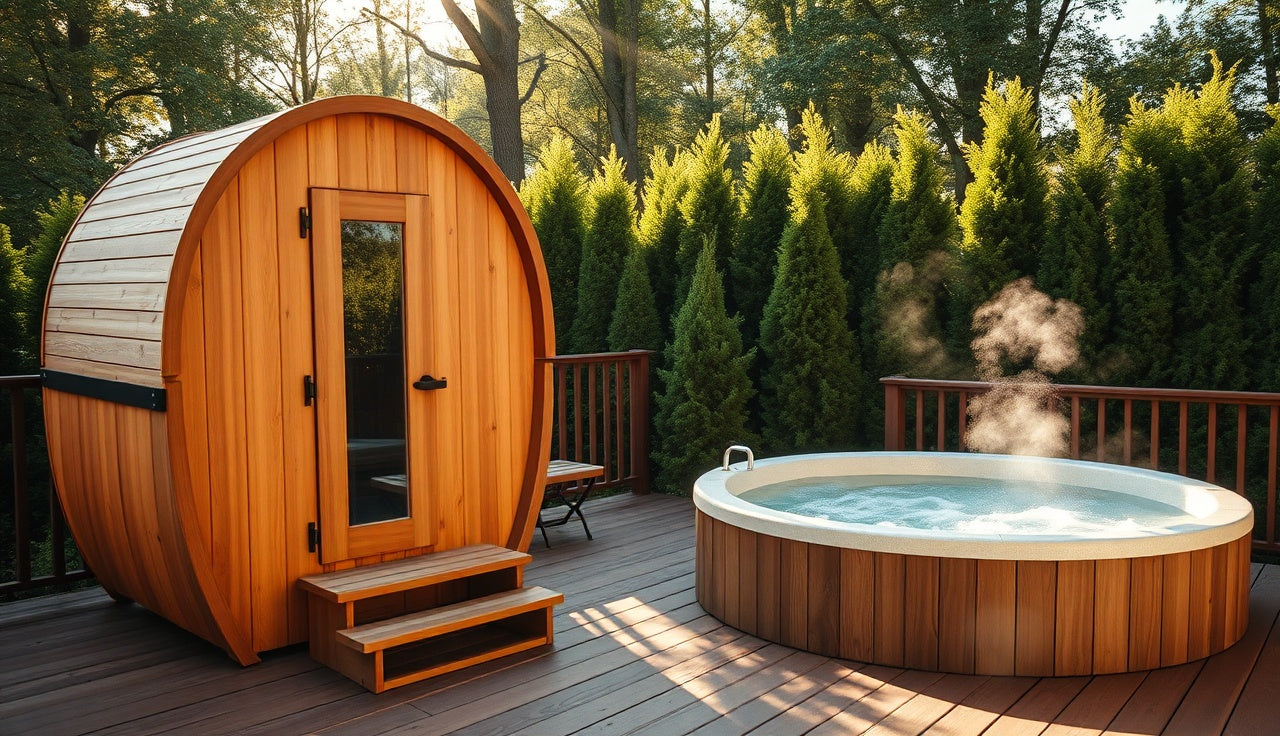
Space is the most flexible variable. A barrel sauna and a freestanding cold plunge tub fit in a 12 x 16 ft footprint if you skip a deck or lounge. Add a small deck between the two and you're looking at 200 to 300 sq ft. Want a lounge chair, a privacy fence, and an outdoor shower? Budget 400 to 600 sq ft.
Power is where people get surprised. Most outdoor saunas run on a 240V, 30 to 60 amp dedicated circuit. The National Electrical Code Articles 424 and 680 govern heating appliances and wet-location wiring, and your local jurisdiction almost certainly requires a permit and inspection [1]. Running a new sub-panel circuit from your main panel costs $500 to $2,000 depending on distance and local labor rates. Sort this out before you fall in love with a specific sauna spot.
Water and drainage matter more for the cold plunge than most buyers expect. A chiller-equipped plunge recirculates water and only needs a garden-hose fill plus an occasional drain. A passive ice bath needs frequent dumping. Either way, you want a floor drain or a gravel bed within a few feet and a hose bib close enough that you're not dragging 100 feet of hose. Putting the plunge on a deck? Confirm the framing can take the load. A 65-gallon plunge tub full of water weighs roughly 540 lbs before you climb in, since a US gallon of water weighs 8.34 lbs [2].
The transition distance is the single most underrated usability factor. Every extra step you take cold and wet across a deck in January is a reason to skip the plunge. Keep the two units 6 to 15 feet apart with a non-slip surface between them and you'll use both consistently. Put the plunge around the corner or across the yard and it becomes a planter.
What are the most practical layout configurations for a small backyard?
Under 1,200 sq ft of outdoor space, three configurations do most of the work. Pick based on your lot shape and how much you care about how it looks.
Side-by-side linear layout. The sauna and plunge sit on a shared deck or pad, 3 to 5 ft of clearance between them. You step out of the sauna, turn, and drop into the plunge in under five seconds. This is the tightest use of space and the cheapest to plumb and wire because both units sit close together. The catch: it reads utilitarian unless you add matching materials, a pergola, or a privacy screen.
L-shaped layout with a connecting deck. The sauna anchors one end, the plunge sits at a 90-degree angle, and the connecting deck doubles as a lounge and transition zone. This works on corner lots and irregular yards. The corner of the L is a natural home for an outdoor shower, which is genuinely useful for rinsing before you plunge. Plan for 300 to 450 sq ft of deck.
Sauna shed with an attached or adjacent plunge pad. Building a custom sauna room or converting a shed lets you pour a small concrete pad right off the door for the plunge. This is the most permanent option and the one that photographs best. Weatherproofing gets easier too, since both units sit against structure. The tradeoff is money: a site-built sauna room runs $10,000 to $35,000 or more before the plunge [3].
Tight on room? A portable sauna paired with a compact cold plunge tub works on a patio as small as 10 x 10 ft. You give up insulation quality and session capacity, but you keep the contrast.
| Layout | Min. space needed | Estimated deck/pad cost | Best for |
|---|---|---|---|
| Side-by-side linear | 150 to 250 sq ft | $1,500 to $5,000 | Small yards, budget builds |
| L-shaped with deck | 300 to 450 sq ft | $4,000 to $12,000 | Corner lots, social use |
| Sauna shed + pad | 200 to 350 sq ft | $8,000 to $30,000+ | Permanent builds, resale value |
| Portable sauna + tub | 80 to 120 sq ft | $0 to $1,500 | Renters, minimal commitment |
How far apart should the sauna and cold plunge be?
Six to twelve feet between the sauna door and the plunge edge is the sweet spot. Close enough to transition before you lose your heat, far enough that sauna steam doesn't warm the plunge water or fog the chiller. Every second you spend crossing cold, wet ground changes the stimulus your body gets.
Contrast therapy protocols move you between heat and cold in short windows. A 2021 review in the International Journal of Environmental Research and Public Health described alternating sauna heat (80 to 100°C) with cold water (10 to 15°C) in roughly 10 to 20 minute heat and 1 to 5 minute cold intervals, and reported favorable cardiovascular and perceived recovery outcomes [4]. The layout lesson: a long transition bleeds body heat before you hit the water, which softens the effect.
Don't crowd the units either. Most cold plunge chillers are rated to run in ambient temperatures up to 95 to 105°F depending on the manufacturer. Park one against a sauna's radiant heat in a confined space on a hot day and it works harder, cools slower, and wears out faster.
Building a cover over both? Give the roofline enough airflow that heat doesn't pool. A pergola with open slats beats a solid patio cover for exactly this reason.
What permits and codes apply to a backyard sauna and cold plunge setup?
Almost every jurisdiction requires at least an electrical permit for a new 240V circuit. Many also require a building permit for structures over a set size, commonly around 120 sq ft, though the threshold varies widely by city and county [5]. Call your building department before you pour concrete or pull wire.
A site-built sauna room or a large new deck will need a building permit. A freestanding barrel sauna sitting on gravel or an existing pad, not attached to the house, is one many homeowners skip permitting. That carries real risk at resale and for insurance claims, so weigh it honestly.
The NEC Article 680 covers wet-location equipment. Your building department may classify a cold plunge tub differently depending on whether it has jets, a chiller compressor, or is basically a large stationary vessel. That classification drives outlet placement and GFCI requirements, so ask before you commit to a layout [1].
HOA rules are their own layer. Some ban visible utility equipment like chillers and tanks, or cap structure height. Get written approval before you build anything.
Setbacks matter too. Most residential zoning requires accessory structures to sit at least 5 to 10 feet from property lines, though the number varies by parcel. Your county planning department website has the specifics for your lot.
How much does a backyard sauna and cold plunge combo cost?
The honest range is wide. Figure $8,000 on the low end for a used or entry-level barrel sauna plus a basic plunge tub, up to $60,000 or more for a custom sauna room, premium chiller, full deck build-out, and landscaping. Here's where the money actually goes.
Sauna unit. A solid 2-person barrel sauna with a Finnish-style heater runs $3,000 to $8,000 for the unit alone. A prefab 4-person cabin runs $7,000 to $18,000. Site-built custom rooms hit $15,000 to $40,000 or more in labor and materials [3].
Cold plunge unit. A passive tub (no chiller, you add ice) costs $500 to $2,500. A chiller-equipped plunge that holds 39 to 55°F without ice runs $3,000 to $10,000 for a quality build. Compare the cold plunge options before you commit.
Site prep and electrical. A gravel bed or concrete pad runs $1,000 to $4,000. A new electrical circuit runs $500 to $2,000. Adding a deck? Figure $15 to $35 per sq ft for pressure-treated or composite.
Ongoing costs. A 6kW sauna heater used 3 to 4 sessions a week, an hour each, adds roughly $30 to $60 a month to your bill at average US rates of $0.12 to $0.16 per kWh [6]. A chiller holding 50°F in a moderate climate adds another $20 to $50 a month.
SweatDecks carries cold plunge and outdoor sauna units with full specs listed, so you can match a model to your site before you buy.
| Item | Low end | High end |
|---|---|---|
| Barrel or prefab sauna | $3,000 | $18,000 |
| Cold plunge (passive) | $500 | $2,500 |
| Cold plunge (chiller) | $3,000 | $10,000 |
| Electrical circuit | $500 | $2,000 |
| Deck / pad | $1,500 | $15,000 |
| Outdoor shower (optional) | $300 | $3,000 |
| Total range | $8,800 | $50,000+ |
| Barrel or prefab sauna unit | $10,500 |
| Cold plunge with chiller | $6,500 |
| Deck or concrete pad | $8,000 |
| Electrical circuit (240V) | $1,250 |
| Outdoor shower (optional) | $1,750 |
| Privacy fencing / landscaping | $5,500 |
Source: Angi / HomeAdvisor cost guides and U.S. EIA electricity data, 2023 to 2024
What surface should go between the sauna and the cold plunge?
Non-slip is the only hard requirement. After that, your choice affects cost, upkeep, and how the space feels underfoot. Whatever you pick, slope it at least 1/8 inch per foot away from both units so water drains instead of pooling next to a sauna or a chiller.
Composite decking is the popular default, and for good reason. It handles wet feet, doesn't splinter, needs almost no maintenance, and looks clean. It runs $15 to $35 per sq ft installed. The downside: it holds heat in direct sun, so it can be brutal underfoot on a July afternoon.
Pressure-treated wood decking costs less at $10 to $20 per sq ft installed, but needs sealing once a year in most climates. It stays warmer in cool weather, which a lot of people prefer for winter contrast sessions.
Concrete with a brushed or textured finish is the most durable and lowest-maintenance option. It's also the coldest underfoot in winter. A rubber anti-fatigue mat between the units fixes that cheaply.
Pavers or natural stone look great and stay cooler than composite in summer, but grout lines want attention and some stone turns slick when wet. Travertine and tumbled bluestone are common picks and need a sealer once a year.
Artificial turf works surprisingly well as a surround. It's soft, drains reasonably, and never bakes hot. Skip it directly under the plunge where splash and overflow collect, but around the units it's comfortable and cheap.
Should you add an outdoor shower to your sauna cold plunge layout?
Yes, almost always. An outdoor shower earns its footprint in a contrast setup for three reasons.
First, rinsing before the plunge strips off sweat and skin oils from the sauna. That matters for cold plunge water quality if you run a chiller with filtration. Cleaner bodies mean longer stretches between water changes and filter swaps.
Second, a cool (not cold) shower makes a gentle intermediate step between sauna and plunge. It's a friendlier on-ramp for anyone new to contrast therapy or a guest who isn't ready for a 50°F full immersion.
Third, a warm rinse after your final cold round and before you towel off feels genuinely good and helps you rewarm, especially in cold outdoor air.
A basic outdoor shower, a PVC or stainless fixture on a wood post over a gravel drainage bed, costs $300 to $800 DIY or $1,000 to $3,000 installed. Put it in the corner of an L-shaped layout or along the back fence of a linear one. Plumb both hot and cold so you control the temperature instead of settling for whatever the cold line delivers.
Check your local plumbing code before you connect to a hot water supply outdoors. Some jurisdictions require specific valve types or minimum clearance from property lines for outdoor fixtures [7].
How do you handle privacy in a backyard sauna cold plunge setup?
Plan for privacy from day one. You're going to be half-dressed, flushed from the sauna, dropping into cold water, then standing around drying off. A neighbor's second-story window sees all of it. Three tools handle this: fencing, landscaping, and structure.
Fencing is the fastest fix. A 6-foot solid cedar or composite privacy fence along the exposed property lines blocks sightlines immediately. Most residential codes allow 6-foot fences in rear yards without a permit, but verify locally [5]. Cost runs $20 to $45 per linear foot installed.
Landscaping takes longer but looks better and adds value. Fast screening plants like arborvitae, Leyland cypress, or bamboo in a root barrier reach 10 to 15 feet within 3 to 5 years. A staggered double row of 6-foot arborvitae planted 4 feet apart gives you a dense screen in 2 to 3 growing seasons. Plants run $40 to $150 each depending on starting size.
Structure means a pergola with privacy lattice, a shed wall as a backdrop, or a sauna cabin that builds privacy into its architecture. It's the priciest route and the most finished-looking.
For most backyards, mix them: a solid fence on the neighbor-facing sides and a pergola overhead to kill second-story views without feeling boxed in. Budget $3,000 to $8,000 for a privacy surround that's done right.
What's the best sauna type for a combo backyard setup?
For a first backyard combo, a barrel sauna with a wood-burning or electric Finnish heater is the practical pick. It's built for outdoor life, quick to set up, and reliable.
Barrel saunas shed rain and snow off the curved roof, the shape moves heat efficiently, and they ship pre-assembled or as kits that don't need a contractor. A good 2-person barrel with a decent electric heater hits 180°F in 30 to 45 minutes. The home sauna guide goes deeper on sizing.
A traditional Finnish-style room built into a shed or outbuilding holds heat better and feels more like the real thing, but construction cost and timeline jump. If you're building a permanent structure that adds property value and the budget's there, go this route.
Infrared saunas are fine indoors but poorly matched to outdoor contrast therapy. They heat your body rather than the air, so the ambient environment stays cool, and stepping out into cold air gives you a different physiological jolt than stepping out of a 190°F Finnish-style room. They're also less weather-hardy as a category. The sauna benefits research is mostly built on traditional dry heat at 80 to 100°C, so the comparison isn't apples to apples [4].
Wood-burning heaters are romantic and off-grid, but they demand cord wood storage, ash cleanup, and usually run afoul of urban and suburban fire codes. Check your fire district's rules before buying one [8].
For a first build, an electric barrel sauna plus a chiller-equipped plunge delivers the most reliable contrast experience with the least operational fuss.
What cold plunge temperature and protocol actually makes sense?
Nobody has perfectly clean data on the single best contrast protocol for every goal and every body. That said, the range the research works within is well established, and it's a fine place to start.
Most studies showing recovery or cardiovascular effects use water between 10 to 15°C (50 to 59°F) [4]. Some athletic protocols go colder, 7 to 10°C. Below 10°C the shock response climbs, along with the risk of hyperventilation and cold shock, especially for people new to cold or living with cardiovascular conditions. The American Heart Association warns that sudden cold water immersion triggers an autonomic response that can be dangerous for people with undiagnosed heart conditions [9].
A common session structure in the literature: 10 to 20 minutes in the sauna at 80 to 100°C, then 1 to 5 minutes in cold water at 10 to 15°C, then 5 to 10 minutes of rest, repeated 2 to 4 times. Total session time usually lands at 60 to 90 minutes.
Running a passive ice bath instead of a chiller? Holding a steady temperature without a thermometer is harder than it sounds. Ice-to-water ratio, ambient temperature, and your own body heat all move the number. A waterproof thermometer costs $10 to $15 and earns its keep.
If your main goal is post-workout muscle recovery, know the nuance. A 2019 meta-analysis in the British Journal of Sports Medicine found cold water immersion "significantly reduced" delayed onset muscle soreness compared to passive recovery, while also noting possible interference with long-term strength gains when used right after resistance training [10]. The evidence is real but context-dependent. Cold plunge after cardio is generally fine. Cold plunge immediately after heavy lifting, if you're chasing muscle growth, is worth skipping or delaying a few hours.
The cold plunge benefits guide covers the full picture.
How do you winterize a backyard sauna and cold plunge setup?
Both units run year-round in most climates. The prep you need scales with how cold your winters get and how your plumbing is routed.
The sauna needs almost nothing if you're on an electric heater and the unit is built for outdoor use. Snow on a barrel roof is fine, it insulates rather than damages. The heater should be rated for outdoor use, and the control panel should sit inside the sauna or in a weatherproof box. Skip it for a few weeks? Run a quick heat-up cycle every week or two to keep the interior dry and mold-free.
With a chiller-equipped plunge, the plumbing lines and the compressor are the weak points. Most manufacturers set a minimum operating ambient temperature around 35 to 40°F. Below that, refrigerant efficiency drops and the unit may not cool well. In hard-freeze climates you have two moves: pull the chiller into a shed or garage when it's not in use (if the unit disconnects easily), or insulate it and keep it running at a maintenance temperature. Check your manual.
External plumbing (outdoor shower, fill lines) should be drained and blown out with compressed air before the first hard freeze. A $20 compressor adapter for hose bibs turns this into a 10-minute job. Lines you can't drain need heat tape, which adds a little to your electric bill [6].
In genuinely cold climates (USDA zones 4 to 6), the outdoor shower is the most vulnerable piece. Insulate the supply lines or route them through a conditioned space. Foam pipe insulation works down to about 15 to 20°F; below that, you need heat tape.
Does adding a sauna and cold plunge increase home value?
This is genuinely uncertain. No large, nationally representative appraisal study isolates sauna-cold-plunge combos as a discrete variable. What we have is narrower.
The National Association of Realtors' 2022 Remodeling Impact Report found that outdoor living features broadly tend to recover a meaningful portion of their cost at resale, with the figure swinging hard on regional market conditions and build quality [11]. A well-built permanent sauna structure gets treated like other quality outbuildings by most appraisers: it adds auxiliary square footage, shows well in listing photos, and appeals to a narrow but motivated buyer pool.
A cold plunge tub, especially a chiller-equipped one, is murkier. If it's freestanding, it's personal property, which means it can walk out the door when you sell and won't necessarily show in the appraisal. Built into a permanent pad with integrated plumbing and a cover structure, it's more likely to count as a fixture.
The practical call: if you're building mostly as a resale play, spend on permanent structures (the sauna cabin, the deck) and buy a quality but movable plunge unit. You capture the listing appeal and keep the option to take the plunge with you.
Building for your own use with resale as a side concern? The math gets simple. Buy what you'll use consistently. The health and quality-of-life returns are real no matter what a future buyer offers.
Frequently asked questions
What is the minimum backyard size for a sauna and cold plunge combo?
You can fit a barrel sauna and a freestanding cold plunge tub in roughly 150 to 200 square feet of usable space, including a small transition area between them. That's about a 12 x 15 ft footprint. Any smaller and you're limited to a portable sauna. Add 100 to 200 sq ft if you want an outdoor shower, lounge chairs, or a privacy screen.
Do I need a permit to install an outdoor sauna and cold plunge?
Almost certainly yes for the electrical work. A new 240V circuit requires an electrical permit in virtually every US jurisdiction under the National Electrical Code. A building permit may also apply if you're building a structure over roughly 120 sq ft. Cold plunge tubs get classified differently depending on local plumbing codes. Call your building department before you start work.
Can a cold plunge chiller run outdoors in winter?
Most cold plunge chillers set a minimum operating ambient temperature around 35 to 40°F. Below that, refrigerant efficiency drops and the unit may not hold target temperatures. In hard-freeze climates you'll either bring the chiller indoors when temperatures fall that low, or keep it running inside a protected, insulated enclosure. Check your specific unit's specs.
How much does it cost to run a sauna and cold plunge per month?
A 6kW electric sauna heater used 3 to 4 times a week adds roughly $30 to $60 a month at average US rates ($0.12 to $0.16 per kWh). A chiller holding 50°F adds another $20 to $50 a month depending on ambient temperature, insulation, and how often you use it. Combined, figure $50 to $110 a month.
What's the ideal temperature sequence for contrast therapy in a home setup?
Research protocols typically use 10 to 20 minutes in a sauna at 80 to 100°C (176 to 212°F), then 1 to 5 minutes in cold water at 10 to 15°C (50 to 59°F), with 5 to 10 minutes of rest between rounds, repeated 2 to 4 times. There's no single proven optimal sequence. This framework shows up consistently in the contrast therapy literature and is a reasonable starting point for healthy adults.
Is a wood-burning or electric sauna heater better for a backyard setup?
Electric is more practical for most suburban backyards. It heats predictably, needs no cord wood storage, and satisfies fire codes that often ban wood-burning appliances in dense residential areas. Wood-burning heaters offer an authentic experience and work off-grid, but they require ash cleanup, more maintenance, and may not be allowed in your fire district. Verify local rules before buying wood-burning equipment.
How do I keep cold plunge water clean without draining it constantly?
Most chiller-equipped plunges include a filtration and UV or ozone sanitation system. To keep water clean, shower before entering, skip soap and lotions, and maintain sanitizer levels on the manufacturer's schedule. Cold water below 55°F naturally slows bacterial growth, so chilled plunges stay cleaner longer than room-temperature tubs. Most owners do a full water change every 4 to 8 weeks.
Will an outdoor sauna and cold plunge setup survive harsh winters?
Yes, with proper prep. Barrel saunas and prefab outdoor cabins are built for outdoor installation and handle snow and cold fine. The sauna heater benefits from weekly heat-up cycles to keep the interior dry. The cold plunge chiller needs protection below 35 to 40°F. External plumbing for an outdoor shower should be drained or heat-taped before the first hard freeze.
Should I put the sauna or the cold plunge closer to the house?
Put the sauna closer to the house if you can. You'll want quick access when you're starting a cold-weather session, and the sauna's 240V connection is cheaper to run over a shorter distance. The cold plunge only needs a garden hose for fill and a nearby drain, so it's easier to place farther out. Proximity to house utilities is the bigger constraint either way.
Can I use an inflatable or stock tank cold plunge in a backyard sauna setup?
Yes. A galvanized stock tank (100 to 150 gallon) costs $200 to $400 and works well as a passive cold plunge. You fill it with water and ice, monitor temperature with a waterproof thermometer, and drain or refill as needed. It's heavy when full (roughly 1,000 to 1,200 lbs with ice and water for a 100-gallon tank), so set it on a concrete pad or compacted gravel, never an elevated deck without structural engineering.
What's the best flooring material for the area between a sauna and cold plunge?
Composite decking is the popular choice: non-slip when wet, low maintenance, durable. Brushed concrete with a non-slip additive is the most durable and cheapest long-term. Natural stone and pavers look great but need annual sealing and can get slick without a textured finish. Whatever you pick, slope the surface at least 1/8 inch per foot away from both units for drainage.
How long does it take to install a backyard sauna and cold plunge from start to finish?
A straightforward setup with a prefab barrel sauna and a freestanding plunge on an existing concrete pad can be done in 2 to 4 weeks once equipment arrives, assuming the electrical permit and inspection move quickly. A full build with a new deck, sauna cabin, privacy fencing, and landscaping usually takes 2 to 4 months. Electrical permits and inspections are typically the longest single variable.
Does cold water immersion after sauna reduce muscle soreness?
A 2019 meta-analysis in the British Journal of Sports Medicine found cold water immersion significantly reduced delayed onset muscle soreness compared to passive recovery. The same analysis noted possible interference with long-term strength gains when used right after resistance training. For cardio recovery, the evidence is more uniformly positive. For hypertrophy training, waiting a few hours before plunging may preserve more of the muscle-building stimulus.
What's the difference between a cold plunge and an ice bath for a backyard setup?
A cold plunge usually means a purpose-built vessel, often with a chiller to hold a set temperature without ice. An ice bath is a passive method using a tub, stock tank, or even a chest freezer filled with water and ice. Chiller plunges cost more upfront ($3,000 to $10,000) but drop the ongoing cost and hassle of buying ice. For regular use, a chiller pays for itself in 6 to 18 months versus buying ice. See the full comparison in the ice bath guide.
Sources
- National Fire Protection Association, NFPA 70 (National Electrical Code) Article 424 and Article 680: NEC Article 424 and 680 govern outdoor heating appliances and wet-location wiring; local jurisdictions require permits and inspections for 240V outdoor circuits.
- USGS Water Science School, water weight reference: One US gallon of water weighs approximately 8.34 lbs; a 65-gallon cold plunge tub holds roughly 542 lbs of water before occupant weight.
- HomeAdvisor (Angi), Sauna Installation Cost Guide: Site-built custom sauna rooms range from $10,000 to $40,000+ in labor and materials; prefab sauna cabins range from $7,000 to $18,000.
- International Journal of Environmental Research and Public Health, 2021, contrast therapy review: Alternating sauna heat (80 to 100°C) with cold water (10 to 15°C) in 10 to 20 minute heat and 1 to 5 minute cold intervals produced favorable cardiovascular and perceived recovery outcomes.
- International Code Council, International Building Code (IBC) accessory structure thresholds: Many jurisdictions require a building permit for accessory structures over approximately 120 sq ft; residential fence height is typically limited to 6 feet in rear yards.
- U.S. Energy Information Administration, Average Retail Price of Electricity: Average US residential electricity rate is approximately $0.12 to $0.16 per kWh, used to estimate monthly sauna and cold plunge chiller operating costs.
- International Association of Plumbing and Mechanical Officials, Uniform Plumbing Code: Outdoor plumbing fixtures connecting to hot water supply may require specific valve types or minimum clearance from property lines under local plumbing codes.
- U.S. Fire Administration, FEMA, outdoor fire safety and burning restrictions: Many urban and suburban fire districts prohibit or restrict wood-burning outdoor appliances; local fire codes should be verified before installing a wood-burning sauna heater.
- American Heart Association, cold water immersion and cardiovascular risk: Sudden cold water immersion triggers an autonomic response that can be dangerous for people with undiagnosed cardiovascular conditions.
- British Journal of Sports Medicine, 2019, cold water immersion meta-analysis: Cold water immersion significantly reduced delayed onset muscle soreness vs passive recovery but may interfere with long-term strength adaptations if used immediately after resistance training.
- National Association of Realtors, 2022 Remodeling Impact Report: Outdoor living features broadly recover a meaningful portion of their cost at resale; specifics vary by regional market and quality of construction.

Share:
Heated walkways for outdoor saunas: how to prevent ice safely
Cold plunge near sauna outdoor enclosure ideas that actually work