
Last updated 2026-07-09
TL;DR
A barrel sauna with a window adds light, a view, and a second vent point, but it costs $200, $800 more than a windowless model and can bleed heat if you pick single-pane glass or place it badly. Front-wall or side-wall tempered glass is the standard. Cedar is still the best barrel wood. Budget $3,500, $9,000 for a quality windowed outdoor unit.
What exactly is a barrel sauna with a window?
A barrel sauna is a cylindrical wood structure, usually built from tongue-and-groove cedar or Nordic spruce staves, that sits on cradle rails outdoors or in a garage. The curved shape holds less air than a rectangular box of the same length, so the stove heats the space faster and burns less fuel doing it. A window version is exactly what it sounds like: one or more glazed openings cut into the barrel's wall.
The glass is almost always tempered or double-pane tempered, because single-pane annealed glass cracks under the swing from a 40°F morning to a 180°F interior [1]. Most factory barrels offer a 16x16 inch or 22x24 inch window in the front wall (the door wall), a side wall, or, less often, the back wall or a skylight slot in the curved top.
A window does not turn the sauna into a steam room or change its dry-heat character. You still pour water on the rocks. You still run 160 to 195°F. The cedar still smells the way cedar should. The glass is there for light and for looking out. That's all it does.
Why do people want a window in their barrel sauna?
Sitting in a dim wooden box for 20 minutes feels very different from sitting in that same box while it frames a snowy backyard or a stand of trees. Plenty of buyers never thought they wanted a window until their first session in a windowed model at a showroom or a friend's place. Part aesthetic, part psychology.
The practical reasons are real too. A hinged or sliding window gives you a second vent point beyond the door and the floor-level intake. When the heat creeps past your comfort zone but you want to stay in, cracking a window drops the air temperature faster than opening the door, because the opening sits high on the wall where the hottest air pools.
People with claustrophobia often report a real difference with a window in front of them. The research on sauna and mental wellness looks at the heat stimulus, not the enclosure design [2], so nobody has clean data showing windows cut anxiety in sauna users specifically. It's still a common reason buyers give, and it makes sense.
And if the sauna faces a garden, a lake, or a mountain, you want to see it. Reason enough.
Where should the window go: front wall, side wall, or back?
Placement matters more than most buyers realize going in. The four options break down like this.
Front wall (door wall). The most common spot. The window sits next to or above the door, usually at bench height so seated users can see out. It does the least damage to the stave layout because the door already interrupts the curve. Installation is simpler, cost is lower, and the glass does not face the stove, so radiant heat off the rocks never blasts it directly.
Side wall. The pick when you want a lateral view of a yard or pool. A side-wall window means cutting through the curved staves, which a good manufacturer handles with a reinforcing header and jamb. The structural concern is real but manageable in units engineered for it. Do not cut a side window into a barrel that was not designed for one.
Back wall. Least common. Good if the sauna backs up to a fence and you want to look away from the house. Structurally it acts like a front-wall window, since the back is also a flat circular endcap.
Roof or skylight slot. Some high-end models offer a curved polycarbonate or tempered glass skylight. It looks incredible under stars. The catch is heat loss: hot air stacks at the top of the barrel, and a roof window bleeds it faster than a wall window even when insulated. It also collects debris and is a pain to clean, and in a hot-sun climate it can cook the interior all summer. Skip it unless the look is non-negotiable.
For most buyers, a front-wall window at bench height, 16x24 inches, double-pane tempered, is the sweet spot. Simple. It works. It doesn't fight the stove.
Does a window make the barrel sauna harder to heat?
Yes, somewhat, but glass quality decides how much. Single-pane tempered glass runs about R-0.9. Double-pane tempered (two panes with an air gap) runs R-2 to R-2.5 [3]. The 2-inch cedar stave walls on a barrel land around R-1.5 to R-2 depending on density and thickness. A double-pane window insulates about as well as the wall it sits in.
Single-pane glass is the heat-loss culprit. A 16x24-inch single-pane window at R-0.9 in a sub-freezing yard dumps meaningful BTUs all session. Running your sauna year-round in Minnesota or Montana? Spend the extra $100, $200 on double-pane. It pays back in stove efficiency and preheat time.
A properly sized stove handles a windowed barrel without drama. The common rule is 1 kW of electric heat per 45 cubic feet of interior volume, with wood-burning stoves sized on the same volume basis [4]. A barrel with one standard double-pane window does not need a bigger stove. Add two large windows plus a skylight and you might bump output 10 to 15%.
Preheat in a well-built cedar barrel with one double-pane window runs 30 to 45 minutes to 170°F in moderate weather. The windowless version of the same barrel might hit temperature in 25 to 35 minutes. That gap is real. It's not a dealbreaker for most people.
What does a barrel sauna with a window cost?
A base barrel sauna without a window runs $2,800, $6,500 for a quality 6-foot-diameter, 7-foot-long model from a reputable maker, before delivery or electrical work [5]. A factory window adds $200, $600 depending on size and glass spec. Cutting a window into an existing barrel costs more: $400, $900 with labor, glass, and sealing, because the curved wall complicates the framing.
High-end barrels with panoramic or floor-to-ceiling curved glass, the kind you see in Nordic spa photography, run $10,000, $30,000. Those are custom builds and a different category entirely.
Here's what a realistic home install looks like:
| Configuration | Typical price range |
|---|---|
| Barrel sauna, no window, DIY kit | $2,500, $4,500 |
| Barrel sauna, single window, factory-built | $3,500, $7,000 |
| Barrel sauna, two windows, factory-built | $4,000, $8,500 |
| Barrel sauna, panoramic glass front | $7,000, $15,000 |
| Retrofit window into existing barrel | $400, $900 (labor + materials) |
Delivery for a pre-assembled or flat-pack barrel adds $300, $800 depending on distance from the manufacturer. Electric installation for an electric heater runs $500, $1,500 depending on whether you need a new 240V circuit. Wood-burning units skip that cost but need clearance from combustible structures, typically 36 inches in most jurisdictions though local fire codes vary [6].
Want to see current pricing across tiers? The outdoor sauna and home sauna guides on this site break down more options.
| DIY kit, no window | $3,500 |
| Factory-built, 1 window | $5,250 |
| Factory-built, 2 windows | $6,250 |
| Panoramic glass front | $11,000 |
| Retrofit window (add-on) | $650 |
Source: North American Sauna Society consumer pricing data and retailer market research, 2024
What glass type is best for a sauna window?
Tempered glass is the floor, not a feature. Tempered is heat-treated to be about four times stronger than annealed glass, and it breaks into small rounded pebbles instead of sharp shards [7]. Sauna windows take rapid thermal cycling: cold outside, very hot inside, plus the occasional water splash when someone opens the door mid-session. Annealed glass cracks under that. Every credible sauna manufacturer uses tempered. This is not a debate.
For insulation, double-pane tempered beats single-pane by a wide margin, as covered above. Some European cold-climate barrels use triple-pane, but it adds weight and cost with thin returns anywhere but the coldest regions (below -20°F on the regular).
One option worth knowing: borosilicate glass, the stuff in lab equipment and cookware, shrugs off thermal shock. It shows up in some high-end sauna doors and windows. It costs more than standard tempered and resists thermal shock better, but for a typical home sauna, double-pane tempered is enough.
Tinted or privacy glass comes up a lot. Lightly tinted tempered (bronze or gray) cuts visibility from outside while still letting good light in, and trims some summer solar gain. Reasonable if your sauna faces a neighbor's yard. Frosted or etched glass keeps more privacy but blurs the view, which kills the reason most people wanted a window in the first place.
Does a sauna window affect privacy or safety?
Privacy is a real concern. A window at bench height means anyone standing at the right angle outside can see in. The fixes: site the sauna so the window faces away from property lines, plant screening shrubs, use lightly tinted glass, or install an interior roller blind rated for high heat (rare, but they exist).
Standard fabric blinds will not survive sauna heat. For interior covering, look for heat-resistant fiberglass or aluminum venetian blinds, which handle 200°F without off-gassing. No vinyl. No standard fabric.
On safety, the two risks that matter are cracked glass from thermal shock (solved by tempered glass) and a child pressing against hot glass. The interior surface of a single-pane window in a hot sauna can reach 130 to 150°F, hot enough to burn skin fast. Double-pane runs cooler on the interior surface, typically 90 to 110°F at 180°F air temperature. If young kids use the sauna, that alone justifies the double-pane upgrade.
Electrical safety sits apart from the window question but earns a mention. The National Electrical Code (NEC) Articles 424 and 680 govern sauna wiring in the US, and your install has to meet them regardless of window choice [8]. Buying a pre-wired unit? Confirm it's UL or ETL listed.
Cedar vs. spruce: does the wood choice change anything for windowed models?
Not much, as far as the window goes. Western red cedar and Nordic spruce are both common barrel materials, and the window frame usually matches the staves for a clean look.
Cedar has natural oils that resist moisture and insects, smells wonderful, and edges out spruce for outdoor installs that see rain and snow. Cedar also has slightly lower thermal conductivity, so the walls warm faster and feel less cold to the touch in the first ten minutes. The aromatics are genuinely part of the experience for a lot of people.
Spruce is harder than cedar, less prone to denting, cheaper, and still performs well in sauna conditions. Plenty of Scandinavian barrels use Nordic spruce or thermally modified spruce and last decades on basic upkeep.
Either way, the window frame needs periodic oiling with a sauna-safe wood oil so the dry heat doesn't crack it over the years. Same maintenance the rest of the interior needs. Budget one to two hours and about $30 in oil a year.
For a fuller breakdown of sauna types and materials, the main sauna guide is worth reading before you commit.
How do you maintain and seal a sauna window?
The seal between glass and wood frame is the one maintenance point that actually matters. Wood expands and contracts with every heat cycle. Over years, a cheap sealant cracks, moisture works into the frame, and you get rot or mold inside the wall cavity.
Factory barrels seal the glass-to-frame joint with high-temperature silicone rated for 400°F or higher. That's the right material. If you ever reseal, use only high-temp silicone. Standard window caulk, even exterior-grade, degrades fast at sauna temperatures.
The exterior of the barrel, window frame included, wants a UV-resistant exterior wood finish every two to three years depending on climate. That's not sauna-specific care. It's standard outdoor wood maintenance. The glass itself needs glass cleaner outside and a dry cloth inside. Skip ammonia-based cleaners on the interior, since they can attack the wood finish.
Check the frame-to-stave joint once a year. Slight gaps from wood movement are normal. Gaps wider than 1/8 inch should get re-caulked with high-temp silicone. Twenty minutes of work that heads off a much bigger problem.
What size barrel sauna should you get if you want a window?
Barrel diameter sets your window options. A 6-foot-diameter barrel has more flat wall area on the endcaps and more stave length on the sides than a 5-foot barrel. A 22x24-inch window fits comfortably in a 6-foot front wall; the same window in a 5-foot barrel eats a bigger slice of the endcap and crowds the door.
Common barrel lengths run 6 feet (2-person), 7 feet (3-person), and 8 to 9 feet (4-person or longer). The 7-foot-long, 6-foot-diameter setup is the most popular for home use. At that size, a 16x24-inch or 22x24-inch front-wall window is proportional and doesn't touch structural integrity.
Want a side-wall window for a lateral view? A longer barrel (7 to 9 feet) gives you more wall to work with and keeps the window clear of the end-stave structural zone. The staves near the endcap rings carry more load in the barrel's hoop-stress system, so you want the opening away from them.
Do not buy a 2-person barrel with two big windows and a skylight. The glass becomes a large fraction of the envelope, heat retention suffers, and the stove grinds all session. For a 2-person setup, one well-placed window is plenty.
Can a barrel sauna with a window be used year-round?
Yes, and it's one of the barrel design's real strengths. The curved shape sheds snow on its own, without the roof-load worries you get with a flat-roof rectangular sauna. The small air volume lets you preheat to session temperature even at -10°F outside, though preheat stretches to 45 to 75 minutes.
The window turns into a liability in extreme cold only if it's single-pane. At -20°F ambient with single-pane glass, you lose heat fast enough that a standard 6kW heater struggles to hold 170°F. In that range, double-pane isn't optional.
In summer the window is an asset: crack it to vent steam, air out between rounds, or grab airflow when you step out. A hinged or sliding window beats a fixed one here. If your barrel faces a sunny direction and takes hard afternoon sun, lightly tinted glass keeps the interior from pre-heating on its own before your session.
One underrated point: looking out at a snow-covered yard from inside a 180°F cedar barrel is one of the best experiences in home wellness. If you're building a year-round practice (and the sauna benefits are worth a read if you're new), the window earns its keep most in the cold months.
How does a barrel sauna with a window compare to other sauna types?
The windowed barrel is an outdoor sauna category, and it's different from indoor saunas, rectangular outdoor saunas, and infrared cabins in ways that matter to your wallet and your preheat clock.
| Feature | Barrel sauna (windowed) | Rectangular outdoor sauna | Indoor sauna room | Infrared cabin |
|---|---|---|---|---|
| Typical price (installed) | $4,000, $9,000 | $5,000, $15,000 | $3,000, $12,000 | $1,500, $5,000 |
| Heat type | Convection (Finnish dry) | Convection (Finnish dry) | Convection or combo | Infrared radiant |
| Preheat time | 30 to 50 min | 35 to 60 min | 25 to 45 min | 10 to 20 min |
| Window options | Yes, curved or flat endcap | Yes, standard framing | Yes, glass doors common | Limited, some models |
| Year-round outdoor use | Yes, excellent | Yes, good | N/A (indoor) | Not recommended in extreme cold |
| Maintenance | Moderate | Moderate-high | Low-moderate | Low |
The barrel's edge is heat efficiency per dollar and the looks that justify the window in the first place. A rectangular outdoor sauna at the same price gives you more interior floor space and takes a standard window more easily, but it costs more to heat and takes longer to preheat. Infrared cabins offer a window on some models, but the view is usually through a small glass door panel, not a real scenic window, and the heat is a different animal from traditional Finnish sauna [9].
If the view and the wood-fired experience both matter to you, the windowed barrel is the best value in that combination. If interior space is your priority, go rectangular.
For the wider category, the outdoor sauna guide covers rectangular, pod, and barrel designs side by side.
What should you look for when buying a barrel sauna with a window?
Here's my checklist, in the order I'd run it.
Glass spec first. Ask straight out: tempered or not, single or double-pane, R-value or U-factor. If the seller can't answer, walk.
Window mechanism. Fixed windows are fine for light and looks. Hinged (tilt-in) or sliding windows give you ventilation control. For year-round use in a variable climate, a hinged window is worth the extra $50, $100.
Stave thickness. Thicker holds heat better. 1.75-inch staves are the minimum for a quality outdoor barrel, 2-inch is better, and anything under 1.5 inches is a budget shortcut you'll feel in winter.
Stove compatibility. Confirm the stove that ships with the unit (or sells separately) is sized for the barrel's cubic footage plus the window's extra heat loss. A 6kW electric stove handles a 6x7-foot barrel with one standard window in most climates.
Warranty on wood and glass. Quality makers offer 2 to 5 years on structural components. Be skeptical of anything under a year.
ETL or UL listing on the heater. This matters for your homeowner's insurance and for safe operation.
Cradle material. Galvanized steel or stainless cradles last. Untreated steel rusts and streaks the wood. Ask what the rails are made of.
SweatDecks carries outdoor barrel saunas including windowed models; filter by size and window configuration on the home sauna collection page to compare specs side by side.
Thinking about pairing the sauna with a cold plunge for contrast therapy? The two work well together outdoors. A window in the barrel is especially nice when the plunge sits outside too, since you can watch the cold tub between rounds without leaving the heat.
Frequently asked questions
Can I add a window to a barrel sauna I already own?
Yes, but it's not a simple DIY job. The curved stave wall needs a reinforcing header and a properly fitted frame, and the joint needs high-temperature silicone. A carpenter with sauna or timber-frame experience can do it for $400, $900 in materials and labor. You'll need tempered glass cut to fit. Avoid cutting near the hoop rings or endcap joints, since those areas carry structural load.
What temperature does the inside of a sauna window glass get?
With single-pane glass and a 180°F interior, the inside glass surface can reach 130 to 160°F, hot enough to burn on contact. Double-pane runs much cooler on the interior surface, typically 90 to 115°F under the same conditions, because the air gap between panes insulates. If children use your sauna, double-pane glass is a meaningful safety upgrade.
Does a window affect the sauna's humidity or steam?
Only if it's open. A closed window has no effect on humidity inside the barrel. Pour water on the rocks (löyly) and steam distributes normally. Open the window and you create a convection path that vents hot humid air faster than cracking the door does. Some people use a partly open window to fine-tune the steam-to-heat ratio mid-session, which is a real benefit of an operable window over a fixed one.
How big should the window be in a barrel sauna?
For a 6x7-foot barrel (the most common home size), a 16x24-inch or 22x24-inch window is proportional and doesn't meaningfully hurt heat retention if it's double-pane. Bigger windows look dramatic but increase heat loss and steal flat wall area from benches or framing. One standard-size window is almost always the right call for a two-person barrel.
Will a window make the barrel sauna look better outdoors?
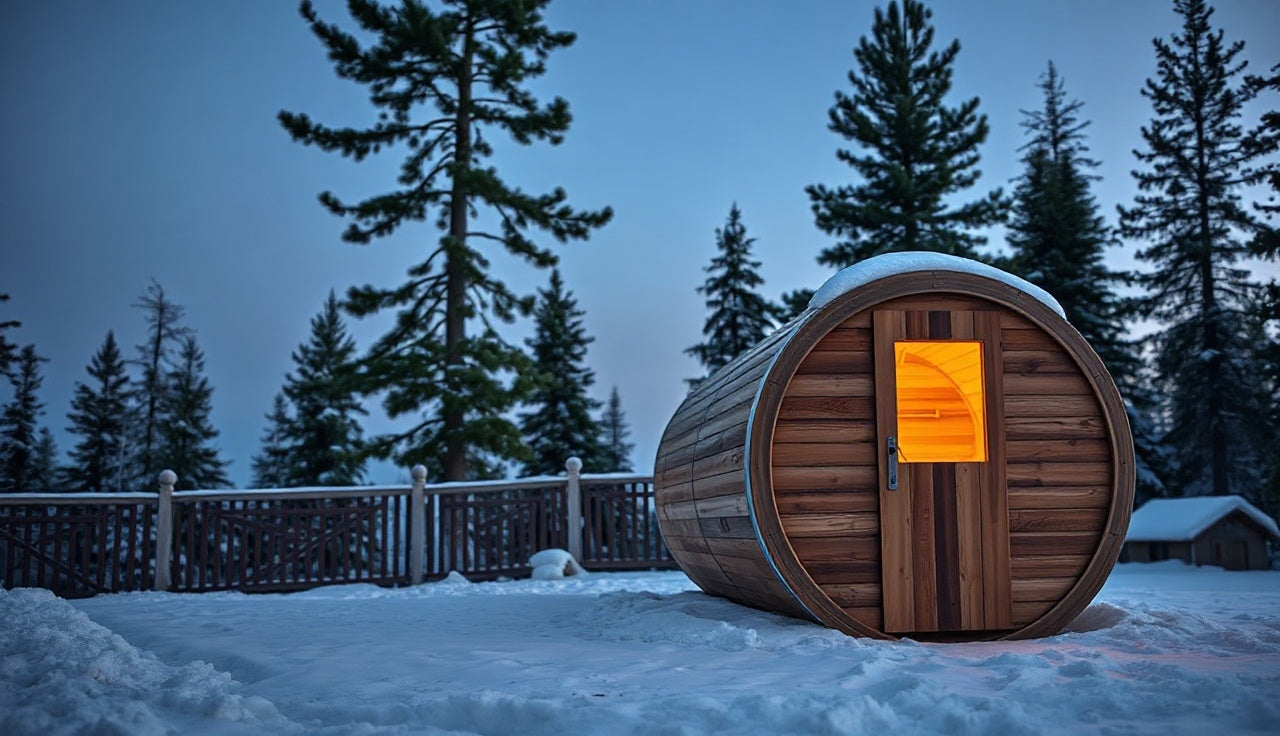
Most people think yes, and the market reflects it: windowed models sell at higher rates than windowless ones among home buyers, though published figures on this are hard to find. The window breaks the visual mass of the cylindrical wood form and adds a focal point. At night, with the sauna lit inside, the glow through the glass is genuinely attractive in a backyard.
What permits do I need for an outdoor barrel sauna with a window?
Requirements vary by municipality. Many jurisdictions exempt small accessory structures under a set footprint (often 120 to 200 square feet) from building permits, but a permanent electrical connection almost always needs a permit and inspection. Check your local building department before installation. Wood-burning stove installs may also require a separate chimney or clearance inspection. Your HOA may add rules on outdoor structures.
Can you use a barrel sauna window as an emergency exit?
Not practically. Standard sauna windows are 16x24 inches or smaller, too small for an adult to climb through in an emergency. The door is your primary exit. Always make sure the sauna door opens from the inside without a key or a latch that needs two hands. Basic safety point that applies to any sauna design, windowed or not.
How long does a cedar barrel sauna with a window last outdoors?
A well-maintained western red cedar barrel should last 15 to 25 years outdoors. The wood is naturally rot-resistant, and the curved shape sheds water well. The window seal (high-temp silicone) needs an annual look and reapplication every 5 to 10 years. The stove has its own life: wood-burning stoves often outlast the barrel, electric heaters typically last 10 to 15 years with normal use.
Is a barrel sauna with a panoramic or full-glass front worth the extra cost?
Panoramic glass fronts look stunning in photos and showrooms. In practice you're at $8,000, $20,000+ for a quality unit, heat loss is higher, and bench placement gets constrained because the glass wall is the front wall. For most home buyers, a standard window in a $4,000, $7,000 cedar barrel delivers 90% of the aesthetic at a fraction of the cost. The panoramic option earns its price only if the view is exceptional and budget isn't the constraint.
Do sauna windows fog up or get condensation?
Single-pane windows fog and show condensation on the cold exterior surface in winter, which can hide the view. Double-pane windows resist exterior fogging because the outer pane stays warmer. Interior fogging can flash briefly when you open the door and cold air hits hot glass, but it clears within seconds. For consistent view clarity in cold climates, double-pane is the practical choice.
Can I pair a barrel sauna with a cold plunge in my backyard?
Yes, and it's one of the better ways to set up a home contrast therapy station. The two units sit well together outdoors. A windowed barrel facing the cold plunge lets you watch the tub between heat rounds, which some users find helps with the mental prep for the cold. The evidence on contrast therapy is promising but still developing; one 2013 review found cold-water immersion reduced delayed onset muscle soreness compared to passive rest [11].
What is the best wood stain or finish to use on the exterior of a windowed barrel sauna?
Use a penetrating UV-resistant exterior oil or stain made for cedar or pine, applied to the exterior stave surfaces every two to three years. Cabot Australian Timber Oil and similar penetrating finishes are common choices. Avoid film-forming paints or varnishes on the exterior, since they trap moisture and peel. Give the window frame exterior the same treatment as the surrounding wood to prevent differential weathering and joint cracking.
Sources
- Consumer Product Safety Commission (CPSC): Tempered glass shatters into small rounded fragments rather than sharp shards and is required where thermal cycling or impact risk is present.
- PubMed (NIH National Library of Medicine), Laukkanen et al. (2018), Cardiovascular and Other Health Benefits of Sauna Bathing: Sauna health research focuses on the heat stimulus; the review covers cardiovascular, mental health, and respiratory benefits of regular sauna use.
- U.S. Department of Energy, Energy Saver (window and glazing R-value and U-factor guidance): Single-pane glass insulates at roughly R-0.9 to R-1; double-pane insulating glass runs about R-2 to R-2.5 depending on gap and coatings.
- Finnish Sauna Society (Suomen Saunaseura): Sauna heater sizing guideline: approximately 1 kW of heater output per 45 cubic feet of sauna interior volume is a standard industry starting point.
- North American Sauna Society: Quality outdoor barrel saunas from reputable manufacturers typically run in the low thousands of dollars before delivery and electrical installation.
- National Fire Protection Association (NFPA) 211, Chimneys, Fireplaces, Vents, and Solid Fuel-Burning Appliances: Wood-burning appliances including sauna stoves require clearance from combustible structures; local fire codes typically specify minimum 36-inch clearance requirements.
- Consumer Product Safety Commission (CPSC), 16 CFR Part 1201, Safety Standard for Architectural Glazing Materials: Tempered glass is required in locations with thermal or impact risk; it is approximately four times stronger than annealed glass.
- National Fire Protection Association (NFPA), NFPA 70 National Electrical Code (NEC), Articles 424 and 680: NEC Articles 424 and 680 govern sauna wiring requirements in the United States including heater installation and circuit protection.
- PubMed (NIH National Library of Medicine), Laukkanen et al. (2016), Cardiovascular effects of sauna bathing, Annals of Medicine: Traditional Finnish sauna operates at 80–100°C (176–212°F) with low humidity; infrared sauna operates at lower temperatures and different heat transfer mechanisms.
- PubMed (NIH National Library of Medicine), Versey et al. (2013), Water Immersion Recovery for Athletes, Sports Medicine: Cold-water immersion reduces delayed onset muscle soreness compared to passive rest in multiple controlled trials.

Share:
Traditional barrel sauna: the complete buyer's guide
Barrel sauna cost: what you'll actually pay in 2025