
Last updated 2026-07-09
TL;DR
A traditional barrel sauna is a round, wood-stave outdoor sauna that heats to 150 to 195°F using a wood-burning or electric stove. Most backyard units cost $2,000 to $9,000 installed. They heat faster than rectangular saunas because the cylinder holds less air, and they sit outside on wooden runners with no concrete foundation.
What is a traditional barrel sauna?
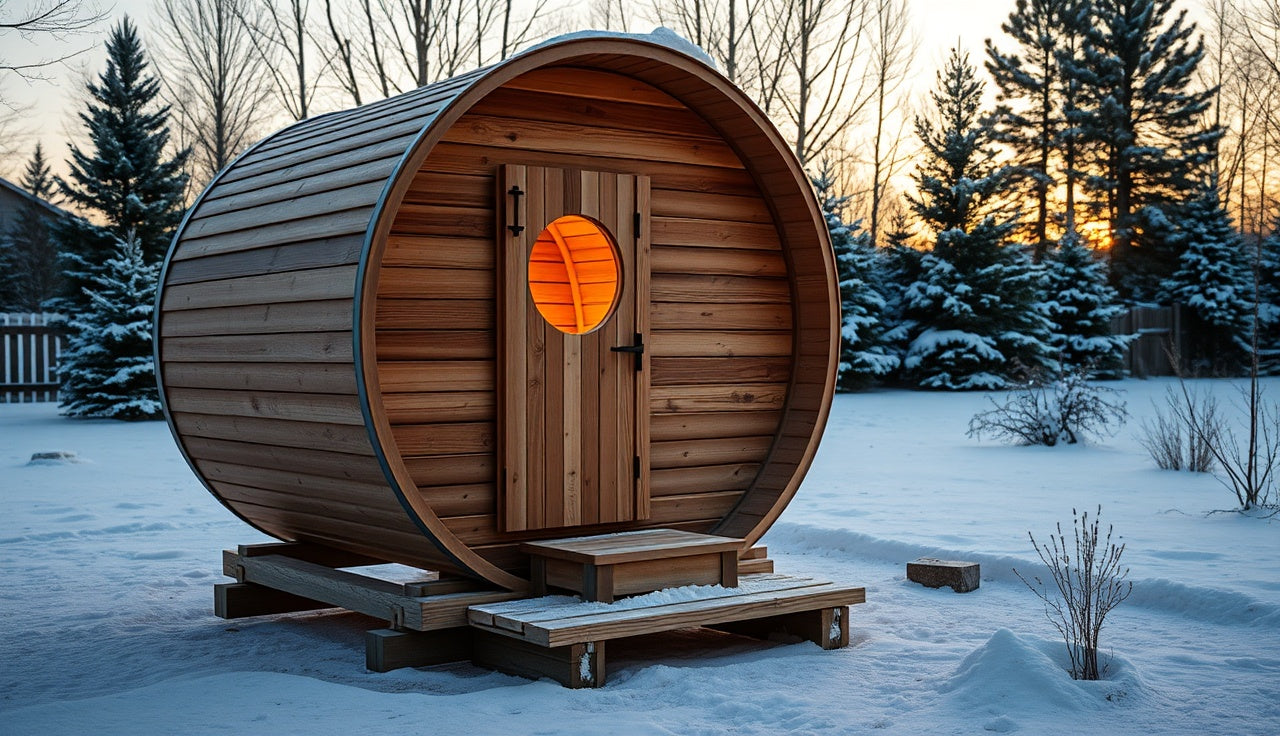
A barrel sauna is a cylindrical sauna built from staves of wood banded together with steel hoops, the same technique coopers used for wine barrels for centuries. The shape is not a gimmick. The curved interior kills the dead corner air you get in a rectangular cabin, so the stove heats the space you actually sit in faster and more evenly.
Most barrel saunas sit outdoors on a pair of wooden cradle runners. They need no concrete foundation. You level the site, set the cradles on gravel or pavers, and roll the sections into place. Some people finish assembly in under a day.
The word "traditional" gets used loosely. Purists mean a Finnish-style dry sauna: high heat (150 to 195°F / 65 to 90°C), low humidity at rest, and the option to ladle water over hot stones (called löyly) to burst the humidity for a few seconds before it fades [1]. That is a different animal from a steam room, which runs cooler and holds humidity near 100%. If you want the authentic Finnish experience in your backyard, a barrel sauna is a strong candidate.
See also: sauna vs steam room for how the two sessions feel different on the body.
How does the barrel shape affect heat distribution and efficiency?
The physics are simple. Heat rises and pools at the top of any enclosed space. In a rectangular box, the air at bench level and the air at the ceiling can sit 30 to 40°F apart, and the corners never fully circulate. A barrel's curved ceiling keeps redirecting the rising air back toward the center and down the walls, so you get a natural convection loop with a smaller temperature gap from floor to bench to peak [2].
The result you feel: a two-person barrel sauna with a 6 kW electric heater reaches session temperature in 30 to 45 minutes. A rectangular cabin of comparable occupancy often takes 45 to 60 minutes. With a wood-burning stove, times swing with wood species, kindling prep, and outside temperature, but experienced users report similar gains over rectangular wood-fired rooms.
Smaller interior volume also lowers operating cost. Less air to heat means less energy per session. Nobody has published a rigorous controlled study comparing barrel versus rectangular energy draw head to head, but the volume argument is sound physics, not marketing.
One caveat. The curved ceiling costs you headroom at bench level. Bathers over 6'2" often find the seated position fine but standing inside awkward, and it depends on barrel diameter. Check the interior diameter before you buy.
What are the real costs of a barrel sauna?
Prices swing hard depending on wood species, diameter, length, heater type, and whether you buy a kit or pay for professional installation.
| Configuration | Typical price range |
|---|---|
| Small 2-person kit (4 ft dia, 6 ft long, electric heater) | $2,000, $3,500 |
| Standard 4-person kit (6 ft dia, 8 ft long, electric heater) | $3,500, $5,500 |
| Large 4 to 6 person kit (6 to 7 ft dia, 8 to 10 ft long) | $5,000, $7,500 |
| Premium cedar, wood-fired, with changing room extension | $7,000, $12,000+ |
| Professional installation labor | $500, $2,000 additional |
| Electrical rough-in (240V circuit for electric heater) | $300, $1,200 depending on panel distance [11] |
The figures above reflect common retail and contractor pricing as of mid-2025. Individual quotes vary by region, wood availability, and permit requirements in your municipality.
Think hard about the heater, because it drives both upfront and ongoing cost. A quality 6 to 9 kW electric heater adds $400 to $900 to the kit. A wood-burning sauna stove runs $300 to $800 for the stove itself, but it also needs a properly flashed chimney penetration and usually a local inspection for fire clearance. Electric is simpler to permit and easy to control on a thermostat. Wood is the old-school choice, and some people find the ritual genuinely worth the extra work.
For a broader look at what home saunas cost end to end, the home sauna guide breaks down all the installation variables.
| Portable sauna (infrared) | 20 |
| Barrel sauna (electric, 6 kW) | 38 |
| Barrel sauna (wood-fired) | 52 |
| Rectangular cabin sauna (electric) | 57 |
| Rectangular cabin sauna (wood-fired) | 70 |
Source: Finnish Sauna Society; ASHRAE convection principles; industry-average product specifications
What wood species are barrel saunas made from, and does it matter?
Yes, it matters. The wood has to stay stable under repeated thermal cycling, resist moisture-driven warping, and stay low in resin so it doesn't off-gas or turn sticky when hot. Four species show up most:
Western red cedar is the common choice in North American barrel saunas. Low density, handles humidity well, smells great, resists decay. It's also widely available, which keeps prices reasonable. Most kits in the $3,000 to $6,000 range use it.
Nordic spruce (Scandinavian white spruce) shows up in Finnish and European-origin kits. Lighter in color, less aromatic than cedar, and it makes a very clean sauna environment. Good spruce is excellent; low grades warp if the kiln-drying was rushed.
Thermo-treated wood (thermally modified wood) is heat-treated to strip resins and stabilize the cell structure. It's darker, more dimensionally stable, and lasts longer than untreated equivalents. Expect a 20 to 40% premium over standard cedar kits. For a sauna that will take hard winters, it's worth the money.
Hemlock lands in entry-level and mid-range kits. It's fine. It lacks cedar's natural decay resistance, so maintenance matters more over time, but it performs well under a cover or partial shelter.
Avoid any barrel sauna built from pressure-treated lumber. The preservative chemicals are not rated for high-heat enclosures and can off-gas compounds you don't want to breathe [4].
Do you need a permit to install a barrel sauna in your backyard?
Almost certainly yes, for the electrical work. A 240V/40A or 240V/60A circuit for an electric sauna heater is a permitted electrical job in every U.S. jurisdiction that follows the National Electrical Code (NEC), which means a licensed electrician and an inspection [3]. That's non-negotiable regardless of what any vendor tells you.
For the structure itself, rules vary widely. Many municipalities treat a barrel sauna on runners as a temporary or accessory structure. If it's under 200 square feet (and most are), plenty of residential zoning codes exempt it from a building permit, though setback rules from property lines and fences still apply. A handful of jurisdictions require a permit for any permanently sited outdoor structure no matter the size.
Installing a wood-burning stove adds inspection requirements around the chimney, spark arrestor, and clearance to combustibles. The International Residential Code (IRC) Chapter 10 governs solid-fuel appliances in most U.S. states [5]. Your local authority having jurisdiction (AHJ) may have amendments.
Call your building department before you order. The call takes ten minutes. Moving a fully assembled barrel sauna off a setback violation takes a weekend and a bad mood.
How long does it take to assemble a barrel sauna kit?
Most manufacturers say 4 to 8 hours for two adults with basic carpentry skills. That holds for a standard 6-foot diameter, 8-foot long kit on a prepared, level surface. Add time if your site needs grading, if you're working alone, or if the instructions were translated from Finnish with gaps.
The sequence runs roughly like this: level the cradle runners, roll the floor stave section into the cradles, build up the wall stave rings one at a time (they interlock), tighten the steel banding hoops, fit the door frame and door, set the interior benches, and install the heater to the manufacturer's clearance specs.
The heater hookup should be done by or reviewed by a licensed electrician even when the mechanical connection feels obvious. The NEC requires GFCI protection for electric sauna heaters in damp locations, and the heater must be listed (UL or ETL) for sauna use [3].
One real-world note. The banding hoops need re-tightening after the first few wet-dry cycles as the wood settles. Budget 30 minutes to check tension after your first month. That's normal, not a defect.
How does a barrel sauna compare to other outdoor sauna options?
The main alternatives are rectangular cabin saunas, prefab modular saunas, and portable saunas. Here's how they stack up honestly:
| Factor | Barrel sauna | Rectangular cabin sauna | Portable sauna |
|---|---|---|---|
| Heat-up time | 30 to 45 min | 45 to 70 min | 15 to 25 min |
| Typical occupancy | 2 to 6 people | 2 to 8 people | 1 person |
| Foundation needed | No (cradle runners) | Usually yes | No |
| Wood-fired option | Yes | Yes | No |
| Cost range | $2,000, $12,000 | $3,500, $20,000+ | $100, $600 |
| Authenticity of experience | High | High | Low |
| Curb appeal | High | Variable | Low |
A portable sauna is the cheapest way in, but the experience is a different thing: lower temperatures and no stone heater.
A rectangular outdoor sauna cabin gives you more headroom, more interior volume, and more bench flexibility for bigger groups. It costs more and almost always needs a concrete pad.
Barrel saunas hit the sweet spot for most backyard buyers: authentic heat, no foundation, faster heat-up, strong looks. The downsides are the curved ceiling (limited headroom for tall users) and smaller max capacity than a cabin of the same footprint.
What are the health benefits of regular sauna use?
The most cited dataset on sauna and health comes from the Kuopio Ischemic Heart Disease Risk Factor Study, a prospective cohort of 2,315 Finnish men followed for 20 years. Men who used a sauna 4 to 7 times per week had a 40% lower risk of fatal cardiovascular events than once-weekly users, and a 66% lower risk of dementia [6]. The association is real. Whether it's fully causal or partly explained by confounding (frequent sauna users also tend to be more physically active) is still an open question.
On cardiovascular function, a 2018 review in Mayo Clinic Proceedings reported that regular sauna bathing produces acute heart rate increases (up to 100 to 150 bpm) that resemble moderate exercise, and repeated sessions appear to improve endothelial function and lower blood pressure in hypertensive patients [7].
Heat acclimation research suggests regular heat exposure raises plasma volume and may improve exercise performance in both hot and temperate conditions [8]. Athletes use saunas for that reason more than for relaxation.
Stay conservative here. These are associations and physiological observations, not prescriptions. People with cardiovascular disease, pregnancy, or conditions that affect heat tolerance should talk to a physician before starting any sauna protocol. The American College of Sports Medicine notes that healthy adults generally tolerate sauna sessions of 8 to 20 minutes at typical temperatures without adverse effects, but individual variation is real [9].
For a fuller breakdown of the research, the sauna benefits guide covers the current evidence without overstating it.
Can you use contrast therapy with a barrel sauna?
Yes, and this is one of the best reasons to own one. Contrast therapy means alternating heat (sauna) with cold (cold plunge, ice bath, or cold shower), and the practice runs deep in Finnish and Nordic culture.
The typical protocol is 10 to 20 minutes in the sauna, then 1 to 3 minutes of cold immersion or shower, repeated 2 to 4 cycles. Some people take a final rest at ambient temperature before the last round.
The rationale: heat drives vasodilation and raises cardiac output; sudden cold triggers peripheral vasoconstriction and fires up the sympathetic nervous system. The back and forth creates big swings in peripheral blood flow. Research on the contrast cycle specifically (versus heat or cold alone) is thinner than the individual literatures, but the appeal is consistent and the safety profile for healthy adults is good.
A cold plunge next to your barrel sauna is the natural pairing. Effective cold plunge temperatures for recovery sit around 50 to 59°F (10 to 15°C), though some protocols go colder [10]. You don't need a pricey dedicated unit; a stock tank with ice works fine in warmer months.
The cold plunge benefits guide and the ice bath guide both cover the cold side in depth if you want to build a full contrast setup.
How do you maintain a barrel sauna and make it last?
A well-maintained cedar barrel sauna lasts 15 to 25 years. Neglected ones start looking rough and go structurally soft in 5 to 8 years. The maintenance isn't complicated, but it has to be consistent.
Keep the exterior dry when it's not in use. A fitted cover or a simple overhanging roof protects the wood dramatically. UV and standing water are the two biggest threats. Many manufacturers recommend an exterior penetrating oil (teak oil or a purpose-made wood finish) once or twice a year on the outside staves only. Never oil the interior. The inside should stay untreated so the wood can breathe and won't off-gas.
Ventilate after every session. Leave the door open for 30 to 60 minutes so interior moisture escapes. Close it up wet over and over and you invite mold on the bench wood.
Re-tighten the banding hoops each spring, or more often in the first year. Wood swells and shrinks with the seasons. A wrench and 15 minutes handles it.
Clean the heater stones once a year. Sauna stones crack and degrade over time and hold heat less well. Replace them every 1 to 3 years depending on use. Finnish tradition uses olivine diabase or peridotite; avoid river rocks, which can crack explosively when you pour water on them [1].
Inspect the door seals and hinges. A barrel sauna door that doesn't seal bleeds heat and stretches your heat-up time. Silicone or felt sauna door gaskets are cheap to swap.
What size barrel sauna should you buy?
This is the question most buyers get wrong by going too small. Buy for the group you actually want to use it with, not the minimum your budget allows, because going back to upgrade is expensive.
4-foot diameter: very tight. One adult lying down, or two seated close. Fine for solo use or a couple who doesn't mind proximity.
6-foot diameter: the sweet spot for most buyers. Two adults seated with room to stretch, or three to four seated at bench level. This is what most "4-person" barrel saunas actually are.
7-foot diameter: genuinely fits 4 to 6 people. Better headroom for taller users. Heavier and harder to move if you ever relocate it.
Length drives bench depth and whether you can add a changing room end. An 8-foot barrel gives you a reasonable bench depth. A 10-foot barrel lets you add a small changing or cool-down vestibule at one end, a nice upgrade for year-round cold-climate use.
One practical note. Measure your access path. A 7-foot diameter barrel section won't fit through a standard 6-foot gate. Plenty of buyers find that out on delivery day.
Is a barrel sauna worth the money?
For most backyard buyers who'll use it at least twice a week, yes. Against gym or spa sauna access at $20 to $50 per visit, a $4,500 installed barrel sauna breaks even in 90 to 225 visits. Two people, twice a week, and you're roughly one to two years to break even on cash cost, before you even count having it 30 feet from your back door.
The honest caveats: you need a yard. You need 240V power (or the budget for a wood-burning setup). You have to actually use it, because a sauna that turns into outdoor furniture is an expensive mistake. And budget realistically for the electrical circuit, which vendors routinely leave out of the advertised price.
Against a gym sauna, a home barrel sauna hands you full control over temperature, stones, wood type, and session length. No waiting. No sweaty strangers. No time limits. For people who take recovery seriously, that autonomy is worth real money.
SweatDecks carries a selection of barrel saunas and cold plunge setups if you want to compare specific models and configurations in one place.
Still comparing options? The sauna overview and home sauna guide are good starting points before you commit to a barrel configuration specifically.
Frequently asked questions
How long does it take a barrel sauna to heat up?
Most barrel saunas reach session temperature (150 to 185°F) in 30 to 45 minutes with an electric heater, or 45 to 60 minutes with a wood-burning stove depending on wood quality and outside temperature. The cylindrical shape holds less air to heat than a rectangular cabin, which is the main reason heat-up is faster.
Can a barrel sauna stay outside year-round?
Yes. This is one of the design's real strengths. Cedar and thermally modified wood handle freeze-thaw cycles well. The steel banding hoops may need a touch of rust-inhibiting spray in very wet climates. Fitting a waterproof cover or small roof section over the barrel extends the exterior finish life considerably and is worth doing in a wet or snowy region.
What is the best wood for a barrel sauna?
Western red cedar is the most practical choice for most buyers: widely available, naturally decay-resistant, thermally stable, and pleasantly aromatic. Thermally modified wood (thermowood) is more dimensionally stable long-term and worth the premium in harsh climates. Avoid pressure-treated lumber entirely; the preservative chemicals are not safe at sauna temperatures.
Do barrel saunas require a foundation or concrete pad?
No. Barrel saunas rest on wooden cradle runners that spread the load. You need a level, firm, well-drained surface: gravel, pavers, or compacted stone all work. Avoid setting cradles straight on grass or bare soil where moisture speeds up rot. A gravel bed 4 to 6 inches deep is the most common and cost-effective base.
What electrical requirements does a barrel sauna need?
Most electric barrel sauna heaters need a dedicated 240V circuit. A 6 kW heater typically draws about 25 amps and needs a 30 to 40A breaker; larger 9 kW units need a 40 to 60A circuit. The NEC requires a licensed electrician and an inspection for this work. Budget $300 to $1,200 for the electrical rough-in depending on how far your panel sits from the install site.
How many people fit in a barrel sauna?
A 4-foot diameter barrel comfortably fits 1 to 2 people. A 6-foot diameter fits 3 to 4 seated at bench level. A 7-foot diameter fits 4 to 6. Manufacturer ratings often overstate capacity. Check the interior bench length (a better guide than the occupancy rating), and remember that sauna culture values enough room to stretch out more than sitting shoulder to shoulder.
Can you use a wood-burning stove in a barrel sauna?
Yes, and many purists prefer it. A wood-burning sauna stove runs $300 to $800 for the unit, plus chimney and flashing materials. It needs proper clearance to combustibles, a chimney that exits the barrel safely, and usually a local fire or building inspection. The experience (the crackle, the smell, the ritual of tending the fire) is meaningfully different from electric.
How do you pour water on sauna stones correctly?
Use a long-handled wooden ladle and pour small amounts (about 2 to 4 oz) slowly over the center of the stone pile. Pouring too fast or too much at once risks cracking the stones or splashing near-boiling water. Use clean water or lightly diluted essential oils like eucalyptus or birch. Avoid stones with visible cracks; replace them if they're crumbling.
How long should a sauna session last?
Most research protocols use sessions of 10 to 20 minutes at 176 to 212°F (80 to 100°C). The Kuopio cohort study linked health benefits to sessions averaging 14 minutes at about 176°F. Beginners should start with 8 to 10 minute sessions and get out if they feel dizzy or off. There is no benefit to pushing through discomfort; acclimatization happens gradually over weeks.
What is löyly and do barrel saunas support it?
Löyly is the Finnish word for the steam burst created when water hits hot sauna stones. It briefly raises perceived humidity and sharpens the heat before it fades. Any barrel sauna with a proper stone heater (wood-fired or electric with a stone tray) supports löyly. It's a central part of traditional Finnish sauna culture, not an optional accessory.
How do barrel saunas compare to infrared saunas?
Traditional barrel saunas heat the air to 150 to 195°F; infrared saunas heat surfaces directly at 120 to 140°F using radiant panels. The experiences feel different: traditional saunas give you full-body environmental heat and support löyly; infrared runs cooler and drier. The health research base is substantially larger for traditional Finnish saunas. Barrel saunas do not use infrared technology.
Can a barrel sauna be used in winter?
Yes, and many people find winter the best time to use one. The contrast between 180°F inside and cold air outside is striking. Expect to add 15 to 20 minutes to heat-up time in very cold weather. Keep the exterior finish in good shape, clear snow off the top (the curved shape sheds a lot on its own), and make sure drainage below the cradles stays clear of ice.
What is the average lifespan of a barrel sauna?
A well-maintained cedar barrel sauna lasts 15 to 25 years. The factors that decide it: exterior oiling once or twice a year, post-session ventilation to keep interior moisture down, annual banding hoop tension checks, and keeping the unit off bare soil. Neglected saunas in wet climates can degrade in 5 to 8 years. Thermally modified wood versions tend to outlast standard cedar.
Do barrel saunas add value to a home?
There's limited formal appraisal data on this. Anecdotally, outdoor amenities including saunas are increasingly marketed as value-adds, especially in markets where outdoor living space is prized. A barrel sauna that's well-maintained and properly permitted (especially with a dedicated electrical circuit) is less likely to create inspection complications at resale than an unpermitted one.
Sources
- Finnish Sauna Society, Sauna Bathing Guide: Traditional Finnish sauna uses dry heat at 70–100°C with intermittent steam (löyly) from water poured on stones; olivine diabase recommended for heater stones
- ASHRAE, Fundamentals Handbook (heat transfer and convection principles): Curved enclosures redirect convective airflow continuously, reducing temperature stratification compared to rectangular rooms of equivalent volume
- NFPA, National Electrical Code (NEC) Article 422 and 680: Electric sauna heaters require a dedicated 240V circuit with GFCI protection in damp/wet locations and must be UL/ETL listed for sauna use; installation requires licensed electrician and inspection
- U.S. Environmental Protection Agency, information on treated wood and wood preservatives: Pressure-treated wood contains preservative chemicals not intended for high-heat interior enclosures and should not be used where off-gassing and skin contact occur
- International Code Council, International Residential Code (IRC) Chapter 10 – Chimneys and Fireplaces: IRC Chapter 10 governs clearance, chimney construction, and inspection requirements for solid-fuel appliances in residential structures adopted by most U.S. states
- JAMA Internal Medicine, 'Association Between Sauna Bathing and Fatal Cardiovascular and All-Cause Mortality Events' (Laukkanen et al., 2015): Men using sauna 4–7 times per week had 40% lower risk of fatal cardiovascular events and 66% lower risk of dementia compared to once-weekly users in a 20-year Finnish cohort study of 2,315 men
- Mayo Clinic Proceedings, 'Cardiovascular and Other Health Benefits of Sauna Bathing' (Laukkanen et al., 2018): Regular sauna bathing produces acute heart rate increases to 100–150 bpm resembling moderate exercise and improves endothelial function and blood pressure in hypertensive patients
- Journal of Science and Medicine in Sport, heat acclimation review (Périard et al., 2015): Regular heat exposure increases plasma volume and improves exercise performance in both hot and temperate conditions through heat acclimation adaptations
- American College of Sports Medicine, Position Stand on Exercise and Fluid Replacement / Heat Stress guidance: Healthy adults generally tolerate sauna sessions of 8–20 minutes at typical temperatures (80–100°C) without adverse effects; individual variation exists and medical clearance recommended for at-risk populations
- International Journal of Sports Physiology and Performance, cold water immersion temperature review (Bleakley et al., 2012): Cold water immersion at 10–15°C (50–59°F) is the most commonly used temperature range in recovery research; lower temperatures increase vasoconstriction response
- U.S. Department of Energy, residential electrical wiring and circuit guidance: Dedicated 240V circuit installation costs vary by panel distance and local labor rates, typically $300–$1,200 for residential sauna heater circuits

Share:
Barrel sauna with window: what to know before you buy
Barrel sauna cost: what you'll actually pay in 2025