
Last updated 2026-07-09
TL;DR
Barrel saunas for sale run from about $1,500 for a basic two-person kit to $8,000 or more for a large assembled cedar unit with a quality heater. Price tracks wood species, diameter, length, heater type, and whether installation is included. Most homeowners spend $3,000 to $5,500 on a solid four-person outdoor barrel that lasts 15-plus years with light maintenance.
What is a barrel sauna and why does the shape matter?
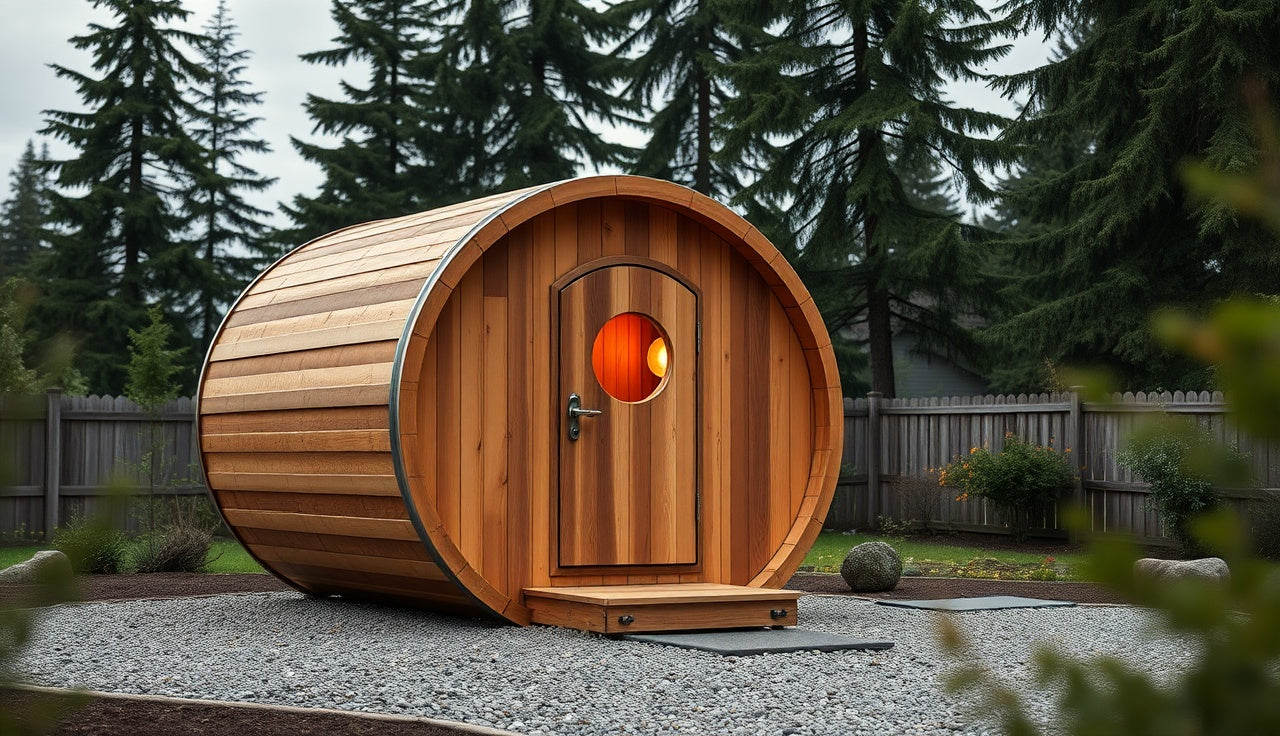
A barrel sauna is exactly what it sounds like. It's a cylindrical wooden body built from staves, the same cooperage method used for wine barrels. The curved walls push dead air space to the top of the cylinder, so the heater reaches your sitting level faster than in a rectangular room of the same volume. The cylinder also spreads thermal stress evenly across the staves as the wood expands and contracts, which is why a well-built barrel can go seasons without the cracks and joint gaps that show up in flat-wall saunas.
The practical payoff is heat-up time. A quality four-person barrel with an 8 kW electric heater usually hits 170°F in 30 to 45 minutes. A rectangular room of similar capacity with the same heater output takes 45 to 60 minutes. That's not a marketing claim. It's geometry. Less cubic air at head height means faster heat saturation at body level.
The shape carries the load too. Proper stave-and-band construction doesn't lean on adhesives or interior framing for structural strength, which matters outdoors where freeze-thaw cycles work fasteners loose over time. The barrel sits on cradles, two curved rocking-chair-style feet, and that's usually the whole foundation. No concrete slab in most cases, though check your local building codes.
For a broader look at how a home sauna heats and what the experience feels like, that background helps when you're weighing barrel against a traditional box sauna.
How much does a barrel sauna cost?
The honest range for barrel saunas for sale in the US right now is $1,500 on the low end (a small two-person DIY kit, no heater) to $10,000 or more for large luxury models with custom wood, glass end-walls, and a premium Finnish heater. Most people shopping a four-person outdoor barrel land between $3,000 and $5,500 all-in. That includes the heater but not always delivery or a licensed electrician for the 240V circuit.
Here's where the money actually goes.
Wood species is the biggest variable. Western red cedar is the industry standard because it's lightweight, resists warping, and smells good. Nordic spruce costs less and works fine. Thermowood (heat-treated pine or spruce) adds 15 to 25% but handles wet climates better. White oak barrels exist, but they're rare and costly.
Diameter and length matter more than you'd think. A 47-inch (4-foot) diameter barrel seats two comfortably, maybe three if everyone's friendly. A 59-inch (5-foot) diameter seats four to six. An extra foot of interior length adds roughly $300 to $600 to the kit price, and each step up in diameter costs more than that because you're adding stave material all the way around.
Heater type is a real cost fork. A basic Chinese-made electric heater bundled with budget kits runs $150 to $300, and you'll likely replace it in three to five years. A Finnish-made Harvia, Helo, or Narvi unit runs $500 to $1,200 on its own, and the quality gap is wide. Wood-burning stoves add $400 to $900 and need a chimney penetration, which adds labor.
Assembly versus kit. A flat-pack kit you build yourself saves $500 to $1,500 in labor, but assembly takes two people a full weekend and basic carpentry skills. Pre-assembled models ship on a pallet and arrive ready to wire.
Delivery surprises people. A 6-foot-diameter, 8-foot-long barrel can weigh 800 to 1,400 pounds assembled. Freight from the manufacturer to your driveway runs $200 to $600 depending on distance, and you still need a way to move it from the truck to its spot. Some makers build a forklift pocket into the cradle for exactly this.
| Configuration | Approximate Price Range |
|---|---|
| 2-person barrel kit, no heater | $1,500, $2,500 |
| 2-person barrel, basic electric heater included | $2,000, $3,200 |
| 4-person barrel, mid-range electric heater | $3,000, $5,000 |
| 4 to 6 person barrel, premium Finnish heater | $4,500, $7,500 |
| Large 6+ person barrel, glass ends, premium wood | $6,500, $10,000+ |
| Licensed electrician for 240V circuit (separate) | $300, $800 |
These ranges reflect typical US retail as of mid-2025. Supply-chain swings can move them 10 to 15% in either direction [1].
What wood is best for a barrel sauna?
Western red cedar is the right answer for most buyers. It has low density (around 23 lbs per cubic foot), high natural tannin content that resists rot and insects, low thermal conductivity so the surface doesn't feel scalding, and a smell that's genuinely pleasant in a hot room. The catch is that premium clear-grain cedar has gotten expensive, and some budget makers substitute lower-grade cedar with visible knots and resin pockets that weep sap at high temps. If you're buying cedar, ask for kiln-dried, vertical-grain or clear-grade staves.
Nordic spruce is the traditional Finnish choice. It's denser than cedar and weathers a little harder on the eyes over the years, but structurally it's excellent. Many of the best Finnish makers use nothing else. Price usually runs 10 to 20% below comparable cedar.
Thermowood deserves more attention than it gets. Heat-treating pine or spruce at 180 to 215°C strips out hemicellulose and sharply cuts the wood's tendency to soak up moisture, which is the main enemy of outdoor saunas in rainy climates [2]. The wood turns chocolate brown, stabilizes dimensionally, and the treatment uses no added chemicals. Data from the Finnish ThermoWood Association shows equilibrium moisture content around 5 to 6% versus 12 to 18% for untreated wood, which means less expansion-contraction cycling season to season [2]. The tradeoff is slightly lower bending strength, which matters in structural framing but is irrelevant for sauna staves.
Hemlock and basswood show up in some budget units, mostly as interior surfaces. They're fine inside, but I'd want cedar or thermowood on the exterior staves.
Whatever wood you pick, the finish question comes up fast. For outdoor barrels, most makers recommend leaving the exterior bare or using a penetrating oil (teak or linseed) rather than a film-forming varnish or paint. A film finish traps moisture behind it and speeds up rot. The interior should stay bare or get treated with pure paraffin oil. Never use polyurethane inside a sauna. At 170°F the off-gassing is not something you want to breathe.
| 2-person kit, no heater | $2,000 |
| 2-person, basic electric heater | $2,600 |
| 4-person, mid-range heater | $4,000 |
| 4–6 person, premium Finnish heater | $6,000 |
| Large 6+ person, premium build | $8,250 |
Source: Angi / HomeAdvisor Sauna Cost Guide, 2025
Electric heater or wood-burning stove: which is better for a barrel sauna?
Electric wins on convenience. Wood-burning wins on experience. That's the honest split.
An electric heater runs off a 240V/40 to 60A dedicated circuit (exact amperage depends on wattage), heats on a timer, and holds consistent, controllable heat. A 6 to 9 kW unit fits most four-to-six-person barrels. Dial in 160°F, throw water on the rocks for steam (löyly), and walk in 30 to 45 minutes after pressing a button. Harvia's KIP 6 (6 kW), for example, is rated for rooms up to 283 cubic feet [3], which covers a typical 5-foot-diameter barrel.
Wood-burning stoves are a different animal. The heat feels softer, the combustion humidity reads slightly different, and there's a ritual to splitting and stacking wood that a lot of sauna people consider the whole point. The downsides are real. You can't schedule a fire remotely, heat-up takes 45 to 90 minutes, and you need a spark-safe clearance zone around the chimney penetration. Some jurisdictions restrict open-fire appliances in backyard structures, so check your local fire code before you buy a wood stove.
One more thing. Barrels with wood stoves often can't sit against a wall or fence because of minimum clearance rules. Electric units place more freely.
For how sauna heat stacks up against steam, the sauna vs steam room breakdown is worth a read before you settle on heater type. Some buyers are really after a steam experience, and an electric heater with good rock capacity handles that better than most people expect.
What size barrel sauna should you buy?
Most makers plan on 18 to 24 inches of bench length per person. A 6-foot interior barrel seats two lying down or three to four sitting. An 8-foot interior seats four to six sitting. Past 8 feet you're into large-party territory, which wants a heater in the 9 to 12 kW range to heat efficiently.
Diameter matters as much as length for the heat experience. A 47-inch (4-foot) diameter interior fits one person lying down but feels cramped for two adults sitting across from each other. The 59-inch (5-foot) diameter is the sweet spot most serious buyers settle on. Some makers now offer 71-inch (6-foot) diameter barrels with genuine face-to-face bench seating like a rectangular room, plus a lower bench for kids or anyone who wants gentler heat.
Measure your placement space before you order, then add 18 to 24 inches on each end for door swing and cradle overhang. A nominally 8-foot barrel often needs 9.5 to 10 feet of ground length once cradles and door are accounted for. Width clearance should match the outer diameter plus 12 inches on each side for airflow and maintenance access.
If space is genuinely tight, a portable sauna is worth comparing, though the experience is a different thing from a real wood barrel.
Do you need a permit for a barrel sauna in your backyard?
Almost certainly yes in most US jurisdictions, though the permit type and process swing hard by city and county. Call your building department before you order. That single call saves the most grief.
A barrel with an electric heater usually counts as an accessory structure with electrical work, which means at minimum an electrical permit and inspection for the 240V circuit. If the sauna sits on a permanent foundation or attaches to a deck or structure, you may trigger a building permit for the structure itself. Many jurisdictions require a permit for accessory structures over 120 square feet, a threshold barrel saunas usually stay well under [10].
The National Electrical Code (NFPA 70) Article 680 covers pools and spas, but Articles 422 and 424 govern permanently installed appliances, including electric heaters. Your local authority having jurisdiction (AHJ) interprets these. The NEC is adopted in most states, but local amendments exist [4].
Finnish and Canadian installers often point out that a sauna on cradles (not a permanent foundation) can sometimes be treated as movable and skip structural permits. This varies. A $75 permit costs far less than a stop-work order or a forced relocation of a 1,200-pound barrel after the fact.
HOAs add another layer. If you're in one, the CC&Rs may restrict outbuildings, require design review, or cap the height of backyard structures. Check those before you buy.
For drainage, leveling, and electrical rough-in, the outdoor sauna guide covers the install details.
How long does a barrel sauna last, and what maintenance does it need?
A well-built cedar or thermowood barrel, used regularly and cared for, should last 15 to 25 years outdoors. The enemies are standing water, UV, and neglect. None of them are hard to manage.
The cradles fail first. They sit on the ground and wick moisture. Raise them on pressure-treated 4x4 sleepers or a gravel bed and they last far longer. Inspect them yearly and hit them with a penetrating exterior oil if you see surface checks.
The stave bands (the steel hoops holding the barrel together) need annual eyes on them. Surface rust on galvanized or stainless bands is cosmetic. Structural corrosion is a problem. Tighten the band bolts in early spring after the freeze-thaw season, since the cycling loosens them slightly.
The bench wood and floor slats take the most abuse from moisture and feet. Floor slats should be removable. Pull them after every session and let the floor dry. A stiff brush and warm water clean them. Never use bleach or detergent inside a sauna. It soaks into the wood and off-gasses when you heat up.
Inspect the heater rocks twice a year if you're doing steam. Cracked or eroded rocks hold heat poorly and can shatter from thermal shock when water hits them. Harvia recommends sauna-specific stones only (olivine diabase or vulcanite) and replacing the full load every one to two years with heavy use [3].
Give the exterior a coat of penetrating oil (raw linseed or teak) every one to three years depending on sun and rain. Don't skip the end-grain on the stave tops, where moisture enters fastest. In heavy-snow country, buy a cover or get in the habit of brushing snow off the top, since the load concentrates along the top stave curve.
What are the health benefits of using a barrel sauna regularly?
Here's where I'll be straight about what the evidence shows versus what sauna marketing claims.
The strongest data comes from a long-running cohort study of Finnish men, the Kuopio Ischaemic Heart Disease Risk Factor Study, published in JAMA Internal Medicine in 2015. Men who used a sauna four to seven times a week had a 40% lower risk of fatal cardiovascular events than men who used one once a week, after adjusting for confounders [5]. The stated conclusion: "frequent sauna bathing is associated with a reduced risk of SCD, fatal CHD, fatal CVD, and all-cause mortality." [5] Real finding, real peer review. It's observational, not a randomized trial, so it shows association, not proven cause.
Passive heat raises core body temperature and triggers cardiovascular responses that resemble moderate aerobic exercise in some ways. Heart rate climbs to 100 to 150 bpm in a typical session. Skin blood flow jumps. A 2018 review in Mayo Clinic Proceedings pulled together multiple short-term studies showing blood pressure reductions after regular sauna use, though the size and duration of those effects vary a lot between studies [6].
On mental health, a 2018 systematic review in Complementary Therapies in Medicine reported that sauna bathing was linked to fewer depressive symptoms among users, though the review flagged design and sample limits that keep the conclusions soft [7].
Muscle recovery is the most common reason athletes add a sauna. Heat raises blood flow to muscle and has cut delayed-onset soreness in some post-exercise trials. The mechanism is plausible. The effect size in controlled trials is modest.
What the evidence does not support: saunas as a primary treatment for any medical condition. The American Heart Association has not issued formal guidelines recommending sauna use for cardiovascular disease management, and anyone with uncontrolled hypertension, severe aortic stenosis, or a recent cardiac event should talk to their physician before regular sauna use [6].
For a closer read of the studies, the sauna benefits article works through the major ones. If you're thinking about pairing heat with cold, the cold plunge benefits page covers that protocol's evidence on its own.
Where can you buy a barrel sauna, and what should you watch for?
Barrel saunas sell through several channels, each with real tradeoffs.
Direct from the manufacturer (or their authorized US distributors) is usually the best call for quality and warranty support. Almost Heaven Saunas, Dundalk LeisureCraft, HUUM, and Sauna King have sold barrels long enough to have real warranty track records. Expect 1 to 5 year warranties on structure and 1 to 2 years on included heaters from reputable brands.
Big-box retailers (Home Depot, Wayfair, Costco) carry barrels, mostly at the lower-to-mid range. The selection skews entry-level, warranty support runs through the retailer rather than the maker, and you won't find premium heaters or custom sizes. For what Costco actually stocks and whether it's worth it, the costco sauna guide gives useful context.
Specialty sauna retailers (including SweatDecks at sweatdecks.com) carry curated lineups with more knowledgeable pre-purchase help and better access to add-ons like quality heaters, install accessories, and sauna stones. Worth a look if you want someone who knows the difference between stave grades before you commit.
Second-hand barrels show up on Craigslist and Facebook Marketplace all the time. A used barrel can be a real deal, but inspect the band tension, the bench condition, and especially the heater wiring before you pay. One stored dry and used occasionally can have 10 more years in it. One that sat outdoors uncovered and unlevel can hide rot in the cradles and cracked staves that cost more to fix than the sauna is worth.
Signs of a low-quality barrel, at any price:
- Staves that are finger-jointed or edge-glued instead of solid. Under heat and moisture those joints move.
- A heater listed only by wattage with no certifications. Look for ETL or UL listing on any heater installed in the US [11].
- Band bolts in plain carbon steel instead of stainless or hot-dipped galvanized. They rust through in a few seasons.
- Foam or synthetic insulation between end walls and staves. Wood needs to breathe. Spray foam in a sauna is a moisture trap.
A good barrel is simple: solid wood staves, tight bands, a quality heater, solid end walls. The fewer synthetic materials inside, the better.
Can you finance a barrel sauna, and is it tax-deductible?
Financing has opened up a lot in recent years. Most specialty retailers offer point-of-sale financing through Affirm, Klarna, or GreenSky, with APRs from 0% promotional to 29.99% depending on credit and term. A $4,500 barrel financed at 12% over 24 months runs about $212 a month. Zero-percent promos exist but usually require paying off the balance before the promo ends, or interest accrues retroactively.
On tax deductibility, the answer is almost always no, with one narrow exception. A barrel bought for personal recreation is not tax-deductible. Period.
The exception: if a physician prescribes sauna use to treat a diagnosed condition, the cost may qualify as a medical expense under IRS Publication 502, which covers "amounts paid for the diagnosis, cure, mitigation, treatment, or prevention of disease." [8] The IRS language requires the expense to be primarily for medical care, not general health improvement. The bar is high, the documentation requirement is real, and the deduction only helps if your total qualifying medical expenses top 7.5% of adjusted gross income for the year [8]. Talk to a tax professional before you count on it.
As a home improvement, a barrel may add to your home's cost basis, which could trim capital gains taxes when you sell. It almost certainly doesn't qualify for the residential energy tax credits on IRS Form 5695, since electric resistance heating is excluded from those credits [9].
Business owners who actually run a sauna facility for employee wellness or client use fall under the deduction rules in IRC Section 274, and a tax professional is essential there. Don't take sauna tax advice from a sauna blog. Get it from a CPA.
How does a barrel sauna compare to other types of home saunas?
Four home sauna types are worth comparing: barrel, traditional rectangular (indoor or outdoor), infrared, and portable tent-style.
Barrel versus box sauna. A rectangular room offers more design flexibility, can be built into a garage, basement, or shed, and takes interior benching, backrests, and custom layouts more easily. It usually costs more to heat because the box geometry doesn't push hot air toward the occupant as efficiently. Barrels cost less to install as standalone outdoor units because there's no foundation, framing, or insulation work. A traditional indoor sauna in a dedicated room often runs $5,000 to $15,000+ including construction.
Barrel versus infrared. Infrared saunas use radiant panels instead of convective heat and typically run 120 to 140°F rather than 160 to 195°F. Some people prefer the lower temperature, and infrared units draw less power (15 to 30 amps at 120V versus 240V for a traditional heater). The research base for infrared-specific health effects is thinner than for Finnish-style heat, and infrared can't make steam, which some people consider central to the experience. Infrared barrel hybrids exist but stay uncommon.
Barrel versus portable. A portable sauna tent runs $100 to $400 and sets up and stores in an apartment. Sitting in one is not the same as sitting in a wood barrel at 175°F. Portables have a place. They don't replace a real sauna if the real sauna experience is what you're chasing.
The full sauna guide covers every major type and the tradeoffs across budgets.
| Sauna Type | Typical Home Cost | Heat-Up Time | Steam Capable | Outdoor Friendly |
|---|---|---|---|---|
| Barrel (electric) | $3,000, $7,500 | 30 to 45 min | Yes | Yes |
| Barrel (wood stove) | $3,500, $8,000 | 45 to 90 min | Yes | Yes |
| Traditional box (outdoor) | $5,000, $15,000+ | 45 to 60 min | Yes | Yes |
| Infrared (indoor cabinet) | $2,000, $8,000 | 15 to 25 min | No | No |
| Portable tent | $100, $400 | 15 to 30 min | No | Marginal |
If you're also weighing cold water immersion to pair with the sauna, the cold plunge and ice bath guides explain how contrast therapy works and what gear it adds to the setup.
Frequently asked questions
How much is a barrel sauna from a reputable brand?
From established brands like Almost Heaven, Dundalk LeisureCraft, or comparable makers, expect $2,500 to $5,000 for a four-person cedar barrel with a decent electric heater included. Smaller two-person models start around $1,800 to $2,500. Premium builds with glass end-walls, large diameter, and a Finnish Harvia or HUUM heater climb to $6,000 to $9,000. These are US retail prices as of 2025 and exclude delivery and electrician costs.
Can a barrel sauna stay outside year-round?
Yes. Barrels are built for permanent outdoor installation. Cedar and thermowood handle freeze-thaw cycling well as long as the cradles sit off bare ground (gravel or pressure-treated sleepers work) and you use the sauna regularly so internal moisture cycles out. In heavy snow, clear the top periodically and consider a fitted cover for long off-season gaps. Annual exterior oiling keeps the wood in shape.
How long does it take to assemble a barrel sauna kit?
Two people with basic carpentry skills typically need six to ten hours to assemble a four-to-six-person barrel kit from flat pack. The stave assembly goes fast if the kit is well-engineered. The end-wall fitting and door hanging take the most time and patience. Pre-assembled barrels arrive ready to position and wire, which cuts setup to two to four hours including leveling and cradle placement.
What size electrical circuit does a barrel sauna need?
Most four-to-six-person barrels with a 6 to 9 kW electric heater need a 240V, 40 to 60 amp dedicated circuit with a GFCI breaker. Smaller 3 to 4 kW heaters in two-person barrels may run on a 240V/20 to 30A circuit. The exact requirement is on the heater's nameplate and in the install manual. A licensed electrician should pull the permit and do the rough-in. This is not a DIY job in most jurisdictions.
Do barrel saunas hold heat as well as square saunas?
Yes, and often better. The cylindrical geometry cuts the volume of ceiling-height air that has to heat before occupant-level air reaches target temperature. A barrel typically holds operating temperature with 15 to 20% less heater run-time than a comparably rated rectangular room, based on general thermal efficiency principles. Tight stave-and-band construction also cuts convective losses through gaps.
Is western red cedar the best wood for a barrel sauna?
For most North American buyers, yes. Western red cedar has low thermal conductivity so surfaces don't burn skin at high temps, natural tannins that resist rot and insects, and good dimensional stability. Nordic spruce is the traditional Finnish choice and performs comparably. Thermowood (heat-treated pine or spruce) resists moisture better for very wet climates at a 15 to 25% price premium. Avoid high-resin softwoods. They drip sap at sauna temperatures.
Can I add a barrel sauna to my deck or patio?
Often yes, but the load matters. A fully assembled large barrel can weigh 1,000 to 1,400 pounds, concentrated on two small cradle footprints. Most residential decks built to modern code handle this, but older or light-duty decks may need reinforcement. Consult a structural engineer or your building department before placing a barrel on an elevated deck. Ground-level patios (concrete or pavers) take the load without issue.
What is the difference between a barrel sauna and a pod sauna?
A barrel sauna is a full cylinder with the length running horizontal, and you sit inside the cylinder. A pod sauna (or egg-shaped sauna) is a variant with a more pronounced curved footprint, sometimes oval or teardrop in cross-section, and it's usually a newer design with more variation. Both use stave-and-band construction and perform similarly. Barrels have a longer track record, more available parts, and more competition among makers keeping prices down.
How do I clean the inside of a barrel sauna?
After each session, leave the door open 20 to 30 minutes so steam escapes and the wood dries. Remove floor slats and shake them out. For periodic cleaning, use a stiff brush and warm water only, no soap, bleach, or chemical cleaners. The wood develops a slight gray patina over years of use, which is normal. Lightly sanding benches (120-grit) every year or two refreshes the surface without chemicals.
Can you use a barrel sauna for contrast therapy with a cold plunge?
Yes, and it's one of the most popular uses. The typical protocol is 10 to 20 minutes in the sauna at 160 to 190°F, then two to five minutes in cold water at 50 to 59°F (10 to 15°C), repeated two to three rounds. The barrel's fast heat-up makes this practical at home. Put the cold plunge within easy walking distance of the barrel door. The cold plunge and ice bath guides on this site cover cold water setup.
Are barrel saunas from Costco worth buying?
Costco's barrels are generally entry-level to mid-range cedar or spruce units from OEM makers, priced $2,000 to $4,500. They're structurally fine for light to moderate use. The bundled heaters are usually the weak link: generic units without the stone capacity or longevity of a Finnish-branded heater. If the price is right and you budget $500 to $900 for a heater upgrade, a Costco barrel can be a reasonable starting point.
How much does shipping for a barrel sauna typically cost?
Freight for a large assembled or partly assembled barrel runs $200 to $600 for most continental US destinations, though remote or rural freight zones push higher. Kit shipments (flat-pack staves and components) cost less, often $150 to $300. Most makers quote freight separately from the unit price. Budget for delivery to your driveway only. Moving the barrel from driveway to final spot is on you, and it usually takes at least three adults or equipment.
Does a barrel sauna add value to a home?
There's limited formal appraisal data on this. Anecdotally, a well-maintained cedar barrel in a desirable outdoor space appeals to buyers in markets that value outdoor wellness (Pacific Northwest, Colorado, Midwest lake communities). An appraiser may value it at 50 to 80 cents on the dollar of installed cost as personal property, or ignore it entirely if it's not permanently affixed. It's not a reliable financial investment, but in most markets it's not a liability either.
What sauna stones work best with a barrel sauna heater?
Olivine diabase and vulcanite, both dark, dense volcanic rocks, are the most widely recommended sauna stones by Finnish heater makers including Harvia. They hold heat evenly, crack less from thermal shock than sedimentary rocks, and don't shed the silica dust lighter rocks can produce. Use stones 4 to 7 cm in diameter for most residential heaters. Replace the full load every one to two years with heavy use, or whenever steam gets uneven or rocks crack often.
Sources
- HomeAdvisor (Angi) – Sauna Cost Guide: Typical US retail price ranges for barrel saunas by configuration as of 2024–2025
- Finnish ThermoWood Association – ThermoWood Handbook: Thermowood equilibrium moisture content of approximately 5–6% versus 12–18% for untreated wood, and heat-treatment process at 180–215°C
- Harvia Plc – KIP Heater Product Documentation: Harvia KIP 6 kW heater rated for sauna rooms up to 283 cubic feet; recommendation to replace sauna stones every 1–2 years with regular use
- NFPA – National Electrical Code (NFPA 70), Articles 422 and 424: NEC Articles 422 and 424 govern permanently installed appliances including electric heaters; adopted in most US states with local amendments
- JAMA Internal Medicine – Tanjaniina Laukkanen et al., 2015: "Association Between Sauna Bathing and Fatal Cardiovascular and All-Cause Mortality Events": Men using sauna 4–7 times per week had 40% lower risk of fatal cardiovascular events vs. once-per-week users; study conclusion quoted directly
- Mayo Clinic Proceedings – Laukkanen et al., 2018: "Cardiovascular and Other Health Benefits of Sauna Bathing": Short-term studies showing blood pressure reductions following regular sauna use; heart rate reaching 100–150 bpm during sessions; AHA has not issued formal guidelines recommending sauna for CVD management
- Complementary Therapies in Medicine – Hussain & Cohen, 2018: "Clinical effects of regular dry sauna bathing: A systematic review": Sauna bathing associated with reduced depressive symptoms in observational data; study design limitations noted
- IRS Publication 502 – Medical and Dental Expenses: Medical expense deduction covers amounts paid for diagnosis, cure, mitigation, treatment, or prevention of disease; expenses must exceed 7.5% of AGI
- IRS Form 5695 Instructions – Residential Clean Energy Credit: Electric resistance heating is excluded from residential energy tax credits under IRC Section 25C
- International Code Council – International Residential Code (IRC), Section R105 Permits: Accessory structures over 120 square feet typically require a building permit under model residential codes; local adoption and thresholds vary
- UL Standards & Engagement – UL 875 Electric Dry-Bath Heaters: UL 875 covers safety requirements for electric sauna heaters sold in the US; ETL listing indicates compliance with same standard

Share:
Sun Home Saunas Equinox 2-person full spectrum infrared sauna: complete review
Hotbox infrared sauna: what it is, how it works, and whether it's worth it