
Last updated 2026-07-09
TL;DR
A hotbox infrared sauna uses infrared light panels to heat your body directly instead of heating the surrounding air first. Typical temperatures run 120 to 150°F, lower than traditional saunas. Sessions last 20 to 45 minutes. Research links regular use to modest cardiovascular, recovery, and relaxation benefits, though the evidence is still maturing. Home units cost $1,500 to $10,000 depending on size and wood quality.
What exactly is a hotbox infrared sauna?
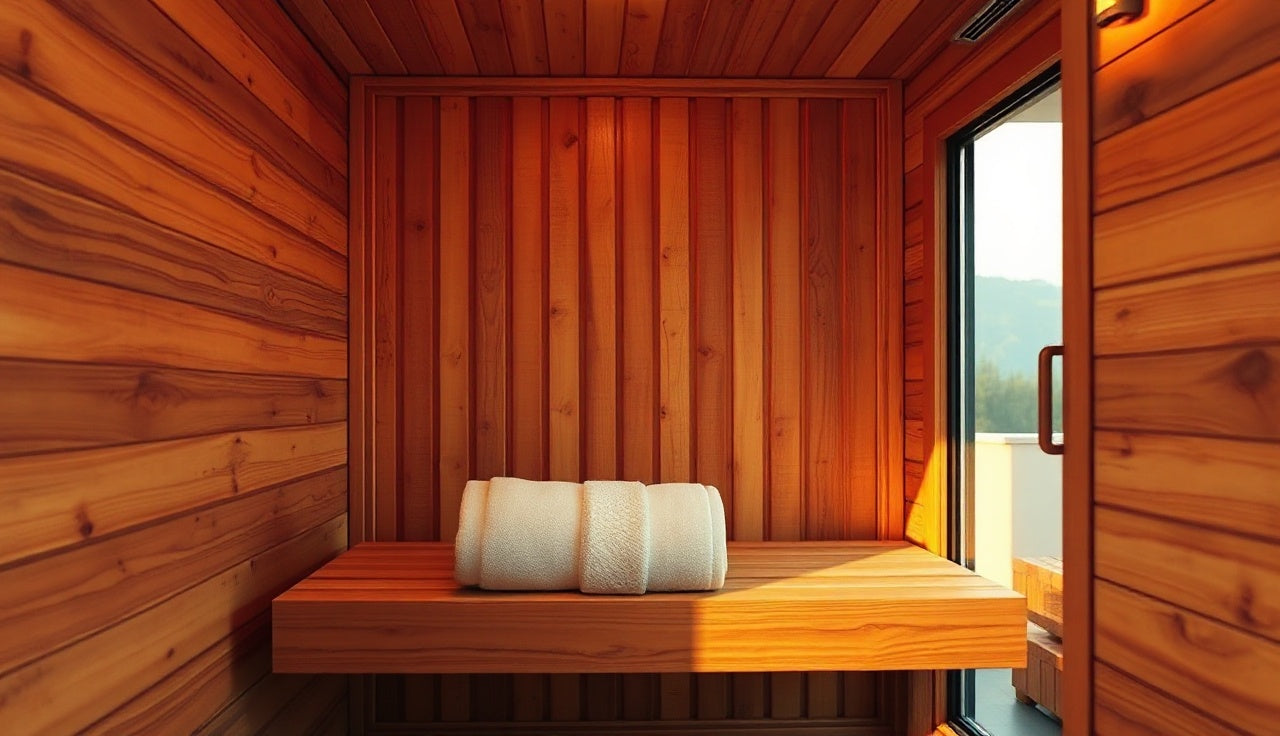
A hotbox infrared sauna is a wood-paneled enclosure lined with infrared emitters (ceramic, carbon, or full-spectrum panels) that radiate heat straight onto your skin and into the top few centimeters of soft tissue. "Hotbox" is informal slang for the whole category, not a brand, though some studios have adopted the word in their marketing.
The heat mechanism is what sets it apart from a traditional Finnish sauna. A Finnish sauna heats the air to 170 to 200°F and you absorb that heat by convection and conduction. An infrared sauna runs at 120 to 150°F, but the panels aim radiant energy at your body, so you sweat comparably or more at a lower air temperature [1]. Picture a cold room with a radiator next to you versus a warm room with no radiator. The radiant source matters more than the thermometer on the wall.
The "hotbox" label also shows up in group fitness studios that run infrared-heated rooms for yoga or HIIT. If you see "hotbox sauna studio" on a class schedule, that usually means an infrared room held at 95 to 110°F for heated exercise, not passive sweating. The home version is a dedicated cabin for 1 to 4 people.
For a broader look at how the sauna types compare, the sauna overview is a good starting point.
How does infrared heat work differently from a traditional sauna?
Infrared is electromagnetic radiation sitting just below visible red light on the spectrum, roughly 700 nanometers to 1 millimeter in wavelength. Your body emits and absorbs infrared radiation all day long, which is why it feels natural rather than burning at normal sauna intensities.
Manufacturers split infrared into three bands:
| Band | Wavelength | Penetration depth | Common use in saunas |
|---|---|---|---|
| Near-infrared (NIR) | 0.7 to 1.4 µm | ~5 mm (epidermis) | Some full-spectrum units |
| Mid-infrared (MIR) | 1.4 to 3 µm | ~2 cm (soft tissue) | Full-spectrum panels |
| Far-infrared (FIR) | 3 µm to 1 mm | ~4 cm (muscles, joints) | Most consumer saunas |
Far-infrared dominates home saunas. The panels emit wavelengths centered around 8 to 10 micrometers, which happens to match the peak emission of human skin, so absorption is efficient [2]. Your skin temperature rises, you sweat, your heart rate climbs, and your core temperature follows.
Here is where the marketing gets ahead of the science. The claim that infrared "penetrates deeper" to produce effects that convective heat can't is still debated in the research. Your thermoregulatory response (sweating, vasodilation, higher cardiac output) looks similar regardless of the heat source once your core temperature rises by the same amount [3]. The lower air temperature is real and genuinely useful for comfort and for people with respiratory sensitivities. Depth-of-penetration hype is not settled science.
What are the actual health benefits of infrared sauna, and what does the research say?
The honest answer: the evidence is promising but thin in spots, and nobody should buy an infrared sauna expecting it to replace medication or medical care.
Cardiovascular effects are the best-studied area. A 2015 study in JAMA Internal Medicine tracked the Kuopio Ischemic Heart Disease cohort (2,315 Finnish men) and found sauna use 4 to 7 times per week was associated with a 50% lower risk of fatal cardiovascular disease compared to once-weekly use [4]. That study used traditional Finnish saunas, not infrared, so applying it to infrared takes some inference.
Infrared-specific trials are smaller. A study in the Journal of the American College of Cardiology found daily 15-minute far-infrared sessions over 2 weeks improved endothelial function and reduced symptoms in chronic heart failure patients [5]. The authors reported "significant improvement in cardiac function and clinical symptoms." Promising for a specific group, but a small sample.
For muscle recovery, the logic holds up: heat raises blood flow, eases delayed-onset soreness, and may speed clearance of metabolic byproducts. A 2015 study in Springerplus found far-infrared sessions after exercise reduced DOMS and improved recovery in male athletes [6]. Nobody has clean data on the optimal infrared dose for recovery. The closest trials use 20 to 30 minute sessions.
Relaxation and cortisol claims come up constantly but are poorly quantified for infrared specifically. The thermal load of any sauna nudges the parasympathetic nervous system into gear afterward, drops cortisol in some studies, and improves reported sleep quality. Whether infrared does this any better than a hot bath is unknown.
Buying an infrared sauna for general wellness and relaxation is reasonable on the evidence. Buying it to treat a specific condition deserves a conversation with your doctor first. For a deeper read on the data, the sauna benefits article covers the published research across all sauna types.
| 1x per week (baseline) | 0% |
| 2–3x per week | 27% |
| 4–7x per week | 50% |
Source: Laukkanen T et al., JAMA Internal Medicine, 2015
How hot does a hotbox infrared sauna get, and how long should a session last?
Most home infrared saunas run between 110°F and 150°F (43 to 65°C). Consumer units usually max out around 140 to 150°F, with the range most people actually use landing at 120 to 135°F. Studio infrared rooms built for heated fitness run cooler, around 90 to 105°F, because you're exercising and making your own heat.
Traditional Finnish saunas hit 170 to 200°F, which is why first-timers in an infrared cabin sometimes feel shortchanged. The room itself doesn't feel scorching. Give it 10 to 15 minutes and your core temperature catches up.
Session length depends on your goal and tolerance. Most manufacturers suggest starting at 15 to 20 minutes and building up to 30 to 45. The Finnish cohort research used sessions of at least 20 minutes [4]. Sweating usually kicks in around the 10 to 15 minute mark in an infrared unit.
Pre-heating matters. Infrared panels need 10 to 20 minutes to reach target temperature, and the wood walls need time to warm too. Getting in during the ramp-up is fine, and some people like the gradual warm-up, but the clock for research-based benefit really starts once you're sweating, not when you sit down.
Hydration is non-negotiable. A 30-minute session can produce 0.5 to 1.5 liters of sweat [7]. Drink water before and after, and add electrolytes if you're running sessions longer than 30 minutes.
What are the different types of infrared sauna panels, and which is best?
Panel type matters more than almost any other spec, and the marketing around it is a mess.
Carbon fiber panels are thin and flat, and they emit heat over a large surface at relatively low panel temperatures (typically 170 to 200°F at the surface). That means lower EMF output, even heat, and faster warm-up than ceramic. Most mid-range home saunas ($2,500 to $6,000) use carbon panels.
Ceramic panels (or ceramic-coated rods) run hotter at the emitter surface and put out a higher intensity of infrared in a tighter zone. Some people say ceramics feel more intense. They also tend to read slightly higher EMF at the surface, though in-cabin levels are usually still low. Older and budget units lean ceramic.
Full-spectrum panels try to emit near, mid, and far-infrared at once, usually by pairing a halogen or quartz near-infrared emitter with carbon far-infrared panels. These cost the most, and the health claims tied to near-infrared specifically (collagen synthesis, wound healing) are less established in sauna-context research than the far-infrared cardiovascular data. If you want to cover every band and budget isn't the limit, full-spectrum is fine. If budget is the limit, a quality carbon FIR sauna gets you most of the studied benefit.
EMF (electromagnetic field) output is a fair concern for some buyers. Well-built carbon panel saunas typically test under 3 milligauss at seating position, which sits below the threshold used in most exposure guidelines [8]. Ask for third-party EMF test reports, not the manufacturer's own numbers.
How much does a hotbox infrared sauna cost to buy and to run?
Home infrared sauna prices break down roughly like this:
| Category | Price range | What you get |
|---|---|---|
| Entry-level (1-person) | $1,500 to $2,500 | Hemlock or basswood, basic carbon panels, Bluetooth audio |
| Mid-range (2-person) | $2,500 to $5,000 | Better wood, lower-EMF carbon panels, chromotherapy lighting |
| Premium (2 to 4 person) | $5,000 to $10,000 | Cedar or eucalyptus, full-spectrum panels, app control |
| Commercial/custom | $10,000+ | Large cabins, medical-grade panels, custom builds |
Running cost is low. A 2-person unit with 1,500 to 2,000 watts of panel power, running 45 minutes, costs about $0.15 to $0.30 per session at average U.S. electricity rates (around $0.13 per kWh as of 2024, per the U.S. Energy Information Administration) [9]. Set that against a gym or studio membership with sauna access at $50 to $200 a month, and a home unit starts paying for itself inside 2 to 3 years of regular use.
Installation cost hinges on whether you need a dedicated 20-amp or 240-volt circuit. Most 1 to 2 person infrared saunas run on standard 120V 15 to 20 amp outlets. Larger units and most traditional saunas need 240V wiring, which adds $200 to $800 to installation [10].
If a full cabin feels like too much, a portable sauna costs $100 to $500 and uses the same far-infrared principle in a collapsible tent. You lose the wood-paneled feel and the even heat, but you get the sweat.
Is an infrared sauna better than a traditional sauna?
"Better" depends entirely on what you want.
Want the closest match to what the big cardiovascular outcome studies actually tested? A traditional Finnish sauna is more directly supported by that evidence. The 2,315-person Kuopio cohort used steam saunas [4]. Extending that data to infrared is a reasonable inference, not proven equivalence.
Have heat intolerance, asthma, or trouble breathing 190°F air? Infrared is meaningfully more accessible. Plenty of people who can't tolerate a traditional sauna do fine at 130°F infrared.
Installing at home in a tight space? Infrared cabins are self-contained plug-and-play units. Traditional saunas need a heat source (electric or wood-fired), proper ventilation, and usually a dedicated room or outdoor structure. The home sauna guide covers the full installation comparison.
Care about humidity? Traditional saunas let you throw water on rocks for a steam burst. Infrared saunas are dry. Pure personal preference.
For a side-by-side that also covers steam rooms, read the sauna vs steam room article.
My honest take: for most people buying their first home sauna, a quality mid-range infrared unit is easier to install, cheaper to run, and good enough that you'll actually use it. Consistent use beats the theoretically superior option you skip because it's a hassle.
What should you look for when buying a hotbox infrared sauna?
Start with the wood. Cedar is the standard to beat: naturally antimicrobial, aromatic, and stable through repeated heat cycles without warping. Hemlock and basswood are cheaper and structurally fine, but they lack cedar's aromatics and natural moisture resistance. Skip any unit with MDF or composite backing boards inside the cabin. They off-gas at heat.
Panel quality and coverage matter more than panel count. Ask for total wattage, the emitter coverage area relative to cabin size, and a third-party EMF test report. A 1,500-watt system in a 1-person cabin heats you well. The same wattage in a 4-person cabin won't.
Door glass is a small but real point. Full-length glass doors look good and lose more heat than solid wood doors. Some people love the openness. Others hate watching the heat bleed out. Your call.
Controller quality decides how often you actually use the thing. A simple digital control with a timer and temperature display is all you need. Fancy app control is nice when it's reliable. Read reviews about the controller software specifically before buying any premium unit.
Warranty length signals build confidence. Look for at least 5 years on the cabin and panels, and 1 to 2 years on electronics. Some premium brands offer lifetime warranties on the wood.
SweatDecks carries a curated selection of home saunas with documented EMF specs and real warranty terms if you want to compare models without wading through manufacturer marketing.
One last thing: measure your space with a tape measure, not an eyeball. A 2-person infrared cabin typically runs 47 to 51 inches wide by 39 to 47 inches deep. Add 6 to 12 inches of clearance on all sides for airflow and access.
What are the safety risks of infrared sauna use, and who should avoid it?
Infrared saunas are safe for most healthy adults, but the contraindications are real.
Dehydration and heat exhaustion top the list. Symptoms include dizziness, nausea, and headache. If any of these start, get out, cool down, and drink water. A 2018 review in Evidence-Based Complementary and Alternative Medicine reported that adverse events in sauna research are rare, and most involve dehydration or hemodynamic changes [11].
Anyone with cardiovascular disease should get physician clearance before using any sauna. The heart rate bump in a 30-minute infrared session is similar to moderate exercise, roughly 100 to 150 bpm. Manageable for most people, not for everyone.
Pregnancy. Most OB guidelines advise against anything that meaningfully raises core body temperature, saunas included. The American College of Obstetricians and Gynecologists advises against raising core temperature above 38.3°C (101°F), especially in the first trimester [12]. If you're pregnant, talk to your OB.
Conditions that warrant caution include multiple sclerosis (heat can temporarily worsen symptoms), lupus, and any medication that impairs thermoregulation or causes photosensitivity. Some blood pressure medications, diuretics, and anticholinergics all affect heat tolerance.
Alcohol and saunas mix badly. Alcohol impairs thermoregulation and adds cardiovascular stress. Several sauna-related deaths have involved alcohol.
Children can use saunas at lower temperatures and shorter durations but should always be supervised. Most manufacturers cap it at 110°F and 15-minute sessions for children over 6.
For healthy adults following basic hydration and time limits, the risk is low. The same thermal stress that creates the cardiovascular benefit is the thing you manage with common sense.
Can you use a hotbox infrared sauna for contrast therapy with a cold plunge?
Yes, and contrast therapy (alternating heat and cold) is one of the most popular protocols for recovery-focused buyers. The usual pattern is heat for 10 to 20 minutes, cold immersion for 1 to 3 minutes, repeated for 2 to 4 rounds.
The rationale is straightforward. Heat causes vasodilation and higher cardiac output. Cold causes vasoconstriction and a catecholamine spike (adrenaline, noradrenaline). Alternating the two creates a pumping effect on circulation and a strong autonomic response. Whether it beats either intervention alone for recovery is still being studied.
A 2016 meta-analysis in the British Journal of Sports Medicine found cold-water immersion significantly reduced DOMS compared to passive recovery, and some contrast protocols outperformed cold alone [13]. The infrared-specific contrast data is thinner, but given the equivalent heat response at lower air temperatures, the mechanism should transfer.
Setting up a home contrast station? A sauna paired with a cold plunge is the most common configuration. Space and budget permitting, outdoor setups work well, with the sauna venting heat outward and the cold plunge sitting next to it. The cold plunge benefits article has the full research breakdown on the cold side.
You don't need a dedicated cold plunge unit to start. An ice bath in a standard tub or a chest freezer conversion gets you the cold stimulus at lower cost while you decide if the full contrast setup earns its space.
What does a hotbox infrared sauna studio session look like compared to a home unit?
Hotbox-style infrared studios have spread through major cities over the past decade, with drop-in sessions typically priced at $25 to $60 for 30 to 45 minutes. Some are pure passive sauna. Others run the infrared room as a heated fitness space for yoga, pilates, or HIIT.
A pure sauna session at a studio gets you a private or semi-private wood cabin at 120 to 145°F, usually with ambient lighting, music, and sometimes chromotherapy built in. Some studios add essential oil diffusers or red light panels on the ceiling.
The fitness version is different. Rooms run at 90 to 108°F, you move through a class, and the heat raises workout intensity, caloric burn, and sweating. Research on heated fitness classes is limited. The main documented risk is that exercising in heat raises cardiovascular demand and heat-illness risk more than passive sauna use does.
For regular users, the math on studio versus home ownership tips toward buying somewhere between 18 and 36 months, depending on frequency and local pricing. At 3 sessions a week at $35 each, that's $5,460 a year. A good 2-person home unit at $4,000 pays for itself in under a year at that pace.
Studios make sense if you're testing the format before buying, if you live in an apartment with no installation option, or if you travel a lot and want the option wherever you land.
How do you set up a hotbox infrared sauna at home?
Most 1 to 2 person infrared saunas ship flat-packed and assemble in 1 to 3 hours with two people and basic tools, usually just a rubber mallet and a screwdriver. The panels interlock, the roof panel drops in, and the control panel mounts to the exterior.
Location requirements: a level floor (tile, concrete, or hardwood all work), access to the right electrical outlet, and enough ceiling height (most units are 74 to 78 inches tall). Carpet under a sauna is workable but collects moisture over time. A tile or hardwood base is better.
Electrical: most 1 to 2 person units draw 1,400 to 1,800 watts on 120V 15 to 20 amp circuits. A standard bedroom outlet works if it's a dedicated circuit or the room isn't otherwise loaded. Larger 3 to 4 person units often step up to 240V. The National Electrical Code (NFPA 70) Article 422 governs appliance installation requirements, and your local jurisdiction may add its own [14]. When in doubt, have an electrician verify your circuit before you assemble.
Ventilation: infrared saunas don't make steam and don't need dedicated ventilation like a bathroom exhaust, but some passive airflow helps keep moisture off the exterior wood over time. Don't wedge the unit into a room with no air circulation.
Maintenance is minimal. Wipe down the interior bench with a damp cloth after each session (sweat is corrosive over time), sand lightly with fine-grit sandpaper once a year if the bench feels rough, and check the panel connections every year or two. Never seal or stain the interior wood. It needs to breathe, and off-gassing a finish at 130°F is a bad situation.
For outdoor installations, weather-rated covers and sealed exterior finishes change the requirements a lot. The outdoor sauna guide covers weatherproofing and electrical for exterior builds.
Frequently asked questions
What is a hotbox infrared sauna?
A hotbox infrared sauna is a wood-paneled cabin with infrared emitters (carbon, ceramic, or full-spectrum) that heat your body directly rather than heating the surrounding air to high temperatures first. It runs at 110 to 150°F versus a traditional sauna's 170 to 200°F, which makes it more tolerable for many people while still producing heavy sweating and a similar core temperature rise.
Is infrared sauna actually good for you?
The evidence is genuinely promising, especially for cardiovascular health and recovery. Research links regular sauna use to lower cardiovascular mortality risk and better heart function in specific patient groups. Infrared-specific trials are smaller but point the same direction. It won't cure anything, and claims about detox or dramatic weight loss are overblown. For relaxation and general wellness in healthy adults, the evidence supports use.
How long should I stay in an infrared sauna?
Start with 15 to 20 minutes per session and build up to 30 to 45 minutes as you adapt. Research protocols typically use 20 to 30 minutes. If you feel dizzy, nauseous, or overheated at any point, get out immediately. Hydrate well before and after. Most people hit a steady sweat response at the 10 to 15 minute mark inside an infrared unit.
What temperature does a hotbox infrared sauna run at?
Home infrared saunas typically run between 110°F and 150°F (43 to 65°C), with most users settling into the 120 to 135°F range. Studio infrared rooms used for heated fitness classes run cooler, often 90 to 108°F, because participants generate their own metabolic heat while exercising. These temperatures are well below traditional Finnish saunas, which run 170 to 200°F.
What is the difference between far-infrared and full-spectrum infrared sauna?
Far-infrared (FIR) saunas emit wavelengths in the 3 micrometer to 1 millimeter range and make up the vast majority of consumer units. The cardiovascular and recovery research is largely based on FIR exposure. Full-spectrum units add near-infrared (NIR) and mid-infrared emitters, with NIR theoretically supporting tissue repair and collagen synthesis. The added benefit of full-spectrum over FIR alone in a sauna context is not well established in clinical literature.
How much electricity does an infrared sauna use?
A typical 2-person infrared sauna draws 1,500 to 2,000 watts. At the U.S. average electricity rate of roughly $0.13 per kWh (per the EIA), a 45-minute session costs about $0.15 to $0.20. Annual cost for 4 sessions a week totals roughly $30 to $45 in electricity, which makes running cost close to negligible next to the purchase price or a gym membership with sauna access.
Can I use an infrared sauna every day?
Most healthy adults can use an infrared sauna daily without trouble if they stay hydrated and keep sessions to 20 to 45 minutes. The Kuopio cohort data actually showed better cardiovascular outcomes with higher frequency (4 to 7 times per week). Daily use is only a concern if you have underlying cardiovascular disease, take medications that affect thermoregulation, or notice you're not recovering between sessions. When in doubt, ask your doctor.
Who should not use an infrared sauna?
People who should get physician clearance or avoid infrared saunas include those with cardiovascular disease, low or uncontrolled blood pressure, multiple sclerosis, lupus, and pregnant women (especially in the first trimester, when elevated core temperature poses fetal risk). Medications including diuretics, anticholinergics, and certain blood pressure drugs also affect heat tolerance. Anyone who feels unwell, dizzy, or overheated should exit the sauna immediately.
How does an infrared sauna compare to a steam room?
An infrared sauna uses dry radiant heat at 110 to 150°F. A steam room uses moist heat (humidity near 100%) at 100 to 120°F. Cardiovascular and thermoregulatory effects overlap, but the humidity difference matters for people with respiratory conditions (steam helps, dry infrared is neutral to helpful). The sauna vs steam room article covers the full comparison, including recovery and relaxation differences.
What wood is best for an infrared sauna cabin?
Cedar is the best choice for most buyers: naturally antimicrobial, aromatic, moisture-resistant, and stable through repeated heat cycles. Hemlock and basswood are acceptable budget alternatives with less natural antimicrobial protection. Avoid any unit with MDF, particleboard, or composite materials on interior surfaces, since these can off-gas formaldehyde at sauna temperatures. Check that the interior wood is untreated and unfinished.
Is a hotbox infrared sauna worth it for home use?
For people who use it consistently (3+ times a week), yes. The per-session cost drops below $1 fast, the cardiovascular and recovery evidence is real if not conclusive, and having a sauna at home removes the friction that makes gym sauna use inconsistent. At $2,500 to $4,000 for a solid mid-range unit, the break-even against studio sessions at $35 to $50 each runs roughly 12 to 18 months of regular use.
Can I pair an infrared sauna with a cold plunge for contrast therapy?
Yes, and this is one of the most popular home recovery setups. The standard protocol is 15 to 20 minutes of infrared heat followed by 1 to 3 minutes of cold immersion, repeated 2 to 4 rounds. Research supports cold water immersion for reducing DOMS, and contrast protocols show added benefit in some studies. You don't need a dedicated cold plunge to start. A cold bath works while you evaluate whether a full setup is worth it.
Do infrared saunas produce harmful EMF levels?
Quality infrared saunas with carbon panel construction typically measure under 3 milligauss at seating position, within normal background environmental exposure. Ceramic panels can read higher at the emitter surface. Always ask manufacturers for third-party EMF test documentation, not in-house measurements. Distance from the emitter matters, and sitting in a properly sized cabin puts you well away from peak emitter output.
How do I maintain a home infrared sauna?
Wipe down the interior bench and walls with a damp cloth after each session to prevent sweat buildup, which is mildly corrosive over time. Light sanding with fine-grit sandpaper once or twice a year keeps the bench surface smooth. Check electrical connections annually. Never seal, stain, or paint the interior wood. Keep the area around the unit dry and ventilated to prevent exterior moisture damage.
Sources
- Laukkanen JA et al., Mayo Clinic Proceedings (2018) — Cardiovascular and Other Health Benefits of Sauna Bathing: Infrared saunas operate at lower ambient temperatures (typically 45–60°C / 110–140°F) than traditional Finnish saunas while still producing comparable sweat response
- Vatansever F & Hamblin MR, Photonics & Lasers in Medicine (2012) — Far infrared radiation: its biological effects and medical applications: Human skin absorbs far-infrared radiation most efficiently at wavelengths of 8–10 micrometers, matching peak panel emission in consumer saunas
- Hussain J & Cohen M, Evidence-Based Complementary and Alternative Medicine (2018) — Clinical Effects of Regular Dry Sauna Bathing: Thermoregulatory responses (sweating, vasodilation, cardiac output) are driven primarily by core temperature rise regardless of heat source
- Laukkanen T et al., JAMA Internal Medicine (2015) — Association Between Sauna Bathing and Fatal Cardiovascular and All-Cause Mortality Events: Sauna use 4–7 times per week associated with 50% lower risk of fatal cardiovascular disease compared to once-weekly use in 2,315 Finnish men
- Kihara T et al., Journal of the American College of Cardiology (2002) — Repeated sauna treatment improves vascular endothelial and cardiac function in patients with chronic heart failure: Daily far-infrared sauna sessions of 15 minutes for 2 weeks produced 'significant improvement in cardiac function and clinical symptoms' in chronic heart failure patients
- Mero A et al., Springerplus (2015) — Effects of far-infrared sauna bathing on recovery from strength and endurance training sessions in men: Far-infrared sauna sessions after exercise reduced delayed onset muscle soreness and improved recovery in male athletes
- Hannuksela ML & Ellahham S, American Journal of Medicine (2001) — Benefits and risks of sauna bathing: A 30-minute sauna session can produce 0.5–1.5 liters of sweat; adequate hydration before and after is essential
- International Commission on Non-Ionizing Radiation Protection (ICNIRP) — Guidelines for limiting exposure to electromagnetic fields: Exposure guideline context for evaluating 3 milligauss EMF threshold cited in sauna panel assessments
- U.S. Energy Information Administration — Electric Power Monthly: Average Retail Price of Electricity: Average U.S. retail electricity price approximately $0.13 per kWh as of 2024, used to calculate per-session infrared sauna running cost
- U.S. Department of Energy — Home Energy Saver: Electrical Systems: Installing a dedicated 240V circuit for a larger home sauna typically costs $200–$800 depending on distance from panel and local labor rates
- Hussain J & Cohen M, Evidence-Based Complementary and Alternative Medicine (2018) — Clinical Effects of Regular Dry Sauna Bathing: Adverse events in sauna research are rare; most involve dehydration or hemodynamic changes in susceptible individuals
- American College of Obstetricians and Gynecologists — Committee Opinion: Exercise During Pregnancy and the Postpartum Period: Pregnant women advised to avoid raising core body temperature above 38.3°C (101°F), applicable to sauna use guidance
- Machado AF et al., British Journal of Sports Medicine (2016) — Can water temperature and immersion time influence the effect of cold water immersion on muscle soreness? A systematic review and meta-analysis: Cold-water immersion significantly reduced DOMS compared to passive recovery; some contrast protocols outperformed cold alone in meta-analysis
- National Fire Protection Association — NFPA 70: National Electrical Code, Article 422 (Appliances): NFPA 70 Article 422 governs electrical installation requirements for household appliances including sauna units

Share:
4 person infrared sauna: what to know before you buy
4 person infrared sauna: what to know before you buy