
Last updated 2026-07-09
TL;DR
A 4 person infrared sauna usually measures 5 to 6 ft wide by 4 to 5 ft deep and costs $2,500 to $8,000, depending on wood quality, heater type, and brand. Most plug into a standard 120V outlet, but larger units need 240V. Budget 6 to 9 ft of clear floor space, plus a level, weatherproof surface if it goes outside.
What does a 4 person infrared sauna actually look like?
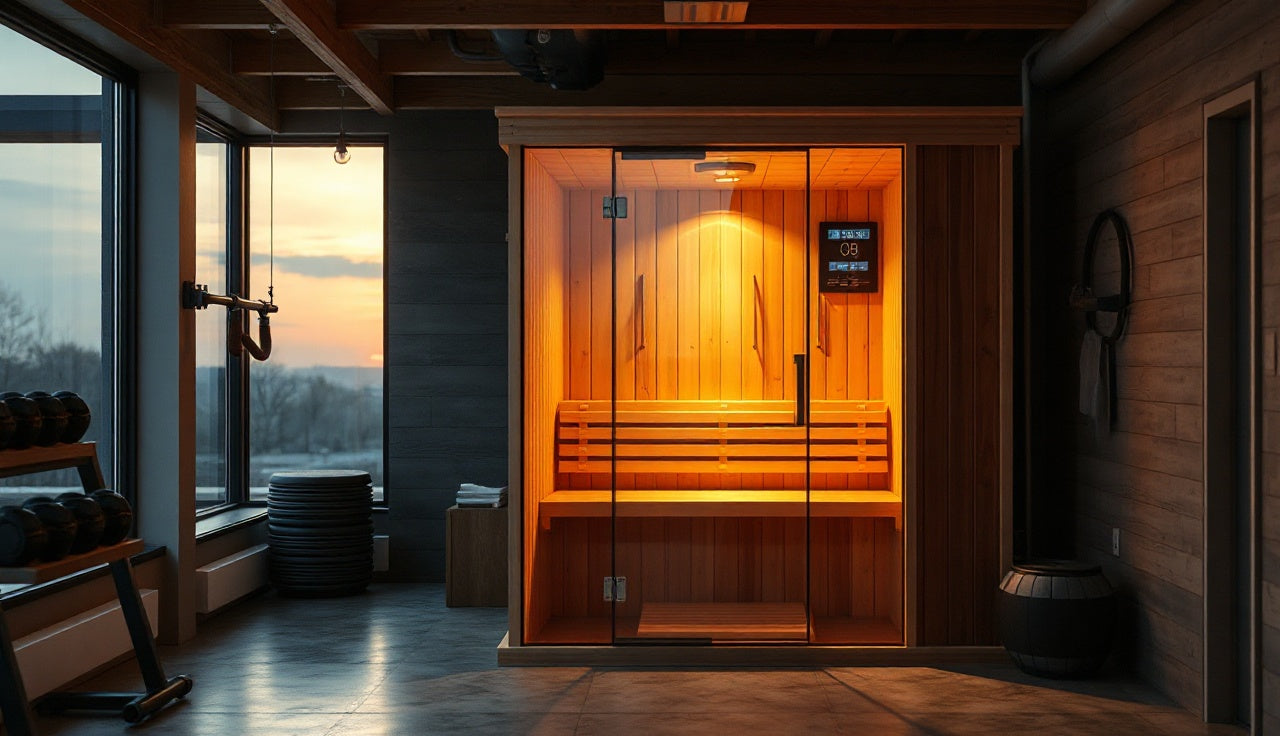
A 4 person infrared sauna is bigger than most people picture. The interior footprint runs around 5 ft wide by 4 ft deep on a true four-seater, closer to 6x5 ft on premium models, with a ceiling height of 74 to 78 inches. That gives four adults room to sit on two facing benches without knees touching. Fitting four large adults comfortably still comes down to bench layout.
If you've sat in a 2-person unit, the 4-person version is roughly twice the floor space. The exterior shell adds 2 to 4 inches per wall for insulation and framing, so plan for an outside footprint of about 5.5 ft by 4.5 ft at minimum. Leave at least 1 to 2 inches of clearance above the unit for ventilation.
For context, a three person infrared sauna usually measures around 4.5 ft wide by 4 ft deep. The jump to four seats adds a real chunk of floor space, and that chunk matters in a basement, garage, or spare bedroom. Measure twice before you order.
Most manufacturers include two L-shaped or U-shaped benches. Some offer a single wide bench with a backrest, which works better if two people want to lie down. Check whether the bench is a single height or split-level. Split-level benches put some occupants closer to the heaters and others farther away, which changes the heat noticeably from seat to seat.
What are the main types of infrared heaters in a 4 person sauna?
Infrared saunas split into three heater categories: near-infrared (NIR), mid-infrared (MIR), and far-infrared (FIR). Nearly every consumer unit sold as a 4-person sauna uses far-infrared, which operates in the 8 to 14 micron wavelength range and warms your body directly instead of heating the air around you [1].
Within FIR, two heater technologies dominate: carbon fiber panels and ceramic rod heaters. Carbon panels run cooler at the face (around 140 to 175 F) and spread heat over a larger surface, which tends to feel more even. Ceramic rods run hotter at the surface but heat up faster. A 4-person carbon-panel sauna might carry 8 to 14 individual panels on the back wall, side walls, under the bench, and at leg level.
Some high-end brands add near-infrared emitters as a separate set of lamps and claim deeper tissue penetration. The research comparing near-infrared to far-infrared in home saunas is genuinely thin. A 2018 review in Mayo Clinic Proceedings noted that most published sauna studies use Finnish-style dry saunas, and that far-infrared evidence, while promising, comes from small trials [2]. Nobody has run a large randomized trial comparing heater types in humans. So treat heater-type marketing with a raised eyebrow.
Here's what actually decides performance in a 4-person unit: total wattage. A properly sized 4-person infrared sauna needs roughly 1,500 to 2,800 watts of heater capacity to reach operating temperature (130 to 155 F) in 20 to 40 minutes. Below 1,500W you'll wait forever, or never hit target temperature with four bodies inside.
How much does a 4 person infrared sauna cost?
The price range is wide. Entry-level 4-person infrared saunas start around $2,500. Mid-range units run $3,500 to $5,500. Premium and medical-grade models from brands like Clearlight or Sunlighten climb past $7,000 to $10,000 [3].
Here's the honest breakdown of what each tier buys you:
| Price Tier | Typical Price Range | Wood Quality | Heater Type | EMF Shielding | Warranty |
|---|---|---|---|---|---|
| Entry | $2,500 to $3,500 | Hemlock or poplar | Carbon or ceramic | Basic or none | 1 to 3 years |
| Mid-range | $3,500 to $5,500 | Canadian cedar or hemlock | Low-EMF carbon panels | Present | 3 to 5 years |
| Premium | $5,500 to $10,000+ | Western red cedar or basswood | Ultra-low-EMF carbon or full-spectrum | Certified low | 5 years to lifetime |
The wood matters more than most buyers realize. Canadian western red cedar is the gold standard. It's naturally antimicrobial, smells good when heated, and resists warping through years of heat cycles. Hemlock costs less and holds up fine, but it's nearly odorless. Poplar is cheapest and shows wear faster in humid conditions.
Don't forget installation. If your unit needs a 240V circuit you don't already have, electrician work runs $200 to $600 depending on panel distance and local labor rates [4]. Shipping a 4-person sauna adds another $150 to $400, and some budget brands ship freight with curbside delivery only. That means you and a friend are moving 350 to 600 lb of crated lumber up the driveway.
If budget is a hard constraint, a portable sauna is worth a look, though the experience is a world away from a permanent cabin unit.
| Entry (hemlock/poplar, basic heaters) | $3,000 |
| Mid-range (cedar/hemlock, low-EMF carbon) | $4,500 |
| Premium (cedar/basswood, ultra-low-EMF) | $7,750 |
Source: Consumer Reports, Home Sauna Buying Guide
What electrical requirements does a 4 person infrared sauna need?
This is where buyers get caught off guard. Plenty of 4-person infrared saunas are marketed as plug-and-play on 120V, but the honest answer depends on total wattage.
A unit drawing 1,500W or less can technically run on a standard 15A, 120V household circuit. The problem: you'd be running near the 80% continuous-load threshold that the National Electrical Code (NEC) Article 210 requires circuits to stay within [5]. Most electricians and manufacturers recommend a dedicated 20A circuit at that wattage. If the unit is rated at 1,600W or more, you need a 240V/20A or 240V/30A dedicated circuit.
NEC Article 210.23 covers this directly. For a 20A circuit, the 80% ceiling is 16A, which is about 1,920W on 120V or 3,840W on 240V. A 2,400W sauna on 240V needs at minimum a dedicated 20A/240V circuit.
The takeaway: check the sauna's listed amperage draw on the spec sheet, more than the wattage. Call an electrician before you order if you're unsure. Running a high-draw sauna on an undersized circuit is a fire risk, not a minor inconvenience.
Outdoor installs add a second requirement. The circuit needs GFCI protection under NEC Article 210.8 for outdoor and wet-location receptacles [5]. If the unit sits on a covered deck or in a detached garage, that GFCI rule applies whether or not the sauna itself is waterproof.
Where can you put a 4 person infrared sauna: indoors vs. outdoors?
Most 4-person infrared saunas are built for indoor use. The wood joints, electrical components, and control panels on a standard cabin unit aren't rated for direct rain, and steady outdoor humidity speeds up wood checking and hardware corrosion.
Still, plenty of people run them outdoors under cover: screened porches, covered patios, gazebos, dedicated sauna outbuildings. Three conditions matter. The unit never gets rained on directly. There's airflow to keep mold off the exterior. The floor is level and stable, meaning a concrete slab or composite decking rated for the weight.
For a true outdoor sauna build that shrugs off weather, buy a unit sold specifically as outdoor-rated, with treated wood, exterior-grade hardware, and sealed seams.
Indoor placement, ranked by how well it works: basement first (climate-controlled, easy electrical access), spare bedroom second (check the subfloor rating, since 40 lbs/sq ft live load is the minimum residential standard), garage third (great ventilation, but cold climates slow heat-up time), and a dedicated wellness room if you have one.
Weight is a real concern. A crated 4-person sauna can weigh 400 to 700 lbs. Assembled, the sauna plus four occupants (roughly 600 to 700 lb of people) means you want to confirm the subfloor can carry the load. Residential floors are typically engineered for 40 lbs per square foot of live load [6]. A 5x4 ft footprint is 20 sq ft, which pencils out to an 800 lb capacity on a minimally rated floor. That's tight with a heavy unit and four adults. A structural engineer's opinion costs a few hundred dollars and takes the guessing out of it.
What health benefits does infrared sauna use actually have evidence for?
Be skeptical of sweeping claims. The evidence base for infrared sauna specifically is smaller than the one for traditional Finnish sauna, and most high-quality research uses Finnish saunas at higher temperatures (175 to 212 F versus infrared's typical 120 to 155 F).
There is a real body of research, though. A 2018 review in Mayo Clinic Proceedings summarized findings that regular sauna bathing links to lower cardiovascular risk, with a dose-response pattern across 4 to 7 sessions per week compared to once weekly [2]. The Finnish Kuopio Ischemic Heart Disease study (n=2,315) found that men who used a sauna 4 to 7 times per week had a 63% lower risk of sudden cardiac death than once-weekly users [7]. The authors of that study concluded that "increased frequency of sauna bathing is associated with a reduced risk of sudden cardiac death."
For infrared specifically: a small 2009 trial in the Journal of the American College of Cardiology found that daily 15-minute far-infrared sauna sessions over 3 weeks improved endothelial function and lowered oxidative stress markers in coronary artery disease patients [8]. Sample sizes are small, so read these as directionally interesting rather than settled.
Pain and recovery: a 2015 systematic review in the Journal of Alternative and Complementary Medicine found preliminary evidence for reduced chronic pain and fatigue after repeated infrared sessions, while flagging methodological limits in the available studies [9].
What the research does not support: detox claims, weight loss (the water weight you sweat off comes right back with rehydration), and anti-aging. Read sauna benefits for a fuller breakdown of what the evidence actually says.
Contraindications matter. People with certain heart conditions, low blood pressure, or a pregnancy should talk to a physician before regular sauna use. The American Heart Association hasn't issued formal sauna guidelines as of this writing.
How does a 4 person infrared sauna compare to a traditional sauna?
The differences are real, not marketing spin. Understanding them tells you which type fits your use.
| Feature | 4-Person Infrared | 4-Person Traditional (Finnish) |
|---|---|---|
| Operating temp | 120 to 155 F | 160 to 212 F |
| Humidity | Dry (no rocks) | Adjustable (up to ~40% RH with water on rocks) |
| Heat-up time | 15 to 30 minutes | 30 to 60 minutes |
| Power draw | 1,500 to 2,800W | 4,500 to 9,000W+ |
| Install complexity | Low to moderate | Moderate to high |
| Typical cost (4-person) | $2,500 to $8,000 | $3,500 to $12,000 |
| Experience feel | Radiant, gentle | Convective, intense |
The lower operating temperature of infrared is both a feature and a limit. It's genuinely easier on people who find traditional sauna heat overwhelming, and you get a real sweat at 130 to 140 F. But if you want the heat shock that traditional sauna culture is built around, an infrared cabin won't give it to you.
Traditional saunas also demand a heavier install: a proper sauna-grade heater (usually 240V/40A or more), kiln-dried softwood lining, real ventilation, and ideally a floor drain. A 4-person infrared unit, by contrast, often goes together in 2 to 4 hours with two people and basic tools.
One more thing worth reading: sauna vs steam room, if you're also weighing a steam generator for a home wellness space.
What should you look for in a 4 person infrared sauna: the buying checklist
After looking across the field, here's what separates a good 4-person unit from a regrettable one.
EMF levels. Infrared heaters produce electric and magnetic fields. There's no federal limit on sauna EMF specifically, but ICNIRP (International Commission on Non-Ionizing Radiation Protection) guidelines suggest keeping ELF-EMF exposure below 2,000 mG for the general public [10]. Good manufacturers publish third-party EMF test results. If a brand won't show you those, walk.
VOC and material testing. Canadian hemlock and western red cedar are naturally low-VOC. Some cheaper units hide MDF or particle board in the framing, which off-gasses formaldehyde when heated. Ask for material safety documentation, or look for CARB Phase 2 compliant materials.
Bench design. A 4-person sauna should give you at least 16 to 18 inches of bench depth per seat, with smooth, splinter-free grain. Canadian cedar and basswood stay relatively cool to the touch even near heaters, which matters more than it sounds when you're sitting barefoot.
Control panel placement. Interior-only controls are a daily annoyance. Look for both interior and exterior controls so you can pre-heat from outside. Some models add a phone app over Bluetooth or WiFi, which is a genuine upgrade if you use the sauna consistently.
Warranty terms. Read what's actually covered. A "lifetime warranty" that only covers the heaters and excludes wood, wiring, and controls is nothing like a genuine lifetime structural warranty. Read the full document before you buy.
Assembly. Most 4-person units ship as pre-cut panels and go together in 2 to 4 hours for two adults. Watch for brands that need proprietary tools or ship poorly translated manuals. Both are reliable tells for shaky build quality.
SweatDecks carries a picked lineup of 4-person infrared saunas with published EMF test data and full warranty documentation, so you're not guessing on either.
Is a 4 person sauna too big for one or two people to use regularly?
Not necessarily. A lot of solo buyers pick 4-person units on purpose, for the extra room. Stretching out on a bench, lying down for a longer session, or bringing a partner without feeling packed in is a real quality-of-life difference.
The tradeoff is heat-up time and energy cost. A larger interior volume takes longer to reach temperature and costs more per session to run. At an average U.S. residential rate of $0.16/kWh (the national average as of 2024, per the U.S. Energy Information Administration) [11], a 2,400W sauna running for 1 hour costs about $0.38. Run it daily for a year and that's roughly $140 in electricity. Not dramatic, but real.
If two people is your true maximum, a 3-person infrared sauna may hit a better balance of comfort and efficiency. Three-person units usually measure around 4 to 4.5 ft wide by 3.5 to 4 ft deep, which still gives two people comfortable room and heats up 5 to 10 minutes faster.
Here's my take. If you'll use this daily or near-daily, the 4-person buys flexibility for the day a friend visits or a family member joins. Under-buying on size is the more common regret, based on how these units actually get used over time.
How do you pair a 4 person infrared sauna with cold therapy?
Contrast therapy, meaning alternating heat and cold, is one of the most popular use patterns among people who build out home recovery setups. The most-studied protocol runs sauna sessions of 10 to 20 minutes, then cold water immersion or a cold shower for 1 to 5 minutes, repeated 2 to 3 times [12].
A 2021 study in the International Journal of Environmental Research and Public Health found that sauna-cold cycling cut delayed onset muscle soreness markers more than sauna alone in competitive athletes. The sample was 20 participants, so treat it as preliminary [12].
For a home setup, the practical pairing with a 4-person infrared sauna is a dedicated cold plunge tub or barrel, positioned close enough that the hop from hot to cold takes under 60 seconds. That fast transition is part of what drives the cardiovascular response. Cold water hitting the skin right after heat sets off a strong sympathetic nervous system spike, which most users describe as feeling suddenly, sharply awake.
If a dedicated plunge is out of budget, a cold shower or ice bath does the same physiological job for less money. Cold immersion targets generally sit at 50 to 59 F (10 to 15 C), based on where the research clusters, though individual tolerance varies a lot.
Read more in cold plunge benefits if you're weighing cold therapy as part of the setup.
What are the real ongoing maintenance requirements for a 4 person infrared sauna?
Infrared saunas need less maintenance than traditional saunas. They aren't zero-maintenance.
Weekly: wipe down bench surfaces and walls with a damp cloth. Sweat carries salt and oils that discolor wood over time if you leave them. Skip chemical cleaners and soap on cedar. Plain water or a very dilute white vinegar solution is enough.
Monthly: check electrical connections and the control panel for heat damage or discoloration. Inspect the door hinges and latch, since thermal expansion and contraction cycles loosen hardware over time.
Annually: inspect the heaters for visible damage. Carbon panels have no user-serviceable parts in most units, but you can eyeball them for cracking or discoloration. Many manufacturers suggest light sanding of bench surfaces once a year to lift oxidation and bring back the wood's color.
Wood treatment: do NOT apply oils, stains, or sealers to interior surfaces. The wood needs to breathe, and any finish off-gasses badly when heated. The exterior, if it sees humidity, can take a food-safe mineral oil on the outside panels only.
Consumable parts over a 10-year ownership window: one or two heater panel replacements (carbon panels typically last 5,000 to 8,000 hours), one control panel replacement, and possibly replacement bench boards if the originals check badly. Budget $200 to $600 for all of it across the unit's life.
How do you assemble a 4 person infrared sauna at home?
Most 4-person infrared saunas ship as a flat-pack panel system with numbered components and pre-drilled connections. The job is closer to furniture assembly than construction. Two adults can usually finish in 2 to 4 hours.
Tools you'll actually need: a rubber mallet, a power screwdriver or drill with Phillips bits, a level, and a helper. Some units need a 5mm hex key or Allen wrench for the panel bolts. A headlamp is genuinely useful for working inside the frame.
General sequence: lay the floor panel on the prepared surface, assemble the side walls in order (usually numbered L1, L2, R1, R2), connect the back wall panel, thread the pre-wired heater connections through their channels (this varies by brand), set the roof panel, connect the control panel wiring harness, hang the door.
Common mistakes: setting the floor panel on a surface that isn't dead level (causes door alignment problems later), over-tightening the panel bolts (strips the pre-drilled holes in softer woods), and skipping a test of the heater wiring before you close up the walls.
If the unit is going in a basement with one entry point, measure your doorway and staircase clearance against the panel dimensions before ordering. Individual panels on a 4-person unit can run 5 to 6 ft tall and 2 to 3 ft wide. Most consumer units fit through a standard 32-inch interior doorway in panel form, but confirm with the manufacturer.
If you're weighing home sauna options more broadly, including built-in or custom installs, the assembly picture changes a lot from a prefab cabinet.
Frequently asked questions
How much space does a 4 person infrared sauna take up?
Interior floor space on a 4-person infrared sauna is typically 5 ft wide by 4 ft deep, with an exterior footprint of roughly 5.5 ft by 4.5 ft once the walls are counted. Add at least 1 to 2 inches of clearance on all sides for ventilation. Plan for a minimum of 6 by 5 ft of usable floor space in the room, plus door swing clearance.
What voltage does a 4 person infrared sauna require?
It depends on wattage. Units under 1,500W run on a dedicated 120V/20A circuit. Most 4-person saunas rated 1,600W to 2,800W need a 240V/20A or 240V/30A dedicated circuit. Check the amperage draw on the spec sheet, more than the wattage label. Running a high-draw sauna on an undersized circuit is a fire hazard. Hire a licensed electrician for a dedicated circuit if you don't have one.
How long does it take a 4 person infrared sauna to heat up?
Most 4-person infrared saunas reach operating temperature (around 130 to 150 F) in 20 to 40 minutes from a cold start. Actual time depends on total heater wattage, ambient room temperature, and insulation quality. Pre-heating before your session is standard practice. Some app-connected models let you start the pre-heat cycle remotely from your phone.
Is a 4 person infrared sauna big enough to lie down in?
On most 4-person units the bench length runs 60 to 72 inches, enough for most adults to lie down fully extended. Bench depth (front to back) is typically 18 to 20 inches, narrower than you might want for comfortable lying. Some models offer a single wide bench configuration for exactly this. Check bench dimensions, more than the overall interior footprint, before buying.
What's the difference between a 3 person and 4 person infrared sauna?
A three person infrared sauna typically measures around 4 to 4.5 ft wide by 3.5 to 4 ft deep. A 4-person unit adds roughly 1 ft of width and often 6 to 12 inches of depth. That means meaningfully more elbow room and slightly longer heat-up times. The 4-person is worth the upgrade if two people will use it regularly and want to sit comfortably without knees touching.
How much does it cost to run a 4 person infrared sauna per month?
At the U.S. national average of roughly $0.16 per kWh as of 2024, a 2,400W sauna running 1 hour daily costs about $0.38 per session, or $11 to $12 per month. Daily use for a full year runs roughly $140 in electricity. Higher-wattage units, or areas with above-average rates, cost proportionally more. Low energy use is one genuine advantage infrared has over traditional electric saunas.
Can I put a 4 person infrared sauna outdoors?
Most standard 4-person infrared cabin saunas are built for indoor use and shouldn't see direct rain or snow. You can install them outdoors under a fully covered structure like a gazebo or covered patio, as long as the unit stays dry and there's good airflow. For a fully weatherproof outdoor install, buy a unit marketed as outdoor-rated with treated wood and sealed electrical components.
What wood is best for a 4 person infrared sauna?
Canadian western red cedar is the premium pick: naturally antimicrobial, aromatic, stable through repeated heat cycles, and pleasant underfoot. Basswood is a good hypoallergenic alternative for people sensitive to cedar oils. Hemlock is durable and budget-friendly but has almost no natural aroma. Avoid units using MDF or particle board in any interior framing, since those materials off-gas formaldehyde when heated.
How do infrared saunas compare to traditional Finnish saunas for health benefits?
Most of the strongest epidemiological evidence, including the Finnish Kuopio study of over 2,000 men, comes from traditional Finnish saunas at 160 to 212 F. Infrared saunas run at 120 to 155 F and have a smaller but growing research base pointing to cardiovascular and pain-relief benefits. The mechanisms likely overlap but aren't identical. Infrared research is promising; just don't mistake small trials for decades of Finnish sauna data.
How do I maintain a 4 person infrared sauna?
Wipe bench and wall surfaces with a damp cloth after each use to stop sweat buildup and wood discoloration. Check electrical connections monthly. Sand bench surfaces lightly once a year to restore the wood. Never apply oils, stains, or finishes to interior surfaces. Carbon panel heaters typically last 5,000 to 8,000 hours before replacement. Budget $200 to $600 in consumable parts over a 10-year ownership period.
What EMF levels should I look for in an infrared sauna?
Look for units with third-party tested EMF results. ICNIRP guidelines suggest keeping ELF-EMF (extremely low frequency) exposure below 2,000 mG for the general public. Reputable manufacturers publish these results; some premium brands advertise under 3 mG at body distance. If a brand won't share EMF data, that alone is a reason to look elsewhere. Panel placement relative to the body matters as much as panel wattage.
How do I assemble a 4 person infrared sauna?
Most units ship as numbered flat-pack panels and go together in 2 to 4 hours with two adults. You need a rubber mallet, power screwdriver, level, and usually a hex key or Allen wrench. The sequence: floor panel, side walls, back wall, heater wiring connections, roof panel, control panel wiring, door hanging. Level the floor panel carefully before anything else, since misalignment there causes door problems later. Check doorway and staircase clearance against panel dimensions before ordering.
Can I use a 4 person infrared sauna for contrast therapy with cold plunge?
Yes, and it's one of the most popular home wellness setups. The typical protocol is 10 to 20 minutes of infrared sauna at 130 to 150 F, then cold immersion at 50 to 59 F for 1 to 5 minutes, repeated 2 to 3 times. Position the cold plunge or ice bath close enough to transition within 60 seconds. Preliminary research suggests the combination cuts muscle soreness more than heat alone, though studies are small.
Is a 4 person infrared sauna a good investment for a home gym?
For regular users (3 or more sessions per week), a quality 4-person infrared sauna typically pays back in avoided gym or spa membership costs within 2 to 4 years. The bigger question is consistency. The people who get the most value use it habitually, not occasionally. If you're still unsure you'll use it regularly, starting with a gym or spa that has sauna access before spending $3,000 to $8,000 is a reasonable move.
Sources
- National Institutes of Health, National Library of Medicine: Infrared Radiation and Health: Far-infrared radiation operates in the 8-14 micron wavelength range and produces radiant heat that warms the body directly
- Mayo Clinic Proceedings: Cardiovascular and Other Health Benefits of Sauna Bathing (2018): Most published sauna studies involve Finnish-style dry saunas; far-infrared sauna evidence, while promising, comes from small trials, and regular sauna bathing shows a dose-response link to lower cardiovascular risk
- Consumer Reports: Home Sauna Buying Guide: Four-person infrared saunas range from approximately $2,500 at entry level to over $7,000 for premium units
- U.S. Department of Energy: Electrical Wiring and Circuit Cost Estimates: Electrician installation of a new 240V circuit typically costs $200 to $600 depending on panel distance and local labor rates
- National Fire Protection Association: NFPA 70 National Electrical Code, Articles 210.8 and 210.23: NEC Article 210.23 requires that a single cord-and-plug connected appliance not draw more than 80% of branch circuit ampere rating; Article 210.8 requires GFCI protection for outdoor receptacles
- International Code Council: International Residential Code, Section R301 Floor Load Requirements: Residential floors are typically engineered for a minimum 40 lbs per square foot of live load
- JAMA Internal Medicine: Association Between Sauna Bathing and Fatal Cardiovascular and All-Cause Mortality Events (Laukkanen et al., 2015): In the Kuopio Ischemic Heart Disease study (n=2,315), men who used a sauna 4 to 7 times per week had a 63% lower risk of sudden cardiac death compared to once-weekly users; increased frequency of sauna bathing is associated with a reduced risk of sudden cardiac death
- Journal of the American College of Cardiology: Far Infrared Sauna and Endothelial Function in Coronary Artery Disease (2009): Daily 15-minute far-infrared sauna sessions for 3 weeks improved endothelial function and reduced oxidative stress markers in coronary artery disease patients
- Journal of Alternative and Complementary Medicine: Effects of Infrared Sauna on Chronic Pain (2015 systematic review): Preliminary evidence for reduction in chronic pain and fatigue with repeated infrared sauna sessions, with noted methodological limitations
- International Commission on Non-Ionizing Radiation Protection (ICNIRP): Guidelines for Limiting Exposure to ELF Electric and Magnetic Fields: ICNIRP suggests keeping ELF-EMF exposure below 2,000 mG for the general public
- U.S. Energy Information Administration: Average Retail Price of Electricity, 2024: The U.S. national average residential electricity rate was approximately $0.16 per kWh as of 2024
- International Journal of Environmental Research and Public Health: Sauna-Cold Cycling and Muscle Soreness in Athletes (2021): Sauna-cold cycling reduced delayed onset muscle soreness markers more than sauna alone in a group of 20 competitive athletes

Share:
Hotbox infrared sauna: what it is, how it works, and whether it's worth it
Hotbox infrared sauna: what it is, how it works, and whether it's worth it