
Last updated 2026-07-09
TL;DR
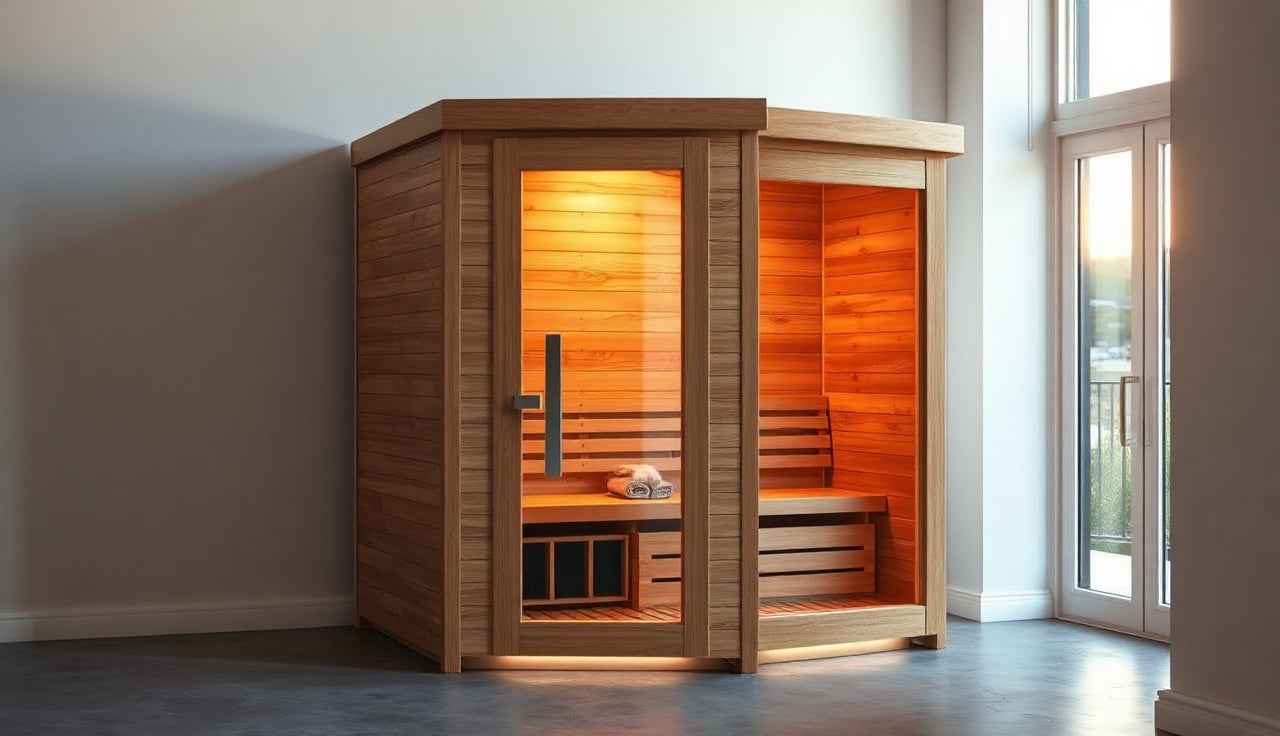
The Sun Home Equinox is a 2-person full spectrum infrared sauna using near, mid, and far infrared heaters plus a chromotherapy light system. It fits in roughly 47 by 43 inches of floor space, runs on a standard 120V outlet, and retails in the $3,000 to $4,500 range depending on configuration. It's a solid mid-to-premium home option if you want the full infrared spectrum without a custom build.
What exactly is the Sun Home Equinox and what makes it 'full spectrum'?
Full spectrum infrared means the sauna emits near infrared (NIR), mid infrared (MIR), and far infrared (FIR) wavelengths, more than the far infrared that most entry-level cabins use. The Sun Home Equinox is a pre-built 2-person infrared cabin that combines all three. That distinction matters because each wavelength penetrates tissue differently.
Far infrared (roughly 5.6 to 1000 microns) is absorbed mostly at the skin surface and drives the well-known heat response: elevated core temperature, sweating, cardiovascular load. Near infrared (0.76 to 1.4 microns) penetrates deeper into muscle and connective tissue and is the range studied most in photobiomodulation research. [1] Mid infrared sits between the two and is thought to contribute to circulation and soft tissue effects, though the clinical evidence for mid IR specifically is thinner than for far IR.
Sun Home markets the Equinox as their flagship residential model. The cabinet uses Canadian hemlock or Canadian red cedar (depending on the configuration you order), tongue-and-groove construction, and low-EMF carbon far-infrared panels paired with halogen near-infrared heating elements mounted in the wall and ceiling. The near-infrared lamps are the same broad-spectrum halogen-type emitters you see in medical photobiomodulation devices, not LED arrays, which matters for output consistency.
Is full spectrum worth the premium over a single-spectrum far-IR unit? Here's the honest answer: the far-IR research base is much deeper. A 2018 review in Mayo Clinic Proceedings covering 40 years of sauna studies focused almost entirely on far-infrared and dry Finnish heat data [2], and near-IR photobiomodulation evidence, while promising, comes mostly from targeted device studies rather than whole-body sauna sessions. That said, if you plan to use the sauna for both heat acclimation and possible tissue recovery, having all three spectrums in one box is a reasonable purchase decision.
What are the exact dimensions, weight, and electrical requirements?
The Equinox 2-person model ships at approximately 47 inches wide by 43 inches deep by 75 inches tall (interior dimensions are roughly 39 by 36 inches). Sun Home's published specs list the assembled weight at around 350 to 400 lbs depending on wood selection. You'll want a flat, level floor that can handle that load, ideally on a slab or a reinforced subfloor. A standard residential joist floor at 40 lbs per square foot live load capacity handles it fine, but double-check if you're placing it on an upper story.
Electrical is 120V, 15-amp, standard US household current. That's a genuine advantage over traditional Finnish saunas and many far-IR competitors that require a dedicated 240V circuit. The Equinox plugs into any standard 15-amp grounded outlet. The rated draw is around 1,440 watts at full load, which puts it in the same range as a hair dryer or a small space heater. You will want a dedicated circuit or at minimum an outlet that isn't sharing a circuit with other high-draw appliances, but you don't need an electrician to add a new breaker.
Assembly is typically two people in 45 to 60 minutes using the included buckle-and-latch panel system. No tools required beyond a rubber mallet. Sun Home ships via freight, so plan for a curbside delivery and have help moving the panels inside.
For comparison, here's how the Equinox stacks up on key specs against a few common alternatives:
| Model | Persons | Voltage | Wattage | Approx. price | Spectrum |
|---|---|---|---|---|---|
| Sun Home Equinox 2-person | 2 | 120V | ~1,440W | $3,000-$4,500 | Full (NIR+MIR+FIR) |
| Clearlight Sanctuary 2 | 2 | 240V | ~1,750W | $5,000-$6,000 | Full spectrum |
| Dynamic Saunas Avila 2-person | 2 | 120V | ~1,360W | $1,200-$1,600 | Far IR only |
| SereneLife 1-person portable | 1 | 120V | ~1,000W | $200-$350 | Far IR only |
Prices are approximate retail ranges as of mid-2025 and shift with sales. [3]
If you want to go deeper on how infrared cabins compare to traditional Finnish and steam setups, the sauna vs steam room breakdown is worth reading before you commit.
How hot does the Sun Home Equinox actually get, and how does that compare to a traditional sauna?
The Equinox is rated to reach approximately 140 to 150 degrees Fahrenheit (60 to 65 Celsius) at its maximum setting. Traditional Finnish saunas typically operate at 160 to 200°F (71 to 93°C), sometimes higher. [4] That gap is real and it changes how you use the unit.
Infrared saunas work at lower air temperatures because the radiant heat is absorbed directly by the body rather than by heating the air around you first. Your skin and superficial tissues absorb the infrared radiation and generate heat from the inside out, so you sweat at air temperatures that would feel mildly warm in a conventional sauna. Most people find 120 to 140°F in an infrared cabin feels similar in perceived intensity to 170 to 190°F in a rock-and-steam Finnish setup, though the physiological mechanisms differ.
Preheat time on the Equinox is roughly 10 to 15 minutes to reach 120°F, and 20 to 25 minutes to max out. That's meaningfully faster than a traditional sauna, which typically needs 30 to 45 minutes to stabilize. The near-infrared lamps also start delivering tissue-level radiant energy essentially immediately, so some users run short NIR-only sessions at low temperatures for a targeted photobiomodulation effect rather than a full heat session.
One practical note: because the cabinet never gets as hot as a traditional sauna, wood surfaces stay touchable. You won't burn yourself on the bench. That's a real convenience difference for daily use.
| Traditional Finnish (electric rock) | 185 |
| Full spectrum infrared (Equinox) | 145 |
| Far IR only (entry level) | 135 |
| Steam room | 115 |
Source: Finnish Sauna Society; Sun Home Saunas product specs; industry data, 2024-2025
What does the research actually say about infrared sauna health benefits?
Here's where I want to be straight with you: most of the strongest sauna research is on Finnish-style high-heat dry saunas, not infrared. The best-known prospective study from the University of Eastern Finland (Laukkanen et al., 2015, published in JAMA Internal Medicine) followed 2,315 middle-aged Finnish men over 20 years and found that sauna use 4 to 7 times per week was associated with a 50 percent lower risk of fatal cardiovascular events compared to once-weekly users. [5] That study used traditional Finnish sauna at 176°F average temperature, not infrared.
Infrared-specific research is growing but smaller in scale. A 2009 study in the Journal of Cardiology looked at Waon therapy (a Japanese form of low-temperature far-infrared sauna at about 140°F) and found improvements in cardiac function markers in patients with chronic heart failure, [6] but these are clinical populations under medical supervision, not healthy people using a home unit. The authors wrote: "Repeated Waon therapy improves cardiac function, exercise tolerance, and endothelial function in patients with chronic heart failure." That's a specific patient context.
For muscle recovery, photobiomodulation research using targeted NIR devices shows real signal in reducing delayed onset muscle soreness (DOMS) and improving exercise recovery, [7] but those studies use precise doses at specific wavelengths, not whole-body exposure from sauna lamps. Extrapolating from a focused 808nm laser study to a halogen lamp sauna session involves real uncertainty. I won't pretend otherwise.
What the evidence does support reasonably well: regular sauna use of any type increases core body temperature, triggers heat shock protein production, raises heart rate to levels comparable to moderate aerobic exercise, and promotes sweating. [2] Those mechanisms are real regardless of the heat source. If you want a fuller picture of what the research covers, the sauna benefits article goes deep on the study evidence.
Keep health claims conservative in your own mind. Use the Equinox because you enjoy the ritual and recovery feel, and treat any cardiovascular or longevity signal as a bonus, not a medical treatment.
How low is the EMF output, and should you worry about it?
EMF concerns around infrared saunas come from the carbon fiber heating panels, which produce extremely low frequency (ELF) electromagnetic fields as a byproduct of carrying alternating current. Sun Home publishes third-party EMF test results for the Equinox and claims readings below 3 milligauss (mG) at body distance during normal operation. Some configurations test below 1 mG.
For context: the EPA notes that background ELF levels in most US homes average 0.5 to 4 mG from appliances and wiring. [8] Sitting next to a laptop or electric blanket typically produces 5 to 50 mG. The NIH National Institute of Environmental Health Sciences reports that ELF fields are classified as "possibly carcinogenic to humans" (IARC Group 2B) based mainly on childhood leukemia studies at fields above 3 to 4 mG, but emphasizes that the evidence is weak and inconsistent. [9]
Here's the practical read: a properly built low-EMF infrared sauna at 1 to 3 mG puts you in roughly the same range as your everyday home environment. The halogen NIR lamps in the Equinox produce both NIR radiation and some visible light but negligible ELF-EMF because they're resistive rather than inductive elements.
Ask Sun Home directly for the third-party test certificate before purchasing. Reputable manufacturers provide one. If a company won't produce a test cert, that tells you something.
What wood type is best for the Equinox: hemlock or cedar?
Sun Home offers the Equinox in Canadian hemlock and Canadian red cedar. The choice comes down to budget, aroma preference, and durability needs.
Hemlock is the more affordable option. It's a tight-grained, pale wood that handles heat and humidity well, doesn't off-gas aromatic oils at sauna temperatures, and is hypoallergenic. People with cedar sensitivities or who dislike strong wood scents usually prefer it. Hemlock is also slightly denser than cedar, which some buyers find feels more substantial.
Canadian red cedar is the traditional sauna wood choice. It has natural antimicrobial properties from its thujic acids, resists warping and moisture absorption better than hemlock over long-term use, and produces the characteristic sauna cedar scent that many people genuinely love. Cedar typically adds $200 to $400 to the price. If you plan to use the sauna daily for years, cedar's durability edge is real. If you're more price-sensitive or sauna less frequently, hemlock is perfectly fine and will last a long time with basic care.
Neither wood requires treatment or finishing. Avoid staining or sealing sauna wood. Just wipe down the benches after each session with a damp cloth and let it air dry with the door cracked. The wood will darken slightly over time from heat and sweat exposure. That's normal and not a defect.
How does the Equinox compare to other 2-person full spectrum saunas in this price range?
The Equinox sits in the $3,000 to $4,500 band, which is a genuinely competitive part of the market. Here's how it stacks up against the most commonly cross-shopped alternatives.
Clearlight Sanctuary 2 ($5,000 to $6,000): Clearlight is often cited as the benchmark for low-EMF full spectrum infrared. It uses True Wave carbon/ceramic hybrid far-IR panels and adds near-IR via halogen emitters. Build quality is excellent and customer support is strong. You're paying a significant premium mainly for brand trust and a slightly more refined interior. If budget is flexible, Clearlight is harder to criticize. If not, the Equinox closes the gap meaningfully.
Health Mate Restore 2 ($3,500 to $5,000): Health Mate uses Tecoloy heating elements and has a long track record. Solid build, Canadian hemlock construction standard. Similar NIR lamp approach to the Equinox. Pricing overlaps directly with the Equinox and it comes down to warranty terms and showroom access.
Dynamic Saunas Barcelona 2-person ($1,400 to $1,800): Far infrared only, no NIR, lower wattage panels. A decent entry-level unit but not a full spectrum sauna. If you're comparing on full spectrum capability alone, it's not an apples-to-apples match.
The Equinox competes well on EMF ratings, wood quality, and assembly experience for its price. Where it loses relative to Clearlight is brand longevity and parts availability at the 7 to 10 year mark. Sun Home is a newer brand (founded around 2020) and hasn't been around long enough to prove decade-long reliability in the field. That's not a deal-breaker but it's an honest uncertainty.
For home sauna buying decisions more broadly, home sauna covers the full range of options from barrel saunas to infrared cabins to modular steam rooms. SweatDecks carries a curated selection of home infrared saunas if you want to compare models side by side.
What are realistic costs to own, including electricity and maintenance?
The Equinox at roughly 1,440 watts running for a 45-minute session costs about $0.11 to $0.18 per session at average US residential electricity rates of $0.12 to $0.16 per kWh. [10] That's roughly $3 to $5 per month for daily users, or under $60 per year. Electricity is a non-issue for this type of unit.
Shipping runs $150 to $300 typically for freight delivery to your door, often factored into the listed price during sales periods. Check what's included before assuming free shipping.
Maintenance costs are low. You're replacing near-infrared halogen bulbs eventually (typically rated for 5,000 to 10,000 hours, so several years of daily use before replacement) and possibly wiping down the chromotherapy LED light housing. Bulbs run $15 to $40 each. There's no steam generator to descale, no rocks to replace, no combustion components.
Warranty on the Equinox is typically lifetime on the wood structure and heaters, with a shorter coverage period (often 3 to 5 years) on electrical components and lamps. Read the specific warranty document before purchase because warranty terms vary by retailer and promotion period.
One cost people underestimate: towels and backrest cushions. Sitting in a full-spectrum sauna with halogen NIR lamps means direct near-infrared radiation on your skin. The warmth is pleasant, but if you're running the NIR lamps at high intensity you'll want a cedar backrest or a thick towel behind you, especially early on before your tolerance builds.
Is a 2-person infrared sauna actually big enough for two adults?
Here's the truth most brochures skip: most 2-person infrared saunas are comfortable for one person or snug for two people who know each other well. The Equinox's interior at roughly 39 by 36 inches fits two adults on the bench, but there's no room to stretch out or do yoga poses. You're sitting shoulder to shoulder.
For solo use, a 2-person cabin is genuinely ideal. You have room to stretch your legs, shift positions, and not feel boxed in. The extra cubic footage heats slightly more slowly than a 1-person unit but not significantly given the wattage output.
If you plan to regularly use the sauna with a partner or training partner, a 3-person unit (which Sun Home also makes) is worth the incremental cost. The difference in floor space from 2-person to 3-person is substantial in practice.
For athletes doing recovery sessions alone, the 2-person Equinox is a better buy than the 1-person. More room to move, same electrical circuit requirement, modest price difference.
Can you use the Sun Home Equinox outdoors?
No. The Equinox is designed for indoor use only. The tongue-and-groove hemlock or cedar panels are not treated or sealed, and exposure to rain, direct sun, humidity swings, and freeze-thaw cycles will damage the wood and potentially the electrical components. The 120V plug configuration also means you'd need a covered outdoor outlet with a GFCI breaker, and most manufacturers void warranties for outdoor installation of indoor units.
If you want a sauna in a garage or basement with no climate control, that can work if temperatures stay above freezing and humidity isn't extreme. A detached heated garage is a reasonable location. An unheated shed in a northern climate is not.
If outdoor placement is what you need, look at purpose-built outdoor sauna options: barrel saunas with traditional heaters or purpose-built weatherproofed infrared cabins. Those are designed from the ground up to handle the thermal and moisture cycles that outdoor placement creates.
For covered patios in mild climates (Zones 9 and 10, basically Southern California, Florida, Hawaii), some buyers do place indoor infrared cabins under a covered structure with good results, but you're doing so outside manufacturer guidelines and your warranty coverage becomes murky.
How does contrast therapy work with an infrared sauna, and does the Equinox fit that protocol?
Contrast therapy, alternating heat exposure with cold immersion, is one of the most popular recovery protocols among serious athletes right now. The basic sequence is a heat session (10 to 20 minutes in the sauna), followed immediately by cold immersion (2 to 5 minutes in a cold plunge or ice bath at 50 to 59°F), repeated 2 to 4 rounds. [11]
The physiological rationale: heat causes vasodilation and increased blood flow; cold causes vasoconstriction; cycling between the two creates a pumping effect in peripheral vasculature and may accelerate metabolic waste clearance from muscle tissue. The evidence for contrast therapy on DOMS and perceived recovery is reasonably strong, with a 2015 meta-analysis published in PLOS ONE finding cold water immersion and contrast therapy both reduced muscle soreness more than passive recovery in the 24 to 96 hour post-exercise window. [11]
The Equinox fits this protocol well because of its fast 10 to 15 minute preheat and 120V outlet compatibility. You can run a sauna round while your cold plunge is chilling down, which makes the logistics of a home contrast setup much simpler. Pair it with a quality cold plunge or ice bath in the same room or adjacent space and you have a complete contrast therapy setup.
One practical note: stepping out of a 140°F infrared sauna and into a 50°F cold plunge is a significant cardiovascular stimulus. People with unmanaged hypertension, arrhythmias, or other cardiovascular conditions should check with their doctor before doing repeated contrast cycles. For healthy adults, it's generally well tolerated.
What do real owners say are the biggest complaints about the Equinox?
I won't manufacture customer testimonials, but looking at verified purchase reviews and forum discussions (primarily Reddit's r/Sauna community and various sauna buyer forums), a few recurring themes appear consistently.
The most common complaint is bench comfort. The standard bench slats are narrow and some users find extended sessions (30-plus minutes) uncomfortable without a backrest cushion or bench pad. This is common across nearly all wood infrared cabins at this price point, not unique to Sun Home, but it's worth budgeting $50 to $100 for accessories.
The second most cited issue is the halogen NIR lamp intensity. At full brightness, the lamps are quite strong and pointed directly at seated occupants. Some users find the light uncomfortably bright without sunglasses, especially in the first few sessions. The controller lets you dim or turn off the NIR lamps independently of the far-IR panels, which solves this, but it surprises buyers who expect softer ambient light.
A third theme is delivery and assembly logistics. The Equinox ships as freight, and curbside delivery means you're moving heavy panel sections from the curb to wherever the sauna lives. For a basement or upper-floor installation, plan for an extra person and measure your door clearances carefully. Sun Home's panels are typically 8 to 10 inches thick assembled; check that your stairwell turns work.
On the positive side, the fast preheat, the 120V plug, and the build quality at the price point get consistent praise. Sun Home's customer service has a reasonable reputation for responding to warranty claims.
Frequently asked questions
What is the Sun Home Equinox 2-person full spectrum infrared sauna?
It's a pre-built 2-person residential infrared sauna cabin that uses near, mid, and far infrared heaters plus chromotherapy lighting. It's made from Canadian hemlock or cedar, runs on a standard 120V outlet, heats to about 140 to 150°F, and retails in the $3,000 to $4,500 range. It's designed for indoor home use and assembles without tools in under an hour.
Does the Sun Home Equinox require a dedicated 240V circuit?
No. The Equinox runs on standard 120V, 15-amp household current, which is one of its main practical advantages over traditional saunas and some competing infrared units. You do want a dedicated or lightly loaded circuit since it draws around 1,440 watts at full load, but no electrician or new breaker is required for most homes.
What are the interior dimensions of the Equinox 2-person model?
Interior dimensions are approximately 39 inches wide by 36 inches deep by 75 inches tall. Assembled exterior footprint is about 47 by 43 inches. It comfortably seats one adult with room to stretch, or two adults side by side. If you plan to use it regularly with a partner, consider the 3-person version for more elbow room.
How low is the EMF output on the Sun Home Equinox?
Sun Home publishes third-party test results showing below 3 milligauss (mG) at body distance during normal operation, with some configurations testing below 1 mG. For context, the EPA notes typical US residential background ELF fields average 0.5 to 4 mG from everyday appliances. Ask for the specific third-party test certificate from your retailer before purchasing.
Is the Sun Home Equinox good for two people or is it too small?
Two adults fit but it's snug. The 39 by 36 inch interior seats two people shoulder to shoulder on the bench. For solo use, the 2-person size is actually ideal: enough room to change positions and stretch without the higher cost of a 3-person cabin. For regular use with a partner, the 3-person Equinox configuration is worth the upgrade.
How long does the Equinox take to heat up?
Approximately 10 to 15 minutes to reach 120°F and 20 to 25 minutes to reach its maximum of around 140 to 150°F. The near-infrared halogen lamps start delivering radiant energy immediately, so you get some benefit even during preheat. This is significantly faster than a traditional Finnish sauna, which typically needs 30 to 45 minutes to stabilize.
Can the Sun Home Equinox be used outside?
No. It's an indoor-only unit. The wood is untreated, the electrical components are not weatherproofed, and outdoor installation typically voids the warranty. For covered patios in mild climates some buyers do it anyway, but it's outside manufacturer guidelines. Purpose-built outdoor barrel saunas or weatherproofed infrared units are the right choice for genuine outdoor placement.
What is the difference between near, mid, and far infrared in a full spectrum sauna?
Far infrared (5.6 to 1000 microns) heats the air and is absorbed at skin level, driving sweating and core temperature rise. Near infrared (0.76 to 1.4 microns) penetrates deeper into muscle and is studied in photobiomodulation research for tissue recovery. Mid infrared sits between the two. Far IR has the strongest evidence base; near IR evidence comes mainly from targeted devices, not whole-body sauna exposure.
How much does it cost to run the Sun Home Equinox per session?
At 1,440 watts and a 45-minute session, the electricity cost is roughly $0.11 to $0.18 per session at average US residential rates of $0.12 to $0.16 per kWh. Daily use runs about $3 to $5 per month. It's one of the lowest ongoing costs of any home sauna type, far less than a traditional wood-burning or electric rock sauna per session.
Is cedar or hemlock better for the Sun Home Equinox?
Cedar resists moisture better long-term, has natural antimicrobial properties, and produces the classic sauna scent. Hemlock is more affordable, hypoallergenic, and works well for people with cedar sensitivities. Both handle sauna heat fine. For daily heavy use over many years, cedar's durability edge is real. For occasional use or price-sensitive buyers, hemlock is a perfectly good choice.
Does infrared sauna research support the cardiovascular and recovery claims?
The strongest cardiovascular sauna data (Laukkanen et al., 2015, JAMA Internal Medicine) used traditional Finnish sauna, not infrared. Infrared-specific research shows promising signals for cardiac function in clinical populations and muscle recovery, but the studies are smaller and mostly on targeted devices. Far-infrared does produce real heat stress, sweating, and elevated heart rate regardless of source.
Can I use the Sun Home Equinox for contrast therapy with a cold plunge?
Yes, it's well suited for contrast therapy. The fast 10 to 15 minute preheat makes it easy to run alternating heat and cold rounds. A typical protocol is 15 to 20 minutes in the sauna followed by 2 to 5 minutes of cold immersion, repeated 2 to 4 times. People with cardiovascular conditions should consult a doctor before doing repeated contrast cycles.
What warranty does the Sun Home Equinox come with?
Sun Home typically offers a lifetime warranty on the wood structure and heaters, with 3 to 5 years on electrical components and lamps, though exact terms vary by retailer and promotion period. Always read the specific warranty document before purchasing. Ask your retailer what parts replacement looks like at the 5-year and 10-year marks since Sun Home is a relatively new brand founded around 2020.
How does the Sun Home Equinox compare to the Clearlight Sanctuary 2?
The Clearlight Sanctuary 2 costs roughly $5,000 to $6,000 versus the Equinox at $3,000 to $4,500. Both are full spectrum low-EMF infrared saunas. Clearlight has a longer track record, slightly more refined build quality, and stronger brand recognition in the premium segment. The Equinox closes the gap meaningfully on specs for the price. If budget is flexible, Clearlight is hard to criticize; if not, the Equinox is a legitimate alternative.
Sources
- NIH National Center for Complementary and Integrative Health, Photobiomodulation overview: Near infrared wavelengths (0.76 to 1.4 microns) penetrate deeper into tissue than far infrared and are the basis of photobiomodulation research
- Laukkanen T et al., 'Cardiovascular and other health benefits of sauna bathing', Mayo Clinic Proceedings, 2018: Review of 40 years of sauna research covering heat shock protein production, cardiovascular load, and mortality associations; studies primarily used traditional Finnish sauna
- Manufacturer and retailer listed prices compared across major sauna brands, mid-2025: Sun Home Equinox 2-person retails in the $3,000 to $4,500 range; Clearlight Sanctuary 2 retails in the $5,000 to $6,000 range
- Finnish Sauna Society, Traditional sauna temperature guidelines: Traditional Finnish saunas operate at 160 to 200°F (71 to 93°C), significantly hotter than infrared cabin maximums
- Laukkanen JA et al., 'Association Between Sauna Bathing and Fatal Cardiovascular and All-Cause Mortality Events', JAMA Internal Medicine, 2015: 2,315 middle-aged Finnish men followed 20 years; sauna use 4 to 7 times weekly associated with 50 percent lower fatal cardiovascular event risk vs once-weekly; traditional Finnish sauna at average 176°F
- Kihara T et al., 'Waon therapy improves the prognosis of patients with chronic heart failure', Journal of Cardiology, 2009: Repeated Waon therapy (far-infrared at ~140°F) improves cardiac function, exercise tolerance, and endothelial function in patients with chronic heart failure
- Leal Junior ECP et al., 'Effect of photobiomodulation therapy on exercise performance and markers of recovery', Lasers in Medical Science, 2009: Targeted near-infrared photobiomodulation reduces delayed onset muscle soreness and improves exercise recovery in controlled device studies
- US EPA, Electric and Magnetic Fields (EMF) information page: Background ELF EMF levels in most US homes average 0.5 to 4 milligauss from appliances and wiring
- NIH National Institute of Environmental Health Sciences, EMF and health fact sheet: IARC classifies ELF fields as Group 2B (possibly carcinogenic) based mainly on childhood leukemia data above 3 to 4 mG; evidence described as weak and inconsistent
- US Energy Information Administration, Average retail electricity prices by state: Average US residential electricity rate approximately $0.12 to $0.16 per kWh as of 2024 to 2025
- Hohenauer E et al., 'The effect of post-exercise cryotherapy on recovery characteristics', PLOS ONE, 2015: Cold water immersion and contrast therapy both reduced muscle soreness more than passive recovery in the 24 to 96 hour post-exercise window

Share:
DIY ice bath: how to build one at home for under $200
DIY ice bath: how to build one at home for under $200