
Last updated 2026-07-09
TL;DR
A barrel sauna is a cylindrical cedar or spruce sauna that heats faster than a box sauna because its rounded ceiling cuts dead air volume. Expect $2,000 to $10,000 for a quality unit, plus $500 to $2,000 for installation and electrical. They handle year-round outdoor use and last 15 to 25 years with basic maintenance.
What exactly is a barrel sauna?
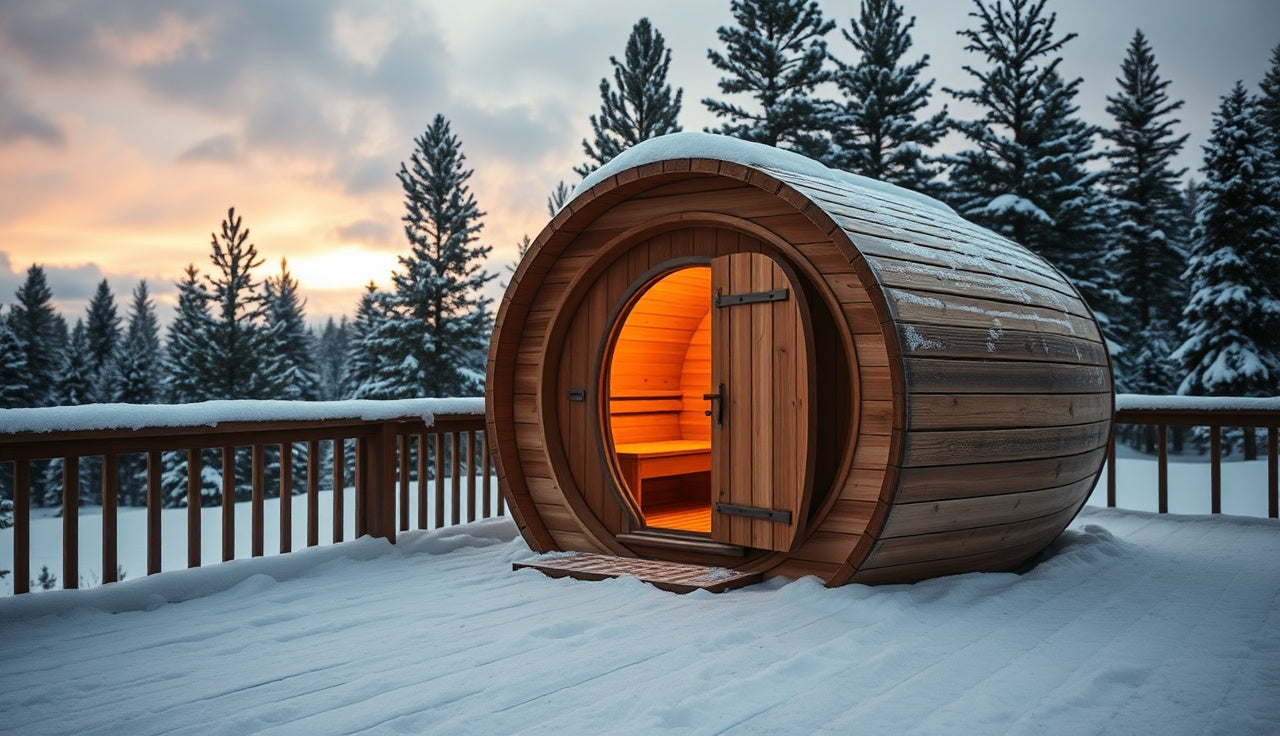
A barrel sauna is a cylindrical sauna built from wood staves, the same construction used to make wine barrels. Metal bands under tension hold the planks together, and the whole structure sits horizontally on cradle supports. No framing. No flat walls. Just a round room.
The shape is the whole point. A box sauna has flat walls and a flat ceiling, so a layer of air sits near the top of the room doing nothing. A barrel's curved ceiling pushes that dead air volume down toward the benches and the people using them. The effective heated space is smaller, so the stove hits target temperature faster and burns less energy getting there.
Barrel saunas are almost always outdoor units. The round design sheds rain and snow, and the exposed wood weathers in a way that looks intentional rather than neglected. You'll see them in backyards, on decks, beside lakes, and at ski lodges. Few sauna formats look this good outside.
The most common wood is Western red cedar. It resists rot naturally, it's low-density (so it doesn't soak up heat), and it smells mild and pleasant when hot. Nordic spruce and hemlock show up in budget and mid-range models. Some premium Finnish brands use thermowood, kiln-treated to improve durability and stability. Each choice changes price, longevity, and smell.
How much does a barrel sauna cost?
Barrel sauna prices run from about $2,000 on the low end to $15,000 or more for large, premium Finnish-made units. Most of the market sits between $3,500 and $8,000 for a 2-to-4-person outdoor unit with a decent wood-burning or electric stove included.
Here's roughly how the tiers break down:
| Tier | Price Range | What you typically get |
|---|---|---|
| Budget | $2,000-$3,500 | Hemlock or pine, thin staves, basic stove, DIY assembly |
| Mid-range | $3,500-$6,500 | Cedar or Nordic spruce, thicker staves (1.5"), decent stove, hardware included |
| Premium | $6,500-$10,000 | Thick cedar or thermowood, quality Finnish stove, longer warranty |
| High-end/custom | $10,000+ | Custom sizing, premium Finnish brands, thicker insulation, professional finish |
The unit is only part of the bill. An electrician charges $300 to $800 to run a dedicated 240V circuit for an electric stove, and that assumes your panel has room. If you need a panel upgrade, add $1,000 to $3,000. A gravel or concrete pad for the cradles runs $200 to $600 if you don't already have a stable surface. Delivery for a larger barrel can cost $150 to $400 depending on distance.
Wood-burning models skip the electrical cost but need a fire permit in many places, plus wood (roughly $150 to $400 per cord depending on region). They also demand more clearance from structures.
Compared to other home sauna formats, barrels tend to cost less than a prefab indoor cabin sauna of similar capacity, and much less than a custom-built indoor room. The trade-off is you're committing it to one outdoor spot.
How long does a barrel sauna take to heat up?
Most barrel saunas reach 150 to 185 degrees F (65 to 85 C) in 20 to 40 minutes, depending on stove power, outdoor temperature, and barrel size. That beats most equivalent box saunas, which often need 45 to 60 minutes.
The reason is geometry. A 6-foot diameter barrel that's 7 feet long holds roughly 197 cubic feet of air. A box sauna with the same floor area but an 84-inch ceiling holds more dead air up top that takes time and energy to heat. The barrel's curved ceiling keeps hot air circulating close to the benches where you want it.
A 6kW electric stove is the practical minimum for a 2-person barrel. An 8kW or 9kW unit is better for a 4-person barrel, especially in cold climates. Manufacturers sometimes underspec the included stove to keep the price competitive, so check the stove's rated cubic footage against your actual barrel volume before you buy.
In genuinely cold climates (below 20 degrees F / -6 C), heat-up times stretch to 45 to 60 minutes even with a properly sized stove. Stave thickness helps here. Barrels with 1.75-inch or 2-inch staves hold heat noticeably better than the 1.5-inch staves common in budget models.
For a broader look at how saunas work and what temperatures to expect, the sauna overview is worth reading before you settle on a format.
| Budget (hemlock/pine, basic stove) | $2,750 |
| Mid-range (cedar, decent stove) | $5,000 |
| Premium (cedar/thermowood, Finnish stove) | $8,250 |
| High-end/custom | $12,500 |
Source: SweatDecks market survey of major North American barrel sauna retailers, 2025
What are the health benefits of using a barrel sauna?
The sauna research is real, and it's grown a lot in the last decade, though almost all of it was done in traditional Finnish saunas rather than barrels specifically. The physical experience is close enough that the findings likely carry over.
The strongest evidence is cardiovascular. A 2018 review in Mayo Clinic Proceedings, drawing on the long-running Finnish cohort of 2,315 middle-aged men, reported that frequent sauna use (4 to 7 times per week) tracked with a roughly 50% lower risk of fatal cardiovascular disease compared with once-weekly use [1]. That same review put the physiology plainly: sauna bathing produces "hemodynamic changes similar to moderate- to vigorous-intensity physical exercise" [1].
There's also reasonable evidence for heat adaptation, post-exercise recovery, and less muscle soreness after hard training [2]. Studies on growth hormone show acute spikes after sauna sessions, though the long-term meaning of that spike isn't settled.
For mental health, the data leans observational rather than mechanistic. Regular sauna users report lower rates of depression and anxiety in population studies, but it's hard to isolate whether the sauna is doing the work or whether healthier, more socially connected people simply use saunas more.
Blood pressure deserves care. In healthy people, blood pressure drops during a session and normalizes after. In people with uncontrolled hypertension or serious heart disease, the cardiovascular stress from heat can be dangerous. The Finnish Sauna Society and most cardiologists say to talk to your doctor before starting regular sauna use if you have any cardiac history [3].
The fuller picture on sauna benefits is covered elsewhere, including the exact temperatures and durations used in the research protocols.
How does a barrel sauna compare to a traditional box sauna?
The core differences come down to shape, placement, and heating behavior. Everything else is secondary.
A box sauna has vertical flat walls and a horizontal ceiling. That shape is easier to insulate and better for indoor installs where you're building it into a room. Flat walls also make it simpler to add benches in different layouts and to wire lighting and controls into the framing. If your priority is an indoor sauna that blends into a basement or spare room, a cabin-style sauna wins on flexibility.
A barrel sauna is built for outdoors. The round shape drains itself, sits low, and holds its own weight without a floor frame. It heats faster per unit of energy, which matters if you're using it four or five times a week and paying the electric bill. Assembly is DIY-friendly for most adults: the stave-and-hoop build goes together with basic tools in 4 to 8 hours for a standard two-person unit.
Where barrels lose is interior space. A 6-foot diameter barrel sounds roomy until you're inside with two other adults and the curved walls eat bench space at both ends. A 7-foot diameter or longer unit fixes most of that. The round floor is also an awkward shape. Changing clothes, stretching, or lying down feels tighter than in a box sauna of similar footprint.
On longevity, the two formats are comparable when the wood is quality cedar or thermowood and the stove is maintained. Budget barrels with thin staves and untreated softwood can crack or warp within 5 to 7 years in harsh climates. Quality units genuinely last 15 to 25 years.
Still deciding? Comparing a sauna vs steam room or looking at outdoor sauna options more broadly can help narrow the field.
What size barrel sauna do I need?
Barrel saunas come in three standard diameters: 4 feet, 5 feet, and 6 feet (7 feet for custom or commercial units). Length is the other variable, usually 6 feet to 10 feet or more in 2-foot increments.
For most buyers, 6 feet in diameter and 7 to 8 feet in length is the sweet spot. That fits two adults comfortably lying down, three sitting, and gives the stove enough room to work without the space feeling cavernous and slow to heat.
A 4-foot diameter barrel is cramped for anyone over 5'8". It works as a solo unit in a small yard, but two adults will feel it. The 5-foot diameter adds real usability, especially if you want to stretch or lie on the lower bench.
Length matters mostly for the bench layout. Longer barrels allow a full-length lower bench running end to end, which is a genuine luxury. Shorter barrels use L-shaped or opposing bench setups that feel pinched.
For families of 3 to 4 or anyone who expects social sessions, a 6-foot diameter barrel at 8 to 9 feet long is the right call. The stove scales with the space: roughly 1kW per 45 to 50 cubic feet is a workable rule of thumb, though ratings vary by brand.
If outdoor space is tight, a portable sauna is worth considering before you commit to a permanent barrel install.
What kind of stove does a barrel sauna use?
Barrel saunas run on either an electric stove (kiuas in Finnish) or a wood-burning stove. Each has real advantages and real drawbacks, and the right one depends on your situation more than your preference.
Electric stoves are easier. You set a temperature, you get that temperature. They work with smartphone timers and remote controls, so you can preheat the sauna before you get home from the gym. Installation is a one-time cost: a dedicated 240V circuit. Electric stoves are allowed in nearly any jurisdiction without special permits. The main downside is running cost. A 6kW stove running for an hour costs roughly $0.60 to $1.20 depending on your local rate (the national average was about $0.163 per kWh in early 2025, per the U.S. Energy Information Administration [4]).
Wood-burning stoves feel different. The heat has more variation, more life to it. You can do proper loyly, the Finnish practice of throwing water on hot stones for steam, with more dramatic effect because the stones get hotter. Building a fire is a ritual many people love. The downsides are real: you need dry firewood on hand, you start 45 to 60 minutes before you want to use it, you manage ash and cleaning, and you check local fire codes. Some municipalities and HOAs ban wood-burning outdoor appliances outright.
For rural or semi-rural buyers with easy access to firewood, a wood-burning stove in a barrel is a great setup. For urban and suburban buyers, electric almost always makes more sense.
A third option, less common but worth knowing, is a wood-burning stove with an exterior firebox. You feed wood from outside the barrel while you're sitting inside, which keeps the mess and smoke out of the sauna.
How do I install and set up a barrel sauna?
Most barrel saunas ship as a kit built for DIY assembly. The job takes one or two adults 4 to 8 hours, assuming the site is prepped.
Site prep is the step people underestimate. The barrel needs a level surface. It doesn't need a concrete slab (though that works well), but it does need something stable: compacted gravel, concrete piers, a deck, or pressure-treated sleepers. The cradles that hold the barrel off the ground have to sit level, or the whole thing twists over time and stresses the stave joints.
Assembly itself is straightforward. Staves interlock like a tongue-and-groove floor. You build them around the circular end pieces, then tighten the metal bands that hold everything under tension. The bands are the step that matters: too loose and you get gaps, too tight and you crack staves. Most kits include a torque spec. After that, the benches bolt together, the stove goes in, and the chimney or electrical connection is the last step.
For electric stoves, you need a licensed electrician. This is not optional and not a DIY job. A dedicated 240V, 40 to 60 amp circuit is required for most 6 to 9kW stoves, and your panel needs the capacity. Budget $300 to $800 for the electrician, more if conduit has to run a long way from the panel.
For wood-burning stoves, the chimney pipe exits through the barrel roof via a heat-rated thimble. Check your local building department for setbacks: most jurisdictions require wood-burning appliances to sit 10 to 25 feet from any structure, but it varies.
Ground clearance drives longevity. Sitting directly on soil traps moisture against the bottom staves. Cradles that lift the barrel 4 to 6 inches off the ground allow airflow and add years to the wood.
How do I maintain and protect a barrel sauna?
A barrel sauna with minimal care lasts 15 to 25 years. A neglected one shows cracks and blackened wood in 5 to 7 years. The maintenance isn't complicated, but it has to be consistent.
The exterior is the main concern. Raw cedar weathers to a gray patina that many people find attractive, but without sealant it eventually turns porous and lets moisture in. An exterior wood sealant or UV-protective oil once every 1 to 2 years keeps the wood from drying out and cracking. Products made for cedar or outdoor furniture work fine. Avoid film-forming finishes like polyurethane on the interior, which off-gas when heated.
The interior should not be sealed or stained. The wood needs to breathe. Wipe down benches after sessions with a damp cloth to clear sweat, and leave the door cracked after use so moisture escapes. Mold rarely develops in a well-ventilated barrel because the heat is intense enough to prevent it, but it can appear if you seal the sauna airtight while it's wet.
The stove needs seasonal attention. For wood-burning stoves, clear ash after every few uses and inspect the flue pipe annually for creosote. For electric stoves, wipe down the stones (kiuas rocks) now and then and check the element for scaling, especially if you use mineral-heavy water for loyly.
The metal bands holding the staves need a check once a year. They loosen as the wood expands and contracts through the seasons. Most have a tightening nut or bolt that takes two minutes to adjust. Catch it early and you avoid gaps; miss it and water works into the joints.
A breathable outdoor cover during long stretches of non-use (a month or more) adds real protection without trapping moisture the way an airtight cover would.
Can I pair a barrel sauna with a cold plunge?
Yes, and it's one of the better home wellness setups you can build. Heat plus cold, often called contrast therapy, is used widely by athletes and increasingly by general wellness users. The barrel handles the heat side; the cold is a separate piece of equipment.
The basic protocol is simple. Spend 10 to 20 minutes in the sauna, get straight into cold water (50 to 60 degrees F / 10 to 15 C is the common target), stay 1 to 3 minutes, then rest or head back to the sauna. Repeat the cycle 2 to 4 times a session. This is standard in Nordic wellness culture and forms the basis for most contrast therapy research.
A dedicated cold plunge unit beats a cold shower or garden hose by a wide margin. A quality home plunge holds temperature on its own and fits full immersion, which drives a stronger physiological response than a cold shower at the same temperature. Whole-body cold immersion triggers a more complete cold shock response, including a bigger release of norepinephrine [5].
For a backyard, a barrel sauna within 10 to 20 feet of a cold plunge is ideal. You want the transition fast so your body doesn't warm back up on the walk. Setting both on the same deck or patio keeps the logistics clean.
If cold therapy interests you on its own, the ice bath and cold plunge benefits articles cover the research in more depth.
SweatDecks carries outdoor barrel saunas alongside cold plunge units because the contrast pairing is what most buyers are actually building toward.
Are there any safety or code requirements for barrel saunas?
Barrel saunas sit in a regulatory gray zone in most U.S. jurisdictions. The short answer: check with your local building department before you buy.
Most municipalities classify a barrel sauna as an accessory structure. If it's permanent (connected to electrical, on a foundation, or over a certain size), it usually needs a building permit. Size thresholds vary: some jurisdictions exempt structures under 120 square feet, others under 200, others require permits regardless. A barrel's footprint is typically 30 to 60 square feet, which often falls below permit thresholds, but the electrical connection can trigger a separate permit.
HOA rules are a different issue from municipal codes. Many HOAs restrict outdoor structures, accessory buildings, or wood-burning appliances. Read your covenants before you spend money.
Electrical safety is non-negotiable. The National Electrical Code (NFPA 70) Article 422 governs fixed electric appliances including sauna heaters, and any wet or outdoor location requires GFCI protection [6]. A licensed electrician who knows outdoor appliance installs is the right person for this work.
For wood-burning stoves, NFPA 211 covers chimney, fireplace, and venting systems and sets clearance requirements and installation standards [7]. Many local fire codes adopt NFPA 211 directly or with tweaks. The standard clearance from combustible structures is typically 36 inches, but verify locally.
Property insurance is worth a call to your agent. Most homeowner policies cover permanent structures on your property, but some insurers exclude saunas or require a rider. A sauna may nudge your premium up, though it typically also adds assessed value.
On the health-safety side, the American College of Cardiology says sauna use in healthy people is generally safe, but recommends skipping alcohol before or during sessions and keeping sessions to 5 to 20 minutes at temperatures above 170 degrees F (77 C) [8].
What are the best barrel sauna brands worth knowing?
This isn't an exhaustive ranking, but knowing the major players helps you read the market and spot which budget units cut corners.
Finnish and Scandinavian brands carry the most credibility by history. Helo and Harvia are the two dominant Finnish stove makers, and their stoves show up in many higher-end barrel kits even when the barrel itself comes from somewhere else. A barrel with a Helo or Harvia stove is usually a decent signal on the heating component.
Dutch Tub and Kirami are European brands with premium materials and pricing to match. You're paying for thermowood barrels, thicker staves, and better-documented manufacturing. These units run $6,000 to $12,000-plus in the U.S. market.
North American brands like Almost Heaven, Dundalk Leisurecraft, and Canadian Timber Collection dominate the $2,500 to $6,000 middle market. Quality varies by model within each brand. Almost Heaven and Dundalk have the widest distribution and the most third-party reviews to cross-reference. Solid mid-range products, not premium, but not junk.
Budget units from lesser-known importers turn up on Amazon and big-box sites in the $1,500 to $2,500 range. Some are fine for occasional use in mild climates. The risk is thin staves (sometimes 1.25 inches), weak metal bands, and undersized stoves paired with oversized barrels. If the stove that ships with a 6-person barrel is rated at 4.5kW, that's a red flag.
One thing to check regardless of brand: the warranty on the wood versus the warranty on the stove. Good manufacturers separate the two because wood failures and electrical or mechanical failures are different animals. A 1-year warranty on everything is a budget signal. Better brands offer 5 years on the barrel structure.
Is a barrel sauna worth the money for a home buyer?
For most buyers who'll actually use it regularly, yes. The math works out better than people expect.
A quality mid-range barrel at $5,000 installed, used four times a week, costs roughly $22 per use amortized over five years (ignoring operating cost). Gym or spa sauna memberships run $30 to $100 per month, and you're sharing equipment and working around their hours. Owning the sauna also kills per-session friction, which matters more than it sounds: research on behavior change consistently shows proximity and convenience are the biggest predictors of whether a habit sticks.
Resale value is real but modest. A well-maintained outdoor sauna adds to property value, especially in markets where outdoor living carries weight. Real estate agents in Nordic-influenced markets (Minnesota, Michigan, the Pacific Northwest) treat saunas as a positive selling point. Hard data is thin here. The closest credible source is the National Association of Realtors, which surveys home feature preferences but doesn't publish sauna-specific appreciation numbers [9].
The case weakens for buyers who travel constantly, live where outdoor use is limited to 4 or 5 months, or aren't sure they'll use it more than once a week. A $5,000 purchase used twice a month for two years before interest fades is an expensive mistake.
Genuinely undecided? A portable sauna at $300 to $700 is a low-commitment way to test whether you'll build the habit before you commit to a permanent barrel.
For buyers who've already decided on outdoor heat therapy and want something that looks good, heats fast, and lasts decades with reasonable care, a barrel sauna is one of the cleaner home wellness buys out there. SweatDecks carries a curated range of barrel saunas and cold plunge units if you want to compare specific models side by side.
Frequently asked questions
How long does a barrel sauna last?
A quality cedar or thermowood barrel sauna lasts 15 to 25 years with basic maintenance: annual exterior sealing, keeping the metal bands tight, and setting the unit on cradles that allow airflow underneath. Budget barrels with thin staves and untreated softwood can deteriorate in 5 to 7 years in wet or freeze-thaw climates. The stove usually outlasts the barrel if properly maintained.
How much electricity does a barrel sauna use?
A 6kW electric stove running one hour uses 6 kWh. At the U.S. average rate of $0.163 per kWh (U.S. Energy Information Administration, 2025), that's about $0.98 per session. A larger 9kW stove costs around $1.47 per hour. Monthly cost for four sessions a week runs $15 to $25 for most users, depending on stove size and local rates.
Can a barrel sauna stay outside year-round?
Yes. Cedar and thermowood barrel saunas are built for year-round outdoor exposure, and the curved shape sheds snow load naturally. In climates with hard freezes, leave the drain open so trapped water doesn't expand and crack the wood. Some owners put a breathable cover over the barrel during stretches of non-use in deep winter, which cuts UV exposure and extends the exterior finish.
Do I need a permit for a barrel sauna?
Probably, but it depends on your municipality. Most jurisdictions treat permanent saunas as accessory structures needing a building permit, especially once they're connected to electrical. Some exempt structures under 120 to 200 square feet. The electrical connection almost always requires a separate electrical permit pulled by a licensed electrician. Check with your local building department and, if it applies, your HOA before purchasing.
What temperature should a barrel sauna reach?
Most barrel saunas target 150 to 195 degrees F (65 to 90 C) at bench level. Traditional Finnish culture uses the high end, around 176 to 194 degrees F (80 to 90 C). Most of the cardiovascular research ran at temperatures in this range. For beginners, starting at 150 to 160 degrees F and working up is more comfortable and still drives meaningful physiological responses.
How many people fit in a barrel sauna?
A 4-foot diameter barrel fits one adult comfortably. A 5-foot diameter fits two. A 6-foot diameter fits two adults lying down or three to four sitting. Length matters too: longer barrels allow full-length bench setups that seat more people. For regular family use with 3 to 4 people, a 6-foot diameter barrel at 8 to 9 feet long is the practical minimum.
What's the difference between cedar and spruce for barrel saunas?
Western red cedar resists rot naturally, weighs less, and holds its shape through humidity swings better than spruce. It smells pleasant when heated. Nordic spruce is denser and less aromatic. It's a fine wood but more prone to moisture damage over time without treatment. Cedar costs more but earns it for outdoor use, where the wood cycles through wet and dry seasons over and over.
Can I use a barrel sauna if I have high blood pressure?
Sauna use causes a temporary blood pressure drop during the session, followed by normalization after. In healthy people this is generally safe. In people with uncontrolled hypertension or significant cardiac disease, the cardiovascular stress from heat carries real risk. The American College of Cardiology recommends consulting your physician before starting regular sauna use if you have any cardiac history. Never use a sauna after drinking alcohol.
What's the best way to set up a barrel sauna on a deck?
The deck has to carry the weight: a fully assembled 6-foot diameter, 8-foot long cedar barrel with a stove weighs 800 to 1,200 lbs. Verify your deck's load rating with a contractor before installation. Set the barrel on the provided cradles, align them across deck joists rather than just decking boards, and route the electrical through weatherproof conduit. Leave 12 to 18 inches of clearance on all sides for airflow and access.
Is a barrel sauna better for contrast therapy than an indoor sauna?
Not inherently, but the outdoor placement makes pairing with a cold plunge more practical. Proximity is the point: a barrel 15 feet from a cold plunge means a fast hot-to-cold transition, which is the key to effective contrast therapy. An indoor sauna forces a longer walk to an outdoor plunge, letting your body warm up before immersion. For dedicated contrast setups, outdoor barrel plus cold plunge is a natural pairing.
Can I build a barrel sauna myself from scratch?
Technically yes, but it's a serious woodworking project. Cooperage (barrel-making) needs specialized tools to cut staves at the right bevel angle so they fit without gaps. Most DIYers buy a kit and assemble it rather than fabricating from raw lumber. Kit assembly takes 4 to 8 hours with basic tools. True from-scratch work requires a stave saw, a croze cutter, and real woodworking experience. The savings over a kit rarely justify the complexity.
How does a barrel sauna perform in a cold climate like Minnesota or Canada?
Very well, with the right setup. Thick staves (1.75 to 2 inches) hold heat far better than 1.5-inch staves in sustained sub-freezing temperatures. A properly sized stove (8 to 9kW for a 6-foot diameter barrel) reaches target temperature in 45 to 60 minutes even at 0 degrees F (-18 C). Many of the most enthusiastic barrel sauna users live in exactly these climates, where the contrast between outdoor cold and sauna heat is most dramatic.
What maintenance does a wood-burning barrel sauna need?
Ash removal after every few sessions, a full chimney inspection and creosote check once a year, and annual tightening of the metal bands on the exterior. The firebox grates may need replacement every 3 to 5 years depending on use. Exterior sealant every 1 to 2 years extends stave life. Keep the area around the firebox clear of debris, and confirm your local fire code's rules on seasonal use restrictions or permit renewals.
Sources
- Mayo Clinic Proceedings, Laukkanen et al. 2018, 'Cardiovascular and Other Health Benefits of Sauna Bathing: A Review of the Evidence': Frequent sauna use (4-7 times per week) associated with roughly 50% lower risk of fatal cardiovascular disease vs once-weekly use; sauna bathing produces hemodynamic changes similar to moderate- to vigorous-intensity exercise
- National Center for Biotechnology Information (NIH), review of sauna bathing and post-exercise recovery: Sauna use associated with reduced muscle soreness and faster recovery after exercise
- Finnish Sauna Society, sauna health guidelines: Recommends consulting a doctor before regular sauna use for individuals with cardiac history
- U.S. Energy Information Administration, Electric Power Monthly, 2025: U.S. average retail electricity price approximately $0.163 per kWh as of early 2025
- National Center for Biotechnology Information (NIH), Shevchuk 2008, 'Adapted cold shower as a potential treatment for depression': Cold water immersion triggers robust norepinephrine release as part of the cold shock response
- National Fire Protection Association, NFPA 70 National Electrical Code (NEC), Article 422: NEC Article 422 governs fixed electric appliances including sauna heaters; outdoor and wet locations require GFCI protection
- National Fire Protection Association, NFPA 211: Standard for Chimneys, Fireplaces, Vents, and Solid Fuel-Burning Appliances: NFPA 211 specifies clearance requirements and installation standards for wood-burning stove chimney systems
- American College of Cardiology, Cardiovascular Benefits and Risks of Sauna Bathing, 2018: ACC recommends limiting sauna sessions to 5-20 minutes at high temperatures and avoiding alcohol before or during sauna use
- National Association of Realtors, Home Features and Buyer Preferences surveys: NAR surveys home feature preferences; outdoor living features consistently rank as positive selling points in relevant markets
- Centers for Disease Control and Prevention, heat and health guidance: Heat exposure raises core temperature and cardiovascular load; hydration and time limits reduce risk of heat illness
Share:
Sauna temperature sensors: how they work and where to put them
Thermory barrel sauna: is it worth the price in 2025?