
Last updated 2026-07-09
TL;DR
Thermory barrel saunas are Estonian-made outdoor units built from Thermowood, heat-treated pine and aspen that resist rot and warping without chemical preservatives. Kits run $4,000 to $12,000+ depending on diameter, length, and heater. The build quality is real. A few competitors match the wood at lower cost. Worth the premium if you want a long-lived outdoor sauna backed by a certified thermal-modification standard.
What is a Thermory barrel sauna?
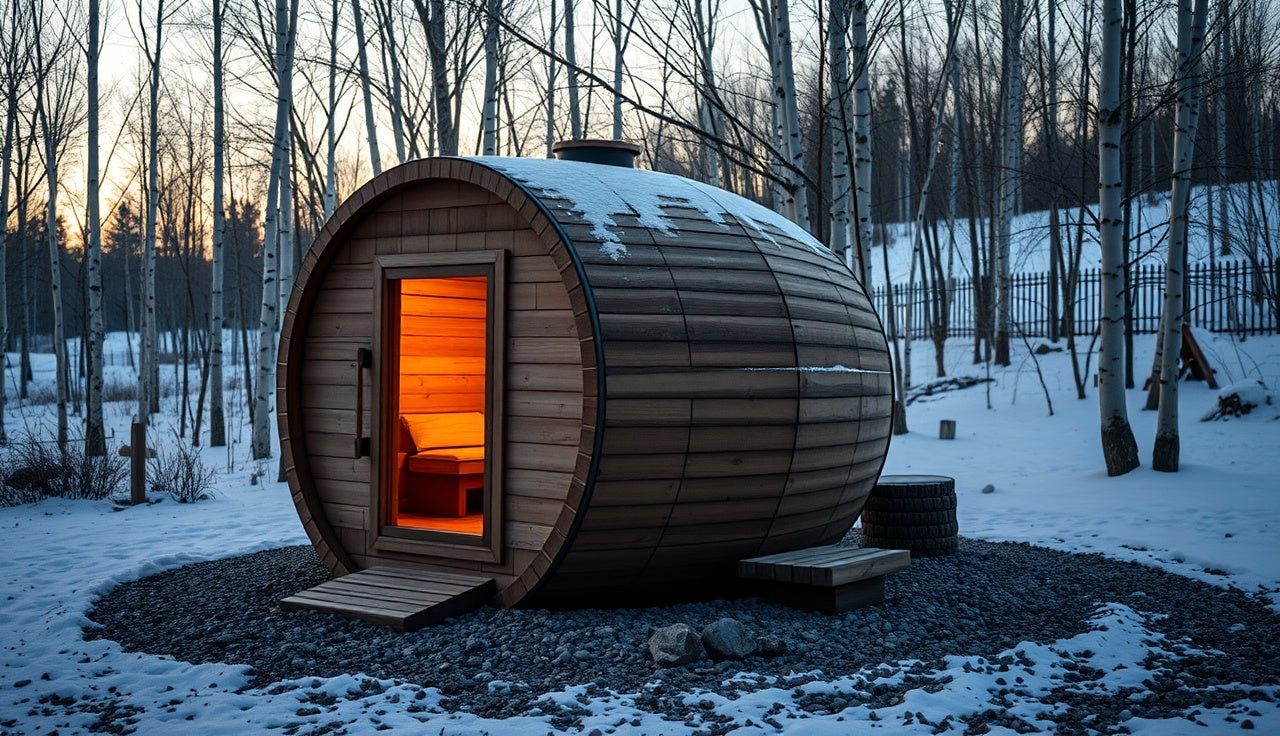
A Thermory barrel sauna is a self-contained outdoor sauna shaped like a horizontal cylinder, built by an Estonian wood company founded in 1994 that makes thermally modified timber under the Thermowood brand. The barrel form has been popular in Scandinavia since at least the 1980s, and it earns its keep. Curved walls push radiant heat toward the center bench, cut heat-up time versus a square room of equal volume, and shed rain and snow on their own.
The wood is what sets Thermory apart. Construction-grade pine or spruce soaks up moisture, swells, shrinks, and eventually rots when it lives outside all year. Thermowood goes through thermal modification: the timber is heated to 185 to 215°C in a steam-saturated kiln, which breaks down the hemicelluloses that normally pull in water [1]. What comes out has an equilibrium moisture content roughly 40 to 50% lower than untreated wood, much better biological durability, and a darker, even color that needs no stain.
An international standard covers the process. The Finnish ThermoWood Association maintains a product standard defining two treatment classes: Thermo-S (stability focus, 185 to 195°C) and Thermo-D (durability focus, 200 to 215°C). Thermory uses Thermo-D for exterior barrel components, which lands the material at European durability class 2 or better [1]. That counts for an outdoor sauna facing rain, frost, and repeated heat cycles.
The barrels use two wood species. Thermally modified pine covers structural and exterior surfaces. Thermally modified aspen goes inside for benching. Aspen is the traditional Nordic bench wood because it stays cool to the touch at high temperatures and carries almost no resin. Thermory's process keeps those traits while improving dimensional stability.
How much does a Thermory barrel sauna cost?
A Thermory barrel sauna costs $4,000 to $12,000+ depending on three things: barrel diameter, barrel length, and heater package. Thermory sells direct and through authorized dealers in North America, Europe, and Australia, and prices differ between those channels.
As of 2025, entry-level barrels (roughly 1.8 m diameter, 2.4 m length, two-person capacity) start around $4,000, $5,500 USD for the shell kit without a heater. A configured four-person unit (2.0 m diameter, 3.6 m length) with a Harvia or Huum electric heater lands in the $7,000, $9,500 range. The largest barrels, the six-person or extended-length models, reach $11,000, $13,000 USD installed through a dealer [2].
Those numbers leave out several real costs:
- Delivery freight, which for a full barrel kit adds $300, $800 depending on distance
- A concrete pad or gravel base (plan $500, $2,000 depending on your site)
- Electrical work for an electric heater (a 240V / 30 to 60A circuit from a licensed electrician runs $400, $1,500 depending on panel distance)
- Any local permit fees
Go with a wood-burning heater like the Harvia M3 and you skip the electrical cost but add a chimney flue kit ($150, $400). You also have to confirm local fire codes allow an open-flame outdoor heater on your property.
Against competitors in the same quality tier, Thermory sits near the top of the barrel market. Almost Heaven and Northern Lights barrels built from cedar or hemlock often run $3,000, $7,000 for comparable sizes. Finnish brands like HUUM and Kirami overlap with Thermory in the $6,000, $10,000 range. Thermory earns the premium on the documented, standardized thermal modification process, not raw species selection alone [1].
What is Thermowood and why does it matter for an outdoor sauna?
Thermowood is pine or aspen heated to 200 to 215°C in a controlled kiln so it resists rot and moves less with the seasons, and it matters outdoors because untreated wood swells, cracks, and decays in wet climates. The phrase "thermally modified wood" covers a spectrum of treatments, and they are not equivalent. Thermory's Thermowood carries third-party certification from the Finnish ThermoWood Association, which publishes the treatment parameters, testing protocols, and durability classifications [1]. You can verify it, which beats marketing copy.
The durability comes from chemistry. Heat wood above roughly 160°C and the hemicellulose chains that feed wood-rotting fungi start to degrade. Above 200°C, the Thermo-D range, the degradation is enough to move untreated pine from European durability class 3-4 up to class 2, so it performs like native hardwoods such as teak or iroko in above-ground exposure tests [1]. For a barrel sitting on runners or a pad through wet winters, that difference shows up.
Dimensional stability is the other half. Raw pine can expand and contract 4 to 8% across the grain seasonally. Thermory's Thermo-D pine moves roughly 2 to 4% across the grain [1]. Stave joints stay tighter, cracking around windows and doors drops, and any exterior finish lasts longer between coats.
The trade-off: thermal modification cuts strength. Bending strength of Thermo-D pine runs roughly 15 to 25% lower than untreated pine [1]. For a barrel this is a non-issue because the geometry is a compression arch that carries load efficiently. You would not build a load-bearing deck joist from it.
For outdoor sauna use, thermally modified wood genuinely outperforms untreated cedar and hemlock in wet climates. In dry ones like the American Southwest or the interior mountains, the gap narrows because untreated wood stays dry most of the year anyway. Live in the Pacific Northwest, New England, or anywhere past 40 inches of annual rainfall, and the durability case for Thermowood is real.
One thing Thermory does not claim, and neither should you: Thermowood is not impervious. It still wants a UV-protective exterior oil every two to three years to slow surface graying and checking. The thermal modification handles rot and movement. It does nothing against sunlight.
| Small (2-person, 2.0–2.4 m length) | $4,750 |
| Medium (4-person, 3.0–3.6 m length) | $7,500 |
| Large (6-person, 4.2–4.8 m length) | $10,500 |
Source: Thermory USA product pages, 2025
How hot does a Thermory barrel sauna get, and how long does it take to heat up?
A well-insulated barrel sauna reaches 80 to 100°C (175 to 212°F) at bench level in 30 to 45 minutes with a correctly sized heater. The geometry helps. A 1.8 m diameter barrel holds roughly 4 to 5 cubic meters of air for a two-person length. A flat-walled square sauna of the same bench capacity encloses 6 to 8 cubic meters. Less air, faster heat-up, same heater output [3].
Thermory matches heater recommendations to barrel size. The smallest models take a 6 to 8 kW electric heater (Harvia, HUUM, or similar). Larger four-to-six person barrels want 9 to 12 kW. The Finnish rule for heater sizing is about 1 kW per cubic meter of room volume, adjusted up for poorly insulated walls and windows [3].
Add a window package and you invite a heat sink. A double-pane sauna window loses heat roughly 3 to 5 times faster than the insulated wall around it, so a barrel with two large side windows may need 1 to 2 extra kW to hold temperature at the same pace.
Traditional Finnish protocol targets 80 to 90°C air at bench level with 10 to 20% relative humidity, then uses löyly (water poured on hot stones) to spike humidity to 40 to 60% for the steam sensation. Thermory barrels work with this. The recommended heaters all have stone compartments rated for löyly.
Here is the health context. Repeated sauna sessions at 80 to 100°C track with better cardiovascular and longevity outcomes in observational studies. A cohort study from the University of Eastern Finland, published in JAMA Internal Medicine, reported that men using a sauna 4 to 7 times per week had a 40% lower risk of all-cause mortality than once-weekly users over 20 years of follow-up [4]. Those are associations, not randomized trial data, so causation stays unproven. The proposed mechanisms (heat-induced cardiovascular stress response, heat shock protein upregulation) are biologically plausible [4]. You can read what the research actually shows on sauna benefits.
How do you assemble a Thermory barrel sauna?
You assemble a Thermory barrel from a pre-cut kit: staves, roof panels, benches, door frame, and hardware arrive labeled and ready to build with no sawing. A competent two-person team finishes a standard two-to-four person barrel in 6 to 10 hours. The largest models with full-length changing rooms take a full weekend.
The sequence follows a logic. Lay the two cradle supports (the curved base rails), stack the floor staves across them, then build the walls with the tongue-and-groove stave system. Steel tension bands circle the barrel at intervals, and you tighten them with a ratchet to draw the staves into compression. The geometry does the rest. Then comes the door frame, door, benching, heater shelf, and flue or electrical knockout.
Instructions ship in English. Most North American buyers report they are accurate but thin on detail, and several YouTube walkthroughs fill the gaps. If drilling, leveling, and following a parts diagram are not in your wheelhouse, plan on a handyman or contractor for a half-day.
Site prep is the part buyers underestimate. A level, well-drained base is non-negotiable. Your options:
- A concrete pad (most permanent, best for heavy barrels over 3.6 m)
- Compacted gravel on landscape fabric (good drainage, DIY-friendly)
- Pressure-treated wood sleepers (convenient, but risky if your site holds water)
The barrel does not need bolting to the pad, but Thermory recommends anchor strapping in high-wind regions. Check your local building codes. Many jurisdictions treat a sauna under 120 square feet as an accessory structure needing no permit, though this varies widely [5].
What size Thermory barrel sauna do you actually need?
Buy one size up from what you think you need. Most buyers undersize. A two-person barrel is fine for one or two occasional users. Have a family of four, friends who join sessions, or any plan to pair the sauna with a cold plunge routine where people rotate in and out, and you want more room.
Thermory's primary sizes break down like this:
| Model size | Interior length | Capacity | Heater range | Approx. price (kit) |
|---|---|---|---|---|
| Small (1.8 m dia.) | 2.0 to 2.4 m | 2 persons | 6 to 8 kW | $4,000, $5,500 |
| Medium (2.0 m dia.) | 3.0 to 3.6 m | 4 persons | 8 to 10 kW | $6,500, $8,500 |
| Large (2.0 m dia.) | 4.2 to 4.8 m | 6 persons | 10 to 13 kW | $9,000, $12,000+ |
The changing room add-on (an unheated vestibule at one end) is worth it in cold climates. It gives you a place to undress and stash towels without opening the sauna, and it cuts heat loss at the door. It adds roughly $500, $1,200 to a kit depending on size.
Bench height matters more than buyers expect. Traditional Finnish benches sit at two levels: a lower bench around 45 cm and an upper bench at 90 to 100 cm. In a barrel the hottest air pools at the top of the arc, so the upper bench runs 10 to 15°C hotter than the lower one. New to sauna? Start low. Building for experienced users who want intense heat? Prioritize upper-bench headroom, which points you to the 2.0 m diameter barrel over the 1.8 m.
For how barrels compare to other home sauna configurations, that page runs through the full range of indoor and outdoor options.
How does Thermory compare to other barrel sauna brands?
Thermory sits in the upper mid-range of the barrel market: pricier than untreated-cedar barrels, competitive with Finnish Thermowood brands, and below custom smart-control makers. The North American market has grown a lot since 2018. Here is the honest comparison by tier.
At the budget end, Dundalk LeisureCraft (Canadian cedar) and Almost Heaven (North American cedar or hemlock) sell barrels in the $2,500, $5,000 range. The wood is untreated natural cedar, which has good natural durability and a fine smell but grays and checks over time without maintenance. Solid value for dry climates or buyers who will keep up the exterior.
In the mid-range ($5,000, $9,000), Thermory competes with Finnish brands like HUUM and Kirami and with North American premium cedar makers. HUUM is strong competition because it uses high-quality Thermowood sourced from Estonia (a supply chain similar to Thermory's) and bundles excellent heater technology. Thermory's edge is more consistent barrel-specific manufacturing documentation and broader North American dealer support.
At the top end ($10,000+), you find custom Finnish barrel makers and brands like Kolo Club with integrated smart controls and premium finishing. Thermory sits just below on price and competes on wood quality.
Where Thermory genuinely wins: certified Thermowood, a reasonably detailed assembly kit, consistent joinery quality reported by buyers, and after-sale parts through the dealer network. Where it has room to improve: North American customer service draws mixed reviews in forums, and the stock window and door hardware on entry-level kits is basic.
The comparison worth making is a brand using the same Thermo-D class timber versus a brand using untreated cedar. The cedar often smells better out of the box. The Thermowood will likely move less over 10 winters.
For a wider look at the outdoor sauna landscape, including fixed-wall cabins versus barrels, the heat-up time and cost differences are worth reading before you commit.
What heater should you pair with a Thermory barrel sauna?
Match the heater to your barrel volume and climate: a 6 to 8 kW electric unit for small barrels, 9 to 12 kW for larger ones, and a wood-burning stove if you want ambiance over remote control. Thermory does not make heaters. It bundles or recommends units from third parties, most often Harvia, HUUM, and occasionally Tylö or Narvi. Each brand has a personality.
Harvia is the volume leader. It makes electric heaters from 3.5 kW to 18 kW and wood-burning heaters in several sizes. The Harvia M3 wood-burning stove is probably the most popular wood heater in barrel saunas worldwide and retails around $600, $900 USD [9]. It heats a medium barrel in 30 to 45 minutes burning dry hardwood and gives controllable löyly. The catch: it needs a flue, makes ash to clean, and demands a wood supply.
HUUM makes arguably the best-looking electric heaters going, with a river-stone-filled open grid that takes pour-on steam without a stone cage. Its Drop and Hive models in the 6 to 12 kW range suit Thermory barrels and run $800, $1,600 [10]. HUUM heaters connect to a wifi controller and preheat remotely, handy in cold climates when you want the barrel warm before you get home.
For sizing, the Finnish Sauna Society uses about 1 kW per cubic meter of sauna volume as the baseline, adding 1.5 kW per square meter of glass [3]. A barrel with one standard window (roughly 0.25 m²) and 4.5 m³ of interior volume needs about 4.5 + 0.4 = 4.9 kW minimum, so a 6 kW heater is the sensible pick with headroom for cold starts.
Electric heaters need a dedicated 240V circuit in North America. A 6 kW heater draws 25 amps at 240V. A 9 kW heater draws about 37.5 amps. Electricians typically install a 30A or 40A breaker with wire sized to match per NEC Article 424 [6]. Budget for that work if you do not already have 240V power near the site.
How long will a Thermory barrel sauna last?
A Thermory barrel realistically lasts 20+ years with good site prep and light maintenance, matching the 25-year service life the Finnish standard assigns to Thermo-D timber. The honest caveat: nobody has 30-year outdoor field data on Thermowood barrel saunas specifically, because commercial-scale thermal modification is only about 25 to 30 years old. What exists is accelerated aging tests and the durability class framework.
The Finnish ThermoWood Association rates Thermo-D timber at European durability class 2, defined as "durable" in above-ground and covered exterior applications, with expected service life exceeding 25 years and no chemical treatment [1]. That is the same class as western red cedar and larch. Cedar barrel saunas kept in reasonable shape have routinely lasted 20 to 30 years in northern climates.
In practice, longevity rides on site prep and maintenance more than on the wood. The three killers of barrel saunas: 1. Water pooling under the base (rot from below) 2. UV degradation opening surface checks that let water in 3. Freeze-thaw cycling in gaps around the door frame and hardware
Set the barrel on a gravel bed or concrete pad that drains well, apply exterior UV oil every two to three years, and caulk any checking around hardware annually, and a Thermory barrel should clear 20 years. Neglected on a wet lawn with no maintenance, any wood barrel shows serious surface deterioration within 5 to 8 years, whatever the species.
The interior aspen benching needs less care than the exterior because it never sees UV or rain. Leave interior surfaces unfinished or treat with a sauna-safe wax. The aspen holds up well to the heat-humidity cycles of regular use.
Can you use a Thermory barrel sauna year-round in cold climates?
Yes, and it is one of the better cold-climate outdoor sauna options out there. The Thermowood's dimensional stability keeps stave joints tighter in cold, wet conditions than untreated barrels manage. The curved roof sheds snow load without special reinforcement in most regions.
Below -10°C (14°F), heat-up time climbs. A 6 kW electric heater that hits 80°C in 35 minutes in summer may take 50 to 60 minutes in deep winter because of the larger temperature gap. Sizing up 1 to 2 kW over the minimum recommendation pays off in Minnesota, Quebec, or similar climates.
A practical note: in hard winters, electric heaters with remote preheat (HUUM's wifi models, for instance) earn their keep fast. Start the heat cycle 45 minutes before you want the sauna, and you never stand around in the cold.
Water for löyly freezes if you leave a bucket outside. Keep it in the house or the changing room. The heater stones are fine either way; they cycle through heat and cold without complaint.
For contrast therapy pairing a hot sauna with a cold plunge, winter is prime time. The gap between a 90°C sauna and a snow-covered yard or a plunge at 10°C peaks in winter, which is exactly what contrast therapy advocates chase [7]. If that protocol interests you, the cold plunge page is worth reading alongside this one.
Is a Thermory barrel sauna a good investment for your home?
As pure recovery infrastructure, a Thermory barrel pays for itself fast against gym sauna access. At $80, $150 per month for a gym membership, a $7,000 barrel breaks even in 4 to 7 years on membership costs alone, before you count home convenience or resale.
Home appraisers have no universal premium formula for outdoor saunas, and the National Association of Realtors publishes no sauna-specific ROI figure. General remodeling research puts outdoor living features in the $5,000, $15,000 range at 50 to 80% cost recovery at resale in markets where buyers value outdoor space [8]. A well-maintained premium sauna likely lands toward the top of that band in the Pacific Northwest, New England, and parts of the Mountain West where sauna culture runs deep.
A sauna is not primarily a financial play. You are buying years of regular heat therapy, the ability to host friends and family for sessions, and a piece of outdoor infrastructure you will use for two decades with maintenance. The money math supports the decision. It does not drive it.
The SweatDecks outdoor sauna collection lists Thermory barrels alongside other brands if you want to compare specs and current pricing in one place before you buy.
One honest caveat: if your outdoor space is small, shaded, or heavily landscaped, the barrel shape creates real installation headaches. Barrels are large and round; they do not tuck into corners. Measure your space against the barrel dimensions, including door-swing clearance and a path for chimney or electrical access.
What do owners actually say about Thermory barrel saunas after a year or two?
Owner feedback after a year or two clusters around tight joinery and graceful aging on the plus side, and undersized door hardware plus thin instructions on the minus side. I cannot point to a structured owner survey worth citing, but the consistent chatter across sauna enthusiast forums (SaunaForum.net, Reddit's r/finlandia and r/sauna communities) breaks into clear patterns.
Positive themes that come up repeatedly:
- Stave joints stay tight after two or three winters, better than some cedar competitors
- The darkened color of Thermowood ages gracefully with minimal maintenance
- Heat-up times match Thermory's stated estimates
- Interior aspen benching stays cool and comfortable at high temperatures
Negative themes that come up repeatedly:
- Entry-level door hardware (hinges and latch) on some kits is undersized for the door weight and sometimes needs replacing within a year
- Instructions assume more joinery experience than the average buyer has
- Thermory's North American customer support can be slow to respond next to some domestic brands
- Steel tension bands can show surface rust after a few years outdoors if untreated, staining the wood underneath
None of these are dealbreakers, but budget for them. Upgrading the door latch runs $20, $80. Treating tension bands with a clear metal sealant at installation takes five minutes. Reading the assembly instructions twice and watching a video walkthrough clears up most of the confusion.
For first-time buyers, the learning curve is real regardless of brand. If you have never owned a sauna, the home sauna overview is a good primer on what to expect before you settle on a specific barrel. SweatDecks has a product team that fields pre-purchase questions if you want a second opinion on sizing or heater selection.
Frequently asked questions
How much does a Thermory barrel sauna cost in 2025?
Entry-level two-person Thermory barrel kits start around $4,000, $5,500 without a heater. Medium four-person models with heater packages run $7,000, $9,500. Large six-person configurations reach $12,000 or more. Add $300, $800 for freight, $500, $2,000 for a base pad, and $400, $1,500 for electrical work if you choose an electric heater.
What wood does Thermory use and is it safe for sauna interiors?
Thermory uses thermally modified pine for exterior and structural components and thermally modified aspen for interior benching. The thermal modification process uses only heat and steam, no chemical preservatives, so it is safe for sauna interiors. Aspen is the traditional Nordic interior sauna wood because it stays cool to the touch and is nearly resin-free even at high temperatures.
How long does it take to heat up a Thermory barrel sauna?
A properly sized heater reaches 80 to 90°C (175 to 195°F) at bench level in 30 to 45 minutes under normal conditions. In sub-zero temperatures, budget 50 to 60 minutes. The barrel geometry reduces interior air volume compared to a square room of equal bench capacity, which meaningfully shortens heat-up time compared to flat-wall outdoor saunas.
Do you need a permit to install a barrel sauna?
It depends on your jurisdiction. Many municipalities classify accessory structures under 120 square feet as permit-exempt, but rules vary widely by state, county, and city. Always check with your local building department before installation. Electrical work for a 240V heater circuit always requires a permit and licensed electrician in most U.S. jurisdictions regardless of the structure's permit status.
Can a Thermory barrel sauna stay outside year-round?
Yes. Thermory barrels are designed for permanent outdoor installation in all climates. The Thermo-D class timber is rated for above-ground exterior exposure with expected service life exceeding 25 years per the Finnish ThermoWood Association standard. Apply an exterior UV-protective oil every two to three years and ensure the base drains well to maximize longevity.
How do Thermory barrel saunas compare to cedar barrel saunas?
Cedar has natural durability and a pleasant aroma. Thermory's Thermowood has lower equilibrium moisture content (40 to 50% less than untreated wood), better dimensional stability in wet climates, and a certified durability classification that matches or exceeds western red cedar. In dry climates the difference narrows. In high-rainfall regions, Thermowood's dimensional stability produces tighter stave joints over time.
What heater size do I need for a Thermory barrel sauna?
The Finnish baseline is approximately 1 kW per cubic meter of interior volume, plus 1.5 kW per square meter of glass. A four-person barrel with roughly 6 m³ of volume and one small window needs about 7 to 8 kW minimum. In cold climates, add 1 to 2 kW of headroom. Thermory's product pages specify recommended heater ranges per barrel model.
Can I use a wood-burning heater in a Thermory barrel sauna?
Yes. Thermory barrels are compatible with wood-burning heaters like the Harvia M3. You need to install a flue kit through the barrel roof or end wall and confirm local fire codes allow open-flame outdoor heaters on your property. Wood-burning heaters skip the electrical installation cost but require dry hardwood fuel and regular ash cleaning.
How hard is it to assemble a Thermory barrel sauna?
A two-person team with basic carpentry skills typically completes assembly in 6 to 10 hours for a standard size. Pre-cut staves, labeled hardware, and a tongue-and-groove system with steel tension bands make the process manageable. Instructions are accurate but sparse; watching a video walkthrough first is strongly recommended. Larger models with changing rooms can take a full weekend.
How do I maintain a Thermory barrel sauna?
Apply a UV-protective exterior wood oil every two to three years to prevent surface checking and graying. Inspect and treat steel tension bands annually to prevent rust staining. Keep the base drainage clear so water does not pool under the barrel. Interior aspen benching needs minimal care, just clean with a mild sauna cleaner if needed. No staining or painting required on the exterior.
Can I pair a Thermory barrel sauna with a cold plunge for contrast therapy?
Absolutely. The barrel sauna's fast heat-up and compact footprint make it a natural partner for a cold plunge or ice bath placed nearby. Contrast therapy protocols typically alternate 10 to 20 minute sauna sessions with 2 to 5 minute cold immersion periods. The physiological rationale and the current research behind contrast therapy is covered on the cold plunge benefits page.
Does a Thermory barrel sauna add value to my home?
No published appraisal formula exists specifically for barrel saunas. General outdoor living improvement research suggests that features in the $5,000, $15,000 range recoup 50 to 80% at resale in markets where buyers value outdoor space. A well-maintained premium sauna in a sauna-culture-friendly market (Pacific Northwest, New England, Upper Midwest) likely performs toward the top of that range.
What is the difference between a barrel sauna and a regular cabin sauna?
A barrel sauna's curved walls reduce interior air volume compared to a flat-wall cabin of equivalent bench space, meaning faster heat-up with the same heater. The barrel sheds precipitation naturally and its compression-arch structure is inherently rigid without framing. A cabin sauna offers more flexible interior layouts, easier expansion, and sometimes better headroom. Barrels typically cost less for equivalent bench capacity.
Are there Thermory barrel sauna models with a changing room?
Yes. Thermory offers changing room extensions as add-on modules for most barrel sizes. These are unheated vestibules attached to one end of the barrel, giving you a sheltered space to undress, store towels, and reduce heat loss when entering and exiting the sauna. Changing room extensions add roughly $500, $1,200 to the kit price depending on size.
Sources
- Finnish ThermoWood Association, ThermoWood Handbook: ThermoWood Thermo-D class treatment at 200–215°C achieves European durability class 2, with equilibrium moisture content 40–50% lower than untreated wood and bending strength reduction of approximately 15–25%
- Thermory USA, Barrel Sauna product pages: Thermory barrel sauna kit pricing across size tiers and dealer pricing structure for North American market
- Finnish Sauna Society, Sauna building guidelines: Finnish heater sizing guideline of approximately 1 kW per cubic meter of sauna volume, with additional allowance for glass surfaces
- JAMA Internal Medicine, Laukkanen et al. 2015, Association Between Sauna Bathing and Fatal Cardiovascular and All-Cause Mortality Events: Men using sauna 4–7 times per week had 40% lower all-cause mortality risk compared to once-weekly users over 20-year follow-up in a Finnish cohort study
- U.S. Department of Housing and Urban Development: Accessory structure permit thresholds (often under 120 sq ft exempt) vary by local jurisdiction; building codes are set at state and local level
- National Fire Protection Association, National Electrical Code (NEC) Article 424, Fixed Electric Space-Heating Equipment: NEC Article 424 governs fixed electric heating equipment wiring requirements including conductor sizing and overcurrent protection for sauna heaters
- National Center for Biotechnology Information (NCBI), Mooventhan & Nivethitha 2014, Scientific Evidence-Based Effects of Hydrotherapy on Various Systems of the Body, North American Journal of Medical Sciences: Contrast therapy alternating heat and cold exposure produces cardiovascular and autonomic nervous system responses that differ from either modality alone
- National Association of Realtors, Remodeling Impact Report: Outdoor living and accessory structure improvements in the $5,000–$15,000 range recoup approximately 50–80% at resale depending on market and feature type
- Harvia Group, Product specifications for Harvia M3 wood-burning heater: Harvia M3 retail pricing approximately $600–$900 USD and heater sizing specifications for barrel sauna applications
- HUUM, Heater product line and wifi control specifications: HUUM Drop and Hive electric heater specifications, 6–12 kW range, wifi preheat capability, pricing $800–$1,600

Share:
Sauna temperature sensors: how they work and where to put them
Sauna temperature sensors: how they work and where to put them