
Last updated 2026-07-09
TL;DR
A sauna temperature sensor reads air or surface heat and feeds that data to a controller or display so you can hold a safe, consistent session. Mount most sensors 6 to 8 inches below the ceiling on the wall opposite the heater. Digital thermistor sensors are the most accurate today; bimetal dial sensors are cheapest but drift over time. Ideal sauna air temperature is 150 to 195 degrees Fahrenheit (65 to 90 Celsius).
What does a sauna temperature sensor actually do?
A sauna temperature sensor measures the air (or surface) temperature inside your cabin and sends that reading somewhere: a dial on the wall, a digital display, or a heater controller that uses the number to switch heating elements on and off. That last job is the one most people underestimate. A sensor feeding a controller is more than a thermometer. It is the feedback loop that keeps your sauna from overshooting or undershooting its target.
Most residential saunas pair a sensor with one of two outputs. The first is a simple display, either an analog dial or a digital readout, that tells you the temperature so you can make your own calls. The second is a closed-loop control system, where the sensor signal tells the heater controller to cut power at the set point and restore it when temperature drops. Commercial saunas add a third layer: multiple sensors feeding a building management system that logs session data.
The practical upshot for a homeowner is short. Without a working, accurately placed sensor, your heater controller is blind. It either runs at full power continuously, which is a fire and injury risk, or it cycles on whatever internal thermostat the heater shipped with, which may be calibrated for a completely different cabin size than yours [1].
If you are shopping for a home sauna or already own one, understanding the sensor is the fastest way to diagnose temperature problems and the cheapest upgrade you can make when sessions feel inconsistent.
What are the main types of sauna temperature sensors?
Four sensor technologies show up in a sauna. Each has a different accuracy profile, lifespan, and price.
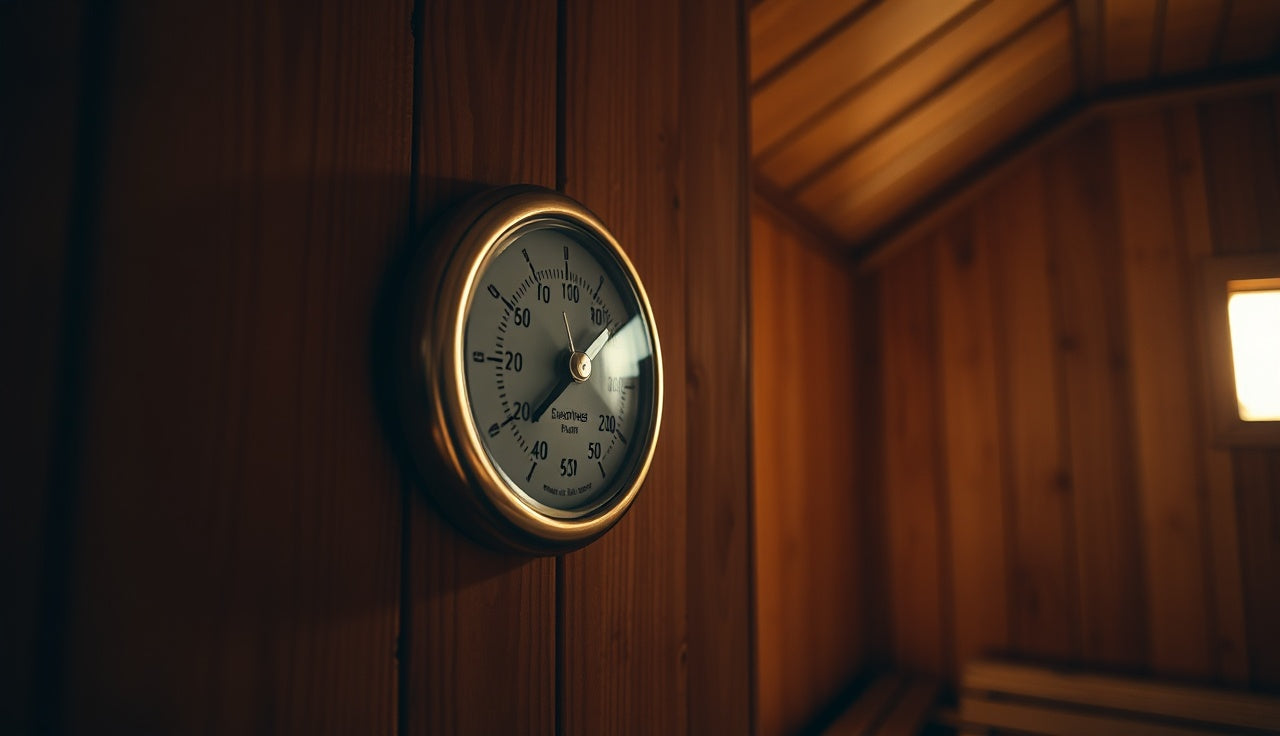
Bimetal dial sensors. Two bonded metal strips with different thermal expansion rates bend as temperature rises, moving a needle across a face. No wiring, no power needed. Accuracy runs plus or minus 5 to 10 percent of full scale, and the calibration drifts after repeated heat cycles [2]. A basic bimetal sauna thermometer costs $10 to $30. Fine for rough monitoring, useless for controller feedback.
Thermistor sensors. A thermistor is a resistor whose resistance changes predictably with temperature. NTC (negative temperature coefficient) thermistors drop in resistance as temperature rises. A controller reads that resistance and converts it to a temperature value. Accuracy runs plus or minus 1 to 2 degrees Fahrenheit when fresh, and they hold calibration well across the 150 to 250 degree Fahrenheit range saunas run in [3]. Most digital sauna controllers ship with an NTC probe.
RTD (resistance temperature detector) sensors. RTDs use a pure metal element, usually platinum (PT100 or PT1000), whose resistance changes almost linearly with temperature. They beat thermistors on accuracy (plus or minus 0.5 degrees Fahrenheit is achievable) and stay stable longer. They cost more, typically $40 to $150 for the probe alone, and turn up in commercial or custom builds far more than residential kits.
Infrared and contact sensors. Infrared (non-contact) sensors read surface radiated heat and sometimes monitor heater stones or bench surfaces. They make a poor substitute for an air temperature sensor because bench and stone surface temps run wildly higher than ambient air. Contact sensors (thermocouples or adhesive RTDs) sometimes attach to sauna heater guards to trigger safety cutoffs.
| Sensor Type | Typical Accuracy | Lifespan | Price Range | Best Use Case |
|---|---|---|---|---|
| Bimetal dial | ±5-10% | 5-10 years with drift | $10-$30 | Visual-only monitoring |
| NTC Thermistor | ±1-2°F | 5-8 years | $15-$60 (probe + cable) | Residential digital controller |
| RTD (PT100/PT1000) | ±0.5°F | 10+ years | $40-$150 | Commercial, custom builds |
| Thermocouple (Type K) | ±2-5°F | 5-10 years | $20-$80 | High-heat safety cutoffs |
For a typical residential sauna, an NTC thermistor paired with a digital controller hits the best balance of accuracy, cost, and compatibility.
What is the correct sauna temperature sensor location?
Put the sensor 6 to 8 inches (15 to 20 cm) below the ceiling, on the wall opposite the heater. That single choice fixes more temperature problems than any hardware swap. Sensor location is where most installation mistakes happen, and a misplaced sensor gives you bad sessions even if the sensor itself is perfect.
The placement above is what major sauna manufacturers and the Finnish Sauna Society recommend [4]. The logic is straightforward. Hot air rises and stratifies, so the ceiling zone is always the hottest part of the room. A sensor a few inches below the ceiling captures the temperature of the air your upper body and face actually feel when you sit on the top bench, which is the thermal environment that matters for safety and comfort.
Mount the sensor directly above or beside the heater and it reads falsely high. The controller cutoff trips too early, and the benches never fully heat. Mount it near the floor and it reads falsely low, so the controller keeps the heater running past safe limits because it is sampling the coolest air in the room.
Wall choice matters too. The wall opposite the heater wins because air has mixed somewhat by the time it crosses the room, so the reading represents overall cabin temperature rather than the immediate heater plume. In small saunas under 4x6 feet, a side wall is acceptable if the opposite wall sits too close to the door.
If your sauna has two sensors (one for the controller, one for the display thermometer), the display sensor can drop a bit lower, around 40 to 48 inches from the floor, which is roughly seated eye level on the top bench. That lets you read comfort temperature without crouching.
For outdoor sauna builds where wall materials vary, keep the sensor probe off the wood. A short standoff mount lets it read air temperature instead of the surface temperature of the board it is fastened to.
| Bimetal dial sensor | 9 |
| NTC thermistor (10k) | 1.5 |
| RTD PT100/PT1000 | 0.5 |
| Type K thermocouple | 3.5 |
Source: OMEGA Engineering Technical Reference [2]; NIST thermistor references [3]; UL 875 [5]; EN 60335-2-53 [10]
What temperature range should a sauna sensor cover?
Cover your sauna's full working range with headroom on top. Traditional Finnish dry saunas run 150 to 195 degrees Fahrenheit (roughly 65 to 90 degrees Celsius) at the upper bench [4]. Steam saunas and low-temperature infrared saunas run cooler, typically 110 to 140 degrees Fahrenheit. Your sensor needs to read across whatever your sauna is built for and then some.
For a wood-burning or electric home sauna, look for a sensor rated to at least 230 degrees Fahrenheit (110 Celsius). Many residential NTC thermistor probes are rated to 302 degrees Fahrenheit (150 Celsius), which gives good margin. Bimetal dial thermometers designed for saunas usually mark to 220 or 250 degrees Fahrenheit.
The heater safety cutoff, a separate and mandatory component in any code-compliant sauna, usually sits between 185 and 194 degrees Fahrenheit for the air sensor and around 300 degrees Fahrenheit for the heater body itself [1]. Residential sauna heaters sold in the US must carry UL or ETL listing, and that listing mandates these cutoffs [5].
One thing worth knowing: the temperature you feel is more than air temperature. Relative humidity shifts perceived heat hard. A ladle of water on hot stones (kiuas) at 185 degrees Fahrenheit feels hotter than dry air at the same number because the steam briefly raises humidity and drives more heat into your skin. A temperature-only sensor never sees this, which is why some enthusiasts run a separate hygrometer alongside it.
How does a sauna temperature sensor connect to a heater controller?
Almost every residential electric sauna heater sold with a digital controller uses a two-wire NTC thermistor probe. The probe sits inside the cabin. The two wires run through a small hole in the wall (sealed with a grommet or ceramic bushing to stop air leakage) to the controller mounted outside the cabin [6].
The controller applies a small reference voltage across the thermistor, measures the resulting current, and calculates temperature from the known resistance-temperature curve of that thermistor type. Most residential controllers are pre-matched to a specific NTC value, commonly 10k ohm at 25 degrees Celsius or 50k ohm at 25 degrees Celsius. Pair the wrong thermistor with a given controller and you get systematic read errors, sometimes 20 to 30 degrees Fahrenheit off. Match the thermistor spec to the controller spec, or buy them as a matched pair.
Wire length matters more than most people expect. Long probe cables pick up electrical interference from heater elements, especially in 240-volt installations. Shielded cable, with the shield grounded at the controller end only, cuts this noise a lot. Most factory probe cables run 6 to 10 feet. If you need to extend, use shielded 2-conductor cable and keep it away from heater power wiring.
Wood-burning saunas without an electric controller have no electrical connection to make. The bimetal or dial thermometer is self-contained and just hangs on the wall. The tradeoff: you are the controller. You manage fire intensity by hand based on what the dial says.
Can you replace or upgrade an existing sauna temperature sensor?
Yes, and it is one of the cheapest improvements you can make to an older sauna. Bimetal sensors drift over years of heat cycling and are worth replacing every 5 to 8 years on principle alone. Digital thermistor probes fail from moisture intrusion or physical damage to the cable.
Before you order a replacement, learn what your controller expects. Pull the controller cover (power off at the breaker) and look for a model number or probe specification on the wiring diagram inside. Harvia, Finnleo, TyloHelo, and Almost Heaven all list their probe part numbers in installation manuals you can download from their sites. The spec you need is the NTC resistance value at a reference temperature, usually written as "NTC 10k" or "NTC 50k."
Can't find the spec? Measure the existing probe with a multimeter set to resistance (ohms) at room temperature (roughly 68 to 72 degrees Fahrenheit / 20 to 22 Celsius). Compare that reading to published NTC resistance tables to identify the type. A 10k NTC at 25 Celsius reads roughly 10,000 ohms at room temperature. A 50k NTC reads roughly 50,000 ohms.
Generic NTC thermistor probes with stainless steel tips and silicone-jacketed cable rated to 302 degrees Fahrenheit are widely stocked by HVAC suppliers and electronics distributors. Budget $15 to $50 for a decent replacement. Upgrading to a full digital display and controller at once? Harvia and Finnleo sell retrofit kits with a matched probe, display, and relay unit for $150 to $400.
Building from scratch or renovating? SweatDecks carries sauna heaters and control packages that ship with matched sensor probes, which takes the compatibility guesswork off your plate.
How accurate does a sauna temperature sensor need to be?
For a display-only thermometer, plus or minus 5 degrees Fahrenheit is fine. For a heater controller, you want plus or minus 2 degrees Fahrenheit or better, because the controller uses that reading to decide when to cut and restore power.
Why does it matter? The gap between 175 and 185 degrees Fahrenheit at bench level is noticeable inside a session. The gap between 185 and 195 degrees Fahrenheit is where some users, particularly those with cardiovascular conditions, cross into a range where heat stress becomes a real physiological factor. A 2018 review in Mayo Clinic Proceedings on the cardiovascular effects of sauna bathing reported that heart rate and blood pressure responses track with session temperature and duration in a dose-dependent way [7]. Consistent temperature control is how you keep the dose consistent.
A sensor that has drifted 10 degrees low means your controller runs the sauna 10 degrees hotter than the set point shows. For most healthy adults that is unpleasant, not dangerous. For someone managing blood pressure or heart disease under a physician's temperature guidance, the error carries more weight.
Calibration check: verify your sensor against a second reference thermometer. A NIST-traceable digital thermometer (about $30 to $60) placed at the same height as your probe gives you a comparison point. If they differ by more than 5 to 7 degrees Fahrenheit, the probe is worth replacing.
What about sensors for infrared saunas?
Infrared saunas work differently from traditional ones. The heaters, either near-infrared lamps or far-infrared ceramic or carbon panels, emit radiant energy that warms your body directly rather than heating the air first. So infrared cabins reach only 110 to 145 degrees Fahrenheit (43 to 63 Celsius) in air temperature [8].
Sensors in infrared saunas still do the same two jobs: show temperature to the user and feed the controller for automatic shutoff. Because air temperatures run lower, accuracy requirements are actually tighter as a percentage of full scale. A 5-degree error at 185 degrees Fahrenheit is about 2.7 percent. The same 5-degree error at 120 degrees Fahrenheit is 4.2 percent and shifts the session feel more.
Most infrared saunas use the same NTC thermistor technology as electric Finnish saunas, just with controllers set to lower points. The placement rule still holds: mount the sensor 6 to 8 inches below the ceiling on the wall opposite the primary heater panels.
One quirk with infrared: radiant heat can warm the sensor housing itself more than the air around it, so some infrared sauna sensors use a shielded or reflective probe housing to cut that radiant error. Replacing a sensor in an infrared cabin? Use the OEM part or a probe designed for infrared sauna use, not a generic HVAC thermistor.
Worth comparing to a sauna vs steam room situation, where the sensor type matters even more because steam rooms run at high humidity and need corrosion-resistant probe materials.
What safety standards apply to sauna temperature sensors and heater controls?
In the US, the standards stack comes from several directions.
UL 875 covers electric dry-bath heaters (standard residential electric sauna heaters). Listing under this standard requires the heater to include a high-limit thermal cutoff that shuts the unit down if the heater body reaches an unsafe temperature, independent of the room air sensor [5]. That is why a properly listed sauna heater will not simply ignite the cabin even if the air sensor fails low and the controller runs continuously.
NEC (National Electrical Code) Article 424 covers fixed electric space-heating equipment and applies to most permanently installed sauna heaters. Local jurisdictions adopt NEC editions on their own schedules. Installing a new sauna with built-in electrical usually means a permit and inspection, and the inspector will check for properly listed equipment [9].
The European standard EN 60335-2-53 specifies that a sauna heater's room thermostat must prevent air temperature from exceeding 185 degrees Fahrenheit (85 Celsius) and that an independent safety thermostat must cut power once 194 degrees Fahrenheit (90 Celsius) is reached [10]. Many sauna heaters sold in the US voluntarily meet both UL 875 and EN 60335-2-53 because they are built for global markets.
Wood-burning saunas have no electric controller, so the temperature sensor is display-only. But the installation still has to meet the clearance requirements in NFPA 211 (Standard for Chimneys, Fireplaces, Vents, and Solid Fuel-Burning Appliances) and local building codes [11].
The short version: buy listed equipment, keep your sensor working and accurately placed, and the safety system does its job. Bypass the high-limit cutoff, or park the sensor where it never reaches set point, and you have stripped out the protection the standard was built around.
How do you troubleshoot a sauna temperature sensor that reads wrong?
The most common complaint is "my sauna runs too hot" or "my sauna never reaches temperature." In both cases the sensor is the first thing to check.
Sauna running too hot: the sensor may be reading high (so the controller cuts off early, but the session feels hotter than the displayed number), or the sensor may sit near the floor or a cold draft and read low, pushing the controller to overshoot. First, compare the sensor reading to a reference thermometer at the same height. If the sensor reads low relative to actual air temperature, re-examine placement or suspect probe failure.
Sauna that never reaches temperature: the sensor may read high, forcing an early controller cutoff. Compare to a reference thermometer. A probe mounted too close to the heater or in the direct convective plume above it will read high.
Wiring checks: a partial short or moisture intrusion in the probe cable changes effective resistance and shifts the temperature reading unpredictably. Power off, disconnect the probe at the controller, and measure resistance with a multimeter. Compare to the expected value for the NTC type at your current room temperature. A wildly off reading (near zero or near infinite) means the cable or tip has failed.
Controller checks: some digital controllers let you program a calibration offset. If the probe is still within spec but reads consistently 5 degrees low, a +5 offset in the controller menu fixes it without new hardware. Check your controller manual.
Portable sauna users: fabric tent saunas have even more variable temperature distribution than wood cabins, and sensor placement relative to the steam source or heating element is harder to standardize. Taking several readings at different heights with a handheld thermometer is the most practical way to understand what you are actually sitting in.
Are there smart or wireless sauna temperature sensors worth buying?
They exist, they work, and whether they earn their keep depends on what you want to do with the data.
Wifi-connected temperature and humidity sensors from Govee, SwitchBot, and Inkbird are built for general home use, but plenty of people drop them in saunas. The catch is that most consumer-grade smart sensors are rated to 140 degrees Fahrenheit (60 Celsius) maximum, below the typical Finnish sauna range. Some Govee models claim up to 176 degrees Fahrenheit (80 Celsius). Run traditional high temperatures and you need to check the sensor's spec sheet before trusting it in a 185-degree cabin.
Dedicated sauna smart controllers from Harvia (the Xenio series) and TyloHelo add app connectivity, temperature logging, and remote preheat. These use properly rated probe sensors designed for sauna temperatures and integrate cleanly with the heater control system. Complete smart controller kits run $300 to $700.
Wireless sensors that only display temperature, without tying into the heater controller, are a useful addition but not a replacement for the hardwired controller probe. Run both: the controller probe as the operational sensor, the wireless unit as verification and a data log.
The logging payoff is real if you are trying to dial in a specific protocol. The American College of Sports Medicine notes that effective heat acclimation depends on repeatable temperature and duration exposures [12]. If you follow a structured protocol, knowing your sauna actually held 175 degrees for 20 minutes beats guessing.
Pairing sauna sessions with cold plunge recovery? That same data discipline carries to the cold side. See our cold plunge guide for how cold water temperature measurement works and why it matters.
How do sauna temperature sensors differ from steam room sensors?
Steam rooms run 100 to 115 degrees Fahrenheit (38 to 46 Celsius) at close to 100 percent relative humidity, a completely different environment from a dry Finnish sauna [13]. The temperature range is lower, but the humidity destroys standard electronic components fast.
NTC thermistors from dry sauna probes can survive in steam rooms if the probe tip and cable are waterproof, but the controller electronics outside the room have to be protected from steam migrating through the wall. RTD sensors with fully sealed stainless steel probes and silicone jacketing handle steam better than exposed-tip thermistors.
The control logic differs too. A steam room controller manages a steam generator, cycling it to hold humidity and temperature at once. Temperature sensing alone often pairs with a humidistat. Some steam room systems use a combined temperature-humidity sensor (a capacitive humidity element plus a thermistor in one housing).
Planning a steam room conversion or new build? Do not use a standard sauna NTC probe without checking its IP (ingress protection) rating. IP65 or higher means the sensor is sealed against water jets. IP67 means it can be submerged briefly. Those ratings matter in a steam environment where condensation never lets up.
Frequently asked questions
Where should I mount my sauna temperature sensor?
Mount the sensor 6 to 8 inches (15 to 20 cm) below the ceiling on the wall opposite the heater. This captures the temperature zone your upper body feels on the top bench and avoids the direct heater plume, which reads falsely high. Never mount it near the floor or directly above the heater. A separate display thermometer can go at seated eye level, around 40 to 48 inches from the floor.
What temperature should a sauna be set to, and how does the sensor relate?
Traditional Finnish saunas run 150 to 195 degrees Fahrenheit (65 to 90 Celsius) at upper bench level. Your controller uses the sensor reading to hit and hold whatever you set in that range. Infrared saunas run cooler, typically 110 to 145 degrees Fahrenheit. The sensor makes that set point meaningful; a drifted or misplaced sensor means the cabin runs hotter or cooler than the display shows.
Can I use a regular thermometer in a sauna?
A bimetal dial thermometer rated to at least 220 degrees Fahrenheit will physically survive and give rough readings. It cannot feed an electric controller. For display-only use it works fine. Avoid digital thermometers with LCD screens or plastic housings not rated for sauna temperatures; most fail or give false readings above 140 degrees Fahrenheit.
How do I know if my sauna temperature sensor has failed?
The clearest signs: the sauna runs much hotter than the set point, never reaches temperature despite a working heater, or the controller shows an error code (most digital controllers display an "E" or specific fault code for sensor failure). Confirm by measuring probe resistance with a multimeter when cold and comparing to the expected NTC value. A shorted or open probe reads near zero or near infinite ohms.
What is the difference between the temperature sensor and the safety thermostat in a sauna heater?
The room temperature sensor (the probe in the cabin) feeds the controller that manages normal heating cycles. The safety thermostat is a separate, independent device built into the heater body that cuts power if the heater itself overheats, regardless of what the room sensor reads. UL 875 requires this redundancy. The safety thermostat is a backup; the room sensor is the primary control.
How often should I replace or calibrate my sauna temperature sensor?
Bimetal dial thermometers drift noticeably after 5 to 8 years of regular use and are worth replacing. Digital NTC thermistor probes are more stable but can fail from moisture intrusion or physical damage. A practical approach: compare your sensor reading to a reference thermometer every year or two. If they differ by more than 5 degrees Fahrenheit, replace or recalibrate the sensor.
What NTC thermistor resistance value do most sauna controllers use?
The two most common values are 10k ohm at 25 degrees Celsius and 50k ohm at 25 degrees Celsius. Harvia and Finnleo controllers commonly use 10k NTC probes; some European brands use 50k. Using the wrong type with a given controller causes systematic temperature errors of 20 to 30 degrees Fahrenheit. Always check the controller specification sheet before buying a replacement probe.
Can I add a smart WiFi temperature sensor to my existing sauna?
Yes, as a supplemental monitor. Most consumer WiFi sensors are only rated to 140 degrees Fahrenheit (60 Celsius), so they suit infrared saunas but not traditional Finnish saunas running at 175-plus degrees. Some Govee and SwitchBot models claim higher ratings; verify the spec sheet. A wireless sensor adds logging and remote monitoring but should not replace the hardwired controller probe.
Does sensor placement matter differently in a barrel sauna vs. a cabin sauna?
The same 6-to-8-inches-below-ceiling rule applies, but barrel saunas have a curved ceiling that concentrates heat differently than a flat-ceiling cabin. In a barrel, the apex of the curve is the hottest point. Place the sensor 6 to 8 inches below the highest interior point, on the curved wall section opposite the heater. Avoid mounting directly at the peak where heat stratification is most extreme.
Are sauna temperature sensors required by code?
No code explicitly mandates a room air temperature sensor as a standalone component, but UL 875 requires listed electric sauna heaters to include both a room thermostat (which uses a sensor) and a separate high-limit safety cutoff. In practice, any listed heater sold with a controller already includes a sensor. For wood-burning saunas, a display thermometer is not code-required but is standard practice.
What temperature sensor do infrared saunas use?
Infrared saunas typically use the same NTC thermistor technology as electric Finnish saunas, with controllers calibrated to the lower 110-to-145-degree Fahrenheit range. Because far-infrared panels emit radiant energy directly, some manufacturers use probe housings with reflective shields to minimize radiant heating of the sensor itself, which would cause falsely high air temperature readings.
Can a bad sensor location cause my sauna heater to shut off too early?
Yes. If the probe sits too close to the heater or in the direct convective plume above it, it reads hotter than the actual seated air temperature. The controller hits the set point and cuts power while the benches are still cold. Moving the probe to the opposite wall, 6 to 8 inches below the ceiling, is the fix. This is one of the most common installation errors in residential sauna builds.
What should I look for in a replacement sauna thermometer for display purposes only?
Look for a bimetal dial or digital display unit rated to at least 220 degrees Fahrenheit, made with stainless steel or heat-resistant housing, and clearly labeled as a sauna thermometer. Combined thermometer-hygrometers that show both temperature and relative humidity add useful context for session feel. Budget $20 to $60 for a quality unit. Cheap dial thermometers under $15 often have faces that peel or fog after repeated heat cycles.
How does sauna temperature affect the health benefits of a session?
Research suggests temperature and duration together drive physiological response. A 2018 review in Mayo Clinic Proceedings reported cardiovascular and blood pressure changes were dose-dependent on session temperature and frequency. Consistently holding the intended temperature, which depends on accurate sensor placement and function, is what makes a structured protocol repeatable. No specific health outcomes can be promised, but controlling the variables is how you study and replicate results.
Sources
- Harvia, Sauna Heater Installation and Operation Manual (general residential heater series): Controllers use the room air sensor to cycle heating elements; a misplaced or failed sensor causes overshoot or undershoot relative to set point; safety cutoff is independent of the room sensor.
- OMEGA Engineering, Temperature Measurement Handbook: Bimetal Thermometers: Bimetal thermometers have typical accuracy of plus or minus 1 to 2 percent of full scale and drift after repeated thermal cycling.
- National Institute of Standards and Technology (NIST), thermistor calibration and temperature measurement resources: NTC thermistors achieve high accuracy when calibrated and hold calibration well across their rated temperature range; calibration against a traceable reference is the accepted verification method.
- Finnish Sauna Society, Sauna Construction and Use Guidelines: Traditional Finnish sauna air temperature at upper bench level is 60 to 90 degrees Celsius (140 to 194 Fahrenheit); thermometer should be mounted 20 to 30 cm below the ceiling on the wall opposite the heater.
- UL Solutions, UL 875 Standard for Electric Dry-Bath Heaters: UL 875 requires electric sauna heaters to include an independent high-limit thermal cutoff device separate from the room air thermostat.
- Finnleo (TyloHelo), Sauna Heater Control System Installation Guide: Residential digital sauna controllers use a two-wire NTC thermistor probe; the probe wires pass through the sauna wall to the external controller.
- Mayo Clinic Proceedings, 'Cardiovascular and Other Health Benefits of Sauna Bathing' (Laukkanen et al., 2018): Blood pressure and heart rate changes during sauna bathing are significant and dose-dependent on session temperature and duration.
- National Center for Biotechnology Information / PubMed, 'Infrared Sauna in Patients with Cardiovascular Risk Factors' (Beever, 2009): Infrared sauna cabins operate at 43 to 60 degrees Celsius (109 to 140 Fahrenheit) air temperature, substantially lower than traditional Finnish sauna.
- NFPA, National Electrical Code (NEC) Article 424: Fixed Electric Space-Heating Equipment: NEC Article 424 governs permanently installed electric heating equipment including sauna heaters; local jurisdictions require permits and inspections for new installations.
- European Committee for Electrotechnical Standardization (CENELEC), EN 60335-2-53: Particular Requirements for Sauna Heating Appliances: EN 60335-2-53 specifies that sauna heater room thermostats must prevent air temperature exceeding 85 Celsius and a safety thermostat must cut power at 90 Celsius.
- NFPA 211, Standard for Chimneys, Fireplaces, Vents, and Solid Fuel-Burning Appliances: NFPA 211 governs installation clearances and construction requirements for solid fuel-burning appliances including wood-burning sauna heaters.
- American College of Sports Medicine, Position Stand on Exertional Heat Illness and Heat Acclimatization: Effective heat acclimation protocols depend on consistent, repeatable temperature and duration exposures; session temperature control is fundamental to protocol fidelity.
- Centers for Disease Control and Prevention (CDC), Healthy Swimming and Recreational Water guidance: Steam rooms operate at near-100 percent relative humidity and 38 to 46 degrees Celsius air temperature, distinct from dry sauna environments.

Share:
Thermory barrel sauna: is it worth the price in 2025?
Thermory barrel sauna: is it worth the price in 2025?