
Last updated 2026-07-09
TL;DR
The Backyard Discovery 1-person cedar indoor infrared sauna is a budget-to-midrange plug-and-play unit built from Canadian hemlock or cedar, running on standard 120V power. It heats to around 140°F using carbon or ceramic far-infrared panels, fits in roughly 36x36 inches of floor space, and costs between $800 and $1,400 depending on the retailer and sale cycle.
What exactly is the Backyard Discovery infrared sauna line?
Backyard Discovery started as a play-set and outdoor furniture brand, and it has since moved into home wellness gear, including a line of indoor infrared saunas sold at Walmart, Sam's Club, and Amazon. The 1-person model is the entry point. The brand also sells a backyard discovery 4-person cedar indoor infrared sauna and a backyard discovery 4-person cedar indoor infrared corner sauna for households that want more capacity or a space-saving footprint.
The saunas are manufactured in China, which is standard for this price tier. The cabinets are marketed as cedar or hemlock, and the distinction matters: western red cedar has natural antimicrobial oils and a familiar sauna scent, while hemlock is a lighter-colored, odor-neutral wood that tends to be slightly cheaper. Walmart's listing sometimes uses the words interchangeably, so read the spec sheet closely before you order.
Infrared saunas heat you differently than traditional Finnish-style saunas. A home sauna running on a wood stove or electric rock heater warms the air to 170 to 195°F. Infrared panels emit electromagnetic radiation in the far-infrared spectrum (roughly 5 to 15 microns), which the body absorbs directly. Cabin temperature stays lower, typically 110 to 150°F, but you still sweat hard because radiant heat penetrates tissue instead of just warming the surrounding air [1].
For a closer look at how that compares to a traditional steam environment, the sauna vs steam room breakdown covers the humidity and temperature tradeoffs in detail.
What are the dimensions and weight of the 1-person model?
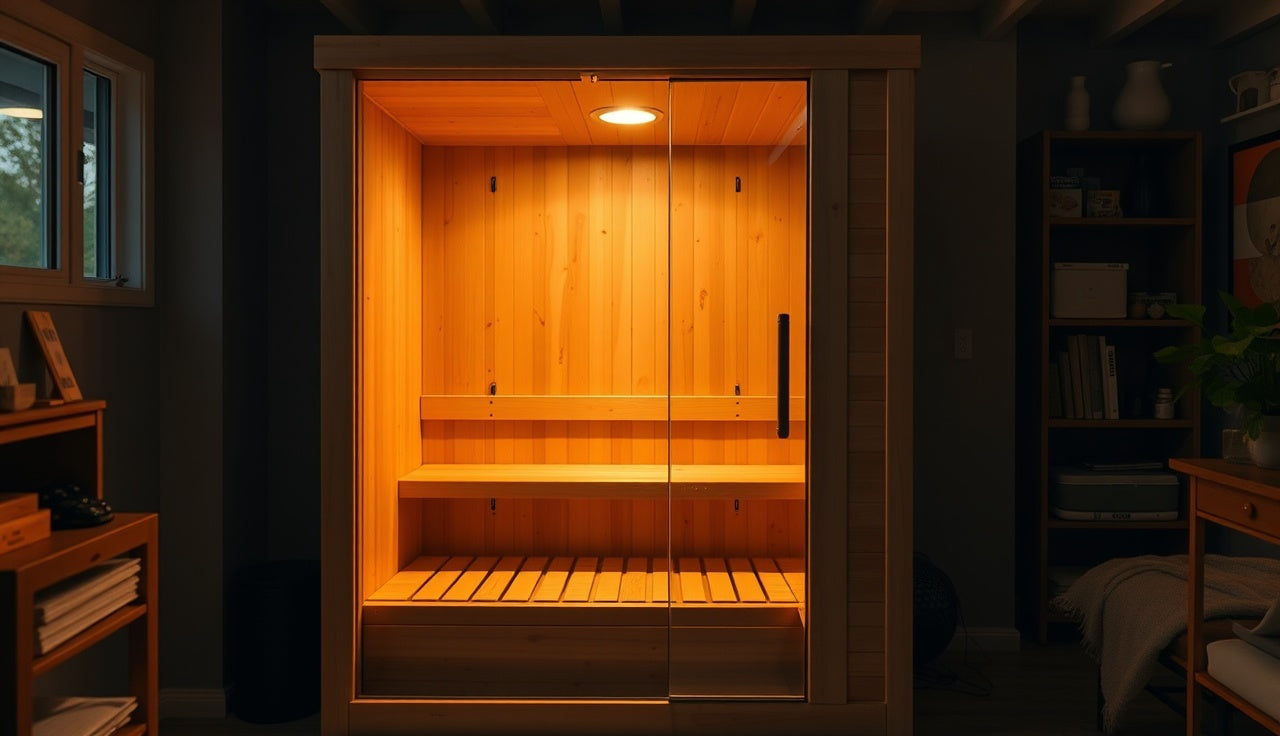
The 1-person Backyard Discovery sauna measures about 35 to 36 inches wide, 35 to 36 inches deep, and 75 inches tall (roughly 3 feet by 3 feet of floor footprint). Weight runs between 165 and 220 pounds depending on the wood and heater configuration. You need about 6 inches of clearance on at least three sides for ventilation and safe operation, so plan on a minimum floor area of roughly 5 feet by 5 feet.
The interior is tight. One average-sized adult fits comfortably seated on the included bench, but you cannot lie down or bring a friend. If two people are your use case, skip straight to the 4-person version. The 1-person cabin is a solo session space, full stop.
Shipping weight is typically around 250 to 280 pounds in the crate. Most retailers use freight or threshold delivery rather than standard parcel, so confirm before ordering whether the carrier will bring it inside. Several buyers report that the crate arrives in decent shape but the assembly hardware bag hides under the bench panels, worth knowing so you do not panic during unpacking.
| Spec | Typical 1-person value |
|---|---|
| Interior W x D x H | 35" x 35" x 74" |
| Exterior footprint | ~36" x 36" |
| Heater type | Carbon or ceramic far-infrared |
| Power requirement | 120V / 15A standard outlet |
| Wattage | 1,400 to 1,750W |
| Max temperature | ~140°F |
| Heat-up time | 15 to 25 minutes |
| Wood type | Canadian hemlock or cedar |
| Assembly time | 1 to 2 hours (2 people recommended) |
How does the infrared heating system work and is it actually effective?
The 1-person model uses either carbon flat-panel heaters or ceramic tube heaters, sometimes both in a hybrid setup. Carbon panels spread heat more evenly across a larger surface area and are generally preferred for whole-body exposure. Ceramic elements reach higher surface temperatures faster but can create hot spots if you sit too close.
Far-infrared energy is absorbed by water molecules in tissue at depths of 1 to 2 inches below the skin surface [1]. You get a core warming effect at air temperatures that feel merely warm in a traditional sauna. Studies on infrared sauna use show elevated core body temperature, heart rate increases comparable to moderate exercise, and measurable sweat output, though the research base is smaller and more mixed than the marketing implies [2].
Be clear about one thing: the evidence for specific health benefits is still early. A 2018 review in Evidence-Based Complementary and Alternative Medicine concluded that infrared sauna use showed promising associations with cardiovascular and pain outcomes but called for larger randomized controlled trials before strong clinical recommendations could be made [2]. In plain terms, regular sauna use appears to be good for you based on available data, but the infrared-specific claims ("detox," "lymphatic drainage") are mostly marketing. Sweat is sweat. Read more about what the research actually shows on the sauna benefits page.
The control panel on the Backyard Discovery unit is a simple digital display. You set temperature and a timer (usually up to 60 minutes). Some models add a Bluetooth speaker and chromotherapy LED lighting. Those extras are fine, but they are not the reason to buy a sauna, and the speaker quality is predictably mediocre.
| 1-person (1,750W) | $6.5 |
| 4-person standard (3,200W avg) | $11.9 |
| 4-person corner (4,000W avg) | $14.9 |
Source: U.S. Energy Information Administration, Electric Power Monthly
What does the Backyard Discovery 1-person sauna cost, and where do prices vary?
List price across Walmart.com, Amazon, and similar retailers runs $899 to $1,399 for the 1-person model. The price moves a lot. Black Friday, early January, and Memorial Day cycles reliably push the unit below $900. If you are not in a rush, waiting for one of those windows saves you $200 to $400.
The 4-person models (standard and corner) cost more, usually $1,800 to $2,800 depending on configuration. The backyard discovery 4-person cedar indoor infrared corner sauna sits at the higher end because the angled design uses more panels and takes up less wall space, which commands a premium.
Shipping is typically free on all three models from major retailers. Assembly is not included unless you pay for a third-party service. Walmart sometimes bundles assembly through a third party for around $150 to $200. If you are reasonably handy, the 1-person unit is two adults and an afternoon.
Total cost of ownership goes past the purchase price. Running the unit at 1,750W for 45 minutes a day at the US average residential electricity rate of $0.17/kWh [3] comes to about $0.21 per session. That is roughly $76 per year at daily use, meaningfully cheaper than a gym membership with a sauna. Compare it to driving to a gym sauna at midnight: this setup wins on convenience and long-term cost.
For context on where this product sits in the wider market, see the sauna buying overview.
How do you assemble the Backyard Discovery 1-person cedar sauna?
Assembly follows a panel-and-peg system. The floor panel goes down first, then the back wall, side walls, and roof sections slot together using pre-drilled holes and wooden dowels or cam locks depending on the production run. The heater panels are pre-wired to a central control harness, so you are mostly connecting labeled plugs, not doing any real electrical work.
Common pain points reported by buyers:
1. The instruction manual can be poorly translated with ambiguous diagrams. Searching YouTube for the model number usually turns up a walkthrough video that beats the paper instructions.
2. The bench height is fixed on most versions, which is fine for users 5'4" to 6'0" but can feel awkward for taller people who want to lean back.
3. Door alignment sometimes needs adjustment after assembly. The hinge screws are accessible and most buyers fix this in under 10 minutes.
Do not assemble this solo if you can help it. The wall panels are light (roughly 20 to 30 pounds each), but positioning them while keeping adjacent walls plumb is genuinely a two-person task. Budget 90 minutes to 2 hours.
Once assembled, plug it into a standard 15-amp 120V outlet. The unit does not need a dedicated circuit at 1,750W (a 15A 120V circuit handles up to 1,800W continuously), but avoid running other high-draw appliances on the same circuit while using the sauna.
Is the Backyard Discovery sauna safe to use indoors?
Yes, with a few practical notes. Infrared saunas do not produce combustion, open flame, or steam, so they carry less risk than wood-burning units for indoor use. The exterior stays warm but not hot enough to burn surrounding materials under normal conditions. Most manufacturers recommend 6 inches of clearance from walls and ceiling.
Still, the interior hits 130 to 140°F and the heater panels reach higher surface temperatures. Do not hang towels or clothing on the heater panels. Keep the session timer on, especially if you are new to sauna use or prone to overheating.
The Consumer Product Safety Commission has not issued recalls or safety alerts for Backyard Discovery sauna models as of this writing, but the agency maintains a database of product recalls [4] worth checking before purchase if you want to verify current status.
Hydration matters more than people expect. The American College of Sports Medicine notes that even modest dehydration of 1 to 2% of body weight impairs thermoregulatory function [5]. Bring water into the session. Start with 15 to 20 minutes at lower temperatures if you are new to infrared use, and step out if you feel dizzy or nauseous.
People with cardiovascular conditions, pregnancy, or implanted medical devices (including certain pacemakers) should get physician clearance before regular use. The CDC does not have infrared sauna guidance, but general heat stress thresholds from OSHA's occupational heat guidance make a useful reference [6].
How does the 1-person model compare to the 4-person and corner versions?
The three Backyard Discovery models fit different household situations, and the choice is mostly about space and budget, not quality differences.
The 1-person unit is the obvious pick for a single user who has a spare bedroom corner, a finished basement, or a large bathroom. It takes up less than 10 square feet of floor space and the lower wattage (1,400 to 1,750W vs. 2,400 to 4,800W for the 4-person) keeps electricity costs modest.
The backyard discovery 4-person cedar indoor infrared sauna expands to roughly 47" x 47" or larger depending on configuration. Four-person is a marketing stretch for a unit this size. Two adults sit comfortably, two more squeeze in, and that is the real capacity. Couples or small families get real value here.
The backyard discovery 4-person cedar indoor infrared corner sauna uses an angled cabinet designed to slot into a room corner, which saves linear wall space even though the total square footage is similar. If your layout has a dead corner but not a full wall run, this configuration is the practical choice. The heater panel count is usually higher, meaning faster heat-up and more even coverage.
| Model | Approx. interior size | Wattage | Typical price |
|---|---|---|---|
| 1-person | 35" x 35" x 74" | 1,400 to 1,750W | $899 to $1,399 |
| 4-person | 47"+ x 47"+ | 2,400 to 4,000W | $1,800 to $2,500 |
| 4-person corner | 47"+ angled | 2,800 to 4,800W | $2,000 to $2,800 |
All three models run on 120V at lower wattages or 240V at higher wattages depending on the specific configuration sold. Confirm the voltage before you buy, because retrofitting a 240V outlet costs $200 to $600 depending on your panel's proximity to the sauna location.
What do real buyer reviews say about long-term durability?
The honest picture from verified purchaser reviews is mixed in the right ways for this price tier.
Positives that come up repeatedly: easy assembly compared to competitors, effective sweating even at relatively low temperatures, quiet operation, and the fact that it actually fits in the advertised space without modification.
Negatives that come up repeatedly: the Bluetooth speaker is weak, the temperature readout can run 5 to 10°F higher than actual internal temperature (a known quirk of budget digital sensors), and the wood finish is not quite the rich cedar look you see in marketing photos. Some buyers report minor warping of bench or wall panels after 12 to 18 months of heavy use, usually from inadequate ventilation after sessions. Leaving the door cracked open for 20 to 30 minutes after each use cuts moisture buildup and extends the wood's life.
Control panel failures are the most common hardware complaint. The digital control board in budget infrared saunas is a known weak link. Replacement boards cost around $40 to $80 on Amazon, and the swap is straightforward if you are comfortable with basic electrical connectors. Warranty coverage on the Backyard Discovery units is typically 1 year on parts and limited coverage on the wood structure, so register your warranty the day it arrives.
For comparison, a portable sauna costs $100 to $300 but is a fundamentally different (and less effective) product. The Backyard Discovery unit is a real wood cabin sauna, not a pop-up tent with a steam wand.
How does an infrared sauna compare to a cold plunge for recovery?
These two modalities do different things physiologically, and combining them is a legitimate recovery strategy used by a lot of athletes.
Infrared sauna sessions raise core temperature, increase heart rate, drive vasodilation, and promote sweating. Cold water immersion (a cold plunge or ice bath) does the opposite: rapid vasoconstriction, reduced inflammation markers, and a big norepinephrine release. A 2021 meta-analysis in Sports Medicine found that cold water immersion significantly reduced muscle soreness and perceived fatigue in the 24 to 72 hour window post-exercise [7].
The combination of heat followed by cold, sometimes called contrast therapy, produces alternating vasodilation and vasoconstriction that some practitioners describe as a "vascular pump." The research on contrast therapy specifically is thinner than the research on either modality alone. The closest data comes from a 2013 Journal of Strength and Conditioning Research study showing superior next-day performance recovery with contrast versus passive rest [8]. Nobody has perfect data on optimal timing and temperature differentials. Most protocols use 10 to 15 minutes of heat followed by 2 to 5 minutes of cold, repeated 2 to 3 rounds.
If you are building a home recovery setup, pairing the Backyard Discovery sauna with a cold plunge or chest freezer conversion is reasonable and increasingly popular. More on the cold side of the equation at cold plunge benefits.
SweatDecks covers both categories if you want to compare specific products side by side in one place.
What should you check before buying this specific sauna?
A few things worth confirming before you pull the trigger:
First, check the exact model number listed in the retailer's item description. Backyard Discovery has updated its lineup and some older listings still circulate. The newer versions use higher-quality carbon panels; the older ones used ceramic tube heaters. Neither is bad, but carbon panels are generally preferred for even heat distribution.
Second, measure your door width. The assembled cabinet is roughly 36 inches wide and 75 inches tall. Most interior doors are 32 to 36 inches wide. If your target room has a 30-inch door, the panels will not fit through assembled and you will need to assemble them in place, which is harder.
Third, confirm the electrical situation. The 1-person unit at 1,750W runs on a standard 15A 120V outlet, which most homes have in every room. Some buyers report the unit trips a shared circuit when the refrigerator or other high-draw appliances run on the same breaker. Running the sauna on a lightly loaded circuit solves this without any rewiring.
Fourth, think about flooring. The unit sits on a wood floor panel, but vibration and mild heat transfer to the floor below. A rubber or cork mat underneath adds insulation and protects hardwood from the minor moisture that escapes during sessions.
Finally, compare the Backyard Discovery against other options at a similar price point, including units sold under the Costco label. The costco sauna overview covers how those units stack up on wood quality, heater wattage, and warranty terms, which is useful context before committing to any budget-tier purchase.
Is the Backyard Discovery sauna worth buying in 2025?
It depends on what you are comparing it to.
Against a gym membership for sauna access ($50 to $100/month at most facilities), the Backyard Discovery 1-person unit pays for itself in under 18 months of regular use, and you get unlimited sessions on your own schedule. That math is straightforward.
Against a higher-end infrared sauna from Sunlighten, JNH Lifestyles, or Clearlight, the Backyard Discovery unit is a notch below on wood quality, heater longevity, and warranty support. Those brands charge $2,500 to $8,000+ for 1-person models. Whether that premium is justified depends on your budget and how seriously you plan to use the unit.
For someone who wants to try regular infrared sauna sessions without a large financial commitment, the Backyard Discovery 1-person model is a reasonable starting point. It heats up, it makes you sweat, it takes up manageable space, and the assembly is not a nightmare. Use it three or more times a week for a year, then outgrow it or decide you want something better, and you have lost relatively little money.
If you are already sure you want a sauna as a permanent fixture and you have the budget, spend more on a unit with a better heater warranty and thicker wood panels. The difference in daily user experience over five years is real.
SweatDecks has a curated selection of infrared saunas across multiple price tiers if you want to compare the Backyard Discovery against similarly priced competitors before deciding.
Frequently asked questions
Does the Backyard Discovery 1-person sauna need a special electrical outlet?
The 1-person model runs on a standard 120V 15-amp outlet, the same type found in most US home rooms. At 1,750W it approaches the 15A continuous limit, so avoid sharing the circuit with other high-draw appliances while in use. You do not need to install a dedicated circuit, but it helps. The 4-person models at higher wattages may require a 240V outlet; always confirm before purchasing.
How long does it take the Backyard Discovery infrared sauna to heat up?
Expect 15 to 25 minutes to reach 120 to 140°F from a cold start. Far-infrared saunas are sometimes used before they hit target temperature because the panels emit radiant heat from the moment they power on. Many users start their session at the 10-minute mark and let the cabin warm around them, which works fine with carbon panel designs.
Can I use the Backyard Discovery sauna in a bathroom or basement?
Yes, both locations work well. Basements are popular because they stay cool (reducing heat-up time and keeping ambient comfort high), have concrete floors that handle moisture, and sit out of the living areas. Bathrooms work if you have enough floor space (at least 5x5 feet of clear area). Avoid assembling the unit in a space prone to flooding or high ambient humidity year-round, as prolonged moisture exposure degrades the wood and electronics.
What is the warranty on Backyard Discovery saunas?
Standard warranty coverage is 1 year on parts and electronics, with limited structural coverage on the wood frame. This is on the shorter end for the sauna category; higher-end brands offer 3 to 7 years on heaters. Register your warranty right after purchase and keep your receipt. Third-party extended warranties from retailers like Walmart are worth considering given the control board failure rate noted in buyer reviews.
How much does it cost to run the Backyard Discovery sauna monthly?
At 1,750W and the US average electricity rate of $0.17/kWh, a 45-minute daily session costs about $0.21. That works out to roughly $6 to $7 per month at daily use. Running it every other day drops that to around $3 to $4 per month. Costs scale up for the 4-person models, which draw 2,400 to 4,800W depending on configuration.
Is cedar or hemlock better for a sauna cabinet?
Both work well. Western red cedar has natural tannins and oils that resist moisture and bacteria, has a warmer appearance, and produces the classic sauna scent. Hemlock is lighter in color, has no strong odor (preferred by some), weighs a little less, and costs a bit less. Hemlock is also less likely to cause skin irritation in people sensitive to cedar oils. Neither wood will rot or warp quickly with proper post-session ventilation.
Can two people fit in a 1-person Backyard Discovery sauna?
Technically two small adults can squeeze in, but it is genuinely uncomfortable and defeats the purpose of a relaxing session. The interior bench is sized for one person. If two people will use the sauna simultaneously even occasionally, buy the 4-person model. The price difference is significant but the experience difference is dramatic.
How does the Backyard Discovery sauna compare to higher-end infrared brands?
Premium brands like Sunlighten, Clearlight, and JNH Lifestyles offer thicker wood (1.5" vs. 1" panels), better heater warranties (5 to 7 years), lower EMF ratings, and more consistent build quality. They cost $2,500 to $8,000 for a 1-person unit versus $899 to $1,399 for the Backyard Discovery. For casual use, the Backyard Discovery is adequate. For daily use over a 5-year horizon, the premium units likely win on total cost of ownership.
What accessories do I need for the Backyard Discovery sauna?
The unit ships with a bench and basic accessories. Useful additions: a sauna bucket and ladle if you want to experiment with steam (though this is an infrared unit, some users add a little water to a towel on the floor for humidity), a sauna thermometer/hygrometer to verify actual internal temperature, a non-slip floor mat, and a backrest cushion for comfort during longer sessions. A separate Bluetooth speaker is worth it since the built-in one is weak.
Does infrared sauna use have proven health benefits?
The evidence is promising but still maturing. A 2018 review in Evidence-Based Complementary and Alternative Medicine found associations between infrared sauna use and improvements in cardiovascular function and chronic pain, but called for larger randomized trials. Finnish population studies showing reduced cardiovascular risk with frequent sauna use are stronger but were conducted with traditional high-temperature saunas, not infrared. Treat health claims as exploratory, not definitive.
Can the Backyard Discovery sauna be moved after assembly?
Yes, but it requires full disassembly. The panel-and-peg system comes apart and reassembles, and most buyers report the wood holds up through one move without significant damage. Do not slide or roll the assembled unit across floors; at 165 to 220 pounds the structure is not rigid enough to handle lateral stress without joints loosening. If you are in a rental or plan to relocate, treat it like furniture you will need to pack.
Is the Backyard Discovery sauna good for post-workout recovery?
It can support recovery by promoting blood flow, reducing muscle tension, and encouraging relaxation after training. A 2021 meta-analysis in Sports Medicine found that heat and cold modalities both reduce perceived muscle soreness post-exercise. Infrared specifically lacks the same volume of research as cold water immersion for acute recovery. Pairing a sauna session with cold plunge immersion covers both vasodilation and vasoconstriction mechanisms, which is the approach many serious athletes use.
Where is the best place to buy the Backyard Discovery infrared sauna?
Walmart.com and Amazon carry the full lineup and regularly run promotions that push prices 20 to 30% below list. Sam's Club occasionally stocks the 4-person models at competitive prices. Buying from a major retailer is safer than a third-party marketplace listing because returns on a 250-pound crate are logistics-intensive and you want a retailer with a clear returns process. Check the exact model number on each listing since photos do not always match the variant shipped.
What is the difference between the standard 4-person and the corner 4-person model?
The standard backyard discovery 4-person cedar indoor infrared sauna has a rectangular footprint and places against a flat wall. The corner version uses an angled front panel to fit into a room corner, saving linear wall space while keeping similar interior volume. The corner design typically has more heater panels to cover the angled geometry, so heat-up tends to be slightly faster. Price difference is $200 to $400 in favor of the standard rectangular model.
Sources
- National Institutes of Health, National Library of Medicine: 'Infrared Radiation and Its Applications in Medicine': Far-infrared energy is absorbed by water molecules in tissue at depths of 1–2 inches below the skin surface, producing a core warming effect at lower ambient temperatures than traditional saunas.
- Hussain & Cohen, 'Clinical Effects of Regular Dry Sauna Bathing: A Systematic Review', Evidence-Based Complementary and Alternative Medicine, 2018: A 2018 review concluded that infrared sauna use showed promising associations with cardiovascular and pain outcomes but called for larger randomized controlled trials before strong clinical recommendations could be made.
- U.S. Energy Information Administration, 'Electric Power Monthly: Average Retail Price of Electricity': US average residential electricity rate used in cost calculations is approximately $0.17/kWh.
- U.S. Consumer Product Safety Commission, Recalls Database: CPSC maintains a searchable database of product recalls that can be used to verify whether a specific sauna model has been recalled.
- American College of Sports Medicine, 'Exercise and Fluid Replacement' Position Stand: Even modest dehydration of 1–2% of body weight impairs thermoregulatory function during heat exposure.
- U.S. Occupational Safety and Health Administration, 'Heat Stress: Technical Manual Section III': OSHA heat stress thresholds provide a reference framework for safe heat exposure limits relevant to sauna use guidance.
- Machado et al., 'Can Water Temperature and Immersion Time Influence the Effect of Cold Water Immersion on Muscle Soreness?', Sports Medicine, 2021: A 2021 meta-analysis in Sports Medicine found that cold water immersion significantly reduced muscle soreness and perceived fatigue in the 24–72 hour window post-exercise.
- Gill et al., 'Effectiveness of Contrast Water Therapy and Static Stretching', Journal of Strength and Conditioning Research, 2013: A 2013 Journal of Strength and Conditioning Research study showed superior next-day performance recovery with contrast therapy versus passive rest.
- U.S. Energy Information Administration, 'Frequently Asked Questions: How much electricity does an American home use?': Context for residential electricity consumption and cost calculations for sauna operating cost estimates.
- Laukkanen et al., 'Association Between Sauna Bathing and Fatal Cardiovascular and All-Cause Mortality Events', JAMA Internal Medicine, 2015: Finnish population studies showing reduced cardiovascular risk with frequent sauna use; these studies used traditional high-temperature saunas, not infrared.

Share:
Why do athletes take ice baths? The real science explained
Home ice bath: the complete setup and use guide