
Last updated 2026-07-09
TL;DR
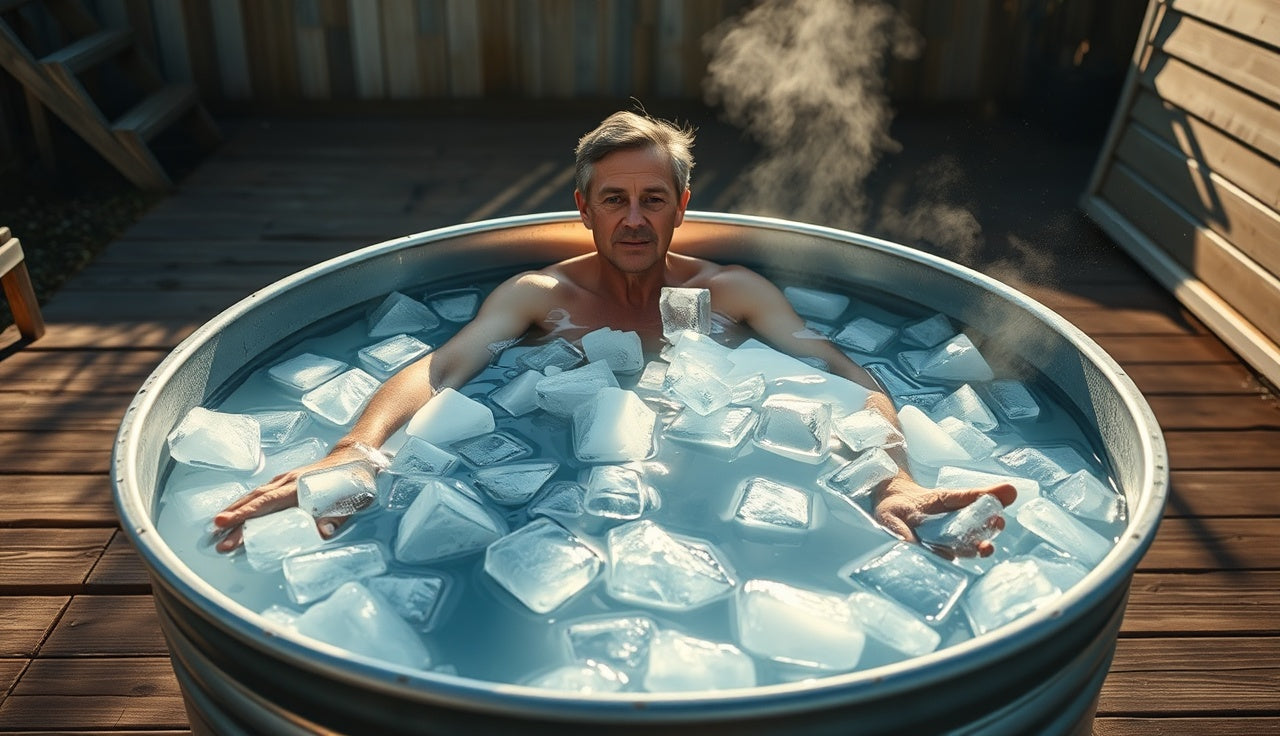
A home ice bath runs from a bathtub full of ice to a chiller-equipped plunge tub. Aim for 50-59°F (10-15°C) water and sessions of 10-15 minutes for recovery. Setup costs range from about $30 for a stock tank to $5,000 and up for a chiller unit. Get the temperature and timing right and the cheap version works as well as the expensive one.
What is a home ice bath and how does it work?
A home ice bath is cold water immersion you do in your own space, no gym membership or clinic visit required. You submerge, usually to the waist or shoulders, in water cold enough to set off a physiological response: blood vessels narrow (vasoconstriction), tissue temperature drops, norepinephrine spikes, and once you climb out, your vessels dilate again as the body rewarms.
The basic mechanism is well understood. Cold water pulls heat from your body roughly 25 times faster than air at the same temperature, which is why 55°F water feels far colder than a 55°F room. Muscle tissue cools, nerve conduction slows, and short-term inflammatory signaling drops.
The research is messier than the marketing. A meta-analysis in the British Journal of Sports Medicine (Machado et al.) found cold water immersion reduced perceived muscle soreness and fatigue compared to passive rest, but the effect on objective performance recovery was modest [1]. Nobody serious claims it replaces sleep or food. It is one real tool, not a cure-all.
For most people, an ice bath at home is one piece of a heat-and-cold routine. Add a sauna session before or after and you have contrast therapy, which brings its own uses.
What temperature should a home ice bath be?
Aim for 50-59°F (10-15°C). That is the range used in most cold water immersion recovery research [1][2]. Athletes in lab settings sometimes go to 46-50°F (8-10°C), but you lose most of the measurable benefit below 50°F while the risk of cold shock climbs sharply.
Most home setups land between 50°F and 58°F, easy to hit with grocery-store or gas-station ice. A bag or two (about 20 lbs each) dropped into cold tap water gets you there, depending on your starting water temperature and how warm the room is.
Here is a rough guide to how temperature changes the experience:
| Temperature | Feel | Typical use |
|---|---|---|
| 68°F (20°C) | Mildly cool | Too warm for most recovery protocols |
| 59°F (15°C) | Cold, manageable | Light recovery, beginners |
| 50-55°F (10-13°C) | Very cold | Standard athlete protocol |
| 46-50°F (8-10°C) | Intense | Experienced users, short exposures |
| Below 45°F (<7°C) | Dangerous | Not recommended for home use |
New to it? Start at 59°F and work down over several weeks. Your body acclimates. The shivering and panic-breath that hit you the first few times genuinely fade with repeated exposure.
How long should you stay in a home ice bath?
Ten to fifteen minutes. That is the window used in most cold water immersion research at the temperatures above [1][2]. Past 15-20 minutes in water below 55°F, the benefit stops climbing, and if you are pushing colder temperatures your hypothermia risk starts to matter.
The changes you are chasing happen fast. The norepinephrine spike (one study in Acta Physiologica Scandinavica found it rising up to 300% after cold exposure [3]), the vasoconstriction, and the tissue cooling all arrive within the first 5-10 minutes. After that, the return drops off a cliff.
A sane beginner progression: start at 2-3 minutes in 59°F water, add a minute or two each session over a few weeks, and build toward 10-12 minutes at 52-55°F. You do not need an extreme number to get the effect.
Timing around your workout matters too. Post-exercise immersion within 30-60 minutes of training is the standard research window. Some researchers studying muscle growth have asked whether regular post-lift cold immersion blunts strength gains, and a 2015 study in the Journal of Physiology (Roberts et al.) found it did [4]. If your main goal is building muscle, keep cold plunges to days you are not lifting.
What are the cheapest ways to set up an ice bath at home?
You can get a working home ice bath for under $50. Here are the real options, cheapest first:
Your bathtub. Free, minus ice. Fill it with cold tap water, add two to four 20-lb bags from a gas station ($5-8 each), and you land around 50-55°F. The catch: most tubs are 5 feet long, so submerging your legs while keeping your head out is awkward. And you buy ice every single time.
A stock tank. A 100-gallon galvanized stock tank from a farm supply store (Tractor Supply, Rural King) runs about $120-180 [5]. Polyethylene tanks cost about the same. These are deep enough for full leg immersion and hold up, which makes them the default DIY pick for regular users. You still need ice each session unless you add a chiller.
A chest freezer conversion. A used 7-15 cubic foot chest freezer costs $100-300. Add a pre-set thermostat controller (about $20) so the compressor holds your target temperature instead of freezing the water solid. Now you have filtered, controllable, reusable cold water for $150-400 all in, and it is the best value in cold plunges [6]. The water still needs sanitizing and upkeep.
Purpose-built tubs without chillers. Insulated tubs sell for $300-1,200. They hold temperature longer than a stock tank but still need ice.
Starting out? Take the stock tank or the bathtub. Prove you will actually use the thing before you spend real money.
Want to compare the wider cold plunge market? There is a lot of noise to cut through.
What do chiller-equipped cold plunge units cost?
If you want water that is always cold and never needs ice, you need a chiller. Prices run from modest to eye-watering:
| Option | Estimated cost | Notes |
|---|---|---|
| Chest freezer conversion | $150-400 | DIY, best value, needs maintenance |
| Entry-level tub with chiller | $1,500-2,500 | Purpose-built, compact |
| Mid-range cold plunge unit | $2,500-5,000 | Better insulation, faster chill |
| Premium units (e.g., Plunge, ColdTub) | $5,000-10,000+ | Built-in filtration, wi-fi controls |
The sticker price is not the whole cost. Budget for water chemistry (a bromine or chlorine sanitizer system runs $20-60/month), filter cartridges, and electricity. A chiller running continuously adds roughly $30-80/month to your power bill, depending on room temperature and how well the unit is insulated.
SweatDecks carries a curated set of cold plunge options if you want to compare specs side by side without wading through sponsored influencer noise.
One thing to know: the $5,000-10,000 tier is where you pay for looks, app controls, and ozone/UV filtration. The cold water itself is not colder or more therapeutic than a $400 chest freezer setup. Buy the expensive one because you want it in your bathroom, not because it works better.
See also the full breakdown on cold plunge benefits if you want the research before you decide how much to spend.
| Bathtub + ice (3x/week) | $2,000 |
| Stock tank + ice (3x/week) | $2,200 |
| Chest freezer conversion | $700 |
| Entry-level chiller unit | $3,000 |
| Mid-range cold plunge unit | $5,500 |
| Premium cold plunge unit | $10,000 |
Source: Tractor Supply Co. retail pricing, Popular Mechanics DIY guide, and manufacturer published pricing, 2024-2025
Is a home ice bath safe? What are the real risks?
Cold water immersion carries real risks. They are manageable for a healthy adult, but do not skip this section.
Cold shock response. In the first 30-90 seconds, involuntary gasping and hyperventilation can make you inhale water if your face is near the surface. Never submerge your head in a cold plunge, especially alone. The gasp reflex does not fade much even with experience, according to a cold shock review in Wilderness & Environmental Medicine (Tipton et al.) [7].
Hypothermia. True hypothermia (core temperature below 95°F / 35°C) is unlikely in a 10-15 minute session at 50-55°F for a healthy adult, but it is possible if you fall asleep, stay too long, or are very underweight. Children and older adults are far more vulnerable and should not do home cold plunges without medical guidance.
Cardiovascular effects. Cold immersion spikes heart rate and blood pressure in the first minute, then triggers a parasympathetic rebound. For anyone with a heart condition, that is a real risk. The American Heart Association advises people with cardiovascular disease to talk to a physician before cold immersion [8].
Never go alone when you are new. Keep someone nearby for your first several sessions. Cold shock, hyperventilation, and panic together can make it hard to climb out safely.
Pregnancy. There is not enough safety data on cold immersion during pregnancy. Avoid it.
None of this makes home ice baths dangerous for the average healthy adult who follows the guidelines. Millions do this safely every week. Just go in informed.
How do you set up an ice bath at home step by step?
Here is the process, depending on your setup.
Bathtub setup: 1. Fill the tub with cold tap water to about waist-to-chest height when seated. 2. Add 20-40 lbs of ice, which usually pulls tap water (55-65°F) into the 50-58°F range. Confirm with a thermometer. 3. Get in slowly. Sit down, control your breathing, and let your body adjust for 30-60 seconds before you settle in. 4. Stay 10-15 minutes. Keep a timer where you can see it. 5. Get out, dry off, and rewarm naturally. Skip the immediate hot shower, which may blunt some of the effect.
Stock tank or chest freezer setup: 1. Fill and chill. A chest freezer conversion holds temperature indefinitely; a stock tank with ice needs re-icing each session. 2. Check the water with a digital thermometer before you get in. Never guess. 3. Keep it clean. Change water every 1-2 weeks in an unfiltered stock tank, and add a sanitizer if you reuse water across sessions. 4. Put the tank somewhere stable near a drain. A 100-gallon tank weighs over 800 lbs full. 5. Same protocol: controlled entry, 10-15 minutes, exit, rewarm.
One thing most guides skip: plan your exit before you get in. Cold-numbed hands and legs are clumsy. Make sure there is a solid edge to grip, a mat on the floor, and nothing on you that could tangle.
Does contrast therapy (sauna then ice bath) work better than ice bath alone?
Contrast therapy, alternating hot and cold, is a different protocol from cold-only immersion. Heat opens the blood vessels, cold clamps them shut, and the swing acts like a pump on your peripheral circulation.
The evidence is real but modest. A meta-analysis in the Journal of Strength and Conditioning Research (Bieuzen et al.) found contrast water therapy reduced delayed onset muscle soreness more than either cold or thermoneutral water alone [9]. Effect sizes were small to moderate. Not a dramatic result, but a consistent one across several trials.
Subjectively, most people who try both say contrast feels better and is easier to stick with than cold alone. Starting in a home sauna or a portable sauna for 15-20 minutes, then moving into cold water, is a practice with real backing and a long history in Finnish, Japanese, and Scandinavian bathing culture.
A reasonable home contrast protocol:
- Heat: 15-20 minutes in a sauna at 170-190°F (or a hot tub)
- Cold: 5-10 minutes in 50-58°F water
- Repeat 2-3 cycles if you have time
- End on cold for alertness, end on warm for relaxation
Building a home recovery setup on one budget? The evidence slightly favors the cold plunge for acute recovery. But if you have room and money for both, the combination is an enjoyable daily habit that most people actually keep.
How do you keep ice bath water clean at home?
This is the part nobody talks about enough. Ice bath water gets dirty fast, especially with daily use or more than one person.
The sources are exactly what you would guess: skin bacteria, sweat, debris, and algae if the water sits warm between sessions. Without sanitizing, a stock tank or tub can turn into a health hazard within a few days.
For ice-based setups you drain after every session, cleaning is simple. Rinse and wipe the vessel, let it dry, refill. Done.
For systems where you reuse water (chest freezer conversions, chiller units), here is a standard maintenance routine:
- Sanitizer: Bromine tabs are gentler on skin than chlorine at cold temperatures and more stable. Hold 3-5 ppm bromine, checked weekly with test strips. Chlorine works too but usually needs more frequent testing.
- pH: Keep it between 7.2 and 7.8. Outside that range, sanitizers weaken and skin irritation goes up.
- Filter: If your unit has a pump and filter, run it several hours a day. Change cartridges on the manufacturer's schedule, usually monthly.
- Full water change: Every 2-4 weeks for a typical single user, or sooner if the water turns cloudy despite correct chemistry.
- Cover it: A lid keeps out debris and slows temperature rise between sessions.
No sanitizer replaces periodic full drains. Any standing-water tub is a maintenance commitment. Factor that into what you buy.
What are the science-backed benefits of ice baths at home?
Here is what the research supports, minus the hype.
Reduced perceived muscle soreness. The most consistent finding. The British Journal of Sports Medicine meta-analysis (Machado et al.) confirmed cold water immersion lowered muscle soreness scores compared to passive rest [1]. The effect is real.
Mood and alertness. Cold exposure drives a large, reliable spike in norepinephrine and dopamine. The Acta Physiologica Scandinavica study found norepinephrine rising by as much as 300% after immersion in water near 57°F [3]. Those are the neurochemicals tied to focus, mood, and drive, and the lift lasts hours after a session.
Reduced subjective fatigue. Across multiple trials, athletes report lower fatigue after cold immersion than after passive rest, even when the objective performance markers look similar.
Possible metabolic effects. Cold activates brown adipose tissue, which burns calories to make heat. Regular cold exposure may raise brown fat volume and metabolic rate over time, though the weight-loss significance in humans is still being studied [10].
What is not well established: Cold immersion is not proven to speed injury healing, treat depression on its own, or improve cardiovascular health by itself. Some of those effects are plausible. The evidence just is not strong enough yet to make the claim.
Honest summary: home ice baths are a legitimate recovery tool with real support for soreness reduction and neurochemical effects. The bigger claims circulating online have run ahead of the science.
What equipment do you actually need for a home ice bath?
Not much. Here is the honest minimum plus the upgrades that actually earn their spot.
Non-negotiable:
- A vessel (bathtub, stock tank, chest freezer, or dedicated tub)
- A digital thermometer ($10-20). Do not skip this. You cannot judge water temperature by feel.
- Ice (for non-chilled setups) or a chiller/controller (for reuse setups)
Genuinely useful:
- A waterproof timer. Your phone works, but cold wet hands and glass screens are a bad pair.
- Neoprene socks and gloves if cold extremities are what pushes you out early. Hands and feet have a high surface-area-to-volume ratio and cool fast.
- A mat or non-slip surface next to the tub.
- A drain hose or sump pump for stock tanks. Draining 100 gallons by hand is miserable.
Nice at higher budgets:
- Ozone or UV sanitation (cuts chemical load)
- A lid or insulating cover (slows temperature rise a lot)
- A small circulation pump ($30-60) to kill cold spots
Skip these:
- Branded "recovery additives" and ice bath salts. No evidence they improve outcomes.
- Fancy thermometers. A $15 probe is accurate enough.
Building a full cold-and-heat setup? See SweatDecks' cold plunge collection for what filtration and chiller specs actually mean in practice.
Can you use a regular bathtub as an ice bath?
Yes, and plenty of serious athletes do exactly that. A standard American bathtub holds 40-60 gallons, enough water to work with.
The limits are real, though. Most tubs run 5 feet long, so a 6-foot person cannot fully submerge their legs while keeping the torso and head out. You also cannot sit upright comfortably in most tubs, which makes it harder to steady your breathing and stay calm through a session.
And the ice cost adds up. At $5-8 per 20-lb bag and 2-4 bags per session, you spend $10-30 each time. Three times a week is $1,500-4,500 a year. At that rate, a chest freezer conversion pays for itself in under a year.
For occasional use, or for testing whether you will actually keep the habit, the bathtub is fine. For regular use, it gets inconvenient and expensive fast. The stock tank is the better long-term answer for most people who do not want a full chiller.
Frequently asked questions
How much ice do I need for an ice bath at home?
For a standard bathtub starting with 55-60°F tap water, expect 20-40 lbs of ice to reach 50-55°F. A 100-gallon stock tank needs 40-60 lbs. A 20-lb bag costs $5-8 at most gas stations or grocery stores. Buying bulk from a grocery store or an ice delivery service cuts the per-pound cost a lot if you plunge several times a week.
How often should I take an ice bath at home?
Most research protocols use 2-4 sessions per week. Daily cold immersion is fine for healthy adults, though it may blunt muscle protein synthesis if done right after strength training. If hypertrophy is your main goal, hold off on cold immersion on lifting days. For general recovery and mood, daily use looks safe. Take a week off now and then to see how you feel without it.
Is an ice bath good for weight loss?
Cold exposure activates brown adipose tissue and raises metabolic rate a little. A 2022 study in Cell Metabolism (Søberg et al.) found regular cold exposure meaningfully activated brown fat in adults. But the calorie burn in a single 10-15 minute session is too small to drive real weight loss on its own. Cold immersion is not a reliable standalone weight loss tool based on current evidence.
What should I wear in an ice bath?
Whatever you are comfortable in. A swimsuit is the common choice. Some people use neoprene shorts for groin protection, and neoprene socks and gloves genuinely help if cold hands and feet are what push you out. No clothing adds a recovery benefit. Wear what lets you stay in long enough to finish the protocol.
Can I take an ice bath if I have high blood pressure?
Cold water immersion drives a fast rise in blood pressure in the first 60-90 seconds from vasoconstriction. For anyone with hypertension or a cardiovascular condition, that is a real concern. The American Heart Association advises consulting a physician before cold immersion if you have a cardiac history. Do not start cold plunges to treat blood pressure. Talk to your doctor first.
How do I rewarm after a home ice bath?
Rewarm naturally: move around, put on dry warm clothes, and have a warm drink if you want one. Skip the immediate hot shower, which may reduce some of the post-immersion response you are after. Light movement like walking or dynamic stretching warms the extremities faster than sitting still. Most people feel fully comfortable within 15-30 minutes of a properly timed session.
What is the difference between a cold plunge and an ice bath?
Most people use the terms interchangeably. Technically, a cold plunge often means a purpose-built vessel with filtration and sometimes a chiller, while an ice bath usually means a temporary setup with ice in a bathtub or stock tank. At the same temperature the physiological experience is identical. The difference is convenience, cost, and looks, not effectiveness.
How do I make my ice bath colder without buying more ice?
Start with the coldest tap water you have. In winter, cold tap water in northern US states can run 45-50°F on its own, so you barely need ice. Prechilling your stock tank or tub overnight with a small circulation pump helps. Adding salt lowers the freezing point and can make the water feel colder, though it complicates chemistry and may irritate skin at high concentrations.
Is it safe to do an ice bath alone at home?
For experienced users following set protocols, solo plunging is common. For beginners, keep someone nearby for the first several sessions. The cold shock response in the first 30-90 seconds can cause gasping and disorientation. Solo, use a timer, keep your phone close, never submerge your head, and stay in water shallow enough that you can stand and step out easily.
Can I build my own cold plunge at home cheaply?
Yes. The most cost-effective DIY cold plunge is a chest freezer conversion: a used chest freezer ($100-300), a thermostat temperature controller ($15-25), and water. Set the controller to your target (50-55°F) and it runs the compressor just enough to hold that without freezing. Total is usually $150-400. You still maintain water chemistry, but you drop ice buying entirely.
Does an ice bath help with inflammation?
Cold water immersion lowers acute inflammatory signaling in the short term by cooling tissue and slowing cellular metabolism. Multiple studies confirm reduced markers of exercise-induced muscle damage right after immersion. The longer-term effect on chronic inflammation is less clear and not well established. Treat it as a way to manage exercise soreness, not a treatment for inflammatory conditions.
How long does ice last in a home ice bath setup?
In an insulated stock tank or tub with a lid, 40-60 lbs of ice in cold tap water holds 50-55°F for roughly 1-2 hours in a 70°F room. In direct sun or warm outdoor air, that window shrinks fast. For a single 15-minute session, ice longevity is a non-issue. For multiple daily sessions, you need either a chiller or a plan to add fresh ice before each use.
What is the ideal home ice bath routine for muscle recovery?
Most sports science research uses post-exercise immersion within 30-60 minutes of training, at 50-59°F, for 10-15 minutes. That is a reasonable home target. If you train for strength and size, some researchers advise skipping cold immersion right after lifting, since a 2015 Journal of Physiology study found it may blunt long-term muscle adaptation. Save cold plunges for rest days or after conditioning work in that case.
Sources
- British Journal of Sports Medicine, Machado et al. 2016, meta-analysis on CWI and muscle recovery: Cold water immersion reduced muscle soreness and fatigue compared to passive rest; effect on objective performance recovery was modest
- Journal of Physiology, Versey et al. 2013, water immersion recovery for athletes: Optimal cold water immersion temperature range of 10-15°C (50-59°F) for recovery protocols
- Acta Physiologica Scandinavica, Srámek et al. 2000, physiological responses to cold water immersion: Norepinephrine increases up to 300% after immersion in cold water around 14°C (57°F)
- Journal of Physiology, Roberts et al. 2015, post-exercise cold water immersion and muscle adaptation: Regular post-training cold water immersion attenuated long-term muscle strength and hypertrophy gains compared to active recovery
- Popular Mechanics, DIY chest freezer cold plunge guide: Chest freezer conversion with thermostat controller is a viable DIY cold plunge at $150-400 total cost
- Wilderness & Environmental Medicine, Tipton et al. 2014, cold shock response review: Cold shock gasping and hyperventilation response occurs in first 30-90 seconds of cold water immersion and does not decrease substantially with experience
- American Heart Association, heart.org, physical activity and cardiovascular conditions: People with cardiovascular conditions should consult a physician before cold water immersion due to rapid heart rate and blood pressure changes
- Journal of Strength and Conditioning Research, Bieuzen et al. 2013, contrast water therapy meta-analysis: Contrast water therapy reduced delayed onset muscle soreness more than cold or thermoneutral water alone, with small to moderate effect sizes
- Cell Metabolism, Søberg et al. 2022, cold exposure and brown adipose tissue activation: Regular cold exposure meaningfully activated brown adipose tissue in adult humans, suggesting metabolic effects from cold immersion

Share:
Are infrared saunas safe? What the evidence actually shows
Are infrared saunas safe? What the evidence actually shows