
Last updated 2026-07-09
TL;DR
A 6-person barrel sauna runs 6.5 to 7.5 feet in diameter and 8 to 9 feet long, costs $4,000 to $12,000 installed, and needs a 240V/40A circuit for an electric heater or code clearance for a wood stove. Cedar and thermowood hold up best. Two people can assemble most kits in a weekend.
What exactly is a 6-person barrel sauna?
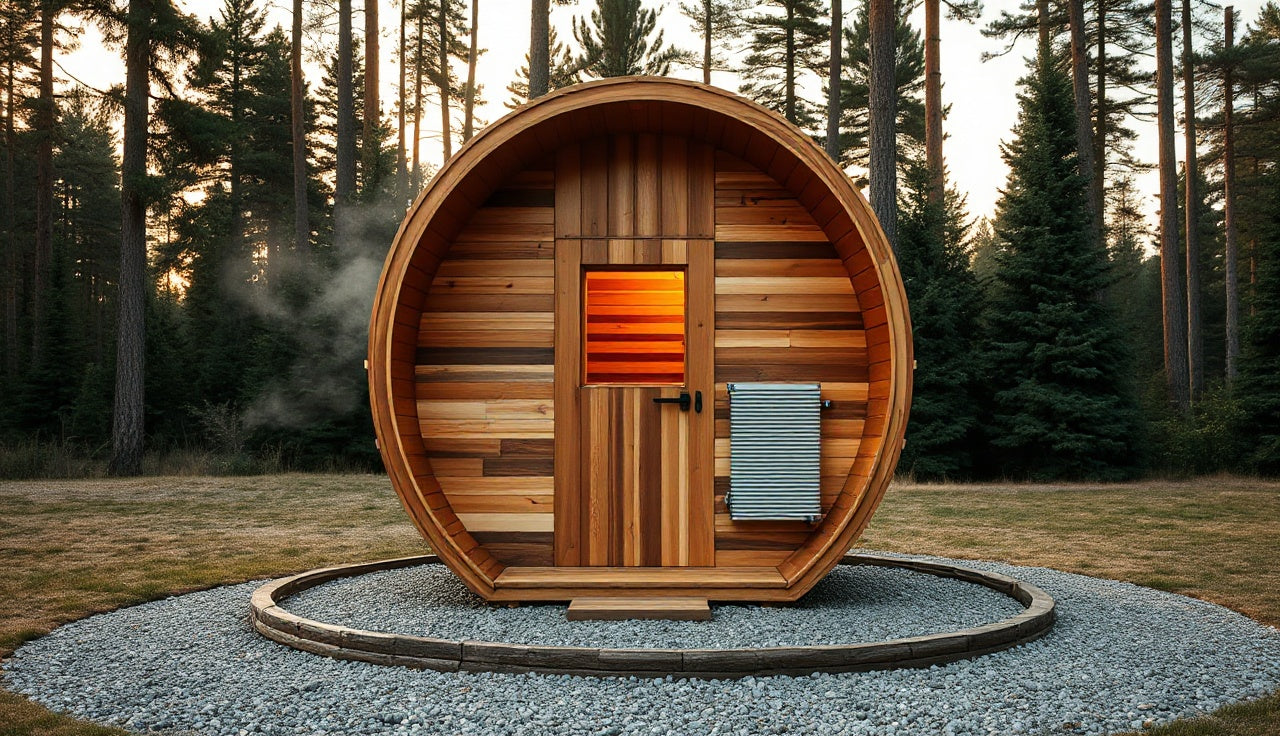
A barrel sauna is a cylindrical wood structure built from curved staves, usually red cedar or Nordic spruce, cinched together by stainless steel or aluminum bands. The round shape does real work. Hot air rises, cools, and falls along the curved walls in a continuous loop, which shrinks the temperature gap between your feet and your head compared to a boxy cabin.
A 6-person barrel is the biggest standard size most manufacturers offer. Numbers vary, but you're almost always looking at an interior diameter between 6.5 and 7.5 feet and a length of 8 to 9 feet. That's enough bench perimeter for six adults, though "6 person" ratings assume slim people sitting bolt upright with no elbow room. Four to five adults who want to actually relax is the honest figure.
The format has Scandinavian roots. Traditional Finnish saunas often used cylindrical log sections, and the modern barrel took off in North America through the 1980s and 90s as a factory-made alternative to a custom cabin. Units ship as pre-cut stave kits, which is why assembly runs in hours instead of days.
Comparing sizes helps. A barrel sauna 2 person unit runs about 4 to 5 feet in diameter and 5 to 6 feet long, roughly half the interior volume of a 6-person model. The 6-person is a different kind of purchase. It needs permanent electrical work, a real foundation, and a lot more yard.
How much does a 6-person barrel sauna cost?
Plan on $4,000 to $12,000 all-in for a good 6-person barrel sauna. Here's how that breaks down.
| Category | Price Range | Notes |
|---|---|---|
| Budget kits (spruce, basic hardware) | $3,500 - $5,000 | Often thinner staves, cheaper bands |
| Mid-range cedar kits | $5,000 - $8,000 | Most popular segment, good longevity |
| Premium thermowood or thick-stave cedar | $8,000 - $12,000 | Better heat retention, longer lifespan |
| Electric heater (if not included) | $500 - $1,500 | Harvia, Finnleo, Helo are common brands |
| Wood-burning stove (if not included) | $800 - $2,500 | Higher upfront, no electrical cost |
| Electrical rough-in (240V/40A circuit) | $500 - $1,500 | Varies wildly by panel distance |
| Gravel or concrete pad | $300 - $1,200 | Gravel is cheaper and drains better |
| Delivery | $200 - $600 | Heavy freight; curb-side only is common |
The $2,800 kits floating around marketplaces almost always use 1-inch or thinner staves. They bleed heat and they check and crack sooner. Good staves run 1.5 inches minimum, and the best sit at 1.75 to 2 inches. Thicker wood costs more but holds heat longer, which means faster warmups in the cold and a lower electric bill for as long as you own it.
A custom indoor home sauna with the same capacity routinely runs $10,000 to $25,000 once you add framing, vapor barrier, tile, and HVAC. For outdoor use, the barrel is the cheaper path by a wide margin.
Nobody has clean industry-wide data on average installed cost, because most sales go direct to consumer with no contractor in the loop. The ranges above come from manufacturer pricing pages cross-referenced with electrician estimates from HomeAdvisor and Angi, which put 240V circuit installation at $300 to $1,500 depending on how far the panel sits from the sauna [1].
What size and dimensions do you actually need for 6 people?
Interior benchable length is the number that matters, not the exterior footprint. Six people need at least 15 linear feet of bench across the upper and lower benches to sit without a knee in someone's ribs. A 9-foot barrel with full-length benches on both sides gives you roughly 16 to 18 feet, which genuinely works for six.
Ceiling height trips people up. The high point inside a 7-foot diameter barrel runs about 6.5 to 6.8 feet at the center, tall enough for most adults to stand. Sit on the lower bench and you have headroom to spare. Stand dead center and you're fine. Sit on the upper bench near the edge and a tall person will graze the ceiling. That's the geometry of a cylinder, and there's no fixing it.
For the exterior, plan on roughly 7.5 feet wide by 9 to 10 feet long, plus clearance. Most fire codes and manufacturer specs call for 18 to 36 inches of clearance on the sides and back for airflow and maintenance access [2]. Out front you'll want a small deck or landing, another 4 to 6 feet. So the real estate you're committing is closer to a 10 by 14 foot zone once you count usable access.
A level, load-bearing surface is non-negotiable. Most manufacturers spec a foundation rated for 1,500 to 3,000 pounds. Compacted gravel, 4 to 6 inches deep on landscape fabric, is the most common and the most practical answer. It's cheap, it drains, and it doesn't trap moisture under the wood the way a solid slab sometimes does.
| Budget kit (spruce, basic hardware) | $5,500 |
| Mid-range cedar kit | $8,000 |
| Premium thermowood / thick-stave cedar | $11,000 |
| Electrical rough-in only (avg) | $1,000 |
| Foundation (gravel pad) | $750 |
Source: Manufacturer pricing, Angi, U.S. EIA, 2024
Wood-burning vs electric heater: which is better for a 6-person sauna?
This splits buyers more than any other decision, and the honest answer depends on where you live and how often you'll fire it up.
An electric heater is the practical choice for most people. Set a temperature, walk away for 30 to 45 minutes, come back to a ready sauna. Models sized for 6-person volumes, like the Harvia KIP or comparable Finnleo units, typically run 9 to 12 kW, matched to a 300 to 500 cubic foot interior [3]. At average U.S. electricity rates ($0.12 to $0.16 per kWh in 2024, per the U.S. Energy Information Administration), a session runs roughly $1.10 to $1.90 assuming a 1-hour warmup and 1 hour of use [4].
A wood stove takes 45 to 90 minutes to reach temperature, needs dry wood you have to source and store, and wants attention mid-session. But it throws a different heat, what Finns call löyly, and plenty of serious sauna users swear there's no substitute. A wood stove also runs during a power outage, gives you a real fire crackling, and costs nothing to run on the grid.
Permitting is where wood stoves get messy. Many places regulate outdoor wood-burning appliances under air quality or fire code. California's Air Resources Board, for example, restricts wood burning on certain days and in certain air basins [5]. Check local rules before you commit to wood. An electric heater sidesteps all of it.
If you're planning a cold plunge nearby for contrast sessions, electric is the cleaner pairing. You can time rounds to the minute and repeat the cycle without stoking a fire between plunges.
For a 6-person barrel sauna you expect to run with a group often, electric wins on convenience. For a rural solo or couples retreat where you have the time and the woodpile, a quality wood stove is worth a hard look.
What electrical and permit requirements apply?
A 9 to 12 kW electric heater needs a 240V, 40A to 50A dedicated circuit in most setups. Some 6 kW units run on 30A, but they're undersized for a space this big, especially in the cold. The National Electrical Code (NEC) Article 424 covers fixed electric space-heating equipment and requires the circuit to be reachable but protected from moisture [6].
Your electrician runs a dedicated circuit from the main panel. Panel 100 feet away? Expect to pay more. Panel near capacity? You may need an upgrade, and that can push electrical costs from $500 to over $3,000.
Permits are usually two separate questions. Most jurisdictions require a permit for any permanent electrical work, and many require a building permit for an accessory structure above a square footage threshold. A 6-person barrel typically lands in the 60 to 80 square foot exterior footprint range, which trips permit requirements in most counties [2]. Call your local building department before you order. An unpermitted structure can snarl a home sale and complicate insurance claims.
HOA rules are their own creature. If you're in a community with covenants, read them first. Many HOAs restrict outbuildings by height, setback, and appearance. A barrel sauna looks distinctive, and that sometimes triggers aesthetic review.
What wood species holds up best outdoors?
Western red cedar is the default for most barrel saunas, and it earns the spot. It resists rot naturally, stays dimensionally stable through wet and dry cycles, ships light enough to keep freight reasonable, and it smells like a sauna should. The oils in cedar fight mold and mildew without any chemical treatment, which matters when high humidity meets outdoor exposure.
Nordic spruce is the traditional Finnish pick, and it's what most European-made units use. It's less rot-resistant than cedar outdoors, but the grain is cleaner and the aroma milder. Under a cover or in a dry climate, spruce does fine. In a wet climate, cedar wins.
Thermowood (heat-treated wood, usually pine or spruce processed at 180 to 230°C) is the premium option. The thermal treatment changes the wood's cell structure and sharply improves dimensional stability and decay resistance with no chemical preservatives [7]. Thermowood units cost 20 to 40% more than cedar of the same size, but they're the right call for a shaded, humid yard where moisture never fully leaves.
Skip any barrel built from pressure-treated lumber. It uses copper azole or similar preservatives that off-gas at sauna temperatures. Skip units with OSB or plywood backing behind the staves too, a cost-cutting trick that breeds moisture problems within a few years.
How long does assembly take and can you do it yourself?
Two adults with basic tool skills assemble most 6-person barrel kits in 6 to 10 hours. It isn't technically hard, but sequence matters. Staves go in a set order, bands need even tension, and the end walls have to be squared before the whole thing goes rigid.
Most kits ship with step-by-step instructions and all the hardware. You'll want a rubber mallet, a socket wrench set, a level, and a drill. Some kits need a framing square and clamps for the end walls. Have the foundation ready before you start. This is not the day to improvise a base.
The heavier the unit, the more a third set of hands helps for lifting end panels and settling the barrel onto its cradles. A fully assembled 6-person cedar barrel weighs 900 to 1,500 pounds depending on stave thickness and accessories, so moving it later is basically off the table. Place it right the first time.
Professional assembly runs $500 to $1,500. If the process or the lifting isn't for you, that money is well spent. A sloppy build with uneven band tension opens gaps and leaks at the stave joints inside a year.
For a wider view of putting an outdoor sauna together, the choices around foundation type, site drainage, and electrical access get more room there.
What health benefits does regular sauna use actually show?
The strongest data comes from Finnish population studies. A 2018 study in JAMA Internal Medicine that followed 2,315 Finnish men found those who used a sauna 4 to 7 times a week had a 40% lower risk of all-cause mortality than those who went once a week [8]. It's an association study, not a controlled trial, so it doesn't prove cause. The relationship held after adjusting for cardiovascular risk factors, which is notable.
A 2021 review in the journal Temperature looked at the acute cardiovascular effects of Finnish sauna bathing and reported that a typical session pushes heart rate to 100 to 150 bpm, comparable to moderate exercise, with a temporary drop in blood pressure during the cooldown [9].
The honest caveat: most of this research studies Finnish practice, which means 80 to 100°C (176 to 212°F) sessions of 15 to 20 minutes. Many electric-heated barrel saunas are rated to 150 to 185°F, inside that window. If your heater tops out at 130°F, you're not replicating the exposure the studies measured.
If you want to pair heat with cold, the sauna benefits and cold plunge benefits articles cover the physiology in more depth than I can fit here.
Check with a doctor before starting a sauna practice if you have cardiovascular conditions, are pregnant, or take medications that affect thermoregulation. The American College of Sports Medicine has no formal recreational-sauna guideline but advises caution for those groups [10].
How does a 6-person barrel sauna compare to a traditional indoor sauna?
This comparison comes up constantly. The answer hinges on use case and budget more than on which is objectively better.
| Factor | 6-Person Barrel Sauna | 6-Person Indoor Traditional Sauna |
|---|---|---|
| Typical cost installed | $5,000 - $12,000 | $10,000 - $25,000+ |
| Installation complexity | Moderate (kit + electrician) | High (construction + vapor barrier + HVAC) |
| Heat-up time | 30 - 60 min | 20 - 45 min |
| Aesthetic | Rustic, outdoor | Clean, can match interior |
| Humidity control | Naturally ventilated | More controllable |
| Footprint impact | Outdoor space | Interior room |
| Resale value | Moderate (moveable) | Higher (permanent feature) |
| Weather exposure | Cedar degrades if unmaintained | Protected from elements |
The barrel wins on total cost and install simplicity. The indoor traditional sauna wins on heat consistency, low-maintenance longevity, and year-round use no matter the weather.
If you're in a place with brutal winters and want year-round use, think hard about reaching your barrel sauna through 18 inches of snow between the back door and the sauna door. Many buyers solve it with a covered walkway or a deck enclosure. That adds cost, but it changes the usability math a lot.
A portable sauna is a third option if you want the experience with zero permanent installation, though the gap between a portable unit and a full-size barrel is real.
What maintenance does a 6-person barrel sauna need?
Cedar and thermowood barrels ask for less maintenance than most buyers expect. Not zero, though.
Once a year: inspect and re-tension the stainless steel bands. Wood dries and shrinks with the seasons, and that loosens the bands over time. A loose band means gaps between staves, which means heat loss and water getting in where it shouldn't. Most manufacturers say check tension every 6 to 12 months and tighten with the included wrench.
Every 2 to 3 years: put a UV-protective wood treatment on the exterior if you want to keep cedar's warm color. Left alone, cedar weathers to silver-gray within 1 to 2 years. The gray is harmless, and plenty of owners prefer it. If you want the original look, use a clear exterior finish rated for high-moisture conditions (not a deck stain) on the outside only. Never finish interior surfaces. They off-gas at sauna heat.
The interior benches take the most wear. Sand them lightly when they get rough, and check for cracks or splinters once a year. Replacement bench boards run $50 to $200 a set from most manufacturers.
Drain and air it out after every session. Crack the door or open a vent between uses. Trapped humidity is the number one cause of early wood rot.
Where can you buy a 6-person barrel sauna and what should you look for?
The market breaks into three lanes: direct-from-manufacturer brands (Almost Heaven, Dundalk LeisureCraft, Sauna Life, Homecraft), specialty sauna retailers, and general marketplaces (Amazon, Wayfair, Costco). The costco sauna options come up a lot on price, and some are legitimate units, but after-sale support and replacement part availability swing widely.
What separates a good 6-person barrel kit from a bad one:
Stave thickness of at least 1.5 inches (38mm). Ask for the spec directly if the listing hides it.
Stainless steel bands, not galvanized. Galvanized rusts in a wet climate within a few years.
Door and window quality. Tempered glass and a door with a proper wood or metal frame that won't warp mark a better unit.
A correctly sized heater. Match the included or recommended heater to interior cubic footage, not to the person count. A 6 kW heater in a 350 cubic foot barrel struggles in winter.
Warranty length and coverage. A 5-year structural warranty is reasonable. Anything under 2 years tells you the manufacturer doesn't trust its own product.
SweatDecks carries a curated selection of barrel saunas at sweatdecks.com, including 6-person configurations with electric and wood-burning options. The buying guides there pair well with this article once you're close to deciding.
Building out a full contrast setup? The ice bath section covers cold immersion options that sit well next to a barrel sauna.
Is a 6-person barrel sauna worth it for a home buyer?
For a household that will actually use it regularly, yes. The health data on sauna is more consistent than for most wellness gear, the cost per session over 10 years is genuinely low (a $7,000 installed sauna used twice a week for a decade costs about $6.70 per session before electricity, with electricity adding maybe $1.50), and a large sauna is a different social experience than a cramped 2-person box.
Where it wastes money: a 6-person unit for two people who'll use it now and then. A smaller sauna costs less, heats faster, and sips electricity. The 6-person format earns its keep when you have the people to fill it or you entertain and want the sauna to be part of it.
Resale value is real but modest. A well-kept outdoor sauna helps a listing in most markets, especially in the Pacific Northwest, upper Midwest, and Mountain West where buyers increasingly expect outdoor wellness features. A 2023 analysis by Fixr estimated outdoor sauna installation recovers 50 to 80% of cost at resale on average, with wide variation by market [11].
A 6-person barrel isn't right for everyone. But if it fits your space, your household, and your intent to use it, it's one of the better long-term home wellness buys at its price. That's not a hard sell. It's just the math.
Frequently asked questions
What is the interior diameter of a 6-person barrel sauna?
Most 6-person barrel saunas have an interior diameter of 6.5 to 7.5 feet and an interior length of 8 to 9 feet. The ceiling high point at the center runs roughly 6.5 to 6.8 feet on a 7-foot diameter unit, enough for most adults to stand upright. Exterior dimensions add another 3 to 6 inches per side for the stave thickness.
How long does it take to heat up a 6-person barrel sauna?
With an electric heater sized right for the interior (9 to 12 kW for most 6-person units), plan on 30 to 60 minutes to reach 160 to 185°F. A wood-burning stove takes 45 to 90 minutes depending on wood quality and outdoor temperature. Cold climates below 20°F add 15 to 30 minutes to either method.
Does a 6-person barrel sauna need a permit?
In most U.S. jurisdictions, yes. Any permanent 240V electrical work requires an electrical permit. The structure itself often needs a building permit if it exceeds the accessory structure square footage threshold in your local code, which a 6-person unit typically does. Check with your local building department before ordering. Some rural counties are more relaxed, but assume you need permits and plan accordingly.
How much does it cost to run a 6-person barrel sauna per month?
At average U.S. electricity rates of $0.12 to $0.16 per kWh, a 10 kW electric heater running 2 hours (1 hour warmup, 1 hour use) costs roughly $2.40 to $3.20 per session. At 3 sessions a week, that's about $28 to $38 a month in electricity. Wood-burning stoves drop the electric cost but run $10 to $30 a month in firewood depending on your source.
Can you leave a barrel sauna outside in winter?
Yes. Cedar and thermowood barrels are built for year-round outdoor exposure. The wood contracts in cold weather, so you may need to re-tension the bands in spring once it expands again. Cover the door opening if you'll go several weeks without use in extreme cold. The heater should be rated for your temperature range; most standard electric heaters handle outdoor installs down to around minus 20°F.
What foundation does a 6-person barrel sauna need?
A level, compacted gravel pad 4 to 6 inches deep on landscape fabric is the most practical and affordable option, usually $300 to $600. Concrete pavers on compacted gravel work well too. A solid concrete slab holds up structurally but can trap moisture under the wood cradles. The foundation needs to support 1,500 to 3,000 pounds and stay level within a half-inch across the full length.
Is a barrel sauna or a traditional box sauna better for outdoor use?
Barrels have a real edge outdoors: the round shape gives moisture no corners to pool in, natural circulation reduces temperature stratification, and kit construction handles settling and wood movement better than a framed box. Traditional box saunas suit permanent indoor installs where you control the environment tightly. Outdoors, barrels are more forgiving.
How many people actually fit comfortably in a 6-person barrel sauna?
Four to five adults fit comfortably in a bench layout with room to relax and stretch out legs. Six fit if everyone sits upright with normal spacing. Manufacturer person ratings assume roughly 18 to 20 inches of bench width per person. If your group runs larger, or if anyone wants to lie down, four is a more realistic comfortable maximum for a standard 9-foot unit.
What is the difference between a 2-person and 6-person barrel sauna?
The size gap is bigger than the numbers suggest. A standard 2-person barrel runs 4 to 5 feet in diameter and 5 to 6 feet long, about 75 to 100 cubic feet of interior volume. A 6-person barrel holds 300 to 400 cubic feet, three to four times more space. Heat-up takes longer, the heater needs a dedicated 240V circuit, the foundation carries more weight, and total cost roughly doubles to triples.
How do I care for the exterior wood on a barrel sauna?
Left untreated, cedar weathers to silver-gray within 1 to 2 years, which is harmless. If you want the original color, apply a clear UV-protective finish rated for exterior high-moisture conditions to the exterior surfaces only every 2 to 3 years. Never finish interior surfaces. Inspect and re-tension the metal bands every 6 to 12 months, since seasonal wood movement loosens them.
Can I pair a 6-person barrel sauna with a cold plunge for contrast therapy?
Yes, and it's a popular setup. Put the cold plunge within a few steps of the sauna door. A common contrast protocol alternates 10 to 20 minutes in the sauna at 160 to 185°F with 2 to 5 minutes in a cold plunge at 50 to 60°F, repeated 2 to 4 times. Research on contrast therapy is thinner than on sauna alone, but the cardiovascular and perceived recovery effects are an active area of study.
What heater size do I need for a 6-person barrel sauna?
For a 6-person barrel with 300 to 400 cubic feet of interior volume, a 9 to 12 kW electric heater is the right range in most climates. In colder regions where you'll run it in sub-freezing temperatures, lean toward 12 kW. Sizing below 8 kW in this volume means longer warmups and trouble reaching traditional sauna temperatures above 170°F.
Does a barrel sauna add value to a home?
It can, modestly. A 2023 Fixr analysis estimated outdoor sauna installation recovers 50 to 80% of cost at resale on average. Market matters enormously: in the Pacific Northwest, upper Midwest, and Mountain West, sauna features increasingly appeal to buyers and add listing value. In hot climates or dense urban markets, the added value is less predictable. A well-maintained unit is never a liability, but it's not a guaranteed dollar-for-dollar return.
What are the risks of using a sauna I should know about?
Dehydration is the most common risk. Drink 16 to 24 ounces of water before a session and skip alcohol beforehand. People with cardiovascular conditions, low blood pressure, or pregnancy should consult a physician before regular use. A session shouldn't run past 20 to 30 minutes for most adults, with a cooling break between rounds. Children under 12 should be supervised and limited to shorter, cooler sessions.
Sources
- HomeAdvisor / Angi, Electrical Panel and Circuit Installation Cost Guide: 240V circuit installation averages $300 to $1,500 depending on panel distance and local labor rates
- International Residential Code (IRC), Chapter 1 and local AHJ accessory structure provisions: Most fire codes and manufacturer recommendations call for 18 to 36 inches of clearance; accessory structure permits triggered at varying square footage thresholds
- Harvia, Sauna Heater Sizing Guide: 9 to 12 kW heaters are sized for sauna interiors of 300 to 500 cubic feet in standard residential applications
- U.S. Energy Information Administration, Electric Power Monthly, Average Retail Price of Electricity: Average U.S. residential electricity rates were $0.12 to $0.16 per kWh as of 2024
- California Air Resources Board, Wood-Burning Restrictions: California restricts wood burning on certain Spare the Air days and in certain air basins under state air quality regulations
- National Electrical Code (NEC), NFPA 70, Article 424: Fixed Electric Space-Heating Equipment: NEC Article 424 governs fixed electric space-heating equipment including dedicated circuit and moisture-protection requirements
- USDA Forest Service, Forest Products Laboratory, Wood Handbook: Wood as an Engineering Material: Thermal modification of wood at 180 to 230°C improves dimensional stability and decay resistance by altering wood cell structure
- Laukkanen T, et al., JAMA Internal Medicine, 2018, Association Between Sauna Bathing and Fatal Cardiovascular and All-Cause Mortality Events: Men who used sauna 4 to 7 times per week had a 40% lower risk of all-cause mortality versus once per week in a cohort of 2,315 Finnish men
- Laukkanen JA et al., Temperature, 2021, Cardiovascular and Other Health Benefits of Sauna Bathing: A Review: Typical Finnish sauna session produces heart rate increases to 100 to 150 bpm, comparable to moderate-intensity exercise
- American College of Sports Medicine, Position Stand resources on thermoregulation and exercise: ACSM advises caution for sauna use in individuals with cardiovascular conditions, pregnancy, and those on thermoregulation-affecting medications
- Fixr, Sauna Installation Cost Report, 2023: Outdoor sauna installation recovers an estimated 50 to 80% of cost at resale on average, varying significantly by regional market

Share:
Kohler cold plunge review: price, specs, and honest verdict
Kohler cold plunge review: price, specs, and honest verdict