
Last updated 2026-07-09
TL;DR
A 4-person barrel sauna kit typically runs 6 to 8 feet in diameter and 7 to 8 feet long, costs between $3,000 and $9,000 depending on wood species and heater, and takes two people a weekend to assemble. Western red cedar is the most popular wood. Most kits ship flat-packed with pre-cut staves and hardware included.
What exactly is a 4-person barrel sauna kit?
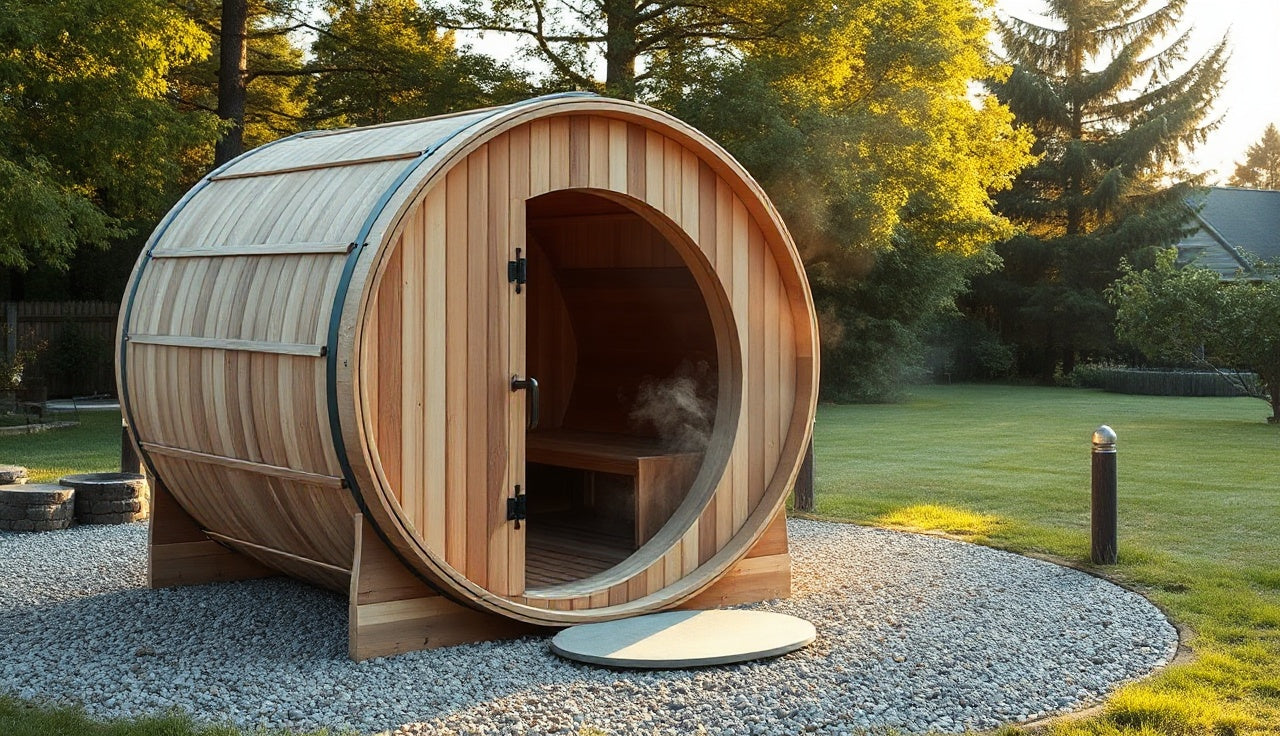
A barrel sauna kit is a pre-cut, flat-packed package that gives you every piece you need to assemble a cylindrical sauna shell at home. The "4-person" label means the interior bench can seat four adults comfortably, though most people find it genuinely comfortable for three and snug for four. The barrel shape is more than aesthetic. The curved walls create a smaller interior air volume compared to a rectangular box of the same footprint, so the heater warms the space faster and heat stays closer to the occupants rather than pooling at a ceiling several feet above their heads.
A typical kit includes pre-cut tongue-and-groove staves (the curved planks that form the barrel), metal bands that cinch the staves together, pre-built or flat-packed bench frames, a door (usually tempered glass or wood), a vent, exterior cradle supports, and sometimes a heater and heater rocks. What is not always in the box: a heater, electrical wiring, a foundation, or roofing for the overhang. Read the spec sheet carefully before you order.
The kits originate mostly from Canadian and Northern European manufacturers, though Chinese-made kits have entered the market at lower price points over the past several years. Quality varies significantly between those two categories, which we'll cover in the wood and construction section below.
What size is a 4-person barrel sauna, and will it fit in my backyard?
Most 4-person barrel kits fall in the 6-foot diameter range, with interior lengths between 6 and 8 feet. A 6-foot diameter by 7-foot interior length is the most common configuration. Add the door overhang (usually 12 to 18 inches) and the changing room if the kit includes one (adds another 3 to 4 feet), and your total exterior footprint lands somewhere around 8 to 9 feet long by 6.5 feet wide.
For backyard placement, you want at least 2 feet of clearance on all sides for ventilation and maintenance access. That puts your minimum clear space at roughly 10 feet by 10 feet. Most residential lots handle that without issue, but check your local zoning ordinance before ordering. Many municipalities treat outdoor saunas as accessory structures and require a permit if the structure exceeds a certain square footage, often 120 square feet, though that threshold varies by jurisdiction [1].
The barrel sits on cradle supports (typically two or four curved wooden or steel cradles) rather than a full foundation. A level gravel pad, concrete pavers, or a small concrete pad all work fine. You do not need to pour a slab, but you do need the surface to be level and to drain well so the wood stays dry underneath.
If your backyard is genuinely tight, there are 2-person barrel kits at 4 to 5 feet in diameter. Going the other direction, a 7-foot diameter barrel gets you into 6-person territory. The 6-foot diameter 4-person version is the sweet spot for most suburban yards and the most widely stocked configuration.
For a broader look at what outdoor placement involves, see our guide to outdoor sauna setups.
How much does a 4-person barrel sauna kit cost?
The honest range is $3,000 to $9,000 for the kit alone, before heater, electrical work, or any site preparation. Here is how that breaks down by tier:
| Tier | Price Range | What You Get |
|---|---|---|
| Budget (often imported) | $3,000, $4,500 | Hemlock or pine staves, basic steel bands, simple wood bench, no heater |
| Mid-range (Canadian/North American) | $4,500, $6,500 | Western red cedar staves, stainless bands, glass door, quality bench, sometimes heater included |
| Premium (Nordic brands, thick stave) | $6,500, $9,000+ | Thick cedar or Nordic spruce, triple-pane door, premium heater, better hardware, longer warranty |
A decent electric sauna heater for a 4-person barrel adds $400 to $1,500 depending on brand and kW rating. For a 6-foot by 7-foot barrel interior, you typically want a heater in the 6 to 9 kW range [2]. A wood-burning sauna stove (harvia, kuuma, or similar) runs $500 to $1,200 but requires a chimney kit, which adds another $200 to $400 and some extra installation work.
Electrical rough-in for an electric heater (usually 240V, 40-amp or 60-amp circuit) costs $300 to $800 depending on how far you are from your panel and local labor rates. That is not optional if you go electric.
Shipping weight for a 4-person kit is typically 600 to 900 pounds. Most vendors ship freight LTL, and delivery to your curb (not into your backyard) is usually included. Moving it from the curb to the installation site is your problem. Rent a hand truck and a furniture dolly, and bring a friend.
For context on where barrel kits sit relative to other home sauna options, our full home sauna guide covers the full cost landscape.
| Budget (imported, hemlock/pine) | $3,750 |
| Mid-range (Canadian cedar, glass door) | $5,500 |
| Premium (Nordic brands, thick stave) | $7,750 |
Source: SweatDecks market survey of major North American barrel sauna vendors, 2024
What wood species is best for a barrel sauna kit?
Wood choice is the single most important quality variable in a barrel sauna kit. The wood needs to tolerate repeated wet-dry-heat cycles without warping, splitting, or growing mold, and it needs to resist the oils and acids from sweat without degrading.
Western red cedar is the dominant choice in North American kits for good reason. It has a low density, which means it does not absorb or radiate excessive heat back at you (nobody wants to touch a bench that feels like a frying pan). It has natural oils that make it highly resistant to moisture and decay [3]. It smells the way people expect a sauna to smell. And it is dimensionally stable through heat cycles. The downside is price: cedar costs more than alternatives.
Nordic spruce (sometimes called "white spruce" or "clear spruce") is the traditional Finnish choice. It is tighter-grained than cedar, lighter in color, and quite good at resisting heat. Finnish sauna purists often prefer it because it does not off-gas the same aromatic oils as cedar, giving a cleaner, neutral experience. Good Nordic spruce kits are excellent; cheap spruce kits are not. Knots in spruce become painful resin pockets that get very hot to the touch.
Hemlock is the budget wood. It is stable and reasonably durable, but it lacks the natural oils of cedar, so moisture management matters more. It works fine in a well-ventilated barrel that dries out between sessions. It is not a great choice in climates with very high humidity.
Avoid kits that use pine without qualification. Knotty pine off-gasses resin heavily when heated and the knots can weep sticky sap. Some clear pine is fine, but vague "pine" in the spec sheet is a yellow flag.
Thicker staves are better. 1.5-inch staves hold heat longer and are more dimensionally stable than 1-inch staves. Premium kits use 1.75 to 2 inches. Budget kits often spec 1 inch or less.
How hard is it to assemble a 4-person barrel sauna kit, and do I need a contractor?
Most reasonably handy homeowners can assemble the barrel shell in one to two days with two people. The stave-and-band method is actually clever: you stand staves up on the cradles one by one, band them loosely as you go, and then tighten all the bands at once to pull the cylinder together. No nails go through the exterior. No complex joinery. The tongue-and-groove edges self-align.
The hardest parts are usually: getting the kit from the curb to the installation site, ensuring the cradles are perfectly level before you start stacking staves, and fitting the door frame plumb after the barrel is assembled. None of those require a contractor, but they require patience.
Where you genuinely do need a licensed electrician is the heater wiring. A 240V sauna heater requires a dedicated circuit, and the National Electrical Code (NEC) Article 424 governs fixed electric space heating equipment [4]. Running that circuit yourself without a permit is a fire risk and an insurance liability. Budget $300 to $800 for an electrician depending on panel distance and local rates.
If your kit includes a wood-burning stove, you need a chimney through the roof of the barrel (most kits that include this option come with a chimney collar and flashing kit). Check that the chimney clearances meet NFPA 211 standards for solid-fuel appliances [5]. Again, a licensed inspector signing off is worth the cost.
Most vendors include an assembly manual and increasingly post video walkthroughs. Watch them before the kit arrives. Identifying any missing or damaged pieces before you start building saves you from a half-assembled barrel and a two-week wait for replacement staves.
Electric heater or wood-burning stove: which should you choose for a barrel sauna?
This is genuinely a lifestyle question more than a technical one.
Electric heaters are easier. You set a temperature, they heat in 30 to 45 minutes, and you do not manage fire or ash. Most residential electric heaters for a 4-person barrel run 6 to 9 kW, which requires a 240V circuit. Harvia, Finnleo, and Huum are well-regarded brands with strong service networks in North America. Electric heaters also allow you to use a sauna controller with a timer, so the sauna can be ready when you walk out the back door.
Wood-burning stoves produce a fundamentally different experience. The heat ramps up slower and often feels "softer" (higher relative humidity from the combustion process, combined with the thermal mass of the stove). You can get the barrel to higher temperatures, and the ritual of building a fire is something a lot of people genuinely enjoy. The tradeoff is you need to be present, you need dry firewood nearby, and you need to clean ash periodically.
A wood-burning option makes sense if you have easy access to firewood, live somewhere with frequent power outages, or just love the traditional Finnish feel. Electric makes sense if you want convenience, if you live in a fire-restricted area, or if HOA rules prohibit open burning.
One more consideration: if you want to do contrast therapy with a cold plunge right after your sauna session, the timer on an electric heater makes that protocol much easier to coordinate.
What temperature should a barrel sauna reach, and how long does it take to heat up?
A properly sized 4-person barrel sauna should reach 160 to 195 degrees Fahrenheit (70 to 90 degrees Celsius) with an electric heater in 30 to 50 minutes. Wood-burning stoves can push past 200°F but take 45 to 90 minutes depending on wood and fire management.
The barrel shape helps here. A 6-foot diameter by 7-foot barrel has roughly 170 to 200 cubic feet of interior air volume, which is significantly less than a rectangular room sauna with similar seating. Less air volume means a smaller heater can do the job, and that heater reaches target temperature faster.
The Finnish Sauna Society recommends a temperature range of 80 to 90°C (176 to 194°F) at bench level as traditional [6]. For first-time users, starting at the lower end (around 160°F) and working up over several sessions is sensible. The research on sauna health benefits mostly uses sessions of 15 to 20 minutes at 80 to 100°C [7].
Loyly (the water ladled onto stones) is what creates steam and drives perceived heat up sharply. Even a dry-rock electric heater benefits from a small amount of water on the stones periodically. Do not pour water on a heater that is not rated for it, though; check the manufacturer's specs.
For more on what those temperature sessions actually do physiologically, our sauna benefits article covers the research without overstating it.
Do you need a permit to install a barrel sauna in your backyard?
Almost certainly yes, for the electrical work. And possibly yes for the structure itself.
On the electrical side: any 240V dedicated circuit addition requires an electrical permit in virtually every U.S. jurisdiction. This is non-negotiable. The permit process protects you at resale and protects your home from an insurance denial if something goes wrong.
On the structure side: most U.S. municipalities classify outdoor saunas as accessory structures. Many jurisdictions exempt accessory structures under a certain square footage (120 square feet is a common threshold, but it varies) from building permits [1]. A 6-foot by 7-foot barrel has a footprint of roughly 42 square feet, so it often falls below the threshold. But zoning setback requirements still apply even if no permit is needed. Most residential zones require accessory structures to sit at least 3 to 5 feet from property lines and sometimes further from the primary structure. Check with your local planning department.
HOA rules are a separate question entirely. If you live in an HOA, get written approval before ordering. Some HOAs prohibit any detached structure; others have rules about wood finishes or visibility from the street. Find out before a $6,000 kit arrives on your driveway.
State and local rules vary enormously. For general guidance on accessory structure rules, your local building department website is the authoritative source. Many counties post their zoning code online and have a "do I need a permit?" FAQ that covers this exact scenario.
How do you maintain a barrel sauna kit once it's assembled?
The barrel sauna's biggest vulnerability is moisture sitting on or under the wood when the sauna is not in use. The interior dries out fine from normal use if you ventilate properly. The exterior is where neglect shows up as darkening, mildew, or cracked staves after a few years.
Exterior maintenance: sand and re-apply a penetrating exterior wood oil or UV-protective cedar finish every one to two years, more often in wet climates. Do not use film-forming stains or paint; the wood needs to breathe. Some owners leave cedar unfinished intentionally and let it silver naturally, which is a legitimate aesthetic choice and works fine structurally if your drainage is good.
Interior maintenance: never apply any finish to interior surfaces. The interior wood is meant to stay unfinished so it breathes freely and does not off-gas chemicals into the hot air. After each session, leave the door cracked open and the vent open for 30 to 60 minutes to let the interior dry. Scrub benches with a dilute hydrogen peroxide solution (not bleach) if they start showing any darkening from sweat residue.
The metal banding: check tension annually. Wood shrinks slightly as it fully cures in its first year, and the bands may loosen slightly. Most kits come with a tensioning bolt you can tighten by hand. Do not over-tighten; you want snug, not crushing.
The heater rocks: replace them when they start to crack or crumble, typically every three to five years depending on how often you ladle water. Cracked rocks can pop and splatter, which is unpleasant at best.
A well-maintained cedar barrel sauna should last 15 to 25 years. Neglected ones start looking rough at 7 to 10.
What are the best 4-person barrel sauna kit brands to consider?
A few brand categories dominate the market, and knowing the difference saves you from a frustrating purchase.
Established North American brands with good service networks include Almost Heaven Saunas, Dundalk LeisureCraft, and Canadian Timber Collection (all making Western red cedar kits assembled in Canada or the U.S.). These brands have been in the market long enough to have real owner communities online, actual customer service phone lines, and available replacement parts. Almost Heaven and Dundalk kits consistently appear in buyer discussions with positive long-term ownership experiences.
Nordic/Finnish brands like Harvia (primarily known for heaters but entering complete sauna kits), Kirami, and TylöHelo make premium kits available through dealers. They tend to be more expensive but use Nordic spruce that is well-graded and kiln-dried to exacting specs.
Budget imported kits from brands you find on Amazon or generic e-commerce sites often spec hemlock or unclear wood species, thinner staves (sometimes 3/4 inch), and lighter-gauge banding. Some of these are fine starter units; some are genuinely disappointing. The giveaways are vague wood species labeling, no North American dealer network, and suspiciously low price per square foot of interior.
At SweatDecks, we've curated a selection of barrel kits that we've vetted for wood quality and hardware; you can browse the home sauna collection if you want to see what we actually recommend versus what floods the general market.
One honest note: at this price point, buy from a vendor with a clear return or damage claim process and a real phone number. LTL freight deliveries occasionally arrive with damaged staves, and you want a vendor who will send replacements without a fight.
How does a barrel sauna compare to other outdoor sauna options?
The barrel is one of several configurations worth knowing about before you commit.
A rectangular cabin sauna (sometimes called a "pod" or "cube" sauna) offers more usable interior space for the same footprint, easier wall-mounting of accessories, and a more familiar layout. The tradeoff is a larger air volume that takes longer and more energy to heat, and a boxier aesthetic that some people find less interesting outdoors.
A barrel sauna is more efficient per square foot of bench space because of the reduced air volume. It also has a distinctive look that many homeowners prefer in a garden or yard setting. The main practical downside is that the curved interior walls limit what you can hang or mount on them, and there is no dead corner space for storing towels or extra rocks.
A portable sauna (fabric pop-up style) costs far less ($200 to $800) but delivers a meaningfully different experience: lower temperatures, no rock heater, and a distinctly impermanent feel. If you're genuinely unsure whether you'll use a sauna regularly, a portable unit is a low-risk trial. But the thermal experience of a barrel sauna at 185°F is not comparable to a fabric tent.
Compared to a traditional steam room, a barrel sauna runs hotter and drier. The physiological effects overlap but are not identical. Steam rooms operate at 100 to 120°F with near-100% humidity; saunas run 160 to 195°F at 10 to 30% humidity. Both have supporting research for cardiovascular and recovery benefits, but the experiences feel quite different [8]. Our sauna vs steam room comparison walks through the research in detail.
For people interested in pairing sauna sessions with cold exposure, a barrel sauna next to a cold plunge is a setup that is genuinely hard to replicate with other sauna formats, and contrast therapy protocols have real research behind them [9].
Is a 4-person barrel sauna actually good for your health?
The honest answer is: the research is more promising than definitive, and much of it uses Finnish-style sauna sessions that map well to what a barrel sauna delivers.
The most-cited research comes from a 2018 study in Mayo Clinic Proceedings that followed over 2,300 middle-aged Finnish men for roughly 20 years. The authors reported that frequent sauna use (4 to 7 sessions per week) was associated with lower cardiovascular mortality compared to infrequent use [7]. This is an observational study, not a randomized controlled trial, so causation is not proven. The researchers noted that "regular sauna bathing is associated with reduced cardiovascular mortality" while acknowledging confounding factors.
A 2018 systematic review in the International Journal of Environmental Research and Public Health found evidence suggesting sauna use may support blood pressure reduction, improved arterial compliance, and better recovery after exercise, but called for more well-designed randomized trials before firm clinical recommendations [8].
For musculoskeletal recovery, heat exposure after exercise has some support in the literature for reducing delayed onset muscle soreness [10]. This is where regular barrel sauna use around athletic training has a real, practical use case even if the cardiovascular longevity data is still associational.
The main safety considerations: people with unstable cardiovascular disease, hypotension, or pregnancy should talk to a physician before regular sauna use. Hydration matters. Alcohol and sauna is a genuinely bad combination that contributes to sauna-related deaths in Finland [11].
None of this is medical advice. It is a fair summary of what the research actually says, without inflating it.
For a full treatment of the evidence, our sauna benefits guide goes through the major studies and their limitations.
Frequently asked questions
How many people actually fit in a 4-person barrel sauna?
Four adults fit, but it is cozy. Three is more comfortable for a relaxed session. The "4-person" rating assumes average adult size sitting upright on benches without gear. If you or your regular guests are larger-framed, plan for three as your realistic capacity and four as an occasional maximum.
Can I leave a barrel sauna outside year-round in a cold climate?
Yes. Western red cedar barrel saunas handle cold climates well, including heavy snow loads. The curved barrel roof sheds snow naturally. The main winter concern is the water supply if you have a hose bib nearby for ladle water; drain and disconnect that. Interior wood handles freeze-thaw cycles without issue when the sauna is dry between uses.
How long does it take to assemble a 4-person barrel sauna kit?
Most kits take two people one to two days to assemble the shell. The barrel itself goes up in a half-day if you have done your site prep (level pad, cradles placed correctly). Fitting the door, bench, and vent adds another few hours. Electrical hookup is separate and requires a licensed electrician.
Do barrel sauna kits come with a heater?
Sometimes, but not always. Some kits include a basic electric heater in the package price; many list the heater as an add-on. Read the spec sheet carefully. If the kit price seems very low, the heater is almost certainly not included. Budget $400 to $1,500 for a good heater on top of the kit price.
What foundation does a barrel sauna need?
Barrel saunas sit on cradle supports and do not need a poured foundation. A level gravel pad (4 to 6 inches of compacted gravel), concrete pavers, or an existing concrete patio all work. The surface needs to be level within about a half-inch end to end and drain well so water does not pool under the cradles and rot the wood.
What size heater do I need for a 4-person barrel sauna?
For a 6-foot diameter by 7-foot interior barrel, a 6 to 9 kW electric heater is the right range. Manufacturer sizing charts typically recommend roughly 1 kW per 50 cubic feet of interior volume, adjusted upward for poor insulation or very cold climates. A 6 kW unit handles most well-built kits; 9 kW gives you headroom for fast heat-up times.
How much does it cost to run a barrel sauna per session?
A 9 kW electric heater running for 1 hour (30-minute heat-up plus a session) uses roughly 9 kWh. At the U.S. average residential electricity rate of about 16 cents per kWh, that is roughly $1.44 per hour. Real-world costs vary by local electricity rates and heater efficiency, but most owners report $1 to $3 per session for electric, less for wood-fired.
Can a barrel sauna be placed indoors or in a garage?
Technically yes, but ventilation is the constraint. The sauna produces significant heat and moisture, and you need to exhaust both. A wood-burning stove indoors also requires a proper chimney penetration. Electric barrel saunas in a garage or large outbuilding are more practical if the space has good airflow, a concrete floor, and the electrical circuit is accessible.
How long does a cedar barrel sauna last?
A well-maintained western red cedar barrel sauna should last 15 to 25 years. The main longevity factors are exterior wood treatment (oil every one to two years), good drainage under the cradles so the wood does not sit in moisture, and interior ventilation after each session. The metal banding and hardware may need replacement around the 10 to 15 year mark.
Is a barrel sauna worth it compared to a traditional rectangular sauna?
For most homeowners with outdoor space, yes. The barrel heats faster because of its lower air volume, handles outdoor placement naturally, and costs less than a custom-built rectangular structure. The tradeoff is less usable interior space per diameter and a curved wall that limits accessories. If you want maximum interior space, a rectangular cabin sauna wins. For efficiency and aesthetics, the barrel is hard to beat.
Can I pair a barrel sauna with a cold plunge for contrast therapy?
Yes, and this is one of the most popular setups. Contrast therapy alternating heat and cold exposure has research support for cardiovascular adaptation and recovery. Practically, place the cold plunge within a short walk of the sauna door. An electric sauna with a timer makes the protocol easier to manage. Our cold plunge benefits guide covers the research behind the cold side of this equation.
What maintenance does a barrel sauna need in the first year?
In the first year, check the metal band tension after about one month as the wood fully cures and may shrink slightly. Tighten with the tensioning bolt if needed. Apply an exterior cedar oil finish before the first winter if your climate is wet or has UV exposure. Keep the interior unfinished and ventilate after each session. That's genuinely all the first-year maintenance required.
Sources
- International Code Council, 2021 International Residential Code (IRC) Section R105 — Permits: Many jurisdictions exempt accessory structures under 120 square feet from building permits; the IRC provides model thresholds that local governments adopt and modify.
- USDA Forest Service, Forest Products Laboratory — Wood Handbook Chapter 2 (Characteristics of Commercial Wood Species): Western red cedar has natural extractives that give it high resistance to decay and moisture, making it suitable for high-humidity applications like saunas.
- National Fire Protection Association, NFPA 70 National Electrical Code Article 424 — Fixed Electric Space Heating Equipment: NEC Article 424 governs installation requirements for fixed electric space heating equipment, requiring permits and licensed installation for 240V sauna heater circuits.
- National Fire Protection Association, NFPA 211 Standard for Chimneys, Fireplaces, Vents, and Solid Fuel-Burning Appliances: NFPA 211 sets clearance and installation standards for chimneys serving solid-fuel appliances including wood-burning sauna stoves.
- Finnish Sauna Society — Traditional Finnish Sauna Guidelines: The Finnish Sauna Society recommends 80 to 90 degrees Celsius (176 to 194°F) at bench level as the traditional operating temperature range.
- Laukkanen et al., Mayo Clinic Proceedings 2018 — Cardiovascular and Other Health Benefits of Sauna Bathing: Frequent sauna bathing (4–7 sessions per week) was associated with reduced cardiovascular mortality over a 20-year follow-up in over 2,300 Finnish men; authors stated 'regular sauna bathing is associated with reduced cardiovascular mortality.'
- Hussain & Cohen, International Journal of Environmental Research and Public Health 2018 — Clinical Effects of Regular Dry Sauna Bathing: A systematic review found evidence for sauna use supporting blood pressure reduction and improved arterial compliance but called for more RCTs before firm clinical recommendations.
- Mooventhan & Nivethitha, North American Journal of Medical Sciences 2014 — Scientific Evidence-Based Effects of Hydrotherapy on Various Systems of the Body: Contrast therapy (alternating heat and cold) has research support for cardiovascular adaptation and recovery applications.
- Petrofsky et al., Journal of Clinical Medicine Research 2013 — The Effect of Heat and Cold on Muscle Recovery: Heat exposure post-exercise has evidence supporting reduced delayed onset muscle soreness in athletic populations.
- Ahlström et al., BMC Public Health — Alcohol and Sauna-Related Deaths in Finland: Alcohol use combined with sauna bathing is a documented risk factor contributing to sauna-related deaths in Finland.
- U.S. Energy Information Administration — Average Retail Price of Electricity (Residential): U.S. average residential electricity rate used to calculate per-session operating cost estimate of approximately $1.44 per hour for a 9 kW heater at 16 cents/kWh.

Share:
What temperature should a sauna be set at?
Aleko barrel sauna: honest review, specs, and what to know before buying