
Last updated 2026-07-09
TL;DR
Aleko makes cedar and hemlock barrel saunas from roughly $1,500 to $3,500, sold mostly through Amazon, Home Depot, and Walmart. They heat with electric stove kits and fit two to six people. Build quality lands in the budget-to-mid tier: fine for most backyards, but they need steady maintenance and are not the last sauna you'll ever buy.
What is the Aleko barrel sauna and who makes it?
Aleko is a U.S. company based in Washington State that sells a big catalog of outdoor and home products, from awnings and gates to saunas. Their barrel saunas are built overseas, mostly in China, and sold through Amazon, Walmart, Home Depot, and a few specialty retailers. Aleko runs no sauna showrooms of its own.
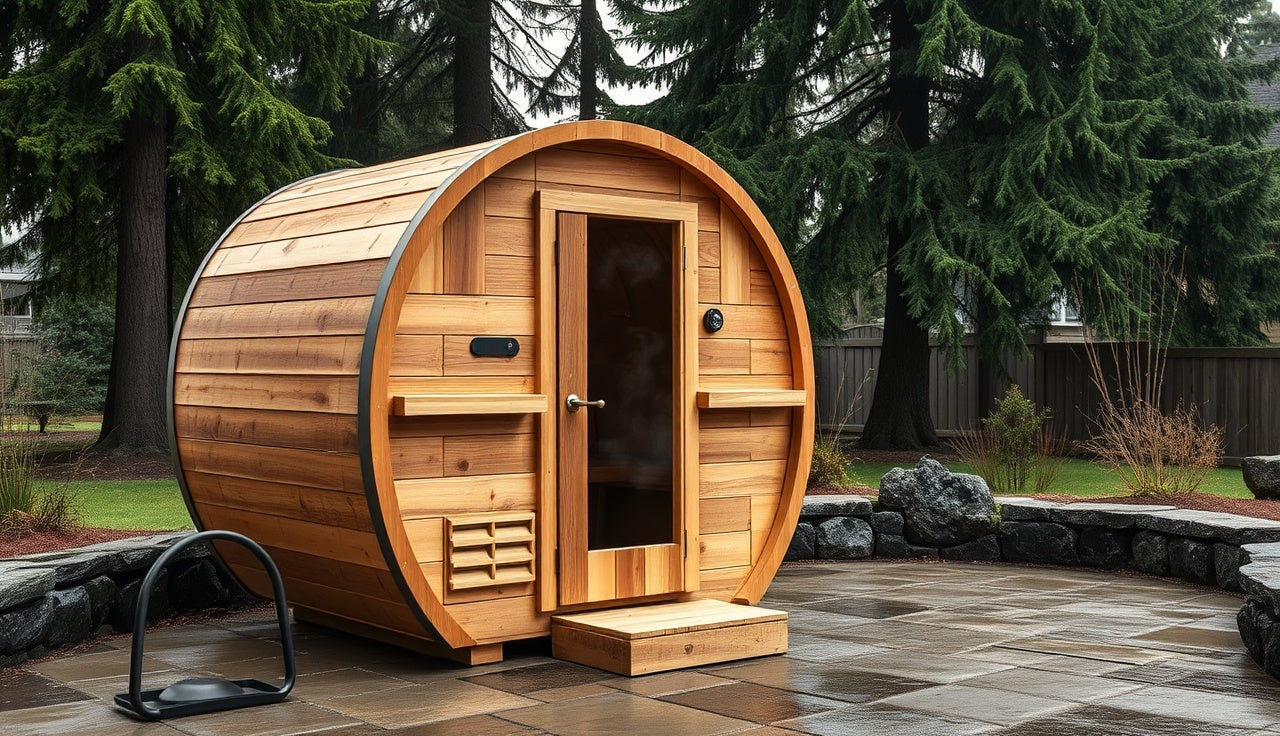
The barrel form is not Aleko's idea. The cylinder has Scandinavian roots and the design goes back decades. Aleko manufactures the shape in a few standard diameters, usually 4 feet and 5 feet, at lengths from about 6 feet to 8 feet. Most models use Canadian red cedar or hemlock. Both are established sauna woods because they resist warping and stay cool enough to touch at normal sauna temperatures.
Comparing this brand against others gets easier once you understand the category. A home sauna covers everything from prefab kits like Aleko to full custom builds, and outdoor sauna options specifically include barrel, cabin, and pod styles. Aleko competes in the entry-level outdoor barrel segment, and that's exactly where its strengths and limits live.
What models does Aleko make and what are the specs?
Aleko's barrel lineup shifts fairly often, but as of mid-2025 the core models break down like this:
| Model | Diameter | Length | Capacity | Stove (electric) | Approx. Price |
|---|---|---|---|---|---|
| STHE4X6CEW | 4 ft | 6 ft | 2 persons | 4.5 kW | ~$1,500, $1,800 |
| STHE4X7CEW | 4 ft | 7 ft | 3 to 4 persons | 6 kW | ~$1,800, $2,200 |
| STHE5X7CEW | 5 ft | 7 ft | 4 persons | 6 kW | ~$2,200, $2,700 |
| STHE5X8CEW | 5 ft | 8 ft | 5 to 6 persons | 8 kW | ~$2,800, $3,500 |
Prices swing with retailer promotions and inventory, so treat these as ballpark. The stoves Aleko ships are their own branded electric units: functional, not premium. Stave wall thickness runs around 1.5 inches, which is fine for temperate climates but thin if you plan to run the sauna in subfreezing weather often.
The 5x7 is the most reviewed model and the best balance of space and price. The 4-foot-diameter models feel cramped for two adults sitting side by side on one bench level, whatever the marketing claims. Plan one size up from what you think you need.
How hot does an Aleko barrel sauna get?
Aleko's electric stoves are rated to bring the interior to 150 to 175°F (65 to 80°C) under normal conditions. What you actually hit depends on stove size versus interior volume, outdoor temperature, and how well the barrel seals after assembly.
The Finnish Sauna Society puts proper sauna temperature at 80 to 100°C (176 to 212°F) at the upper bench, with relative humidity around 10 to 20% [1]. Aleko's smaller 4.5 kW package will struggle to reach the high end of that in cold weather or with a leaky door.
The barrel shape helps here. A cylinder traps hot air better than a rectangular box because there are no cold corners, so the convective loop stays tight. An Aleko barrel can feel hotter than a rectangular kit sauna running the same wattage.
For what these temperatures do to the body, the sauna benefits guide covers the research on heat stress, cardiovascular response, and session protocols.
| 4 ft × 6 ft (2-person) | $1,650 |
| 4 ft × 7 ft (3–4 person) | $2,000 |
| 5 ft × 7 ft (4-person) | $2,450 |
| 5 ft × 8 ft (5–6 person) | $3,150 |
Source: Aleko Products, sweatdecks.com research, July 2025
What wood does Aleko use and does it matter?
Aleko advertises Canadian red cedar on most U.S. models, with hemlock on some SKUs. Both are acceptable. Cedar is aromatic, resists moisture and insects, and stays relatively cool to the touch. Hemlock is denser, less fragrant, and cheaper; it's the wood in most Finnish-made saunas exported to North America.
Milling and drying matter more than species. Barrel saunas are made from individual staves that have to fit tightly against each other to seal the barrel, hold heat, and stop gaps from opening as the wood expands and contracts through the seasons. Wet or badly dried wood shrinks unevenly after install and opens visible gaps. This is the single most common complaint in verified buyer reviews of Aleko saunas across Amazon and Home Depot, and it is not unique to Aleko. It hits the whole budget barrel category.
If you live with big seasonal temperature swings, budget for tightening the metal bands around the barrel in the first year. Aleko kits ship with adjustable hoops you can tighten as the wood settles. Do it. Most owners who report gaps skipped this step.
How difficult is Aleko barrel sauna assembly?
Aleko sells these as DIY kits, and that's honest for anyone comfortable with basic tools. You don't need a contractor. You do need a full weekend, a helper, and patience.
The steps: pour or level a concrete pad or deck base, assemble the cradle legs, stack and number the staves in sequence, tighten the metal hoops, install the benches and backrest, mount the stove, and run the electrical connection. The stove needs a dedicated 240V circuit in the U.S. [2]. No circuit at your install spot? Add $300, $800 for an electrician depending on distance from your panel.
The assembly manual gets mixed reviews for clarity. The most useful step owners skip is pre-soaking or lightly wetting the exterior staves before final tightening, which lets the wood swell into a tighter fit before the first heat cycle. It isn't in Aleko's manual, but it's standard practice among barrel sauna installers.
Total build time for the 5x7 runs four to eight hours for two people. Budget eight your first time.
What electrical requirements does an Aleko sauna need?
Every electric sauna stove 1 kW and up needs a hardwired 240V connection in the United States, not a standard 120V outlet. The National Electrical Code (NEC), Article 422, governs sauna heater installations and requires a dedicated branch circuit with a disconnect within sight of the sauna [2]. Your local jurisdiction may add more.
Aleko's 4.5 kW unit pulls about 18.75 amps at 240V. The 8 kW unit pulls roughly 33 amps. You'll typically run 10-gauge wire on a 30-amp breaker for the smaller units and 8-gauge wire on a 40-amp breaker for the 8 kW. Hire a licensed electrician. Sauna stove wiring in a wet outdoor environment is not the place to save money. Outdoor sauna circuits also require GFCI protection and weatherproof connections under CPSC residential electrical safety guidance [10].
Some buyers ask about running an Aleko on a generator for off-grid setups. Possible, but you need a generator rated well above the stove's continuous draw (add 25% headroom minimum) and a transfer switch. It's a bigger project than most people expect.
How does Aleko compare to other barrel saunas at the same price?
The barrel market under $3,500 is crowded. Aleko's main U.S. competitors at similar prices include Almost Heaven (made in West Virginia), Dundalk LeisureCraft (Canadian company, Canadian cedar), and various generic imports under store-brand names.
| Brand | Origin | Wood | Warranty | Price Range |
|---|---|---|---|---|
| Aleko | Mfr. overseas, U.S. dist. | Cedar / Hemlock | 1 year limited | $1,500, $3,500 |
| Almost Heaven | USA (WV) | Hemlock / Cedar | 1 year limited | $2,000, $5,000 |
| Dundalk LeisureCraft | Canada | Canadian Cedar | 5 years structural | $3,000, $7,000 |
| Harvia (branded kits) | Finland | Nordic Spruce | Varies by retailer | $2,500, $5,000 |
Aleko wins on price. Almost Heaven is made domestically and has better parts support. Dundalk's five-year structural warranty reflects real confidence in their wood, and it's the best warranty in the budget-to-mid tier [8]. Harvia stoves are a genuine step up in heater quality; some buyers grab an Aleko barrel shell and swap in a Harvia or Helo stove.
If you can afford Dundalk, spend it. If $1,500, $2,200 is your real ceiling, Aleko is a reasonable choice, not a great one. You're buying a sauna that works, not an heirloom. That's fine for plenty of buyers.
What maintenance does an Aleko barrel sauna need?
Outdoor barrel saunas need more upkeep than indoor prefab units. The wood sits in rain, UV, and freeze-thaw cycles all year.
The exterior needs a UV-blocking wood treatment or stain every one to two years. Don't use interior sauna treatments on the exterior; they're formulated differently. Aleko ships the unit with no pre-applied exterior finish, so treat it before the first rainstorm.
The interior should stay untreated or get a sauna-specific oil. Never varnish. Bench surfaces do well with light sanding and an occasional wipe of diluted teak oil if the wood dries out.
The stove rocks and heating element need annual inspection. Wipe the stove exterior. Check the electrical connections for corrosion, especially in humid climates. Replace the sauna rocks every three to five years; they crack and lose thermal mass over time.
In winter climates, leaving the sauna cold for months lets the wood saturate with moisture, which raises the odds of stave separation come spring. Run it at least once a month through winter if you can.
Is an Aleko barrel sauna worth it for regular sauna use?
It depends on what "regular" means to you and what your alternative is.
If the choice is an Aleko or no sauna at all, Aleko wins easily. You get a real dry-heat sauna in your backyard for under $2,500 installed (before electrical), and the research on regular sauna use is genuinely positive. A 2018 study in Mayo Clinic Proceedings found sauna bathing four to seven times per week was associated with a 50% lower risk of cardiovascular disease mortality versus once-weekly use in a cohort of Finnish men [3]. That's association, not proof of cause, and the group had lifelong sauna habits, but it's among the strongest observational data in the sauna literature. An earlier 2015 JAMA Internal Medicine analysis of 2,315 Finnish men followed for 20 years pointed the same direction on all-cause and cardiovascular mortality [9].
If the choice is Aleko versus a well-built Dundalk or a custom wood build, and you plan to use it four-plus times a week for the next decade, spend more. Heavy use will likely push the Aleko into significant maintenance or partial rebuilding within five to seven years.
For occasional use, a social backyard sauna, or a first-timer testing whether they'll actually use it, Aleko makes sense. It's a well-priced entry point, not a forever purchase.
SweatDecks carries a curated selection of outdoor saunas if you want to compare barrel and cabin styles side by side before committing.
Can you add a cold plunge or contrast therapy with an Aleko sauna?
Yes, and it's one of the most common upgrade paths for Aleko owners. The barrel's outdoor placement makes adding a cold plunge tub or stock tank nearby straightforward.
Contrast therapy means alternating between hot and cold in cycles. The protocol most practitioners run is 10 to 20 minutes of sauna, then 1 to 3 minutes of cold immersion, repeated two to four times. Nobody has gold-standard RCT data on the ideal timing. The closest evidence comes from a 2021 review in the International Journal of Environmental Research and Public Health, which found cold water immersion after heat exposure reduced perceived muscle soreness and fatigue compared with passive rest [4].
A cold plunge doesn't need to be expensive to work. A dedicated cold plunge unit or a properly chilled stock tank set five to fifteen feet from the barrel door makes a functional contrast setup. The usual cold-immersion target is below 59°F (15°C) [4].
For the recovery side of this, the cold plunge benefits guide covers what the research actually says, minus the hype.
What do real owners say are the biggest problems with Aleko saunas?
Across verified buyer reviews on Amazon (ASIN B07K1VLF6W and similar), Home Depot, and sauna forums like r/Sauna, the complaints cluster around a few themes:
1. Stave gaps forming in the first season. Almost always fixable by tightening the metal bands; most owners who reported it didn't tighten on schedule.
2. Assembly instructions that are incomplete or vague on the electrical hookup. The manual covers carpentry adequately but is thin on stove wiring, which should go to a licensed electrician anyway.
3. Low-quality stove rocks that crack after a few sessions. Replace them with proper sauna rocks (olivine diabase or peridotite) before the first use. This runs $30, $60 and makes a real difference in steam quality if you pour water.
4. Door seal wear after two to three years outdoors. The magnetic or compression seal dries out; replacements exist but you'll source them from third parties, since Aleko's parts supply is inconsistent.
5. Slow customer support. Multiple verified reviews describe slow or missing responses to warranty claims. The warranty is one year limited, shorter than most mid-tier competitors.
None of these are dealbreakers, and plenty of owners at three to five years report real satisfaction. Go in with clear eyes.
Does an Aleko barrel sauna need a permit?
It depends on your municipality, and the answer matters more than most buyers expect.
In the United States, whether a sauna needs a building permit generally turns on: whether it sits on a permanent foundation, its assessed value or cost, its electrical installation, and local zoning. A structure on a portable or temporary base under a certain square footage (often 120 sq ft, though it varies) may be exempt from a building permit in many places, but the electrical work almost always needs an electrical permit regardless [5].
The 2021 International Building Code (IBC), Section 105.2, lists certain minor structures as exempt from permits, but sauna electrical systems fall under NEC Article 422 requirements that apply whether or not the structure itself needs a permit [2].
Call your local building department before you install. Ask about three things: structure permits for an accessory outdoor sauna, an electrical permit for a 240V circuit to an outdoor structure, and setback requirements from property lines. Some HOAs also cap outdoor structure height.
The call takes 15 minutes and saves you from moving or dismantling a fully assembled barrel later.
Frequently asked questions
How long does an Aleko barrel sauna last?
With steady maintenance (annual exterior wood treatment, regular band tightening, and proper stove care) most Aleko barrel saunas last seven to twelve years. High-humidity climates and neglected exterior finishing shorten that a lot. Dundalk LeisureCraft and other premium barrel brands with stronger structural warranties typically last fifteen to twenty-plus years under similar conditions.
Does the Aleko barrel sauna come with rocks?
Yes, Aleko ships sauna rocks with most models. Most experienced users replace them before the first session. The included rocks tend to be low grade and crack quickly when water hits them. Proper sauna rocks made from olivine diabase or similar dense volcanic stone cost $30, $60 for a full stove load, produce better steam, and last far longer.
Can the Aleko sauna stay outside year-round?
Yes, it's built for year-round outdoor installation. The cedar or hemlock handles moisture and temperature swings reasonably well. Apply an exterior UV-protective wood stain before the first winter and reapply every one to two years. In heavy-snowfall climates, brush accumulated snow off the roof end to reduce load on the cradle legs.
What size Aleko barrel sauna should I buy?
Buy one size larger than you think you need. The 4-foot-diameter models are tight for two adults. If you'll ever use it with more than one other person, go with the 5-foot diameter. The gap between the 4x7 and 5x7 is usually $400, $600, worth it for the shoulder room. The 5x8 is genuinely comfortable for four.
Can I use an Aleko barrel sauna as an indoor sauna?
Technically possible but impractical. The barrel doesn't fit through standard doorways, and ventilation requirements for an electric stove indoors are significant. Aleko barrel saunas are designed and sold as outdoor structures. For indoor use, a prefab indoor kit with a rectangular footprint suits the job far better.
How long does an Aleko sauna take to heat up?
Most Aleko barrels reach 150°F (65°C) in 30 to 45 minutes with the right stove size for the volume. Smaller 4.5 kW stoves in larger barrels can take 60 minutes or more in cold weather. The barrel shape helps by killing cold corners, so heat spreads more evenly than in a rectangular box of the same volume.
Is Aleko a good brand for saunas?
Aleko is a functional, budget-tier brand. Their saunas work and offer reasonable value for buyers on a limited budget who want a real outdoor sauna. They aren't premium: support is inconsistent, warranties are shorter than competitors, and component quality is average. If your budget reaches Dundalk LeisureCraft or Almost Heaven, those are meaningfully better products with better support.
Does the Aleko barrel sauna have a wood-burning option?
Some Aleko models list optional wood-burning stove compatibility, but most kits ship configured for electric stoves. Wood-burning setups need a chimney flue through the barrel roof, which Aleko offers on select SKUs. Check the specific model listing carefully. Most buyers pick electric for convenience and simpler permitting.
How does a barrel sauna compare to a cabin-style sauna?
Barrel saunas heat faster than cabin saunas of equal volume because the cylinder cuts dead air space. Cabin saunas give more usable interior square footage for a given footprint and are easier to customize. Barrels shed water better thanks to the curved roof. For two to four people who want heat efficiency and a smaller footprint, the barrel wins. Larger groups usually prefer cabins.
What foundation does an Aleko barrel sauna need?
Aleko barrels rest on two curved wooden cradle feet that come with the kit. These need a flat, level, solid base: a concrete pad, compacted gravel bed, or treated wood deck platform all work. The base should be level within about a quarter inch over the cradle span. An unlevel base puts uneven stress on the staves and drives gap formation over time.
Can I add more bench space to an Aleko barrel sauna?
The standard setup has two bench levels running lengthwise: a lower seat bench and an upper reclining bench. Some owners add a small end bench at the wall opposite the door for more seating. Aleko sells accessory porch extensions that attach to the door end, adding a small covered vestibule that works as a cooling station. Third-party cedar bench kits also fit with minor modification.
How do I prevent my Aleko barrel sauna from turning gray outside?
Apply an exterior UV-blocking penetrating oil or stain before the first sun exposure. Products like Cabot Australian Timber Oil or Sikkens Cetol are popular among outdoor wood owners. Once cedar or hemlock grays from UV oxidation, you can restore color by sanding lightly and applying a wood brightener before refinishing, but prevention beats reversal every time.
What is the cost to run an Aleko barrel sauna per session?
A 6 kW stove running one hour uses 6 kWh. At the U.S. average residential rate of about $0.17 per kWh as of 2024 [6], that's roughly $1.02 per session hour. An 8 kW stove costs about $1.36 per hour at the same rate. Monthly operating cost for four one-hour sessions a week runs $16, $22 depending on stove size.
Does Aleko offer free shipping on barrel saunas?
Aleko barrel saunas on Amazon usually ship freight (LTL) with shipping included or discounted for Prime members. Through Home Depot or Walmart, free freight delivery to a local store or your home is often available. Delivery is usually curbside; you move it from the driveway. The full kit ships in two to four large boxes totaling 400 to 700 pounds depending on model size.
Sources
- Finnish Sauna Society, official sauna usage guidelines: Proper Finnish sauna temperature is 80–100°C at upper bench level with 10–20% relative humidity
- National Fire Protection Association, NFPA 70 (NEC) Article 422 – Appliances: Sauna heaters require a dedicated 240V branch circuit with a disconnect within sight of the unit under NEC Article 422
- Mayo Clinic Proceedings, 2018 – Sauna bathing and risk of fatal cardiovascular diseases: Sauna bathing 4–7 times per week was associated with a 50% lower risk of cardiovascular disease mortality vs once weekly
- International Journal of Environmental Research and Public Health, 2021 – Cold water immersion review: Cold water immersion below 15°C after exercise significantly reduced perceived muscle soreness and fatigue compared with passive rest
- International Code Council, 2021 International Building Code Section 105.2 – Work exempt from permit: IBC Section 105.2 exempts certain minor accessory structures from building permits but electrical work remains subject to NEC requirements
- U.S. Energy Information Administration, Electric Power Monthly – Average retail electricity price 2024: Average U.S. residential electricity rate was approximately $0.17 per kWh as of 2024
- Dundalk LeisureCraft, barrel sauna warranty documentation: Dundalk LeisureCraft offers a 5-year structural warranty on their barrel sauna line, compared with Aleko's 1-year limited warranty
- JAMA Internal Medicine, 2015 – Association between sauna bathing and fatal cardiovascular and all-cause mortality (Laukkanen et al.): Frequent sauna use was associated with reduced all-cause and cardiovascular mortality in a cohort of 2,315 Finnish men followed for 20 years
- U.S. Consumer Product Safety Commission, residential electrical safety guidelines: Outdoor electrical appliances including sauna stoves require GFCI protection and weatherproof connections per CPSC residential safety guidance

Share:
Barrel sauna garden kit: what you actually get and whether it's worth it
Barrel sauna garden kit: what you actually get and whether it's worth it