
Last updated 2026-07-09
TL;DR
A barrel sauna garden kit ships as numbered, pre-cut cedar or spruce staves, a pre-hung door, a heater, and every fastener you need. Two people assemble one in 4 to 8 hours with a mallet and a drill. Kits run $2,000 to $8,000 depending on diameter, length, and heater. Most U.S. jurisdictions require no building permit under 200 sq ft, but the electrical circuit almost always needs a permit.
What is a barrel sauna garden kit and what comes in the box?
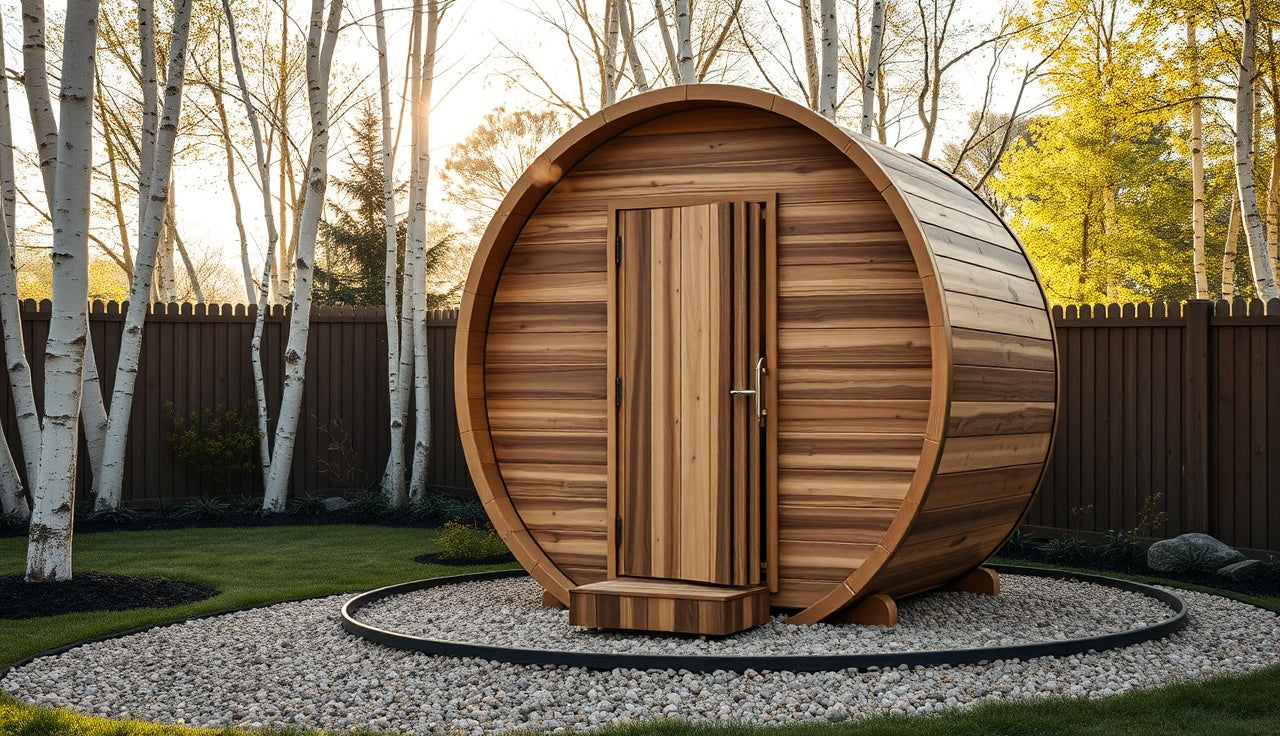
A barrel sauna garden kit is a complete outdoor sauna that arrives flat-packed as cylindrical staves, pre-cut to length, pre-drilled, and numbered so they stack into a round room without any custom carpentry. The round shape earns its keep. A barrel spreads hoop stress around its circumference, so the joints pull tighter as the wood heats and expands instead of warping outward the way a boxy frame does.
A standard kit from most major suppliers includes kiln-dried tongue-and-groove staves (usually cedar or Nordic spruce), galvanized steel tension bands that wrap the exterior and cinch the staves together, a pre-hung door with a tempered glass or wood panel, interior benches and backrest boards, a roof structure (a flat canopy or a second barrel arc over the door vestibule), a cradle of two curved wooden rockers or adjustable steel feet, a sauna heater (electric or wood-burning, depending on what you specify at order), sauna rocks, and all fasteners.
Here is what is usually NOT in the box: the electrical rough-in and the dedicated 240V circuit an electric heater needs, a concrete pad or gravel base, the exterior stain or sealant, and any flue pipe beyond a short collar on a wood-burning model. Read the spec sheet on those four items before you compare price tags across brands. They are where the real cost hides.
For how outdoor saunas differ from indoor models, see our guide to outdoor sauna.
What sizes do barrel sauna kits come in?
Barrel saunas are sold by diameter and interior length. The two standard diameters are 4 feet (about 1.2 m) and 5 feet (about 1.5 m), measured inside the stave ring. Length runs from a compact 5 feet up to 8 feet or more when the kit includes a front changing vestibule.
Here is how those dimensions translate into real capacity:
| Diameter | Interior Length | Bench Capacity | Approx. Heated Volume |
|---|---|---|---|
| 4 ft | 5 ft | 2 people | ~63 cu ft |
| 4 ft | 6 ft | 2 to 3 people | ~75 cu ft |
| 5 ft | 6 ft | 3 to 4 people | ~118 cu ft |
| 5 ft | 8 ft | 4 to 6 people | ~157 cu ft |
The 5-foot diameter is the sweet spot for most households. A 4-foot model heats faster (handy if you sauna solo and want to be sweating within 20 minutes), but the ceiling arc sits roughly 4 feet above the bench and some taller users find it cramped. At 5 feet you get about 5 feet of headroom over the lower bench, which fits most adults sitting up straight.
Planning a changing-room vestibule? Look for kits that spell out a second barrel arc for the front porch. Some brands sell it as a separate add-on, and the price difference runs $400 to $900 [1].
How much does a barrel sauna garden kit cost?
Prices swing hard on wood species, diameter, length, heater type, and country of manufacture. Here is an honest range based on publicly listed retail prices as of mid-2025.
Entry-level kits (hemlock or spruce, 4-foot diameter, electric heater, no vestibule): $2,000 to $3,500.
Mid-range kits (western red cedar, 5-foot diameter, electric or wood-burning heater, basic vestibule): $3,500 to $5,500.
Premium kits (clear-grade western red cedar or Alaskan yellow cedar, 5-foot diameter, infrared or high-output wood heater, full vestibule): $5,500 to $8,000 and up.
The kit price is not the whole number. Budget for:
- Electrical rough-in and dedicated 240V circuit: $300 to $800, depending on distance from your panel [2].
- Gravel bed or concrete pad: $200 to $600 DIY, more if you hire out.
- Exterior stain or oil finish: $50 to $150 every 1 to 2 years.
- Shipping freight (most kits ship on a pallet by LTL freight): $150 to $400, depending on distance from the supplier.
Total landed-and-installed cost for a 5-foot cedar kit with electric heat and modest site prep runs $4,500 to $7,000 for most homeowners doing their own assembly.
For a side-by-side look at entry-level retail options, our costco sauna article walks through how club-store kits compare on price and quality.
| Entry-level kit (4 ft, spruce, no vestibule) | $2,750 |
| Mid-range kit (5 ft, cedar, basic vestibule) | $4,500 |
| Premium kit (5 ft, clear cedar, full vestibule) | $6,750 |
| Add: electrical install (dedicated 240V circuit) | $550 |
| Add: site prep / gravel base | $400 |
Source: Almost Heaven Saunas retail listings & U.S. EIA electricity data, 2025
What wood species are barrel sauna kits made from, and does it matter?
It matters more than most buyers expect. The wood lives in repeated wet-heat cycles, and how well it resists rot, holds its shape, and stays cool enough to touch at 180 degrees F depends heavily on species.
Western red cedar is the benchmark. It carries natural oils that shrug off moisture and insects, sits at a very low density (so it heats fast and stays comfortable to lean on), and gives off the aroma most people picture when they think of a sauna. Its thermal conductivity is roughly 0.11 W/m-K, low enough that even at 185 degrees F a bench board stays below the pain threshold [3].
Nordic spruce is cheaper and lighter, common in European kit saunas. It is fine wood, but it lacks cedar's oils, so it needs more diligent exterior finishing to survive outdoors and it grays out faster.
Hemlock (eastern or western) is a common mid-tier pick in North American kits. It has no real odor (a plus if cedar smell bothers you), machines cleanly, and holds up well when sealed.
Alaskan yellow cedar, sometimes called Nootka cypress, is the premium upgrade. It packs even more natural oil than western red cedar, takes weather exceptionally well, and its grain is tighter. Kits built from it cost 20 to 35 percent more, and they earn it if the sauna sits fully exposed to rain and UV all year.
Walk away from any kit that will not name the species, or that hides behind "Canadian wood" or "North American softwood." That vagueness usually means mixed off-cuts with inconsistent moisture content.
What heater options come with a barrel sauna kit?
Most kits let you choose at order time among three practical options for a garden barrel: electric, wood-burning, and infrared. Each one carries a real trade-off.
Electric heaters are the most common choice. A 6 kW unit brings a 5-foot barrel to 160 degrees F in about 30 to 40 minutes. You need a dedicated 240V/30A circuit run from your main panel. Running cost tracks your local rate: at $0.15/kWh, a 60-minute session in a 6 kW heater burns roughly $0.50 to $0.90 of energy once the room is at temperature [2]. The payoff is precise thermostat control. The catch is the install cost and the need for grid power at the sauna.
Wood-burning heaters (often called a kiuas or a sauna stove) are the traditional pick, and the right one if your yard sits far from a panel or you want an off-grid setup. A stove takes longer to bring the room up (45 to 60 minutes) and needs a flue penetrating the roof or the barrel end. Many jurisdictions require a clearance setback from structures and a spark arrestor on the chimney. Check your local fire code before you order. Fuel cost is firewood, which runs $150 to $300 per cord in most of the country.
Infrared panels show up as an option now and then. They run at much lower air temperatures (120 to 140 degrees F rather than 160 to 195 degrees F) and often draw off a 120V circuit. Some people strongly prefer them. The published evidence on health outcomes is thinner than it is for traditional high-heat Finnish-style sessions. For the distinction, see our deeper look at sauna benefits.
My call for most garden barrel buyers: go electric if you can run the circuit without a headache, wood-burning if you cannot or if the off-grid ritual is the whole point.
Do you need a permit for a barrel sauna in your backyard?
Most people skip this question and then regret it. The honest answer: it depends on your municipality, your lot, and how the structure meets the ground.
In most U.S. jurisdictions, accessory structures under a floor-area threshold (commonly 120 or 200 sq ft, which varies by state and city) that sit on non-permanent foundations are exempt from building permits. A barrel sauna on wooden cradle rockers or adjustable steel feet usually qualifies as non-permanent. The International Residential Code Section R105.2 lists exempt structures, including prefabricated swimming pools and playground equipment, but never mentions saunas, so local amendments decide [4].
Electrical work is a separate matter, and the rules are stricter. In nearly every U.S. jurisdiction, a new dedicated circuit requires an electrical permit and inspection, no matter how the sauna structure itself is classified [5]. Do not skip it. A failed inspection after install is expensive. A house fire from an unpermitted 240V run is far worse.
Flue pipe for a wood-burning heater also typically needs inspection where the International Fire Code or a local equivalent applies.
Here is the five-minute move before you buy: call your city or county building department, describe a "prefabricated outdoor barrel sauna on non-permanent cradle feet," give the dimensions, and ask whether a building permit and electrical permit apply. Most departments answer on the phone. HOA rules are a completely separate check.
On the electrical side, the National Electrical Code Article 680 covers "Hydromassage Bathtubs and Similar Equipment," which some inspectors apply to sauna circuits, while others use Article 424 for fixed electric space heating [5].
How hard is it to assemble a barrel sauna kit yourself?
Most barrel sauna kits are built for two adults with basic mechanical aptitude and a free afternoon. Manufacturers typically quote 4 to 8 hours for two people.
The sequence is straightforward. Set the cradle rockers or foundation feet on your prepared base and level them. Stand the staves (vertically or horizontally, depending on kit orientation) and rack them together with the tension bands. The door frame and bench brackets drop into pre-routed grooves. Tighten the bands, install the roof boards, hang the door. Then connect the heater, install the chimney if it is wood-burning, and the structure is done.
Tools you actually need: a rubber mallet, a cordless drill, a level, a tape measure, and a second set of hands. That is the whole list for most kits.
What slows people down: a base that is not level (check it twice before you start), staves that were never sorted by number, and tension bands over-tightened before all the staves are seated, which then have to come loose and go back on. None of these are serious. They just cost you time.
The electrical connection is the one part you should not DIY unless you hold a license. Hire a licensed electrician to run the circuit and make the final connection at the heater's terminal block. That job usually takes an electrician 2 to 4 hours [2].
SweatDecks carries several barrel sauna kits with detailed assembly documentation if you want to see what a real instruction set looks like before you commit.
What foundation does a barrel sauna garden kit need?
A flat, level, well-drained base is the only real requirement. Barrel kits do not need a concrete slab, though one works fine.
The easiest base is compacted gravel. A 4-inch layer of crushed stone (3/4-inch clean stone, not pea gravel) over weed fabric, raked level, drains beautifully and costs $200 to $400 in materials for a typical site. The cradle rockers or steel feet sit directly on the gravel.
A concrete pad works if you already have one or you are doing other hardscaping. The sauna does not need anchoring to it. Gravity and the stave-band tension hold everything together under normal conditions.
Deck installation is possible, but check the deck's load capacity first. A 5-foot barrel sauna, fully loaded, weighs 700 to 1,000 lbs. Most residential decks built to modern IRC standards handle that, but confirm with the builder or a structural engineer if the deck is older or the sauna will land on a cantilevered section.
Never set a barrel sauna directly on soil or sod. The cradle wood rots from ground contact within 2 to 3 seasons even in cedar, and moisture wicking up into the stave joints warps the barrel from the bottom. A gravel bed kills both problems for very little money.
Think about drainage too. Set the barrel so the low end of the site slopes away, and leave at least 18 inches of clearance on all sides for airflow and so you can walk around it for maintenance.
How long does a barrel sauna garden kit last outdoors?
With basic maintenance, a well-built cedar barrel sauna should last 15 to 25 years outdoors in most North American climates. Call that a reasonable expectation, not a promise. It hinges on two things: the wood quality in the kit and how consistently you refresh the exterior finish.
The biggest threat is UV degradation and moisture cycling on the exterior stave faces. Untreated cedar grays in one season and starts checking (surface cracking) within two. An annual coat of penetrating exterior oil or a UV-blocking wood finish keeps the exterior staves stable. Products made for cedar siding, including those meeting the ASTM D3359 adhesion standard, hold up well [6]. Budget one to two hours a year for this.
The interior needs no finishing and should never get painted or sealed with film-forming products. The wood has to breathe and dry between sessions. The only interior chore is scrubbing the bench boards with a stiff brush and hot water after heavy use.
Inspect the steel tension bands each spring. A little surface rust is cosmetic. Any corrosion that pits the band or the hardware contact points should be handled before it weakens the joint. Most manufacturers sell replacement bands.
In very wet climates (Pacific Northwest, coastal New England), a simple gable or shed roof over the barrel, or a weatherproof cover for the off-season, adds years to the exterior. In dry climates (Southwest, high desert), UV is the bigger enemy, so a quality UV-blocking oil matters more than moisture protection.
For comparison, a well-maintained home sauna built into an indoor structure will outlast an outdoor barrel by decades. That is not the point. The outdoor experience is a different thing entirely.
What are the real health benefits of using a barrel sauna?
The research on sauna use is stronger than most people realize, and the best of it studies traditional high-heat Finnish-style sessions, which is exactly what a barrel sauna delivers.
A prospective cohort study published in JAMA Internal Medicine in 2015 followed 2,315 middle-aged Finnish men for 20 years. Men who used a sauna 4 to 7 times a week had a 40 percent lower risk of all-cause mortality than once-weekly users. The authors put their conclusion plainly: "Sauna bathing is a safe and well-tolerated activity in healthy individuals with potential cardiovascular benefits" [7].
A 2018 review in Mayo Clinic Proceedings examined the physiology of sauna bathing and concluded that repeated use raises resting heart rate variability, reduces arterial stiffness, and lowers blood pressure in people with hypertension [8].
For recovery, the most studied mechanism is the rise in heat shock proteins after repeated heat exposure. Those proteins help repair damaged muscle proteins. A 2007 study in the Journal of Applied Physiology found that far-infrared sauna use (lower temperature, worth flagging) reduced muscle soreness in trained runners [9]. Traditional-sauna data on DOMS is thinner. Nobody has good randomized controlled trial data here yet.
What is still unsettled: the optimal session length, the minimum frequency for cardiovascular benefit, and whether infrared saunas match the outcomes of traditional high-temperature models. The honest read is that the strongest evidence sits with 80 to 100 degrees C (176 to 212 degrees F) Finnish-style sessions.
Set the health claims aside for a second. Most people who own a barrel sauna use it because it feels good, and because heating up, sweating, and cooling off is one of the better ways to end a day.
If you want to pair heat with cold, our cold plunge guide walks through the contrast therapy protocol.
How do barrel saunas compare to other outdoor sauna types?
Barrel saunas compete mainly with prefab cube saunas, cabin-style outdoor kits, and portable sauna tents. Here is the honest scorecard.
| Type | Typical Cost | Assembly | Heat-Up Time | Longevity | Aesthetic |
|---|---|---|---|---|---|
| Barrel sauna kit | $2,000, $8,000 | 4 to 8 hrs, 2 people | 20 to 45 min | 15 to 25 yrs | Classic, garden-friendly |
| Cabin/cube outdoor kit | $4,000, $12,000 | 1 to 3 days, some carpentry | 30 to 60 min | 20 to 30 yrs | Shed-like |
| Portable sauna tent | $100, $500 | 10 to 20 min | 15 to 30 min | 2 to 5 yrs | Temporary |
| Custom-built outdoor | $10,000, $30,000+ | Professional install | Varies | 25 to 40 yrs | Anything |
The barrel's real edge over a cube or cabin kit is heating efficiency. The curved interior leaves less dead air near the ceiling than a rectangular room, so you waste less energy warming air nobody sits in. The rounded ceiling also bounces radiant heat back toward the bench more evenly.
The cabin-style kit wins on headroom (you can stand fully upright anywhere inside), on flexibility for windows and layout, and on resale appeal if you ever sell the house. A barrel is harder to move once it is set, and a well-built cabin reads more like a permanent structure.
Portable tents are barely in the same conversation. They work, they cost almost nothing, and the fabric gives out after a few years. They are a reasonable way to try sauna before you commit to a permanent install.
For a wider look at sauna types before you decide, the sauna overview covers the full range.
What should you look for when buying a barrel sauna kit?
The market is full of mediocre kits, and price does not always signal quality. These are the specs that separate a good kit from a frustrating one.
Stave thickness. Look for staves at least 1.5 inches thick (38 mm). Thinner staves hold heat poorly, flex under the tension bands, and split faster at the tongue-and-groove joint. Some budget kits sell 1.125-inch staves as "1.5-inch nominal," a lumber trade convention that is misleading here. Ask for the actual finished thickness, not nominal.
Tension band quality. Galvanized steel bands should run at least 1.5 inches wide and 14 gauge or heavier. Thin bands stretch and lose tension as the wood dries with the seasons. A good kit uses a lag-bolt and adjustable bracket so you can re-tension in the field.
Kiln-dried wood spec. The staves should arrive dried to 8 to 12 percent moisture content. Wood above 15 percent shrinks after install and opens gaps at the joints. Reputable manufacturers certify this on the spec sheet. If the spec sheet is silent on moisture content, ask.
Heater certification. For electric heaters, confirm a UL (Underwriters Laboratories) or ETL listing, both of which mean the unit was tested to ANSI/UL 875, the electric dry sauna standard [10]. For wood-burning heaters, look for EPA certification if you live somewhere with wood-burning restrictions [11]. An uncertified heater can void your homeowner's insurance.
Return and warranty terms. A solid manufacturer backs the wood with at least a 2-year structural warranty and the heater with 1 to 3 years on parts. Be wary of any kit offering only a 90-day "satisfaction" warranty.
SweatDecks stocks cedar barrel kits vetted on every one of these specs if you want a pre-screened starting point before you shop around.
How do you maintain and care for a barrel sauna garden kit?
Maintenance is simple, but it is not zero. Here is what actually matters.
After every session: prop the door open or crack it for 30 to 60 minutes so the interior dries fully. Trapped moisture in bench boards grows mold. Wipe the bench and backrest with a dry towel if they took heavy sweat.
Monthly: check that the tension bands are snug. Wood shrinks in dry seasons and swells in wet ones, so the bands often want a quarter-turn tighter in late summer and a slight loosening in spring. Confirm the cradle or feet are still level, especially after a wet season moves the soil.
Annually: sand the bench boards lightly (120-grit) if they have darkened or gone rough from sweat salts. Apply exterior oil or UV finish to every exterior stave face and the roof boards. Inspect the door seal and swap the silicone or foam gasket if it has compressed flat.
Every 3 to 5 years: inspect the cradle rockers or foundation feet for rot or corrosion. If you used untreated wood cradles, this is your most likely failure point. Replace them or treat with a penetrating exterior preservative at the first soft spot.
For the heater: electric units need almost nothing. Brush the sauna rocks clear of debris once or twice a year and replace any that have crumbled, since fractured rocks can pop under steam. Wood-burning stoves need the flue cleaned annually to keep creosote from building up, per NFPA 211 guidance for solid-fuel appliances [12].
Keep chemical cleaners off the interior wood entirely. Hot water and a brush handle everything. Harsh cleaners raise the grain, strip natural resins, and reek when the sauna heats up.
Frequently asked questions
How long does it take to heat up a barrel sauna?
A 5-foot barrel with a 6 to 8 kW electric heater reaches 160 to 180 degrees F in about 30 to 45 minutes in most weather. A 4-foot barrel heats in 20 to 30 minutes because the volume is smaller. Wood-burning heaters take 45 to 60 minutes depending on the fire and the outside temperature. Cold weather adds 10 to 15 minutes for either heater type.
Can a barrel sauna kit stay outside year-round in cold climates?
Yes. Cedar and spruce barrel saunas are built for outdoor year-round use, freezing temperatures included. The wood actually benefits from cold, dry winters because it dries fully between sessions. The main cold-climate risks are ice damming water in the flue (if wood-burning) and the electric control panel freezing if it is not rated for outdoor use. Most quality kits use outdoor-rated panels. Crack the door between sessions so interior moisture does not freeze the latch.
Do I need to seal or stain the inside of my barrel sauna?
No. Leave the interior unfinished. Any film-forming sealant or paint off-gasses at sauna temperatures and creates unpleasant or potentially harmful fumes. The wood also needs to breathe so it dries between sessions. The only interior treatment occasionally used is a thin wipe of food-safe mineral oil on bench boards to slow darkening from sweat, and even that is optional.
What size heater do I need for a barrel sauna?
The standard rule from most heater makers is 1 kW per 50 cubic feet of volume, with a 4.5 kW minimum for any sauna. A 5-foot by 6-foot barrel holds roughly 118 cubic feet, so a 6 kW heater is the right size. Going one step up to 8 kW buys faster heat-up and handles cold-weather installs better with no meaningful bump in operating cost.
How much does it cost to run a barrel sauna per session?
At the U.S. average residential rate of roughly $0.15 per kWh (2024, per U.S. EIA data), a 60-minute session with a 6 kW heater costs about $0.50 to $0.90 once at temperature, plus heat-up energy. Total energy per session is typically 4 to 6 kWh, so $0.60 to $0.90 at average rates. Your local rate rules: at $0.30/kWh, common in California or New England, double those numbers.
Can I convert a barrel sauna to infrared?
Technically yes, but it rarely makes sense. Infrared panels need specific placement relative to the occupants to deliver their rated dose, and a barrel's curved interior fights that geometry. More to the point, you would lose the high-heat experience a barrel is built for. If infrared is your preference, a rectangular room with flat walls is a better starting point than a barrel kit.
Is a barrel sauna a good pair with a cold plunge?
Yes, and it is one of the most popular backyard wellness setups right now. The contrast protocol most cited in research alternates 10 to 20 minutes of heat with 1 to 5 minutes of cold immersion, repeated 2 to 3 cycles. A barrel sauna next to a cold plunge tub fits this well. See our cold plunge benefits guide for the research behind cold immersion.
What is the best wood for a barrel sauna kit?
Western red cedar is the best all-around choice: naturally rot-resistant, low thermal conductivity so benches stay comfortable, pleasant aroma, widely available. Alaskan yellow cedar is a meaningful upgrade for very wet or coastal climates. Nordic spruce is a reasonable budget option if you commit to annual exterior finishing. Avoid any kit that will not name the species.
How do I level the ground for a barrel sauna?
You do not need a perfectly flat grade, but the cradle feet or rockers must sit level within about a quarter inch over the full length. For most installs: mark the footprint, remove sod, excavate 4 inches, add compacted gravel, rake level, and set the cradles. Run a long level across the cradles before you place any staves. Adjustable steel feet, included in some kits, make leveling faster than fixed wooden rockers.
Does a barrel sauna add value to a home?
There is no published appraisal data specific to barrel saunas. Appraisers generally treat outdoor sauna structures like other high-end outdoor amenities: they rarely add dollar-for-dollar value at resale, but they can differentiate a listing and cut time on market where buyers prize wellness features. A permanent, well-built cedar barrel is more likely to get a positive listing note than a portable tent, but neither is a reliable financial investment.
Can one person assemble a barrel sauna kit alone?
Technically possible for a small 4-foot kit, but genuinely hard. Raising the staves goes far better with one person holding them in place while the other tightens the first tension band. Manufacturers consistently recommend two people. If you must go solo, build a simple temporary jig from scrap lumber to hold the first few staves upright, and expect the job to take twice as long.
How do barrel saunas compare to traditional Finnish saunas in heat experience?
A barrel running at 160 to 195 degrees F with a proper electric or wood-burning kiuas and a ladle of water on the rocks (loyly) delivers the same thermal experience as a traditional Finnish sauna. The room shape is the main difference, not the heat. The curved ceiling returns radiant heat efficiently and the compact volume heats quickly. Most Finnish purists are comfortable in a quality barrel. Where a barrel falls short is the dressing room that Finnish sauna culture usually includes.
What is the difference between a barrel sauna and a pod sauna?
They are essentially the same thing. "Pod sauna" is a marketing term some European and Canadian manufacturers use for the same barrel-stave-and-tension-band cylindrical design. There is no structural or functional difference. When comparing kits, focus on wood species, stave thickness, heater quality, and warranty rather than the name the manufacturer picks.
Sources
- U.S. Energy Information Administration, Average Retail Price of Electricity: U.S. average residential electricity rate and per-session operating cost basis
- USDA Forest Service, Wood Handbook: Wood as an Engineering Material, Chapter 4: Thermal conductivity of western red cedar is approximately 0.11 W/m-K
- International Code Council, International Residential Code Section R105.2: IRC R105.2 lists exempt accessory structures that do not require building permits
- National Fire Protection Association, NFPA 70 National Electrical Code Articles 424 and 680: New dedicated electrical circuits require permits and inspection; relevant NEC articles for sauna circuits
- ASTM International, ASTM D3359 Standard Test Methods for Rating Adhesion by Tape Test: ASTM D3359 adhesion standard referenced for exterior wood finish selection
- Laukkanen et al., JAMA Internal Medicine, 2015, Sauna bathing and cardiovascular mortality: Men who used a sauna 4-7 times per week had a 40% lower risk of all-cause mortality; 'Sauna bathing is a safe and well-tolerated activity in healthy individuals with potential cardiovascular benefits'
- Laukkanen et al., Mayo Clinic Proceedings, 2018, Cardiovascular and other health benefits of sauna bathing: Repeated sauna use increases resting heart rate variability, reduces arterial stiffness, and lowers blood pressure in hypertensive subjects
- Masuda et al., Journal of Applied Physiology, 2007, Far-infrared sauna and muscle soreness: Far-infrared sauna use reduced muscle soreness in trained runners in a 2007 study
- UL Standards, ANSI/UL 875, Standard for Electric Dry-Heat Saunas: Electric sauna heaters should carry UL or ETL listing to ANSI/UL 875 for safety certification
- U.S. Environmental Protection Agency, Certified Wood Heaters: EPA certification for wood-burning heaters applies in jurisdictions with wood-burning restrictions
- National Fire Protection Association, NFPA 211 Standard for Chimneys, Fireplaces, Vents, and Solid Fuel-Burning Appliances: NFPA 211 recommends annual flue cleaning for solid-fuel appliances to prevent creosote buildup

Share:
Aleko barrel sauna: honest review, specs, and what to know before buying
Aleko barrel sauna: honest review, specs, and what to know before buying