
Last updated 2026-07-09
TL;DR
A 4-person barrel sauna measures 7 to 8 feet long with a 5- to 6-foot diameter and costs $3,000 to $8,000, driven by wood species, heater type, and extras. It seats four adults on opposing benches and reaches 160 to 180F in 30 to 45 minutes with an electric heater. Cedar and hemlock are the common woods. Almost everyone installs it outdoors.
What are the actual dimensions of a 4-person barrel sauna?
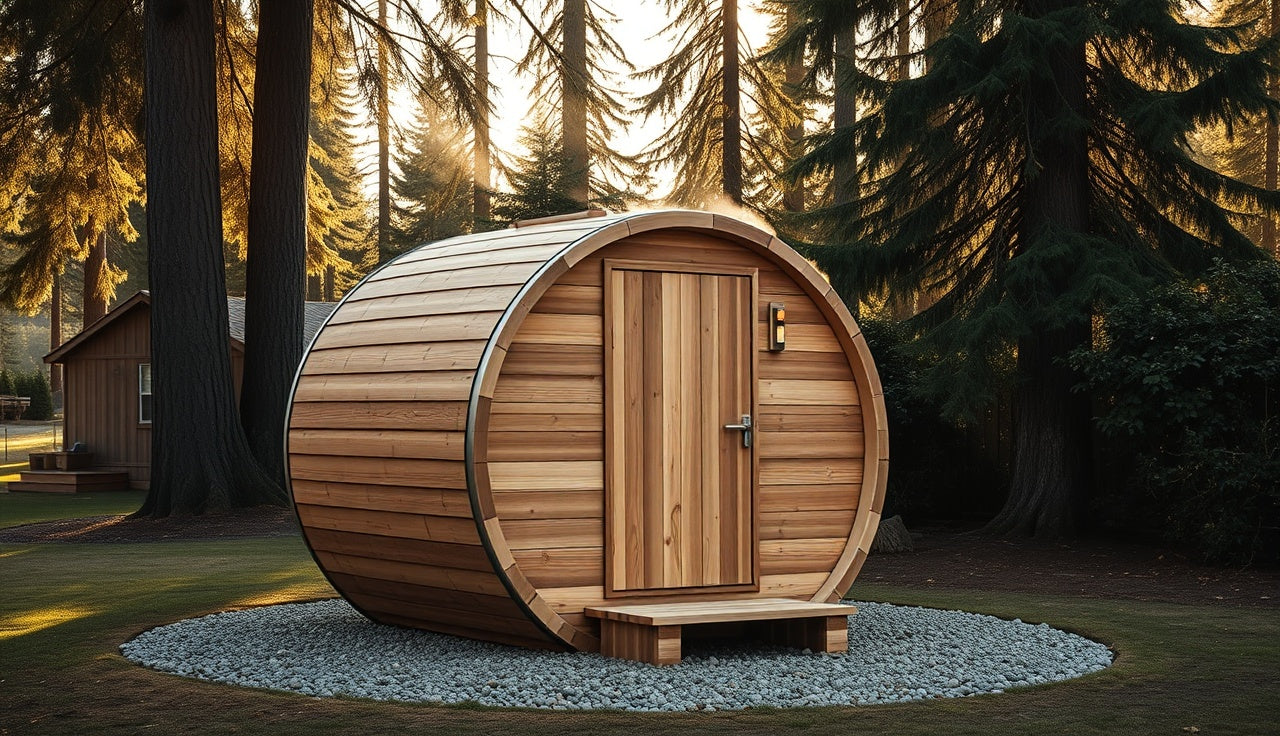
Most 4-person barrel saunas measure 7 feet long with a diameter of 5 to 6 feet, giving you roughly 35 to 42 square feet of floor area inside the cylinder. Some makers stretch the barrel to 8 feet for extra legroom, which you'll appreciate the first time you lie down after a hard session.
The interior is almost always two benches facing each other along the long axis. Each bench runs the full interior length and sits 18 to 20 inches off the floor, with an upper bench at 36 to 40 inches on some models. Four average-build adults fit without knocking elbows. Six people fit if everyone tolerates contact, but the "4-person" label is honest here, which is more than you can say for a lot of indoor sauna marketing.
Door width trips people up. Most barrel doors are 22 to 24 inches wide, narrow by residential standards. Fine for walking in. Worth knowing if you plan to carry in a bucket and ladle or add interior lighting later.
The cylinder shape isn't decoration. Curved walls and ceiling guide hot air in a convection loop, so heat spreads more evenly than it does in a rectangular box. The usable volume also runs smaller than the total interior volume, which is why your heater hits target temperature faster than it would in a rectangular home sauna of the same bench count. [1]
How much does a 4-person barrel sauna cost?
The honest range is $3,000 to $8,000 for the barrel alone, before electrical, delivery, or site prep. Budget kits use hem-fir or pine, a basic electric heater, and thin staves (around 1.5 inches). Premium builds use old-growth western red cedar, 2-inch staves, and often a wood-burning stove instead of an electric heater.
Installation adds real money. A 240V circuit run from your panel runs $300 to $800 for an electrician depending on distance [2]. A gravel or concrete foundation costs $150 to $500 if you do it yourself, or $600 to $1,500 if you hire it out. Freight for a pre-assembled barrel runs $200 to $600, and some retailers bill separately for the cradle stands that keep the barrel from rolling.
Here's what drives price at each tier:
| Price tier | Wood | Heater | Wall thickness | Extras |
|---|---|---|---|---|
| $3,000, $4,500 | Pine or hem-fir | Electric, 6 to 8 kW | 1.5 in | Basic bench, no window |
| $4,500, $6,000 | Canadian hemlock or Nordic spruce | Electric, 8 to 9 kW | 1.75 in | Window, porch add-on option |
| $6,000, $8,000+ | Western red cedar | Wood-burning or electric | 2 in | Front porch, LED lighting, premium benches |
Costco sometimes sells barrel saunas in the $2,500 to $4,000 range under house brands, and they're fine for occasional use. Read the costco sauna breakdown before you commit to one. If you plan to sauna three or more times a week, the thinner staves and cheaper wall construction on those kits show wear faster in humid climates. [3]
Wood-burning vs. electric heater: which is better for a 4-person barrel?
This question separates serious buyers from casual ones. Electric is easier. Wood-burning is better if you want the real thing.
Electric heaters ask nothing of you. Set a temperature on the panel, wait 30 to 45 minutes, walk in. They need a dedicated 240V circuit (typically 20 to 30 amps for a 6 to 9 kW heater). Most 4-person barrels ship with electric because it clears code in most places without extra inspections.
Wood-burning stoves are the traditional pick and the one to get if you care about an authentic Finnish session. A proper loyly (the burst of steam when water hits hot rocks) is hard to match with electric. A good wood stove heats the rocks to higher surface temperatures, and the air has a quality experienced sauna users notice right away. The costs: you need a chimney, which adds $200 to $500 to installation, and you need a wood supply. Reaching temperature takes 45 to 75 minutes depending on wood type and outdoor air. [4]
For a 4-person barrel, a stove rated 9,000 to 15,000 BTU is right. Undersized stoves struggle in cold climates. If your winters drop below 20F regularly, size up.
One thing nobody mentions: wood stoves in barrel saunas usually need a minimum clearance to combustibles that eats into your interior footprint. Check the manufacturer's spec sheet before you assume the stove drops cleanly into the end wall.
| Budget (pine/hem-fir, basic electric) | $4,500 |
| Mid-range (hemlock/spruce, 8–9 kW electric) | $6,500 |
| Premium (cedar, wood-burning, porch add-on) | $9,500 |
Source: SweatDecks market survey and cited retailer data, 2024
What wood species actually holds up outdoors?
Western red cedar is the standard answer, and it's the right one for most buyers. The natural oils resist moisture, slow mold, and keep the wood dimensionally stable through freeze-thaw cycles. It smells the way a sauna should. The catch is price: cedar costs more than other species, and old-growth cedar (tighter grain, more oil) costs more than plantation-grown.
Canadian hemlock is the budget alternative that punches above its price. It's tight-grained, resists warping reasonably well, and is nearly odorless, which some people prefer. It runs paler in color and sits a step below cedar for weather longevity, but with a UV-protective exterior treatment applied yearly, hemlock barrels last 15 to 20 years without trouble.
Nordic spruce shows up in Scandinavian imports. Nice look, performs well in the dry climates of Finland and Norway, but it's more porous than cedar and needs more upkeep in humid American regions (Pacific Northwest, Southeast).
Pine and hem-fir are the cheap seats. They work at entry-level prices but can pitch resin under heat, leaving sticky spots on benches. Not a dealbreaker. Just annoying.
Whatever the species, the exterior of any outdoor barrel wants a semi-transparent stain or oil every 1 to 2 years. Never seal the interior (stains and varnishes off-gas toxics under heat), but the exterior takes weather straight on and needs protection. [5]
Can a 4-person barrel sauna stay outside year-round?
Yes, and most are built for exactly that. The round form sheds rain and snow. Cedar and hemlock handle temperature swings. The staves expand and contract with humidity, which is normal.
A few habits protect longevity. Elevate the barrel on its cradle stands so the lowest staves get airflow underneath, because barrels sitting on wet ground rot faster. If you get heavy snow load, confirm your cradle system spreads weight evenly, since a poorly supported barrel under 200 pounds of wet snow can rack the stave alignment over years. In wet climates, cover the door opening with a tarp or fitted cover during long stretches of non-use.
Outdoor installation is even better for contrast setups. Stepping from a barrel sauna into a cold plunge or ice bath in fresh air is easier to manage outside than in. You walk out, cool down, walk back in. A 4-person barrel next to a cold plunge tub is one of the more practical home recovery setups you can build. [6]
The one real weakness is UV. Sun grays and dries cedar fast in high-sun states (Arizona, Southern California). Apply exterior UV oil or stain at setup and repeat annually there. The interior stays unfinished no matter the climate.
What electrical and permit requirements apply to a barrel sauna?
Most 4-person electric barrel saunas need a dedicated 240V, 20- to 30-amp circuit on a GFCI breaker. The National Electrical Code (NEC) Article 680 doesn't address saunas directly, but NEC Section 424 covers fixed electric space heating, and inspectors often apply those rules to sauna heaters. Ask your permit office which rules apply locally before you install, not after. [7]
Wood-burning barrels need no electrical work for the heater, but interior lighting still needs a circuit. A wood stove usually triggers a building permit in most jurisdictions because of the through-roof chimney penetration. Some cities treat a standalone sauna under 200 square feet as an accessory structure that skips the building permit. Read your local zoning ordinance.
Setbacks are the requirement people forget. Most residential zoning codes push accessory structures 5 to 10 feet from property lines and a set distance from the main house. A 4-person barrel runs 7 to 8 feet long, so you need enough yard depth to clear setbacks on both ends plus space to reach the door. On tight urban lots, this rules out barrel saunas outright.
The IRS covers medical expense deductions in Publication 502, but a backyard sauna almost never qualifies unless a physician prescribes it for a specific condition and you document it. Don't count on writing it off. [8]
How do you assemble a 4-person barrel sauna kit?
Most kits arrive as pre-cut stave panels, two end walls, bench assemblies, a heater, a door, and hardware. First-timers spend 4 to 8 hours with two people. If you've done it before, 3 to 5. The tools you actually need are a rubber mallet, a drill, a socket set, and a level.
Sequence matters. Set the cradle stands on level ground, lay the first stave panel as the floor base, and build the cylinder by adding panels around a central ring guide (usually threaded rod or steel band). The rings pull tight once every stave is seated. This is where a second person earns their spot: one holds tension while the other seats each stave.
End walls go in last. They're tongue-and-groove assemblies that drop into the cylindrical opening. The door end wall is heavier because it carries the door frame and hinges. Pre-hang the door with the end wall flat on the ground, then lift the whole unit into the barrel opening together.
Benches are simple: two side supports with cross slats, screwed into the interior wall. The heater mounts to the floor or a hearth pad depending on type.
One honest note. Kit quality varies a lot. Premium brands pre-drill everything. Budget kits sometimes ship with alignment problems that need shimming or minor cutting. Read assembly reviews from real buyers, not the product page, before you pick a brand.
How long does it take a 4-person barrel sauna to heat up?
An electric 4-person barrel with a 6 to 9 kW heater reaches 160 to 180F in 30 to 45 minutes at moderate outdoor temperatures (around 50F). Below 20F, add 15 to 20 minutes. Thicker staves and better insulation cut that time by holding heat instead of bleeding it through the walls.
Wood-burning stoves take 45 to 75 minutes to reach temperature, depending on wood species, moisture content, and outdoor air. Kiln-dried hardwood (oak, ash, birch) burns hotter and cleaner than green wood. None of this is a drawback if you like building the fire. It's a genuine inconvenience if you want heat on demand after a workout.
The barrel shape helps. Because the interior air volume is smaller than a rectangular box of the same bench capacity, heat builds faster. A 4-person rectangular infrared sauna with similar bench space might hit temperature in 20 to 30 minutes with comparable heater output, but the experience is different: traditional Finnish sauna (this) runs 160 to 195F with steam off the rocks, while infrared runs cooler (120 to 140F) and warms the body directly. The sauna overview walks through the different types.
Holding temperature during a session means the heater cycles on and off. Most electric heaters in this class stay within 5 to 10F of target without issue. A 60-minute session for four adults is typical.
What health effects does regular sauna use produce?
The cardiovascular research is the most consistent part of the sauna literature. A Finnish cohort study published in JAMA Internal Medicine in 2015 followed 2,315 middle-aged men and found that frequent sauna use (4 to 7 sessions per week) was associated with a 50% lower risk of fatal cardiovascular events versus once-weekly use [9]. The authors called it observational and wrote that "sauna bathing may be a recommendable health habit," while stating causation wasn't established.
Core body temperature rises to 38 to 39C (100 to 102F) during a typical session, which mimics some of the cardiovascular load of moderate exercise. Heart rate climbs to 100 to 150 bpm in most adults. These short-term effects are well-documented.
For recovery, heat exposure supports muscle relaxation and may reduce delayed onset muscle soreness, though effect sizes in controlled trials are modest. [10]
Pair sauna with cold water immersion (contrast therapy) and the limited evidence suggests better short-term subjective recovery and less perceived fatigue, though long-term outcomes are murkier. Nobody has clean data on the optimal protocol. The most-cited parameters in sports science suggest 2 to 3 rounds of sauna followed by cold immersion, each round 10 to 15 minutes hot and 1 to 3 minutes cold.
The sauna benefits breakdown reviews what the research actually says. Stay conservative on medical claims. Talk to a doctor before using a sauna if you have cardiovascular conditions, low blood pressure, or you're pregnant.
Is a 4-person barrel sauna worth buying vs. other sauna types?
Barrel saunas hit a specific sweet spot: outdoor-ready, good-looking, and sized right for a household of two to four regular users. Want it indoors? A rectangular indoor kit uses space better for the same bench count. Want ultra-portability? A portable sauna costs far less. Comparing dry heat to steam? The sauna vs steam room breakdown covers the functional differences.
The barrel format makes sense if:
- You have outdoor yard space and want a permanent fixture
- You value traditional high-heat Finnish sessions over infrared
- You want something that looks good without building a separate outbuilding
- You'll use it with guests or a partner regularly (four people around three times a week is where the value math works)
It makes less sense if:
- Your winters are brutal and your yard isn't sheltered (wind chill on a barrel is real)
- You have a small lot with tight setbacks
- You mostly want infrared heat (infrared panels don't work in a curved barrel)
- You want heavy customization (custom tile, sound systems, specific bench layouts)
SweatDecks carries a selection of outdoor sauna options including barrel models if you want to compare specs side by side.
For most homeowners who want a real sauna and have 200 to 400 square feet of outdoor space, a 4-person barrel at the $4,500 to $6,000 price point delivers legitimate value. It isn't cheap. It also isn't a gimmick.
What should you look for when comparing 4-person barrel sauna brands?
Stave thickness is the single most important spec after wood species. Anything under 1.5 inches feels flimsy and loses heat noticeably faster in the cold. Target 1.75 to 2 inches for year-round outdoor use. Some makers advertise "double-wall" construction with an air gap, which helps above 40F, though the gain is marginal in extreme cold because the gap isn't thick enough to change heat retention much.
Heater brand matters more than most buyers realize. The barrel maker and the heater maker are usually different companies. Look for heaters from established Finnish or German makers like Harvia, Helo, or TYLO. Those brands have parts availability, real safety certifications (ETL or UL listing), and warranty support. Generic heaters bundled with budget kits often lack ETL/UL certification, which can void your homeowner's insurance if something goes wrong. [11]
Warranty length shows how much the maker trusts its own product. Five years on the barrel structure and 2 to 3 years on the heater is baseline for a reputable brand. Anything shorter on the structural warranty for a $5,000 product deserves a hard look.
The cradle system (what keeps the barrel off the ground) should adjust for uneven terrain and use galvanized or coated steel. Painted mild steel cradles rust out in 3 to 5 years in wet climates. Cheap to fix, annoying to deal with.
Read the assembly instructions before you buy. Brands that publish full instructions in public are usually the confident ones. If a brand hides assembly docs until purchase, treat that as a yellow flag.
How do you maintain a 4-person barrel sauna over time?
Monthly during regular use: sweep the floor, wipe the benches with a dry cloth, and eyeball the stave rings for tension. The threaded rods or metal bands loosen slightly as the wood cycles through humidity in the first year. A half-turn of tightening in fall and spring keeps the structure sound.
Annually: apply exterior UV-protective oil or semi-transparent stain to the outside. Never the inside. Clean the heater rocks by pulling them and rinsing with water. Cracked or crumbling rocks need replacing because they hold less heat and can spit fragments. Sauna rocks last roughly 2 to 3 years of regular use.
Every few years: check the door seal. The door is often the first thing to warp because it's a flat panel in a round opening, taking different stress than the curved staves. A warped door leaks heat and usually fixes with a hinge adjustment or a new gasket.
Wood-burning users: clean the flue annually. Creosote builds up with any wood stove and it's a fire hazard. A professional chimney sweep runs $100 to $250 and earns it.
Electric users: check the heating element and thermostat connections at the 5-year mark. Most quality electric heaters run 15 to 20 years without a failed element, but the connection points are the weak spot. Loose terminals are the most common cause of heater failure, and the cheapest fix if you catch them early.
Frequently asked questions
How many people actually fit in a 4-person barrel sauna?
Four average-build adults fit comfortably on the two opposing benches in a standard 7-foot barrel. Six can squeeze in, but it's uncomfortable and heat recovery between rounds slows down because more body mass absorbs more heat. For a household of four who want to sauna together regularly, the 4-person size is accurate without being cramped.
What is the best wood for a barrel sauna?
Western red cedar is the top choice for outdoor barrel saunas. Its natural oils resist moisture and mold, it stays dimensionally stable through freeze-thaw cycles, and it carries the classic sauna scent. Canadian hemlock is a solid, cheaper alternative. Nordic spruce works in dry climates but needs more upkeep in humid American regions. Skip pine for anything you use often; it pitches resin under heat.
Do barrel saunas need a concrete pad foundation?
Not necessarily. A compact gravel base 4 to 6 inches deep gives you drainage and stability and is often enough. A concrete pad works too but adds cost and permanence. What matters is a flat, level, well-drained surface. The cradle stands need even support to keep the structure from racking over time. Don't set the barrel directly on soil or grass, which invites rot at the lowest stave contact points.
How much does it cost to run a barrel sauna electrically per session?
A 9 kW electric heater running one hour uses about 9 kWh. At the U.S. average residential rate of roughly $0.16 per kWh (EIA, 2024), that's about $1.44 an hour. A 90-minute preheat plus a 60-minute session costs roughly $3.50 to $4.50 in electricity. Three sessions a week runs about $55 to $70 a month depending on your local rate and climate.
Can I use a wood-burning stove in a barrel sauna?
Yes, and many purists prefer it. A wood stove produces a different quality of heat and lets you make traditional Finnish loyly steam. Installation needs a chimney penetration through the end wall, which most makers offer as an option or handle with a chimney kit. Check local building permits for wood-burning appliance rules. Size the stove for the barrel volume, typically 9,000 to 15,000 BTU for a 4-person barrel.
What size heater does a 4-person barrel sauna need?
For a 4-person barrel (roughly 175 to 210 cubic feet of interior volume), an electric heater in the 6 to 9 kW range is standard. In cold climates with outdoor installation, lean toward 8 to 9 kW. For wood-burning, a stove rated 9,000 to 15,000 BTU fits. Undersize it and the heater runs nonstop without hitting temperature in the cold. Oversize it and you waste energy and overheat the space fast.
How long do barrel saunas last outdoors?
A well-maintained cedar barrel lasts 15 to 25 years outdoors. Annual exterior oil or stain is the most important step. Hemlock barrels last 12 to 20 years with the same care. Mild steel cradle stands may need replacing after 7 to 10 years in wet climates. The heater is usually the first major component to go, at 10 to 20 years depending on how often you use it and the brand.
Do I need a permit to install a barrel sauna in my backyard?
It depends on your municipality. Many jurisdictions exempt a standalone accessory structure under 200 square feet from building permits, but you still have to meet setback requirements. Electric connections almost always require an electrical permit and inspection. Wood-burning stoves usually need a separate permit for the flue. Check with your local building department before installation; requirements vary a lot by city and county.
Can I put a barrel sauna on a deck?
Yes, with caveats. A 4-person cedar barrel weighs 800 to 1,200 pounds assembled, plus occupants. Most residential decks are rated for 40 pounds per square foot live load. Because the weight concentrates on the cradle contact points, you may need to reinforce joists or add support posts under those points. Talk to a structural engineer or contractor before setting one on an existing deck.
What is the difference between a barrel sauna and a traditional cabin sauna?
A barrel sauna is cylindrical with curved stave walls and sits outdoors on cradle stands. A cabin (or box) sauna is rectangular and can be a standalone building or an indoor room. Barrels heat faster because their interior volume is smaller relative to bench capacity. Cabins offer more customization, better insulation options, and easier electrical integration. Barrels cost less and install faster. Cabins last longer with less maintenance in most climates.
Is a 4-person barrel sauna good for contrast therapy?
It's one of the better home setups for it. The outdoor location makes the hot-to-cold transition natural. A barrel paired with a cold plunge tub or ice bath 10 to 15 feet away lets you move between extremes fast. Protocols in the sports science literature typically suggest 2 to 3 rounds of 10 to 15 minutes in the sauna followed by 1 to 3 minutes of cold immersion. See the cold plunge benefits overview for what the evidence actually shows.
How do I prevent mold inside a barrel sauna?
Ventilation is the main defense. Most barrels have a vent near the floor for fresh air intake and one near the top of an end wall for exhaust. Keep both open after sessions so moisture escapes. Leave the door cracked when the sauna sits idle. Don't seal the interior wood. If mold shows up on benches, scrub with dilute white vinegar and water, then fix the airflow. Mold in a well-ventilated barrel is uncommon.
What accessories are worth buying with a 4-person barrel sauna?
A wooden bucket and ladle set is non-negotiable for traditional steam. A thermometer/hygrometer combo mounted at bench height (not the ceiling) tells you the actual sitting temperature. A sand timer for tracking rounds. A changing room add-on (a front porch vestibule mounted to the entrance) is worth it on a cedar model you'll use year-round; it buffers cold air and gives you a spot for towels. LED lighting is a nice touch for evening use.
Sources
- Finnish Sauna Society, sauna construction guidelines: Cylindrical barrel shape promotes even convective air circulation, reducing the interior volume relative to bench capacity compared to rectangular designs
- U.S. Bureau of Labor Statistics, Occupational Outlook Handbook: Electricians: Licensed electrician labor rates inform the $300–$800 estimate for running a 240V circuit
- Consumer Reports, outdoor sauna buying guide: Entry-level barrel sauna kits in the $2,500–$4,000 range use thinner stave construction that shows faster wear under frequent use
- Harvia Sauna, heater product technical specifications: Wood-burning sauna stoves require 45 to 75 minutes to reach target temperature depending on ambient conditions; kiln-dried hardwood improves burn efficiency
- U.S. Forest Service, Forest Products Laboratory: Wood Handbook: Western red cedar contains natural oils that resist moisture and fungal decay; its dimensional stability suits repeated thermal cycling
- National Institutes of Health, PubMed: contrast water therapy review: Contrast therapy (alternating heat and cold immersion) is associated with reduced perceived fatigue and improved short-term subjective recovery in athletic populations
- National Fire Protection Association, NFPA 70 National Electrical Code (NEC): NEC Section 424 governs fixed electric space heating; local inspectors apply these rules to sauna heater installations requiring dedicated 240V circuits
- IRS Publication 502, Medical and Dental Expenses: A home sauna is generally not deductible as a medical expense unless prescribed by a physician for a specific condition and properly documented
- JAMA Internal Medicine, 'Association Between Sauna Bathing and Fatal Cardiovascular and All-Cause Mortality Events,' 2015: Frequent sauna use (4–7 sessions/week) was associated with a 50% lower risk of fatal cardiovascular events vs once-weekly use in a cohort of 2,315 Finnish men; authors stated 'sauna bathing may be a recommendable health habit'
- PubMed Central, heat therapy and muscle recovery review: Heat exposure supports muscle relaxation and may reduce delayed onset muscle soreness, though effect sizes in controlled trials are modest
- Intertek (ETL) and UL, sauna heater safety certification requirements: ETL or UL listing is required for electric sauna heaters to meet safety standards; uncertified heaters can void homeowner's insurance coverage
- U.S. Energy Information Administration, Average Retail Price of Electricity: Average U.S. residential electricity rate is approximately $0.16 per kWh as of 2024, used to calculate per-session operating cost
Share:
What temperature should a sauna be set at?
4 person barrel sauna kit: what to buy, build, and expect