
Last updated 2026-07-09
TL;DR
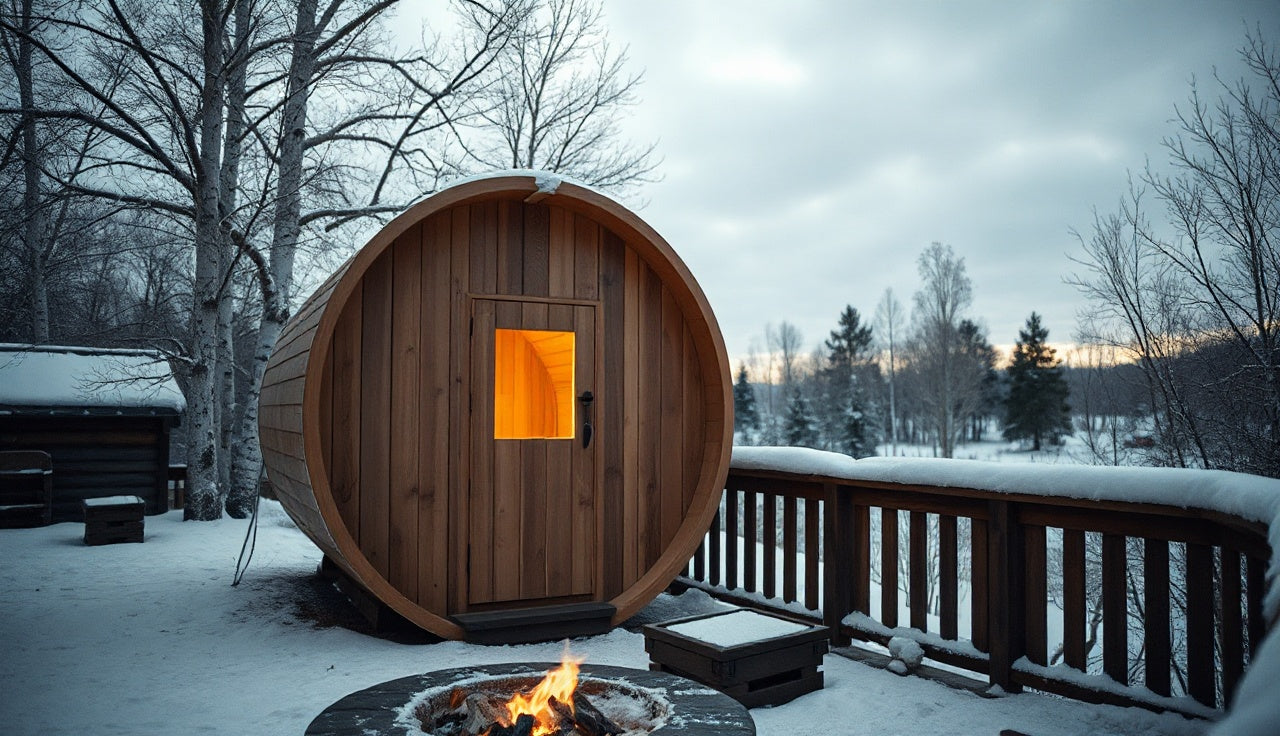
A wood barrel sauna is a cylindrical outdoor sauna built from curved staves of cedar, spruce, or thermowood held under compression by steel hoops. Prices run $2,000 to $10,000 depending on size and heater type. Barrel saunas heat faster than a boxy cabin sauna, shed rain and snow off the curved roof, and sit on gravel with no foundation. Most homeowners have one running within a weekend.
What exactly is a wood barrel sauna?
A barrel sauna is a cylindrical sauna cabin built the way a wine barrel is built: curved wooden staves held together under compression by steel or aluminum hoops. No framing. No insulation batts. No drywall. The wood is the structure, the insulation, and the finished surface all at once.
The geometry does real work. A cylinder has less surface area relative to its interior volume than a rectangle, so the room loses heat through the walls more slowly. The heater has less to fight, and you reach target temperature faster. Most barrel saunas in the 6-foot-diameter range reach 170°F to 190°F in 30 to 45 minutes. A rectangular wood-frame cabin sauna of similar volume takes 45 to 75 minutes [1].
The curved roof sheds rain and snow without any extra overhang design. That matters when the thing sits in your backyard through four seasons.
Barrel saunas are almost always built for outdoor installation, though a few manufacturers make indoor-rated versions. If you are still comparing formats, a barrel is one of four or five main shapes worth understanding before you commit. Our broader home sauna guide lays out the rest.
What are barrel saunas made from, and which wood is best?
The four common woods are Western red cedar, Nordic spruce, white cedar, and thermowood. Each has its own feel, price, and maintenance profile.
Western red cedar is the default for North American buyers. Natural oils resist moisture, insects, and rot. Its low density keeps the wood from getting too hot to touch. And the smell is the smell most people picture when they picture a sauna. Expect a modest premium over spruce.
Nordic spruce is the Scandinavian standard, which makes sense because most barrel designs originated there. It is denser and slightly harder than cedar, holds its shape well under compression, and costs less. Raw spruce needs more careful maintenance than cedar to fend off moisture damage over the years.
Thermowood is regular softwood, usually spruce or pine, heat-treated at 185°C to 215°C in a low-oxygen environment [2]. The process cuts the wood's equilibrium moisture content by roughly 50%, so it absorbs and releases water far more slowly than untreated wood. A thermowood barrel stays dimensionally stable, resists warping, and carries a darker, richer color than raw spruce. The catch is price. Thermowood staves cost more to produce, so finished units run roughly 20 to 30 percent more than comparable cedar.
Here is how the main options stack up:
| Wood type | Rot resistance | Heat-to-touch | Price relative to cedar | Maintenance level |
|---|---|---|---|---|
| Western red cedar | Excellent | Low (cool) | Baseline | Low |
| Nordic spruce | Good | Medium | 10 to 20% less | Medium |
| Thermowood spruce/pine | Excellent | Low (cool) | 20 to 30% more | Very low |
| White cedar | Very good | Low | Similar to red cedar | Low |
If you want to set it and forget it, thermowood earns its premium. If you will actually apply a UV-protective oil once a year, cedar and spruce both hold up beautifully.
How much does a wood barrel sauna cost?
A wood barrel sauna costs $2,000 to $10,000 depending on size, wood, and heater. Entry-level electric kits start near $2,000. A solid mid-range unit installed runs $5,000 to $8,000 all in. Premium wood-fired units top out around $10,000 before installation.
Entry-level kits (two-person, roughly 5 feet in diameter, electric heater included) start around $2,000 to $3,500. These are usually spruce staves with galvanized hoops and a basic wall-mounted electric heater in the 4 kW to 6 kW range. They work. But the staves are often thin (around 1.5 inches) and the hardware is unrefined.
Mid-range units (four-person, 6-foot diameter, better hardware) run $4,000 to $6,500. You get cedar or thermowood staves 1.75 to 2 inches thick, stainless hardware, and a heater worth owning. This tier gives most homeowners the best value per dollar.
Premium and large-format barrels (six-person and up, 7- to 8-foot diameter, optional wood-fired stove) reach $7,000 to $10,000 or more before installation. At this size the barrel becomes a social space rather than a solo recovery tool.
Installation adds cost. A gravel pad and assembly runs $200 to $600 if you hire a local crew. Electrical work for a 240V circuit (required for heaters above roughly 4 kW) typically costs $400 to $1,200, depending on how far your panel sits from the install site [3].
Go wood-fired and you skip the electrical run entirely. You add the stove insert instead ($400 to $900 for a quality unit) plus the chimney system.
A solid mid-range barrel with electric heat lands at roughly $5,000 to $8,000 installed. That is meaningfully less than most outdoor sauna cabin builds at the same capacity.
| Entry-level (2-person, spruce, basic electric) | $3,500 |
| Mid-range (4-person, cedar/thermowood, quality electric) | $6,500 |
| Premium (6-person, thermowood, wood-fired) | $10,000 |
Source: Industry pricing ranges, Angi cost data [3] and EIA electricity rates [5], 2025
Wood-fired vs. electric barrel sauna: which heating option is better?
Neither wins outright. Electric is better for daily, low-friction use; wood-fired is better for the weekend ritual and produces steam many sauna users prefer. Pick based on how you actually plan to use it, not which sounds nicer.
Electric heaters are convenient. Set a temperature, wait 30 to 45 minutes, walk in. Most modern units have Wi-Fi or app control so you can preheat on the drive home. They need a 240V circuit (in the US, usually a 20 to 40 amp breaker depending on heater size [4]), which means an electrician visit if you do not already have power near the install location. Running cost tracks your local rate. A 6 kW heater running one hour per session at the US average residential rate of roughly 16 cents per kWh costs about $0.96 per session [5].
A wood-fired barrel uses a dedicated wood-burning stove that sits inside the barrel on one end, with a chimney exiting through the roof. The experience is different in a way that is hard to quantify and easy to feel. The heat builds gradually. The smell of burning wood fills the room. Water on a wood-fired kiuas throws a steam (löyly) that many experienced users rate above electric steam. Building and tending the fire is half the appeal for a lot of people.
The downsides of wood are real. You need dry firewood on hand. Startup runs longer (45 to 75 minutes is typical). You cannot preheat from your phone. And ash needs clearing.
Want a daily recovery tool with minimum fuss? Electric wins. Want a Saturday afternoon ritual? Wood-fired is hard to beat. Some barrels support both with a combination stove that takes wood or an electric element. Flexible, but it adds cost.
How long do barrel saunas last, and what maintenance do they need?
A well-built cedar or thermowood barrel sauna, maintained properly, lasts 15 to 25 years. The hoops are the structural weak point. Galvanized steel hoops rust in wet climates, so specify stainless steel or aluminum if you live somewhere with sustained rain or coastal salt air.
The staves last longest when the sauna runs through full wet-dry cycles on a regular schedule. Staves that stay damp for long stretches (rain pooling, a door left open in wet weather, poor drainage under the barrel) grow mold and eventually rot. A gravel pad or pressure-treated cradles that lift the barrel off the ground and let air move underneath make a measurable difference [11][12].
Annual upkeep comes down to three tasks. Tighten the hoops each spring and fall, because the wood expands and contracts seasonally and the hoops need periodic snugging to hold compression; most manufacturers ship a wrench for exactly this. Apply a UV-protective exterior oil or stain to any exposed wood once a year, which stops the grey weathering cedar develops when left bare. Inspect the door seal and hinges for wear, since the door moves more than anything else on the unit.
The interior needs no finish. Applying sealers or paints inside a sauna is a health problem, because those chemicals off-gas at high heat. Let the interior wood breathe.
Do you need a permit to install a barrel sauna in your backyard?
Sometimes. In the US it depends on your municipality, but the pattern holds: a structure on a permanent foundation, above a set footprint (commonly 120 sq ft, though some places use 200 sq ft), or connected to electrical service usually needs a permit [6]. Most barrels stay under the 120-square-foot footprint threshold, but the electrical circuit for an electric heater almost always triggers a permit and inspection.
This is the question most buyers skip and then regret.
A wood-fired barrel on a gravel pad with no electrical connection is the most permit-friendly setup in most jurisdictions. You are placing a freestanding outdoor structure with no utilities, which many local codes treat like a large shed.
HOA rules are a separate layer. Plenty of HOAs restrict outbuildings by height, color, distance from property lines, or material. Read your CC&Rs before you order.
On zoning setbacks, most residential zones want structures at least 5 to 10 feet from property lines and easements, but this varies widely. The safest move is a 15-minute call to your local building department before you buy. They tend to be more helpful than people expect.
How hard is it to assemble a barrel sauna kit yourself?
Not very. Most kits are built for two reasonably handy people with basic tools. Pre-cut, pre-drilled staves arrive bundled, the hoops come pre-formed, and assembly follows a clear order: lay the cradle rails, stand the end walls, stack the floor staves, add the side staves, tighten the hoops, hang the door and hardware, then install the heater.
A typical two-person, 6-foot-diameter kit takes one full day. Larger six-person kits usually take a weekend. The main thing that slows people down is not having a flat, level base ready before the kit shows up.
The base matters more than people expect. Barrel saunas are heavy. A 6-foot by 7-foot cedar barrel can weigh 800 to 1,200 pounds fully assembled. A 4-inch compacted gravel pad at least 2 feet wider than the barrel's footprint on all sides is the standard recommendation from most manufacturers. Concrete pads work fine but are overkill here.
Going electric? Book the electrician before the kit arrives so the circuit is ready to connect the moment assembly ends. Running temporary extension cords through a sauna door is a fire hazard and a hassle.
SweatDecks stocks barrel saunas with assembly guides included. The home sauna collection pages list specs and dimensions clearly enough that you can measure your space against the kit before you order.
What size barrel sauna do you actually need?
For most homeowners, a 6-foot diameter is the answer: two people lying down or four seated, and the most popular size sold in North America. Diameter drives capacity more than length does, because usable bench space depends on the curved interior cross-section.
A 4-foot-diameter barrel is tight. One adult lying down, two sitting upright. These get marketed as personal or couples units, and most buyers find them cramped once the novelty fades.
A 6-foot-diameter barrel is the sweet spot for one to four people. Two can lie down on opposite benches, or four can sit.
A 7- or 8-foot-diameter barrel starts to feel like a room. Four to six people seated, two lying down at once. The larger diameter allows a full 360-degree wraparound bench in some designs. These cost much more to ship (freight only, not standard carrier) and demand more heating power.
Length adds capacity too. A 6-foot-diameter barrel at 6 feet long seats fewer people than the same diameter at 8 feet. Most standard kits come in 6-foot or 8-foot lengths, with custom lengths available from premium makers.
One honest caveat: manufacturer person-capacity is almost always optimistic. Treat their numbers as social maxima, not comfortable everyday use.
What are the health benefits of regular sauna use, and do barrel saunas deliver them?
Yes. The sauna health research is built almost entirely on Finnish-style dry heat, which is exactly what a barrel sauna produces. The barrel shape does not change the physiological exposure. Temperature and duration are what matter.
The most-cited work comes from the Finnish Kuopio Ischemic Heart Disease Risk Factor Study, which followed 2,315 middle-aged Finnish men over roughly 20 years. Men who used a sauna 4 to 7 times per week had a 40% lower risk of all-cause mortality than once-weekly users [7]. The authors reported that sauna bathing is "a safe activity for healthy adults" and noted that the cardiovascular response during a session resembles moderate-intensity exercise.
Other research points to lower resting blood pressure over time [8], improved arterial compliance, and reduced muscle soreness after exercise [9]. None of it is specific to barrel saunas. It applies to any sauna hitting the same conditions, roughly 80°C to 100°C (175°F to 210°F).
A barrel reaches those temperatures as reliably as any other design. Faster preheat and lower cost mean people tend to use a barrel more consistently, and consistency is what drove the outcomes in the long-term studies.
Honest caveat: the cardiovascular studies are observational and mostly on healthy middle-aged men. People with heart conditions, anyone pregnant, and anyone on certain medications should talk to a physician before regular sauna use. For more on the documented sauna benefits, that piece goes deeper into the study designs.
Pairing sauna with cold water immersion has its own growing literature. Cold plunge sessions after sauna are common in home setups, and the combination appears to amplify the heart rate variability response more than either alone, though the data on this specific protocol is still early.
How does a barrel sauna compare to other outdoor sauna options?
The barrel wins on install simplicity and value per dollar. Its main rivals in the backyard market are cabin saunas, pod saunas, and prefab indoor units moved outside. Each trades something.
Cabin saunas are rectangular, traditionally framed, and look like a small building. They cost more to build (custom builds run $8,000 to $20,000+), take longer to heat, and want a proper foundation in most climates. The upside is interior volume. A cabin can feel roomier at the same person-capacity, and it is easier to add a dressing room or anteroom.
Pod saunas are an egg-shaped or teardrop variant using similar curved-stave construction. Less common, often pricier, and limited on bench layouts. Distinctive to look at, practically similar to a barrel.
Prefab cabin kits (the ones sold through warehouse retailers) often cost less upfront than a quality barrel but demand more install work, more space, and a 240V circuit regardless of size. They also tend to be less weather-resilient, because conventional insulation and framing can trap moisture.
For a buyer who wants an outdoor sauna with minimum install complexity and the most value per dollar, the barrel format wins. You can even move a barrel if you relocate. You cannot move a cabin build.
Looked at big-box options already? Compare specs carefully before deciding. Our piece on costco sauna options breaks down what those units actually include versus what the marketing implies.
Can you use a barrel sauna in cold climates and winter?
Yes, and plenty of owners argue winter is the best time for it. Stepping out of a 190°F barrel into 15°F air and snow is a big part of Nordic sauna culture.
The barrel handles cold better than most rectangular cabins for two reasons. The cylindrical shape sheds snow load naturally, so snow does not pile the way it sits on a flat or low-pitch roof. And the compression-fit stave construction actually tightens as the wood contracts in cold weather, which cuts air infiltration.
Extreme cold does slow heat-up. A barrel that reaches 180°F in 35 minutes at 50°F ambient might need 50 to 60 minutes at 0°F. In a climate with sustained sub-zero temperatures, size your heater generously (a 9 kW electric or a larger wood stove). It is worth it.
One winter maintenance note: door hardware, especially hinges and magnetic catches, can freeze if the sauna cools completely between uses in bitter cold. A thin coat of food-grade silicone lubricant on the metal before winter prevents most of it.
What should you look for when buying a barrel sauna kit?
Stave thickness first. It is the most overlooked spec. Budget kits use 1.5-inch staves; better kits use 1.75 to 2 inches. The thicker stave holds heat longer, which helps both session quality and energy cost over time.
Hoop material next. Stainless steel or aluminum hoops earn their premium in any climate with real moisture. Galvanized steel eventually rusts and stains the wood.
Door construction matters a lot. A poorly fitting door bleeds heat and makes temperature hard to hold. Look for a proper wooden frame (better than a plain tongue-and-groove stave door), a quality seal, and stainless hinges.
Heater quality deserves more attention than most buyers give it. A cheap electric heater in a well-built barrel still delivers a mediocre session. Finnish-made heaters from Harvia, HUUM, or Finlandia are the benchmark. They throw better steam and last far longer than budget units.
Ventilation is a safety item, not a nice-to-have. A barrel needs at least one adjustable vent near the floor for fresh air intake and one at the upper end for exhaust. Without both, oxygen drops during long sessions and the air goes stale [10]. Many budget kits include only a single vent, so confirm the setup before you buy.
Check the warranty last. Quality manufacturers offer 5-year structural warranties on the stave assembly and 2 to 3 years on hardware. A one-year warranty on everything signals lower build quality.
Frequently asked questions
How long does it take a wood barrel sauna to heat up?
Most 6-foot-diameter barrel saunas with an appropriately sized electric heater reach 170°F to 190°F in 30 to 45 minutes. Wood-fired models take longer, typically 45 to 75 minutes depending on fire management and outside temperature. The cylindrical shape helps heat concentrate near the benches faster than a rectangular room of similar volume.
What is thermowood and is it better for a barrel sauna?
Thermowood is softwood (usually spruce or pine) heat-treated at 185°C to 215°C in a low-oxygen process that cuts equilibrium moisture content by roughly 50%. The result is a dimensionally stable, dark-toned wood that absorbs and releases moisture much more slowly than untreated wood. For a barrel left outdoors year-round, thermowood warps and degrades less than untreated cedar or spruce, at a cost premium of about 20 to 30 percent.
Do barrel saunas need a foundation?
No. Most barrels sit on two cradle rails that spread the weight across a gravel pad, concrete pavers, or pressure-treated sleepers. A compacted gravel pad at least 4 inches deep and 2 feet wider than the barrel on all sides is the standard recommendation. The key is drainage and airflow underneath, not structural support. Avoid setting the barrel directly on soil, which traps moisture against the wood.
How many people fit in a barrel sauna?
A 4-foot-diameter barrel fits one or two people seated. A 6-foot-diameter barrel (the most popular size) fits two lying down or four seated. A 7- to 8-foot-diameter barrel fits four to six people comfortably. Manufacturer person-capacity numbers tend to be optimistic, so treat them as social maxima rather than comfortable daily-use numbers.
Can I install a barrel sauna myself or do I need a contractor?
Most kits are built for two people with basic tools and assemble in one to two days. The kit itself is DIY-friendly. The part that often needs a contractor is the 240V electrical circuit for an electric heater, which requires a licensed electrician and a permit in most US jurisdictions. Wood-fired models skip the electrical work entirely, which makes them the most DIY-accessible option.
How much does it cost to run a barrel sauna per month?
For an electric barrel with a 6 kW heater used three sessions per week (each roughly one hour of heating), running cost at the US average residential rate of about 16 cents per kWh is roughly $11 to $15 per month. Wood-fired cost depends on local firewood prices, but a cord of seasoned hardwood ($200 to $400 depending on region) yields roughly 50 to 80 sessions.
What kind of maintenance does a barrel sauna need?
Tighten the hoops each spring and fall as the wood expands and contracts seasonally. Apply a UV-protective exterior oil or stain annually to exposed outdoor surfaces. Keep the area under the barrel clear of debris and standing water to prevent rot from below. Never seal or paint the interior; the wood needs to breathe and interior finishes off-gas dangerously at sauna temperatures.
Is a wood barrel sauna good for cold climates and winter use?
Yes. The cylindrical roof sheds snow naturally, and the compression-fit stave construction actually tightens as the wood contracts in cold weather, which reduces air leaks. Heat-up time rises in very cold ambient temperatures, so buyers in sub-zero climates should size the heater generously, a 9 kW electric unit or a larger wood stove. Door and hinge hardware benefits from silicone lubricant before winter to prevent freezing.
How long do barrel saunas last?
A well-maintained cedar or thermowood barrel lasts 15 to 25 years. The hoops are the structural weak point, and stainless or aluminum hoops outperform galvanized steel in wet climates. The staves last longest when the sauna runs through full wet-dry cycles rather than staying damp. Consistent use is actually good for the wood; long dormant periods with moisture trapped inside cause more damage than heavy use.
Do I need a permit to install a barrel sauna in my backyard?
It depends on your municipality. Most local codes require permits for any structure above 120 square feet (some use 200 sq ft) or connected to electrical service. A wood-fired barrel on a gravel pad with no electrical connection is the most permit-free option in most jurisdictions. The electrical circuit for an electric heater almost always requires a permit and inspection. Check with your local building department and HOA before ordering.
What is the difference between a wood barrel sauna and a cabin sauna?
A barrel sauna is cylindrical, built from compression-fit curved staves with no framing or insulation batts. A cabin sauna uses conventional rectangular framing, insulation, and interior paneling. Barrels cost less, install faster, need no foundation, and heat up more quickly. Cabin saunas offer more design flexibility, a larger footprint option, and typically look more like a permanent building, which some buyers prefer.
Can I pair a barrel sauna with a cold plunge for contrast therapy?
Yes, and many buyers do exactly this. A common contrast protocol is 10 to 20 minutes of sauna followed by cold immersion for 1 to 5 minutes, repeated two to four times. A barrel sauna and a cold plunge or ice bath positioned within steps of each other makes the transition practical. The combination appears to amplify heart rate variability response compared to either alone, though long-term data on this specific protocol is still limited.
Which wood is best for a barrel sauna, cedar or thermowood?
Both work well. Western red cedar has natural oils that resist rot and insects, stays cool to the touch, and carries the classic sauna smell. Thermowood is more dimensionally stable and absorbs moisture more slowly, which makes it lower-maintenance in wet or variable climates. Thermowood costs roughly 20 to 30 percent more. For buyers who will maintain the exterior annually, cedar is excellent value. For set-it-and-forget-it buyers, thermowood earns the premium.
What size heater do I need for a barrel sauna?
The common rule of thumb is 1 kW of heater capacity per 45 to 50 cubic feet of sauna volume, though thinner-walled or poorly insulated saunas need more. A 6-foot-diameter by 7-foot-long barrel has roughly 200 cubic feet of interior volume, which points to a 4 to 6 kW heater. Cold climates add demand, so buyers in consistently cold regions should size up by 1 to 2 kW beyond the calculated minimum.
Sources
- University of Eastern Finland, Kuopio campus: sauna research overview: Barrel saunas and cylindrical structures heat up faster than rectangular rooms of similar volume due to lower surface-area-to-volume ratio
- Thermowood Association, technical specification ThermoWood Handbook: Thermowood is produced by heat treatment at 185°C to 215°C in a low-oxygen environment, reducing equilibrium moisture content by roughly 50%
- Angi, cost guide for electrical panel and circuit installation: Installing a new 240V circuit typically costs $400 to $1,200 depending on distance from panel and local labor rates
- National Fire Protection Association, NFPA 70 National Electrical Code, Article 422 Appliances: Electric sauna heaters above approximately 4 kW in the US typically require a dedicated 240V circuit on a 20 to 40 amp breaker per NEC Article 422
- U.S. Energy Information Administration, Electric Power Monthly, average retail electricity prices: US average residential electricity rate is approximately 16 cents per kWh as of recent reporting periods
- International Code Council, International Residential Code (IRC) Section R105 Permits: Many jurisdictions use 120 or 200 square feet as the threshold below which accessory structures may not require a building permit under IRC provisions
- JAMA Internal Medicine: 'Association Between Sauna Bathing and Fatal Cardiovascular and All-Cause Mortality Events' (Laukkanen et al., 2015): Men using sauna 4 to 7 times per week had 40% lower all-cause mortality risk vs once-weekly users; researchers concluded sauna bathing is safe for healthy adults
- American Journal of Hypertension (Oxford Academic): sauna bathing and blood pressure research: Regular sauna use is associated with reduced resting blood pressure over time in multiple observational studies
- Journal of Athletic Training (Allen Press): heat therapy and post-exercise muscle recovery review: Heat therapy including sauna is associated with reduced delayed onset muscle soreness in several studies
- U.S. Consumer Product Safety Commission, outdoor structure and heater safety guidance: Outdoor heated structures including saunas require adequate ventilation to maintain safe oxygen levels during use
- University of Vermont Extension, wood moisture content and dimensional stability: Wood equilibrium moisture content varies seasonally, causing expansion and contraction that affects compression-fit structures like barrel saunas
- USDA Forest Service, Forest Products Laboratory, Wood Handbook (FPL-GTR-282), cedar and spruce properties: Western red cedar has natural extractives providing decay resistance; untreated spruce requires more active moisture management outdoors

Share:
Dundalk Harmony barrel sauna: full review and buyer's guide
What is the purpose of an ice bath and does it actually work?