
Last updated 2026-07-09
TL;DR
The Dundalk Harmony is a Canadian-made outdoor barrel sauna built from clear western red cedar. It comes in 6-foot and 7-foot diameters and runs roughly $4,000 to $7,500 depending on size and heater. It sits above Dundalk's entry Serenity line and below custom builds. Two people can assemble it in a weekend.
What exactly is the Dundalk Harmony barrel sauna?
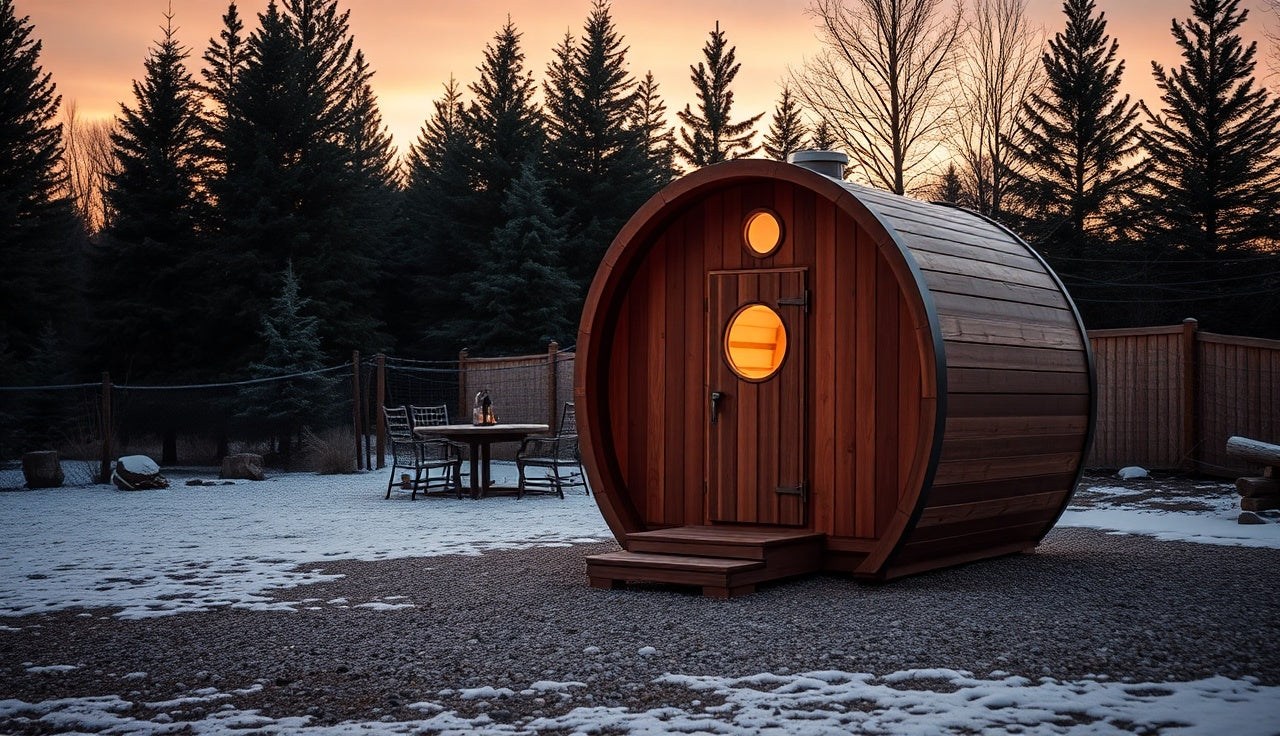
The Dundalk Harmony is a ready-to-assemble outdoor barrel sauna made by Dundalk LeisureCraft, an Ontario company that has built cedar leisure products since 1989 [1]. The Harmony sits in the middle of their barrel lineup, above the basic Dundalk Serenity and below their premium custom builds.
The barrel shape is not decorative. Curved walls move heat around more evenly than a rectangular box, and there are no cold corners for air to pool in near the floor. Hot air rises, rides the curve, and comes back down to the benches instead of stacking at the ceiling. If you've sat in a boxy prefab and felt your head cook while your feet froze, you already get why geometry matters.
Dundalk builds the Harmony from clear western red cedar, the heartwood grade. Clear cedar has almost no knots, which keeps the stave joints stable as the wood expands and contracts across seasons. Cedar also conducts heat slowly, so the benches and walls don't scorch your skin once the room hits 180 degrees F.
This is an outdoor-first design. It comes with an overhang on the door end that works as a small covered porch, a feature most competing barrels skip. You can cool down outside without standing in rain or full sun.
What are the Dundalk Harmony's dimensions and capacity?
The Harmony comes in two diameters. The 6-foot version measures about 6 feet across inside and comes in 6, 7, or 8-foot lengths. The 7-foot version gives you more headroom in similar length increments.
Here is how the common configurations compare:
| Configuration | Interior Diameter | Typical Interior Length | Bench Capacity | Approx. Footprint (with porch) |
|---|---|---|---|---|
| 6 ft / 6 ft long | 70 in | 72 in | 2 to 3 adults | ~7 ft x 8 ft |
| 6 ft / 7 ft long | 70 in | 84 in | 3 to 4 adults | ~7 ft x 9 ft |
| 6 ft / 8 ft long | 70 in | 96 in | 4 to 5 adults | ~7 ft x 10 ft |
| 7 ft / 7 ft long | 82 in | 84 in | 4 to 5 adults | ~8 ft x 9 ft |
| 7 ft / 8 ft long | 82 in | 96 in | 5 to 6 adults | ~8 ft x 10 ft |
Most buyers with a family or regular guests should get the 7-foot diameter. The jump from a 70-inch to an 82-inch interior sounds small until you're sitting inside and want to lie flat on a bench. Adults over six feet tall can stretch out fully in the 8-foot-length versions.
Assembled weight runs 800 to 1,100 pounds depending on length. That matters if you plan to set it on a deck. Most residential decks are built to a 40 pounds-per-square-foot live load and a 10-pound dead load under typical code minimums [2]. For a barrel this heavy, a gravel pad or spread foundation at ground level is usually the simpler and safer route.
For more on planning a dedicated outdoor unit, see our guide on outdoor sauna setups.
How much does the Dundalk Harmony barrel sauna cost?
Pricing swings with retailer, heater package, and configuration. The realistic ranges as of 2025:
| Configuration | Approximate Price (USD, no heater) | With Electric Heater Package |
|---|---|---|
| 6 ft diameter, 6 ft long | $3,800 to $4,400 | $4,400 to $5,200 |
| 6 ft diameter, 8 ft long | $4,500 to $5,400 | $5,100 to $6,200 |
| 7 ft diameter, 7 ft long | $5,500 to $6,500 | $6,200 to $7,500 |
| 7 ft diameter, 8 ft long | $6,200 to $7,500 | $6,900 to $8,500 |
These are street prices at authorized dealers. Dundalk does not widely publish MSRP, so expect some dealer-to-dealer variation. The Canadian dollar exchange rate moves the numbers too, since LeisureCraft manufactures in Ontario [1].
A wood stove usually costs less upfront than the electric package. It also needs a chimney kit, annual flue cleaning, and more paperwork at permit time. Electric heaters from Harvia, Finnleo, or Dundalk's own line run $400 to $900 depending on kilowattage. A 6 kW unit handles the 6-foot configurations. The 7-foot models want 8 kW or more.
Compare that to big-box barrel saunas at $2,000 to $3,000, which typically use lower-grade spruce or hemlock that grays and warps faster than clear cedar. The Harmony costs more, and it should. Cedar at this grade shrugs off moisture-driven rot for decades outdoors [3].
For how barrel saunas stack up against prefab indoor models, our home sauna overview covers the main tradeoffs.
How does the Harmony compare to the Dundalk Serenity barrel sauna?
This is the question buyers ask most. The honest answer: the differences are real but sometimes oversold in marketing copy.
The Dundalk Serenity (sold as the LeisureCraft Serenity MP in the multi-person size) is the entry point. Both models use western red cedar stave construction. The Serenity uses a thinner stave, roughly 1.5 inches versus the Harmony's 1.75 inches, and comes with fewer interior accessories in the base package.
That stave thickness shows up in heat retention at the margins. Thicker walls lose heat more slowly, so the heater cycles on less often once you're at temperature. Over years of use, that offsets part of the price gap. In a Northern winter at 20 degrees F outside, the thicker-walled Harmony holds target temperature with less work from the heater.
The Serenity also comes in smaller diameters, including 5-foot versions, which suits tighter yards. The Harmony starts at 6 feet.
The porch overhang is standard on the Harmony and either an add-on or missing on many Serenity builds. In rainy climates like the Pacific Northwest or the Upper Midwest, that integrated porch does real work, more than looks.
If budget is tight and your weather is mild, the Serenity is fine. If you live with four real seasons and plan to use the sauna year-round, the Harmony pays off over time.
What heater should you use in a Dundalk Harmony?
Dundalk sells the Harmony with wood-burning and electric options, and several third-party heaters fit well.
For electric, the Harvia KIP series (6 kW, 8 kW) and Finnleo Pure models are the common pairings. Harvia's KIP 60 (6 kW) lists around $450 to $550 and suits the 6-foot diameter, 6-foot-length build. Step up to 8 kW for anything longer than 7 feet. Running an 8 kW heater for one hour costs about $0.80 to $1.20 at the U.S. average residential rate near 16 cents per kilowatt-hour [4].
For wood-burning, the Harvia M3 is a popular pick at this size. Wood heat gives you a wetter, more traditional loyly (the steam cloud from water poured over hot rocks). Plenty of purists prefer it. The cost is 30 to 45 minutes of fire-tending before the room is ready, against 15 to 20 minutes for electric.
Most U.S. jurisdictions require a permit for wood-burning setups, plus clearance distances from anything combustible. The International Residential Code, Section R1006, governs factory-built fireplace and solid fuel appliance installations in single-family homes [2]. Your local authority having jurisdiction may add requirements. Don't skip this.
If you want to compare the wood-fired experience to other sauna types, our sauna vs steam room article breaks down the humidity and temperature differences.
What are the real health benefits of using a barrel sauna regularly?
The research on sauna use runs deeper than most people expect, and it's more specific too. The most-cited prospective study followed 2,315 Finnish men for 20 years and found that men who used a sauna 4 to 7 times per week had a 40% lower risk of all-cause mortality than once-weekly users [5]. That paper, published in JAMA Internal Medicine in 2015, is the one most health writers point to. It's observational, so it can't prove cause. But the dose-response pattern across frequency groups is hard to wave away.
A 2018 review in Mayo Clinic Proceedings looked at cardiovascular effects and concluded that "sauna bathing is associated with reduced cardiovascular disease events in multiple studies," while noting the mechanisms are not fully established [6].
For athletic recovery, the picture is murkier. Heat exposure raises plasma volume, which may lower perceived effort at a given heart rate. One small study (n=19) found that post-exercise sauna use over three weeks increased run time to exhaustion by 32% [7]. Nineteen people is too few to generalize, but the physiology holds up.
Here's the conservative read. Regular sauna use, meaning multiple sessions a week at 160 to 195 degrees F for 15 to 20 minutes, tracks with better health outcomes in observational data. A sauna is not a substitute for medical treatment, and anyone with a cardiovascular condition should clear it with a doctor first [6].
For a closer look at what the literature actually says, our sauna benefits breakdown covers the main research areas.
| 1x per week (baseline) | 0% |
| 2–3x per week | 24% |
| 4–7x per week | 40% |
Source: Laukkanen et al., JAMA Internal Medicine, 2015
How hard is the Dundalk Harmony to assemble?
Dundalk ships the Harmony as a kit on a pallet. Staves, benches, door, door frame, floor decking, and hardware all arrive numbered and labeled. Most buyers call it a two-person, one-to-two-day job.
The stave-by-stave barrel construction is the main skill gate. You're building a wooden barrel: staves slot together with tongue-and-groove joints, and included steel bands clamp the whole thing into a round. Getting the first few staves plumb and level takes the most patience. Once the barrel is round and banded, the interior benches, door frame, and floor go fast.
Dundalk provides written instructions and video content. The instructions read clearly for anyone comfortable with basic carpentry. If you've built a flatpack deck or shed, you're in range. If you've never handled dimensional lumber, paying a local carpenter for half a day to supervise the banding step is a fair $150 to $300.
The weight is real. Two adults handle most steps, but a third helps when you tilt the barrel into final position on the pad.
Electrical rough-in is a separate task and needs a licensed electrician in most places. A dedicated 240-volt circuit is standard. Budget $400 to $800 for the electrical, depending on how far your panel sits from the sauna.
What foundation does the Dundalk Harmony need?
Dundalk wants a level surface, which in practice means one of three things: a concrete pad, compacted gravel with treated timber runners, or a deck rated for the load.
A concrete pad is the most permanent and the easiest to level. A 4-inch slab over a 6-inch gravel sub-base is standard for a structure this heavy. Expect $8 to $18 per square foot for a basic pad from a concrete contractor, depending on region [8].
Compacted gravel with pressure-treated 4x4 runners under the barrel floor works well in drier climates. The gravel needs to be at least 4 to 6 inches deep and well-tamped so it won't settle. Keep a level handy for the first few months and re-shim if anything shifts.
Want to set the Harmony on an existing wood deck? Do the dead-load math first. At about 1,000 pounds spread over an 8-by-8-foot footprint, that's roughly 16 pounds per square foot for the sauna alone, before occupants. Most residential decks can take it, but check your deck's beam and joist sizing against local code before you commit. The American Wood Council's deck design resources help here [9].
Never set the barrel on bare soil. Ground contact speeds wood decay even in cedar, and the barrel will move as the soil freezes and thaws.
How do you maintain a Dundalk Harmony long-term?
Western red cedar resists decay and insects on its own, but outdoor exposure grays it within one to two seasons if you don't treat it. That graying is cosmetic and does nothing to the structure. Cedar carries natural oils called thujaplicins that block fungal rot [3], and a sauna's interior stays hot and dry enough that mold rarely shows up inside.
For the exterior, most owners apply a penetrating UV-blocking cedar oil or a natural finish like Cabot's Australian Timber Oil every one to two years. Skip film-forming finishes such as polyurethane or varnish on the outside. They trap moisture and peel in freeze-thaw weather.
Leave the interior untreated. Stain or sealant on interior wood off-gasses at high heat. Sand any rough spots on the benches with 120-grit paper.
The steel tension bands that hold the staves together want a seasonal check. They loosen a little as the wood dries in summer or swells in wet months. A quarter-turn on the bolt hardware usually closes any gap between staves.
Follow the heater manufacturer's yearly schedule. For wood-burning models, clean the chimney flue before each season. For electric heaters, inspect the elements and rocks every 12 months. Rocks break down after repeated thermal cycling and should be swapped every three to five years [10].
Expect 15 to 25 years from a properly maintained Dundalk cedar barrel, though Dundalk says their cedar products last decades with minimal upkeep [1].
Can you do contrast therapy with a Dundalk Harmony?
Yes, and a barrel sauna is one of the better setups for it. Its outdoor placement makes adding a cold plunge nearby easy. Contrast therapy, alternating heat and cold, has run through Nordic and Finnish culture for centuries and has a small but growing research base.
The basic protocol: heat in the sauna 10 to 20 minutes until you're sweating hard, drop into a cold plunge or cold shower for 1 to 3 minutes, then rest 5 to 10 minutes. Repeat two to three rounds. The size of the temperature gap drives most of the perceived recovery.
A 2021 study in the European Journal of Applied Physiology found that contrast water therapy cut perceived muscle soreness and fatigue more than passive rest after high-intensity exercise [11]. It used water near 104 degrees F hot and 57 degrees F cold, both well within reach of a running barrel sauna and a reasonably priced plunge tub.
To build a full contrast setup at home, our cold plunge guide covers what to look for in a plunge unit. The cold plunge benefits article walks through the research on cold exposure specifically.
SweatDecks carries both barrel saunas and cold plunge units, which is worth knowing if you're buying both pieces at once, since pairing them changes how you plan the space.
One practical note: put the cold plunge within 15 to 20 steps of the sauna door. You want the hot-to-cold transition to take seconds, not minutes. The Harmony's covered porch helps, since you can stand in cold air for a beat before stepping into the plunge.
What do owners actually say about the Dundalk Harmony?
There's no shortage of owner talk on forums like r/Sauna and the home improvement communities, and the pattern across hundreds of reviews holds fairly steady.
The repeated positives: the cedar quality is noticeably better than entry-level competitors, the door and frame fit tight out of the box, and electric heat-up at 20 to 25 minutes beats what many owners expected for a barrel this size. Owners in rainy climates keep praising the porch overhang.
The repeated complaints: the assembly instructions have gaps, especially around door frame alignment. A small share of buyers report minor stave gaps in the first season that tighten on their own as the wood swells with use. Dealer customer service seems to vary more than the product itself.
One thing to expect going in: no barrel sauna ships flawless. Clear cedar is a natural product, and small surface checks (hairline cracks along the grain) are normal and structural, not defects. They don't touch heat retention or lifespan.
The Harmony has no independent third-party test data out in public the way some consumer electronics do. The health claims tied to the product rest on general sauna research (see the benefits section above), not product-specific trials. Worth stating plainly.
Is a Dundalk Harmony right for you, or should you consider alternatives?
The Harmony is the right call if you want an outdoor sauna that handles four seasons in a cold or rainy climate, you value Canadian-made clear cedar over imported lower-grade wood, and you have a budget of at least $5,000 including installation and electrical.
It's probably wrong if you need indoor placement (the barrel's diameter makes interior doorway clearance almost impossible), you want a plug-and-play 120V unit (the Harmony needs a 240V dedicated circuit), or you're chasing the lowest upfront price.
Competitors worth a look: Almost Heaven Barrel Saunas (West Virginia-made, lower price points, spruce-hemlock on base models), Northern Lights Cedar Barrel Saunas (Canadian, similar quality tier), and HUUM-partnered configurations from various Nordic importers. Each carries real tradeoffs in wood grade, warranty, and dealer support.
If you want an indoor sauna option instead, or you're just starting out, our sauna overview and home sauna guide help calibrate expectations.
SweatDecks carries Dundalk products alongside cold plunge options, and those product pages show current pricing that tracks manufacturer adjustments more accurately than any guide article can.
Frequently asked questions
How long does it take to heat up a Dundalk Harmony barrel sauna?
With an electric heater sized right (6 kW for the 6-foot diameter models, 8 kW for the 7-foot), the Harmony reaches 160 to 180 degrees F in about 20 to 30 minutes in moderate outdoor temperatures. Cold weather below 20 degrees F adds 10 to 15 minutes. Wood-burning heaters take 30 to 45 minutes and need active fire management.
What's the difference between the Dundalk Harmony and the Dundalk Serenity barrel sauna?
The Harmony uses thicker staves (about 1.75 inches vs. 1.5 inches on the Serenity), comes standard with a covered porch, and only comes in 6-foot and 7-foot diameters. The Serenity starts at 5-foot diameter and costs less. Both use clear western red cedar. The Harmony holds heat better in cold weather and includes more interior accessories in the base package.
Does the Dundalk Harmony come with a heater?
It depends on the package. Dundalk sells the Harmony as a shell only and also in heater-bundled configurations, and most dealers offer both. The bundled electric heater is usually a Harvia KIP or equivalent. Buy without a heater and you'll add $450 to $900 for a quality electric unit plus $400 to $800 for a licensed electrician to run a 240V dedicated circuit.
What size Dundalk Harmony should I buy for two people?
The 6-foot diameter, 6-foot-length version fits two adults comfortably with room to spare. If you want to lie down or host an occasional third person, step up to the 7-foot length. The 7-foot diameter upgrade makes sense if anyone in your household is over six feet tall or you expect regular groups of three or more.
Can you put a Dundalk Harmony barrel sauna indoors?
Not practically. The smallest Harmony is roughly 7 feet wide including the stave overhang, which won't clear most interior doorways or standard ceiling heights. The ventilation and chimney requirements for a wood-burning unit also make indoor installation complex. The Harmony is built for outdoor use. For indoor spaces, a rectangular prefab sauna room is a more workable choice.
How many years will a Dundalk Harmony last?
With basic maintenance, 15 to 25 years is realistic. Western red cedar's decay resistance comes from thujaplicins, antifungal compounds in the heartwood that stay active for decades. The steel tension bands and hardware usually need replacement first, typically after 8 to 12 years of outdoor exposure, and they're available as replacement parts from Dundalk.
Do I need a permit to install a Dundalk Harmony barrel sauna?
Usually yes, at least for the electrical, and often for the structure if it clears your local accessory structure threshold (commonly 120 or 200 square feet). Requirements vary by city and county, so check with your building department before you start. Wood-burning heater installations typically need a separate mechanical permit under the International Residential Code, Section R1006.
What's the best foundation for a Dundalk barrel sauna?
A 4-inch concrete pad over 6 inches of compacted gravel is the most stable and longest-lasting option. Compacted gravel with pressure-treated 4x4 runners works well in drier climates and is easier to DIY. Setting the barrel on an existing wood deck works if the deck is rated for the load, roughly 1,000 pounds plus occupants. Never set it on bare soil.
Can I use a wood-burning stove in the Dundalk Harmony?
Yes. The Harvia M3 and similar compact wood stoves fit the standard Harmony barrel. Wood-burning models need a chimney kit with correct clearances, an exterior air supply in tighter builds, and annual flue cleaning. Expect 30 to 45 minutes to reach temperature. Many traditionalists prefer wood heat for its authentic loyly and drier initial heat.
How often should I use the sauna to get health benefits?
The strongest observational data comes from a 20-year Finnish study of 2,315 men, which found the greatest cardiovascular mortality reduction among those using the sauna 4 to 7 times per week versus once weekly. Frequency seemed to matter more than session length. Most researchers treat two to four sessions per week as a reasonable minimum for health-related goals, at 15 to 20 minutes and 160 to 190 degrees F.
Is the Dundalk Harmony good for contrast therapy with a cold plunge?
Yes. Its outdoor placement makes it easy to position a cold plunge nearby, which is the key practical requirement for contrast therapy. A 2021 study in the European Journal of Applied Physiology found contrast water therapy (alternating about 104 degrees F hot and 57 degrees F cold) cut perceived post-exercise soreness more than passive rest. Keep the cold plunge within 15 to 20 steps of the sauna door for fast transitions.
What maintenance does the Dundalk Harmony require annually?
Exterior wood needs a UV-protective cedar oil or similar penetrating finish every one to two years to hold off graying. Check and tighten the steel stave bands seasonally. For electric heaters, inspect the elements and replace sauna rocks every three to five years. For wood-burning heaters, clean the chimney flue every season before you start. Leave interior wood untreated. Never apply varnish or sealant to interior surfaces.
Where is the Dundalk Harmony manufactured?
Dundalk LeisureCraft is based in Dundalk, Ontario, Canada, and builds its barrel saunas there. The clear western red cedar comes from Western Canada and the Pacific Northwest. Canadian manufacturing matters practically: the product ships reasonably fast to most U.S. addresses, typically one to three weeks for in-stock configurations, and parts stay accessible.
How does the Dundalk Harmony compare to Almost Heaven barrel saunas?
Almost Heaven builds barrel saunas in West Virginia at generally lower price points. Their base models use hemlock or spruce rather than clear western red cedar, which is less naturally rot-resistant. Almost Heaven's Pinnacle series uses Canadian cedar and gets closer to Dundalk's tier. For four-season outdoor use, most experienced owners consider Dundalk's cedar quality and stave thickness a genuine edge over Almost Heaven's entry and mid-tier models.
Sources
- Dundalk LeisureCraft, Company Overview: Dundalk LeisureCraft is a Canadian manufacturer based in Ontario that has been building cedar leisure products since 1989
- International Code Council, International Residential Code (IRC): IRC Section R1006 governs factory-built fireplace and solid fuel appliance installations; residential deck live load minimums are typically 40 psf per residential building codes
- USDA Forest Service, Forest Products Laboratory, Wood Handbook Chapter 15: Western red cedar contains thujaplicins (natural antifungal compounds) in the heartwood that provide decay resistance for decades in outdoor conditions
- U.S. Energy Information Administration, Electric Power Monthly, Average Retail Price of Electricity: Average U.S. residential electricity rate is approximately 16 cents per kilowatt-hour as of recent reporting, making an 8 kW heater cost roughly $0.80 to $1.20 per one-hour session
- Laukkanen et al., JAMA Internal Medicine, 2015, Sauna Bathing and Fatal Cardiovascular and All-Cause Mortality: In a 20-year prospective study of 2,315 Finnish men, those who used a sauna 4 to 7 times per week had a 40% lower risk of all-cause mortality compared to once-weekly users
- Laukkanen et al., Mayo Clinic Proceedings, 2018, Cardiovascular and Other Health Benefits of Sauna Bathing: Review concluded that sauna bathing is associated with reduced cardiovascular disease events in multiple studies, while noting mechanisms are not fully established
- Scoon et al., Journal of Science and Medicine in Sport, 2007, Effect of post-exercise sauna bathing on endurance performance: Post-exercise sauna use over three weeks increased run time to exhaustion by approximately 32% in a small study (n=19)
- HomeAdvisor / Angi, Cost to Pour a Concrete Slab (national average data): A basic concrete pad costs approximately $8 to $18 per square foot installed, depending on region and slab specifications
- American Wood Council, Prescriptive Residential Wood Deck Construction Guide: The AWC deck design guide provides beam and joist sizing for residential decks under various load conditions, useful for evaluating whether an existing deck can support a barrel sauna
- Harvia Group, Sauna Heater and Stone Maintenance Guidelines: Harvia recommends replacing sauna stones every three to five years as they degrade from repeated thermal cycling
- Bieuzen et al., European Journal of Applied Physiology, 2021 (contrast water therapy meta-analysis): Contrast water therapy at approximately 104 degrees F hot and 57 degrees F cold reduced perceived muscle soreness and fatigue more than passive rest after high-intensity exercise

Share:
Sun Home sauna reviews: are they worth the price in 2026?
Wood barrel sauna: the complete buyer's guide for 2026