
Last updated 2026-07-09
TL;DR
A Viking cold plunge is a compact, insulated cold-water tub built for home recovery. Good ones run $1,200 to $4,500 depending on chilling power and build quality. The chiller is what you pay for. This guide covers what to look for, how these tubs stack up against a stock tank, what cold immersion research actually shows, and who really gets value from spending more.
What is a Viking cold plunge, exactly?
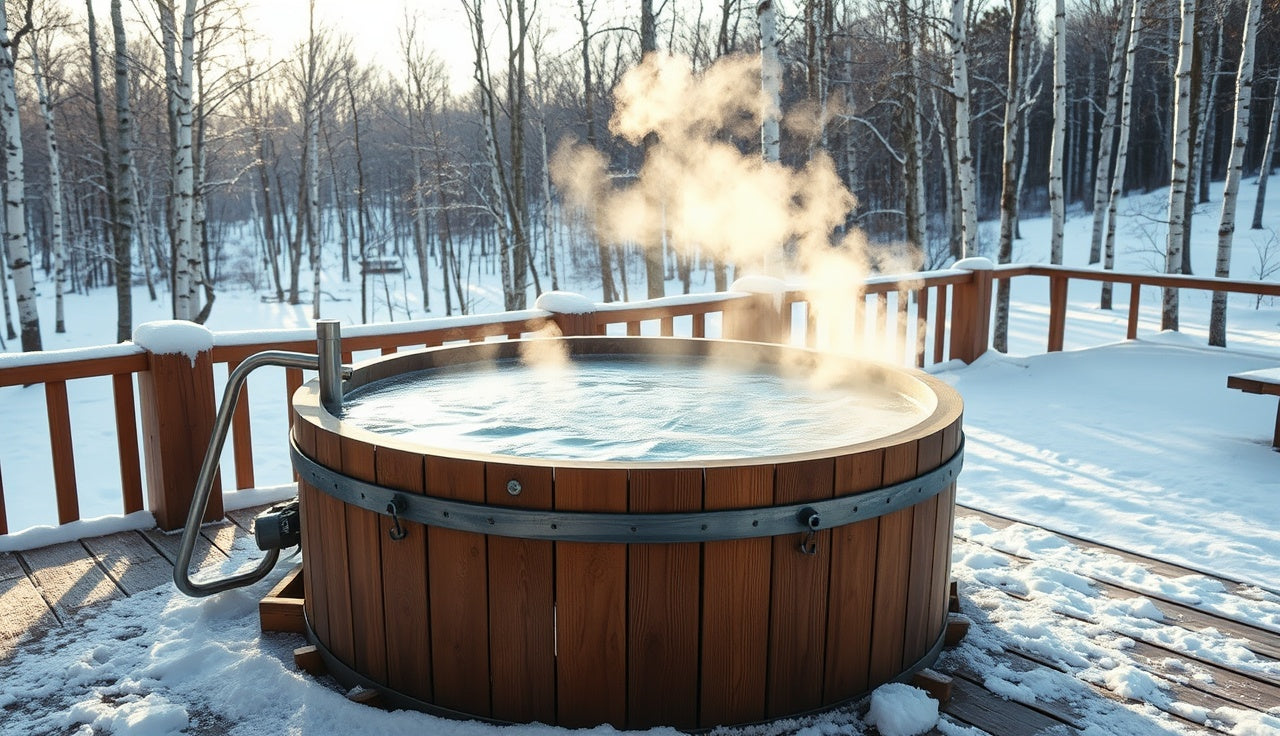
"Viking cold plunge" isn't one company's product. It's a style label, like "Scandinavian sauna," that several brands and direct-to-consumer sellers borrowed to point at the Nordic habit of hitting cold water after heat. What you're actually shopping for is a compact, insulated cold-water immersion tub. Some come with a chiller. Some don't.
The Viking look usually means a round or oval barrel, wood or polymer walls, room for one person seated or slightly reclined, and a temperature floor around 39 to 50°F (4 to 10°C). Some are dressed-up insulated stock tanks. Others pack 1/3-horsepower to 1-horsepower chillers, circulation pumps, and filtration. That gap decides whether you're buying ice every week or flipping a switch.
The cultural roots are real. Finnish "avanto" (ice-hole swimming) and Norwegian winter bathing go back generations, so the branding isn't pure invention. The invention is the premium price tier that grew up around these tubs over the last five years, pushed hard by athlete endorsements and social media clips. If you want the practice itself before you spend on hardware, the cold plunge basics are worth a read first.
How does a Viking-style cold plunge actually work?
There are three tiers, and they work in very different ways. At the basic end, the tub is an insulated bucket you fill with water and ice. You dump bags in, you get in. Temperature lands wherever your ice-to-water ratio puts it, usually 50 to 60°F without careful management.
To drop a 100-gallon tub from tap temperature (around 60°F) into the 50 to 55°F range, you need 20 to 40 lbs of ice, which runs $5 to $15 per session at retail prices [1]. That cost repeats every time.
One tier up, you get a passive-cooling lid and thick insulation. These hold cold overnight or across a day with no power, which cuts ice use a lot. Some build phase-change material panels into the walls.
The third tier is the chiller-integrated tub, and it's what most "Viking cold plunge" marketing leans on. A refrigeration chiller (the same compressor idea as a window AC or a small commercial fridge) pushes water through a heat exchanger. These are rated in BTUs or fractions of a horsepower. A 1/3-HP unit holds a 100-gallon tub at 55°F against outdoor temperatures up to about 80 to 85°F. A 1-HP unit handles hotter climates and bigger tanks. The chiller also runs a circulation pump, so water moves through a filter, and that alone cuts how often you drain and refill.
Here's the cost most reviews skip. A chiller draws 300 to 700 watts during active cooling, which works out to roughly $20 to $60 a month depending on your electricity rate and how hard the compressor cycles [2].
What does a Viking cold plunge tub cost, and what do you get at each price?
Here's what the market looks like as of mid-2025. Prices move, so read these as honest ranges, not locked quotes.
| Price tier | What you're buying | Example features | Typical capacity |
|---|---|---|---|
| $300, $800 | Insulated barrel, no chiller | Wood or poly stave, drain plug, lid | 60 to 100 gal |
| $800, $1,500 | Rigid polymer tub, no chiller | Thick-wall HDPE, better insulation, sometimes a cover | 80 to 120 gal |
| $1,500, $2,800 | Entry chiller system | 1/3-HP chiller, basic filtration | 60 to 100 gal |
| $2,800, $4,500 | Mid-range chiller tub | 1/2 to 3/4 HP, UV or ozone sanitation, temp display | 85 to 130 gal |
| $4,500, $8,000+ | Premium / commercial-grade | 1-HP+, WiFi control, stainless internals | 100 to 200 gal |
The biggest jump is between $800 and $1,500. Below it, you add ice. Above it, the machine holds temperature for you. Whether the gap is worth it comes down to how often you plunge and what ice costs where you live.
Households using the tub four or more times a week tend to break even on the chiller against ice costs in roughly 12 to 24 months. Lighter users may never break even on the hardware premium. Nobody has published a rigorous cost analysis specific to cold plunge tubs, but the ice-plus-electricity math is simple enough to run for your own situation.
If you're shopping the affordable cold plunge tub end seriously, the $800 to $1,200 insulated-barrel category is genuinely fine for people in climates where tap water already runs cold in winter. In Texas in August? You'll bleed money on ice.
| Basic insulated barrel (no chiller) | $550 |
| Rigid polymer tub (no chiller) | $1,150 |
| Entry chiller system (1/3 HP) | $2,150 |
| Mid-range chiller tub (1/2–3/4 HP) | $3,650 |
| Premium / commercial-grade (1 HP+) | $6,250 |
Source: SweatDecks market survey, 2025 (aligned with EIA electricity cost data [2])
What does the research actually say about cold water immersion benefits?
The science is real, but it's more modest and more conditional than the marketing lets on. Here's what holds up.
Cold water immersion, usually defined as water at or below 59°F (15°C) for 5 to 15 minutes, reliably cuts perceived muscle soreness in the 24 to 72 hours after hard exercise. A 2012 Cochrane review of 17 randomized trials by Bleakley and colleagues found cold water immersion beat passive rest for reducing delayed onset muscle soreness, though the authors flagged that ideal temperature and duration are still unclear [3]. Smaller trials have repeated that finding since.
The cardiovascular response is well documented. Cold immersion sets off the dive reflex (slowed heart rate plus peripheral vasoconstriction), and repeated exposure appears to build cold tolerance over weeks. A 2016 Dutch randomized trial in PLOS ONE found regular cold showers cut self-reported sick-day absence by 29% versus controls, though those were showers, not full immersion, and self-reported illness is a soft outcome [4].
The genuinely contested part is what cold does to strength training. A 2015 paper in the Journal of Physiology by Roberts and colleagues found cold water immersion after resistance training blunted long-term muscle growth and strength gains compared to active recovery, tied to suppressed mTOR signaling and satellite cell activity [5]. "Our data suggest that cold water immersion is not an appropriate recovery strategy when muscle hypertrophy is an adaptation goal," the authors wrote. Serious lifters should know that tradeoff before building cold into every session.
For general recovery, sleep, and stress, the evidence is promising but early. If you want a fuller breakdown of what's supported and what's still speculation, the cold plunge benefits page digs in further.
Some people pair cold plunges with sauna in a practice called contrast therapy. The rationale is the swing between vasodilation and vasoconstriction, and the subjective jolt is hard to overstate. If that interests you, sauna benefits and the broader ice bath literature both apply.
Is a Viking cold plunge tub better than a stock tank or ice bath setup?
For a first setup, honestly, maybe not.
A galvanized steel stock tank from a farm supply store (Tractor Supply, Rural King, a local co-op) runs $150 to $350 for 100 to 150 gallons. Add a $30 to $50 submersible pump for circulation and a $15 garden-hose thermometer, and you have a working cold immersion setup for under $400. Bolt on a chest-freezer chiller conversion run by an Inkbird ITC-308 temperature controller ($20 to $30) and you're at $500 to $700 total with reliable control down to 40°F.
The branded Viking-style tubs add better looks (genuinely nicer on a deck), easier draining (a ball valve instead of siphoning), sometimes better insulation, and occasionally better filtration. They also add $800 to $3,000 over a DIY stock tank.
If the tub sits in a visible backyard or a dedicated wellness room, the aesthetics case holds water. If it lives in a garage or a utility corner, the stock tank is a completely legitimate call, and a big share of what gets sold as "Viking cold plunge" is functionally a stock tank with cosmetic upgrades.
The one place premium tubs clearly win is the integrated chiller. Building a DIY chiller that matches a purpose-built 1/2-HP commercial refrigeration unit is genuinely hard unless you have refrigeration skills. If you want hands-off temperature control with no ice, the branded systems earn their premium right there.
What temperature should a cold plunge actually be, and for how long?
Most recovery and soreness research uses water at 50 to 59°F (10 to 15°C) for 10 to 15 minutes [3]. A 2013 review by Versey and colleagues confirms that range as the most common protocol in the literature [10]. It's where you get the physiological stimulus without meaningful risk of tissue damage in healthy adults.
Colder is not automatically better. Water at 39 to 45°F triggers faster peripheral vasoconstriction but sharply raises the risk of hyperventilation, cold shock, and, in vulnerable people, cardiac events. That involuntary gasp and hyperventilation on sudden entry is the main mechanism behind cold-water drowning, which is why controlled entry and breath control matter [6].
Start at 60°F. Stay in for 2 to 3 minutes. Build from there over several weeks. The adaptation is real: what feels brutal in week one is tolerable by week four. Most people settle around 50 to 55°F for 5 to 10 minutes, which is exactly where the research support is strongest.
The American Red Cross doesn't publish a cold plunge protocol, but its open-water safety guidance warns that cold water can cause immediate loss of breathing control and recommends gradual acclimatization [6]. That's framed for a different setting, but the physiology underneath is the same.
What should you look for in a Viking-style cold plunge tub before buying?
A handful of things matter more than the marketing copy. Start with chiller capacity relative to volume. A 1/3-HP chiller on a 120-gallon tub will struggle in outdoor summer heat. Match the chiller to the volume and your climate. Makers usually publish a spec like "maintains 50°F in ambient up to 85°F," and that's the number to check.
Filtration and sanitation come next. A tub used daily grows biofilm and bacteria faster than you'd guess. Look for a circulation pump paired with a UV-C stage, an ozone generator, or at minimum a replaceable cartridge filter. Skip filtration and you're draining and refilling weekly or more, which wastes water and time.
Drain placement is a small thing that matters at 5 a.m. A bottom-drain ball valve at the tub's lowest point makes draining quick. A rear-elevated drain or a siphon is a daily annoyance.
Insulation matters too, and most makers don't publish an R-value. Thicker walls (2 inches or more of foam) hold cold noticeably better than thin-wall designs. Ask, or hunt for review data on overnight temperature rise with the chiller off.
Then there's weight. A 100-gallon tub holds roughly 835 lbs of water alone, before the tub itself. Most decks are rated for 40 to 55 lbs per square foot live load per IRC Table R301.5 [7], and a concentrated 900-lb load on a 4-square-foot footprint is a real structural question. A concrete pad, reinforced deck, or ground-level placement is the safe default.
Last, electrical. Many chiller tubs need a dedicated 15A or 20A circuit, and some want 240V. Verify before buying and budget for an electrician if your outdoor spot doesn't already have the right circuit.
For comparing brands without hunting across 15 manufacturer sites, SweatDecks lists cold plunge options at various price points with consistent specs.
How does a cold plunge fit into a sauna and contrast therapy routine?
Contrast therapy means alternating heat and cold. The classic Scandinavian version is sauna (80 to 100°C / 176 to 212°F) for 10 to 20 minutes, then cold immersion, a cold shower, or a roll in snow for 1 to 5 minutes, repeated 2 to 4 cycles with rest between.
The logic is reasonably well supported. Heat drives peripheral vasodilation and raises core temperature, cold drives vasoconstriction and a fast sympathetic surge, and the swings act like a pump on peripheral circulation. Whether that beats either modality alone on any clinical measure is less settled. Research on contrast therapy specifically is thinner than research on sauna or cold immersion on their own.
What's clear is the subjective side: the combination feels dramatically different from either alone, and people stick with rituals they enjoy. That matters more than it sounds, because a cold plunge you actually use beats a fancier one gathering dust.
If you have or are weighing a home sauna alongside the plunge, the pairing changes how both feel. A dedicated home sauna setup also shifts the math on the cold plunge, because the cold becomes part of a full routine instead of a lonely cold-weather habit. The same holds if you're planning an outdoor sauna with room for both units close together.
Are there safety risks with home cold plunge tubs?
Yes, and they're worth stating plainly. Cold shock is the biggest acute risk. Sudden immersion below 60°F triggers an involuntary gasp, hyperventilation, and a brief loss of breath control. In open water that causes drowning. In a contained tub it's less lethal, but it can cause panic, dizziness, and, in people with cardiac conditions, arrhythmia [6]. Don't plunge alone when you're new, especially the first several sessions.
Hypothermia in a home tub is rare but possible if someone falls asleep or passes out in the water. At 50°F, significant heat loss sets in after about 30 minutes. Set a timer, every time.
Cardiovascular contraindications are real. People with known heart disease, uncontrolled hypertension, Raynaud's, or a pregnancy should talk to a physician first. This isn't boilerplate: cold immersion can spike blood pressure transiently by 20 to 40 mmHg, which is physiologically significant [6].
Then there's biofilm and Legionella. Warm tubs get more attention, but a poorly maintained cold plunge sitting above 50°F can grow bacteria too. CDC guidance on recreational water illness applies to home tubs, so regular sanitation and water replacement are not optional [8].
Children and cold water need extra care. Cold shock thresholds are lower in kids and the consequences worse. Cover and secure the tub when it's not in use, the same rule you'd apply to a pool.
How do you maintain a Viking cold plunge tub long-term?
Maintenance is the line item people under-budget, in both time and money. For a non-chiller tub using ice, drain and rinse after every 3 to 5 uses, more often in warm weather. Algae and bacteria move fast in standing water, especially with body oils, sunscreen, and organic gunk in the mix. A dilute bleach rinse (roughly 1/4 cup per 100 gallons, 30-minute contact, then drain) is an effective disinfection step consistent with CDC guidance for small recreational water vessels [8].
For a chiller tub with filtration, swap filter cartridges on the maker's schedule, usually every 2 to 4 weeks with daily use. Test water chemistry monthly. Target free chlorine of 1 to 3 ppm (if you use chlorine) or equivalent sanitizer levels, and pH 7.2 to 7.8. Those are the same numbers as a pool or hot tub, and any pool supply store stocks the strips and chemistry.
Once a year, inspect the chiller's refrigerant lines and condenser coils, blow the coils clean of dust with compressed air, and check the gaskets and seals on the drain valve. Most chiller failures trace back to coils clogged with debris, which makes the unit overheat trying to work in summer.
Budget $100 to $300 a year on consumables (cartridges, sanitizer, test strips) for a regularly used chiller tub. That's not nothing, but it runs on par with a hot tub and well below ongoing ice costs.
What are the best Viking cold plunge brands actually worth considering?
I'm not going to list 15 brands and hand them all four stars. Here's an honest read on the landscape.
In the sub-$2,000 no-chiller tier, the market is crowded with near-identical poly-barrel and HDPE tubs. The real differences are lid quality, drain valve quality, and how well the insulation holds cold overnight. Read reviews specifically for overnight temperature-rise data, because that's the differentiator that actually matters.
In the $2,500 to $4,000 chiller tier, the competition gets meaningful. Compare chiller HP, tank gallonage, whether filtration includes UV-C or ozone (a big quality-of-life gap), and the warranty on the compressor specifically. A compressor warranty under 2 years is a yellow flag.
Some buyers fixate on wood, and that's fair if the tub is a visible feature outdoors. Just know that wood-stave barrels need more upkeep than polymer (sealing, watching for leaks as the wood swells and dries with the seasons), and the wood adds nothing to thermal or recovery performance.
If you're weighing a Viking-branded tub against a wider set, SweatDecks carries a range across these tiers and lists specs consistently, which makes side-by-side comparison practical. The cold plunge benefits page pairs well with this if you're still deciding whether the spend makes sense for your use.
One honest opinion: for most people doing 3 to 5 sessions a week, a well-built $2,000 to $3,000 chiller tub is the sweet spot. Spend more and you're mostly buying faster chilling, smarter controls, and commercial-grade durability. Spend less and you're adding ice regularly, which is fine if you'll actually do it. Most people don't.
Frequently asked questions
Is a Viking cold plunge worth the money?
For people who plunge 4+ times a week, yes. The chiller tends to pay for itself against ice costs in 12 to 24 months, and the ease of use drives real consistency. For occasional users doing 1 to 2 sessions a week, a cheaper insulated tub plus ice is hard to beat on cost. Cold immersion research supports genuine recovery benefits, but only if you actually use the tub regularly.
What temperature should my cold plunge be set to?
Most muscle-recovery research uses 50 to 59°F (10 to 15°C) for 10 to 15 minutes. That range produces measurable soreness reduction without the cold-shock risk of sub-45°F water. Beginners should start at 60°F and work down over several weeks. Colder is not better; it mainly raises risk while adding little extra benefit.
How long should you stay in a Viking cold plunge?
Beginners: 2 to 3 minutes at 55 to 60°F. Experienced users: 5 to 15 minutes at 50 to 55°F. Recovery research typically uses 10 to 15 minute protocols. There's no established benefit past 15 minutes, and meaningful heat loss starts around 30 minutes at 50°F. Set a timer every session.
Can you use a cold plunge every day?
Yes, with one caveat. Daily cold plunging right after resistance training may blunt muscle growth by suppressing mTOR signaling, per a 2015 Journal of Physiology study. If building muscle is the goal, limit post-lifting plunges to 2 to 3 times a week or use them on non-lifting days. For endurance athletes or general wellness, daily use looks safe for healthy adults.
What is the difference between an ice bath and a Viking cold plunge tub?
Functionally they're the same thing: cold water immersion. The difference is the equipment. An ice bath is any container (bathtub, stock tank, cooler) filled with water and ice. A Viking cold plunge tub is purpose-built, usually insulated and sometimes chiller-equipped, made for regular use. The physiology is identical; the tub buys convenience and steady temperature.
How much electricity does a cold plunge chiller use?
A typical 1/3-HP chiller draws 300 to 500 watts during active cooling. If the compressor runs 30 to 50% of the time, that's roughly 100 to 250 watt-hours per hour of operation. At the U.S. average rate of about $0.16/kWh, daily cost runs roughly $0.40 to $1.00, or $12 to $30 a month. Larger 1-HP units run $30 to $60 a month.
Where should I put a cold plunge tub at home?
Ground level on concrete or solid pavers is safest. A filled 100-gallon tub weighs roughly 835 lbs. Most residential deck framing handles 40 to 55 lbs per square foot, so verify structural capacity before deck placement. Indoors works if drainage and ventilation are adequate. Outdoor placement needs a dedicated circuit for chiller models, and shade cuts chiller workload in summer.
How often do you need to change the water in a cold plunge?
With a chiller and filtration (UV-C or ozone plus a cartridge filter), a water change every 4 to 8 weeks is typical for daily users. Without filtration, drain and refill every 3 to 7 days depending on use and how well you shower before entry. Test free chlorine or equivalent sanitizer weekly. Biofilm builds faster than most owners expect.
Can a Viking cold plunge be used outdoors year-round?
Yes in most climates. In freezing weather, chiller tubs need winterizing or need to keep running so the water doesn't freeze and damage the lines. Most makers specify a minimum ambient operating temperature for the chiller, usually around 32 to 40°F. Some tubs let you bypass the chiller and fill manually in winter, when tap water is already cold enough on its own.
Is cold plunging safe if I have high blood pressure?
Ask your doctor first. Cold immersion causes a transient blood pressure spike, potentially 20 to 40 mmHg, from peripheral vasoconstriction. Most healthy adults handle it fine, but for people with uncontrolled hypertension, heart disease, or arrhythmias, that response is a real risk. The American Heart Association recommends physician clearance before starting cold immersion practices.
Does cold plunging after a sauna change the effects?
Contrast therapy (alternating sauna and cold plunge) adds the cold shock and vasoconstrictive phase on top of the heat-driven vasodilation of sauna. The alternating cycles are intense and anecdotally popular for recovery. Research on the combination specifically is thinner than for either modality alone. The clearest practical finding: most people enjoy and stick with the combined ritual more than either alone.
What is the best affordable cold plunge tub for home use?
Below $1,000, a thick-wall insulated poly barrel (2-inch foam walls, good lid, ball-valve drain) plus ice is the honest best value in cooler climates. In warm climates, ice costs push the $1,500 to $2,000 entry chiller tier into the value spot within 18 months of regular use. A DIY stock tank plus chest-freezer chiller conversion also works for under $700 if you're mechanically inclined.
What size cold plunge tub do I need?
For one person, 80 to 100 gallons covers seated immersion to shoulder depth. 100 to 130 gallons allows a more reclined position and easier entry and exit. Past 130 gallons just adds water you have to chill and maintain with no real benefit for solo use. Couples sharing a tub need 120 to 180 gallons for simultaneous use.
Do I need a permit to install a cold plunge tub at home?
Usually not for a portable tub, but a new dedicated electrical circuit (needed for most chiller models) typically requires a permit and licensed electrician in most U.S. jurisdictions. Some municipalities classify any outdoor water vessel over a certain volume as a pool or spa and require fencing or safety covers. Check your local building department before installing.
Sources
- USDA Agricultural Marketing Service, Ice commodity pricing: Retail bagged ice costs roughly $5–$15 for 20–40 lbs, the amount needed to cool a 100-gallon tub from tap temperature to 50–55°F
- U.S. Energy Information Administration, Average Retail Price of Electricity: U.S. average residential electricity rate approximately $0.16 per kWh, used to calculate cold plunge chiller operating cost
- Cochrane Database of Systematic Reviews, Bleakley et al. 2012, Cold-water immersion (cryotherapy) for preventing and treating muscle soreness after exercise: Cochrane review of 17 RCTs found cold water immersion more effective than passive rest for reducing DOMS; optimal temperature and duration remain unclear
- PLOS ONE, Buijze et al. 2016, The Effect of Cold Showering on Health and Work: A Randomized Controlled Trial: Regular cold showers reduced self-reported sick-day absence by 29% compared to controls
- Journal of Physiology, Roberts et al. 2015, Post-exercise cold water immersion attenuates acute anabolic signalling: Cold water immersion after resistance training blunted long-term muscle hypertrophy and strength gains; authors stated it is not appropriate when hypertrophy is an adaptation goal
- American Red Cross, Drowning Prevention and Cold Water Safety: Water below 60°F can cause immediate loss of breathing control; gradual acclimatization recommended; cold shock response is the primary mechanism behind cold-water drowning
- International Residential Code, IRC Table R301.5, Minimum Uniformly Distributed Live Loads: Most residential deck framing is rated for 40–55 lbs per square foot live load per IRC Table R301.5
- CDC, Healthy Swimming / Recreational Water Illness Prevention: CDC guidelines for recreational water illness apply to home tubs; dilute bleach disinfection and regular sanitation required; free chlorine target 1–3 ppm, pH 7.2–7.8
- PubMed, Versey et al. 2013, Water immersion recovery for athletes: effect on exercise performance and practical recommendations: Cold water immersion at 50–59°F for 10–15 minutes is the most commonly used protocol in recovery research

Share:
Ice bath after gym: does it actually help your recovery?
Ice bath after gym: does it actually help your recovery?