
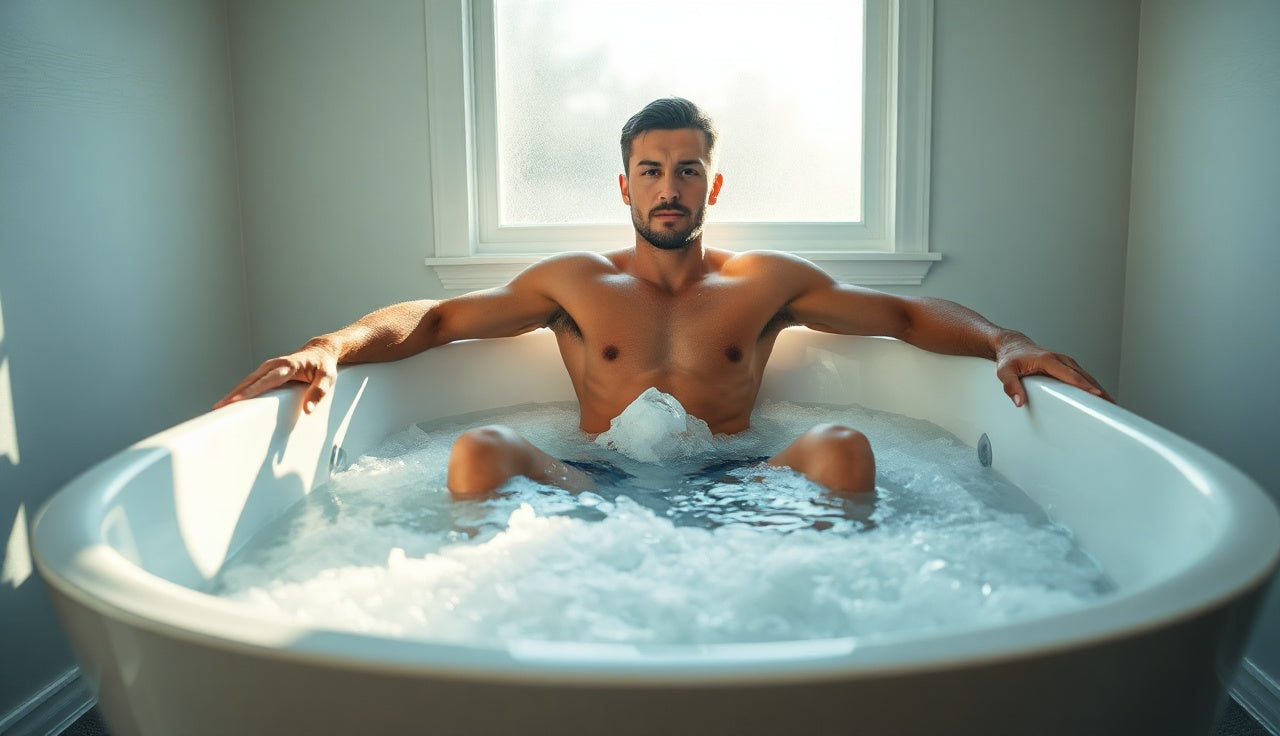
Last updated 2026-07-09
TL;DR
An ice bath after the gym can meaningfully reduce delayed-onset muscle soreness (DOMS) and perceived fatigue, especially in the 24-72 hours after hard training. The evidence is real but modest: water between 50-59°F (10-15°C) for 10-15 minutes hits the sweet spot. Skip it on days when muscle growth is your primary goal, because cold blunts the anabolic signaling that drives hypertrophy.
What does an ice bath actually do to your body after exercise?
Lower yourself into cold water and several things happen at once. Blood vessels near the skin constrict sharply, pushing blood back toward your core. Your heart rate drops. Metabolic activity in the cooled tissue slows. Nerve conduction velocity falls, which is a fancy way of saying pain signals travel slower. All of that happens inside the first 60-90 seconds.
The downstream effects are what athletes care about. Reduced blood flow to the muscle limits the inflammatory cascade that follows intense exercise. That cascade produces the swelling, local heat, and tenderness you feel 24-48 hours later, classically called delayed-onset muscle soreness (DOMS). A 2016 Cochrane systematic review of 17 randomized controlled trials found that cold water immersion (CWI) reduced DOMS compared to passive rest, with a standardized mean difference of -0.55 at 24 hours and -0.66 at 48 hours after exercise [1]. Those numbers translate to a real but moderate reduction in soreness, not elimination.
There is a psychological piece nobody talks about enough. Getting out of an ice bath tends to produce a noticeable mood lift, partly from the spike in norepinephrine that cold exposure triggers. That feeling of alertness and calm is real physiology, not placebo, though the research on exactly how long it lasts at recreational doses is still thin.
One more mechanism worth knowing: the hydrostatic pressure of the water itself helps clear metabolic waste from muscles. You get this benefit even if the water is not ice cold, which is why a cool bath at 60-65°F still does something. Temperature matters. Immersion alone matters too.
How long should you stay in an ice bath after the gym?
Most studies that show benefit used immersion times between 10 and 15 minutes [1][2]. Shorter than 5 minutes probably gives you minimal physiological effect. Longer than 20 minutes raises the risk of cold shock, numbness that masks real pain signals, and in rare cases hypothermia if the water is very cold.
The dose-response relationship here is not linear. You do not get twice the benefit from 20 minutes versus 10. The core cooling and vasoconstriction effects plateau quickly. A 10-minute soak in water at 50-59°F is roughly the protocol used across the most cited research, and it is the honest starting point.
New to cold immersion? Start at 5 minutes and work up over several sessions. The discomfort in the first 90 seconds is the hardest part. Most people find that after that initial shock, the body adapts enough to get through 10 minutes without serious distress. Breathing slowly through the nose during those first 90 seconds helps more than almost any other trick.
One thing to time carefully: do not get in immediately after heavy resistance training if you are still overheated to the point of heavy sweating. Give yourself 5-10 minutes to cool down to near-normal skin temperature first. Plunging into ice water while your core temperature is significantly elevated creates a steeper thermal gradient and a harder cardiovascular response.
What temperature should the water be for an ice bath after exercise?
The range that appears consistently across human research is 10-15°C (50-59°F) [1][2][3]. Colder than 10°C does not appear to add meaningful soreness benefit and raises the risk profile. Warmer than 15°C starts to look more like a cool bath than cold water immersion, and the vasoconstriction and nerve-conduction effects are weaker.
Hitting exactly 50°F in a tub of tap water and ice bags is easier than you might think. Fill the tub with cold tap water, add ice gradually while checking with a simple kitchen thermometer, and target that 50-59°F window. In warm climates you might need 15-20 lbs of ice. In cold climates with cold groundwater, sometimes none at all.
A dedicated cold plunge unit makes temperature control far simpler. These chillers hold water at a set temperature indefinitely, so you do not need to buy ice or guess. If you are doing cold immersion more than 3-4 times a week, the economics of a dedicated unit start to make sense against the cost and hassle of bagging ice.
The coldest most people should go in a home setting is around 45°F (7°C). Below that, the pain response gets hard to manage without experience, and the risk of hyperventilation from cold shock increases meaningfully.
Does an ice bath after the gym actually reduce soreness? What does the research show?
Short answer: yes, it helps, but the effect is moderate and it depends heavily on what kind of training you just did.
The 2016 Cochrane review mentioned earlier included 366 participants across 17 trials. The pooled result showed CWI beat passive rest for reducing DOMS at 24 hours (SMD -0.55, 95% CI -0.84 to -0.27) and at 48 hours (SMD -0.66, 95% CI -0.97 to -0.35) [1]. The review noted that most trials were small and at high risk of bias, so treat these numbers as directionally correct rather than precise.
A separate 2018 meta-analysis in the British Journal of Sports Medicine looked at recovery modalities across multiple outcomes and found CWI was among the most effective single strategies for reducing DOMS compared to passive recovery, ahead of active recovery and massage on some metrics [2]. The authors flagged high heterogeneity across studies, meaning the results vary a lot depending on the population and training type.
For team sports with repeated competition, the case is stronger. When you need to play or train again within 24-48 hours, reducing soreness enough to restore performance capacity matters. The British Journal of Sports Medicine meta-analysis found CWI improved recovery of muscle strength and perceived recovery in the 24-48 hour window after intense intermittent exercise [2].
For purely aerobic work like running or cycling, the evidence is thinner. Some studies show benefit for perceived fatigue, others show minimal effect on performance markers. Nobody has good data specifically on ice bath timing after endurance events versus resistance training; most of what we know comes from resistance or team-sport protocols.
Here is the honest bottom line. Ice baths after the gym work well enough that serious athletes use them, and the research justifies that, but they are not a cure and they do not replace sleep, nutrition, or basic periodization.
Should you do an ice bath after every workout, or only sometimes?
This is where the science creates a genuine tension, and any honest answer has to say so.
Cold water immersion after resistance training dampens the anabolic signaling that drives muscle growth. A 2015 study in the Journal of Physiology by Roberts et al. found that CWI after lower-body resistance training significantly blunted long-term gains in muscle mass and strength over 12 weeks compared to active recovery [3]. The mechanism is real. The inflammation you are suppressing is part of the signaling cascade for muscle protein synthesis. The same biological process that makes you sore is partly responsible for making you bigger and stronger.
So the practical answer is: use ice baths selectively.
After high-intensity competition, sports games, or hard conditioning sessions where you need to recover fast for the next day, an ice bath makes sense. After a hard hypertrophy-focused resistance session where your goal is muscle growth and you do not train again for 48+ hours, skipping the cold and just resting is probably the smarter call.
Many strength and conditioning coaches in professional sport have settled on a middle-ground protocol: cold water immersion on the day after competition (not the night of), or reserved for periods of congested scheduling. That is a reasonable approach for recreational athletes too.
Training for general fitness with no tight competition schedule? An ice bath once or twice a week after your most demanding sessions is a reasonable frequency. Daily cold immersion for people chasing muscle hypertrophy is probably working against you on balance.
| Cold water immersion | 0.66 |
| Contrast therapy | 0.59 |
| Compression garments | 0.49 |
| Massage | 0.43 |
| Active recovery | 0.28 |
Source: Dupuy et al., British Journal of Sports Medicine, 2018
Does an ice bath after the gym blunt muscle growth?
Yes. This is not a fringe concern. It is the most important caveat in the whole ice bath discussion for anyone training with hypertrophy as a goal.
The Roberts et al. study in the Journal of Physiology assigned men to either CWI (10 minutes at 10°C) or active recovery after every resistance training session over 12 weeks [3]. The CWI group gained significantly less muscle mass (measured by MRI) and less lower-body strength by the end of the trial. Muscle biopsies showed reduced activity in satellite cells and key signaling proteins like p70S6K1 in the CWI group.
Put plainly: if you do ice baths after every lifting session hoping to recover faster and grow more muscle, the science says you are likely doing the opposite. You recover perceptually a little faster while slowing the adaptation.
The effect size matters too. The hypertrophy difference over 12 weeks was statistically significant but not dramatic. For someone training for general health rather than competitive bodybuilding, this probably does not change much. For someone whose primary goal is maximizing muscle mass, it is a real reason to reconsider post-lift ice baths as a regular habit.
Note that this finding applies to resistance training specifically. The same concern does not apply in the same way to endurance training, where the primary adaptation mechanism is different.
How does an ice bath compare to other recovery methods after the gym?
It helps to see where cold immersion fits relative to the other tools.
| Recovery method | DOMS reduction | Strength recovery | Muscle growth impact | Evidence quality |
|---|---|---|---|---|
| Cold water immersion (10-15°C, 10-15 min) | Moderate [1] | Moderate improvement 24-48h [2] | Negative with regular use [3] | Moderate (RCTs) |
| Active recovery (light movement) | Mild | Mild | Neutral | Moderate |
| Compression garments | Mild-Moderate | Mild | Neutral | Moderate |
| Massage | Mild | Mild | Neutral | Moderate |
| Sleep (8+ hrs) | High | High | Positive | Strong |
| Nutrition (protein timing) | Moderate | High | Positive | Strong |
| Contrast therapy (hot/cold) | Moderate | Moderate | Likely neutral | Low-Moderate |
Sleep and nutrition are not optional and are not comparable to any modality above. They are the foundation. Ice baths sit in the tier of tools that add modest benefit on top of that foundation.
Contrast therapy (alternating hot and cold) is worth mentioning because it is getting attention. The research is thinner than for CWI alone, but some studies suggest it may share some benefits of cold immersion with less of the anabolic blunting effect [4]. If you have access to both a sauna and a cold plunge, alternating 10-15 minutes of heat with 5-10 minutes of cold for 2-3 rounds is a protocol used widely in Scandinavian and Finnish athletic culture. Read more about cold plunge benefits and sauna benefits if you are considering building that kind of setup at home.
What are the risks of taking an ice bath after the gym?
Ice baths are not dangerous for healthy adults when done sensibly, but there are real risks worth knowing.
Cold shock response is the most immediate concern. When cold water hits warm skin, the body triggers an involuntary gasp reflex followed by hyperventilation. In a controlled setting like a tub, this is uncomfortable but manageable. For this reason, never use an ice bath alone if you are new to cold immersion, and never submerge your face or fully dunk your head.
Cardiovascular stress is real. Cold water immersion causes a rapid increase in blood pressure and heart rate in the first 30-60 seconds. For healthy, active people this is manageable. For people with uncontrolled hypertension, cardiac arrhythmias, or Raynaud's disease, cold immersion carries higher risk. The American Heart Association does not have specific ice bath guidance, but general cold-exposure cautions for cardiac patients are consistent across clinical literature [5].
Hypothermia from prolonged exposure is a risk at the low end of temperatures, especially if you stay in longer than 20 minutes. Stop if you start shivering uncontrollably, feel confused, or lose dexterity in your hands.
One underappreciated risk: masking injury. The numbing effect of cold can make a real injury feel minor. If you took a hit or felt a sharp pain during training, get it evaluated before submerging and hiding the signal.
Pregnant women should avoid ice baths. Children and older adults should be more cautious about cold extremes. If you have any chronic health condition, talk to a physician before starting regular cold immersion.
How long after the gym should you wait before getting in an ice bath?
No high-quality trial has isolated the optimal timing window post-exercise for cold immersion. Most study protocols use immersion within 30-60 minutes after the session [1][2]. That is the range the evidence supports, not because researchers proved that timing is best, but because that is what the trials used.
Physiologically, earlier is probably better if your goal is DOMS reduction, because the inflammatory cascade begins immediately after exercise. Getting ahead of it within 30-60 minutes likely dampens the early phase. Waiting several hours is probably less effective but still better than nothing.
Worried about the hypertrophy-blunting effect? Some researchers have speculated that waiting at least a few hours might reduce the interference with anabolic signaling, but that has not been tested directly. Plausible, not confirmed.
A practical rule: shower, eat or drink something, let your heart rate and skin temperature return toward normal, then get in. That is usually 15-30 minutes after training. Do not rush from the gym floor straight into ice water while you are still breathing hard.
What's the best setup for an ice bath at home after the gym?
You have a few options at different price points, and the right one depends on how often you plan to use it.
A standard bathtub with bags of ice is the most accessible starting point. Fill with cold tap water, add 10-20 lbs of ice until you hit 50-59°F, and use a thermometer. The cost is low (ice bags run $1-3 each) but the hassle is real, and after a few sessions many people find it annoying enough to quit. Fine for occasional use.
A dedicated ice bath or cold plunge tub with a chiller is a different experience entirely. These units recirculate and chill water to your target temperature and hold it there indefinitely. Prices range from around $1,500 on the low end to $5,000 or more for professional-grade units, though basic functional options sit closer to $2,000-3,000 [6]. The convenience of stepping in anytime without prep is what actually drives consistency. Consistency is what creates results.
Also interested in contrast therapy? Pairing a cold plunge with a home sauna gives you both tools in one space. SweatDecks carries cold plunge and sauna options sized for home use, worth a look if you are in the research phase.
For something in between, inflatable cold plunge tubs ($200-500) and large chest freezers converted to cold plunge use ($300-500 plus the freezer cost) are popular DIY options. The freezer approach can hold temperature well and is cheaper long-term if you are handy enough to install a submersible pump and filter.
Whatever setup you use, a waterproof thermometer is non-negotiable. Guessing the temperature is how people either do too little (warm water that barely does anything) or too much (dangerously cold water they underestimate).
Is contrast therapy (sauna then ice bath) better than ice alone after the gym?
Possibly, in some contexts, though the honest answer is that the research is less settled here than for CWI alone.
Contrast water therapy alternates between hot and cold exposure. The classic protocol is 1-3 minutes hot followed by 1-3 minutes cold, repeated 3-6 times, finishing cold. Studies have shown benefits for perceived recovery and DOMS similar to CWI [4], and some researchers propose that the vasoconstriction-vasodilation alternation creates a pumping effect that clears metabolic waste faster than cold alone.
The potential advantage of contrast therapy over cold alone: heat exposure (particularly in a sauna) does not appear to carry the same anabolic blunting effect as cold. Sauna use actually has some data supporting muscle protein synthesis and heat shock protein upregulation. So a sauna-then-cold-plunge protocol might give you recovery benefits without the same hypertrophy cost. Reasonable hypothesis, but it has not been directly tested against cold-only for hypertrophy outcomes.
For athletes who already have both tools, a typical protocol is 10-15 minutes in the sauna at 170-190°F followed by 5-10 minutes in the cold plunge, repeated 2-3 times. Finish cold if recovery is the goal; some protocols finish warm if relaxation and sleep are the priority.
Building a home recovery setup? Adding a sauna to a cold plunge is the most versatile combination. You can use either tool alone or together depending on the training goal that day.
Frequently asked questions
How cold should an ice bath be after the gym?
Target 50-59°F (10-15°C). That is the range used in most research showing DOMS reduction benefits. Colder than 45°F increases risk without adding meaningful benefit for soreness. Use a thermometer rather than guessing. You can reach this range with cold tap water plus 10-20 lbs of bagged ice, depending on your starting water temperature.
How long should I sit in an ice bath after lifting weights?
10 to 15 minutes is the protocol used in the most cited studies and the practical target for most people. Going shorter than 5 minutes delivers minimal physiological effect. Going longer than 20 minutes does not add meaningful benefit and increases the risk of excessive cooling. If you are new, start at 5 minutes and build up over several sessions.
Will an ice bath after the gym stop my muscle gains?
Regular cold water immersion after resistance training can blunt muscle hypertrophy. A 2015 study in the Journal of Physiology found that men who used cold immersion after every lifting session over 12 weeks gained significantly less muscle mass than those using active recovery. If building muscle is your main goal, limit ice baths to sessions focused on conditioning or competition recovery, not every lifting day.
Should I take an ice bath before or after the gym?
After. Cold immersion before training can reduce muscle activation, power output, and nerve conduction velocity, which are the last things you want before a workout. The recovery and soreness-reduction benefits of cold come from its effect on post-exercise inflammation, so timing after training is what the research supports. Give yourself 15-30 minutes between finishing your session and getting in.
Is an ice bath or a cold shower better after the gym?
Ice bath. Cold showers do expose the skin to cold, but they do not provide the hydrostatic pressure of immersion, and they cannot maintain consistent full-body contact with cold water the way submersion does. Research on DOMS reduction is done on immersion protocols. Cold showers are better than nothing if that is all you have, but they are not equivalent to a proper ice bath.
Can I take an ice bath every day after the gym?
Physically yes, but probably not smart. Daily cold immersion will progressively blunt anabolic signaling if you are lifting regularly, potentially slowing muscle growth. It also desensitizes the norepinephrine response over time, reducing the mood and alertness benefit. Most practitioners suggest 2-4 times per week, reserved for your most demanding sessions, rather than every single training day.
How soon after the gym should I take an ice bath?
Within 30-60 minutes is the window used in most research. That timing catches the early phase of the inflammatory cascade. Let your heart rate settle and skin temperature come down before getting in, roughly 15-30 minutes after finishing your session. Waiting several hours is better than skipping, but early immersion appears to be more effective for DOMS based on study protocols.
Does an ice bath help with DOMS?
Yes, modestly. A 2016 Cochrane review of 17 randomized trials found cold water immersion reduced DOMS compared to passive rest with a standardized mean difference of -0.55 at 24 hours and -0.66 at 48 hours. That is a real reduction in soreness, though not elimination. The effect is most consistent in the 24-48 hour window after intense exercise.
What should I do after an ice bath after the gym?
Get out, dry off, and warm up gradually with dry clothes rather than a hot shower immediately. Eating a protein-rich meal or shake within 1-2 hours supports muscle repair. Light movement like walking is fine. Avoid intense exercise for the rest of the day. Some people find the post-ice bath alertness window is a good time to do stretching or foam rolling.
Are ice baths after the gym safe for everyone?
Not for everyone. People with cardiovascular disease, uncontrolled hypertension, cardiac arrhythmias, Raynaud's disease, or who are pregnant should consult a physician before using cold immersion. Cold shock in the first 30-60 seconds of immersion raises blood pressure and heart rate sharply. Healthy adults with no relevant conditions tolerate it well. Never use an ice bath alone if you are a first-timer.
Does an ice bath reduce inflammation after the gym?
Yes, that is the primary mechanism behind its DOMS-reducing effect. Cold causes vasoconstriction, slowing blood flow to the cooled tissue and limiting the inflammatory mediators that accumulate after intense exercise. This is a double-edged sword: the same inflammation you are reducing is part of the adaptation signal for muscle growth. Blunting inflammation is useful for short-term recovery but counterproductive for long-term hypertrophy if done every session.
How much does a home ice bath or cold plunge cost?
A basic bathtub-plus-ice setup costs almost nothing upfront but $3-10 per session in ice. Inflatable cold plunge tubs run $200-500. DIY chest freezer setups cost $300-600 total. Dedicated cold plunge units with chillers range from roughly $1,500 to $5,000 or more. If you plunge more than 3-4 times per week, a dedicated unit typically pays for itself over the cost of regular ice within 1-2 years.
Can I combine an ice bath with a sauna after the gym?
Yes, and many athletes prefer this contrast approach. A common protocol is 10-15 minutes in the sauna followed by 5-10 minutes in the cold plunge, repeated 2-3 times. The research on contrast therapy for DOMS is comparable to cold alone, with some evidence the alternating vasoconstriction and vasodilation helps clear metabolic waste. The sauna portion may also carry less hypertrophy blunting than cold alone.
Sources
- Cochrane Database of Systematic Reviews: Bleakley et al., 'Cold water immersion (cryotherapy) for preventing and treating muscle soreness after exercise', 2012 (updated evidence reviewed 2016): Cold water immersion reduced DOMS compared to passive rest with a standardized mean difference of -0.55 at 24 hours and -0.66 at 48 hours after exercise across 17 randomized trials.
- British Journal of Sports Medicine: Dupuy et al., 'An Evidence-Based Approach for Choosing Post-exercise Recovery Techniques to Reduce Markers of Muscle Damage, Soreness, Fatigue, and Inflammation', 2018: Cold water immersion was among the most effective single recovery strategies for reducing DOMS and improving perceived recovery compared to passive rest in the 24-48 hour post-exercise window.
- Journal of Physiology: Roberts et al., 'Post-exercise cold water immersion attenuates acute anabolic signalling and long-term adaptations in muscle to strength training', 2015: Men using cold water immersion (10°C, 10 min) after every resistance training session over 12 weeks gained significantly less muscle mass and lower-body strength than those using active recovery.
- American Heart Association: Cold Weather and Cardiovascular Disease: Cold exposure causes rapid increases in blood pressure and heart rate; individuals with cardiovascular conditions face elevated risk from cold-water immersion.
- Consumer Reports: Cold Plunge Tub Buyer's Guide, 2023: Dedicated cold plunge units with chillers are priced from approximately $1,500 to $5,000 or more depending on features and capacity.
- Sports Medicine: Hohenauer et al., 'The Effect of Post-Exercise Cryotherapy on Recovery Characteristics: A Systematic Review and Meta-Analysis', 2015: The most commonly researched cold water immersion protocol in controlled trials uses water at 10-15°C for 10-15 minutes; this range produced the majority of positive DOMS outcomes across reviewed studies.
- National Strength and Conditioning Association: NSCA Position Statement on Recovery: Cold water immersion is recognized as one of several evidence-supported post-exercise recovery modalities, with practical temperature and duration guidelines consistent with 10-15°C for 10-15 minutes.
- PubMed / National Library of Medicine: Ihsan et al., 'Regular Postexercise Cooling Enhances Mitochondrial Biogenesis Through AMPK and p38 MAPK in Human Skeletal Muscle', 2015: Cold water immersion after exercise activates cellular stress-response pathways in skeletal muscle, with documented effects on AMPK and downstream mitochondrial signaling.
- European Journal of Applied Physiology: Castellani & Young, 'Human physiological responses to cold exposure', 2016: Cold water immersion triggers rapid vasoconstriction, reduced nerve conduction velocity, and an initial cold shock response including involuntary gasping and transient blood pressure elevation.

Share:
Viking cold plunge: what it is, what it costs, and is it worth it
Viking cold plunge: what it is, what it costs, and is it worth it