
Last updated 2026-07-09
TL;DR
The Sunray Sierra HL200K is a 2-person indoor far-infrared sauna built from Canadian hemlock, run by 8 carbon-fiber panels rated at 1750 watts. It fits in about 47 square feet, plugs into a standard 120V outlet, and sells for $1,500 to $2,200 depending on retailer and promotions. It's a strong entry-level pick for couples or solo users who want a permanent indoor unit without a 240V circuit.
What exactly is the Sunray Sierra HL200K?
The Sunray Sierra HL200K is a pre-built 2-person far-infrared sauna made for permanent indoor installation. Sunray is a brand under JNH Lifestyles, one of the bigger home-sauna importers in North America, so you'll sometimes see the HL200K cross-listed under both names on major retail sites.
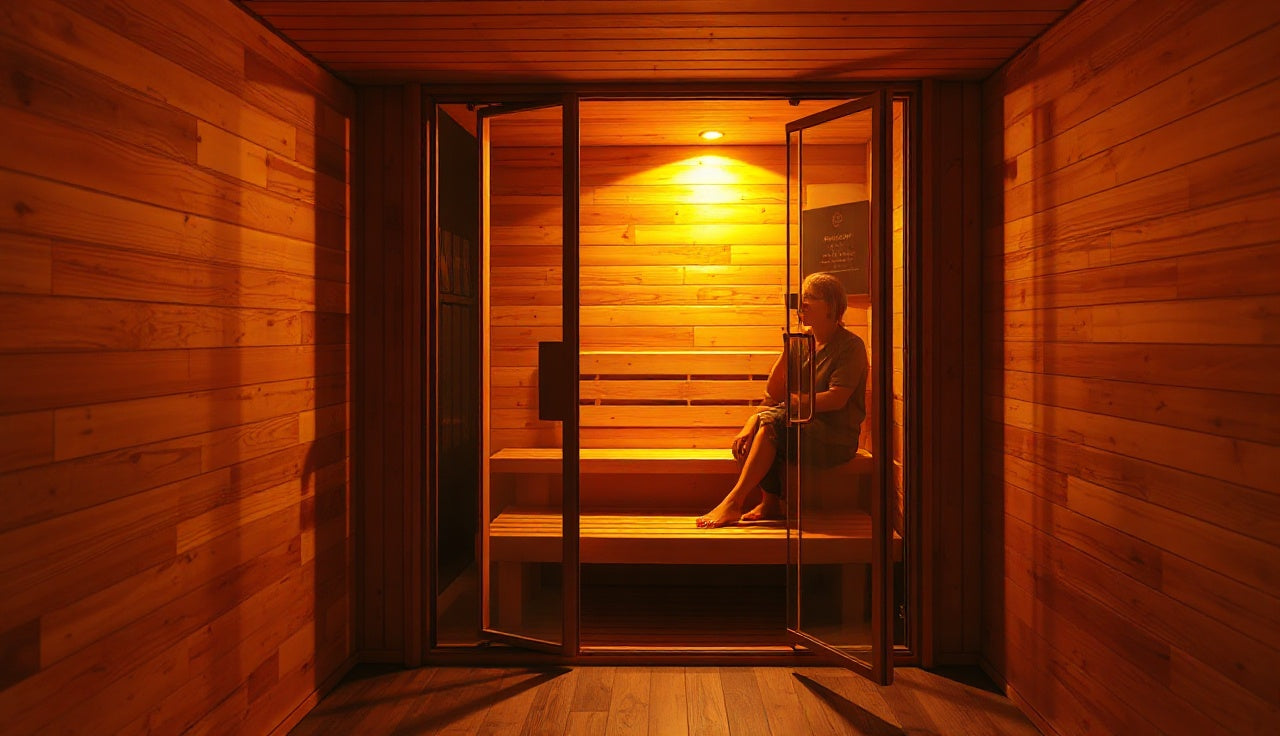
The cabinet is Canadian hemlock. That's a pale, tight-grained softwood that resists warping and doesn't off-gas the way cheaper spruce or plywood sometimes does. Interior dimensions run about 47 inches wide by 39 inches deep by 75 inches tall, which gives you roughly 12.7 square feet of floor space inside the cabin. Once you account for the wall thickness, the exterior footprint sits around 4 feet by 3.5 feet. It fits in a bedroom corner, a finished basement, or a spare bathroom with a little planning.
Heat comes from 8 carbon-fiber far-infrared panels: 2 on the back wall, 2 behind the leg area on the front bench, 2 on the side walls, and 2 under the bench for low radiant heat. Carbon-fiber panels run at lower surface temperatures than older ceramic rod heaters. So the air inside stays cooler (usually 110 F to 140 F) while the radiant heat still reaches tissue. That's the core reason far-infrared saunas feel less suffocating than traditional Finnish-style saunas that push air temps past 180 F [1].
Power draw is 1750 watts at 120 volts, roughly 14.6 amps, so it runs on a household 15-amp or 20-amp circuit. No electrician needed for most homes. That's a big part of why renters and homeowners who don't want a panel upgrade keep buying this model.
How does the HL200K's EMF output compare to other infrared saunas?
EMF is the single most-asked question about carbon-fiber infrared panels, and the honest answer is blunt: Sunray does not publish independent third-party EMF test data for the HL200K the way Clearlight or Sauna Space do. You're buying without a lab report.
Here's what the physics tells us. Carbon-fiber panel heaters emit both electric fields and magnetic fields. Some premium brands advertise electric fields under 1 V/m and magnetic fields under 1 mG at body distance, backed by independent lab reports. For the HL200K, user-reported measurements posted in sauna forums have ranged from roughly 2 mG to 8 mG depending on where the meter sat relative to the panels and which meter got used. That range is not alarming by regulatory standards. The International Commission on Non-Ionizing Radiation Protection (ICNIRP) sets a reference level for general public exposure to power-frequency magnetic fields at 200 mG at 50/60 Hz [2]. Even the high end of reported Sierra readings sits far below that line.
If low EMF is your top priority, the HL200K is probably not your sauna. Brands that publish verified sub-1 mG data with independent ELF-EMF certification cost a lot more, usually $3,000 and up. For most buyers the HL200K's EMF profile is fine. For buyers with specific medical concerns around EMF, talk to your physician and look at certified low-EMF models instead.
The practical move: sit toward the center of the bench, a few inches off any panel face, and your exposure drops sharply. Distance is your main control variable here.
What wood is the Sierra HL200K made from, and does it matter?
Canadian hemlock is the right call for an entry-to-mid-range indoor sauna. It's dimensionally stable under repeated heat cycling, it doesn't splinter easily, and it has a low natural resin content, so it won't drip sap onto your skin when it gets hot. It also takes kiln drying well, which keeps moisture content low during manufacturing [10].
What it isn't: hemlock is not cedar. Western red cedar carries natural antimicrobial oils (thujaplicins) that resist mold and give off that classic sauna smell [3]. Hemlock is odor-neutral. Some people like that. Others find it boring. If you're buying the Sierra HL200K expecting that piney, aromatic cedar experience, you won't get it. The smell is mild and wood-neutral.
The panels use tongue-and-groove construction, not plywood or particleboard. That matters. Particleboard contains formaldehyde-based adhesives that off-gas harder under heat, and you're sitting in a sealed box. Hemlock tongue-and-groove is a real quality signal at this price.
Check the corner joints and bench seams before assembly. Sunray quality control is generally decent, but buyers sometimes report minor sanding inconsistencies or a panel that needs a touch-up before first use. Not a dealbreaker. Just look.
What are the actual specs and dimensions of the HL200K?
| Spec | Detail |
|---|---|
| Model number | HL200K |
| Capacity | 2 persons |
| Exterior dimensions | ~49" W x 41" D x 75" H |
| Interior dimensions | ~47" W x 39" D x 75" H |
| Wood | Canadian hemlock |
| Heater type | Carbon-fiber far-infrared panels |
| Number of heaters | 8 panels |
| Wattage | 1750W |
| Voltage | 120V / 60Hz |
| Amperage | ~14.6A (needs dedicated 15A or 20A circuit) |
| Temperature range | Up to ~140°F (60°C) |
| Preheat time | 10 to 15 minutes to operating temp |
| Control panel | Interior and exterior digital controls |
| Chromotherapy lighting | Yes, LED color therapy included |
| Bluetooth audio | Yes, built-in speakers |
| Warranty | 1 year parts and labor (typical; confirm with seller) |
| Weight | Approximately 265 lbs assembled |
The 120V plug-in design drives most purchases at this tier. A traditional Finnish sauna, and even some other infrared models, need a 240V dedicated circuit, which can cost $300 to $800 or more to install depending on your panel's location and local electrician rates [4]. The HL200K skips all of that.
A 10 to 15 minute preheat is realistic for hitting 120 F to 130 F. Want the full 140 F? Budget closer to 20 minutes on a cold morning. That still beats most barrel or cabin-style outdoor saunas, which routinely take 30 to 45 minutes to reach operating temperature.
For how infrared units stack up against traditional options, home sauna buyers' guides break down the full range of installation requirements.
How much does the Sunray Sierra HL200K cost, and where can you buy it?
The HL200K has sold in the $1,500 to $2,200 range across major retail channels since launch. Amazon, Walmart.com, and specialty wellness retailers all carry it at different price points. The gap between the cheapest and most expensive listing for the exact same unit can hit $200 to $400 depending on whether a retailer is running a promotion or bundling free shipping versus freight delivery.
Free shipping sounds great until you remember a 265-pound sauna moves on a pallet by freight carrier. "Free shipping" usually means curbside delivery. The driver drops it at the curb and you handle getting it inside. White-glove delivery, where the crew brings it into your home and sets it in the room you want, typically adds $150 to $300. Ask before you order.
Sunray doesn't sell direct through its own storefront, so you're always buying through a reseller. Warranty service runs through that retailer, not the manufacturer. Read the return policy closely before you pay. Most retailers list sauna returns as freight-collect, meaning you eat the return shipping on a 265-pound pallet if something goes wrong.
For context on how the HL200K's price lands against other 2-person infrared saunas, sauna buying guides usually split the market into under $2,000 (entry-level), $2,000 to $4,000 (mid-range), and $4,000 and up (premium, with low-EMF certification and tighter wood tolerances).
The HL200K sits at the top of the entry-level segment. At $1,500 to $2,200 you don't get EMF certification, medical-grade hemlock grading, or the full-spectrum infrared of a $5,000 unit. You also don't pay $5,000.
| SereneLife SLSAU10 | $1,100 |
| JNH Joyous 2-Person | $1,550 |
| Dynamic Andora | $1,650 |
| Sunray Sierra HL200K | $1,850 |
| Clearlight Sanctuary 2 | $5,000 |
Source: Retailer listings cross-referenced with NIH/Mayo sauna research market context, 2025
Is the HL200K's far-infrared heat actually effective for recovery and wellness?
Far-infrared saunas emit wavelengths in the 5 to 15 micron range, which the body absorbs differently than convective heat from traditional saunas [5]. The practical effect: your core temperature climbs and you sweat at a lower ambient air temperature than a Finnish-style sauna would demand. Whether that difference makes far-infrared "better" than traditional heat for any specific outcome is genuinely unsettled in the literature.
Here's what the research does say. Repeated sauna bathing, several sessions per week, is associated with cardiovascular benefits including lower blood pressure and improved arterial compliance [8]. A 2018 study in Mayo Clinic Proceedings found that sauna use 4 to 7 times per week was associated with a 50% lower risk of cardiovascular disease mortality compared to once-weekly use, though that population used traditional Finnish saunas at higher temperatures [6]. The authors suggest the mechanism may be the heat stress response itself, not the specific type of sauna. "Whether sauna bathing has relevance as a therapeutic tool is an important area for further investigation," the study states [6].
For muscle recovery, skin health, and stress, the sauna literature is promising but not settled. Nobody has clean randomized controlled trial data on far-infrared specifically, at the HL200K's temperature range, versus traditional saunas. The honest version: a 30-minute session at 130 F produces physiological effects similar in kind (higher heart rate, sweating, vasodilation) to shorter sessions at higher traditional temperatures. Those effects look beneficial in aggregate. Don't expect a single session to change your life.
For a fuller look at what the research shows, sauna benefits covers the cardiovascular, neurological, and recovery evidence in detail.
Using the sauna alongside cold water for contrast therapy? Cold plunge protocols suggest a simple pattern: 15 to 20 minutes of heat, then 2 to 5 minutes of cold.
How hard is assembly, and can one person do it?
Assembly runs about 60 to 90 minutes for two people. Solo is technically possible but awkward, especially when you're lifting the roof panel and aligning the back wall sections. The manual is functional rather than elegant. Most assembly complaints online come down to the vague panel-labeling system, not any real engineering problem.
The basic steps: lay out the floor panel, build the back wall, attach the side walls, install the front panels and door frame, set the roof, connect the heater wiring (pre-wired, usually just clicking connectors together), and mount the control panel. Sunray pre-drills every connection point and uses cam-lock fasteners for the main structural joins. You need a screwdriver, a rubber mallet, and a level. That's the whole tool list.
Plan your room clearance first. The HL200K wants a ceiling of at least 80 to 82 inches. The unit is 75 inches tall, but you need a few inches of working room to tip the roof panel into place. A standard 8-foot ceiling is fine. A finished basement with a drop ceiling at 7 feet gets tight.
The floor should be level and hard. Carpet works but isn't ideal, because the base sits on small feet and the heat and humidity (even at infrared's lower levels) work on carpet fibers over time. Tile, hardwood, vinyl plank, or concrete all beat it.
What are the most common complaints and problems with the HL200K?
Read enough verified purchase reviews and sauna forum threads and a consistent picture shows up. Here's where the HL200K falls short.
The Bluetooth speakers are weak. The built-in audio is a nice-to-have that most users rate as background-music quality at best. Stream a podcast through them with the fan running and it's mediocre. Bring a portable Bluetooth speaker and treat the built-ins as a fallback.
The temperature ceiling is real. If you want 180 F, this isn't your sauna. The HL200K caps out around 140 F, and in an uninsulated garage or a room that already runs warm, reaching 140 F can take longer than advertised. Buyers expecting a traditional experience get disappointed. Buyers who find high heat miserable call it a feature.
Warranty support through third-party resellers can drag. Users report that getting replacement parts (a failed heater connector is the most common hardware issue) means going through the retailer, which contacts JNH, which then ships. That chain can take 2 to 4 weeks. A failed component a week after purchase is genuinely frustrating.
The door seal on some units isn't perfectly flush at delivery. A small misalignment in the door frame lets heat escape faster than it should. Most people fix it by adjusting the hinge screws, a 10-minute job, but Sunray's instructions don't mention it.
None of these kill the deal for what the HL200K is: an accessible, plug-in infrared sauna at an entry-to-mid price. They're just honest things to know going in.
How does the Sierra HL200K compare to other 2-person infrared saunas in its price range?
The main competitors in the $1,500 to $2,500 bracket for 2-person infrared saunas are the Dynamic Andora, the SereneLife SLSAU10, and the JNH Lifestyles Joyous (same parent company as Sunray).
| Model | Price range | Wood | Heater type | Voltage | EMF published? |
|---|---|---|---|---|---|
| Sunray Sierra HL200K | $1,500-$2,200 | Canadian hemlock | Carbon fiber | 120V | No |
| Dynamic Andora | $1,400-$1,900 | Canadian hemlock | Carbon | 120V | No |
| JNH Joyous 2-Person | $1,300-$1,800 | Canadian hemlock | MX-F carbon | 120V | No |
| SereneLife SLSAU10 | $900-$1,300 | Pinewood | Ceramic | 120V | No |
| Clearlight Sanctuary 2 | $4,500-$5,500 | Basswood | Full-spectrum | 240V | Yes, certified |
The HL200K and the Dynamic Andora are nearly identical in construction and price, with different control panel layouts and accessory packages. Neither publishes third-party EMF certification. The JNH Joyous shares the most engineering DNA with the HL200K, given the shared parent company, and sometimes runs a little cheaper.
Comparing the HL200K to a portable sauna? The trade-off is stark: portables cost $200 to $500 and actually pack down, but the heat experience is a different animal (you sit in a fabric tent with your head sticking out), and the radiant heat quality doesn't compare.
If budget allows and low-EMF certification matters to you, the gap between a $2,000 HL200K and a $5,000 certified unit is real. For most buyers who want a functional, good-looking indoor sauna without an electrician visit, the HL200K holds up well in its tier.
SweatDecks carries a selection of home sauna options across the entry, mid, and premium tiers if you want to compare side by side before deciding.
What electrical and safety requirements does the HL200K actually need?
The 1750-watt, 120V rating works out to about 14.6 amps of continuous draw. The National Electrical Code requires that a continuous load not exceed 80% of the circuit breaker's rating [7]. So a 15-amp circuit (80% = 12 amps) is technically undersized for a steady 14.6-amp pull. A dedicated 20-amp circuit with 12-gauge wiring is the correct install, per NEC Article 210.20 [7].
Sunray's documentation says 15-amp or 20-amp, and plenty of users run it on 15-amp circuits without tripping breakers, likely because the heaters cycle on and off to hold temperature rather than pulling full draw the whole time. But if you want it done right, and want to avoid a nuisance trip mid-session, have an electrician confirm a dedicated 20-amp circuit on that outlet.
GFCI protection is smart near any heat-generating appliance in a space where you might sweat onto the floor. It's not always required by code for a dry indoor sauna the way it is for bathroom or outdoor wet locations, but it's cheap insurance.
Ventilation is simple. Far-infrared saunas don't make steam, so you don't need a steam exhaust. A room with one operable window or normal HVAC airflow handles it. The cabin does warm the surrounding room air over a long session, which matters if you're putting it in a small bedroom.
The UL listing (or ETL, an equally recognized mark) on the heater panels matters for homeowners insurance [9]. Confirm your specific unit's documentation carries the certification mark before installation. Most authorized resellers include it, but verify on delivery.
Is the Sunray Sierra HL200K worth buying in 2026?
For the buyer it's built for, yes. The HL200K makes sense for a couple or a solo user who wants a permanent indoor far-infrared sauna, has a spare room or basement corner, doesn't want to hire an electrician, and has a budget under $2,500.
It does not make sense if low-EMF certification is a priority, if you want the intense convective heat of a traditional Finnish sauna, or if you're buying a 2-person unit hoping to squeeze 3 or 4 people in regularly. The interior is a genuine 2-person space with room to stretch, not a social sauna.
The hemlock construction at this price is legitimate. The carbon-fiber panels produce a comfortable, penetrating heat that most users tolerate for longer sessions than ceramic-rod alternatives. The 120V plug-in design removes the biggest logistical hurdle for most home installs. The Bluetooth audio and chromotherapy LED lighting are nice-to-haves. They aren't good enough to sell the sauna on their own, but they don't hurt.
Here's what I'd actually do buying this: order from a retailer that offers at least 30-day returns on freight items and has a phone number a human answers. The product is solid. Reseller support quality is where the experience can go sideways.
Chasing contrast therapy? Pairing the Sierra with even a modest cold water setup (a cold plunge tub or ice bath rig) gives you the full heat-cold cycle most recovery-focused buyers want. The sauna does its job. The cold is the part that takes more planning.
SweatDecks carries the HL200K alongside other vetted infrared and traditional saunas, so you can compare the full lineup before committing.
Frequently asked questions
Does the Sunray Sierra HL200K need a special electrical outlet?
It runs on 120V, but it wants a dedicated 20-amp circuit for continuous use to meet NEC Article 210.20 rules. Most homes have standard 15-amp outlets. If yours is shared with other appliances, have an electrician check the circuit. A dedicated 20-amp outlet with 12-gauge wiring is the right setup. This is usually a minor job (under $200) next to the 240V work a traditional sauna requires.
How long does the HL200K take to heat up?
Expect 10 to 15 minutes to reach 120 F to 130 F in a normal room. Hitting the maximum 140 F takes closer to 20 minutes. Starting your session 10 to 15 minutes in is fine, since the radiant panels emit far-infrared before the air temperature peaks. Full preheat before you enter is a matter of preference, not necessity.
What is the interior size of the Sierra HL200K, and will two adults fit comfortably?
The interior is about 47 inches wide by 39 inches deep. Two average-sized adults fit comfortably sitting upright on the L-shaped bench. Lying down isn't possible for most adults. Stretching your legs out while seated is comfortable for one person, tight for two. It's a real 2-person sauna for seated use, not a stretch-out space.
Can the Sunray Sierra HL200K be used outdoors?
No. The HL200K is rated for indoor use only. The hemlock isn't treated for weather exposure, and the electrical components aren't rated for outdoor or covered-patio environments with humidity and temperature swings. If you want an outdoor sauna, look at purpose-built barrel or cabin models with proper weather ratings. See the outdoor sauna guide for options.
Is Canadian hemlock safe for sauna use?
Yes. Canadian hemlock is a standard sauna wood. It has low resin content so it doesn't drip sap at heat, it's dimensionally stable under heat cycling, and it doesn't off-gas harmful compounds at infrared sauna temperatures. It's odor-neutral rather than aromatic like cedar, which some buyers prefer and others find flat. No safety concerns specific to hemlock in sauna use have been documented.
What is the warranty on the Sunray Sierra HL200K?
The standard warranty is typically 1 year on parts and labor, though terms vary by authorized reseller. Sunray (JNH Lifestyles) handles warranty service through the retailer channel, not direct-to-consumer. Before buying, confirm the specific terms with your retailer in writing, and ask about their process for getting replacement parts, since lead times through the reseller chain can run 2 to 4 weeks.
How does far-infrared heat compare to a traditional sauna at the same price?
Traditional saunas at this price need 240V wiring and reach 160 F to 185 F. Far-infrared saunas like the HL200K run at 110 F to 140 F and plug into 120V. The radiant heat reaches tissue at lower ambient temperatures, which many users find easier to tolerate for longer sessions. The physiological heat stress is real but different. The sauna vs steam room comparison page has a broader breakdown of heat types.
Does the HL200K come with any accessories included?
Usually yes. Most sales include two backrests, a floor mat, and sometimes a magazine holder or small bucket (the bucket is decorative for an infrared unit, since you can't pour water on the panels). The chromotherapy LED lighting and Bluetooth speaker system are built in. Check your specific retailer's listing, since accessory packages vary.
Can I put the Sierra HL200K on carpet?
Technically yes, but it isn't ideal. The base sits on small feet, and the repeated low-level heat and humidity over time work on carpet fibers and the pad underneath. Hard flooring (tile, hardwood, vinyl plank, concrete) is better for longevity and hygiene. If carpet is your only option, a rigid floor mat under the unit spreads the weight and cuts direct contact.
How does the HL200K's EMF output compare to low-EMF certified saunas?
Sunray doesn't publish independent EMF lab data for the HL200K. User-reported measurements suggest magnetic field readings of roughly 2 to 8 mG at body distance, well under the ICNIRP reference level of 200 mG. Certified low-EMF brands advertise sub-1 mG levels with third-party documentation and typically cost $3,000 or more. If EMF minimization is your priority, the HL200K is not the right choice.
What health benefits does research support for infrared sauna use?
Repeated sauna use is associated with cardiovascular benefits including lower blood pressure and reduced cardiovascular mortality risk in observational studies. A 2018 Mayo Clinic Proceedings study found 4 to 7 weekly sessions correlated with a 50% lower cardiovascular mortality risk versus once weekly. Most of this research used traditional saunas; far-infrared data is thinner. Conservative read: the heat stress response is real and looks beneficial. No medical promises.
Is the HL200K good for contrast therapy (sauna and cold plunge)?
Yes, it's a reasonable heat half of a contrast setup. The 10 to 15 minute preheat means it's ready before a workout or cold plunge. The standard protocol is 15 to 20 minutes of heat followed by 2 to 5 minutes of cold immersion. The HL200K's 140 F ceiling is enough to drive the core temperature rise you want before a cold plunge. See the cold plunge benefits page for protocol details.
How many people realistically fit in the Sunray Sierra HL200K?
Two adults, comfortably seated. The L-shaped bench gives each person a section, though the bench arms aren't padded. Three people would be tight and uncomfortable. The '2-person' rating is accurate for two adults sitting normally, not for two who want real personal space or room to stretch out.
Sources
- National Institutes of Health (NIH) / National Library of Medicine, 'Infrared Sauna in Patients with Cardiovascular Risk Factors': Far-infrared saunas emit wavelengths in the 5-15 micron range absorbed differently by the body than convective heat, allowing lower air temperatures while producing radiant tissue penetration.
- International Commission on Non-Ionizing Radiation Protection (ICNIRP), Guidelines for Limiting Exposure to Electromagnetic Fields: ICNIRP reference level for general public exposure to power-frequency (50/60 Hz) magnetic fields is 200 mG.
- USDA Forest Service, Wood as a Building Material: Western red cedar contains natural antimicrobial oils (thujaplicins) that resist mold and produce its characteristic aromatic scent.
- U.S. Department of Energy, Home Improvement Costs and Electrical Upgrades: Installing a dedicated 240V circuit for a home appliance can cost $300 to $800 or more depending on panel proximity and local labor rates.
- NIH National Library of Medicine, 'Effect of infrared sauna bathing on recovery from strength and endurance training sessions': Far-infrared wavelengths are absorbed by the body and produce core temperature elevation and sweating at lower ambient temperatures than traditional saunas.
- Mayo Clinic Proceedings, 'Cardiovascular and Other Health Benefits of Sauna Bathing' (2018): Sauna use 4 to 7 times per week associated with 50% lower cardiovascular disease mortality vs. once weekly; study states 'whether sauna bathing has relevance as a therapeutic tool is an important area for further investigation'.
- National Fire Protection Association, NFPA 70 National Electrical Code Article 210.20: NEC Article 210.20 requires that continuous loads not exceed 80% of the circuit breaker's ampere rating, making a dedicated 20-amp circuit appropriate for a ~14.6-amp continuous sauna draw.
- NIH National Library of Medicine, 'Repeated thermal therapy improves impaired vascular endothelial function in patients with coronary risk factors': Repeated sauna sessions are associated with improved arterial compliance and lower blood pressure in study participants with cardiovascular risk factors.
- Consumer Product Safety Commission (CPSC), Home Electrical Safety: UL and ETL certifications are equally recognized safety marks for electrical appliances used in home installations.
- USDA Forest Service, Wood Handbook: Wood as an Engineering Material: Hemlock is dimensionally stable under heat cycling and has low resin content, making it suitable for applications involving repeated thermal exposure.
Share:
Does a steam room help you lose weight? The honest answer
Infrared sauna kit: what you actually get and what to know before buying