
Last updated 2026-07-09
TL;DR
An infrared sauna kit is a flat-pack package: pre-cut wood panels, infrared heaters, a control panel, and all the hardware to build a sauna at home. Kits start around $1,500 for one-person units and climb past $8,000 for four-person rooms. Assembly takes two to six hours with basic tools. Most run on a standard 120V or dedicated 240V circuit.
What exactly is an infrared sauna kit?
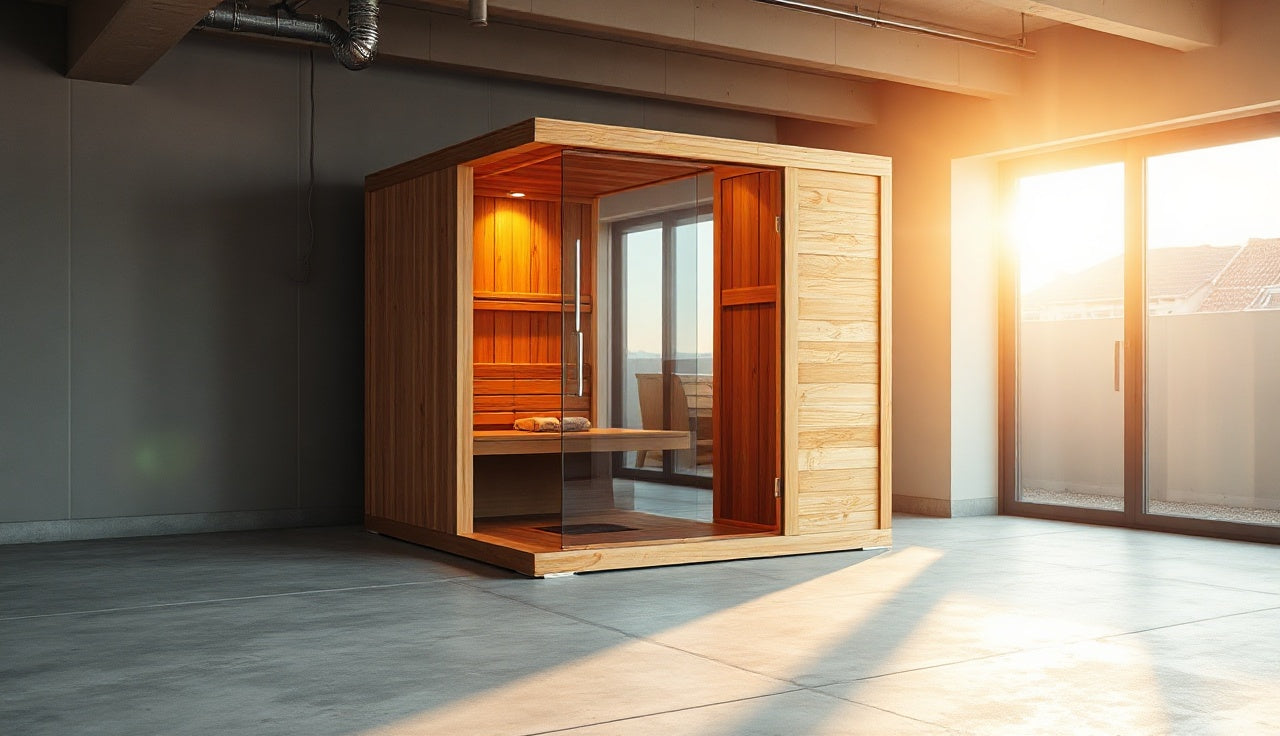
A kit is a factory-built sauna that ships in flat-pack form. The manufacturer pre-cuts every panel, drills the tongue-and-groove joints, and wires the heaters before it leaves the plant. You get a numbered box and an instruction manual. No carpentry skills needed.
A typical kit includes the floor, four walls, a ceiling, a pre-hung door with glass, bench slats, infrared heaters (usually two to six depending on cabin size), a digital control panel, interior lighting, and all the fasteners. Some throw in a Bluetooth speaker and chromotherapy lights. Here's what kits almost never include: the dedicated electrical circuit, any permits, a concrete pad or subfloor for outdoor placement, and anything that needs a licensed trade to install.
The wood species matters more than most buyers expect. Canadian hemlock is the most common entry-level choice because it's cheap and resists warping well. Western red cedar costs more but smells better and has a tighter grain that survives humidity swings over years of use. Nordic spruce shows up on European-made kits. Basswood is the pick for buyers with allergies because it off-gasses less aromatic compound than cedar. None of these is definitively "best" for health outcomes. It's a preference and budget call [1].
This article covers far-infrared (FIR) kits. Near-infrared (NIR) and full-spectrum units exist, but FIR makes up the large majority of the home kit market. If you're weighing the broader sauna landscape before committing to infrared, read that overview first.
How is an infrared sauna kit different from a traditional sauna kit?
Traditional saunas heat the air to 160-200°F using a rock heater (kiuas). Infrared saunas heat objects and bodies directly with electromagnetic radiation in the 3-100 micron wavelength range, so the air temperature sits much lower, typically 120-150°F, while the radiant heat hitting your skin feels intense [2].
For kit buyers that difference matters in three ways. Power requirements differ sharply first. A traditional heater for a two-person cabin often pulls 4.5 to 6 kW, which almost always needs a 240V/30A dedicated circuit installed by an electrician. A comparable infrared kit sometimes runs on 120V/15-20A if it's a one-person unit, though two-person and larger units still need 240V [3]. Second, infrared kits install indoors far more easily because there's no steam, no combustion, no floor drain. Third, preheat is dramatically shorter: most infrared kits hit operating temperature in 10-20 minutes versus 30-45 minutes for a traditional sauna.
For a side-by-side look at the full heat experience, see sauna vs steam room, which weighs both dry-heat formats against steam.
The research picture differs too. Most of the frequently cited cardiovascular and longevity work comes from Finnish dry-sauna studies at much higher temperatures. Infrared-specific research is thinner. A 2018 systematic review in Evidence-Based Complementary and Alternative Medicine found some support for infrared sauna in reducing fatigue and improving quality of life in heart failure patients, but the authors wrote that "most studies were small and methodological quality was variable" [4]. Nobody should buy an infrared kit expecting a clinical result the research hasn't confirmed.
What does an infrared sauna kit cost in 2025?
Prices break down cleanly by size and heater quality. A one-person entry unit starts around $1,500. A four-person full-spectrum room tops $10,000. Here's the full range.
| Configuration | Heater Type | Typical Price Range |
|---|---|---|
| 1-person, entry-level | Carbon panel | $1,500 - $2,500 |
| 2-person, mid-range | Carbon panel | $2,800 - $4,500 |
| 2-3 person, premium | Carbon + ceramic hybrid | $4,500 - $6,500 |
| 4-person, full-spectrum | Full-spectrum NIR/FIR | $6,500 - $10,000+ |
| Outdoor barrel/cabin kit | FIR or full-spectrum | $3,000 - $8,000 |
These are retail ranges from major manufacturer pricing publicly available as of mid-2025 [5]. They exclude shipping (often $200-$500 for freight), installation labor, and the electrical circuit. Budget roughly $300-$800 for a licensed electrician to run a 240V/30A dedicated line if you don't already have one.
Carbon fiber panel heaters spread heat evenly across a large surface at lower face temperatures, typically 120-150°F at the heater. Ceramic rod heaters get hotter at the surface (sometimes 300°F+) and warm up faster but produce more uneven heat. Most buyers prefer the softer feel of carbon panels. Neither is proven better for physiological outcomes.
Warehouse clubs deserve a mention. They sell entry and mid-tier kits seasonally, often at 10-20% below specialty retailers. You get less support and a shorter return window in exchange. For comparison shopping, the costco sauna breakdown covers what those deals actually include.
| 1-person entry-level (carbon panel) | $2,000 |
| 2-person mid-range (carbon panel) | $3,650 |
| 2-3 person premium (carbon + ceramic) | $5,500 |
| 4-person full-spectrum | $8,250 |
| Outdoor barrel or cabin kit | $5,500 |
Source: Angi Cost Guide and manufacturer public pricing, 2025
What size infrared sauna kit do you actually need?
Most people buy one size too small. A one-person kit is genuinely tight: internal dimensions usually run 36" x 36" to 40" x 40". That works if you use it solo every time and prefer a snug session. If you ever want to lie down, stretch, or bring a partner, step up.
A two-person kit (typically 47" x 47" or 57" x 47") is the sweet spot for most households. You can use it solo and still recline on the bench. A three-person unit (around 57" x 57" or 65" x 57") suits couples who sauna together or taller users over 6'2" who want a full-length bench to stretch out on.
Ceiling height is the spec buyers overlook most. Standard kits ship at 75"-78" interior height. If you're 6'1" and plan to stand inside, or you want to sit tall with your head clear of the heat panels, measure before you order. Some manufacturers offer 78"-80" extended-height options for a small upcharge.
For footprint planning, add 2-3 inches on each side of the stated external dimensions for ventilation clearance and easier assembly. You'll also want 6-8 feet of clear space in front of the door so it swings open fully.
Where can you put an infrared sauna kit?
Infrared kits work indoors or outdoors, but the two settings have meaningfully different requirements. Indoors is simpler by a wide margin.
You need a flat, level floor that can handle the weight (most two-person kits run 350-600 lbs assembled). Concrete, tile, hardwood, laminate, and vinyl plank all work fine because infrared saunas don't produce the steam that damages flooring. A bathroom or basement with a GFCI-protected outlet nearby is ideal. The room needs no special ventilation. Just leave the door cracked after use to let moisture escape.
Outdoors, a dedicated outdoor sauna install takes more planning. Many infrared kits aren't rated for outdoor use by the manufacturer, so check the spec sheet before assuming. Outdoor-rated kits typically use thicker tongue-and-groove panels (1.5" versus 1" for indoor units), weather-treated fasteners, and sealed electronics. You'll want a level, weatherproof pad of poured concrete or pavers, and you'll need to protect the electrical connection from rain with proper conduit and a weatherproof junction box.
Permit rules vary by jurisdiction. In most U.S. states a prefabricated plug-in infrared sauna installed indoors needs no building permit because it counts as a portable appliance. But adding a dedicated electrical circuit almost always requires a permit pulled by a licensed electrician [6]. An outdoor structure may trigger permit requirements depending on its size and your local code. Check with your city or county building department before you order. The International Residential Code (IRC) Section R105 covers when permits are required for accessory structures and permanent electrical work [7].
What electrical setup does an infrared sauna kit require?
This is where most buyers get a surprise cost. Read the spec sheet of any kit before purchasing and find two numbers: amperage draw and voltage. Everything else follows from those.
One-person kits with 1.4-1.8 kW of heaters sometimes run on a standard 120V/15-20A circuit. If you have a spare 20A bathroom circuit nearby, you might plug in directly. But two-person kits almost always draw 20-30A at 240V, and three- or four-person units often pull 30-40A at 240V. That means a dedicated 240V circuit in most cases.
Adding a 240V/30A dedicated circuit runs roughly $300 to $800 depending on how far the panel sits from the install point and local labor rates, per Angi's national cost data [8]. In older homes with crowded panels, you might need a panel upgrade, which runs $1,500-$3,000 or more.
A GFCI breaker is required by the National Electrical Code (NEC) for all sauna circuits under NEC Articles 422 and 680, because heat, moisture, and electrical equipment together demand ground-fault protection [9]. Most licensed electricians know this and include a GFCI breaker by default. If yours doesn't mention it, ask.
Never run an infrared sauna kit on an extension cord. The continuous load on an undersized cord is a fire risk. If your outlet isn't close enough, have the circuit moved.
How do you assemble an infrared sauna kit?
Most kits follow the same sequence: floor panels, back wall, side walls, front wall with door cutout, ceiling, benches, then heater and control wiring.
The assembly time manufacturers advertise (usually 1-2 hours) is optimistic. Plan for 3-6 hours for two adults working together, including unpacking and reading the instructions. Most kits need only a rubber mallet, a screwdriver or drill, and sometimes a socket wrench for the bench hardware. No cutting, no specialized carpentry.
The heater wiring is the step people fear, but it's usually pre-terminated at the factory. You're connecting labeled plugs to matching sockets inside the cabin, like assembling a PC. The main control panel wires to the power supply and to each heater with numbered connectors. Separate roof or wall heaters connect the same way. The actual line voltage wiring, meaning the power cord that plugs into your outlet or hardwires in, should go to an electrician if you're at all uncertain.
One tip that saves grief: don't overtighten the tongue-and-groove panels. Wood expands with heat and humidity. Panels hammered together too hard can bow or crack after the first few heat cycles. Snug, not slammed.
Are infrared saunas actually good for you? What does the research say?
The research base is real but limited. It's not nothing, and it's not what the marketing claims.
The strongest evidence comes from cardiovascular work. A 2015 study in JAMA Internal Medicine by Laukkanen and colleagues (the Finnish sauna study) found men who used a sauna 4-7 times per week had a 50% lower risk of fatal cardiovascular events than once-weekly users [10]. But that was traditional Finnish sauna at 80°C (176°F), not infrared. Applying it to infrared is a reasonable hypothesis, not a proven fact.
For infrared specifically, a 2015 study in Complementary Therapies in Medicine found a 15-minute far-infrared session produced measurable improvements in arterial compliance in healthy middle-aged adults, though the sample was small (n=35). A 2018 pilot in Psychotherapy and Psychosomatics found one session of whole-body hyperthermia (related to, not identical to, infrared sauna) produced a rapid antidepressant effect that lasted six weeks. Interesting. Not conclusive.
Here's the honest summary. Moderate regular sauna use, infrared included, is associated with lower cardiovascular risk, some evidence of reduced muscle soreness after exercise, and plausible benefits for sleep. The sauna benefits overview walks the full evidence landscape more carefully. What the research does not support is detoxification (your liver and kidneys handle that, sweat contributes very little), cancer prevention, or immune "boosting" in any measurable way [11].
Use an infrared sauna because it feels good and the recovery data looks promising. Don't use it in place of medical care.
What features should you look for in an infrared sauna kit?
Start with heater quality and placement. The best kits wrap you in heaters: back wall, side walls, and a floor heater when possible. A kit with heaters only on the back wall heats unevenly and leaves your legs cold. Look for total wattage per square foot of cabin floor. Roughly 25-35 watts per square foot is a reasonable target for adequate output.
EMF output is a question buyers ask constantly. Infrared heaters do emit non-ionizing electromagnetic fields. The real question is at what distance and what level. Reputable manufacturers publish third-party EMF test results, usually in milligauss (mG) at a standard distance like 6 inches from the heater surface. Look for readings under 3 mG at body distance. The World Health Organization classifies extremely low frequency EMF as "possibly carcinogenic" (Group 2B) at high occupational exposures, but notes evidence at typical residential or consumer levels is not conclusive [12]. A 20-40 minute session is not a high-exposure scenario by occupational standards.
Other specs worth checking: interior wood finish (avoid any compressed wood or MDF, which off-gasses formaldehyde when heated), door latch quality (glass door hinges and latches fail more often than any other component on cheap kits), and control panel usability. Some kits let you pre-schedule from an app. Others use a physical timer only. App control is convenient but not essential.
If you're deciding whether a kit or a portable sauna fits your space and budget better, work through that comparison before you buy.
How do infrared sauna kits compare to built-in custom saunas?
A custom-built sauna gives you full control over size, wood species, heater placement, bench layout, and how the room integrates with your home. It costs a lot more: custom builds typically run $8,000-$25,000+ once you add framing, electrical, and contractor labor [5]. That makes sense for a permanent home improvement or a dedicated sauna room. It rarely makes sense for a first-timer who isn't sure sauna will become a daily habit.
Kits have real advantages for most home buyers. They're genuinely portable, so you can take one when you move. They need no structural changes to the building. They can be running the same weekend they arrive. And resale value, while not great, means you're not stuck with a total sunk cost if you stop using it.
The quality gap between a good kit and a custom build has closed a lot in the last five years. Premium kit makers now spec the same 1.5" Canadian hemlock and Nordic spruce panels that custom builders use. The difference is mostly heater count, interior finish options, and the prestige of a fully bespoke space.
For anyone researching the full home sauna decision, run the build-vs-buy math there before you commit to either path.
What maintenance does an infrared sauna kit need?
Less than you'd think. There's no water poured over rocks and minimal steam, so the cabin interior stays much drier than a traditional sauna. That means less mold risk and less wood warping over time.
After each session, leave the door open for 30-60 minutes to air out. Wipe the bench with a clean dry towel (most users also put a towel down during the session). Once a month, check the heater connectors for discoloration or loose plugs. Once a year, lightly sand any bench surfaces that feel rough or splintered, and re-tighten any bench hardware that has loosened.
Skip harsh chemical cleaners inside the cabin. To clean the wood, a diluted white vinegar and water solution works fine. Don't soak the wood. Wipe the control panel and any electronics with a barely damp cloth, nothing wetter.
The most common failure points are the door hinges and latch (replace as needed, these are usually standard hardware), the control panel (warranty typically covers this 1-3 years), and heater elements (carbon panels have a rated life of roughly 30,000-50,000 hours, which is decades at daily use). Keep your receipt and warranty paperwork. Most reputable manufacturers offer 1-5 year limited warranties on heaters and structure [13].
Can you pair an infrared sauna kit with a cold plunge for contrast therapy?
Yes, and this is one of the better home wellness setups going right now. Contrast therapy, alternating heat and cold, has a decent evidence base for reducing delayed onset muscle soreness and improving perceived recovery. A review of contrast water therapy found hot/cold immersion cut muscle soreness more effectively than passive recovery, though the size of the benefit varied with protocol [14].
The practical setup: finish your infrared session, step out, and get into a cold plunge or ice bath within 5-10 minutes. Common protocols run 10-15 minutes of heat followed by 2-5 minutes at 50-59°F cold water, repeated 2-3 rounds. Nobody has locked down the definitive protocol. Most practitioners pick a cycle that fits their schedule and tolerance.
For what cold exposure actually does physiologically, the cold plunge benefits breakdown is the right next read.
If you're building a complete home recovery space, SweatDecks carries both infrared sauna kits and cold plunge units and can help you spec both for the same room or outdoor area.
Frequently asked questions
How long does it take to assemble an infrared sauna kit?
Most two-person kits take two experienced adults 3-6 hours from unboxing to first power-on. Manufacturer estimates of 1-2 hours are achievable only if you've built one before and the instructions are clear. Plan for a half-day project. The most time-consuming steps are unpacking and sorting the panels, not the assembly itself, which goes fast once all parts are laid out.
Do I need a permit to install an infrared sauna kit at home?
In most U.S. jurisdictions, a plug-in infrared sauna installed indoors as a portable appliance needs no building permit. But adding a dedicated 240V electrical circuit almost always requires an electrical permit pulled by a licensed electrician. An outdoor infrared sauna structure may also require a permit depending on local codes. Check with your city or county building department before ordering.
What's the difference between carbon and ceramic infrared heaters?
Carbon fiber panel heaters have a larger surface area and run at lower surface temperatures (120-150°F), producing even, gentle heat. Ceramic rod heaters reach higher surface temperatures (sometimes 300°F+), heat up faster, and emit more concentrated warmth. Most buyers find carbon panels more comfortable for longer sessions. Neither type is proven better for health outcomes. It comes down to how you prefer the heat to feel.
Can I put an infrared sauna kit in an apartment?
Technically possible if you have a suitable space (minimum ~40 square feet for a one-person kit plus clearance) and access to the required electrical circuit. The main barriers are electrical (most apartments have no 240V outlets in living areas), building rules (landlords or HOAs may ban permanent installs), and weight (350-600 lbs on upper floors worries some building managers). Check your lease and building rules before buying.
How much does it cost to run an infrared sauna per month?
A two-person infrared sauna drawing roughly 1,700-2,000 watts, used 45 minutes per session four days a week, uses about 24-28 kWh per month. At the U.S. average residential rate of 16.9 cents per kWh (early 2025, per the U.S. Energy Information Administration), that's roughly $4-$5 per month in electricity. Larger units with more heaters run proportionally higher.
What wood is best for an infrared sauna kit?
Western red cedar and Canadian hemlock are the most common choices. Cedar has a pleasant aroma, resists moisture well, and looks beautiful, but costs more. Hemlock is odor-neutral, stable, and cheaper. Basswood is the best option for people with allergies or sensitivity to wood aromatic compounds because it off-gasses the least. Avoid any kit using MDF or compressed wood panels inside. These release formaldehyde when heated.
How hot does an infrared sauna kit get?
Most infrared sauna kits reach air temperatures of 120-150°F (49-65°C) at full power after a 10-20 minute preheat. The radiant heat absorbed by your skin feels more intense than the air temperature suggests. Traditional Finnish saunas run 160-200°F by comparison. If you're used to traditional sauna, an infrared session at 140°F feels different but won't necessarily make you sweat less.
Are infrared sauna kits safe for people with heart conditions?
People with cardiovascular conditions should consult their physician before using any sauna. Sauna use raises heart rate, temporarily lowers blood pressure, and increases cardiac output. These effects can help healthy people but pose risks for anyone with unstable angina, recent heart attack, or severe heart failure. The European Society of Cardiology does not prohibit sauna for stable cardiac patients but recommends medical clearance first. Don't self-prescribe here.
Can children use an infrared sauna kit?
Most manufacturers recommend against sauna use for children under 12 and suggest caution plus shorter sessions (5-10 minutes maximum) for adolescents. Children thermoregulate less efficiently than adults and are more prone to heat illness. If a child uses a sauna, an adult must be present, the temperature should stay at the low end of the range, and the child should hydrate and exit the moment they feel uncomfortable.
What's a realistic resale value for an infrared sauna kit?
Used infrared sauna kits typically resell for 40-60% of original retail in good condition, based on listings on Facebook Marketplace and Craigslist. Premium brands with intact warranties hold value better. Factors that hurt resale: missing hardware, damaged door glass, discolored wood from heavy use, or a heater element that needs replacing. Keep the original packaging if you can. It makes transport and resale much easier.
How does an infrared sauna kit compare to a portable sauna tent?
Portable sauna tents cost $150-$600 and fold away for storage, which appeals in small spaces. But they surround only your body (your head stays outside), give far less even heat than panel heaters, and feel nothing like a full cabin. An infrared sauna kit at $1,500+ is a real room you sit inside. If budget and space are your main constraints, a tent works. If you want the genuine sauna experience, a kit is a different category.
Does an infrared sauna kit add value to a home?
A portable kit adds little to a formal home appraisal because it counts as personal property, not a fixed improvement. A professionally installed, hardwired infrared sauna built into a dedicated room may add some value, especially in high-end markets where wellness amenities are expected, but don't count on dollar-for-dollar return. For most buyers the value is in the use, not the resale.
How often should I use an infrared sauna?
The Finnish longitudinal studies showing cardiovascular benefit found the strongest associations at 4-7 sessions per week. Most practitioners recommend starting with 2-3 sessions per week at 15-20 minutes and building to 4-5 sessions of 30-45 minutes as your body adapts. Daily use is fine for healthy adults as long as you hydrate well (16-24 oz of water before and after each session) and exit if you feel dizzy or nauseous.
Sources
- National Hardwood Lumber Association, Species Guide: Wood species characteristics for sauna construction including hemlock, cedar, and basswood grain and moisture properties
- NCCIH (National Center for Complementary and Integrative Health), Sauna fact sheet: Infrared saunas operate at lower air temperatures (typically 120-140°F) than traditional saunas by heating the body directly with radiant energy
- U.S. Department of Energy, Electrical Basics for Home Appliances: Electrical circuit requirements for high-draw home appliances including 120V vs 240V distinctions
- Hussain J, Cohen M. Clinical Effects of Regular Dry Sauna Bathing: A Systematic Review. Evidence-Based Complementary and Alternative Medicine, 2018.: Systematic review found infrared sauna reduced fatigue in heart failure patients but noted 'most studies were small and methodological quality was variable'
- Angi (formerly HomeAdvisor), Sauna Installation Cost Guide: Custom-built sauna costs range from $8,000-$25,000+ including framing, electrical, and contractor labor; kit prices referenced against market listing data
- International Code Council, International Residential Code (IRC) 2021: IRC Section R105 governs when permits are required for accessory structures and permanent electrical work
- International Code Council, IRC Section R105 – Permits: Permit requirements under the IRC for portable appliances versus permanent structures and fixed electrical installations
- Angi, Cost to Install a 240-Volt Outlet: National average cost to add a 240V/30A dedicated circuit ranges from roughly $300 to $800 depending on panel distance and local labor rates
- NFPA 70 (National Electrical Code), Articles 422 and 680: NEC requires GFCI protection on sauna circuits due to the combination of heat, moisture, and electrical equipment
- Laukkanen T, et al. Association Between Sauna Bathing and Fatal Cardiovascular and All-Cause Mortality Events. JAMA Internal Medicine, 2015.: Men who used sauna 4-7 times per week had a 50% lower risk of fatal cardiovascular events compared to once-weekly users
- Harvard Health Publishing, Harvard Medical School – Sauna health benefits and risks: Sweating in saunas does not meaningfully detoxify the body; liver and kidneys are the primary detoxification organs
- World Health Organization, Electromagnetic fields and public health: WHO classifies extremely low frequency EMF as 'possibly carcinogenic' (Group 2B) at high occupational exposures; evidence at consumer levels is not conclusive
- U.S. Consumer Product Safety Commission, Appliance Warranty Standards: Standard manufacturer warranty coverage periods for consumer appliances including sauna heaters and control panels
- Bieuzen F, Bleakley CM, Costello JT. Contrast Water Therapy and Exercise Induced Muscle Damage: A Systematic Review. PLOS ONE, 2013.: Contrast water therapy reduces muscle soreness more effectively than passive recovery, though magnitude of benefit varies with protocol
- U.S. Energy Information Administration, Electric Power Monthly – Average Retail Price of Electricity: U.S. average residential electricity rate of approximately 16.9 cents per kWh as of early 2025

Share:
Does a steam room help you lose weight? The honest answer
Sunray Sierra HL200K 2-person infrared sauna: full review