
Last updated 2026-07-09
TL;DR
Sunlight Saunas is a US brand making full-spectrum and far-infrared home saunas priced roughly $1,500 to $5,000. Their cabins run 120 to 150°F, lower than traditional saunas, and use carbon or ceramic panels. The peer-reviewed evidence for infrared sauna benefits is promising but limited; most studies are small. This guide covers what they cost, how they compare, and what to look for before buying.
What is a Sunlight Sauna and how does it work?
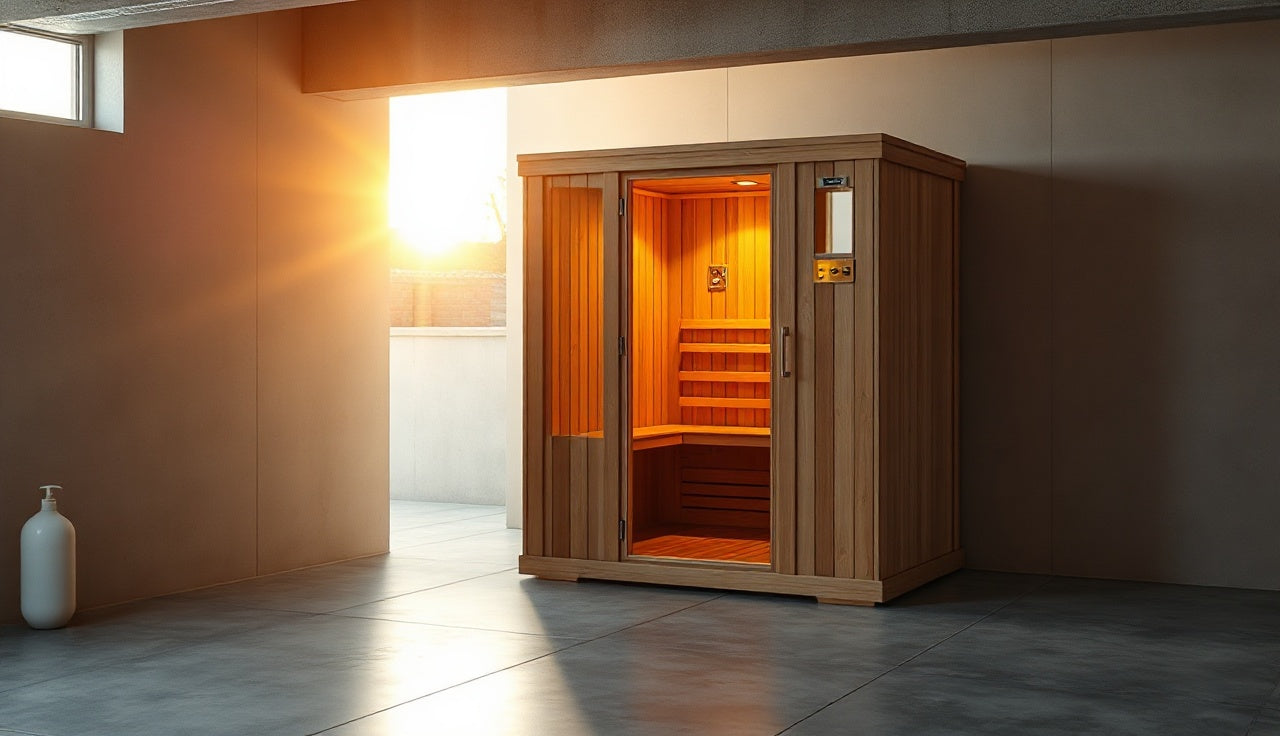
Sunlight Saunas is a Missouri-based company that has been making infrared sauna cabins for home and commercial use since the late 1990s. They build pre-cut, panel-based wooden cabins ranging from single-person units to six-person rooms, all heated by infrared emitters rather than the hot rocks or steam you get in a traditional Finnish sauna.
Infrared heat works differently from convective heat. A conventional sauna heats the air around you to 170 to 200°F, and that hot air then warms your skin. An infrared sauna emits radiant energy in the near, mid, or far-infrared spectrum, which is absorbed directly by skin and superficial tissue without heating the surrounding air as aggressively. Sunlight's cabins typically run 120 to 150°F, which most people find easier to tolerate for longer sessions [1].
Sunlight offers three heater types across their lineup. Far-infrared-only models use carbon flat panels, which produce a broad, even heat output. Their "full-spectrum" line adds near and mid-infrared emitters alongside far-infrared panels, marketing the combination as targeting different tissue depths. The scientific basis for the specific depth claims is debated; we'll get into that below.
Cabin materials are worth paying attention to. Sunlight uses basswood and cedar options, and they market their product as low-EMF and low-ELF (electric field). Third-party EMF testing from labs like Intertek is referenced on their marketing, though you should ask for the actual report, more than the claim, before buying.
How much do Sunlight Saunas cost?
Sunlight Sauna pricing runs from about $1,500 for a basic one-person far-infrared unit to $5,000 or more for a full-spectrum four-person cabin. Street pricing shifts constantly with promotions, so treat any specific number as a starting point rather than a fixed quote.
Here is a general breakdown by tier as of mid-2026:
| Model Type | Occupancy | Approx. Price Range |
|---|---|---|
| Solo far-infrared (carbon panels) | 1 person | $1,500, $2,200 |
| Mid-size far-infrared | 2 person | $2,200, $3,200 |
| Full-spectrum (near + mid + far IR) | 2 person | $2,800, $4,000 |
| Large full-spectrum | 3 to 4 person | $3,800, $5,500 |
Those prices do not include shipping, which can add $200, $500, or any electrical work you need. Most Sunlight units run on standard 120V household current (the smaller ones, at 1,400 to 1,600W) or 240V (larger models). A 240V circuit installation from a licensed electrician runs $300, $800 depending on your panel distance and local labor rates [2].
Compared to a custom outdoor Finnish sauna, which can run $8,000, $20,000 installed, a Sunlight cabinet looks affordable. Compared to a budget barrel sauna or a portable sauna, it is mid-to-upper tier. The price is not unreasonable for what you get, but it is not cheap either, and there are competing infrared brands (Clearlight, Finnleo, Dynamic) in the same range.
What does the research say about infrared sauna health benefits?
Here is the honest version. The evidence for infrared sauna use is genuinely interesting but genuinely early-stage. Nobody should buy one believing they have a prescription-grade therapeutic device.
Cardiovascular function is the best-supported area. A 2018 systematic review published in Evidence-Based Complementary and Alternative Medicine looked at infrared and Finnish sauna research and found associations with reduced blood pressure and improved arterial compliance in short-term studies, though it noted that "most studies had a small sample size and short intervention period" [3]. A Finnish cohort study in JAMA Internal Medicine (Laukkanen et al., 2015) tracked over 2,000 men for 20 years and found frequent sauna use associated with lower cardiovascular mortality, but that was traditional Finnish sauna, not infrared [4].
Pain and stiffness: a small 2009 randomized controlled trial in Clinical Rheumatology (Oosterveld et al.) found far-infrared sauna sessions reduced pain and stiffness in rheumatoid arthritis and ankylosing spondylitis patients, with effects persisting after the study period [5]. Small sample, short follow-up. Interesting, not conclusive.
Muscle recovery: athletes use infrared saunas for post-training soreness, and there is some physiological logic here since heat increases blood flow and may speed clearance of metabolic byproducts. The direct evidence specific to infrared (versus conventional heat) is thin. A 2021 review in the Journal of Human Kinetics noted heat therapy broadly can reduce delayed-onset muscle soreness, but called for more rigorous trials [6].
The "full spectrum" depth-of-penetration claims you see on Sunlight's marketing, near-IR reaching muscle versus far-IR staying shallow, come from tissue optics research, but translating that physics into clinical outcomes has not been rigorously done. Nobody has a clean human trial showing a full-spectrum sauna outperforms far-IR only for any measurable health outcome.
Skin and detoxification claims should be treated skeptically. Sweat does contain trace heavy metals, but the kidneys and liver handle the overwhelming majority of metabolic waste. The sauna-as-detox framing overstates what sweating accomplishes [7].
Here is the takeaway. Regular sauna use, infrared included, looks genuinely good for cardiovascular health and relaxation. The specific advantages of infrared over traditional sauna are not proven. See also the broader sauna benefits literature if you want the full picture.
| Traditional Finnish sauna | 185 |
| Full-spectrum infrared sauna | 145 |
| Far-infrared sauna | 135 |
| Steam room | 110 |
| Hot tub (water temp) | 104 |
Source: NCBI PubMed / Vatansever & Hamblin 2012; Finnish Sauna Society
Infrared sauna vs. traditional sauna: which is actually better?
Traditional saunas (Finnish-style dry heat or steam rooms) operate at 170 to 210°F. Infrared saunas run 120 to 150°F. That temperature gap matters in a few practical ways.
Tolerance: Most people find infrared easier to sit in for 20 to 40 minutes because the air itself is not scalding. If you have respiratory sensitivity or just find extreme heat uncomfortable, infrared is a real advantage. Traditional sauna enthusiasts would say the intense heat is part of the point, and they have the better population-level research behind them.
Sweating profile: You sweat heavily in both. Some infrared proponents claim deeper or more therapeutic sweat at lower air temperatures, but the physiological mechanism is the same in both cases, core temperature rises and the body sweats to cool down.
Installation: A traditional sauna needs a proper heater (wood-fired or electric), heavier ventilation, and often a dedicated drainage floor. An infrared cabinet is essentially a wooden box with heaters plugged into a wall outlet. Easier, cheaper, and more apartment-friendly.
Compare this against a steam room and you add humidity as a variable, which helps with congestion and skin hydration but makes some people feel claustrophobic and raises mold risk indoors.
For pure evidence quality, traditional Finnish sauna has the larger body of research. For practicality in a spare bedroom or garage, infrared wins. If you want a head-to-head breakdown of the formats, the sauna vs. steam room guide covers the broader comparison.
My honest take: if you already have a space for a proper home sauna installation and a reasonable budget, a traditional electric sauna gives you more heat flexibility and a stronger research pedigree. If you want something you can assemble in a bedroom without an electrician, a good infrared cabinet is a reasonable second choice, not a consolation prize.
What makes a good infrared sauna: specs to evaluate before buying
Not all infrared saunas are built the same, and the marketing language can hide what actually matters. Here are the specs worth checking.
Heater type and coverage: Carbon flat-panel heaters produce even, lower-intensity heat across a large surface area. Ceramic rod heaters run hotter and more focused. Most reputable brands, Sunlight included, use carbon panels in their standard models. The key number is heater wattage relative to cabin volume; too little wattage and the unit never gets hot enough. A solo unit should have at least 1,200 to 1,600W of heater capacity.
Wood quality: Basswood is hypoallergenic and low-aromatic, good if you have sensitivities. Cedar smells great and is naturally antimicrobial but can off-gas strongly when hot. Hemlock is a budget option. Avoid any wood treated with formaldehyde-based adhesives; ask the manufacturer for their glue specifications.
EMF levels: This is genuinely worth asking about. The measurement you want is magnetic field strength at body distance, expressed in milligauss (mG). A figure under 3 mG at sitting distance is considered low-EMF by most standards. The WHO notes that typical residential magnetic field exposure is 0.1 to 0.2 mT (equivalent to 1 to 2 mG), and safe limits in the US are set by the EPA and FCC rather than sauna-specific regulation [8]. Get the actual third-party test report, more than the "low-EMF" badge.
Control panel and timer: Basic is fine. You want independent heater controls and a timer with at least a 60-minute range. Phone app connectivity is a nice-to-have, not a must.
Warranty: Sunlight offers lifetime warranties on heaters and wood on their top-tier units, shorter coverage on electronics. Read the fine print; some warranties are parts-only and exclude labor.
Assembly: Most infrared cabin kits take two people 2 to 4 hours. Sunlight's tongue-and-groove panels are generally considered easier than bolt-together competitors. Watch assembly videos on YouTube before committing; some cabins have notoriously fiddly corner connections.
Is a full-spectrum infrared sauna worth the extra money?
Full-spectrum saunas add near-infrared (NIR, roughly 700 to 1400nm) and mid-infrared (MIR, 1400 to 3000nm) emitters on top of the far-infrared (FIR, 3000nm, 1mm) panels. Sunlight's full-spectrum units cost $500, $1,500 more than their equivalent far-IR-only models.
The theory is that NIR penetrates deeper into tissue (some studies in photobiomodulation research suggest a few centimeters) and may support collagen synthesis and wound healing, while FIR is absorbed at the skin surface and drives sweating. The photobiomodulation research on NIR is real and growing, mostly in the context of red-light therapy panels rather than sauna cabins, but the two technologies overlap [9].
Here is the honest problem: nobody has published a clinical trial comparing health outcomes in a full-spectrum sauna versus a far-IR-only sauna, controlling for session time and temperature. The upsell rests on mechanistic reasoning, not a head-to-head result.
If you have budget to spare and you find the red light component appealing on its own (some people notice skin and energy effects from NIR/red light), full-spectrum is a reasonable choice. If you are purely after the cardiovascular and relaxation benefits that the sauna research supports, the extra cost is hard to justify with current evidence. Far-IR alone is what most of the infrared sauna studies actually tested.
How do Sunlight Saunas compare to other infrared sauna brands?
The main competitors in the consumer infrared sauna space are Clearlight (Clearlight Sanctuary), JNH Lifestyles, Dynamic Saunas, and Finnleo. Here is how they stack up against Sunlight.
| Brand | Price Range | Heater Type | Warranty (heater) | EMF Claims |
|---|---|---|---|---|
| Sunlight Saunas | $1,500, $5,500 | Carbon / full-spectrum option | Lifetime (top models) | Low-EMF, 3rd-party tested |
| Clearlight Sanctuary | $3,500, $8,000 | True Wave carbon+ceramic | Lifetime | "Ultra-low" EMF |
| JNH Lifestyles | $800, $2,500 | Carbon panels | 1-year (basic), 5-year (mid) | Low-EMF claim |
| Dynamic Saunas | $700, $2,000 | Carbon panels | 1-year (basic) | Low-EMF claim |
| Finnleo Infrared | $3,000, $6,000 | Infrared panels | Varies | Low-EMF |
Sunlight sits in the middle. Better-built and better-warranted than the budget Amazon-tier brands; not as premium as Clearlight, which has a stronger reputation for customer service. JNH and Dynamic are good for budget shoppers but their warranties are shorter and assembly quality is more variable.
One note: Sunlight was acquired and has changed ownership more than once. Customer service reviews are mixed. Before buying, search current reviews on Reddit (r/Sauna is active) and consumer forums, more than the reviews on the manufacturer's own site.
SweatDecks carries a curated selection of home saunas and infrared options if you want to compare models side by side without sifting through manufacturer marketing.
What are the safety risks of infrared sauna use?
Infrared saunas are safe for most healthy adults, but several situations call for caution or a conversation with a doctor first.
Dehydration is the most common issue. A single sauna session can produce 500ml to over 1 liter of sweat. Drink water before and after, more than during. If you feel dizzy, lightheaded, or nauseated, get out.
Cardiovascular conditions: People with unstable angina, recent heart attack, or uncontrolled hypertension should not use a sauna without medical clearance. The cardiovascular research showing benefits applies to healthy populations; it does not extend to people with active, unstable cardiac disease. The Finnish guidelines (Finnish Sauna Society) recommend that people with serious heart conditions consult their physician [10].
Medications: Anything that impairs heat dissipation (anticholinergics, some antihypertensives, diuretics, alcohol) increases risk. Alcohol and sauna is a genuine danger; multiple sauna-related deaths have involved alcohol use.
Pregnancy: The mainstream medical consensus is to avoid saunas during pregnancy, particularly in the first trimester, due to the risk of fetal hyperthermia. The American College of Obstetricians and Gynecologists advises pregnant women to avoid raising core body temperature above 102.2°F (39°C) [11].
Session length: 15 to 20 minutes per session is a reasonable starting point for most people new to infrared. Experienced users may go 30 to 45 minutes. There is no evidence that longer sessions are proportionally more beneficial, and they increase dehydration risk.
Children: Kids thermoregulate less efficiently than adults. Most sauna manufacturers, including Sunlight, caution against use by young children.
How does an infrared sauna fit into a contrast therapy or cold plunge routine?
Contrast therapy, alternating between heat and cold, is one of the more effective recovery protocols with real physiological backing. Heat causes vasodilation; cold causes vasoconstriction. Cycling between them creates a pumping effect that may speed clearance of inflammation markers and reduce soreness.
An infrared sauna pairs naturally with a cold plunge or ice bath. The typical sequence is sauna first (15 to 20 minutes), then cold immersion (1 to 3 minutes at 50 to 59°F), with one to three rounds. Some practitioners flip the order, cold first then heat, though the evidence on sequence is thin.
A 2021 study in the Journal of Physiology found that cold-water immersion after resistance training blunted some of the hypertrophic (muscle-building) adaptations from training [12]. So if your primary goal is building muscle, save contrast therapy for recovery days rather than immediately after strength sessions.
For people focused on cardiovascular recovery, stress reduction, or managing general soreness from endurance sports, the heat-cold pairing looks genuinely useful. The cold plunge benefits guide covers the cold side of this in detail.
Practically, if you have space for both a sauna cabinet and a cold plunge tub, that combination gets more value out of each piece of equipment than either does alone. A compact infrared solo unit plus a dedicated cold plunge tub can fit in a roughly 8x8 foot space, which is achievable in a basement or large garage.
What space and electrical requirements do you need at home?
Before ordering a Sunlight Sauna or any infrared cabinet, measure your actual space. Most two-person units are roughly 47 to 55 inches wide, 39 to 47 inches deep, and 75 to 78 inches tall. Solo units can be as compact as 36 by 36 inches footprint.
Floor surface matters. Infrared saunas are wood cabinets sitting on your floor; they do not need a drain unless you are rinsing off inside. Tile, concrete, and sealed hardwood all work. Carpet works but gets damp from foot traffic.
Ceiling height: standard units need a flat ceiling of at least 7 feet. Some models with rooftop ventilation panels need an inch or two of clearance above.
Electrical: Solo and two-person models at 1,400 to 2,000W typically run on a standard 15A or 20A 120V household outlet. Larger units (2,400W and up) need a dedicated 240V/20A circuit, the same type your dryer uses. If you do not have one near your planned sauna location, budget for an electrician. The National Electrical Code (NEC) Article 424 governs fixed electric space heating and is what your electrician will reference for the install [2].
Ventilation: Infrared saunas are not steam rooms and do not produce the same moisture load, but you still want some airflow. Most units have a vent near the floor and one near the ceiling. In a basement or interior room with no windows, consider adding a small exhaust fan nearby.
An outdoor sauna setup is also possible with an infrared cabinet if you enclose it in a weatherproof structure, though most infrared cabinets are not rated for direct outdoor exposure due to the electronics.
How do you maintain and clean an infrared sauna?
Maintenance is straightforward but not zero-effort.
Sweat soaks into the wood over time and, if not managed, creates odor and potential mold conditions. Wipe the bench and backrest with a dry or lightly damp cloth after each session. Using a towel on the bench during sessions cuts the soaking a lot. Let the door stay open after use so the cabin dries completely.
Periodic cleaning: a diluted solution of white vinegar (roughly 1 part vinegar to 3 parts water) applied and wiped dry works well for removing residue without leaving chemical off-gassing. Avoid bleach and strong chemical cleaners on bare wood.
The wood will darken and patina over time from heat and sweat contact. That is normal and does not affect performance. Some people lightly sand the bench surface once a year to refresh it.
Heater elements: infrared carbon panels have no moving parts and are generally long-lived (10,000+ hours in quality units). If a panel fails, most manufacturers sell replacements. Check that replacement parts are actually available before you buy; a few budget brands have discontinued models with no parts supply.
Door seals and hinges: inspect annually. A poorly sealing door loses heat and wastes electricity. Replacement magnetic door seals are available from most manufacturers.
One thing people skip and regret: registering the warranty immediately after assembly. Sunlight's warranty requires registration within a certain window. Do it the day you finish building the unit.
Frequently asked questions
Are Sunlight Saunas still a reputable brand?
Sunlight Saunas has been in business since the late 1990s and has decent brand recognition in the infrared space. Their ownership has changed, which has led to inconsistent customer service reviews in recent years. They are not a fly-by-night brand, but before buying, check current Reddit and consumer forum feedback rather than relying only on manufacturer-hosted testimonials.
What temperature does an infrared sauna reach?
Most infrared saunas, including Sunlight models, reach 120 to 150°F (49 to 65°C). This is 40 to 60 degrees lower than a traditional Finnish sauna. The lower air temperature is easier to tolerate for longer sessions. Your skin and superficial tissue still absorb significant radiant heat even though the ambient air feels cooler.
How long should you stay in an infrared sauna per session?
15 to 20 minutes per session is a reasonable starting point if you are new to infrared. Experienced users often go 30 to 45 minutes. There is no strong evidence that sessions longer than 40 minutes add meaningful benefit, and dehydration risk rises with duration. Drink 16 to 24 oz of water before your session and replenish afterward.
Can you use an infrared sauna every day?
Most research on sauna health benefits (particularly the Finnish cohort studies) used frequencies of 4 to 7 sessions per week in healthy adults without adverse effects. Daily use is likely fine for healthy people if you stay well-hydrated and keep sessions reasonable in length. People with heart conditions or on relevant medications should consult a physician first.
Does an infrared sauna actually detox your body?
The 'detox' claim is overstated. Sweating does release small amounts of heavy metals and other compounds, but the liver and kidneys handle the vast majority of metabolic waste processing. There is no credible evidence that sauna sweat meaningfully removes toxins that the body would not otherwise clear. The cardiovascular and relaxation benefits are better supported than any detox claim.
What is the difference between far-infrared and full-spectrum infrared saunas?
Far-infrared (FIR) saunas emit wavelengths in the 3,000nm, 1mm range, absorbed mainly at the skin surface to drive sweating and warmth. Full-spectrum adds near-infrared (NIR, 700 to 1400nm) and mid-infrared emitters. NIR overlaps with red-light therapy wavelengths and theoretically penetrates deeper. No clinical trial has proven full-spectrum produces better health outcomes than FIR alone; the premium rests on mechanistic reasoning.
Is an infrared sauna safe during pregnancy?
The mainstream medical consensus is no. The American College of Obstetricians and Gynecologists advises pregnant women to avoid raising core body temperature above 102.2°F (39°C), which a sauna session can do. Both infrared and traditional saunas carry this risk. Consult your OB before using any sauna during pregnancy, and most providers will advise against it, particularly in the first trimester.
How much electricity does an infrared sauna use, and what does it cost to run?
A typical two-person infrared sauna draws 1,600 to 2,000 watts. A 30-minute session uses roughly 0.8 to 1.0 kWh. At the US average residential rate of about 17 cents per kWh in 2024, that is roughly 14 to 17 cents per session. Running it daily costs about $4, $5 per month, which is meaningfully cheaper than running a traditional electric sauna heater at 6,000 to 9,000 watts.
Do infrared saunas emit dangerous levels of EMF?
Quality infrared saunas from established brands test at under 3 milligauss (mG) at body distance, comparable to sitting near a household appliance. US exposure guidelines from the FCC and EPA do not specifically restrict sauna EMF, but levels at that range are generally considered low-risk. Ask any manufacturer for the actual third-party EMF test report before buying, more than a marketing badge.
What is the best wood for an infrared sauna cabin?
Basswood is a good all-around choice: hypoallergenic, low aromatic, and stable under heat cycling. Cedar smells great and is naturally antimicrobial but has a strong scent some people find overpowering. Hemlock is a budget-friendly option with decent durability. The key thing to avoid is any wood or adhesive containing formaldehyde-based resins, which off-gas more at sauna temperatures.
Can you use an infrared sauna outdoors?
Most infrared cabinet saunas are designed for indoor use only. The electronics and wood joinery are not weatherproofed for rain and temperature swings. You can place an infrared cabinet in a covered outdoor structure (a gazebo, screened porch, or dedicated outbuilding) as long as it stays dry and within the operating temperature range specified by the manufacturer. Traditional barrel or log saunas are better built for outdoor exposure.
How does an infrared sauna compare to a sauna suit for sweating?
A sauna suit traps body heat and moisture against the skin to force sweating during exercise, primarily used for rapid weight cuts in combat sports. An infrared sauna delivers external radiant heat while you sit still. The sweat response is similar in volume, but the physiological mechanisms differ. Sauna suits carry a higher risk of dangerous overheating during exertion and are not a substitute for the cardiovascular effects associated with passive sauna use.
What should I look for in an infrared sauna warranty?
Look for separate coverage periods for heaters, wood structure, and electronics, since failure modes differ. Lifetime heater and wood warranties from established brands (Sunlight's top-tier models, Clearlight) are the best-case scenario. Electronics warranties of 3 to 5 years are reasonable. Confirm whether the warranty covers parts only or also labor, and verify the brand still actively sells replacement parts for the model you are buying.
Sources
- National Center for Biotechnology Information (NCBI), PubMed, Vatansever & Hamblin 2012 – Photonics & Lasers in Medicine, far-infrared radiation overview: Infrared sauna cabins operate at lower ambient air temperatures (120–150°F) than Finnish saunas, heating tissue via radiant absorption rather than convection
- National Fire Protection Association (NFPA), National Electrical Code (NEC) Article 424: Fixed electric space heating installations, including sauna heaters, are governed by NEC Article 424, which electricians reference for dedicated circuit requirements
- NCBI PubMed, Hussain & Cohen 2018, Evidence-Based Complementary and Alternative Medicine – systematic review of sauna/infrared sauna health effects: A 2018 systematic review found associations between infrared sauna use and reduced blood pressure but noted that 'most studies had a small sample size and short intervention period'
- JAMA Internal Medicine, Laukkanen et al. 2015 – Association between sauna bathing and fatal cardiovascular and all-cause mortality events: A 20-year Finnish cohort study of 2,315 men found frequent traditional sauna use associated with significantly lower cardiovascular mortality
- NCBI PubMed, Oosterveld et al. 2009, Clinical Rheumatology – far-infrared sauna in patients with rheumatoid arthritis and ankylosing spondylitis: A 2009 RCT found far-infrared sauna sessions reduced pain and stiffness in RA and ankylosing spondylitis patients with effects persisting post-study
- NCBI PubMed, Petrofsky et al. 2021, Journal of Human Kinetics – heat therapy and delayed-onset muscle soreness review: A 2021 review in Journal of Human Kinetics found heat therapy broadly reduces delayed-onset muscle soreness and called for more rigorous infrared-specific trials
- National Kidney Foundation – how kidneys filter waste: The kidneys and liver handle the overwhelming majority of metabolic waste removal; sweat-based 'detox' claims are not supported by physiological evidence
- World Health Organization (WHO) – Electromagnetic fields, extremely low frequency (ELF) fact sheet: Typical residential magnetic field exposure is 0.1–0.2 microtesla (1–2 mG); WHO notes no established health effects below occupational exposure limits
- NCBI PubMed, Hamblin 2017, Seminars in Cutaneous Medicine and Surgery – photobiomodulation with near-infrared light: Near-infrared wavelengths (700–1400nm) penetrate tissue and are studied in photobiomodulation research for collagen synthesis and wound healing
- Finnish Sauna Society – sauna health and safety guidance: The Finnish Sauna Society recommends people with serious heart conditions consult a physician before sauna use
- American College of Obstetricians and Gynecologists (ACOG) – heat exposure during pregnancy: ACOG advises pregnant women to avoid raising core body temperature above 102.2°F (39°C), which applies to sauna use
- NCBI PubMed, Roberts et al. 2021, Journal of Physiology – cold-water immersion and resistance training adaptations: Cold-water immersion after resistance training can blunt some hypertrophic muscle adaptations, suggesting contrast therapy is better suited to recovery days than post-strength training
- U.S. Energy Information Administration (EIA) – Average retail electricity prices by state, 2024: US average residential electricity rate was approximately 17 cents per kWh in 2024, used to calculate per-session sauna operating cost

Share:
Maxxus infrared sauna review: what you actually get for the money
Sauna benefits for cardiovascular health: what the research actually shows