
Last updated 2026-07-09
TL;DR
Sunhome is a budget sauna brand sold mostly through Amazon and third-party sellers. It offers portable steam tents, single-person infrared cabinets, and infrared blankets. Prices run roughly $50 to $400. Build quality sits at the bottom of the market. Sunhome works for occasional, exploratory use. It is the wrong pick if you want a durable, daily-use home sauna.
What is Sunhome and who actually makes these saunas?
Sunhome is a brand name that appears on portable and small-format saunas sold mostly through Amazon and similar marketplaces. It is not a manufacturer with a long public history, a brick-and-mortar presence, or a documented factory. That is normal in this corner of the market. Most low-cost portable saunas come from contract manufacturers in China and get sold under dozens of brand names, often the same OEM product with a different logo. Sunhome fits that pattern.
The brand shows up on two product types most often: portable steam tents (a folding enclosure paired with a separate steam generator) and, less often, single-person infrared cabinets or foldable infrared blankets. Sunhome products do not consistently carry UL or ETL certification across the line, which matters for electrical safety. Check the individual listing for a certification mark before you buy [1].
So is Sunhome legit? Honest answer: it is a real product you can order and receive, and it sits at the very bottom of the market. That is neither automatically bad nor automatically fine. It depends entirely on what you want the sauna to do.
What types of saunas does Sunhome sell?
Sunhome's catalog splits into three categories.
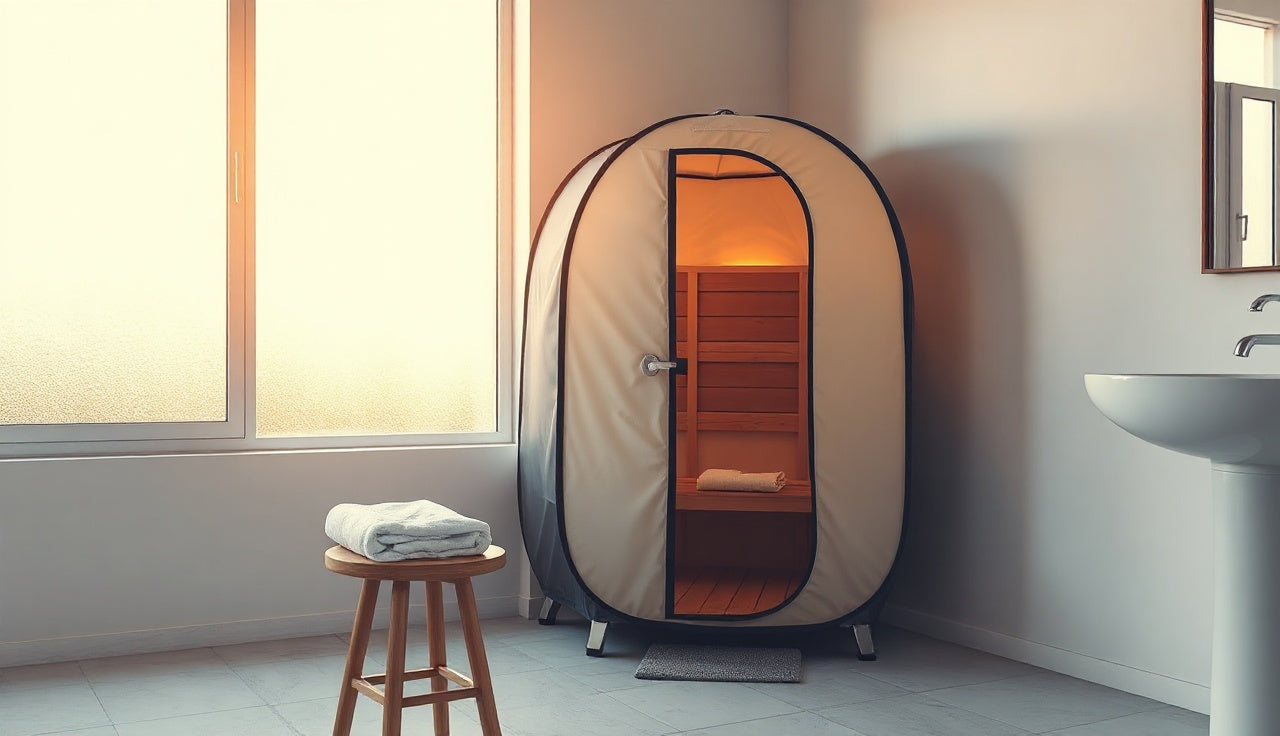
First, portable steam tents. These are fabric or nylon enclosures that fold flat for storage, with a hole for your head and openings for your arms. A separate electric steam generator, usually 800 to 1,000 watts, pumps steam inside. Sessions run 15 to 30 minutes. Temperature inside tops out around 115 to 130 degrees Fahrenheit in practice. That is lower than a traditional Finnish sauna (typically 160 to 195 degrees F) but warm enough to make you sweat [2]. These are the most common Sunhome products, and they cost roughly $50 to $150.
Second, infrared cabinets. A handful of Sunhome listings offer single-person wood-frame infrared cabinets with carbon or ceramic panels. Prices sit between $200 and $400. Assembly is DIY. The cabinets are small, built for one person sitting upright. Carbon far-infrared panels usually run between 120 and 150 degrees F [3].
Third, infrared blankets. These are a step removed from a true sauna. You lie inside a heat-reflective blanket or sleeping-bag pod, and your core temperature rises through conductive and radiant heat instead of a heated room. Cheap and compact, but the experience has nothing in common with sitting in a hot wood cabin.
Across the home sauna market, Sunhome lands at the absolute entry level.
| Product Type | Approx. Price | Max Temp (°F) | Session Use Case |
|---|---|---|---|
| Sunhome steam tent | $50 to $150 | 115 to 130 | Occasional, exploratory |
| Sunhome infrared cabinet | $200 to $400 | 120 to 150 | Light daily use (if durable) |
| Sunhome infrared blanket | $60 to $120 | 100 to 130 | Travel, small-space |
| Mid-range infrared cabinet (other brands) | $800 to $2,000 | 130 to 155 | Regular home use |
| Traditional barrel/outdoor sauna | $2,500 to $8,000+ | 160 to 195 | Full sauna experience |
How do Sunhome sauna prices compare to the rest of the market?
Sunhome sits in the bottom 10 percent of the home sauna price range. The full residential market runs from about $50 for a basic steam tent to $80,000 or more for a custom outdoor build.
The $50 to $400 window Sunhome operates in is crowded. Competitors in the same tier include SereneLife, Durherm, Radiant Saunas, and a dozen white-label brands with interchangeable specs. At this level, brand differences are marginal. You are buying an entry experience, not a long-term appliance.
Step up to the $800 to $2,000 range and quality changes in ways you can feel. Brands like Maxxus, Dynamic, and Clearlight use better wood (hemlock, cedar), thicker heating panels, and actual customer service. Above $3,000 you are into outdoor barrel saunas and prefab kits from Almost Heaven, Finnleo, or Dundalk LeisureCraft, built for ten-plus years of use [4].
Here is the reset: spend $150 on a Sunhome steam tent and it will not survive three years of weekly use. The fabric, seams, and steam unit on budget portable saunas typically last one to two seasons with moderate use. That is not a knock aimed at Sunhome specifically. It is the reality of the price point.
For more on the broader cost landscape, the sauna guide covers what drives price across every sauna type.
| Sunhome steam tent | $100 |
| Sunhome IR cabinet | $300 |
| Mid-range IR cabinet | $1,200 |
| Premium IR cabin (Clearlight) | $4,000 |
| Outdoor barrel sauna | $5,000 |
Source: Dundalk LeisureCraft, Sunlighten, Amazon marketplace listings, SweatDecks market research 2024
Are Sunhome saunas actually safe to use at home?
Safety comes down to two things: electrical certification and thermal risk. Both deserve a real look.
On electrical certification, the US standard is UL (Underwriters Laboratories) listing or ETL certification (by Intertek). Both confirm the product was tested to safety standards like ANSI/UL 875 for electric dry bath heaters, or comparable standards for steam generators [1]. Sunhome products do not consistently carry UL or ETL marks across their listings. Some listings mention CE, which is a European self-declaration of conformity, not third-party US safety testing. The ETL mark, by contrast, is accepted by authorities having jurisdiction across the US and Canada as evidence of compliance [10].
If you cannot confirm a US safety listing on the exact unit you are buying, take that seriously. Plug the steam generator into a GFCI outlet and never leave it running unattended. GFCI protection is required by the National Electrical Code in bathrooms, garages, and other damp locations anyway, under NEC Section 210.8 [5].
On thermal risk, the 115 to 130 degrees F a Sunhome portable reaches sits below the range where healthy adults face serious heat illness during a normal 15 to 30 minute session. Still, people with cardiovascular conditions, pregnant women, and anyone on medications that affect heat regulation should get medical clearance before any sauna use. The American Heart Association advises that warm and hot baths raise cardiac output and heart rate in ways that call for caution in patients with certain heart conditions [6].
Children should not use any sauna unsupervised. Nobody should use one drunk or heavily sedated.
Do Sunhome saunas actually work for health and recovery?
Whether a Sunhome sauna "works" splits into two questions: does it produce the physiological effects of sauna use, and do those effects matter for health?
On the first, yes. Even a $100 steam tent raises core body temperature, increases heart rate, and makes you sweat. Those are the baseline mechanisms. A 2018 review in Mayo Clinic Proceedings by Laukkanen and colleagues examined the cardiovascular effects of sauna bathing and reported that "frequent sauna bathing is associated with reduced risk of fatal cardiovascular events" in observational data, while noting the observational nature of most studies and the need for randomized trials [7]. That research covered traditional Finnish saunas at 80 to 100 degrees C (176 to 212 degrees F), hotter than any Sunhome product reaches.
Here is the honest hedge. Nobody has good data on whether 115 to 130 degrees F in a portable steam tent produces the same cardiovascular adaptations as a traditional sauna. The mechanisms overlap. Intensity matters. A steam tent is warmer than your living room and will make you sweat, but it probably does not replicate the thermal load of a 185 degrees F Finnish session.
For muscle recovery, heat increases blood flow and may reduce delayed-onset soreness. A 2015 study in the Journal of Science and Medicine in Sport by Mero and colleagues found far-infrared sauna use after exercise reduced neuromuscular fatigue [8]. The infrared cabinet versions of Sunhome are closer to that study's conditions than the steam tents.
Bottom line: you get some sauna benefit from a Sunhome unit. You get more from a hotter, better-built one. For the full picture of what the research supports, the sauna benefits breakdown is worth reading.
How does a Sunhome portable steam sauna compare to a traditional sauna?
A traditional Finnish sauna runs at 160 to 195 degrees F with low to moderate humidity, and you raise the steam by ladling water over hot rocks. The experience is a full environment: wood smell, hard dry heat, the crack of steam off the stones, and usually a social or ritual element.
A Sunhome portable steam tent gives you a warm, humid enclosure with your head sticking out the top. Not the same thing. The temperature ceiling is much lower, the wood aesthetic is gone, and you are sitting on a folding stool inside a nylon bag. That is not a criticism of the category. It is an accurate description.
Portable steam saunas do carry real advantages. They store flat, cost almost nothing next to built units, need no installation, and do not require a dedicated room. Live in an apartment and want to test sauna-style heat therapy before committing thousands? A steam tent is a rational starting point. Already know you want sauna in your life and can fit a permanent structure? Skip the portable tier and go straight to an infrared cabinet or barrel sauna.
The portable sauna guide goes deeper on the category if you are still deciding. And if you are weighing heat against steam more broadly, the sauna vs steam room comparison is a good read.
What do real customers say about Sunhome saunas?
Amazon reviews are the main source of feedback for Sunhome products, which matters because that platform skews toward early-use impressions and has documented problems with fake and incentivized reviews. With that caveat, a few themes repeat.
Positive feedback: people like the price, the compact storage, and the easy setup. Steam tents draw comments about effective sweating and relaxation even at lower temperatures. For casual or first-time users, satisfaction runs reasonable in the first few months.
Negative feedback: the steam generator is the most common failure point on tent models. Seals, valves, and the heating element tend to fail within six to eighteen months of regular use. Fabric stitching separates at the seams on some units. Customer service is described over and over as hard to reach or unresponsive, which matters when you need a replacement part.
Infrared cabinet models have fewer reviews, and those skew more mixed on assembly quality. Warped wood panels, misaligned pre-drilled holes, and weak heat output are the recurring complaints.
None of this is unusual for the price tier. It is what you get at $100 to $300 in the home sauna category from any brand.
How does Sunhome compare to other budget sauna brands?
At this price point, most brands are effectively interchangeable. The same OEM factories in China supply dozens of brand names with near-identical products. Here is how the main competitors stack up.
| Brand | Main Products | Price Range | Certification Notes |
|---|---|---|---|
| Sunhome | Steam tents, IR cabinets | $50 to $400 | CE; UL/ETL not consistently listed |
| SereneLife | Steam tents, portable IR | $80 to $250 | Some ETL-listed models |
| Durherm | Steam tents | $60 to $150 | CE; limited US testing info |
| Radiant Saunas | IR cabinets | $300 to $700 | Some ETL listed; better wood |
| Dynamic Saunas | IR cabinets | $600 to $1,800 | ETL listed; hemlock construction |
| Clearlight | IR cabinets, full-room | $2,000 to $6,000 | Full UL; low-EMF certified |
If budget safety testing matters to you, SereneLife carries more ETL-listed models under $250 than Sunhome does. Stretch to $600 or $700 and Radiant Saunas or a Dynamic entry model is a real quality step up without a huge jump in cost. The costco sauna piece is worth a look if warehouse club deals are relevant to you.
SweatDecks carries a curated selection of infrared cabinets and outdoor units from brands with verified safety listings and real return policies, which is worth comparing before you commit to a budget-tier buy.
Is a Sunhome infrared sauna cabin worth buying for daily use?
Probably not, if daily use is the actual goal.
Daily sauna use puts cumulative wear on the heaters, wood panels, and electrical parts. Research on Finnish populations who use sauna four to seven times a week shows the strongest health associations [7], and that frequency stresses any sauna. Budget infrared cabinets at $200 to $400 are not built for that load.
The wood in low-cost IR cabinets is often poplar or basswood rather than the hemlock or cedar that holds up in a heat-humid environment. Hemlock resists warping. Poplar does not. Carbon panels in budget units also lose output efficiency faster than name-brand panels from Clearlight or Sunlighten.
Use a Sunhome IR cabinet three to four times a week and you might get one to two years of service. At that frequency, the cost per session on a $300 unit versus a $1,200 unit lands close over a four-year window: roughly $0.50 to $1.50 per session either way, once you factor in electricity. Infrared cabinets draw about 1,200 to 1,700 watts, or roughly $0.15 to $0.25 per hour at the US average electricity rate of about $0.17 per kilowatt-hour [9].
The real difference is experience and longevity. If you are serious about daily sauna use, the home sauna guide shows where the real quality thresholds sit.
What should you look for if you are buying a budget sauna?
If a Sunhome or similar entry-level sauna is on your shortlist, here is what separates a tolerable purchase from a regrettable one.
First, look for ETL or UL listing on the specific model, not the brand. Electrical safety certification is not negotiable when you are running a unit in your home for an hour at a stretch.
Second, check the wattage of the steam generator or IR panels. Below 800 watts, a steam tent struggles to reach a meaningful temperature in a cool room. Infrared cabinets need at least 1,000 to 1,400 watts to heat properly in a room below 70 degrees F.
Third, read the return and warranty policy before you buy. Budget sauna brands run 30-day return windows and one-year limited warranties that exclude the exact parts most likely to fail (heating elements, steam generators). Amazon's A-to-Z guarantee gives you some cover, but it is not a real manufacturer warranty.
Fourth, plan for the day it breaks. If a SereneLife or Sunhome steam generator dies at month 14, a replacement part is often impossible to source. You will likely toss the unit and start over. Fine if you budgeted for it. Frustrating if you expected a long-term appliance.
For contrast therapy, pairing any sauna with a cold plunge or ice bath is where the recovery research gets more interesting. A budget steam tent plus a chest freezer ice bath is a cheap way to try the full hot-cold loop before investing in premium gear. The cold plunge and cold plunge benefits guides cover the cold side.
Where can you buy a Sunhome sauna and what are the alternatives?
Sunhome products sell mostly on Amazon. Some listings also appear on Walmart's marketplace. There is no company-direct storefront with real customer service that I can confirm exists reliably.
Buy from Amazon and you are covered by Amazon's marketplace policies, which is genuinely useful. The catch: you have no manufacturer relationship, and warranty claims route back through the listing.
For alternatives at similar prices, search Amazon for "portable steam sauna" or "infrared sauna cabinet" and filter for ETL or UL certification in the product description. SereneLife and Durherm cover the same ground with comparable products. Radiant Saunas, sold through Walmart and Costco alongside Amazon, offers slightly better wood quality at $300 to $700.
Ready to step above the budget tier? Retailers like SweatDecks specialize in the mid-to-premium sauna and cold plunge market and carry products with verified safety listings, real warranties, and actual customer support. That step up earns its cost once you know sauna is going to be a habit rather than an experiment.
For an outdoor installation, the outdoor sauna guide covers barrel saunas and prefab kits built to last.
Frequently asked questions
Is Sunhome a legit sauna brand?
Sunhome is a real brand that ships actual products you can receive and use. It is not a scam in the sense of failing to deliver. It is a budget marketplace brand without a strong public track record for durability or customer service. Products are entry-level, likely from Chinese OEM manufacturers, and not consistently certified by US safety bodies like UL or ETL. Treat it accordingly.
How long do Sunhome saunas last?
Realistically, one to two years of moderate use for steam tent models before the generator or seams fail. Infrared cabinets may last longer with gentle use, but budget wood and heating panels degrade faster than mid-range options. Use a Sunhome sauna daily and expect a shorter lifespan. These are exploratory appliances, not long-term fixtures.
What temperature does a Sunhome steam sauna reach?
In practice, Sunhome portable steam tents reach about 115 to 130 degrees Fahrenheit inside the enclosure. That is well below the 160 to 195 degrees F of a traditional Finnish sauna. You will sweat and the heat is real, but the thermal intensity runs lower than a traditional session. The infrared cabinet models reach roughly 120 to 150 degrees F.
Are Sunhome saunas UL or ETL certified?
Not consistently. Some Sunhome listings mention CE certification, a European self-declaration that is not the same as third-party US testing by Underwriters Laboratories (UL) or Intertek (ETL). Check the specific listing for the model you are buying. If you cannot confirm a US listing, plug the unit into a GFCI outlet and never leave it running unattended.
Can you use a Sunhome sauna every day?
You can, but the unit probably will not hold up. Daily use drives cumulative wear on steam generators, heating elements, and wood parts that budget products are not built to handle. If daily sauna use is your goal, a more durable infrared cabinet in the $800 to $1,500 range is a better investment over a two to four year window.
How much electricity does a Sunhome infrared sauna use?
Sunhome infrared cabinet models typically draw 1,000 to 1,400 watts. At the US average electricity rate of about $0.17 per kilowatt-hour, a one-hour session costs roughly $0.17 to $0.24. That is cheap to run. Steam tent generators usually draw 800 to 1,000 watts for a similar per-session cost.
Is a Sunhome steam sauna good for weight loss?
Any heat-induced sweating causes temporary water weight loss, which comes back when you rehydrate. Permanent fat loss from sauna use alone is not supported by strong evidence. Heat raises heart rate and metabolic rate modestly during a session, but not enough to drive real body composition changes on its own. Sauna is a recovery and wellness tool, not a weight loss method.
How do you set up a Sunhome portable steam sauna?
Setup for tent models takes five to ten minutes. Unfold the frame, connect the steam hose from the generator to the tent inlet, fill the generator with water (usually one to two liters), and plug it in. The unit heats to usable temperature in about five to ten minutes. Store it flat after use. No permanent installation required.
What is the difference between a Sunhome infrared sauna and a steam sauna?
The steam tent uses a separate electric boiler to make moist heat inside a fabric enclosure. The infrared cabinet uses carbon or ceramic panels that emit far-infrared radiation to warm your body directly rather than heating the air first. Infrared is drier and penetrates tissue slightly differently. Neither is dramatically superior. They are different heat delivery mechanisms with overlapping benefits.
Can you use a Sunhome sauna if you have high blood pressure or heart disease?
Get medical clearance from your physician first, regardless of brand or type. Heat raises heart rate and dilates blood vessels, which changes cardiovascular load. The American Heart Association advises caution for patients with certain heart conditions. A Sunhome sauna is not categorically off-limits for people with managed cardiovascular conditions, but this is a conversation for your doctor, not a product review.
What is better, a Sunhome sauna or a sauna blanket?
A sauna blanket heats you through conductive contact while you lie down, while a steam tent heats the surrounding air. Both raise core temperature and induce sweating. The tent gives you an upright posture and slightly more ambient heat. The blanket is even more compact. For most people the steam tent gives a slightly fuller experience, but neither replaces a real sauna cabinet or barrel sauna.
Are there better affordable saunas than Sunhome?
Yes. SereneLife has ETL-listed steam tent models at comparable prices, a meaningful safety edge. In the $300 to $700 range, Radiant Saunas offers better wood quality in its infrared cabinets. At $600 to $800, Dynamic Saunas provides ETL-certified hemlock cabinets that are a real step up in durability. If you can stretch the budget at all, those options earn the difference.
Can you use a Sunhome sauna outdoors?
Portable steam tents are made for indoor use. The fabric is not weather-rated, and running a steam generator in rain or cold outdoor conditions creates both a performance problem and an electrical hazard. Infrared cabinets are strictly indoor products too. For outdoor sauna use, look at purpose-built barrel saunas or prefab outdoor kits made with weather-resistant wood and proper weatherproofing.
Sources
- Underwriters Laboratories, UL Product iQ (safety certification lookup): UL and ETL listing indicate third-party safety testing to ANSI standards; products without listing have not been independently verified
- Finnish Sauna Society, sauna temperature and humidity guidelines: Traditional Finnish sauna operates at 80 to 100°C (176 to 212°F); portable steam saunas reach significantly lower temperatures
- Sunlighten, far-infrared technology overview: Far-infrared sauna cabinets typically operate between 120 and 150°F; carbon panels emit wavelengths in the 6 to 14 micron range
- Dundalk LeisureCraft, product specifications and materials guide: Premium outdoor sauna kits use Canadian red cedar and are designed for 10-plus years of outdoor use
- National Institute of Standards and Technology (NIST), National Electrical Code overview; NFPA 70 Section 210.8: NEC Section 210.8 requires GFCI protection for outlets in bathrooms, garages, and other wet/damp locations
- American Heart Association, guidance on heat exposure and cardiovascular health: Warm and hot baths increase cardiac output and heart rate; patients with certain cardiovascular conditions should exercise caution
- Mayo Clinic Proceedings, Laukkanen et al. 2018, 'Cardiovascular and Other Health Benefits of Sauna Bathing': Frequent sauna bathing is associated with reduced risk of fatal cardiovascular events; research based on traditional Finnish sauna at 80 to 100°C
- National Library of Medicine (PubMed), Mero et al. 2015, 'Effects of far-infrared sauna bathing on recovery from strength and endurance training': Far-infrared sauna use after exercise reduced neuromuscular fatigue in the study population
- U.S. Energy Information Administration, Electric Power Monthly, average retail electricity prices: Average US residential electricity price is approximately $0.17 per kilowatt-hour as of recent reporting periods
- Intertek ETL, product safety certification for North America: ETL mark (by Intertek) is accepted by authorities having jurisdiction in the US and Canada as evidence of product safety compliance

Share:
Peak Saunas Fuji 2-person full spectrum infrared sauna: honest review
Infrared sauna detoxification: what the science actually says