
Last updated 2026-07-09
TL;DR
The Peak Saunas Fuji is a 2-person full spectrum infrared cabinet that combines near, mid, and far infrared heaters rated at roughly 1,400 watts total. It runs on a standard 120V outlet, assembles in under two hours, and lists between $2,500 and $3,200. It's a solid mid-range pick for home users who want real heat variety without wiring a dedicated 240V circuit.
What exactly is the Peak Saunas Fuji and who makes it?
Peak Saunas is a direct-to-consumer infrared sauna brand that sells mostly online through specialty wellness retailers. The Fuji is their 2-person full spectrum model. Full spectrum means the heater array combines near infrared (NIR), mid infrared (MIR), and far infrared (FIR) wavelengths instead of relying on far infrared alone like most entry-level cabinets.
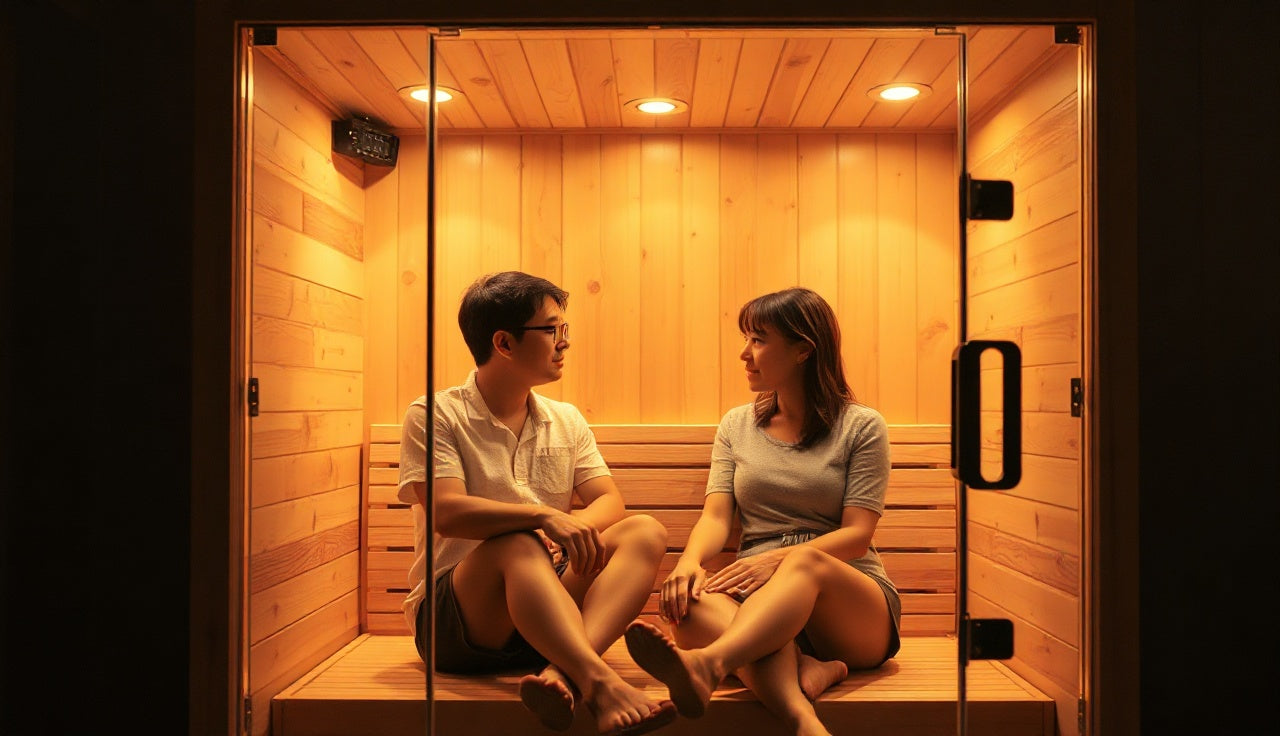
The cabinet is Canadian Hemlock, a lighter-colored softwood that stays cool to the touch on the exterior, handles humidity better than pine, and shows up all over the $2,000-$4,000 infrared segment. Interior dimensions are approximately 47 inches wide by 35 inches deep by 75 inches tall. That fits two adults seated comfortably. Not sprawled out.
Peak Saunas is not a decades-old Finnish brand. They're a North American operation, and if you're researching them you'll find their reputation mostly through online reviews rather than a long retail history. That's neither a red flag nor a badge of honor at this price. What matters is build quality, heater type, EMF levels, and warranty, all of which I break down below.
The Fuji sits in their mid-range lineup, above their 1-person Aspen and below their 3-person Cedar or equivalent models. If you're comparing home sauna options broadly, understand that this is an infrared cabinet, not a traditional Finnish-style steam box. The experience is fundamentally different.
What does full spectrum infrared actually mean for this sauna?
"Full spectrum" means the heater system covers all three infrared bands: near (0.76 to 1.4 microns), mid (1.4 to 3 microns), and far (3 to 1,000 microns). Most budget infrared saunas use carbon or ceramic far infrared panels only. The Fuji adds NIR emitters, usually halogen or LED-based, and pairs them with carbon far infrared panels.
Why does this matter? Different wavelengths reach different tissue depths. Far infrared is absorbed mostly in the top few millimeters of skin and drives the sweating response. Near infrared penetrates deeper into muscle tissue and has the most active research base for photobiomodulation effects on cell mitochondria [1]. Mid infrared sits between the two. The full spectrum claim means you get all of those at once rather than just radiant heat from far IR.
Honesty check: the photobiomodulation research is real, but most of it used targeted NIR devices at specific wavelengths, not ambient sauna emitters. A 2017 review in Photomedicine and Laser Surgery noted benefits of NIR at 810 to 980 nm wavelengths, but the Fuji's NIR output is less controlled than a clinical device [1]. You're getting some exposure to those wavelengths, not a clinical-grade dose.
Here's what you'll actually feel. The Fuji heats up faster than a single-band far infrared sauna (10 to 15 minutes versus 20 to 30 minutes for some budget models), and the heat feels more enveloping because heaters sit on the floor, back wall, side walls, and a dedicated front panel with the NIR emitters. If you've only used a cheap carbon-panel sauna, the Fuji feels noticeably more intense at the same temperature setting.
For context on the broader category, the sauna benefits research is strongest around far infrared and traditional heat exposure, so adding NIR is a bonus, not the headline.
What are the exact specs and electrical requirements?
Here are the key numbers for the Fuji 2-person:
| Spec | Detail |
|---|---|
| Interior dimensions | ~47" W x 35" D x 75" H |
| Exterior dimensions | ~49" W x 37" D x 77" H |
| Wood | Canadian Hemlock |
| Heater type | Full spectrum (NIR + MIR carbon + FIR carbon) |
| Total wattage | ~1,400 W |
| Voltage | 120V, standard household outlet |
| Amperage | ~12A |
| Max temp | ~140°F (60°C) |
| Heat-up time | 10-15 minutes |
| Chromotherapy | Yes, LED color therapy built in |
| Bluetooth/audio | Yes, built-in speaker system |
| Warranty (typical) | 1-5 years depending on component |
| Weight | ~225-250 lbs |
The 120V requirement is genuinely useful. Many competitors in the $3,000+ range need a 240V dedicated circuit, which adds $200 to $800 in electrician fees depending on where your panel is [2]. The Fuji plugs into any standard 15-amp circuit. It draws about 12 amps, so put it on a dedicated circuit or at least one with no other large appliances sharing it.
Check your local electrical code before assuming you can plug it into any outlet. The National Electrical Code (NEC) Article 210.23 governs branch circuit ratings and load calculations, and some jurisdictions require a dedicated circuit for appliances drawing over 80% of a circuit's rated capacity [3]. Twelve amps on a 15-amp circuit is exactly 80%, so a dedicated circuit is the right call.
Max temp of 140°F is lower than a traditional Finnish sauna, which runs 160 to 200°F, but that's expected. Infrared saunas heat your body directly rather than heating the air first, so 130°F in an infrared cabinet can feel as intense as 175°F in a rock sauna to many users. Not always, and the comparison is imperfect, but don't judge infrared units on air temperature alone.
| Basic carbon FIR, 2-person (under $1,500) | $1,250 |
| Mid carbon FIR, 2-person ($1,500-$2,500) | $2,000 |
| Full spectrum 2-person, incl. Fuji ($2,500-$4,000) | $3,200 |
| Premium full spectrum 2-person ($4,000-$7,000) | $5,500 |
| Luxury/custom 2-person ($7,000+) | $8,000 |
Source: Retailer pricing survey, SweatDecks research, 2025
How does EMF exposure compare to other infrared saunas?
EMF (electromagnetic field) exposure is a real consideration in infrared saunas, and it's the spec most budget brands hand-wave. The relevant measurement is ELF-EMF (extremely low frequency, 3 Hz to 3,000 Hz), produced by the carbon heater panels and their wiring.
Peak Saunas advertises the Fuji as low EMF, usually citing readings below 3 milligauss (mG) at seated distance. For comparison, the International Commission on Non-Ionizing Radiation Protection (ICNIRP) sets a general public reference level of 2,000 mG for ELF magnetic fields at 50/60 Hz [4]. At under 3 mG, the Fuji sits well inside that threshold, comparable to sitting near a laptop or a standard household appliance.
Still, take manufacturer EMF claims with measured skepticism. Testing data from sauna brands is self-reported unless a third-party lab certificate is attached. If EMF is a hard concern for you, ask the retailer for the actual test report, not the marketing claim. Companies with genuinely low readings tend to be happy to hand over the paperwork.
EMF from the NIR emitters (typically tungsten halogen) is a different story. Those operate at much higher frequencies (optical/infrared radiation range), not ELF-EMF. The safety issue there is direct eye exposure to bright NIR emitters, which can damage retinal tissue. The Fuji's NIR panels are positioned to avoid direct line-of-sight in normal seated use, but don't stare directly into them.
How hard is it to assemble the Fuji and where can it fit?
The Fuji ships in multiple flat-pack boxes, usually three to five cartons depending on the shipping configuration. Assembly is tongue-and-groove panel construction, so no tools are required for the main cabinet walls, though a rubber mallet helps seat the panels cleanly. Most users report two people can assemble it in 60 to 90 minutes. One person can do it, but the roof panel is awkward.
You'll need a floor space of roughly 50 by 38 inches plus about 6 inches of clearance on each side and the back for ventilation. That's about 4.5 by 3.5 feet of actual floor. Most bedrooms, spare rooms, and finished basements handle this easily. The unit is 77 inches tall, so 8-foot ceilings are fine and 7-foot ceilings are fine. The 6.5-foot ceilings in some older basements will not work.
Floor requirements: the Fuji should sit on a level, non-flammable surface. Concrete, tile, and hardwood are all fine. Carpet is workable but not ideal because the slight moisture and heat at the base can degrade carpet fibers over time. A rubber mat underneath is a simple fix.
Outdoor installation is technically possible if you have a covered patio or deck. The unit is not weatherproof and cannot be exposed to rain. If you're considering outdoor options more broadly, the outdoor sauna category involves different construction requirements entirely.
One thing that catches buyers off-guard: delivery. At 225 to 250 lbs across multiple boxes, you need to be home for delivery and ideally have help moving the cartons from curbside to the installation room. Some freight deliveries are curbside only unless you pay for white-glove service. Confirm this with the retailer before ordering.
What does the Fuji cost and is it worth the price?
The Peak Saunas Fuji 2-person lists between $2,500 and $3,200 at most authorized retailers as of mid-2025, with occasional promotional pricing near $2,200 during major sale events. Prices shift; the range reflects normal retail variation, not a pricing guarantee.
For context on where this sits in the market:
| Price Tier | Typical Products | What You Get |
|---|---|---|
| Under $1,500 | Single-person carbon FIR | Basic panels, limited warranty, smaller space |
| $1,500-$2,500 | 1-2 person carbon FIR | Better wood, longer warranty, audio |
| $2,500-$4,000 | Full spectrum 2-person (Fuji range) | NIR added, better heater layout, low EMF |
| $4,000-$7,000 | Premium 2-4 person | Medical-grade components, thicker walls, longer warranties |
| $7,000+ | Luxury/custom | Clearlight, Sunlighten top tiers, barrel saunas |
The Fuji is genuinely competitive in its tier. A full spectrum heater array in this price range is unusual; most competitors at $2,500 are still carbon-only far infrared. You're paying a real premium for the NIR component, and whether that's worth it depends on how much you weight the photobiomodulation research versus just wanting heat and sweat.
What the Fuji is not: a Clearlight or Sunlighten. Those brands have longer operating histories, more independent testing data, and warranty programs that hold up better over years. If budget allows $4,500 to $5,000 and longevity matters more than anything else, they have the track record. At $2,700, the Fuji is a reasonable bet for most home users.
If you're cross-shopping against Costco sauna options, the Costco infrared units in this price range are usually single-band far IR with less heater coverage and shorter warranties. The Fuji's full spectrum layout is a real differentiator.
What does the research say about infrared sauna health effects?
The most rigorous human data on infrared sauna use comes from cardiovascular and relaxation research. A 2018 systematic review published in Evidence-Based Complementary and Alternative Medicine found that regular infrared sauna use was associated with reductions in blood pressure and improvements in heart failure symptoms, though the authors noted most studies had small sample sizes and short durations [5]. That's an honest summary of the field: promising signals, not definitive proof.
A frequently cited Finnish cohort study published in JAMA Internal Medicine (2015) followed 2,315 middle-aged men for 20 years and found that those who used a sauna 4 to 7 times per week had a 40% lower risk of cardiovascular mortality than those who used it once per week [6]. The catch: that study was traditional Finnish sauna, not infrared. The mechanisms likely overlap (heat stress, improved vascular function, parasympathetic activation) but they aren't identical.
As the 2015 JAMA Internal Medicine study stated directly: "Higher frequency of sauna bathing is associated with a reduced risk of sudden cardiac death, fatal coronary heart disease, fatal cardiovascular disease, and all-cause mortality" [6]. That's the strongest epidemiological signal in the space.
For muscle recovery, a small but real body of work suggests heat exposure after resistance exercise may reduce delayed onset muscle soreness. A 2015 study in the Journal of Athletic Training found post-exercise far infrared sauna use reduced DOMS markers compared to control [7]. The effect sizes were modest.
Nobody has good long-term comparison data on full spectrum versus far-IR-only saunas for health outcomes. The closest evidence is the photobiomodulation literature on NIR wavelengths, which is strongest for wound healing and pain modulation in clinical device settings, not ambient sauna exposure [1]. Keep that gap in mind before buying the Fuji specifically for its NIR benefits.
Health claims stay conservative here on purpose. The sauna benefits evidence is real and growing, but it's not strong enough to call any sauna a medical device.
How does the Fuji compare to other 2-person full spectrum infrared saunas?
The main competitors in the $2,500 to $3,500 full spectrum 2-person bracket are Dynamic Saunas (their Barcelona or Lugano models), SereneLife, and the lower tiers from JNH Lifestyles. Here's how they stack up on the specs that actually matter:
| Model | Price | Heater Type | NIR | EMF Claim | Warranty |
|---|---|---|---|---|---|
| Peak Saunas Fuji | $2,500-$3,200 | Full spectrum | Yes | <3 mG | 1-5 yr by component |
| Dynamic Saunas Barcelona | $1,800-$2,400 | Carbon FIR | No | Low EMF | 1-5 yr |
| JNH Lifestyles Ensi | $2,000-$2,800 | Carbon FIR | No | <3 mG | Lifetime on wood, 1-5 yr parts |
| Sunlighten mPulse (2-per) | $5,000-$7,000 | Full spectrum | Yes | <0.5 mG | 5 yr parts, lifetime wood |
The Fuji's main advantage over Dynamic and JNH at similar prices is the NIR panel. Its main disadvantage versus Sunlighten is warranty depth and tested EMF data. JNH's lifetime wood warranty beats Peak Saunas' wood coverage if longevity is your priority.
If your budget is firm at $2,500 to $3,000 and you want full spectrum, the Fuji is one of the few realistic options at that price. If you can stretch to $3,500 to $4,000, look at Clearlight's entry-tier models, which have more independently verified EMF testing.
For buyers pairing any sauna with contrast therapy, a cold plunge rounds out the protocol. The research on heat-cold alternation for cardiovascular and recovery outcomes is reasonably solid, and the Fuji's 10 to 15 minute heat-up time makes on-demand sauna sessions practical.
What are the common complaints and real ownership issues?
Reading through verified buyer reviews across multiple retailers surfaces a few consistent themes.
The most common complaint is customer service response time during warranty claims. Wood cracking (checking) during the first season is normal for hemlock in dry climates, but when it's structural rather than cosmetic, getting a replacement panel can take weeks. Peak Saunas is a smaller operation, and their support bandwidth shows it.
Second: the Bluetooth speaker system is basic. It works, but the audio quality is what you'd expect from a $30 portable speaker. Not a deal-breaker for most, but worth knowing if sound matters to you.
A few buyers report the digital control panel feeling less intuitive than competing units. Programming a delayed start (heat the sauna before you wake up, for example) means reading the manual, more than punching buttons.
On the plus side, structural complaints about heaters failing are rare in the first two years. The hemlock construction is consistent. The chromotherapy lighting works and stops feeling like a gimmick once you've used it a few sessions.
One thing to flag for anyone considering a sauna in a shared living space: the Fuji's 120V plug is convenient, but at 12 amps running for 30 to 45 minutes, it does add to your electric bill. A daily 45-minute session at $0.163 per kWh (the U.S. residential average in 2024 according to the U.S. Energy Information Administration) costs roughly $0.17 per session, or about $5 per month at daily use [8]. That's not a concern, but it's a real number.
Is the Fuji a good fit for contrast therapy protocols?
Contrast therapy, alternating between heat and cold, has a real evidence base for muscle recovery and cardiovascular adaptation. The Fuji works well as the heat component. Its 10 to 15 minute heat-up time means you can run a session, move to cold, and come back without the sauna cooling much if you keep the door closed.
The standard contrast protocol used in most studies runs 10 to 20 minutes of heat followed by 1 to 5 minutes of cold immersion, repeated 2 to 4 cycles [9]. The Fuji's max temp of 140°F is enough to drive the core temperature response that makes contrast therapy work. You don't need 190°F Finnish-style heat for the protocol to do its job.
For the cold side, an ice bath or purpose-built cold plunge at 50 to 59°F is the typical pairing. A basic chest freezer conversion or a mid-range cold plunge unit puts you in the $300 to $1,500 range depending on the approach. Sweatdecks carries a selection of cold plunge options if you're building out the full setup.
Spatial planning matters. If your sauna is in a spare bedroom and your cold plunge is in the garage, the walk between stations weakens the physiological stimulus. Ideally the two are within 30 seconds of each other. A spare bathroom, a covered patio, or a dedicated wellness room all work.
For a broader look at the science behind cold plunge benefits, the strongest evidence is in post-exercise recovery and mood, with cold water immersion at 59°F or below showing consistent effects on perceived soreness across multiple trials [9].
What should you know before buying the Peak Saunas Fuji?
A few practical points that tend to get glossed over in product listings.
First, measure your doorways before ordering. The assembled cabinet is about 49 inches wide. A standard interior doorway is 32 to 36 inches. You assemble this in the room, not carry it through the door in one piece, but the individual wall panels are still large. Make sure the longest panels (about 75 inches tall) can get through your hallway and room entry.
Second, budget for the accessories you'll actually use. A sauna thermometer/hygrometer (digital ones run $20 to $40) lets you verify actual internal temps. A good sauna towel, a wooden headrest, and a eucalyptus oil diffuser are simple additions that genuinely improve the experience.
Third, understand the break-in period. New infrared saunas emit an "off-gassing" smell from the wood and heater components for the first 3 to 5 sessions. Run it empty with the door open for 2 or 3 sessions before using it with people inside. This is standard for the category, not a defect specific to Peak Saunas.
Fourth, verify your return window before purchasing from any retailer. At 225 to 250 lbs, returning a sauna if you dislike it is logistically painful. Know the return policy in writing before the boxes arrive. Some retailers offer a 30-day window, others are final sale once assembled.
Finally, if you're new to infrared sauna use, start at the lower temperature settings (110 to 120°F) for 15 to 20 minute sessions and work up gradually. The American College of Sports Medicine doesn't publish specific infrared sauna guidelines, but general heat acclimatization principles suggest a gradual approach reduces cardiovascular stress, particularly for older adults or those with blood pressure concerns [10]. Check with a physician if you have cardiovascular conditions, are pregnant, or take medications that affect thermoregulation.
If you're still deciding between infrared and traditional steam, the sauna vs steam room comparison covers the humidity, temperature, and use-case differences in depth. The Fuji is decidedly an infrared play, not a steam experience.
For those building out a complete home wellness setup, SweatDecks carries the Fuji alongside cold plunge options and sauna accessories, which makes comparing the full contrast therapy setup in one place straightforward.
Frequently asked questions
Does the Peak Saunas Fuji require a special electrical outlet or dedicated circuit?
The Fuji runs on standard 120V household power and draws approximately 12 amps. You don't need a 240V circuit, which saves $200 to $800 in electrician costs. That said, 12 amps on a 15-amp circuit is 80% load, so a dedicated circuit is the right move per NEC Article 210.23. Don't run it on a shared circuit with other large appliances.
How long does it take to assemble the Fuji 2-person sauna?
Most buyers finish assembly in 60 to 90 minutes with two people. The construction is tongue-and-groove panels, requiring no tools for the main cabinet. One person can do it but the roof panel is awkward. You'll want a rubber mallet to seat panels cleanly. Plan for 2 hours if this is your first sauna assembly.
What is the actual interior size of the Fuji 2-person model?
The interior runs approximately 47 inches wide by 35 inches deep by 75 inches tall. That comfortably fits two adults seated side by side on the bench. It does not have space for one person to lie down fully extended, which requires a 3-person or larger cabinet. The exterior footprint is roughly 49 by 37 inches.
How does full spectrum infrared differ from far infrared only?
Far infrared only covers the 3 to 1,000 micron wavelength band, which drives sweating and surface heat. Full spectrum adds near infrared (0.76 to 1.4 microns) and mid infrared (1.4 to 3 microns). Near infrared has the most active research base for photobiomodulation and deeper tissue penetration. The practical result is faster heat-up and a more enveloping heat feel at the same air temperature.
Is the Fuji low EMF and how does it compare to safety standards?
Peak Saunas advertises ELF-EMF below 3 milligauss at seated distance. The ICNIRP general public reference level is 2,000 milligauss, so the Fuji sits well inside established safety thresholds. For full confidence, ask the retailer for the third-party test certificate rather than relying on the marketing claim alone.
How much does the Fuji cost to run per month?
At roughly 1,400 watts and the 2024 U.S. average residential electricity rate of $0.163 per kWh, a daily 45-minute session costs about $0.17 per day, or roughly $5 per month. At every-other-day use, that drops to around $2.50 per month. Not a meaningful utility concern for most households.
Can the Fuji be used outdoors?
The Fuji is not weatherproof and cannot be exposed to rain or sustained moisture. Covered patio or deck installation is possible if the unit stays completely dry and protected from humidity and temperature swings. For true outdoor use, purpose-built outdoor barrel saunas or outdoor-rated cabinets are the correct category.
What warranty does Peak Saunas offer on the Fuji?
Warranty terms vary by component. Wood construction typically carries a longer coverage period (sometimes up to 5 years), while electrical components and heaters are covered for shorter windows, often 1 to 2 years. Verify the current warranty terms in writing from the retailer before purchasing, as terms can change between model years.
How does the Fuji compare to Sunlighten or Clearlight at a similar price?
Sunlighten and Clearlight both start above $4,000 for 2-person full spectrum models. The Fuji's advantage is price; you get full spectrum heat at $2,500 to $3,200. Sunlighten and Clearlight have more independently verified EMF data, longer warranty histories, and more established customer service infrastructure. If budget allows, the premium brands offer more documented peace of mind.
What is the heat-up time for the Peak Saunas Fuji?
The Fuji typically reaches operating temperature in 10 to 15 minutes, faster than single-band carbon far infrared saunas that often need 20 to 30 minutes. The near infrared emitters contribute to the faster warm-up. Ambient room temperature affects this; in a cold basement the heat-up time will be toward the longer end.
Can the Fuji be used for contrast therapy with a cold plunge?
Yes, and the 10 to 15 minute heat-up time makes on-demand sessions practical. Standard contrast protocols use 10 to 20 minutes of heat followed by 1 to 5 minutes of cold at 50 to 59°F, repeated 2 to 4 cycles. The Fuji's 140°F max is sufficient for the heat stress response the protocol requires. Spatial proximity of the sauna and cold plunge improves the stimulus.
What floor types can the Fuji sit on?
Concrete, tile, and hardwood all work well. Carpet is workable but moisture and base heat can degrade carpet fibers over time; a rubber mat underneath solves this. The floor must be level. The unit should not sit on uneven surfaces, which can stress the panel joints over time.
Is the Fuji good for beginners to infrared sauna?
Yes, because the temperature range (up to 140°F) and the digital controls make it easy to start low at 110 to 120°F and build up. Run it empty for 2 to 3 sessions first to off-gas the new wood smell. Start with 15 to 20 minute sessions. If you have cardiovascular conditions, blood pressure issues, or take medications affecting thermoregulation, get physician clearance before regular use.
Does the Fuji come with chromotherapy lighting?
Yes. The Fuji includes a built-in LED chromotherapy system. The lights cycle through colors or hold a selected color, and some users find specific wavelengths (red, orange) more relaxing than others. The chromotherapy feature is a genuine inclusion, not an afterthought, and it works reliably. It's controlled through the same digital panel as temperature and timer settings.
Sources
- Photomedicine and Laser Surgery, 2017 review on NIR photobiomodulation: NIR wavelengths at 810 to 980 nm have documented photobiomodulation effects on mitochondria in clinical device settings; ambient sauna NIR exposure is less controlled than clinical doses
- U.S. Department of Energy, Home Electrical Systems: Dedicated 240V circuit installation typically costs $200 to $800 depending on panel location and labor rates
- National Fire Protection Association, NEC Article 210: NEC Article 210.23 governs branch circuit ratings; appliances drawing over 80% of a circuit's rated capacity should be on a dedicated circuit
- ICNIRP, Guidelines for Limiting Exposure to Electromagnetic Fields (2010 update): ICNIRP sets general public ELF magnetic field reference level at 2,000 milligauss (200 microtesla) at 50/60 Hz
- Evidence-Based Complementary and Alternative Medicine, 2018 systematic review on infrared sauna: Regular infrared sauna use associated with reductions in blood pressure and improvements in heart failure symptoms; authors noted small sample sizes and short durations
- JAMA Internal Medicine, 2015, Laukkanen et al., sauna bathing and cardiovascular mortality: "Higher frequency of sauna bathing is associated with a reduced risk of sudden cardiac death, fatal coronary heart disease, fatal cardiovascular disease, and all-cause mortality"; 4-7x/week users had 40% lower cardiovascular mortality risk vs 1x/week
- Journal of Athletic Training, 2015, far infrared sauna and DOMS: Post-exercise far infrared sauna use reduced DOMS markers compared to control; effect sizes were modest
- U.S. Energy Information Administration, Electricity Explained: Prices: U.S. residential average retail electricity price was $0.163 per kWh in 2024
- International Journal of Sports Physiology and Performance, cold water immersion meta-analysis: Cold water immersion at 59°F or below for 1 to 5 minutes shows consistent effects on perceived post-exercise soreness; standard contrast protocol runs 10-20 min heat followed by 1-5 min cold, 2-4 cycles
- American College of Sports Medicine, Heat and Exercise guidelines: Gradual heat acclimatization reduces cardiovascular stress; older adults and those with blood pressure concerns should approach heat exposure protocols incrementally

Share:
Infrared sauna vs dry sauna: which one is right for you?
Sunhome saunas: what they are, who makes them, and are they worth it