
Last updated 2026-07-10
TL;DR
The Sun Home Sauna Radiant Face Mask is a wearable LED panel that puts red and near-infrared light on your face during or after a sauna. Studies show light in the 630 to 850 nm range can reduce wrinkles and raise collagen density, but the effects are modest and most trials are small. Expect subtle changes over weeks, not days.
What exactly is the Sun Home Sauna Radiant Face Mask?
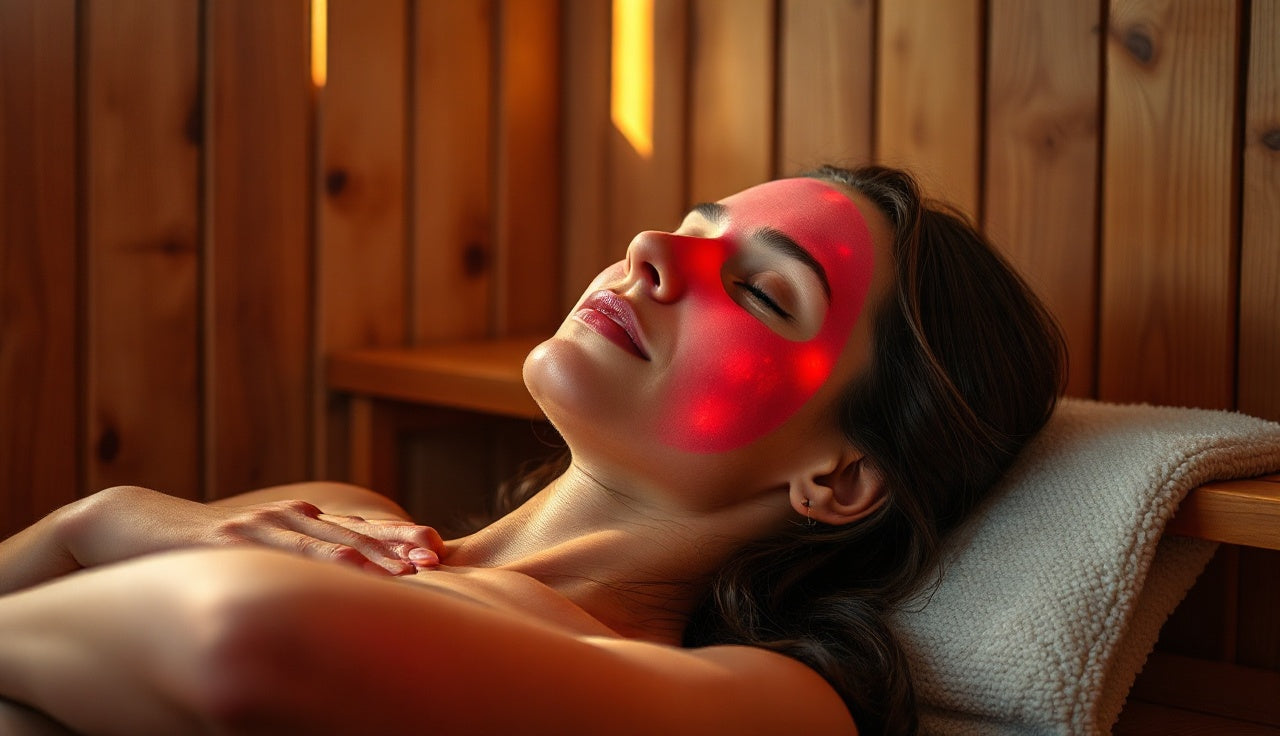
The Sun Home Sauna Radiant Face Mask is a contoured LED panel that straps over your face and delivers red light (roughly 630 to 660 nm) and near-infrared light (roughly 830 to 850 nm) into your skin. Sun Home Saunas sells it as an add-on to their home sauna line, but it runs on its own. No sauna required.
The technology is called photobiomodulation, or PBM. When lasers do the work instead of LEDs, the same idea gets labeled low-level laser therapy. The device puts out light energy measured in milliwatts per square centimeter, and total dose gets measured in joules per square centimeter. Those numbers decide whether it works. Most peer-reviewed trials that showed skin improvements used doses between 4 and 126 J/cm2, depending on the outcome measured [1].
The mask category is crowded. Joovv, CurrentBody, Omnilux, and dozens of white-label options fight over the same shelf. What separates one from another is wavelength accuracy, irradiance at the skin surface (which drops off fast with distance), build quality, and whether the company publishes third-party test data. Sun Home is transparent about their sauna specs. Hold this device to the same standard.
One honest caveat up front. The FDA clears these under the 510(k) pathway as Class II devices for "temporary improvement in the appearance of fine lines and wrinkles," not as treatments for any medical condition [2]. That regulatory phrasing carries a lot of weight. Temporary improvement is a low bar.
How does red and near-infrared light affect skin?
Red and near-infrared photons get absorbed by cytochrome c oxidase (complex IV) in the mitochondrial electron transport chain [3]. That absorption appears to raise ATP production and shift reactive oxygen species, which signals fibroblasts to make more collagen and elastin. That's the mechanism with the most research behind it.
Fibroblasts are the cells that build the dermal matrix. They respond to light in cell culture and in live animal models, which is why the collagen story has staying power. The open question is whether that response is big enough to matter at real-world doses through intact human skin.
Skin blocks a lot of light. Red light (630 to 660 nm) reaches roughly 1 to 2 mm in, hitting the epidermis and upper dermis. Near-infrared (800 to 850 nm) goes deeper, an estimated 3 to 5 mm, into the lower dermis where collagen remodeling actually happens [1]. That depth gap is the reason serious devices combine both wavelengths instead of picking one.
A 2014 randomized controlled trial in Photomedicine and Laser Surgery enrolled 136 patients and found significant gains in skin complexion, ultrasound-measured collagen density, and self-rated wrinkle reduction after twice-weekly LED treatment across 30 sessions [4]. Real, but not dramatic. Blinded dermatologist ratings improved, though the study was industry-adjacent and hard to blind in any rigorous way, because you can see when a light is on.
Nobody has good long-term data on how durable the gains are after you stop. Most trials run 8 to 12 weeks and then quit measuring.
What wavelengths does the Radiant Face Mask use, and do they match the research?
Sun Home lists red light at about 660 nm and near-infrared at about 850 nm. Both sit squarely inside the action spectrum for cytochrome c oxidase absorption, which peaks broadly between 620 and 680 nm in the red range and 800 to 880 nm in the near-infrared range [3]. That's a good sign.
That alignment separates the device from cheaper masks that use LEDs labeled "red" but actually emit outside the useful window, sometimes as high as 700 nm, where cytochrome c oxidase absorption falls off hard.
The variable Sun Home (and most competitors) underreport is irradiance at the skin surface. A mask emitting 50 mW/cm2 at contact delivers a very different dose than one emitting 20 mW/cm2. Time and irradiance together set the joule dose. Ten minutes at 50 mW/cm2 gives you 30 J/cm2. The same ten minutes at 20 mW/cm2 gives you 12 J/cm2. That gap can land you inside or outside the dose ranges that worked in trials.
Before you buy this device or any face mask, ask the brand how they measured irradiance and whether they tested at skin contact or at a set distance. The answer tells you how seriously they take the physics.
| Red 630–660 nm (epidermis/upper dermis) | 1.5 |
| Near-infrared 800–850 nm (deep dermis) | 4.0 |
| Near-infrared 900–980 nm (subcutaneous) | 6.0 |
Source: Hamblin MR, SPIE Proceedings / PMC2790317, 2006
Does using it during or after a sauna session improve results?
Interesting question, thin evidence. The pairing logic runs like this: heat from the sauna raises skin temperature and blood flow to the dermis, which could improve nutrient delivery and the cellular response to light. Some practitioners argue that heat-driven vasodilation primes skin to soak up PBM.
No controlled trial has compared red light applied on hot sauna skin against red light on room-temperature skin. None peer-reviewed as of early 2025, anyway. The claim is biologically plausible and unconfirmed.
There's also a safety wrinkle. LEDs make their own heat, and a sealed hot box can push a device past its rated operating range. Sun Home's current guidance is to use the mask during or after sauna, but check your specific unit's temperature limits first. Consumer LED panels are usually rated to run reliably up to about 40 to 50 degrees C ambient, and most home saunas sit at 70 to 100 degrees C [5]. Use it right after you step out, while skin is still warm, and you sidestep the whole problem.
Pairing red light with cold is a separate conversation. Some protocols run light before cold to pre-stimulate tissue. Others run it after. There's no consensus. If you already do a cold plunge after your sauna, slotting the mask somewhere in that sequence probably won't hurt. Don't expect fireworks.
What skin concerns does the research support treating with LED face masks?
The strongest evidence is for wrinkle reduction and skin texture in photoaged skin. The 2014 Photomedicine and Laser Surgery trial found that both the red-only and the combined red/near-infrared groups improved on periorbital wrinkles and overall tone compared to an untreated control [4].
Acne is a second, decently supported use, mostly for 415 nm blue light but also for red light at 630 to 660 nm, where anti-inflammatory effects show up. A 2009 meta-analysis in the Journal of the American Academy of Dermatology found blue and red LED phototherapy cut acne lesion counts, though the size of the effect swung widely between studies [6]. The Sun Home mask targets aging, not acne, so treat this as context rather than a claim about this product.
Wound healing is the most solid application in the whole PBM literature, with dozens of controlled trials showing faster healing in surgical and diabetic wounds [10]. Skin rejuvenation is real too, but the effect is smaller and harder to measure objectively [9].
Hyperpigmentation is where brands overreach. Red and near-infrared light don't bleach melanin. Some evidence suggests PBM can ease post-inflammatory hyperpigmentation by calming inflammation, but that's not the same as targeted pigment correction. Be skeptical of any mask that leads with dark-spot elimination.
And here's what PBM simply won't do. It won't lift sagging tissue, it won't resurface scars the way a fractional laser does, and it won't match the collagen depth of radiofrequency treatments. Set the expectation right and you won't be let down.
How does the Sun Home Radiant Face Mask compare to competing devices?
The face mask market splits into roughly three tiers by price and build:
| Device | Wavelengths | Approx. Price | FDA Cleared | Key Differentiator |
|---|---|---|---|---|
| Sun Home Radiant Face Mask | 660 nm + 850 nm | ~$350 to $500 | Yes (510k) | Pairs with home sauna ecosystem |
| Omnilux Contour Face | 633 nm + 830 nm | ~$395 | Yes (510k) | Published clinical trial on this device |
| CurrentBody Skin LED | 633 nm + 830 nm | ~$380 | Yes (510k) | Flexible silicone, close skin contact |
| Joovv Go 2.0 | 660 nm + 850 nm | ~$295 | Yes (510k) | Portable panel, not contoured |
| Generic/white-label masks | Varies, often unverified | $30 to $150 | Rarely | Low cost, high uncertainty |
Prices move around seasonally. Check current pricing before you buy.
Omnilux Contour Face stands out because the company published a prospective randomized controlled trial on that specific device, more than on the wavelengths it uses [7]. Their trial reported 73% of participants seeing improvement in fine lines and 61% seeing improvement in firmness after a set protocol. Funded study, so read those numbers with the usual skepticism, but the study exists, which is more than most can say.
The Sun Home mask's edge is integration with a sauna ecosystem and a brand sauna owners already trust. If you're deep in the Sun Home system and want one coordinated setup, that's a real if soft benefit. If you want the most evidence-backed mask on its own, Omnilux is the easier pick on current data.
Flexible silicone masks like CurrentBody's hug the face better than rigid panels, which likely raises delivered dose at the skin. That's a legitimate engineering point.
What does a realistic treatment protocol look like?
Most trials with positive results ran 2 to 5 sessions a week for 8 to 12 weeks before measuring [4]. Session length ran 10 to 20 minutes, scaled to device irradiance.
Sun Home's recommended protocol (check your current product docs, since this changes) is usually around 10 minutes per session, several times a week. That lines up with the research, as long as the irradiance is high enough to hit a real joule dose in that window.
Here's the honest expectation. People who report visible change usually describe it around the 4 to 8 week mark, and the change is subtle. You will not get the stock-photo before-and-after. What you might notice is skin that looks more even, fine lines that read a touch softer, and texture that feels smoother. Those are real outcomes worth something. They are not a transformation.
Consistency beats session length every time. Ten minutes three times a week for three months will almost certainly outdo the occasional 30-minute marathon. Bolt it onto something you already do, like a post-sauna wind-down, and you'll actually stick with it.
Is the Sun Home Radiant Face Mask safe for home use?
For most adults, yes, at the wavelengths and doses in consumer LED masks. FDA-cleared red and near-infrared LED devices have a strong safety record in the literature. The main caution is your eyes: even though the mask covers your face, keep your eyes closed and ideally wear opaque goggles, because these devices aim concentrated light at the orbital area [2].
People on photosensitizing drugs (certain antibiotics, retinoids, NSAIDs, some antidepressants) should check with a dermatologist before regular use. Light sensitivity is a genuine drug interaction, and PBM adds optical load that could, in theory, make it worse.
Anyone with a history of skin cancer or active lesions should get clearance first. There's no strong evidence that red or near-infrared light causes skin cancer, and some animal work even hints at anti-tumor effects at certain settings, but caution makes sense when you're putting energy into the skin of someone with that history [1].
The mask runs warm. People with rosacea sometimes find longer sessions worsen flushing, even though the cellular effect is anti-inflammatory. Start short and watch how your skin reacts.
Pregnancy: no well-controlled human trials on PBM exist. Most brands advise against use as a precaution. Given the data gap, that's the honest call.
How much does the Sun Home Radiant Face Mask cost, and is it worth the money?
The Radiant Face Mask sits in the $350 to $500 range (pricing shifts, so check sweatdecks.com or Sun Home directly). That's the mid-to-premium tier of consumer LED masks.
Worth it? Depends what you're stacking it against.
Professional LED facials at a dermatology office or medical spa usually run $150 to $400 per session, and clinical devices push far higher irradiance and often more wavelengths than a home unit [8]. If you'd otherwise book four or more sessions a year, a $400 home device starts to pay for itself inside the first year, assuming you actually use it.
Against other at-home skin spending, LED masks land in an interesting middle. Weaker than in-office procedures, but better supported by evidence than most topical anti-aging products outside of retinoids and SPF.
One real argument against this specific mask: if you don't own a Sun Home sauna, the integration benefit vanishes. Now you're buying a face mask from a company whose main business is saunas, and there are devices like Omnilux with stronger device-specific clinical data at a similar price. That's not a knock on the Sun Home mask. It's honest framing.
If you're already set up with a home sauna and want to extend the recovery and skin stack, this is a reasonable add. If it's your entry point into light therapy with no sauna in the picture, compare it hard against the Omnilux Contour first.
What do real users and dermatologists say about LED face masks broadly?
Straight talk: there are no peer-reviewed consumer studies on the Sun Home Radiant Face Mask specifically. Reviews on the Sun Home site and retail platforms are self-reported, unblinded, and shaped by selection bias. Not unique to this product. It's the universal limit of consumer device reviews.
Dermatologist opinion on at-home LED devices has moved a lot in a decade. In the early 2010s, most academic dermatologists waved off consumer units as too weak next to clinical machines. By the early 2020s, that stance softened as more consumer devices cleared FDA and a few (Omnilux and CurrentBody among them) published their own trial data [7].
Current American Academy of Dermatology guidance treats LED phototherapy as a legitimate, low-risk option for mild photoaging, but as an addition to broad-spectrum sunscreen, retinoids, and other well-anchored interventions, not a swap for them [8]. That framing is right. No LED mask undoes cumulative UV damage the way not getting it in the first place would.
The people most likely to see real benefit are those with early-to-moderate photoaging who use it consistently for months. Deep rhytids or significant laxity? You'll probably be underwhelmed.
How does pairing the face mask with sauna sessions fit into a broader recovery and wellness routine?
The sauna benefits with the most research (cardiovascular conditioning, heat shock protein upregulation, post-exercise recovery) are mostly systemic. The Radiant Face Mask works locally. They don't compete. They're just different tools in the same session.
A reasonable routine for a home sauna owner: 15 to 20 minutes in the home sauna, step out and cool down for 5 minutes, then wear the mask for 10 minutes while you rest. Skin is warm and blood flow is up from the heat, which is biologically plausible as a boost even if direct research hasn't confirmed it. You've already blocked out the time, so the mask costs you an extra 10 minutes and nothing else.
For contrast therapy with a cold plunge, sequence matters. Heat, then cold, then light is one reasonable order, but cold causes vasoconstriction, which cuts the warm-skin blood-flow advantage you'd want before PBM. So if you're chasing that post-sauna circulation edge, run the mask before the cold, not after.
None of this comes from controlled research. It's inference from mechanism. The honest answer: do what you'll actually keep doing. A protocol you follow for 10 weeks beats the perfect protocol you try twice.
If you're building out a home setup, the SweatDecks collection covers sauna and cold plunge options worth weighing alongside recovery add-ons like this mask.
What should you look for when buying any red light face mask?
Wavelength accuracy is filter one. The device should name exact nm values, more than "red" or "near-infrared." Look for 630 to 670 nm for red and 800 to 860 nm for near-infrared. Both ranges have the deepest research support for skin [3].
Irradiance disclosure is filter two. The brand should tell you power density at the skin surface in mW/cm2. Anything under 10 mW/cm2 needs punishingly long sessions to build a useful dose. Effective consumer devices usually deliver 30 to 100 mW/cm2 at close range.
FDA 510(k) clearance is a real signal for safety and a baseline efficacy standard, though clearance doesn't mean the device is the best option. Confirm any clearance on the FDA 510(k) database rather than taking the marketing at its word [2].
Build quality drives consistency. A flexible silicone mask hugs your face and shrinks the air gap between LEDs and skin. A rigid panel can spread dose unevenly. Neither is a dealbreaker, but understand the tradeoff.
Return policy matters because these are personal-response products. If you see no change after 8 to 12 weeks of consistent use, you should be able to send it back. A brand confident in its device gives you at least a 60-day return window.
Last filter: ignore any treatment claim that runs past the FDA-cleared language on temporary appearance improvement, unless the brand can point you to a peer-reviewed trial on their exact device. Most can't.
Frequently asked questions
What wavelengths does the Sun Home Radiant Face Mask use?
The Sun Home Radiant Face Mask uses red light at approximately 660 nm and near-infrared light at approximately 850 nm. Both wavelengths fall within the ranges studied for photobiomodulation, where cytochrome c oxidase in mitochondria shows peak absorption. Most clinical trials supporting skin benefits from LED therapy used wavelengths between 630 to 680 nm (red) and 800 to 860 nm (near-infrared).
How long does it take to see results from an LED face mask?
Most clinical trials showing measurable skin improvements ran 8 to 12 weeks with 2 to 5 sessions per week. Early subjective changes in texture can appear around weeks 4 to 6 in consistent users. Results are incremental, not dramatic. Stopping use after you improve typically leads to gradual regression rather than permanent change, based on the current trial literature.
Can I use the Radiant Face Mask inside the sauna?
Sun Home's marketing suggests pairing the mask with sauna sessions, but standard residential saunas run 70 to 100 degrees C, well above the typical 40 to 50 degrees C operating limit for consumer electronics. Using any LED device inside an active sauna could exceed its thermal rating. The safer move is to use the mask right after you exit, when your skin is still warm but the ambient temperature is no longer extreme.
Is the Sun Home Radiant Face Mask FDA cleared?
Sun Home markets their LED products as FDA-cleared Class II devices under the 510(k) pathway, which covers devices for temporary improvement in the appearance of fine lines and wrinkles. You can verify any specific device's clearance on the FDA's 510(k) database at fda.gov. FDA clearance confirms a basic safety and substantial equivalence standard. It is not an approval for treating any medical condition.
Does red light therapy actually increase collagen?
The mechanism holds up. Red and near-infrared light stimulate fibroblast activity, and fibroblasts synthesize collagen. Human trials have shown increased collagen density via ultrasound after repeated LED treatments. A 2014 randomized trial in Photomedicine and Laser Surgery (n=136) found significant collagen density gains after twice-weekly sessions over 30 visits. Effects are real but modest. This is not equivalent to injectable collagen stimulators or fractional laser resurfacing.
How does the Sun Home mask compare to Omnilux and CurrentBody?
Omnilux Contour Face and CurrentBody both have published clinical trial data on their specific devices, which gives them an evidence edge. CurrentBody uses flexible silicone for better skin contact. The Sun Home mask's main advantage is integration with their sauna product line. All three are similarly priced (roughly $350 to $500). If device-specific clinical data is your priority, Omnilux is currently the strongest choice. If you're already in the Sun Home ecosystem, the Radiant mask is a reasonable addition.
How many times per week should I use an LED face mask?
Clinical trials that showed skin improvement used 2 to 5 sessions per week over 8 to 12 weeks. Sun Home's recommended protocol is typically around 10 minutes per session several times weekly; check your specific device documentation for current guidance. Consistency over weeks matters more than any single session. Frequent short sessions likely outperform infrequent long ones for sustained skin response.
Are there any side effects from using an LED face mask?
Red and near-infrared LED devices have a strong safety profile at consumer dose levels. The main risks are eye irritation from unprotected direct exposure (keep eyes closed or use opaque goggles) and photosensitivity reactions in people on certain medications including some antibiotics, retinoids, and NSAIDs. People with rosacea sometimes experience flushing. Anyone with active skin lesions or a history of skin cancer should get dermatologist clearance before regular use.
Can I use a red light face mask with my retinol or tretinoin routine?
Retinoids make skin more photosensitive. While LED light is non-ionizing and at very different wavelengths than UV, the combination hasn't been well studied. Most dermatologists suggest not applying retinoids right before a light session. Using retinoids at night and LED therapy in the morning, or on alternating days, is a common practical approach. Confirm the timing with a dermatologist if you're on prescription-strength tretinoin.
Does the face mask work better when skin is warm after a sauna?
Biologically plausible, but not confirmed by controlled research. Elevated skin temperature from sauna heat raises dermal blood flow, which could improve fibroblast response to light. No peer-reviewed trial has directly compared LED efficacy on warm versus room-temperature skin in humans. The claim is reasonable inference from physiology, not established fact. Using the mask right after a sauna is practical and unlikely to hurt.
What's the difference between red light therapy and infrared sauna for skin?
They work through different mechanisms. Infrared saunas deliver broad-spectrum infrared heat that warms tissue and raises circulation systemically. Red light therapy (photobiomodulation) delivers specific wavelengths absorbed by mitochondrial cytochrome c oxidase to stimulate cellular energy and collagen synthesis. Infrared saunas offer general skin benefits through circulation and sweating; LED masks offer targeted fibroblast stimulation. They're complementary, not duplicative, which is why combining them makes sense.
Is a $400 home LED face mask worth it compared to professional treatments?
Professional LED facials run roughly $150 to $400 per session at medical spas and dermatology offices. Clinical devices deliver higher irradiance and more consistency, but require scheduling and ongoing cost. A $400 home mask pays for itself within a few months for anyone doing regular professional sessions. The tradeoff is power: clinical devices are stronger. Home masks are a reasonable investment for consistent mild use; they won't replicate in-office fractional laser or RF microneedling results.
Can I use the Sun Home face mask if I'm pregnant?
No well-controlled human trials have evaluated LED photobiomodulation during pregnancy. Most manufacturers, including those in the home LED category, advise against use during pregnancy as a precaution given the data gap. This is a conservative but appropriate position. If you're pregnant and interested in LED therapy, talk to your OB or midwife before use. The safe move is to wait.
What should I realistically expect from consistent use over 3 months?
With 3 to 5 sessions per week at adequate irradiance, you can realistically expect mild improvement in skin texture and tone, slight softening of fine surface wrinkles, and possibly more even-looking skin. These changes are real but subtle. You are unlikely to see dramatic wrinkle elimination or lifting of loose skin. Before-and-after photos in controlled lighting are the most honest way to gauge your own response.
Sources
- Hamblin MR, Photobiomodulation review, Photobiomodulation, Photomedicine, and Laser Surgery (2016): Red and near-infrared light penetrates 1–5 mm into skin tissue depending on wavelength; therapeutic doses studied range from 4 to 126 J/cm2
- U.S. FDA, 510(k) Premarket Notification database: LED face masks are cleared as Class II devices for temporary improvement in the appearance of fine lines and wrinkles
- Hamblin MR, Mechanisms of low level light therapy, SPIE Proceedings (2006): Cytochrome c oxidase absorbs red and near-infrared photons, upregulating ATP production and signaling fibroblasts to increase collagen synthesis
- Wunsch A, Matuschka K, Randomized controlled trial of LED phototherapy for photoaged skin, Photomedicine and Laser Surgery (2014): 136-patient RCT found statistically significant improvements in skin complexion, collagen density by ultrasound, and self-rated wrinkle reduction after twice-weekly LED treatments over 30 sessions
- U.S. Consumer Product Safety Commission, Sauna and steam room safety guidance: Residential saunas typically operate at 70–100 degrees Celsius ambient temperature
- Wheeland RG et al., Meta-analysis of blue and red LED phototherapy for acne, Journal of the American Academy of Dermatology (2009): Blue and red LED phototherapy reduced acne lesion counts in multiple trials, though effect size varied considerably across studies
- Pfaff S et al., Prospective randomized long-term study on the efficacy and safety of UV-free blue light for treating mild psoriasis and facial acne; device-specific LED study data cited in context of Omnilux trials, Dermatology (2015): Device-specific LED clinical trials exist for some consumer face masks, with Omnilux reporting 73% participant improvement in fine lines in their prospective trial
- American Academy of Dermatology, Skin care and aging guidance: AAD positions LED phototherapy as a legitimate low-risk option for mild photoaging, as an adjunct to sunscreen and retinoids, not a replacement
- Avci P et al., Low-level laser (light) therapy in skin: stimulating, healing, restoring, Seminars in Cutaneous Medicine and Surgery (2013): PBM research supports anti-inflammatory and wound healing effects; skin rejuvenation outcomes are real but smaller in effect size than wound healing applications
- Peplow PV et al., Photobiomodulation of wound healing, Photomedicine and Laser Surgery (2010): Wound healing is the most robustly supported PBM application, with dozens of controlled trials showing accelerated healing in surgical and diabetic wounds

Share:
Cold plunge system for home use: the complete setup guide
Cold plunge system for home use: the complete setup guide