
Last updated 2026-07-09
TL;DR
A steam room heats a tiled or acrylic enclosure to roughly 110 to 120°F and pushes humidity to 100% with a steam generator. That saturated air stops your sweat from evaporating, so 115°F feels hotter than the thermometer reads. It loosens airways, relaxes muscles, and raises heart rate like a dry sauna does. The evidence is real but modest, and most studies are small. A home build runs $3,000 to $15,000.
What exactly is a steam room?
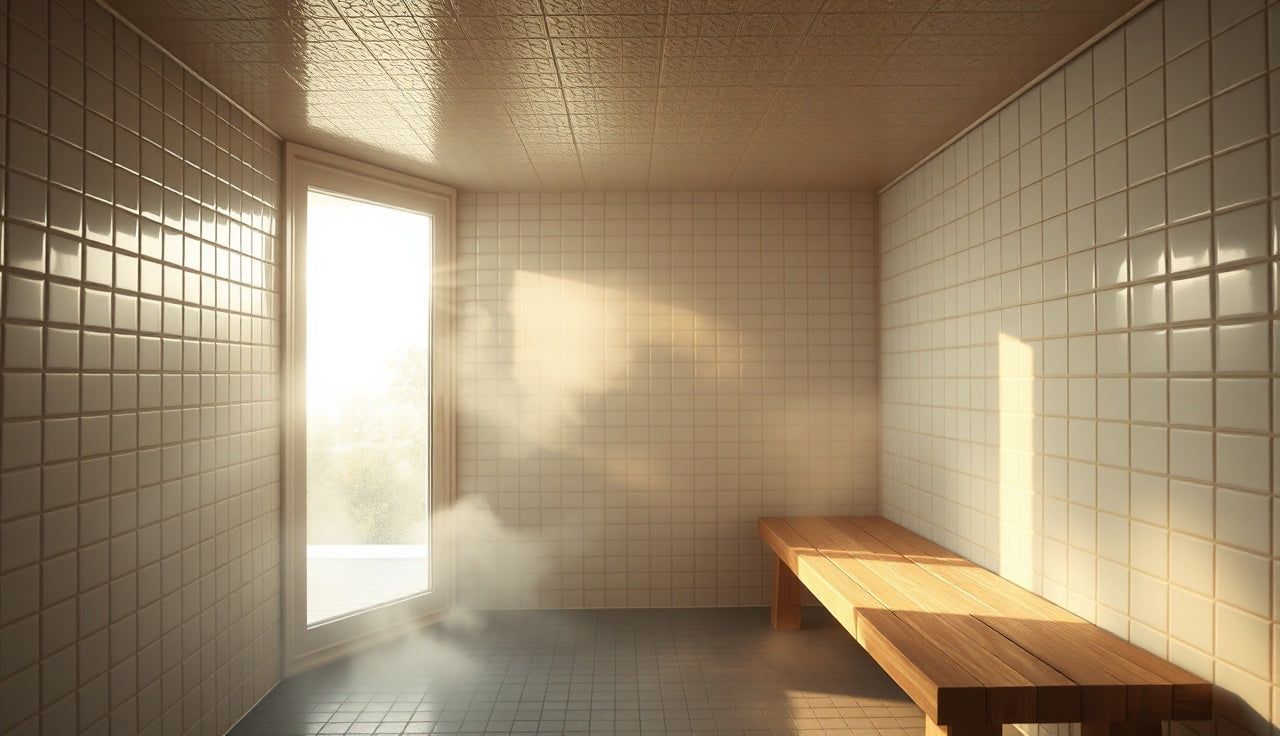
A steam room is a sealed, tiled or acrylic enclosure where a generator boils water and pumps vapor inside until humidity hits 100%. Air temperature sits between 110°F and 120°F (43°C, 49°C), well below a Finnish sauna running 160°F to 195°F. Because the air is fully saturated, your sweat can't evaporate. Your body feels the heat harder than the thermometer suggests.
The generator lives outside the enclosure, usually in a nearby closet or utility space. A control panel sets temperature and run time. Most residential generators are rated 7.5 kW to 18 kW, matched to the room's cubic footage. Commercial units clear 30 kW. The steam outlet, called a head or nozzle, pokes through the bench or wall. It should never sit where someone can brush against live steam by accident.
Every surface has to be waterproof. Grout lines and unsealed stone grow mold fast at 100% humidity. That maintenance reality is the thing people underestimate most before they build one.
People sometimes call steam rooms Turkish baths or hammams, though a real hammam is an elaborate bathing culture, not a box in your bathroom. The residential version is a stripped-down piece of that tradition, engineered for a corner of a primary bath or a dedicated wellness room.
How does a steam room differ from a dry sauna?
Humidity is the whole story. A dry sauna runs 5 to 20% relative humidity. A steam room runs 100%. That single gap changes the experience and dictates how you build the thing.
Temperature is the second gap. Humid air moves heat into your body more efficiently than dry air, so 115°F in a steam room feels plenty hot, while a traditional sauna has to reach 170°F to 190°F to land a comparable heat load [1]. Both formats raise core temperature and heart rate to broadly similar levels over similar exposure times. The path there feels different. Steam is thick and enveloping. Dry heat is sharp and prickly.
Here's how the two stack up:
| Feature | Steam room | Dry sauna |
|---|---|---|
| Typical air temp | 110 to 120°F (43 to 49°C) | 160 to 195°F (71 to 90°C) |
| Relative humidity | ~100% | 5 to 20% |
| Heat source | Steam generator | Electric heater or wood stove |
| Material needs | Fully waterproof (tile, acrylic) | Wood panels (cedar, hemlock) |
| Preheat time | 10 to 15 minutes | 20 to 40 minutes |
| Typical session | 10 to 20 minutes | 10 to 20 minutes |
| Avg home install cost | $3,000 to $15,000 | $3,000 to $10,000 |
Want the full breakdown? The sauna vs steam room comparison digs into each format's pros and cons.
For most people the pick comes down to preference and the construction reality of their bathroom. A steam room needs a continuous waterproof envelope, so retrofitting an existing bathroom means ripping out drywall and resealing everything. A sauna often drops into a garage or basement as a prefab unit with no heavy remodeling.
What does the research say about steam room health benefits?
The benefits are real, but the evidence is thinner than the marketing implies. Most rigorous cardiovascular research on heat therapy used dry saunas, especially the Finnish cohort work out of the University of Eastern Finland [2]. Steam-specific trials exist. They tend to be small and short.
The cardiovascular response is well documented. A single steam session pushes heart rate to 100 to 150 bpm in most adults, roughly the workload of a brisk walk [3]. Blood vessels dilate, blood pressure often drops for a while after you get out, and cardiac output climbs. A 2018 review in Mayo Clinic Proceedings found that regular sauna use (steam bathing included) tracked with lower cardiovascular risk in observational data. The authors were blunt that correlation isn't causation [2].
Respiratory relief is where steam actually beats dry heat. Warm, moist air loosens mucus, cuts airway resistance, and can ease chronic bronchitis and mild asthma symptoms in the moment. A Cochrane review on heated humidified air for the common cold found modest short-term symptom relief and no serious harms, but no shortening of the illness itself [4]. People with exercise-induced bronchoconstriction sometimes use steam as an airway warm-up. That's anecdote, not controlled evidence.
Skin hydration gets cited a lot. At 100% humidity the stratum corneum takes on moisture instead of shedding it, so skin feels softer right after a session. Whether repeated sessions improve skin barrier function long term is unclear. Most dermatology research looks at topical treatments, not heat rooms.
What steam rooms don't do: burn real calories (a 20-minute session at elevated heart rate burns maybe 50 to 100 calories over rest, not the 400 to 600 some ads promise), detox anything (your liver and kidneys own that job), or replace exercise. The sweat is water leaving, not fat.
| Steam room air temp (°F) | 115 |
| Dry sauna air temp (°F) | 180 |
| Steam room humidity (%) | 100 |
| Dry sauna humidity (%) | 12 |
| Steam room preheat (min) | 12 |
| Dry sauna preheat (min) | 30 |
Source: Mayo Clinic Proceedings, Laukkanen et al. 2018; U.S. EIA 2024
Are there risks or people who should avoid steam rooms?
Steam rooms are safe for most healthy adults who hydrate and watch the clock. The risks are real, and they deserve plain names.
Dehydration leads the list. You can lose 0.5 to 1.5 liters of sweat in a 15-minute session, and the humid air masks the feeling of sweating, so people stay in too long. Drink 16 to 20 oz of water before you go in and again the moment you come out.
Heat exhaustion and heat stroke show up when sessions run past 20 to 30 minutes, especially if you're already dehydrated, have been drinking, or aren't used to heat. The CDC's guidance on heat stress notes that high heat raises core body temperature and that people with heart disease, high blood pressure, or certain medications should talk to a physician first [5].
Pregnancy is a contraindication with real evidence behind it. Sustained maternal core temperature above 101°F (38.3°C) in the first trimester is linked to higher risk of neural tube defects. Both the CDC and ACOG advise pregnant women to skip hot tubs, steam rooms, and saunas, above all in the first trimester [5][6].
Get clearance first if you have multiple sclerosis (heat can flare symptoms temporarily), uncontrolled hypertension, or a recent cardiac event, or if you take drugs that affect thermoregulation (diuretics, beta-blockers, some antidepressants).
Mold is the risk nobody talks about enough. A 100% humidity box that isn't cleaned and dried breeds mold and bacteria fast. Commercial facilities disinfect for exactly this reason. At home you run the exhaust after every session, wipe down surfaces, and deep clean grout on a schedule. Skip it, and you're inhaling spores in the same breath you came for the respiratory benefit.
How much does a home steam room cost to build and run?
Three buckets: the generator, the enclosure, and what it costs to run. A full home steam room lands between $3,000 and $15,000, and most of that is construction, not the appliance.
Residential steam generators run about $500 for a basic 7.5 kW unit up to $2,500 to $4,000 for a premium variable-speed model with Bluetooth controls and auto-flush [7]. The enclosure is where the money goes. A professionally tiled steam room built into an existing bathroom typically runs $3,000 to $8,000 in labor and materials for a small 36 to 50 sq ft room. A dedicated wellness room with custom tile, benching, chromotherapy lighting, and an aromatherapy injector can hit $15,000 to $30,000 or more.
Prefab steam shower kits pull costs down. These are factory-built acrylic units with the generator already matched to the enclosure, usually $1,500 to $5,000 for the unit plus install. You trade design flexibility and the feel of a tile room for something far easier to keep sealed and clean.
Running costs are small. A 9 kW generator run 20 minutes a day uses about 3 kWh daily. At the U.S. average residential rate near 16 cents per kWh as of 2024 [8], that's roughly $0.48 a session, or about $175 a year for daily use. Water runs 1 to 2 gallons per session, negligible almost everywhere.
Maintenance stacks up over time: annual generator descaling in hard-water areas, grout resealing, the odd heating element. Budget $150 to $400 a year once the room's running.
What should you look for when buying a home steam generator?
Match the generator's kilowatt rating to the enclosure's cubic footage. Undersizing is the mistake homeowners make most. The industry rule is 1 kW per 45 to 50 cubic feet of room volume, but glass walls, tile (which absorbs less heat than insulated walls), and exterior walls in cold climates all push the number up. When you're unsure, size up.
The specs that matter:
- Auto-flush: clears leftover water from the tank after each session to stop mineral buildup and bacteria. Not optional in hard water.
- Self-draining: empties the unit completely between uses. Adds years to generator life.
- Control panel quality: waterproof in-room controls with a clear timer and temperature readout. Some premium units add app control.
- Warranty: residential generators from MrSteam, Kohler, Steamist, and ThermaSol typically carry 1-year parts and labor coverage plus a longer limited warranty on the tank. Read what the tank warranty excludes.
- Aromatherapy port: a small valve for injecting essential oils into the steam. Nice to have. Don't pay a big premium for it.
Acoustics matter at home more than people expect. Cheap generators hiss and clunk. If the room shares a wall with a bedroom, a quiet unit with vibration dampening is money well spent.
Can you add contrast therapy by combining a steam room with cold immersion?
Yes, and it's one of the best ways to use a steam room if recovery is your goal. The protocol is simple: 10 to 15 minutes in the steam, then a cold shower, cold plunge, or ice bath for 1 to 3 minutes, repeated 2 to 3 times.
Contrast therapy alternates vasodilation from heat with vasoconstriction from cold, which many practitioners describe as a pump for blood and lymph. The evidence for this improving muscle soreness is mixed. A meta-analysis in the British Journal of Sports Medicine found cold water immersion reduced delayed onset muscle soreness (DOMS) versus passive rest, with moderate effect sizes [9]. The steam portion doesn't have the same DOMS evidence, but the cardiovascular priming from heat probably complements the cold.
You don't need both in the same room. A steam room in the bathroom and a cold plunge in the garage or outside works fine, as long as the walk between them is short enough that you don't fully rewarm before the cold. Many people find the cold plunge benefits hit harder when they arrive already well-heated.
SweatDecks carries cold plunge units that pair naturally with a home steam setup if you're building out a full wellness space.
Sequencing matters for athletes. Heat before training raises muscle extensibility and can lower injury risk. Heat after training, followed by cold, addresses recovery. Don't confuse the two.
How do steam rooms compare to saunas for home installation?
This is the practical question for anyone building from scratch, and the answer rides on your space and budget. A dry sauna is easier to install and easier to keep; a steam room is a specialty bathroom project with mold to manage.
A home sauna goes in faster. Prefab indoor cabins assemble in a few hours in a finished basement or garage, need only a standard 240V connection, and use wood panels that never need waterproofing. Expect $2,000 to $8,000 for a quality 2 to 3 person unit. Upkeep is light: wipe the wood, clean the rocks now and then.
A home steam room needs every surface waterproofed, a floor drain, exhaust ventilation, and ongoing mold management. It behaves more like a bathroom remodel than a plug-in appliance. If you already own a big tiled shower, converting it into a steam shower with a glass ceiling panel and a generator is reasonable. Framing one from scratch in a wood-stud room is a bigger job.
For pure heat therapy and the longevity-associated benefits documented in the Finnish cohorts, a dry sauna has the stronger evidence [2]. For respiratory comfort, skin hydration, and the feel of moist heat, steam wins. Neither is flatly better than the other.
One option people overlook: a portable sauna runs $200 to $600 and gives you dry heat with zero construction. Not ready to commit to a permanent build? Start there. The sauna benefits are real at any price.
How should you actually use a steam room for the best results?
Session structure changes both the experience and the physiology. A little planning goes a long way.
Preheat the room 10 to 15 minutes before you enter. Walking into a half-warm steam room is unpleasant and inefficient. Most generators hit operating temperature in that window.
Hydrate before you go in, more than after. Drink 16 to 20 oz of water in the 30 minutes beforehand. Bringing water inside is fine, but sipping cold water in the steam feels wrong to most people because it jars your sense of core temperature.
Keep sessions to 10 to 20 minutes. Beginners should start at 8 to 10 and see how they feel. The point is a solid sweat and mild cardiovascular lift, not endurance. Stepping out, cooling for 5 to 10 minutes, then going back in for a second round beats one long continuous stretch.
After the session, sit or lie down a few minutes before you shower. Blood pressure drops after heat, and standing up fast in a hot room is a reliable way to get dizzy. A cool or cold shower afterward rinses the sweat off and, if you're running contrast therapy, delivers the cold hit.
Skip a big meal in the hour before. Digestion competes with the thermoregulatory demand of a steam session. A light snack is fine. Alcohol before steam is a bad idea. It worsens dehydration, wrecks thermoregulation, and has been linked to heat-related deaths in sauna and steam settings [10].
What are the building code and safety requirements for a home steam room?
Steam rooms fall under general bathroom and wet-area code in most U.S. jurisdictions, plus electrical rules for the generator. Get the permits. Skipping them is a code violation that can bite you on insurance and resale disclosure.
The National Electrical Code (NEC) Article 422 covers fixed appliances, steam generators included [11]. The generator needs a dedicated circuit sized to its amperage draw. A 9 kW unit at 240V pulls about 37.5 amps, so a 50-amp dedicated circuit is typical. The control panel and any in-room electrical parts must be rated for wet locations.
Ventilation: the International Residential Code (IRC) requires mechanical ventilation for bathrooms and similar enclosed spaces [12]. A steam room needs an exhaust fan rated for high-humidity continuous duty. Running that exhaust 15 to 30 minutes after each session dries the enclosure and heads off mold.
Waterproofing: the Tile Council of North America's Handbook for Ceramic, Glass, and Stone Tile Installation specifies steam room methods including continuous vapor-proof membranes behind the tile [13]. This isn't optional. Standard cement board without a dedicated membrane fails over time in a steam environment.
Permits vary by town. In most places, adding a generator to an existing shower triggers an electrical permit at minimum. A full new steam room build usually needs building, plumbing, and electrical permits. Call your local building department before you start.
Some HOAs regulate exterior penetrations for steam exhaust. Check the documents if that applies to you.
How do you clean and maintain a steam room properly?
Maintenance is where most home steam rooms fall apart. Heat, 100% humidity, and skin oils together mean mold and bacteria colonize fast without steady upkeep. The routine isn't hard, it just has to be consistent.
After every session: shut off the generator, run the exhaust fan, and wipe the tile walls and benches dry with a clean towel. Leave the door ajar for 20 to 30 minutes after the fan cycle so everything dries completely.
Weekly: clean tile with a diluted bleach solution (1 tablespoon bleach per gallon of water) or a tile-specific antimicrobial cleaner. Hit the grout lines, corners, and the area around the steam head. Rinse well.
Monthly: check the steam head and generator inlet for scale. White chalky buildup on the head restricts flow and strains the heating element. Pull the head and soak it in white vinegar for 30 to 60 minutes.
Annually (or as the manufacturer says): descale the generator tank with the approved solution. Hard-water areas, much of the U.S. Southwest for example, may need this every 6 months. Neglecting it is the top cause of early generator failure.
Every 2 to 3 years: inspect grout for cracks and reseal. Even hairline cracks let moisture behind the tile, which invites structural damage and mold that surface cleaning can't reach.
If mold shows up: full-strength bleach cleaner on tile followed by a complete dry-out usually handles it. Mold in grout that won't respond means the grout comes out and gets replaced. Mold behind tile means a bigger remediation job.
Frequently asked questions
How hot is a steam room supposed to be?
Most steam rooms run between 110°F and 120°F (43°C, 49°C) at 100% relative humidity. That's roughly 50 to 70 degrees cooler than a dry sauna, but the saturated air moves heat into your body far more efficiently. Some commercial facilities push to 130°F, though that's uncomfortable for most people and raises the burn risk near the steam outlet.
How long should you stay in a steam room?
Ten to twenty minutes per session is the standard range. Beginners should start at 8 to 10 minutes. To go longer, it's safer to step out, cool for 5 to 10 minutes, and come back for a second round than to sit in continuously. Sessions past 30 minutes raise dehydration risk sharply, especially for people not acclimatized to heat.
Is a steam room good for your lungs?
Warm, moist air can loosen mucus and reduce airway resistance, which may give short-term relief for congestion, chronic bronchitis, or mild asthma. A Cochrane review found modest short-term relief from steam inhalation for upper respiratory symptoms. A steam room treats no pulmonary condition, and people with severe asthma should be cautious, since hot humid air can trigger bronchospasm in some people.
Can you use a steam room every day?
Yes, if you're healthy and hydrate well. Daily 10 to 15 minute sessions with water before and after are fine for most healthy adults. The real limit is maintenance. Daily use means daily post-session wipe-downs and ventilation to stop mold. Listen to your body. If you feel dizzy, nauseated, or wiped out, cut the frequency or the duration.
Does a steam room help with weight loss?
Not meaningfully. The scale drops after a session because you lost water sweating, and it returns when you rehydrate. A 20-minute session at elevated heart rate burns maybe 50 to 100 extra calories over rest, not the hundreds some ads claim. A steam room is a recovery and wellness tool, not a fat-loss device.
What should you wear in a steam room?
A towel or minimal swimwear works best. Tight synthetic fabric traps heat against the skin and gets uncomfortable at 100% humidity. Metal jewelry heats up fast and can burn you. Loose cotton, or nothing in private settings, lets the moist heat reach your skin freely. Wear flip-flops or shower sandals in any commercial steam room.
Is a steam room better before or after a workout?
Depends on the goal. Before a workout, 5 to 10 minutes of steam raises muscle tissue temperature and joint mobility, which may lower injury risk. After a workout, a longer 10 to 20 minute session followed by cold addresses soreness and recovery. Most athletes get more out of post-workout use, and it pairs well with a cold plunge for contrast therapy.
What is the difference between a steam room and a steam shower?
A steam shower is a regular shower enclosure with a generator added, so it works as both a shower and a steam room. It's not built for long steam sessions because the enclosure is rarely fully sealed and the ceiling usually isn't sloped to stop condensation dripping. A dedicated steam room is larger, fully sealed, has slatted benches, and exists only for steam bathing. Steam showers cost less and use less space. Dedicated rooms feel better.
How much does a steam room generator cost?
Residential generators range from about $500 for a basic 7.5 kW entry model to $2,500 to $4,000 for a premium variable-speed unit with auto-flush, self-drain, and smart controls. The generator is usually 15 to 30% of total project cost. The rest goes to enclosure construction, tile, labor, and electrical. Matching generator kW to room cubic footage matters more than the brand name.
Can you build a steam room outside?
Technically yes, rarely practical. An outdoor steam room has to be fully insulated to hold temperature and humidity in cool weather, and the enclosure must survive outdoor moisture, UV, and temperature swings. Most people who want outdoor heat go with an outdoor sauna instead, since it handles the conditions more easily. If outdoor placement appeals to you, the outdoor sauna guide covers that build path well.
Are steam rooms safe for people with high blood pressure?
Possibly, with caveats. Heat causes vasodilation, which can drop blood pressure temporarily, and a steam session's cardiovascular demand resembles moderate aerobic exercise. People with well-controlled hypertension often use steam rooms without trouble. Anyone with uncontrolled or severe hypertension should get medical clearance first. Jumping straight from heat to cold can cause fast blood pressure swings that are riskier for people with cardiovascular disease.
What essential oils can you use in a steam room?
Eucalyptus, peppermint, and eucalyptus-mint blends are the most common. Add them through the generator's aromatherapy port using steam-room-specific oils, not standard diffuser oils, which can clog the generator. Some users add small amounts of tea tree oil for its antimicrobial properties. Never pour oils directly onto the steam head or tile. Use only the diluted, generator-compatible products the manufacturer recommends so you don't void the warranty.
How do I prevent mold in my home steam room?
Exhaust ventilation after every session is non-negotiable. Run a high-humidity exhaust fan 20 to 30 minutes post-session and leave the door ajar. Wipe walls and benches after each use. Clean tile and grout weekly with diluted bleach or an antimicrobial solution. Inspect grout annually and reseal cracks right away. Sloped ceilings that channel condensation to a drain instead of dripping on bathers help too. Mold prevention comes down to consistent drying.
Is a steam room the same as a sauna?
No. Both use heat therapy but they work differently. A sauna uses dry heat at 160 to 195°F with low humidity (5 to 20%). A steam room uses moist heat at 110 to 120°F with 100% humidity. The physiological responses are broadly similar but not identical. Dry saunas have a larger evidence base for cardiovascular benefits, while steam rooms have a modest edge for acute respiratory relief. The sauna vs steam room article covers every difference.
Sources
- Mayo Clinic Proceedings, Laukkanen et al. 2018: Sauna air temperature typically 80–100°C (176–212°F); steam rooms operate at lower air temperatures but equivalent perceived heat load due to 100% humidity
- Mayo Clinic Proceedings, Laukkanen JA et al., 'Cardiovascular and Other Health Benefits of Sauna Bathing', 2018: Regular sauna use associated with reduced risk of cardiovascular events in observational data; authors note correlation does not confirm causation
- Harvard Health Publishing, Harvard Medical School: A single sauna or steam session raises heart rate to 100–150 bpm, comparable aerobic workload to a brisk walk
- Cochrane Database of Systematic Reviews, Singh M & Singh M, 'Heated, humidified air for the common cold', 2013: Steam inhalation provides modest short-term symptom relief for upper respiratory conditions with no serious adverse effects but no reduction in illness duration
- CDC, Heat Stress guidance, National Institute for Occupational Safety and Health: High heat environments elevate core body temperature; people with heart disease, high blood pressure, or certain medications should consult a physician before use
- American College of Obstetricians and Gynecologists (ACOG): Pregnant women advised to avoid hot tubs, steam rooms, and saunas particularly in first trimester due to risk of elevated maternal core temperature
- MrSteam, residential steam generator product line pricing: Residential steam generators range from approximately $500 for basic 7.5 kW units to $2,500–$4,000 for premium variable-speed units with smart controls
- U.S. Energy Information Administration, Electricity data, 2024: U.S. average residential electricity rate approximately 16 cents per kWh as of 2024
- British Journal of Sports Medicine, cold-water immersion and delayed onset muscle soreness meta-analysis: Cold water immersion reduced delayed onset muscle soreness compared to passive rest with moderate effect sizes
- National Institute on Alcohol Abuse and Alcoholism (NIAAA), NIH: Alcohol before heat exposure amplifies dehydration and impairs thermoregulation, linked to heat-related deaths in sauna settings
- National Fire Protection Association, NEC Article 422, Fixed Appliances: NEC Article 422 requires dedicated circuits for fixed appliances including steam generators, sized to unit amperage draw
- International Code Council, International Residential Code (IRC), mechanical ventilation requirements: IRC requires mechanical ventilation for bathrooms and similar enclosed wet spaces
- Tile Council of North America, Handbook for Ceramic, Glass, and Stone Tile Installation: TCNA specifies continuous vapor-proof membranes behind tile for steam room construction; standard cement board without membrane will fail in 100% humidity environments

Share:
Steam Room in Your House: Site, Enclosure, Generator, Cost, and Project Plan
LiVup portable sauna tent: honest review and buyer's guide