
Last updated 2026-07-09
TL;DR
Steam saunas run between 110°F and 120°F (43 to 49°C) at 100% relative humidity. Those numbers feel far hotter than they read because humid air moves heat into your skin much faster than dry air. Most healthy adults handle 15 to 20 minute sessions well. Anyone with heart disease, low blood pressure, or a pregnancy should ask a doctor first.
What temperature is a steam sauna?
A steam sauna, also called a steam room, runs between 110°F and 120°F (43°C to 49°C) at or very near 100% relative humidity. That pairing of moderate heat and total saturation is the whole definition. It separates a steam room from every other heat format.
Those numbers look mild. A traditional Finnish dry sauna runs 150°F to 195°F (65°C to 90°C), sometimes hotter. So why does a steam room at 115°F hit so hard?
Humid air moves heat into your body far faster than dry air. Your body cools itself by evaporating sweat off the skin. In a steam room, the air is already full of water, so evaporation stalls. Heat from the air and the steam keeps loading onto your skin, and your body has no quick way to shed it. The heat you feel runs well ahead of what the thermostat says.
The American College of Sports Medicine points to wet-bulb temperature, which accounts for humidity, as a better predictor of heat stress than dry-bulb temperature alone [1]. A steam room at 115°F wet-bulb is physiologically stressful in a way that a 115°F dry sauna is not. Keep that in mind any time you compare the two.
How does steam sauna temperature compare to a dry sauna?
The gap between steam and dry sauna temperatures is large and it matters. A steam room runs 110 to 120°F, a Finnish dry sauna runs 150 to 195°F, and yet many people find them equally tough. Here is how the common formats line up.
| Type | Typical temp range | Relative humidity | Perceived intensity |
|---|---|---|---|
| Steam room | 110 to 120°F (43 to 49°C) | ~100% | Very high |
| Traditional Finnish sauna | 150 to 195°F (65 to 90°C) | 10 to 20% | Very high |
| Infrared sauna | 120 to 140°F (49 to 60°C) | Low | Moderate, high |
| Turkish hammam | 95 to 115°F (35 to 46°C) | ~100% | Moderate, high |
The Finnish sauna wins on raw thermometer readings by a wide margin. That doesn't make it harder on everyone. Some people breathe easier in dry heat and can sit through a hot Finnish session comfortably, while others feel boxed in by dense steam even at lower temperatures. Neither format is universally "more intense." It comes down to the individual.
For a side-by-side breakdown of the two environments, the sauna vs steam room guide covers the structural and physiological differences.
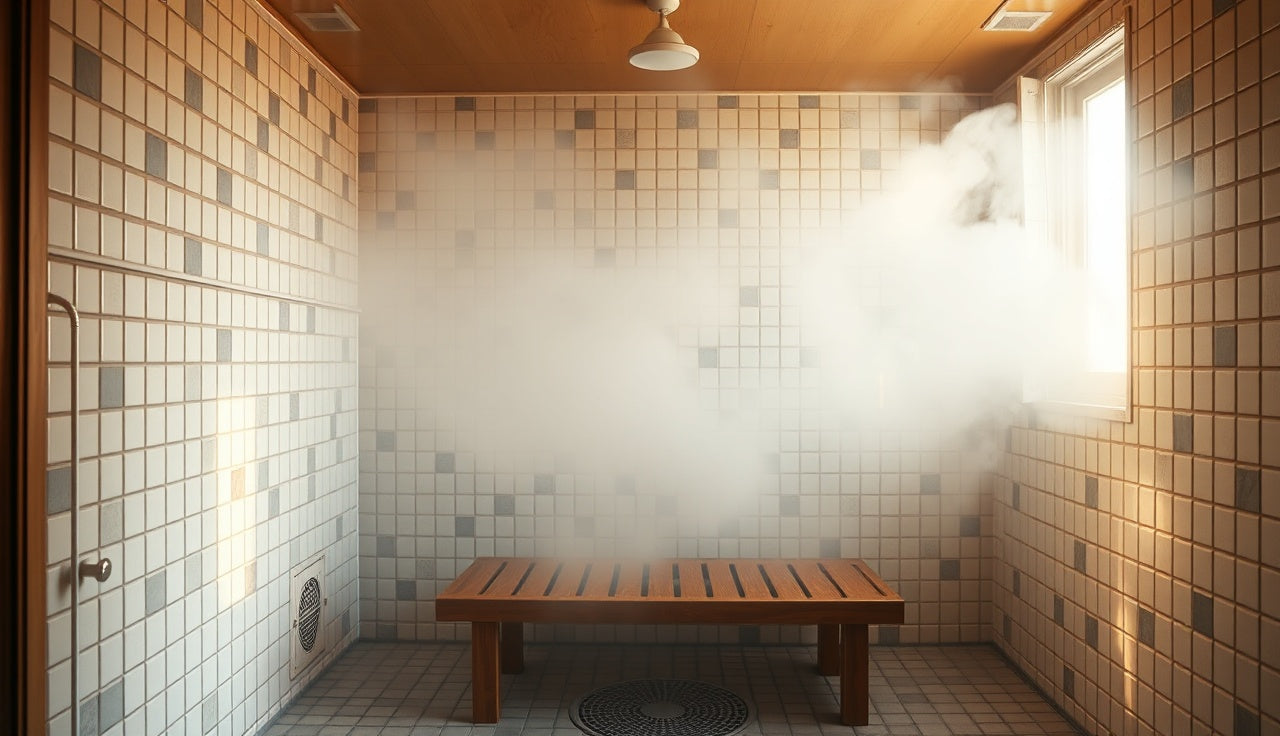
One practical point: a steam room's humidity comes from a steam generator that pumps steam continuously into an enclosed, usually tiled space. The tiles hold heat and stop condensation from chilling the room. That is why the temperature holds steady even as people come and go, unlike a dry sauna where opening the door drops the temperature fast [2].
What is the best temperature for a steam sauna session?
For most healthy adults, the sweet spot is 110°F to 115°F (43°C to 46°C). That range delivers the full heat effect without pushing your body into a zone where the risk starts to outrun the reward.
115°F to 120°F is fine for people who are acclimatized and in good health. First-timers and anyone sensitive to heat should start at the low end and work up over several sessions. There's no prize for going hotter.
A few things shift what "best" means for you. Fitness matters: better cardiovascular fitness helps your body redirect blood to the skin and manage the rise in core temperature [3]. Body mass matters too, since a larger body makes more metabolic heat and may find the same room more taxing. Age cuts the other way. Older adults often sweat less than they used to, which means they can be more overheated than they feel.
Session length carries as much weight as temperature. At 110 to 115°F, aim for 15 to 20 minutes. Push past 30 minutes in a properly heated steam room and even healthy adults enter territory where dehydration and cardiovascular strain turn into real concerns [4]. The heat feels tolerable long before your body is done sweating and struggling to cool.
If you're planning a home sauna and choosing between steam and dry, get the temperature dynamics straight before you spend a dollar.
| Steam room (100% RH) | 115 |
| Turkish hammam (~100% RH) | 105 |
| Infrared sauna (low RH) | 130 |
| Finnish dry sauna (10–20% RH) | 175 |
Source: ACSM Heat Guidance & industry standards, compiled 2024
Why does humidity make steam sauna temperature feel so different?
Humidity changes everything because it shuts down your main cooling system. In a dry sauna, low humidity lets sweat evaporate fast off your skin, and that evaporation pulls heat away. You sweat, it evaporates, you lose heat. The system works.
Heat moves from air to skin through three routes: conduction, convection, and radiation. Dry saunas let evaporative cooling fight back against all three. Steam rooms take that defense away.
At 100% relative humidity, evaporation essentially stops. Sweat drips off you instead of evaporating into the air. Your biggest heat-loss channel is mostly closed. The air, the steam, and the hot tiled surfaces keep pouring heat into your skin, and your core temperature climbs faster than it would in a dry room at a higher thermometer reading.
The wet-bulb globe temperature (WBGT) index, used by the U.S. military, OSHA, and sports medicine groups to gauge heat stress, captures this. OSHA guidance on heat illness prevention treats humidity as a multiplier of heat stress, not a footnote [5]. A steam room at 115°F lands in a WBGT range that most occupational frameworks would flag for careful management.
This is not a reason to skip steam rooms. It's a reason to respect them and to understand why the number on the wall tells you only part of the story.
Is steam sauna temperature safe? What do the guidelines say?
Steam rooms have a long, safe track record when you use them sensibly, and the safety envelope is well mapped. The one risk to watch is core temperature climbing too high. Core temperature above 104°F (40°C) is heat exhaustion territory. Above 106°F (41°C), heat stroke becomes a medical emergency [6].
Healthy adults in a well-maintained steam room at 110 to 120°F usually see core temperature rise 1 to 2°F over a 15 to 20 minute session, which stays in a safe range as long as they leave when they feel dizzy, nauseated, or wiped out.
The Centers for Disease Control and Prevention names the highest-risk groups for heat illness as older adults, young children, people with chronic conditions (especially cardiovascular disease, diabetes, and kidney disease), and people on certain medications including diuretics, beta-blockers, and antipsychotics [7]. If you fall into any of those groups, talking to your doctor before using a steam room is real advice, not boilerplate.
Pregnancy is its own concern. The American College of Obstetricians and Gynecologists recommends that pregnant women avoid activities that raise core temperature above 102.2°F (39°C), because sustained heat in the first trimester carries potential fetal risk [8]. A steam room can hit that threshold fast.
Everyone else: hydrate before you go in, listen to your body, and leave at the first sign of lightheadedness. A steam room should feel like hard work, not a white-knuckle test.
How long should you stay in a steam sauna at typical temperatures?
At 110 to 120°F and 100% humidity, plan on 15 to 20 minutes per session if you're a healthy adult. Some experienced users go 25 or 30 minutes, but the extra benefit past 20 minutes is unclear while the dehydration risk is not.
The research on heat exposure and cardiovascular outcomes keeps growing. A 2018 study in Mayo Clinic Proceedings followed Finnish sauna users over 20 years and found that bathing 4 to 7 times per week was associated with lower cardiovascular mortality than once-weekly use [9]. That study used Finnish dry saunas above 170°F, so applying it directly to steam rooms takes some caution. The broad principle, that regular moderate heat exposure may help, seems to hold. The right steam-room dose is not pinned down the same way.
Here's the practical version. If you're doing contrast therapy, pairing steam with a cold plunge or ice bath after each heat round, run 10 to 15 minutes in the steam room, then 2 to 3 minutes in cold water, then rest. Repeat 2 to 3 rounds. Leave the steam room when your body says so, not when a timer tells you to stay.
What temperature should I set my home steam generator to?
Set the thermostat to 110 to 115°F for general home use. Most residential steam generators from brands like Mr. Steam, Steamist, and Kohler let you dial in a target and cycle the generator on and off to hold it.
Room size matters more than people expect. A properly sized generator should bring a room to operating temperature in 10 to 15 minutes from cold. If it takes 25 to 30 minutes, or the temperature stalls at 100°F, the generator is probably undersized for the room volume. Generators are rated in kilowatts (kW), and the common manufacturer rule of thumb is roughly 1 kW per 45 to 50 cubic feet of room volume, bumped up for rooms with granite or natural stone, which soaks up more heat than tile [10].
A few setup notes. Put the steam outlet near the floor and away from the seats, so steam rises through the room instead of blasting someone at bench height. A digital thermostat with a remote lets you preheat before you walk in. Wall insulation matters more than most people think: a poorly insulated steam room burns energy and fights to hold temperature.
SweatDecks covers home steam and sauna equipment if you're shopping, and the home sauna section has generator sizing guides alongside unit comparisons.
How does steam sauna temperature affect the health benefits?
Temperature drives the size of the effect. The research on sauna use is getting stronger, though most of the best studies use traditional Finnish dry saunas rather than steam rooms. The core mechanism is shared: repeated controlled heat stress that raises heart rate and core temperature.
Cardiovascular response is the most studied benefit. Heat causes peripheral vasodilation, higher cardiac output, and heart rate increases in the range of moderate aerobic exercise. At 110 to 115°F, heart rate often climbs to 100 to 120 beats per minute in healthy adults, sometimes higher [9].
Muscle recovery is a popular reason athletes hit the steam room after training. More blood flow to muscle tissue may help clear metabolic byproducts and ease delayed onset soreness, but the evidence here is thinner than the cardiovascular data. Nobody has a strong controlled trial on steam rooms for muscle recovery specifically; the closest studies use Finnish saunas [11].
Respiratory relief is one area where steam rooms beat dry saunas. Warm, moist air can loosen congestion and may help people with asthma or sinusitis in the short term, though this is comfort, not treatment. The American Lung Association notes that warm, humid air can soothe airways but also warns that mold in poorly maintained steam rooms is a respiratory risk [12].
Temperature shapes all of it. A steam room at 100°F is a different stimulus than one at 120°F. Warmer means higher cardiovascular demand, more sweat, and a stronger heat-stress adaptation. More is not always better, especially if it means you quit early because you're miserable. Steady sessions at 110 to 115°F beat occasional 120°F sessions that end at 8 minutes.
For more on the evidence, the sauna benefits guide covers the cardiovascular, cognitive, and recovery data.
Does steam sauna temperature differ between commercial and home setups?
Expect 110 to 115°F in a well-maintained commercial steam room. Many U.S. gyms and spas target that range. Some run slightly cooler, around 105°F, especially in facilities worried about liability.
Home setups can actually hold temperature better. A dedicated residential generator with a digital thermostat keeps things steady once the room is up to operating temperature. The swings you feel in a commercial steam room usually come from the door opening constantly, the sheer size of the space, and generators that get serviced on and off.
Watch one thing in a home install: sensor placement. A sensor high on the wall near the ceiling reads warmer than one at bench height. If you want to know the air temperature where you actually sit, put the sensor there, not up top. That gap can easily run 5 to 8°F between the reading and your experience.
If you're looking at a portable sauna, most are steam-based and tend to run 105 to 115°F, with looser control and faster cool-down when you open the tent. They're a fair entry point, but they're a different experience from a tiled steam room.
What are the signs that a steam room is too hot?
A steam room is too hot, or you've been in too long, when you notice any of these: dizziness, a heart that pounds uncomfortably hard, nausea, a headache that worsens the longer you sit, or a sudden stop in sweating. That last one, paradoxical anhidrosis, can show up when your thermoregulatory system starts to fail under extreme heat load. It's an early warning sign of heat exhaustion.
Mild discomfort and heavy sweating are normal. Lightheadedness is not. Get out, sit somewhere cooler, drink water, and if symptoms don't fade within a few minutes, move to a cool environment right away.
For first-timers, the first 5 minutes often feel the worst because your skin hasn't fully vasodilated yet. Plenty of people bail at 7 minutes thinking they can't take it, then find on a return visit that riding through that adjustment makes the whole thing far more comfortable. Still, if you genuinely feel unwell, no article should tell you to push through it.
Running a steam room above 120°F is a bad idea for any recreational or wellness use. At that level with 100% humidity, the wet-bulb temperature creates heat stress that outpaces your body's ability to keep up, especially for anyone who isn't in excellent cardiovascular shape.
Can you do contrast therapy with a steam sauna?
Yes, and it works well. Steam heat paired with cold immersion is one of the most popular recovery protocols among athletes and general users alike.
The standard protocol alternates heat and cold: 10 to 20 minutes in the steam room, then 2 to 5 minutes in a cold plunge or ice bath at 50 to 59°F (10 to 15°C), then rest. Repeat 2 to 3 times. Physiologically you get a fast swing between peripheral vasodilation in the heat and vasoconstriction in the cold, which some researchers describe as a workout for your blood vessels that may support circulation and recovery [13].
Here's the honest state of the research. Contrast therapy studies vary a lot in protocol and outcomes. The Bieuzen et al. meta-analysis in PLoS ONE found modest evidence for reduced muscle soreness with contrast water therapy compared to passive rest, but the effect sizes were small and study quality was uneven [13]. Nobody has a strong steam-room-specific contrast trial. The experiential evidence is strong; the clinical evidence is promising but not settled.
For the cold side of the equation, the cold plunge benefits guide covers its own growing body of research, and the combination feels satisfying in practice no matter which citation you prefer.
At SweatDecks, pairing a home sauna with a cold plunge is getting more popular for exactly this reason. Dial the steam room to 110 to 115°F and the plunge to 50 to 55°F and you get a real physiological contrast you can feel session to session.
Frequently asked questions
What temperature should a steam room be set to for beginners?
Start at 105°F to 110°F (40°C to 43°C) for your first few sessions. That's enough heat stress to produce real effects without overwhelming someone new to high-humidity heat. Cap your first sessions at 10 minutes, hydrate well before you go in, and let yourself leave early. Acclimate over several visits before you move up to 115°F.
Is 120°F too hot for a steam room?
120°F at 100% humidity is the upper edge of what most recreational steam rooms should run. It isn't inherently dangerous for healthy adults in short 10 to 15 minute sessions, but it leaves little margin for error. At that wet-bulb temperature, heat stress builds fast. If your steam room consistently runs above 120°F, check the generator thermostat calibration.
How hot is a steam sauna compared to a Finnish sauna?
A Finnish dry sauna typically runs 150°F to 195°F, while a steam sauna runs 110°F to 120°F. The dry sauna reads 30 to 70°F hotter, but the steam room's 100% humidity blocks evaporative cooling, which is why the lower temperature can feel equal or more intense to many people. They're genuinely different physiological experiences.
How long should you stay in a steam room at 110°F?
At 110°F with full humidity, 15 to 20 minutes is a solid target for healthy adults. You can push to 25 minutes once you're well acclimated and well hydrated, but returns drop off past 20 minutes and dehydration risk climbs. Get out sooner if you feel dizzy, nauseated, or your heart feels like it's working too hard.
What is the difference between a steam room and a sauna in terms of temperature?
A steam room runs 110 to 120°F at ~100% humidity. A traditional sauna runs 150 to 195°F at 10 to 20% humidity. The steam room is much cooler on a thermometer, but the saturated air blocks sweat evaporation and creates comparable heat stress at lower temperatures. The structure differs too: steam rooms are tiled and sealed, saunas use wood and allow air exchange.
Is a steam room or dry sauna better for muscle recovery?
Both raise body temperature and increase blood flow to muscle, which may help recovery. The research base for dry Finnish saunas is larger and better controlled. Steam rooms have an edge for upper respiratory congestion. If muscle recovery is your main goal, using either format consistently probably matters more than which you pick. Pairing either with cold immersion has modest evidence behind it.
Can the temperature of a steam room be too low to be effective?
Below about 100°F at high humidity, the cardiovascular stimulus gets mild and you sweat less. That's fine for pure relaxation, but the heat adaptation effects in the research need your core temperature to actually rise, which takes closer to 110°F. A steam room stuck at 95°F is more like a warm shower than a therapeutic heat session.
Is steam sauna temperature safe during pregnancy?
The American College of Obstetricians and Gynecologists recommends pregnant women avoid activities that raise core body temperature above 102.2°F (39°C), especially in the first trimester. A steam room at 110°F can hit that threshold quickly. Most OBs advise skipping steam rooms and hot tubs during pregnancy. This is one case where checking with your doctor isn't optional advice.
What humidity level is normal in a steam room?
Steam rooms run at or very near 100% relative humidity. It's not a dial you set apart from temperature; the steam generator saturates the enclosed space by design. The combination of target temperature (110 to 120°F) and full saturation defines the steam room environment. A space with less than full humidity probably isn't enclosed or sealed properly.
Does a steam sauna burn calories?
Your metabolic rate does rise in a steam room as your body works to regulate temperature, and heart rate climbs to the level of light-to-moderate aerobic exercise. Calorie estimates vary widely and are hard to separate from water weight loss, which isn't fat. Nobody has strong controlled data on steam room calorie burn. The cardiovascular and heat adaptation effects are far better supported than any fat-loss claim.
How do I know if my home steam room is at the right temperature?
Use a calibrated digital thermometer placed at bench height, not near the ceiling, which reads hotter. Your target is 110 to 115°F for general use. The room should reach that within 15 minutes of the generator starting. If it stalls below 100°F or takes more than 20 minutes to heat, your generator may be undersized for the room volume or the insulation is short.
What happens to your body when you sit in a steam sauna?
Your skin temperature rises almost at once. Blood vessels in the skin vasodilate, pulling blood toward the surface to dump heat. Heart rate climbs, often to 100 to 120 beats per minute. Core temperature rises gradually. Sweating increases, though the sweat doesn't evaporate the way it would in dry air. Over a 15 to 20 minute session, core temperature may rise 1 to 2°F in a healthy adult.
Can you use a steam room every day?
For healthy adults, daily use at moderate temperatures (110 to 115°F) and session lengths (15 to 20 minutes) appears safe and is common in cultures with long sauna traditions. The 20-year Finnish cohort study found benefits tied to more frequent use, up to daily. Dehydration is the main practical risk, so rehydrate fully after every session and track how you feel over time.
Sources
- American College of Sports Medicine, Heat and Hydration position resources: Wet-bulb temperature accounts for humidity and is a more accurate predictor of heat stress than dry-bulb temperature alone
- U.S. Department of Energy, Moisture Control Guidance for Building Design: Tiled, sealed steam room enclosures retain heat and limit temperature drop when doors open, unlike wood-lined dry saunas
- National Institutes of Health, MedlinePlus, Heat Disorders overview: Cardiovascular fitness improves the body's ability to redirect blood to the skin and manage core temperature elevation during heat exposure
- CDC, Heat Stress in Workers, NIOSH guidance: Extended heat exposure without rest increases dehydration and cardiovascular strain, particularly above 30 minutes
- OSHA, Heat Illness Prevention guidance: OSHA's heat stress risk assessment explicitly treats humidity as a multiplier of heat danger, not a secondary factor
- CDC, Extreme Heat Prevention, Heat-Related Illness guidance: Core body temperature above 104°F constitutes heat exhaustion territory; above 106°F, heat stroke is a medical emergency
- CDC, Extreme Heat and Your Health, high-risk groups: Older adults, young children, people with cardiovascular disease, diabetes, kidney disease, and those on certain medications face higher heat illness risk
- American College of Obstetricians and Gynecologists, Exercise During Pregnancy FAQ: ACOG recommends pregnant women avoid activities that raise core body temperature above 102.2°F (39°C), particularly in the first trimester
- Laukkanen et al., Mayo Clinic Proceedings, 2018, 'Sauna bathing and systemic inflammation': Sauna bathing 4–7 times per week over 20 years was associated with lower cardiovascular mortality vs once-weekly use; heart rate in sauna can rise to 100–120+ bpm
- Mr. Steam, Residential Steam Generator Sizing Guide: General industry rule of thumb is approximately 1 kW per 45–50 cubic feet of steam room volume, adjusted upward for natural stone surfaces
- NIH National Library of Medicine, PubMed, Heat therapy and muscle recovery review: Evidence for sauna use in muscle recovery is promising but most studies use Finnish dry saunas; steam-room-specific muscle recovery trials are sparse
- American Lung Association, Indoor Air Quality resources: Warm, humid air may soothe airways short-term, but poorly maintained steam rooms with mold pose a respiratory risk
- Bieuzen et al., PLoS ONE, 2013, 'Contrast Water Therapy and Exercise Induced Muscle Damage': Meta-analysis found modest evidence for reduced muscle soreness with contrast water therapy vs passive rest; effect sizes small and study quality variable

Share:
Optimal sauna temperature: what the research actually says
Chest freezer cold plunge: the complete DIY guide