
Last updated 2026-07-09
TL;DR
A chest freezer converted into a cold plunge costs $150-$600 total, holds water between 38-55°F, and works well for daily cold immersion at home. You need a freezer, a waterproof liner or spray coating, a way to filter the water, and a thermometer. It's the cheapest path to consistent cold therapy short of a dedicated cold plunge unit.
What is a chest freezer cold plunge and does it actually work?
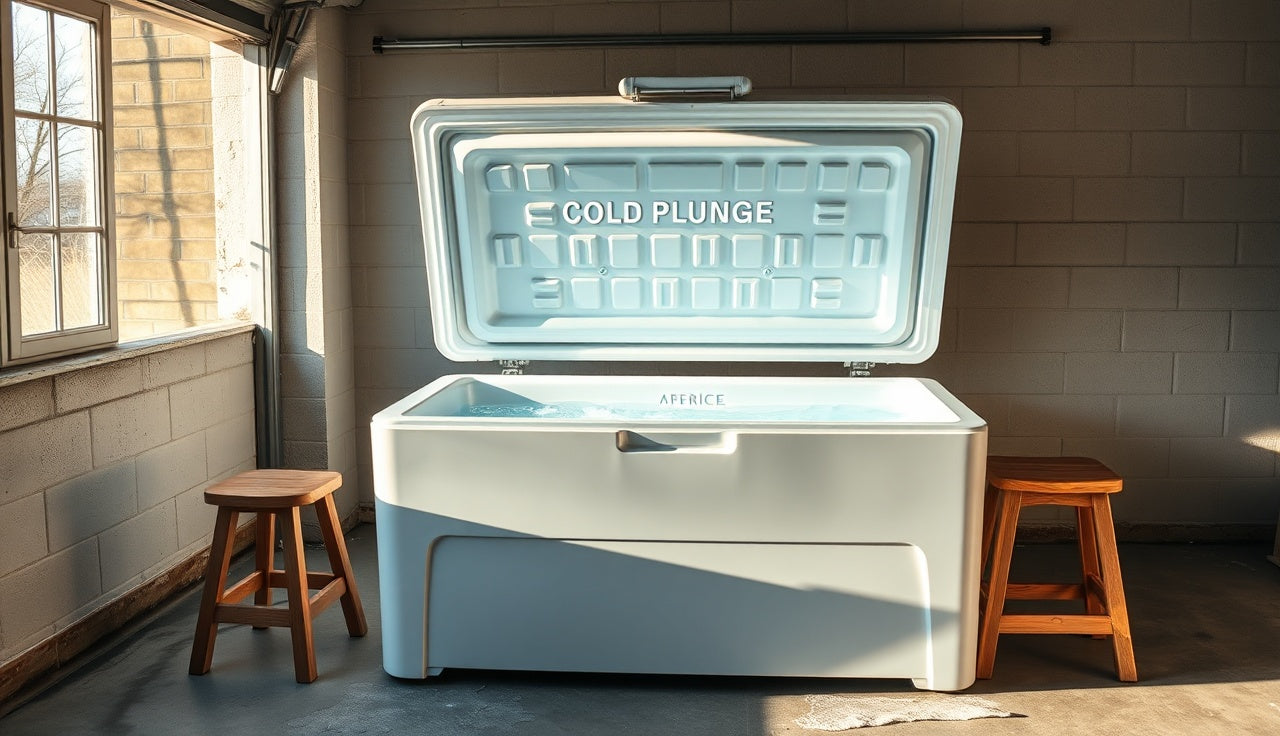
A chest freezer cold plunge is exactly what it sounds like: a standard chest freezer, usually 7 to 15 cubic feet, converted to hold water instead of frozen food and used for cold water immersion. You fill it, set the thermostat to somewhere in the 38-55°F range, and climb in.
It works. That's the short answer.
The physics are simple. A chest freezer is built to hold cold temperatures efficiently, and water has a high thermal mass, so once the unit reaches your target temp, it holds it with minimal compressor cycling. Most chest freezers draw 100-200 watts and cost roughly $2-5 per month to run at cold plunge temps, which is less than a dedicated unit pulling 500+ watts [1].
The reason people do this is money. A purpose-built cold plunge from a name brand runs $3,000-$10,000 or more. A chest freezer conversion can cost as little as $200 total if you buy used. For someone who wants daily cold exposure without a serious equipment budget, the DIY chest freezer is genuinely hard to beat on cost per session.
The tradeoffs are real too. You give up filtration systems, nice looks, easy entry and exit, and the warranty peace of mind that comes with a product designed for human immersion. None of those are trivial, and I'll get into each one. But if you're asking whether the cold is real and whether it does the job, yes, it does.
What size chest freezer do you need for a cold plunge?
Most adults need at least a 7 cubic foot freezer to submerge from the shoulders down with knees bent. If you're taller than about 6 feet, or if you want to stretch your legs out even partially, a 10-15 cubic foot unit is more comfortable.
Here's a rough sizing table:
| Chest Freezer Size | Interior Dimensions (approx) | Good For |
|---|---|---|
| 5 cu ft | ~40" x 22" x 21" | Legs-only or half-body |
| 7 cu ft | ~47" x 25" x 22" | Adults under 5'10", knees bent |
| 10 cu ft | ~55" x 27" x 23" | Most adults comfortable |
| 15 cu ft | ~60" x 30" x 24" | Tall adults, more movement |
Interior dimensions vary a lot by brand, so check the actual interior measurements before buying, not the cubic footage rating. Two 10 cu ft freezers from different makers can have meaningfully different interior shapes.
For water volume, a 10 cu ft freezer holds roughly 70-80 gallons once you account for your body displacement. That matters for water treatment chemistry and for how long the freezer takes to cool from tap temperature (usually 55-65°F out of the tap) down to your target. Expect 4-8 hours for initial cool-down depending on ambient temperature and starting water temp [2].
Buying new, brands like Frigidaire, GE, and Midea all make reliable units in the 7-15 cu ft range for $200-$450. Facebook Marketplace and Craigslist regularly have used chest freezers in good condition for $75-$150.
How cold does a chest freezer get and what temperature should you use?
A chest freezer thermostat typically goes down to 0°F or below, far colder than you'd ever use for cold plunge. The practical question is whether you can dial it up to hold the 38-55°F range, and the answer depends on the specific model.
Many chest freezers have analog dials that run from 1 (warmest) to 7 (coldest), with no precise temperature readout. At the lowest setting on most units, water stabilizes somewhere between 33-40°F. At a mid-setting, you can often land in the 45-55°F range. The problem is that "mid setting" means something different on every freezer, so a separate digital thermometer is not optional. Buy one. They cost $10-15 at any hardware store.
If you want tighter control, an external temperature controller (sometimes called an Inkbird or STC-1000 type controller) plugs between the wall outlet and the freezer, and you set an exact target. The controller cuts power to the compressor when water hits your target and restores it when temp rises above your threshold. These cost $20-40 and are genuinely worth it [3].
On the science side: research on cold water immersion most commonly uses temperatures between 50-59°F (10-15°C). A 2022 analysis published in PLOS ONE found that "water temperatures between 10-15°C are most commonly used across cold water immersion studies," with session durations typically ranging from 5 to 20 minutes [4]. Going colder adds risk without clear added benefit for most people. I'd start at 55°F and work down over a few weeks rather than jumping straight into 38°F water.
| Stock tank + ice (daily use) | $900 |
| Chest freezer DIY (mid estimate) | $500 |
| Chiller on chest freezer | $1,200 |
| Dedicated cold plunge (entry) | $2,700 |
Source: U.S. Department of Energy, Energy Saver; market price survey 2024
What are the health effects of cold water immersion?
Cold water immersion research has grown over the last decade, though the quality of evidence is still uneven and nobody should oversell what we know.
The most consistent findings center on recovery from exercise. A meta-analysis in the British Journal of Sports Medicine looked at 99 trials involving cold water immersion and found reductions in delayed onset muscle soreness and perceived fatigue compared to passive recovery [5]. The effect is real but not massive, and it may blunt some hypertrophy adaptations if done immediately after strength training, per separate research from the same period [10].
For mood and mental state, the data is more interesting than it is conclusive. Cold exposure triggers a norepinephrine release in the brain. A study published in the European Journal of Applied Physiology found that immersion in 14°C water for one hour raised plasma norepinephrine by about 300% and dopamine by about 250% [6]. Whether that translates to lasting mood improvements in regular practitioners at shorter durations is still being studied.
For general metabolic effects, some cold exposure research points toward brown adipose tissue activation and improved insulin sensitivity, but most of that work is preliminary or done in conditions more extreme than a home chest freezer. Conservative takeaway: cold immersion probably helps with recovery, probably lifts mood acutely, and is a decent mental training tool. What it almost certainly doesn't do is replace sleep, nutrition, or actual training.
If you have cardiovascular conditions, Raynaud's disease, or cold urticaria, talk to a doctor before using a cold plunge. Cold shock response from sudden immersion raises heart rate and blood pressure sharply in the first 30-60 seconds [7]. That's manageable for healthy people who know what to expect. It is not trivial for people with existing conditions.
For more on the broader research, the cold plunge benefits guide goes deeper on specific mechanisms.
How do you actually convert a chest freezer into a cold plunge?
Here's the honest step-by-step. None of this is hard, but skipping steps creates real problems.
Step 1: Clean and inspect the freezer. If buying used, clean every surface with a diluted bleach solution and rinse thoroughly. Check the lid seal and the drain plug (if there is one). Many chest freezers have a small drain plug at the bottom or side. If yours doesn't, you'll need a pump to empty it.
Step 2: Line or seal the interior. This is the most debated step in the DIY community. The concern is that the raw metal interior of a freezer isn't rated for prolonged water contact, and rust or electrical problems can follow. Three main approaches:
- A custom-cut vinyl or PVC liner (drop-in, runs $50-200, some sellers on Etsy and Amazon make these to size)
- A food-safe rubberized coating like Flex Seal or similar (spray or brush on, let cure for 24-48 hours before filling)
- No liner at all, just regular water changes and monitoring (common, works for many people, but I'd use a liner or coating)
Step 3: Set up temperature control. As above, an external temperature controller like an Inkbird ITC-308 is worth the $30. Set it to your target temperature.
Step 4: Water treatment. Stagnant warm-ish water in a closed container grows bacteria fast. You need to either change the water every few days or treat it. Options: food-grade hydrogen peroxide (about 1/4 cup of 3% H2O2 per 100 gallons, added weekly), a small pool chlorine tablet in a floater, or an ozone injection system. A small submersible pump to circulate water also helps a lot [2].
Step 5: Get in and out safely. Chest freezers are awkward to climb into. A step stool or small wooden platform outside the freezer, plus a grab handle mounted to the wall or a freestanding unit, prevents the embarrassing and potentially injurious scramble. Don't skip this.
Step 6: Add a lid prop. You want to be able to open the lid from inside if needed. A simple bungee cord or a prop stick solves this.
What are the costs of a DIY chest freezer cold plunge vs a dedicated unit?
This is where the chest freezer setup makes its strongest argument.
| Cost Item | DIY Chest Freezer | Dedicated Cold Plunge |
|---|---|---|
| Initial purchase | $150-$450 (freezer) | $2,500-$10,000+ |
| Liner or coating | $50-$200 | Included |
| Temperature controller | $25-$40 | Included |
| Water treatment supplies | $10-$30/year | Included (often) |
| Monthly electricity | $2-$5 | $10-$40 |
| Total year 1 | ~$250-$750 | $2,500-$10,000+ |
Over five years, even with maintenance costs and eventual replacement of the freezer unit, the DIY path costs a fraction of a dedicated plunge. The gap is real.
What you're paying for with a dedicated unit: filtration (usually ozone or UV), a proper entry system, looks, and a warranty that explicitly covers human immersion. If you're going to put this in a visible part of your home or backyard and care how it looks, that matters. If you're putting it in a garage and you're the only one using it, the chest freezer is a very defensible choice.
A middle path worth knowing about: some brands now sell dedicated cold plunge chillers that mount onto a chest freezer you own, giving you temperature precision and filtration without the full price of a turnkey unit. These run $400-$1,200. They're worth considering if you want a cleaner setup without going fully purpose-built.
For comparison shopping on purpose-built units, the cold plunge category page covers what's available at different price points.
Is a chest freezer cold plunge safe?
For most healthy adults, yes, with reasonable precautions. A few specific things matter.
Electrical safety is the biggest one. You're putting a large appliance next to water you're going to sit in. The freezer should be plugged into a GFCI-protected outlet, which trips the circuit if it detects a ground fault. The National Electrical Code (Article 680) requires GFCI protection for outlets within 6 feet of pools and similar water features [8]. A chest freezer used as a plunge is not exactly a pool, but the principle is the same. If your garage or outdoor outlet isn't GFCI protected, get an electrician to add one or use a GFCI outlet adapter. This is not optional.
Cold shock response is real. The first 30-60 seconds in cold water trigger involuntary gasping, hyperventilation, and a rapid heart rate increase. This is normal physiology, not a sign of danger for healthy people, but it's the reason you should never use a cold plunge alone if you're new to it, and why you should enter slowly rather than jumping in. The UK's Royal National Lifeboat Institution has published extensive public guidance on cold water shock and its effects [7].
Bacterial contamination is a genuine concern if you don't treat or change the water regularly. Water at 38-55°F slows bacterial growth compared to warm water, but it doesn't eliminate it. Change water every 1-2 weeks without treatment, or use a treatment protocol (hydrogen peroxide or pool chlorine at appropriate concentrations) if you want to stretch to 4-6 weeks between changes.
Who shouldn't use one without medical clearance: people with heart conditions, uncontrolled hypertension, peripheral artery disease, cold urticaria, Raynaud's syndrome, or those who are pregnant. This is standard advice for any cold immersion, not specific to the DIY setup.
How do you keep the water clean in a chest freezer cold plunge?
Water hygiene is the part most people underestimate when they build their first chest freezer plunge. Cold slows bacterial growth but doesn't stop it, and the conditions in a chest freezer (still water, organic material from skin contact, periodic warming when the lid is open) are hospitable enough to matter.
Four main approaches, from simplest to most involved:
Frequent water changes. The laziest and cheapest option. Drain or pump out the water every 5-7 days, rinse, refill. Effective, but you're waiting hours for the water to cool each time, which disrupts your routine.
Hydrogen peroxide treatment. Food-grade 3% hydrogen peroxide added at roughly 1/4 cup per 100 gallons, once or twice weekly, controls most bacteria without the chemical load of chlorine. It breaks down into water and oxygen, leaving no persistent residue. This is what many DIY plungers use as a first-line treatment.
Pool chlorine. Small stabilized chlorine tablets in a floater work, but you need to keep free chlorine between 1-3 ppm and check it regularly with test strips. The CDC's Healthy Swimming guidance recommends free chlorine at 1-3 ppm and pH between 7.2 and 7.8 for sanitation [11]. The cold temperature slows chlorine dissipation, so you need less than you'd use in a pool.
Ozone or UV systems. A small ozone generator or UV sterilizer designed for hot tubs or small pools, plugged inline with a circulation pump, gives you continuous sanitization with minimal chemical input. Initial cost is $80-$300 for a decent unit, but water change frequency drops to monthly or less. If you're using this plunge daily and don't want to think about water chemistry every week, this is where I'd put the money.
A submersible pump ($20-50) running for 15-30 minutes after each session to circulate and aerate the water makes any of these approaches work better.
How long should you stay in a chest freezer cold plunge?
Duration depends on temperature and your experience level. The research mostly uses 5-20 minute sessions, and going longer doesn't appear to add proportional benefit while it does add hypothermia risk.
A reasonable progression for someone new to cold immersion:
- Week 1-2: 1-3 minutes at 55-60°F
- Week 3-4: 3-5 minutes at 50-55°F
- Month 2+: 5-10 minutes at 45-55°F
Most practitioners settle somewhere in the 3-10 minute range for daily or near-daily use. The PLOS ONE analysis cited earlier noted that across studies, "mean immersion durations ranged from 5 to 20 minutes" at the temperatures most commonly used [4]. There's no strong evidence that going past 15-20 minutes adds benefit, and core temperature drops meaningfully past that point.
Watch for these signals to get out: uncontrollable shivering that starts while you're still in the water, skin that looks mottled or purple (beyond normal redness), difficulty speaking clearly, or a sudden feeling of warmth (which can paradoxically signal hypothermia onset). These are real warning signs, not the normal discomfort of cold immersion.
After exiting, warm up passively by getting into dry clothes and moving around rather than jumping straight into a hot shower. Some research suggests that the post-immersion rewarming period, more than the immersion itself, drives some of the norepinephrine and dopamine response [6]. How much of that holds up in regular daily use is still unclear.
Can you use a chest freezer cold plunge outdoors?
Yes, and many people do. Outdoors gives you drainage options, less worry about water spills, and usually more space for a step-up platform. A few things are specific to outdoor placement.
Weather protection matters more than people expect. Direct sun on a dark freezer in summer works against your compressor, raising energy use and making it harder to hit low temperatures. A simple shade structure or a covered patio makes a real difference. Freezer compressors also have minimum ambient temperature ratings; most are built to work properly down to about 55°F ambient, so if you're in a climate where outdoor winter temps drop below that regularly, the compressor may struggle or stop working correctly in winter.
For outdoor outlets, you need a weatherproof GFCI outlet rated for outdoor use. A standard indoor GFCI outlet is not enough for outdoor installation. Local building codes govern this; most follow the National Electrical Code, which specifies weatherproof covers and GFCI protection for outdoor outlets [8].
If you're pairing outdoor cold plunge use with an outdoor sauna, a common contrast therapy setup, the chest freezer placed near an outdoor sauna or even a portable sauna gives you both hot and cold access in the same space. That's a genuinely good setup for the money.
Drain planning matters outdoors too. You're going to empty and refill the freezer periodically, and 70-80 gallons of water going somewhere specific beats it going everywhere. A drain path or pump-to-hose setup, sorted before you fill it the first time, saves a lot of hassle.
What are the alternatives to a chest freezer cold plunge?
The chest freezer sits in the middle of the DIY-to-purpose-built spectrum. Worth knowing what's on either side.
Cheaper options:
A stock tank (galvanized steel livestock tank, 100-150 gallons) costs $80-$200 at farm supply stores and works for ice bath use, though you have to add ice every time since there's no refrigeration. That's a real ongoing cost: 20-40 lbs of ice per session at $3-6 per bag adds up fast. For occasional use, fine. For daily use, more expensive than running a freezer within a few months.
A large plastic tote or inflatable pool with ice has the same ice-cost problem and worse insulation. Fine for experimenting once or twice.
More expensive options:
Dedicated cold plunge units with built-in chillers, filtration, and entry steps start around $2,500 and go well past $10,000 for brands with good filtration and looks. They're a genuine upgrade in convenience, cleanliness, and longevity. If budget isn't a constraint and you plan to use a cold plunge long-term, they're worth it.
The ice bath guide covers the ice-and-stock-tank approach in more detail for people who want something simpler than a freezer conversion.
SweatDecks carries a selection of purpose-built cold plunges if you're at the point where the DIY route sounds like more friction than it's worth and you want something ready to use.
Chiller-only attachments are a middle path worth noting. These units (brands like Active Aqua or purpose-built plunge chillers) connect to a stock tank or tub you already own and cool the water mechanically without requiring a chest freezer conversion. They run $400-$1,200 and hold temperature more consistently than a freezer thermostat.
What do people get wrong when building a chest freezer cold plunge?
Having spent time in the DIY cold plunge community, a few mistakes come up again and again.
Skipping the GFCI outlet is the most dangerous one. People run an extension cord from an indoor outlet, skip the ground fault protection, and end up with a metal appliance full of water in their garage. This is a genuine electrocution risk. Fix it first, before anything else.
Buying a freezer that's too small. Seven cubic feet sounds like a lot until you're trying to fold your knees inside a metal box. The ten cubic foot range is a much more comfortable daily-use size for most adults, and the price difference between a 7 and a 10 cu ft unit is usually $50-100.
Not planning for water changes before filling it. Eighty gallons of water is heavy (about 667 lbs) and hard to move once it's in. Know how you're going to drain it before you fill it.
Expecting pool-level filtration from hydrogen peroxide alone. H2O2 is a good maintenance chemical, but if you're using the plunge daily and multiple people share it, you need stronger treatment or more frequent water changes. Biofilm can build on the interior walls even at cold temperatures over several weeks.
Using the freezer thermostat alone and never checking actual water temperature. Freezer thermostats aren't calibrated for water; they're calibrated for air. The water temperature can be meaningfully different from what the dial suggests, especially during the first weeks of use. A $12 digital thermometer with a probe tells you what's actually happening.
Ignoring the lid. The stock lid on most chest freezers has no handle on the inside, and the lids are heavy. Practice opening it from inside before your first session. Add a prop or modify the hinge if needed so you can always exit if something goes wrong.
Frequently asked questions
How much does it cost to run a chest freezer cold plunge per month?
Most chest freezers draw 100-200 watts. Running one 24/7 at cold plunge temperatures (38-55°F) typically costs $2-5 per month in electricity at average U.S. rates of around $0.13/kWh. Warmer ambient temperatures (summer, uninsulated garage) push the compressor harder and increase that cost. Compare that to dedicated cold plunge units that can draw 500+ watts and cost $15-40/month to run.
Can any chest freezer be used as a cold plunge, or are some models better?
Most standard chest freezers work. Look for: interior dimensions that fit your body (at least 47" long for most adults), a drain plug at the base for easy emptying, and a thermostat you can adjust to the warmest setting without the compressor running constantly. Frigidaire, GE, and Midea models in the 7-15 cu ft range have a strong track record in the DIY community. Avoid wine coolers or beverage fridges; they're not built to hold water.
Do I need to line my chest freezer before using it as a cold plunge?
Not strictly required, but strongly recommended. The bare metal interior of most chest freezers can rust with prolonged water exposure, and the interior coating on many models isn't rated for water contact. A vinyl or PVC drop-in liner ($50-200), or a food-safe rubberized spray coating like Flex Seal applied and cured before first fill, extends the life of the freezer and keeps your water cleaner. Many people skip this and are fine for 1-2 years; some regret it.
How long does it take a chest freezer to cool water to 50°F?
Starting from typical tap water temperature (55-65°F), a chest freezer takes 4-8 hours to reach 50°F, depending on the ambient temperature of the room, the volume of water, and the freezer's compressor size. Initial cool-down from room temperature water takes longer, sometimes 12-24 hours. Plan your first fill the night before you want to use it.
How often should I change the water in my chest freezer cold plunge?
Without any chemical treatment, change the water every 5-7 days. With hydrogen peroxide treatment (1/4 cup of 3% H2O2 per 100 gallons, added weekly), you can extend that to 3-4 weeks. With an ozone or UV circulation system, monthly changes are usually enough. The cold temperature slows bacterial growth but doesn't eliminate it, so some treatment protocol is needed for daily use.
What temperature should a chest freezer cold plunge be set to?
Most research on cold water immersion uses 50-59°F (10-15°C). That range delivers the physiological responses linked to cold therapy while keeping risk manageable for healthy adults. Start at 55°F if you're new to cold plunging and lower gradually over weeks. Going below 40°F is possible in a chest freezer but adds hypothermia risk without clear added benefit for most people.
Is a chest freezer cold plunge as effective as a real cold plunge?
For temperature and immersion, yes. A chest freezer can hold 38-55°F water just as well as a purpose-built unit. What you lose is filtration quality, looks, ease of entry and exit, and a warranty. The physiological stimulus is the same if the temperature and duration are the same. The practical differences are about convenience and longevity, not effectiveness.
Can you get electrocuted using a chest freezer as a cold plunge?
The risk is real if you skip GFCI protection. A GFCI outlet trips within milliseconds if it detects a ground fault, preventing electrocution. Always plug a chest freezer cold plunge into a GFCI-protected outlet, and never use a standard extension cord without GFCI protection as your sole connection. This is the single most important safety step in the entire build.
How do you get in and out of a chest freezer cold plunge easily?
A sturdy step stool or small wooden platform 12-18 inches high beside the freezer makes a major difference. A wall-mounted grab bar or a freestanding handle next to the plunge gives you something to hold as you swing your legs over the rim. The rim of a chest freezer is typically 30-36 inches high, similar to a bathtub but wider. Practice dry runs before your first cold session.
Does a chest freezer cold plunge need a chiller or does the freezer unit itself cool the water?
The chest freezer compressor is the chiller. You don't need a separate chiller unit. The freezer's built-in refrigeration system cools the water directly, the same way it would freeze food. An external temperature controller (Inkbird or similar, $25-40) gives you precise control over what temperature the compressor targets, which the factory thermostat dial alone doesn't provide accurately.
What's the difference between a chest freezer cold plunge and an ice bath?
An ice bath uses ice added to a container of water to reach cold temperatures, with no mechanical refrigeration. Temperature drops fast but warms up as ice melts, so sessions are time-limited and ice cost is ongoing. A chest freezer cold plunge holds a stable temperature mechanically as long as it's plugged in. For daily use, the chest freezer is significantly cheaper over time than buying ice regularly. The ice bath guide on this site covers the ice approach in detail.
Can two people use a chest freezer cold plunge at the same time?
Not comfortably in most sizes. A 15 cu ft freezer has roughly 60" x 30" of interior space, which is tight for one adult and not workable for two at once. For two-person cold plunge use, a purpose-built tub or a large stock tank (150-300 gallon) is more practical. The chest freezer is fundamentally a solo or sequential-use setup.
How do I drain a chest freezer cold plunge?
If your freezer has a drain plug at the base, remove it and gravity-drain into a bucket or connect a garden hose with a fitting that matches the drain port size. If there's no drain plug, a submersible utility pump ($25-50) connected to a garden hose empties 80 gallons in about 10-15 minutes. Always drain before moving the freezer; full water weight is 650-700 lbs.
Sources
- U.S. Department of Energy, Energy Saver: Appliance Energy Use: Chest freezers typically draw 100-200 watts; energy cost at average U.S. electricity rates puts monthly running cost at roughly $2-5 for cold-plunge-temperature operation
- NSF International, Water Quality and Treatment Overview: Water circulation and treatment (ozone, UV, or chemical) is necessary to control bacterial growth in residential water immersion applications
- Inkbird Technology, ITC-308 Temperature Controller Product Specification: External temperature controllers plug between wall and appliance to maintain precise target temperatures, with typical price range of $25-40
- Moore E et al., PLOS ONE 2022, Cold Water Immersion: Kill or Cure?: Water temperatures between 10-15°C are most commonly used across cold water immersion studies, with mean immersion durations ranging from 5 to 20 minutes
- Bleakley C et al., British Journal of Sports Medicine, Cold-water immersion and injury recovery meta-analysis: Meta-analysis of 99 trials found cold water immersion reduced delayed onset muscle soreness and perceived fatigue compared to passive recovery
- Srámek P et al., European Journal of Applied Physiology, Stress response to cold water immersion: Immersion in 14°C water for one hour increased plasma norepinephrine by approximately 300% and dopamine by approximately 250%
- Royal National Lifeboat Institution (RNLI), Cold Water Shock Public Guidance: Cold water shock causes involuntary gasping, hyperventilation, and rapid heart rate increase in the first 30-60 seconds of immersion
- National Fire Protection Association, NFPA 70 National Electrical Code Article 680: NEC Article 680 requires GFCI protection for outlets within 6 feet of pools and similar water features
- U.S. Energy Information Administration, Average Retail Price of Electricity: Average U.S. residential electricity rate used for cost calculations is approximately $0.13/kWh as of recent EIA data
- Roberts LA et al., Journal of Physiology, Post-exercise cold water immersion and hypertrophy: Cold water immersion immediately post-strength training may blunt hypertrophy adaptations compared to passive recovery
- Centers for Disease Control and Prevention (CDC), Healthy Swimming: Disinfection and Pool Chemistry: Free chlorine should be maintained between 1-3 ppm for effective sanitation; pH should be kept between 7.2 and 7.8

Share:
Steam sauna temperature: what's ideal and why it matters
Cold plunge cooler: how it works, what to buy, and what to skip