
Last updated 2026-07-09
TL;DR
The Solstice Cold Pod is a standalone inflatable or semi-rigid cold plunge tub for home ice bath use, usually priced $200 to $500. It has no built-in chilling. You add ice or a separate chiller. It competes with the Everlast cold plunge ice bath tub and DIY stock tank setups. Good first purchase. Not a forever product for anyone plunging daily.
What is the Solstice Cold Pod and how does it work?
The Solstice Cold Pod is a portable, freestanding cold plunge tub made for home recovery. It is not a hot tub, not a spa, and not a powered hydrotherapy unit. You fill it with water, add ice or a separate chiller, and climb in. That is the whole idea.
Most versions use an insulated cylindrical or barrel-style shell. Some are inflatable with a thick multi-layer wall. Some are semi-rigid with foam insulation. The insulation is the reason to pick it over a plain bathtub. A good insulated shell holds water temperature within a few degrees for several hours without adding more ice, which matters if you are running repeated sessions across a day or a weekend.
The mechanism is simple. Cold water triggers peripheral vasoconstriction, which pushes blood toward your core. Heart rate drops slightly. Norepinephrine climbs sharply. A 2022 review in the International Journal of Environmental Research and Public Health found that immersion at 10 to 15 degrees Celsius (50 to 59 degrees Fahrenheit) produced consistent physiological responses, including reduced skin temperature and elevated norepinephrine within the first few minutes [1]. None of that requires a $5,000 chiller. A basic insulated pod with bagged ice gets you to the same physiology.
Here is where this product actually sits. Better than your bathtub, which loses cold fast and is too shallow for real leg immersion. Cheaper than a purpose-built chiller unit. More durable than the thin inflatable pools selling for under $50. That positioning is honest. It is not the best cold plunge you can own. It is a reasonable first one for someone who wants to start a cold plunge practice without spending thousands.
What are the dimensions and capacity of the Solstice Cold Pod?
The Solstice Cold Pod runs about 27 to 30 inches in internal diameter and 27 to 30 inches deep, holding roughly 80 to 110 gallons depending on the version. That puts it squarely in the barrel-tub category. Sizing matters more than most buyers think, because you need enough depth to submerge to your shoulders when seated and enough width to sit upright without your knees jammed against the wall.
For reference, a standard bathtub holds about 40 to 60 gallons at a practical fill depth, and its shape makes full-body immersion below the chest almost impossible [2].
A 6-foot person will find their knees partly above water in most pod-style tubs. That is not a Solstice flaw. It is a category limit. If full-leg immersion is your priority, you need a longer rectangular plunge tank, and those start around $1,000 for a basic model.
Wall thickness on insulated versions ranges from 1.5 to 3 inches of combined foam and outer shell. Thicker walls slow the temperature climb. In a 70-degree room, a well-insulated pod can hold 50-degree water within about 5 degrees for three to four hours with no ice added after the fill. That figure comes from reported user experience and basic thermodynamics, not a controlled published test on the Solstice specifically, so treat it as a practical ballpark rather than a guarantee.
How much does the Solstice Cold Pod cost, and how does it compare to similar tubs?
The Solstice Cold Pod runs $200 to $500, which makes it a legitimate entry-level buy. Pricing in this category confuses people because the tiers overlap and the brand names blur together. Here is how the field breaks down.
| Product type | Typical price range | Chiller included | Notes |
|---|---|---|---|
| Solstice Cold Pod (inflatable/basic) | $200 to $500 | No | Portable, moderate insulation |
| Everlast cold plunge ice bath tub | $300 to $600 | No | Similar barrel format, thicker walls on some models |
| Basic rigid barrel tubs (various brands) | $400 to $900 | No | More durable long-term |
| Entry chiller + tank bundles | $2,500 to $4,000 | Yes | Consistent temps, no ice needed |
| Premium plunge systems (Ice Barrel, The Cold Plunge, etc.) | $1,000 to $5,000+ | Varies | Brand premium, warranty support |
Know the running cost before you buy. If you want consistently cold water (below 55 degrees Fahrenheit) and your tap does not run cold, you will spend $6 to $15 per session on bagged ice. Do that daily for a year and you are looking at $2,000 to $5,000 in ice alone [3]. That number is the whole reason serious practitioners eventually move to a chiller.
If you are testing the practice, or you live somewhere cold, or you use the chest-freezer trick (fill gallon jugs, freeze overnight, drop them in), the Solstice Cold Pod is a sensible $300 to $500 experiment. If you already know you want to plunge every day, skip it and budget for a chiller system now.
For a wider view of how the market breaks down, the cold plunge category covers the full range.
| Solstice Cold Pod / inflatable pod | $350 |
| Everlast cold plunge ice bath tub | $450 |
| Rigid barrel (various brands) | $650 |
| Stock tank DIY conversion | $225 |
| Entry chiller + tank bundle | $3,250 |
| Premium chilled plunge system | $4,500 |
Source: retail pricing survey and BJSM 2023 position statement context
What temperature range can the Solstice Cold Pod reach, and do you need a chiller?
The Solstice Cold Pod has no built-in temperature control. It holds whatever temperature you create with ice or a chiller. That is the single fact that decides whether it fits your life.
The research-supported plunge range is 10 to 15 degrees Celsius (50 to 59 degrees Fahrenheit) [1]. Most recovery protocols land between 50 and 60 degrees F. Colder is not automatically better. A 2021 paper in PLOS ONE on post-exercise cold water immersion found that 10 to 15 degrees C produced the most consistent reduction in muscle soreness markers compared to both warmer and colder water, though the sample sizes were small [4].
To hit 50 to 55 degrees F in a 100-gallon pod on a warm day, you typically need 40 to 60 pounds of ice added to tap water starting around 60 to 65 degrees F. More if your tap runs warm. That is real money and real logistics every single time.
A separate chiller plugs into a standard 110V or 220V outlet and circulates water through a cooling coil. Entry-level chillers sized for a pod this size run $500 to $1,200. Add that to the pod and you are in the $800 to $1,700 range, which starts to compete with purpose-built systems that include filtration and a warranty built for this exact use.
So the summary is short. Without a chiller, the Solstice Cold Pod is an ice bath tub. With a chiller, it becomes a cold plunge. Both are valid. They are just different products at different costs.
How does the Solstice Cold Pod compare to using a regular bathtub for cold plunge?
A regular bathtub is a surprisingly bad cold plunge vessel despite being free. Three reasons.
Depth first. Most residential bathtubs give you 14 to 17 inches of usable water at capacity. That barely covers your legs when seated, leaving your chest and shoulders in the air. The cold signal to your nervous system depends partly on how much skin sits in cold water, so partial immersion cuts the effect [1].
Insulation second. A porcelain or acrylic tub bleeds heat into the surrounding material and room air fast. Water temperature rises 5 to 10 degrees F within 15 to 20 minutes with no ice added. If your session is 5 minutes, fine. If you want consistent temperature across several sessions in a day, not fine.
Sanitation third. A dedicated tub can be drained, dried, and treated with sanitizer between uses. A bathtub plunge means dumping ice into your bathroom, which works but gets old fast for a daily habit.
The Solstice Cold Pod handles all three at least partly. Deeper immersion, better insulation, and a dedicated vessel you can keep in a garage or outside. It is not perfect. It is clearly better as a cold plunge ice bath vessel than a standard bathroom tub for anyone doing this on a regular schedule.
How long should you stay in a cold plunge, and what does the research say?
Ten to fifteen minutes at 10 to 15 degrees C is the most-cited practical target for recovery. Research protocols range between 5 and 20 minutes. Go longer in very cold water (below 10 degrees C) and hypothermia risk climbs. The Minnesota Department of Health notes that cold water removes heat from the body roughly 25 times faster than cold air at the same temperature [5].
A 2023 position statement in the British Journal of Sports Medicine reviewed multiple cold water immersion studies and rated the evidence for reduced muscle soreness as "moderate," with effects most consistent when immersion happened within 30 minutes after exercise [6]. The same statement flagged that regular cold immersion right after resistance training may blunt some strength adaptations. Nobody has definitively settled whether that matters long-term at practical immersion temperatures.
For general recovery, 10 to 15 minutes at 50 to 59 degrees F is a reasonable aim. Start with 3 to 5 minutes if you are new. You do not need to grind through a full 15 minutes on day one.
The cold plunge benefits page breaks down the published literature in more depth if you want the research side.
Is the Solstice Cold Pod durable, and how long does it last?
Plan on two to three years of regular use from the Solstice Cold Pod if you store it out of direct sunlight and follow the care instructions. Most inflatable and semi-rigid pod-style plunge tubs are not built for five-plus years of daily outdoor abuse, and that is the honest answer.
The failure points cluster in a few places. Seam integrity goes first on inflatable versions, because UV exposure and repeated inflate/deflate cycles stress the seams. Valve quality is next, and cheap valves fail within 12 to 18 months of regular use. The outer cover material degrades in direct sunlight over time. Rigid foam-shell versions outlast the inflatables but are bulkier to store.
None of this is a knock on Solstice specifically. It is a category reality. A $4,000 stainless steel plunge tank is built to run a decade. A $300 insulated pod is not.
Treat the Solstice Cold Pod as a starter product and plan to upgrade to a proper chiller system within two to three years, and the math works cleanly. Expect it to be your forever setup, and you will be disappointed.
The home sauna guides are a useful parallel here, since long-term home recovery gear raises the same durability questions.
How do you set up and maintain a Solstice Cold Pod?
Setup is simple. Inflate if it is the inflatable version, set it on a level surface, fill with water, add ice or connect a chiller, and go. Most people finish the initial setup in under 30 minutes. Full weight lands at 700 to 900 pounds (water alone runs 8.34 pounds per gallon for a 90-gallon fill), so choose your spot before you fill it [7].
Outdoors, pick a shaded spot or buy a cover. Direct sun heats the water and degrades the shell faster. A drainage hose or pump makes emptying easier. Most pods have a drain valve, but gravity drainage crawls depending on your yard grade.
Maintenance is mostly about water quality. Cold water still grows bacteria over time, especially if you add ice from bags carrying trace debris. Three approaches:
Fresh fill each session is the cleanest. A full 90-gallon refill at average U.S. water rates (around $0.005 per gallon) costs roughly $0.45, so money is not the problem. The inconvenience is.
Reuse with treatment means adding pool or spa grade chlorine or bromine and testing pH weekly. Aim for pH 7.2 to 7.6 and free chlorine of 2 to 4 ppm. The CDC's pool water chemistry guidance applies to small plunge vessels too [8]. Change the water fully every two to four weeks regardless.
Ozone or UV purifiers sell as add-ons and cut chemical use. They help. They also add cost.
Who should buy the Solstice Cold Pod, and who should skip it?
Buy it if any of these fit you: you want to try cold plunging before committing to a $2,000-plus system, your tap water runs below 55 degrees F naturally for much of the year, you have limited space and need something portable or storable, or you want a second cold source to pair with a home sauna for contrast therapy.
Skip it if any of these fit you: you want daily plunges at a consistent controlled temperature without ice logistics, temperature precision matters to your training, you want gear that lasts five-plus years without replacement, or you are already burning $60 or more a week on bagged ice for a basic tub and wondering why it feels unsustainable.
The contrast therapy pairing deserves its own note. Plenty of home sauna owners add a cold plunge for heat-cold work. Moving from a hot sauna to cold water and back (usually two to three cycles) has both traditional roots in Finnish sauna culture and some emerging physiology research on cardiovascular and mood effects. A Solstice Cold Pod parked next to an outdoor sauna or portable sauna is a genuinely sensible setup for anyone starting this practice.
SweatDecks carries a curated selection of cold plunge tubs and systems if you want to line the Solstice Cold Pod up against other options before you buy.
How does the Solstice Cold Pod compare to the Everlast cold plunge ice bath tub?
These two show up in the same searches constantly, so a direct comparison earns its space. The Everlast cold plunge ice bath tub sells mostly through fitness retailers and online. It uses a similar barrel or cylindrical format, insulated walls, and no built-in chiller. Pricing lands between $300 and $600 depending on retailer and any bundled accessories.
Here are the differences based on available product specs and user-reported experience.
| Feature | Solstice Cold Pod | Everlast cold plunge ice bath tub |
|---|---|---|
| Typical price | $200 to $500 | $300 to $600 |
| Wall insulation | Moderate (1.5 to 2.5 inches) | Moderate to thick (2 to 3 inches on most models) |
| Cover included | Often yes | Often yes |
| Chiller compatible | Yes (third-party) | Yes (third-party) |
| Material | PVC/TPU inflatable or rigid foam | Often semi-rigid or rigid construction |
| Weight when empty | 15 to 25 lbs | 25 to 40 lbs |
Neither wins across the board. The Everlast tends toward heavier, sturdier construction on its higher-priced models. The Solstice is often lighter and easier to move. If portability matters, lean Solstice. If you want something that feels more permanent and shrugs off UV exposure better, the Everlast's harder shell versions have an edge.
Both are ice bath tubs. Neither is a chiller system. Make the call on that reality, not on small feature differences.
Are there any health risks or contraindications with cold plunge tubs?
Yes, and this deserves a direct answer, not a buried disclaimer.
Cold shock response is real. Sudden immersion below 60 degrees F triggers an involuntary gasp reflex, hyperventilation, and a cardiovascular stress spike. Heart rate and blood pressure jump immediately. For healthy adults it is transient and manageable with slow, controlled entry. For people with cardiovascular disease, arrhythmias, or uncontrolled hypertension, it is a genuine risk. The British Journal of Sports Medicine position statement notes that cold water immersion "should be avoided by individuals with cardiovascular conditions without medical clearance" [6].
Hypothermia is the other risk, mainly for sessions past 20 minutes or water below 50 degrees F. The Minnesota Department of Health notes that immersion in 50-degree water produces physical incapacitation (difficulty controlling limbs) in 30 to 60 minutes [5]. Keep sessions under 15 minutes, and have someone nearby for your first several.
Pregnancy, Raynaud's syndrome, and cold urticaria (an allergic skin reaction to cold) are standard contraindications. Talk to a physician before starting if you have any of these or are unsure.
Healthy adults doing 5 to 15 minute sessions at 50 to 59 degrees F are not at meaningful risk. The danger scales with colder water, longer sessions, and pre-existing conditions. Be honest with yourself about which bucket you sit in.
Can you use a Solstice Cold Pod with a sauna for contrast therapy?
Yes, and this is probably the strongest case for owning one. Contrast therapy, alternating hot and cold exposure, has run through Scandinavian and Japanese bathing traditions for centuries. The physiology cycles vasoconstriction and vasodilation, which some researchers describe as a passive cardiovascular workout. A 2021 study in the Journal of Human Kinetics found that contrast protocols (heat followed by cold immersion, repeated two to three times) produced greater reductions in perceived muscle soreness than cold water immersion alone, though it flagged small sample sizes [9].
A typical at-home protocol with a sauna and a Solstice Cold Pod: 10 to 15 minutes in the sauna at 160 to 190 degrees F, then 2 to 5 minutes in the cold plunge, repeated two to three cycles, finishing cold. Keep the transition quick, ideally within 60 seconds of leaving the sauna.
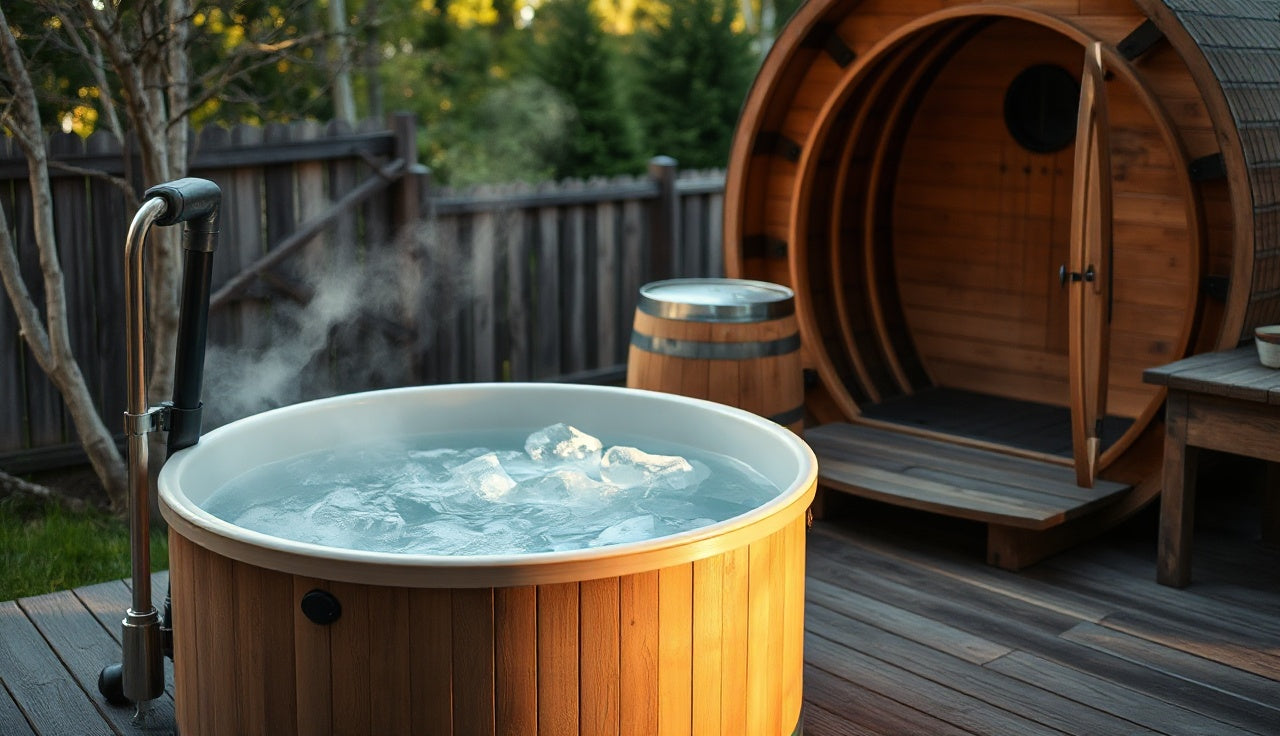
Portability is the real advantage here. You can set the pod right next to an outdoor barrel sauna or beside a portable unit with no plumbing. The transition time between hot and cold matters, physically and mentally, and keeping both in the same outdoor space is what makes the practice stick.
The sauna benefits research is worth reading before you build out the heat side. You can also browse the full SweatDecks cold plunge collection to see compatible systems.
Frequently asked questions
What temperature does the Solstice Cold Pod reach without a chiller?
Without a chiller, the Solstice Cold Pod holds whatever temperature you create with ice or cold tap water. To reach 50 to 55 degrees F in a 90-gallon pod, you typically need 40 to 60 pounds of bagged ice added to tap water starting around 60 to 65 degrees F. Ambient temperature and insulation quality decide how fast it warms back up. Good insulation holds within about 5 degrees F for two to four hours.
How much ice do I need for a cold plunge session in a pod tub?
Plan on 40 to 60 pounds of ice to drop a 90 to 100 gallon pod from 65-degree tap water to around 50 to 55 degrees F. A 20-pound bag runs $3 to $5 at most grocery stores, so each session costs $6 to $15 in ice alone. Do this daily and you reach $2,000 to $5,000 per year, which is the main financial argument for eventually buying a chiller.
Can you use the Solstice Cold Pod outdoors year-round?
Yes, with caveats. In cold climates, drain and store the pod before temperatures drop below freezing, since standing water damages the walls and valves. UV exposure degrades most inflatable and foam-shell materials over time, so a cover during downtime meaningfully extends its life. In mild climates (USDA zones 8 to 10), outdoor year-round use is more practical.
How long does it take to fill and cool a cold plunge pod tub?
Filling a 90 to 100 gallon pod with a standard 2.5 GPM garden hose takes 36 to 40 minutes. Cooling to 55 degrees F depends on your starting water temperature. If tap water runs 60 to 65 degrees F, 40 to 60 pounds of ice drops it to target in 20 to 30 minutes. A chiller takes two to four hours to cool the same volume from ambient temperature.
What is the difference between a cold plunge pod and a traditional ice bath?
A traditional ice bath is any container (often a bathtub or stock tank) filled with water and ice. A cold plunge pod is a purpose-built vessel with insulated walls, a dedicated cover, and better ergonomics for seated immersion. The immersion experience and physiology are identical. The pod difference is practical: better insulation, easier drainage, and simpler sanitation than improvised setups.
Is the Solstice Cold Pod worth the money compared to a DIY cold plunge?
A DIY cold plunge using a galvanized stock tank (50 to 150 gallons, $150 to $300) often beats inflatable pod tubs on durability and longevity at a similar or lower price. The Solstice Cold Pod's advantage is portability and storage. With a permanent outdoor spot and a longevity focus, a stock tank is probably better value. If you need to store or move the tub, the pod format wins.
Does the Solstice Cold Pod come with a cover or lid?
Most versions include an insulating cover or lid. It matters for two reasons: it slows temperature rise between sessions by cutting air contact, and it keeps debris out of the water. A cover can add several hours of useful hold time before you need more ice. If your version does not include one, aftermarket covers are available and worth buying, especially outdoors.
Can you add a chiller to the Solstice Cold Pod?
Yes. Third-party chillers with inlet and outlet hose connections attach to most pod-style tubs. Entry-level chillers that maintain 50 to 55 degrees F in a 90 to 100 gallon vessel run $500 to $1,200. You will use existing drain/fill ports or add fittings for the chiller hoses. This combination kills the daily ice cost but adds upfront expense and some setup complexity.
How do you clean and sanitize a cold plunge pod between uses?
For daily use, run water chemistry like a small pool: free chlorine at 2 to 4 ppm and pH at 7.2 to 7.6. Test weekly with standard pool strips. Add liquid chlorine or a bromine tablet as needed. Drain and scrub the interior every two to four weeks. A UV or ozone sanitizer cuts how much chemical you need but does not replace a full water change.
What safety precautions should I follow when using a cold plunge tub at home?
Enter slowly to manage the cold shock response. Never plunge alone for your first few sessions until you know your tolerance. Keep sessions under 15 minutes below 55 degrees F. Skip alcohol before a plunge. If you have cardiovascular disease, arrhythmia, hypertension, Raynaud's syndrome, or are pregnant, get medical clearance first. The cold shock reflex can cause involuntary gasping; controlled breathing before and during entry reduces it significantly.
How does cold plunging after a sauna session affect recovery?
Alternating heat and cold drives repeated cycles of vasodilation and vasoconstriction, which many practitioners report as more invigorating than either alone. A 2021 study in the Journal of Human Kinetics found contrast therapy protocols cut perceived muscle soreness more than cold water immersion alone. Most protocols use two to three cycles of 10 to 15 minutes of heat followed by 2 to 5 minutes of cold, finishing on the cold side.
How long do inflatable cold plunge tubs last compared to rigid ones?
Inflatable pods with PVC or TPU walls typically last two to four years with regular use and proper care, limited mainly by seam fatigue and UV degradation. Rigid fiberglass, stainless steel, or acrylic tanks last 10 to 20 years. Semi-rigid foam-shell pods land in between, often three to six years. Pricing reflects this: rigid tanks cost $1,000 to $5,000 versus $200 to $600 for inflatable or foam-shell options.
What size cold plunge tub do I need for my height?
For full shoulder and chest immersion in a seated position, you need at least 27 inches of internal depth. Internal diameter should be at least 26 inches for a comfortable seated posture. Taller users (over 6 feet) will almost always have knees above water in a barrel-style pod. For full-leg immersion, rectangular tanks 60 inches or longer are the standard; barrel and pod formats cannot hold a fully extended body.
Where can I buy the Solstice Cold Pod, and are there comparable products?
The Solstice Cold Pod sells through fitness equipment retailers, online marketplaces, and specialty recovery shops. Comparable products at similar prices include the Everlast cold plunge ice bath tub, various barrel-style foam-wall pods from brands like Ice Barrel and Polar Recovery, and stock tank conversions for DIY builds. Sweatdecks.com carries a curated selection across these categories for side-by-side comparison before you buy.
Sources
- International Journal of Environmental Research and Public Health, 2022, cold water immersion review: Water immersion at 10 to 15 degrees Celsius produced consistent physiological responses including reduced skin temperature and elevated norepinephrine within the first few minutes of immersion
- U.S. EPA, WaterSense residential water use data: Standard residential bathtub capacity and typical fill depth for context on cold plunge vessel comparison
- U.S. Bureau of Labor Statistics, Consumer Price Index: Bagged ice pricing range ($3 to $5 per 20-pound bag) used to calculate annual ice cost for daily cold plunge sessions
- PLOS ONE, 2021, cold water immersion and muscle soreness: 10 to 15 degrees Celsius produced the most consistent reduction in muscle soreness markers compared to both warmer and colder immersion conditions
- Minnesota Department of Health, cold water safety guidance: Cold water removes heat from the body approximately 25 times faster than cold air at the same temperature; immersion in 50-degree water produces physical incapacitation in 30 to 60 minutes
- British Journal of Sports Medicine, 2023, cold water immersion position statement: Evidence for reduced muscle soreness rated moderate; cold water immersion should be avoided by individuals with cardiovascular conditions without medical clearance; effects most consistent within 30 minutes post-exercise
- U.S. Geological Survey, Water Science School: Water weighs approximately 8.34 pounds per gallon at standard conditions; used for full pod weight calculation
- Centers for Disease Control and Prevention, Healthy Swimming pool water chemistry guidance: Recommended free chlorine 2 to 4 ppm and pH 7.2 to 7.6 for recreational water vessels; applicable to cold plunge sanitation
- Journal of Human Kinetics, 2021, contrast therapy and muscle soreness: Contrast therapy protocols (heat then cold, 2 to 3 cycles) produced greater reductions in perceived muscle soreness than cold water immersion alone; small sample sizes acknowledged

Share:
Are cold plunges good for you? What the science actually says
Infrared sauna: everything you actually need to know