
Last updated 2026-07-09
TL;DR
Sharper Image sells inflatable cold-plunge tubs in the $80 to $150 range, usually multilayer PVC with an insulating lid and a basic drain valve. They hold roughly 80 to 100 gallons and fit one adult. No chiller, no filtration, no thermometer. Treat it as a cheap way to test the habit, not a serious recovery system. Most committed users upgrade within a year or two.
What is the Sharper Image ice bath and what does it actually include?
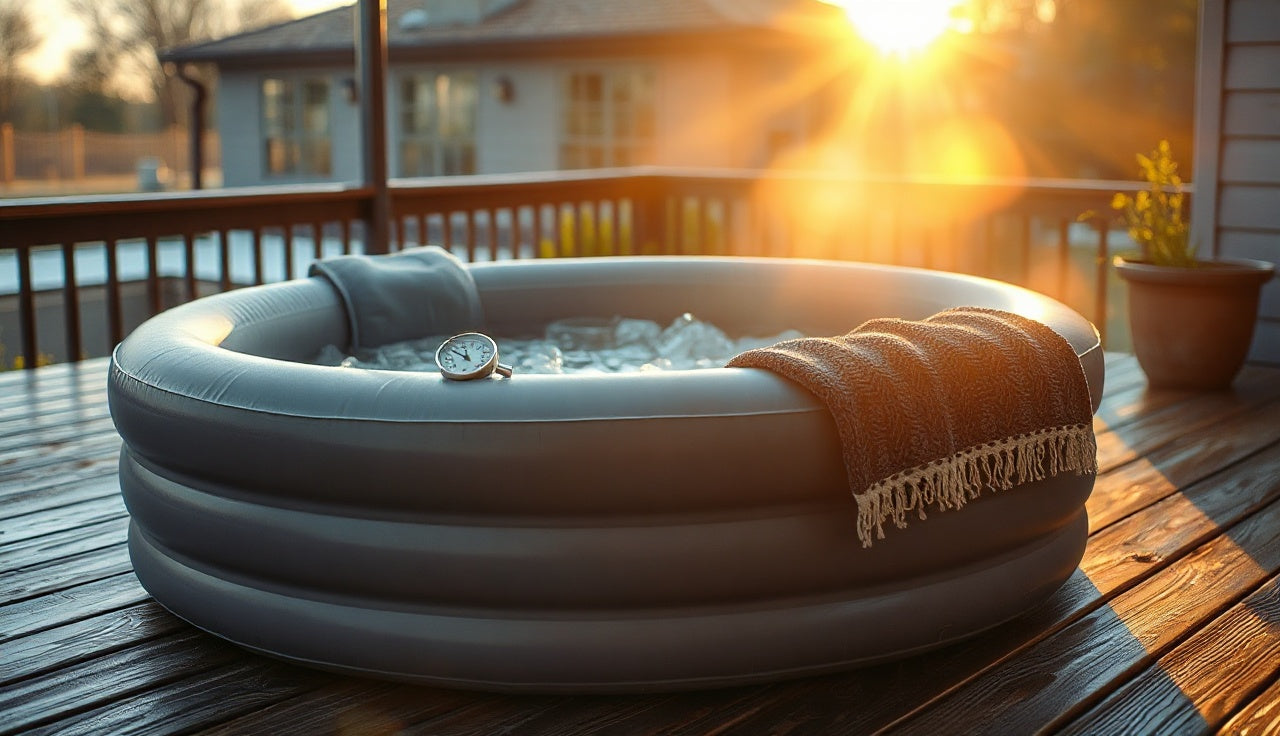
The Sharper Image ice bath is an inflatable cold-plunge tub, not a purpose-built hydrotherapy tank. You get a multilayer PVC barrel or rectangular tub with an insulating outer wall, a fitted lid, and a drain valve at the base. That is the whole package. No chiller. No filtration. No built-in thermometer.
Sharper Image is a consumer gadget and lifestyle brand that sells through Target, Amazon, and its own website. The ice bath line is one small piece of that catalog.
Most models hold somewhere between 80 and 105 gallons. A submerged adult body displaces roughly 10 to 12 gallons, so the math works for one person sitting upright or leaning back in a barrel shape. Setup is exactly what you expect from an inflatable: pump it up, fill it with water, add ice from the store or your own freezer.
The brand has cycled through several versions under names like the Sharper Image Personal Ice Bath Tub and the Sharper Image Inflatable Ice Bath. Retail prices have mostly sat between $79 and $149, depending on the retailer and whether the model is on clearance. For that money you are buying something closer to a fancy stock tank than a cold-plunge system.
If you want to see what a real cold plunge system looks like next to an inflatable, the gap is wide.
How much does the Sharper Image ice bath cost, and where can you buy it?
Expect $79.99 to $149.99, depending on the model and retailer. Target has carried it around $99.99. Amazon listings move up and down. Sharper Image's own site tends to list at the higher end but runs frequent sales.
That price covers the tub, a lid, and a pump on most versions. It does not cover ice, a thermometer, or any cooling system. To hold water at 38 to 42 degrees Fahrenheit (the range common in cold-water immersion research), you add roughly 10 to 20 pounds of ice per session, more on a hot day or with warm tap water. Bagged ice at $2 to $4 a bag adds up fast. Plenty of users freeze water in gallon jugs overnight to skip the store.
Here is how the tub sits against other budget and mid-range options:
| Product | Price (approx.) | Chiller included | Capacity | Material |
|---|---|---|---|---|
| Sharper Image inflatable | $80 to $150 | No | ~90 gal | PVC multilayer |
| Polar Recovery Tub | $100 to $160 | No | ~100 gal | PVC multilayer |
| Ice Barrel 300 | $200 | No | 77 gal | Polyethylene |
| Ice Barrel 400 | $300 | No | 105 gal | Polyethylene |
| Plunge (with chiller) | $4,990+ | Yes | 100 gal | Acrylic/steel |
| Cold Snap Therapy | $3,000 to $5,000 | Yes | varies | varies |
At $80 to $150, the Sharper Image tub competes with other inflatables and nothing else. It does not compete with hard-sided tubs or any chiller-equipped system. Those are different products for a different budget.
Does the Sharper Image ice bath actually work for cold water immersion therapy?
Functionally, yes. Fill it with cold water, get in, and you get cold-water immersion. The real questions are whether it holds the right temperature and whether the experience is pleasant enough to become a habit.
Cold-water immersion research generally targets 50 to 59 degrees Fahrenheit (10 to 15 C), with some protocols going down to 39 degrees Fahrenheit (4 C). A 2022 meta-analysis in PLOS ONE found that cold-water immersion reduced delayed-onset muscle soreness and improved recovery of muscle function, with effects across a 50 to 59 degree Fahrenheit range [1]. The Sharper Image tub can hit those numbers if you add enough ice.
Holding the temperature is the hard part. A PVC wall is not the insulator a hard-walled polyethylene barrel or an acrylic tub with active cooling is. On a 65-degree day, your water creeps up during the session. The lid helps. The insulating layer helps some. Without a chiller, you are fighting thermodynamics with a cooler full of ice.
For a 10 to 15 minute session (a common protocol length [2]), the drift is manageable if you pre-chill the water and add ice right before you get in. Longer sessions or hot weather will burn through ice faster than you planned.
Durability is a genuine concern. Inflatable PVC tubs have seams that can leak and valves that can fail. Sharper Image's warranty terms vary by retailer, and reviews on Amazon and Target report pinhole leaks after a few months of regular use. That problem belongs to the whole inflatable category, not this brand alone.
| Sharper Image inflatable | $115 |
| Polar Recovery Tub (comparable inflatable) | $130 |
| Stock tank (farm supply, 100 gal) | $120 |
| Ice Barrel 300 (hard-sided, no chiller) | $200 |
| Ice Barrel 400 (hard-sided, no chiller) | $300 |
| Chiller-equipped cold plunge (entry) | $3,000 |
Source: Retailer listings (Amazon, Target, manufacturer sites), compiled 2025
What temperature should an ice bath be, and can this tub reach it?
Most research protocols land in the 50 to 59 degree Fahrenheit (10 to 15 C) range [1]. Harder programs go colder, but for recovery there is no strong evidence that colder is better, and colder carries more risk. This tub can reach that range if you add enough ice.
Starting with cold tap water (often 55 to 65 degrees Fahrenheit depending on region and season) and adding two to four standard 7-pound bags of ice usually brings a 90-gallon tub to 50 to 58 degrees Fahrenheit. Warmer climates or summer months need more. Buy a floating thermometer ($5 to $10); the tub does not include one.
One honest caveat: nobody should obsess over 50 versus 55 degrees for a home session. The signal in most studies is "cold enough to feel meaningfully uncomfortable" plus consistent habituation. A 2021 review in the International Journal of Environmental Research and Public Health noted that the exact temperature threshold for physiological benefit remains uncertain, and that individual cold sensitivity varies considerably [2].
If holding a precise, steady temperature without babysitting ice matters to you, this is the wrong tub. You want a cold plunge with an integrated chiller. If you just want to get cold on a regular basis and you accept the ice chore, the Sharper Image tub does the job.
How does the Sharper Image tub compare to a stock tank or purpose-built cold plunge?
This is the decision that actually matters: where should your money go?
A galvanized steel stock tank from a farm supply store (Tractor Supply, Rural King, and the like) runs $80 to $200 for 100 to 150 gallons. It is harder, more durable, and holds temperature better than an inflatable. It is not insulated, and it looks like farm equipment in your yard, but it works and it lasts for years. A lot of serious cold-plungers start here.
A hard-sided tub without a chiller, like the Ice Barrel 300 or 400, runs $200 to $300. Better ergonomics, UV-resistant polyethylene, and a proper drain. Still no chiller.
A chiller-equipped system starts around $3,000 and climbs past $6,000 for well-reviewed units. These hold a precise temperature without ice, include filtration, and often add covers and UV sanitation. Different product, different budget.
The Sharper Image ice bath sits at the bottom of that stack. Its strengths are low upfront cost, portability (deflate and store it), and availability at mainstream retailers. Its weaknesses are leak risk, weaker insulation than any hard-sided option, no chiller path, and the ongoing money and effort of ice.
Trying this for the first time and honestly unsure you will stick with it? The Sharper Image tub is not an embarrassing start. Already know you want a real practice? Skip it and save toward something better. Our ice bath guide covers the full landscape.
If you are also drawn to contrast therapy (heat then cold, which has its own small research base), pairing a cold plunge with a home sauna is the path most committed users take.
Is cold water immersion actually good for recovery? What does the research say?
The evidence is real but messier than the marketing lets on.
A 2022 meta-analysis in PLOS ONE examined 52 studies and concluded that cold-water immersion "significantly reduced muscle soreness and accelerated recovery of muscle function" compared to passive rest [1]. That is the strongest clean statement the current evidence supports. An earlier meta-analysis in the British Journal of Sports Medicine reached a similar conclusion, finding reduced delayed-onset soreness at 24 and 96 hours post-exercise [9].
Here is the complication. Some research suggests cold-water immersion may blunt muscle protein synthesis in the short term, which matters if you are trying to build muscle. A 2015 study in the Journal of Physiology found that athletes who used cold-water immersion after strength training gained less muscle mass and strength over 12 weeks than those who used active recovery [3]. The theory: inflammation, which the ice suppresses, is also part of the signal that drives muscle growth.
So the practical read most sports scientists offer runs like this. Cold-water immersion is probably more useful after endurance or high-volume sessions where soreness is the problem, and less useful in the days right after heavy resistance training when growth is the goal. The ideal frequency is genuinely unsettled; most study protocols use 2 to 5 sessions a week.
For contrast therapy specifically, the cold plunge benefits page lays out what the evidence supports versus what is hype.
The cold shock response is worth understanding before you jump in. Cold-water immersion sets off an immediate cardiovascular jolt: heart rate and blood pressure spike in the first 30 to 60 seconds [8]. For healthy adults that is not dangerous, but people with cardiovascular conditions should talk to a physician first. The American Heart Association has noted that cold-water immersion can provoke cardiac events in susceptible individuals [4].
What are the main complaints about the Sharper Image ice bath from real buyers?
Reviews on Amazon and Target (the two main retail channels for this product) surface a consistent set of gripes. Most apply to inflatable tubs across the board, but they are worth naming.
Leaking tops the list. Seam failures and slow leaks around the valve show up often after two to six months of regular use. Some buyers report a defect out of the box. PVC inflatables are simply more prone to puncture and seam stress than rigid tubs.
Temperature frustration comes next. Users in warm climates or trying to plunge in summer burn through ice faster than they expected. That is physics, not a defect, but many buyers were not braced for the running cost.
The pump and setup draw mixed reactions. Budget inflatable pumps feel flimsy, and a 10 to 20 minute setup before every session is friction that works against a daily habit.
Size is a smaller issue for tall users. At roughly 27 to 30 inches deep and a diameter built for one average adult, anyone over 6 feet 2 inches may find torso submersion awkward.
Positive reviews come back to the same three notes: low price, easy storage when deflated, and "it does what it says" for casual use. Expecting a cheap temporary plunge? Most people are satisfied. Expecting a durable daily-driver recovery tool? The reviews turn much more mixed.
How do you set up and maintain the Sharper Image ice bath?
Setup is simple. Inflate the tub with the included pump on a flat, stable surface (floor, deck, or patio). Fill with cold water first, then add ice. The drain valve at the base makes emptying easy: attach a hose and let gravity do it.
Hygiene is the bigger maintenance problem. A tub with no filtration is a standing pool of water. Bacteria and algae move in fast, especially if the water sits for days in warm weather. Three options:
1. Change the water after every session. Cleanest approach, but it uses a lot of water and ice. 2. Add a small amount of pool-grade chlorine or bromine to hold sanitation between sessions. This is what most inflatable hot tub owners do, and it works, but you have to test the water (strips are cheap) and keep the chemistry in a safe range. 3. Run a submersible pump through a portable filter. Some users rig this with an aquarium or pond pump.
Do not sit in unfiltered water that has been standing for a week. That is a real hygiene issue no matter which inflatable you own.
For storage, deflate, dry it thoroughly (store it damp and you invite mold), and keep it away from sharp objects. PVC breaks down under UV, so storing it indoors or in a garage stretches its life.
SweatDecks has a full guide on what to look for in a cold plunge setup if you want to compare the upkeep of inflatable versus hard-sided versus chiller-equipped tubs.
Are there better alternatives to the Sharper Image ice bath at a similar price?
Yes, a few, and one is barely more money.
The Ice Barrel 300 at around $200 is a clear step up: hard-sided polyethylene, a drain valve, an insulating lid, and a stool. It is not much more than the Sharper Image tub at full retail, and the durability gap is real. Polyethylene does not leak at the seams the way PVC does.
A 100-gallon stock tank from a farm supply store runs $80 to $150 and lasts a decade. It is not built for plunging, so the ergonomics are rough, but on durability alone it is hard to argue against.
The Polar Recovery Tub and similar branded inflatables compete head-to-head with the Sharper Image model in the $100 to $150 range. Build quality is comparable; none is dramatically better or worse at the same price.
Budget is the hard constraint and you just want to test cold-water immersion? The Sharper Image tub is a fair first buy, as long as you accept you may replace it in 12 to 24 months. Can you stretch to $200? The hard-sided options are the better long-term value.
What do you need to use a Sharper Image ice bath safely?
The safety rules are the same for any cold-water immersion tub, brand aside.
Do not plunge alone for your first few sessions. The cold shock response in the first 30 to 60 seconds can trigger involuntary gasping and, occasionally, dizziness [8]. Having someone nearby early on is just sense.
Start short. Three to five minutes is plenty for most beginners. The research-supported recovery range is 10 to 15 minutes at 50 to 59 degrees Fahrenheit, but build up to it over a week or two to cut the risk of overcooling [2].
Do not plunge while heavily fatigued or after drinking. Fatigue and the vasodilation from alcohol both raise cardiovascular risk in cold water.
History of cardiovascular disease, hypertension, Raynaud's disease, or cold urticaria? Talk to a physician before you start. The American Heart Association has flagged cold-water immersion as a possible trigger for cardiac events in people with underlying conditions [4].
Rewarm actively after you get out. Dry off and move around. Cold water pulls heat from the body roughly 25 times faster than cold air, per NIH MedlinePlus, so passive shivering in wet clothes can keep your core temperature dropping [5]. Have a towel and warm clothes ready.
Children should not use cold-water immersion tubs without medical guidance. Their thermoregulation is less efficient than an adult's, and CDC/NIOSH cold stress guidance notes that cold water immersion is among the fastest routes to hypothermia [6].
Is the Sharper Image ice bath worth buying, or should you spend more?
Honest answer: buy it only if you genuinely do not yet know whether you will keep a cold-plunge habit.
Been thinking about cold-water immersion for months and keep stalling? Spending $100 on a low-friction way in makes sense. The worst case is you never use it, you are out $100, and you have learned cold plunging is not for you. That is cheap information.
Already tried cold immersion at a gym or spa and know you want it at home? The Sharper Image inflatable is a frustration waiting to happen. The ice management, the leak risk, and the durability worries are real. At two to three sessions a week, you will likely be shopping for a replacement inside a year. Spending $200 to $300 on a hard-sided tub up front saves that trouble.
Want the full experience, a chiller holding a precise temperature, filtration keeping the water clean, and a tub that lasts years? You are looking at $3,000 and up. Different category entirely.
For most people starting from zero, the Sharper Image tub is a fair experiment. For anyone already committed, it is the wrong tool. SweatDecks carries a curated set of cold plunges across price points if you want to see the step-up options.
And if you want to pair cold with heat, which has a growing research base of its own, the sauna benefits guide covers what the evidence actually says on that side.
Frequently asked questions
What size is the Sharper Image ice bath?
Most Sharper Image inflatable models hold roughly 80 to 100 gallons and stand about 27 to 30 inches deep. The diameter is sized for one average adult. Taller users over 6 feet 2 inches may find full torso submersion awkward. Inflated dimensions vary by model but generally fit within a 40-inch-diameter footprint.
Does the Sharper Image ice bath come with a chiller?
No. It includes no chiller, no filtration, and no thermometer. It is a passive inflatable tub. To reach cold-plunge temperatures (50 to 59 degrees Fahrenheit is the common research-backed range), you add ice from the store or your freezer. Frozen gallon jugs cut the ongoing ice cost.
How much ice do I need for the Sharper Image ice bath?
For a 90-gallon tub starting at 65-degree tap water, expect 20 to 40 pounds of ice to reach 50 to 58 degrees Fahrenheit. Warmer water or warm air needs more. Outdoors in summer, budget 40 to 60 pounds. At $2 to $4 per bag, that runs $8 to $20 per session without a chiller.
How long should I stay in the Sharper Image ice bath?
Research-backed protocols run 10 to 15 minutes at 50 to 59 degrees Fahrenheit. Beginners can start at three to five minutes and still get a physiological response. There is no strong evidence that staying past 15 minutes adds meaningful benefit, and the risk of overcooling climbs sharply beyond that.
Is the Sharper Image ice bath safe?
For healthy adults, yes, with basic precautions. Do not plunge alone your first few sessions, start with three to five minutes, and rewarm actively afterward. People with cardiovascular conditions, Raynaud's disease, or cold urticaria should consult a physician first. The American Heart Association has noted that cold-water immersion can provoke cardiac events in susceptible individuals.
How do I keep the Sharper Image ice bath water clean?
The tub has no filtration. Options: change the water after each session, add a small amount of pool-safe chlorine or bromine to control bacteria between sessions (test with strips to keep the chemistry safe), or rig a submersible pump with a small filter. Leaving untreated water standing for days in warm weather creates real hygiene problems.
How long does the Sharper Image ice bath last?
Customer reviews suggest a useful life of roughly 6 to 24 months with regular use, depending on care. PVC inflatables are prone to seam failures and valve leaks. Storing the tub dry, out of UV, and away from sharp surfaces extends its life. Hard-sided polyethylene alternatives last considerably longer.
Where can I buy the Sharper Image ice bath?
It sells at Target, Amazon, and the Sharper Image website (sharperimage.com). Prices range from about $79.99 to $149.99 depending on the retailer and current promotions. Availability varies; some models cycle in and out of stock.
Can I use the Sharper Image ice bath outdoors?
Yes. It works outdoors or indoors on a flat, stable surface. Outside, direct sun warms the water faster and raises the ice you need, and UV exposure degrades PVC over time, so cover it or keep it shaded when idle. In freezing weather, keep the water from actually freezing inside the tub.
Does cold water immersion help with muscle recovery?
A 2022 meta-analysis in PLOS ONE of 52 studies found cold-water immersion significantly reduced delayed-onset muscle soreness and accelerated muscle function recovery compared to passive rest. However, some research suggests it may reduce muscle protein synthesis in the short term, making it less ideal immediately after heavy strength training aimed at muscle growth.
What is the difference between an ice bath and a cold plunge?
The terms get used interchangeably, but there is a practical split. An ice bath usually means a tub filled with water and ice, managed by hand, with no active cooling. A cold plunge often means a purpose-built unit with an integrated chiller that holds temperature automatically without ice. The Sharper Image product is an ice bath in the traditional sense.
Is the Sharper Image ice bath good for beginners?
It is a fair entry point if you have never tried cold-water immersion and want to test whether you will actually use it before spending more. The low price keeps the risk low. The main friction points are ice management and a 10 to 20 minute setup. If you already know you want a regular practice, a hard-sided tub is a better start.
How does contrast therapy work and can I do it with this tub?
Contrast therapy alternates heat (sauna, steam room, hot shower) with cold-water immersion. The theory is that cycling between vasodilation and vasoconstriction improves circulation and recovery. You can pair the Sharper Image tub with any heat source. The evidence base is growing but still thin, and most studies are small. See the sauna benefits and cold plunge benefits guides for what research supports.
Does the Sharper Image ice bath have a warranty?
Warranty terms vary by retailer and purchase date. Sharper Image typically offers a one-year limited warranty on products sold through its own website, but terms at Target or Amazon may differ. Check the specific warranty documentation at the point of purchase. Given the durability reports in reviews, keep your receipt.
Sources
- PLOS ONE, Moore et al. 2022, meta-analysis of cold-water immersion for recovery: A 2022 meta-analysis of 52 studies found cold-water immersion significantly reduced muscle soreness and accelerated recovery of muscle function compared to passive rest
- International Journal of Environmental Research and Public Health, 2021 review on cold-water immersion protocols: A 2021 review noted that the exact temperature threshold for physiological benefit remains uncertain and that individual cold sensitivity varies considerably; common protocols target 10 to 15 minute sessions at 50 to 59 degrees Fahrenheit
- Journal of Physiology, Roberts et al. 2015, cold-water immersion and strength adaptation: Athletes using cold-water immersion after strength training showed lower gains in muscle mass and strength over 12 weeks compared to those using active recovery, suggesting cold may blunt hypertrophic signaling
- American Heart Association, cold water and cardiovascular risk: The American Heart Association has noted that cold-water immersion can provoke cardiac events in susceptible individuals, particularly those with underlying cardiovascular conditions
- National Institutes of Health, MedlinePlus, hypothermia overview: Core body temperature drop is a real risk in extended cold-water exposure; NIH MedlinePlus outlines that cold water conducts heat away from the body far faster than cold air
- Centers for Disease Control and Prevention, NIOSH cold stress guidance: CDC/NIOSH guidance on cold stress notes that cold water immersion is among the fastest routes to hypothermia, with incapacitation possible within minutes in very cold water
- U.S. Consumer Product Safety Commission, inflatable consumer product safety: CPSC oversight of inflatable consumer products includes requirements for material safety and durability labeling relevant to inflatable tub purchases
- Frontiers in Physiology, Tipton et al. 2017, cold shock response physiology: Cold shock response triggers involuntary gasping and a cardiovascular spike in the first 30 to 60 seconds of cold-water immersion; habituation reduces this response over repeated exposures
- British Journal of Sports Medicine, Leeder et al. 2012, cold water immersion and DOMS meta-analysis: Early meta-analysis confirming cold-water immersion reduces delayed-onset muscle soreness compared to passive rest, with effects measurable at 24 and 96 hours post-exercise
- EPA, WaterSense program, residential water use data: EPA WaterSense data provides average U.S. household water use context; a 90-gallon tub fill represents roughly 3 to 5 percent of a typical daily household water use, relevant for estimating ongoing usage cost

Share:
Clearlight Premier IS-C three-person corner far infrared sauna review
Clearlight Premier IS-C three-person corner far infrared sauna review