
Last updated 2026-07-09
TL;DR
Setri barrel saunas are Canadian-market outdoor barrel saunas built from kiln-dried Nordic spruce or cedar, typically priced between $3,000 and $7,000 CAD depending on diameter and heater package. They heat to 150-185°F in roughly 45-60 minutes with a wood-burning stove. Solid mid-market option, but you should compare them against a few other brands before buying.
What is Setri and who makes their barrel saunas?
Setri sells prefabricated outdoor barrel saunas, mostly through Canadian and North American e-commerce channels. The brand sits in the mid-market: above the budget big-box kits, below premium Finnish imports like Huum or Narvi-equipped custom builds. Their saunas arrive as pre-cut, numbered kits that two people can assemble in a single weekend without special tools.
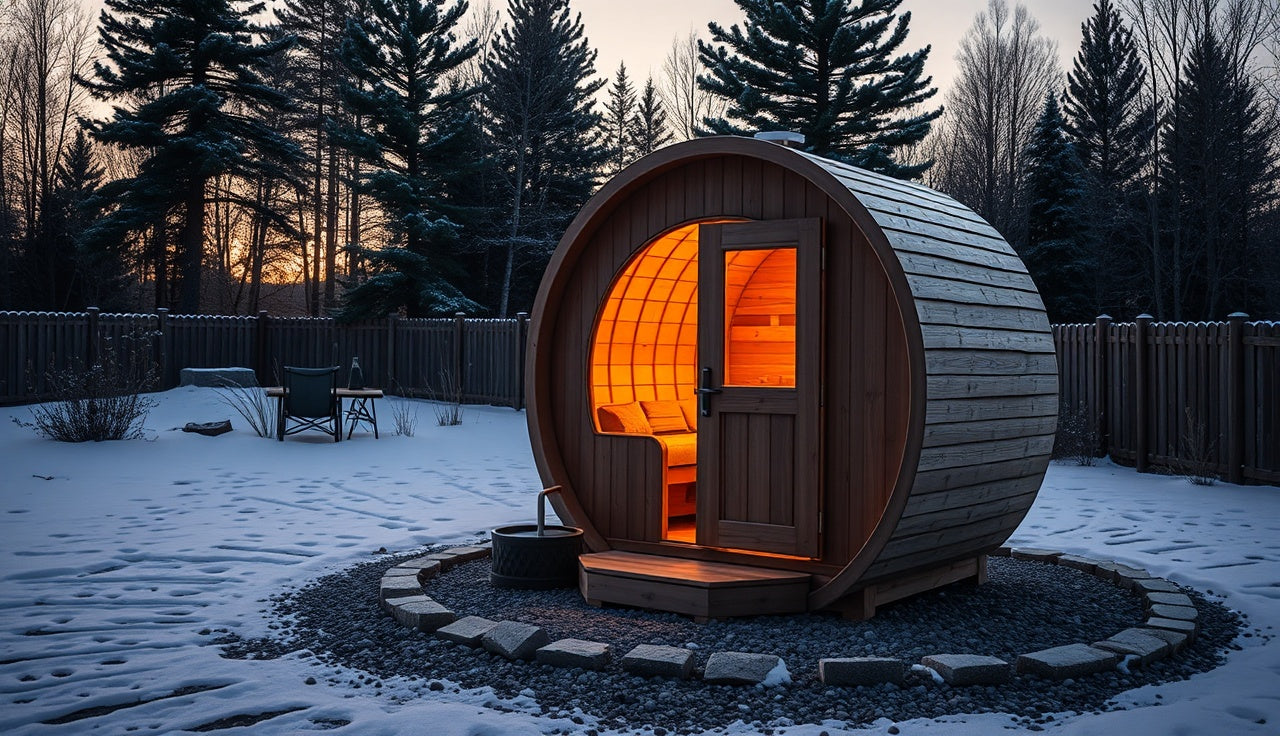
The barrel design is not proprietary to Setri. Barrel saunas trace back to Scandinavian tradition and have caught on in North America over the last decade for good reasons: the curved walls shed rain and snow, the round cross-section heats more evenly than a rectangular box, and the compact footprint fits most suburban backyards [1]. What separates one brand from another is wood species, stave thickness, heater compatibility, and warranty terms.
Setri sources kiln-dried Nordic spruce for most standard models and offers Canadian Western red cedar as an upgrade on larger configurations. Kiln drying matters more than most buyers realize. Green or air-dried wood shrinks after assembly, which opens gaps between staves and lets heat bleed out faster than it should [2]. Skimp on the drying step and you pay for it later.
If you're researching this brand, you've probably already scanned the broader field of outdoor saunas and narrowed to barrel style. That's a sensible path. Barrel saunas genuinely beat rectangular sheds in heat retention per square foot of floor space, mainly because there's less dead air volume in the corners.
How much does a Setri barrel sauna cost?
Setri barrel saunas run roughly CAD $3,000 to $7,500 at retail, depending on diameter, length, and heater package. In USD, that's approximately $2,200 to $5,600 as of mid-2025, though exchange rates shift.
The entry point is usually a 4-foot-diameter, 6-foot-long model with a basic electric heater. That configuration fits two people side by side and is the most common first-time purchase. The 6-foot-diameter versions seat four to six adults comfortably and push toward the top of the range, especially with a wood-burning stove included.
The sticker price hides real costs. Shipping a barrel sauna kit this size typically adds $200 to $600 depending on your location and carrier. A licensed electrician wiring a 240V circuit for an electric heater runs $300 to $800 in labor and materials, which lines up with national averages for dedicated circuit installation [3]. A gravel or compacted-stone pad adds another $100 to $400 in materials if you do it yourself.
For context, a comparable barrel sauna from Almost Heaven or Dundalk LeisureCraft (two of the more visible US/Canadian competitors) runs $2,500 to $6,000 USD depending on options. Setri is no steal against those, but it's not overpriced either. You're paying for similar wood and similar engineering. At this price tier, brand differentiation comes down mostly to warranty length and what's actually inside the heater package.
See the comparison table below for a side-by-side cost and spec breakdown across the main barrel sauna brands North American buyers can get.
How do Setri barrel saunas compare to other brands?
| Brand | Typical price range (USD) | Wood options | Diameter range | Warranty (structure) |
|---|---|---|---|---|
| Setri | $2,200 - $5,600 | Spruce, cedar | 4 ft, 5 ft, 6 ft | 1-2 years (varies by model) |
| Almost Heaven | $2,500 - $5,500 | Hemlock, cedar | 4 ft, 5 ft, 6 ft | 1 year |
| Dundalk LeisureCraft | $3,000 - $7,000 | Cedar | 4 ft, 5 ft, 6 ft | 5 years |
| Leisurecraft Euro Barrel | $3,500 - $6,500 | Nordic spruce | 5 ft, 6 ft | 5 years |
| Finlandia custom | $5,000 - $12,000+ | Cedar, hemlock | Custom | 2-5 years |
The Dundalk and Leisurecraft warranties are the standouts. Five years on structural components beats one to two years by a wide margin, and that gap matters if a stave cracks or a band corrodes in year three. If I were spending my own money, I'd want Setri to match or come close to that before defaulting to them over Dundalk at similar price points.
Setri does well on stave thickness. Their standard staves run 38mm (about 1.5 inches), on par with most mid-market competitors. Thicker staves hold heat longer after you stop feeding the fire and insulate better against cold ambient air. Anything below 35mm starts to feel flimsy in a -10°C Canadian winter.
One honest caveat: independent long-term reviews of Setri are sparse. The brand hasn't accumulated the volume of owner reviews Almost Heaven has built over a decade of US retail, so you're working with less community data. Not a red flag. A real information gap.
| Setri (spruce/cedar) | $3,900 |
| Almost Heaven (hemlock/cedar) | $4,000 |
| Dundalk LeisureCraft (cedar) | $5,000 |
| Leisurecraft Euro Barrel (spruce) | $5,000 |
| Finlandia custom (cedar/hemlock) | $8,500 |
Source: Manufacturer and retailer pricing, compiled 2025
What wood does Setri use and does it matter?
Wood species is one of the biggest decisions in a barrel sauna, and Setri's kiln-dried Nordic spruce for standard models is defensible. Spruce stays dimensionally stable once kiln-dried, resists warping reasonably well, and has a light, clean smell. It is not as rot-resistant as cedar, so it needs better drainage and shouldn't sit directly on wet ground [4].
Cedar is the premium option for outdoor exposure. Western red cedar contains natural oils (thujaplicins and thujic acid) that resist rot, insects, and moisture with no chemical treatment [4]. Those same oils give cedar saunas their scent. If your barrel sauna will live in a wet climate, like the Pacific Northwest or coastal Atlantic Canada, cedar is worth the upcharge. In a dry climate, spruce performs fine for years.
Setri's cedar upgrade shows up on larger diameter configurations but not always on the entry-level units. Ask specifically before ordering if climate resistance matters for your site.
A note on thermally modified wood. Some competitors (and a few premium Setri configurations) now offer thermally modified spruce or pine, heat-treated to permanently lower moisture content and improve rot resistance without chemicals [5]. It's a legitimate technology, not marketing fluff. The wood turns a darker tan and behaves more like cedar outdoors. If Setri offers it, treat it as a middle ground between standard spruce and cedar pricing.
For a wider look at how sauna wood choices shape the experience, the home sauna guide covers this in more detail.
How long does a Setri barrel sauna take to heat up?
With a wood-burning stove, a Setri barrel sauna in the 4-foot to 5-foot diameter range typically reaches 150°F (65°C) in 45 to 60 minutes under normal conditions. The 6-foot models with the same stove take 60 to 90 minutes. Cold ambient air adds time. Expect 20 to 30 minutes longer at -20°C compared to 15°C ambient.
Electric heaters heat faster in smaller volumes but are governed by wattage. A 6kW electric heater in a 4-foot barrel gets you to temperature in 30 to 40 minutes. An 8kW or 9kW unit in the larger models hits similar times. Most standalone barrel sauna heaters in this segment run between 6kW and 9kW [6].
The barrel geometry helps. The curved ceiling reflects heat back down at a steeper angle than a flat ceiling, and there are no cold corner pockets, so the usable volume warms faster than a comparably sized rectangular box. The academic literature on barrel-specific geometry is thin, but the effect on heat distribution in curved enclosures is well understood by builders.
Practically: if you use the sauna on a schedule, an electric heater with a timer is more convenient. If you use it spontaneously or you love the ritual, wood-burning is hard to beat. Both get you into sauna benefits territory (core temperature elevations above 38°C) within a reasonable window.
Can you use a wood-burning stove in a Setri barrel sauna?
Yes. Most Setri barrel sauna models accept a wood-burning stove, and the chimney penetration and collar come with the standard kit on wood-burning configurations. The stoves Setri ships or recommends are usually Finnish-style sauna stoves, steel or cast iron, rated for the cubic footage of the barrel.
The main practical concern with wood-burning is clearance. Fire codes in many US and Canadian municipalities set a minimum clearance between a wood stove and combustible surfaces, and they may require a specific chimney height or spark arrestor [7]. Before you light anything, check with your local authority having jurisdiction (AHJ). In Canada, installations need to conform to the CSA B365 standard for solid-fuel appliances [8].
Setri's stoves come pre-tested by the manufacturer for the enclosures they're sold with, which simplifies the clearance math. You still have to run the chimney through the roof at the correct angle and height for your setup and local code. Get this wrong and you've built a fire risk. Full stop.
Wood type matters too. Use dry hardwood (oak, maple, birch, ash) for long hot burns. Softwoods (pine, spruce) burn faster, produce more creosote, and clog your chimney flue quicker than hardwoods [9]. Birch is traditional in Finnish sauna culture partly because it burns hot and clean.
If you're comparing heat sources for a sauna purchase more broadly, this is one of the decisions that changes your daily experience the most.
Is a Setri barrel sauna easy to assemble?
Assembly is marketed as a two-person weekend project, and that's mostly accurate for the standard models if both people are comfortable with basic tools and numbered instructions. The staves are pre-cut and pre-numbered, the cradle legs are pre-drilled, and the metal bands that hold the staves together arrive cut to length.
The trickiest part is seating the first course of staves evenly in the cradle before you tighten the bands. If they shift during band tightening, you get uneven gaps. Most guides tell you to hand-tighten all bands first, then make incremental passes. Skipping that step is the most common cause of assembly problems in owner forum reports.
Total time for a two-person team on a 4-foot barrel is roughly 6 to 8 hours, including setting up the cradle and installing the door and glass. The 6-foot diameter models run 8 to 12 hours. The benches go in last and are the easiest part.
Setri provides assembly documentation with their kits. If you've looked at other prefab sauna brands, the process is largely the same. Almost Heaven and Dundalk buyers report comparable assembly times. None of these are IKEA-simple, but a motivated homeowner can genuinely do it without pro help.
Check one thing before assembly day: confirm you have a level pad ready. A barrel sauna on an unlevel surface puts uneven stress on the stave joints and can open gaps over time. Compacted gravel is fine. A concrete pad is better. Uneven grass is a problem.
What size Setri barrel sauna do you actually need?
Setri offers three diameters: 4 feet, 5 feet, and 6 feet, each in multiple lengths. Here's the practical breakdown.
The 4-foot barrel is a tight two-person sauna. Adults sit shoulder to shoulder on a single bench tier. It's compact, heats quickly, and fits smaller yards or decks with enough clearance. Solo user or a couple? This is the right size.
The 5-foot diameter opens things up. You can fit two bench tiers (upper and lower), which lets you adjust heat intensity by position, or seat three to four people on a single tier. For most families, this is the sweet spot.
The 6-foot barrel is a proper social sauna. Four to six adults fit comfortably with two-tier benching. It takes longer to heat and costs more to run, but if your use case is post-workout recovery with multiple people or hosting, it earns its size.
Length adds seating on the same tier. A 6-foot-long barrel at 5-foot diameter seats more people than a 4-foot-long barrel at the same diameter. Most standard configurations run 6 to 8 feet in length.
The mistake first-time buyers make is going too small because it looks less imposing. Sessions are better when you're not cramped. If you're debating 4-foot versus 5-foot, almost everyone who upgrades is glad they did. Almost no one who buys the bigger size wishes they'd gone smaller.
Does a barrel sauna add value to your home?
Honest question, honest uncertain answer. There is no large-scale, peer-reviewed study quantifying barrel sauna impact on residential resale value. What exists is anecdotal real estate agent data and some regional market surveys.
What we do know: outdoor amenities add perceived value in certain markets. A 2018 report from the National Association of Realtors found that outdoor features consistently rank among the top amenities buyers request, though it didn't isolate saunas specifically [10]. In Scandinavian-influenced markets (parts of Minnesota, Wisconsin, and the Pacific Northwest), a subset of buyers genuinely expects a sauna, and it can set a listing apart.
The more defensible ROI argument is personal use value. Use a sauna three to five times a week for years and the per-session cost drops fast. A $4,000 barrel sauna used 200 times a year for five years costs $4 per session, ignoring operating costs. Most commercial saunas charge $20 to $40 per session.
Permitting matters for value. Install with a permit (required for permanent structures and electrical in most jurisdictions) and it shows up on your property record as an improvement. Unpermitted structures can complicate sales. Check your local building department before you set concrete footings or run electrical.
SweatDecks has a curated selection of outdoor saunas if you're still comparing configurations before committing to a brand or format.
What are the real health benefits of using a barrel sauna?
The research on sauna use and cardiovascular health is the strongest evidence available. A widely cited prospective cohort study from the University of Eastern Finland (JAMA Internal Medicine, 2015) followed 2,315 middle-aged Finnish men and found that those who used the sauna four to seven times per week had a 63% lower risk of sudden cardiac death compared to once-weekly users [11]. The authors stated: "frequent sauna bathing is associated with a reduced risk of sudden cardiac death, fatal coronary heart disease, fatal cardiovascular disease, and all-cause mortality."
Striking finding, and it's real. But the caveats matter: the study population was Finnish men, an association doesn't prove causation, and people who sauna frequently may differ from infrequent users in other health-relevant ways. No responsible health claim should promise you a specific outcome from buying a sauna.
Other documented short-term effects: elevated core body temperature raises growth hormone transiently, some populations report reduced muscle soreness after exercise, and subjective relaxation and sleep quality improve [12]. Heat stress triggers heat shock proteins, which are genuinely implicated in cellular repair, though the clinical significance in healthy adults using home saunas is not fully established [13].
Many people pair sauna sessions with cold water immersion, a practice often called contrast therapy. The cold plunge article covers the cold side of that protocol in detail, including what the evidence actually supports on recovery and mood.
What should you look for in a barrel sauna warranty and customer support?
Warranty terms separate serious brands from drop-shippers. Here's what to look for and where Setri lands.
Structural warranty covers the wood, staves, and frame. One to two years is the floor you should accept. Five years is better. Setri's warranty varies by model and retailer, so read the specific terms for the configuration you're buying, not the marketing headline.
Heater warranty is separate and usually comes from the heater manufacturer, not Setri. Finnish stove brands like Harvia, Huum, and Narvi carry two to five year warranties on their units. If Setri bundles a no-name heater, investigate that before you buy.
What's excluded is often more important than what's covered. Most barrel sauna warranties exclude weathering, checking (surface cracks from expansion and contraction), and any damage from improper installation. If you didn't level the pad or you over-tightened the bands, you probably can't claim on cracked staves.
Support response time is hard to verify before you have a problem. Here's the practical move: before buying, email Setri a pre-sale question and time the reply. That tells you more than any marketing claim about support quality.
For comparison shopping across formats, SweatDecks carries a range of barrel and traditional sauna configurations with warranty terms listed, which makes side-by-side comparison straightforward.
How do you maintain a Setri barrel sauna long-term?
Maintenance on a barrel sauna is genuinely light compared to most outdoor structures. A few things you can't skip.
Band tensioning is the most overlooked task. The steel or stainless bands holding the staves loosen as the wood settles, especially in the first year. Check them every few months and tighten with a wrench until you can no longer rotate the nut easily by hand. Don't over-tighten. You want snug, not compressed [2].
Wood treatment on spruce models depends on exposure. If the barrel has a good overhang or lives under a roof extension, you may go several years without treating the exterior. In full sun and rain, an exterior wood oil (linseed-based or similar) once a year protects the spruce from UV graying and moisture. Never treat the interior with oil or finish. The heat will volatilize it and you'll breathe the fumes.
The interior bench wood is best left untreated, sanded lightly if it gets rough. Cedar bench boards that gray and roughen slightly are normal and not a structural concern.
Chimney cleaning applies if you run a wood-burning stove. Creosote builds up faster with softwood or wet wood. Clean once per season (or every 50 to 80 fires, roughly), which matches the standard recommendation from chimney safety organizations [9].
Drainage is the single most important site decision. Keep the barrel elevated on its cradle legs with airflow underneath, and make sure water drains away from the base. Sitting water under a wood structure accelerates rot faster than almost anything else, regardless of species.
Frequently asked questions
Are Setri barrel saunas worth the money compared to budget options?
Setri sits above pure budget kits in wood quality and stave thickness, and that matters for longevity. Budget kits under $1,500 USD often use thinner staves, less stable wood, and no-name heaters. If you plan to use your sauna regularly for five or more years, spending more upfront on thicker, kiln-dried wood typically pays off in fewer repairs and better heat retention. The honest caveat is that Setri's warranty is shorter than some comparably priced competitors.
How long does a Setri barrel sauna last?
A well-maintained barrel sauna built from kiln-dried cedar or treated spruce can last 15 to 25 years or more. The main failure points are band corrosion, stave cracking from freeze-thaw cycles, and rot at the base if drainage is poor. Annual band checks, proper siting on a level drained pad, and exterior wood oiling (on spruce models) are the key maintenance steps that separate 10-year saunas from 25-year saunas.
What heater should I get with a Setri barrel sauna?
Match the heater wattage to your barrel volume. Roughly 1kW per 45 cubic feet of interior space is the standard rule of thumb from most heater manufacturers. For a 5-foot diameter, 7-foot long barrel, that works out to about 6 to 8kW electric. For wood-burning, Setri's included stoves are sized for the configurations they're sold with. Finnish brands like Harvia or Huum are well-regarded third-party options if you want to upgrade the heater separately.
Can I put a Setri barrel sauna on my deck?
You can if your deck can handle the weight. A fully assembled 5-foot barrel sauna with people inside can weigh 1,000 to 1,500 pounds or more. Most residential decks are engineered for 40 to 60 pounds per square foot live load. Check with a structural engineer or your deck's original plans before installation. Weight concentrated on the cradle feet is different from distributed load, so the contact points matter as much as total weight.
Do I need a building permit for a barrel sauna?
It depends on your municipality. Most jurisdictions require a permit for permanent outdoor structures over a certain size (commonly 100 to 120 square feet), for any electrical work over 30 amps, and for any structure with a wood-burning appliance. In Canada, CSA B365 governs solid-fuel appliance installation. Contact your local building department before pouring a foundation or running electrical. Unpermitted structures can complicate home sales and void homeowner's insurance in some cases.
How do I level the ground for a barrel sauna?
A compacted gravel pad 4 to 6 inches deep is the most common and practical base. It drains well, provides a stable surface, and is DIY-friendly. You can also use concrete piers or a poured concrete pad. Whatever you use, the surface must be level within about half an inch across its length, or the cradle legs will rock and the stave bands will tension unevenly. A laser level or a long spirit level solves this before assembly begins.
Can I use a Setri barrel sauna in winter?
Yes, and cold-climate performance is actually one of the better use cases for a barrel sauna. The curved walls shed snow load naturally, and the compact insulated volume heats efficiently even at -20°C. Add 20 to 30 minutes to your heat-up estimate in very cold weather. The main winter maintenance task is keeping the chimney clear of snow and ice if you use a wood burner, and making sure the door seal is intact so you're not losing significant heat through gaps.
What's the difference between a barrel sauna and a traditional Finnish sauna?
Traditional Finnish saunas are rectangular rooms, usually indoors or in a dedicated shed, with a sauna stove and löyly (steam from water poured on hot stones) as the core experience. Barrel saunas are outdoor structures with the same basic heat principle but a cylindrical shape that improves heat distribution and reduces assembly complexity. Both reach similar temperatures. The barrel format is more portable and easier to install; a traditional Finnish sauna room is typically larger and more customizable. See our sauna vs steam room article for broader format comparisons.
Is cedar or spruce better for a Setri barrel sauna?
Cedar is better for wet climates and long outdoor exposure because its natural oils resist rot and insects without chemical treatment. Spruce is fine in drier climates and costs less. If your barrel sauna will be fully exposed to rain year-round in a humid environment, the cedar upgrade is worth paying for. In a sheltered location or a drier climate, kiln-dried spruce performs well for many years with basic exterior oil maintenance.
What should I check before buying a Setri barrel sauna?
Confirm these five things before ordering: the exact warranty length and what it covers, whether the heater brand is a recognized manufacturer with its own warranty, stave thickness (look for 38mm or more), whether kiln-dried wood is explicitly stated, and what shipping and delivery look like for your address. Also send a pre-sale support question by email and note the response time. That predicts post-sale support quality better than any marketing claim.
Can I pair a barrel sauna with a cold plunge?
Absolutely, and this is one of the most popular home wellness setups. The typical contrast therapy protocol is 10 to 20 minutes in the sauna, followed by a 1 to 5 minute cold plunge at roughly 50 to 59°F, repeated two to three times. The cold plunge benefits article covers what the evidence actually says about this protocol. Physically, you need enough space for both units and a water source for the plunge. Many people locate them within a few steps of each other.
How often should I use a barrel sauna for health benefits?
The most cited research, including the 2015 JAMA Internal Medicine cohort study from the University of Eastern Finland, found the strongest cardiovascular associations at four to seven sessions per week. But that's a correlation study, not a dose prescription. Three to four times per week is a realistic, well-tolerated frequency for most people. Session length in that research averaged 14 minutes. If you're new to sauna use, start with shorter sessions and lower temperatures and build from there.
Are Setri barrel saunas available in the United States?
Setri ships to both Canada and the United States, though their primary market appears to be Canadian buyers. US buyers should confirm shipping availability to their specific state before ordering, and factor in any customs or cross-border duties if the product ships from a Canadian warehouse. Heater certification matters too: US installations require UL-listed or ETL-listed heaters for most electrical inspections; Canadian installations require CSA-certified units. Verify which certification applies to the heater in your kit.
What's the interior temperature of a barrel sauna and is it adjustable?
Most barrel saunas reach 150 to 195°F (65 to 90°C) at bench level. Electric heaters have a thermostat so you can set and hold a target temperature. Wood-burning stoves are adjustable through airflow dampers but are less precise. Lower bench positions run 10 to 20°F cooler than upper benches in the same enclosure. Finnish sauna tradition typically targets 80 to 90°C (176 to 194°F) at head height on the upper bench, with high relative humidity from löyly.
Sources
- Finnish Sauna Society, Sauna tradition and design overview: Barrel saunas use cylindrical geometry for natural drainage and even heat distribution, rooted in Scandinavian sauna tradition
- Forest Products Laboratory, USDA, Wood Handbook Chapter 4: Moisture Relations: Kiln drying reduces wood moisture content and prevents post-installation shrinkage that can open gaps in wood joints
- U.S. Department of Energy, Electrical Wiring and Circuits for Home Owners: Licensed electrician installation of a dedicated 240V circuit typically costs $300 to $800 in labor and materials
- USDA Forest Service, Western Red Cedar Species Profile: Western red cedar contains natural oils including thujaplicins that provide resistance to rot, insects, and moisture without chemical treatment
- Forest Products Laboratory, USDA, Thermal Modification of Wood: Thermally modified wood is heat-treated to reduce equilibrium moisture content and improve biological durability without added chemicals
- Underwriters Laboratories, UL 875 Standard for Electric Dry-Bath Heaters: Residential sauna electric heaters in the 6kW to 9kW range are the standard for barrel and small room saunas, governed by UL 875 listing requirements
- National Fire Protection Association, NFPA 211 Standard for Chimneys, Fireplaces, Vents: NFPA 211 establishes minimum clearance requirements between solid-fuel appliances and combustible surfaces, and chimney height standards
- CSA Group, CSA B365 Installation Code for Solid-Fuel-Burning Appliances and Equipment: In Canada, solid-fuel sauna stove installations must conform to CSA B365 governing clearances, venting, and installation requirements
- Chimney Safety Institute of America, Creosote and Chimney Fires: Softwoods produce more creosote than hardwoods; annual chimney inspection and cleaning every 50 to 80 fires is the standard recommendation
- National Association of Realtors, 2018 Remodeling Impact Report: Outdoor Features: Outdoor amenities consistently rank among the top features buyers request, though sauna-specific ROI data is not isolated in the report
- Laukkanen et al., JAMA Internal Medicine, 2015, Sauna Bathing and Cardiovascular Mortality: Frequent sauna bathing (4-7x/week) was associated with 63% lower risk of sudden cardiac death versus once-weekly use in a cohort of 2,315 Finnish men; authors stated 'frequent sauna bathing is associated with a reduced risk of sudden cardiac death, fatal coronary heart disease, fatal cardiovascular disease, and all-cause mortality'
- Kukkonen-Harjula K, Kauppinen K, Annals of Clinical Research, 1988, How the Sauna Affects the Endocrine System: Sauna heat stress transiently elevates growth hormone and is associated with improved subjective relaxation and reduced muscle soreness
- Kregel KC, Journal of Applied Physiology, 2002, Heat Shock Proteins: Modifying Factors in Physiological Stress Responses: Heat stress triggers heat shock protein expression implicated in cellular repair processes; clinical significance in healthy recreational sauna users is not fully established

Share:
BZB Cabins 3 room barrel sauna kit W3: full buyer's guide
Finnish sauna temperature: what's normal and why it matters