
Last updated 2026-07-09
TL;DR
The BZB Cabins W3 is a three-room outdoor barrel sauna kit: a dressing room, a washroom, and the main heated chamber in one prefabricated cedar or spruce barrel. It ships flat-packed, assembles with hand tools and two or three people, and runs on a wood-burning or electric heater. Budget roughly $4,000 to $7,500 for the kit, and $6,000 to $10,000 fully installed.
What exactly is the BZB Cabins W3 three-room barrel sauna kit?
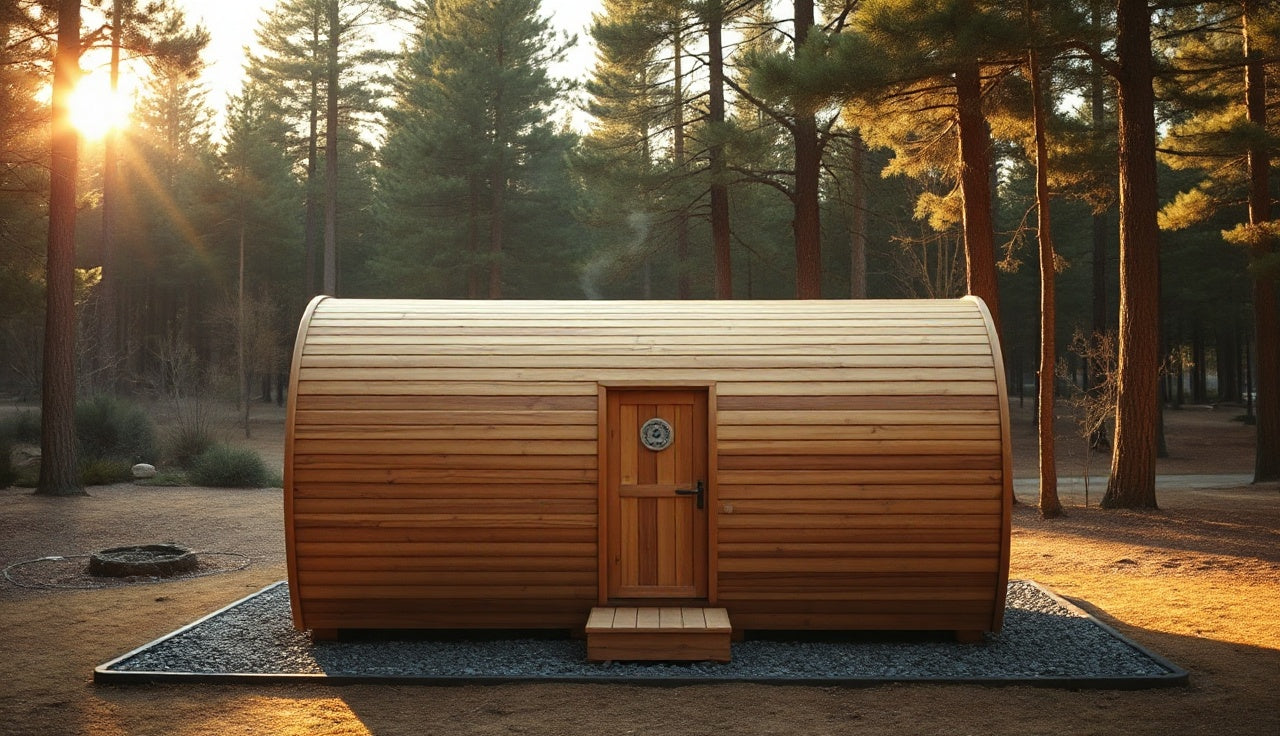
The BZB Cabins W3 is a prefabricated outdoor barrel sauna with three separate rooms inside one long barrel. Most barrel saunas give you one or two spaces. The W3 adds a third. That third room changes how you actually use the thing.
The layout runs front to back like this: a dressing and gear room up front, a middle washroom or cooling room, and the main heated sauna chamber at the far end. The barrel shape earns its keep beyond looks. The curved ceiling circulates hot air more efficiently than a flat-ceiling box sauna, and the rounded walls shed rain and snow instead of pooling water [1].
BZB Cabins is a Latvia-based manufacturer shipping kits to North America and Europe. They mill most of their structures from Nordic or Siberian spruce, and some configurations use Canadian red cedar. The W3 sits in their larger cabin-style barrel lineup, above the entry-level single-room barrels and below their fully custom cabin saunas.
Compared to a standard outdoor sauna box kit, the barrel format costs less per square foot and installs faster. The stave construction holds itself up. You do not need a framing crew.
What are the dimensions and capacity of the W3 kit?
BZB lists the W3 barrel diameter at about 1.9 meters (roughly 6.2 feet). Overall length varies by configuration, landing between 4.5 and 6 meters (about 15 to 20 feet) depending on your wall and door package. Headroom at the barrel apex runs close to 1.7 to 1.8 meters, enough for most adults to stand up straight in the center.
Comfort capacity for the main sauna room is listed at 4 to 6 people on the benches. Four is the honest number, the one where everyone can stretch out. The dressing room fits a bench and hooks for 2 to 4. The middle washroom is the tightest of the three, usually just wide enough for a rinse shower or a small tub.
Here is how the W3 stacks up against the other common BZB barrel configurations:
| Model | Rooms | Approx. Length | Heater Options | Typical Capacity |
|---|---|---|---|---|
| W1 (single room) | 1 | ~2.5 m | Electric or wood | 2-4 persons |
| W2 (two room) | 2 | ~3.5 m | Electric or wood | 3-5 persons |
| W3 (three room) | 3 | ~4.5-6 m | Electric or wood | 4-6 persons |
| W4 / custom | 3-4 | 6 m+ | Electric, wood, or combo | 6-10 persons |
Footprint matters for permits, so measure your pad or deck before you order. Many jurisdictions treat structures under 120 or 200 square feet as accessory structures with lighter permit rules, but this varies a lot. Check with your local building department first [2].
What wood species does BZB use and does it matter?
BZB uses Nordic spruce as the base material across most W-series kits. Some W3 configurations upgrade to Canadian red cedar, Thermo Aspen, or Thermo Radiata pine for more money. Species matters, but not as much as some sellers imply.
Three things actually change with the wood: heat tolerance, moisture resistance, and how much resin the wood off-gasses at high temperature. Spruce is stable, standard in Scandinavian sauna construction, and holds up with basic maintenance [3]. Cedar has natural oils that resist rot and insects, which pays off if the barrel sits in year-round rain or high humidity. Thermally modified woods (Thermo Aspen, Thermo Radiata) go through a heat treatment that drops their moisture content and reduces warping. They cost more and they are genuinely more dimensionally stable.
One honest note. BZB's listings do not always state the exact drying grade or moisture content of their lumber at shipment. That is normal for import barrel kits in this price range, but it means you should expect some checking or minor cracking as the wood acclimates during the first season. It is cosmetic, not structural, and it happens across most home sauna barrel kits at this level.
Skip paint and film-forming sealants on the interior. For the exterior, a penetrating oil or a UV-resistant wood stain is the right call.
| W3 spruce + wood stove (basic install) | $6,000 |
| W3 spruce + electric heater (basic install) | $7,000 |
| W3 cedar upgrade + electric heater | $8,200 |
| W3 cedar + electric + concrete pad + contractor assembly | $10,500 |
Source: Angi Cost Guide (citation 5) and BZB Cabins reseller pricing (citation 11)
What heater options come with the W3 and which one should you choose?
BZB offers the W3 with either a wood-burning sauna stove or an electric sauna heater. Some configurations let you pick at checkout. Others default to one or the other, so confirm before you order.
Wood-burning stoves give you the traditional Finnish experience. They heat fast in bitter cold, need no electrical hookup to the sauna itself, and throw a softer steam when you pour water on the rocks. The tradeoff: you need dry hardwood on hand, you tend the fire, and you need a proper chimney through the barrel roof with correct clearances. Most codes require the flue to extend at least 3 feet above the roof or 2 feet above any structure within 10 horizontal feet [4].
Electric heaters are simpler. Set a temperature, walk away, and the sauna is ready in 30 to 45 minutes. They win for people who want consistency and no fire to babysit. The catch: you need a dedicated 240V circuit run to the sauna, which adds $200 to $800 to your install depending on how far the panel sits from the structure [5]. Hire a licensed electrician for this. Always.
For most homeowners putting the W3 near the house as a daily recovery tool, I would take the electric heater. If the barrel is going somewhere remote without easy power, wood-burning is the practical answer.
Sizing math: the rough rule is 1 kW per 45 cubic feet of sauna volume [6]. A W3 main chamber running roughly 6 to 8 feet in diameter and 8 to 10 feet long holds 400 to 500 cubic feet, which puts you in the 9 to 12 kW range for a properly insulated barrel.
How difficult is the W3 assembly and what does it actually involve?
BZB markets the W3 as a DIY-friendly kit. That holds true if you are comfortable with home construction projects. It is not a quick weekend job.
The kit ships as flat-pack panels and pre-cut staves. The sequence runs roughly like this: prepare a level gravel pad or concrete foundation, set the included cradle supports, slot the stave rings together into the barrel body, attach the end walls and doors, install the bench framing and benches, then mount the heater and run the flue or the electrical.
BZB claims 2 to 3 days for assembly with 2 to 3 people. Buyer reports run closer to 3 to 5 days, especially for first-timers or anyone also doing site prep. Hardware and basic instructions come in the box. The instructions have historically been translated from Latvian and get thin on detail in places, so spend an hour watching other BZB buyers assemble theirs on YouTube before you start.
What you need on hand: a level and tape measure, a rubber mallet, a cordless drill, basic hand tools, and a second or third set of hands for lifting barrel sections into place. No crane, no heavy equipment for the standard W3 length.
One move speeds up the whole job: have your foundation pad ready and cured before the kit arrives. A 4-inch concrete slab or a well-compacted gravel pad with good drainage both work. Drainage matters more than you would guess, because standing water under the barrel rots the wood right at the cradle contact points.
What foundation does the W3 barrel sauna need?
The W3 does not need a deep foundation. The barrel rests its load along two longitudinal cradle supports, so you are dealing with a narrow load path instead of a full perimeter wall.
Three options work. A 4-inch reinforced concrete slab sized to the footprint plus a 12-inch margin on each side is the most permanent and the easiest to keep clean. A compacted gravel pad (crushed stone, 4 to 6 inches deep) over a weed barrier drains well, stays permeable, and handles frost heave better than a slab. Concrete deck blocks or pressure-treated skids let you set the cradle supports at grade without pouring anything.
Frost depth matters in cold climates. If you pour a slab in a zone that freezes hard, the slab needs to be insulated or sized and placed to limit frost heave. A gravel pad sidesteps most of that because it drains and does not lift the same way [2].
Do not set the barrel directly on a wood deck unless that deck was engineered for the load. A W3 with water in a washroom tub or shower pan, plus occupants, can hit 2,000 to 3,000 lbs. Most residential decks are rated for 40 to 60 lbs per square foot, so get a structural read on your deck framing before you put anything this heavy on it.
What does the BZB Cabins W3 cost and what affects the price?
The BZB Cabins W3 has historically run $4,000 to $7,500 USD depending on wood species, heater inclusion, door style, and accessory packages. That range reflects North American reseller pricing across mid-2024 to mid-2025. Manufacturer-direct pricing (BZB Cabins EU) versus North American distributors can differ by several hundred dollars, and exchange rate swings move import pricing around.
The variables that push the number:
- Wood upgrade (spruce to cedar or thermally modified): adds $300 to $800
- Electric heater vs. wood-burning stove: a quality electric heater for a kit this size runs $500 to $1,200
- Glass door vs. standard wooden door: glass adds $200 to $400
- Shipping: these kits are large and heavy. Freight to the continental US typically runs $300 to $600, higher for remote locations or lift-gate delivery
- Installation labor: hiring out assembly runs $800 to $2,000 for a contractor who knows barrel kits
After the kit, budget for the electrical circuit or chimney ($200 to $800), a concrete pad if you need one ($300 to $800 DIY or $800 to $1,500 by contractor), and accessories like buckets, ladles, and thermometers ($50 to $200).
All in, a fully installed W3 with a quality heater and proper foundation lands around $6,000 to $10,000. That beats a custom-built outdoor sauna from scratch, which starts at $8,000 to $15,000 or more for a structure this size.
You can browse current W3 pricing and configurations at SweatDecks, which carries BZB Cabins kits alongside other barrel and box sauna options.
Do you need a permit to install the W3 barrel sauna?
Permit rules for outdoor saunas vary by jurisdiction, but the honest answer is that most homeowners need at least one permit and some need two or three.
The categories to check: a building permit for the structure, an electrical permit for the 240V heater circuit, and a plumbing permit if the washroom drains into your home's sewer or septic.
Many US jurisdictions exempt accessory structures under a set size (commonly 120 or 200 square feet) from full building permits, but this varies by state and municipality [2]. The W3's footprint runs roughly 90 to 115 square feet depending on configuration, which may slip under the threshold in some places. Do not assume it does. Call your building department before you pour a foundation.
Electrical work requires a permit in every US state when done by a licensed contractor, and many states require a permit even for DIY electrical. The National Electrical Code covers sauna and spa wiring in Section 680, including GFCI protection and minimum clearances [7].
If your washroom connects to a drain, that almost always triggers a plumbing permit. Run it dry with a bucket and you avoid that.
Then there is your HOA. Read your CC&Rs before you order. Some HOAs restrict outbuilding height, setbacks, or exterior materials.
How does the W3's three-room layout actually change how you use a sauna?
This is the question that separates buyers who will love the W3 from those who would have been fine with a single-room barrel.
The dressing room earns its space in cold climates. Walking from a warm house across a freezing yard and stripping down inside a heated dressing room beats undressing in the sauna chamber itself. It keeps your outdoor gear out of the sauna proper too, which protects the benches and cuts down tracked-in dirt.
The middle washroom opens up contrast therapy. Install a cold shower, drop in a small cold plunge, or just keep cold water buckets there for the transition between heat and cold. Hot-cold cycling sits at the center of Nordic and Finnish sauna culture, and the acute physiological response to it is reasonably well documented [8]. The W3 makes it practical at home without running back to the house between rounds.
Want the full contrast setup? Pair the W3 with a cold plunge nearby and you have the whole protocol. Our guide to cold plunge options walks through how to build it.
The layout helps socially, too. People can change or cool down in the outer rooms while others heat in the main chamber. For families or small groups, that privacy is worth something.
The tradeoff is length. The W3 runs longer than a two-room barrel, so it needs a bigger footprint and may not fit a tight backyard. If your usable space is under 40 feet in the relevant direction, setbacks included, measure carefully.
What are the real health benefits (and limits) of barrel sauna use?
Regular sauna use has a credible research base. Worth being specific about what the evidence shows instead of making sweeping promises.
The strongest data comes from Finnish cohort studies. A 2018 analysis of the Kuopio Ischaemic Heart Disease study, following 1,688 middle-aged Finnish men over roughly 15 years, found that men who used a sauna 4 to 7 times per week had a lower risk of all-cause mortality than once-weekly users [9]. That is an observational association, not a controlled trial, and Finnish sauna-goers tend to do other healthy things too. But the effect size is large enough to take seriously.
On the cardiovascular side, a 2018 review in Mayo Clinic Proceedings reported that "sauna bathing is associated with a reduced risk of vascular diseases" [10]. Acute effects include a higher heart rate (comparable to moderate aerobic exercise), increased skin blood flow, and a drop in blood pressure after the session.
For recovery and muscle soreness, the data thins out. Some small studies show reduced delayed onset muscle soreness after heat exposure, but sample sizes are small and protocols are all over the place. Nobody has good long-term randomized data on sauna use for athletic recovery specifically. Our sauna benefits guide breaks down what we actually know.
Who should be careful: people with cardiovascular disease, pregnancy, low blood pressure, or those on diuretics or alcohol should talk to a physician before regular sauna use [10]. The main acute risk is dehydration and low blood pressure, not heat stroke, assuming normal 10 to 20 minute sessions at 80 to 100 degrees Celsius.
The W3 does not change any of this. Any well-built sauna that reaches that temperature range consistently produces the same effects.
How does the W3 compare to other barrel sauna kits in this price range?
The three-room barrel category is small, but a few competitors are worth naming honestly.
Aleko and Dundalk Leisurecraft both sell barrel kits in the $3,000 to $7,000 range, though most of their catalog is single or two-room. Dundalk's Canadian Timber series uses white cedar and has a strong reputation for wood quality, but its three-room equivalent runs above BZB's comparable W3 pricing in most North American markets [11].
Aleko's barrel saunas sit at the low end and use hemlock or spruce. They are a reasonable entry point, but the wall staves are thinner, some models at 1.5 inches against BZB's typical 1.75 to 2 inches. Thicker staves hold heat better and matter more in hard cold.
A DIY lumber build can get you a custom three-room structure for roughly the same money as a W3 kit, but it demands real carpentry skill and time. For most buyers, the kit format is faster and lower risk.
The costco sauna category (mass-market big-box barrel kits) runs $2,000 to $4,000, but tops out at two rooms with thinner construction. Fine for occasional use. For daily use or year-round cold-climate installs, the W3's build spec is meaningfully better.
BZB's real weakness against some competitors is documentation and support for North American buyers. The company is EU-based, so warranty claims and support calls sometimes hit time zone gaps and slower responses. Keep that in mind if a stave arrives damaged or milled wrong.
What maintenance does the W3 require after installation?
Barrel saunas ask for less upkeep than people expect, but not zero.
The exterior needs a penetrating UV-resistant oil or wood stain every 1 to 3 years, more often with heavy sun. This stops graying and surface cracking. Skip film-forming products (polyurethane, varnish) on the exterior. They trap moisture and peel.
The interior should stay untreated, or take a light coat of sauna-specific interior oil if the wood starts looking dry. Never put exterior stain inside the chamber. The benches take the most abuse from sweat and humidity, so sand them lightly once a year if they feel rough.
The cradle supports touch the ground and are the first thing to rot. Inspect them every year. If BZB ships pressure-treated or thermally modified cradle pieces, you are ahead. If they are untreated spruce, apply a ground-contact wood preservative or slip plastic shims between the cradle and the ground.
The heater and rocks need occasional attention. For electric heaters, replace the sauna stones every 1,500 to 2,000 hours of use, or once they start to crack and crumble. For wood stoves, clean the ash pan regularly and inspect the flue for creosote once a season [4].
Ventilation keeps the wood alive. The W3 should have a fresh-air vent near the floor and an adjustable vent near the ceiling. Run the sauna with the vents open, then leave the door cracked for 30 minutes after your last session so the interior dries out. That one habit adds years to the interior wood.
Frequently asked questions
What is the interior temperature range of the BZB Cabins W3?
With a properly sized heater, the W3 main chamber reaches 70 to 100 degrees Celsius (160 to 212 degrees Fahrenheit), covering everything from a gentle Finnish session to a high-heat banya. Electric heaters with a thermostat hold a precise temperature. Wood-burning stoves need more active management but hit the same peaks.
Can the W3 barrel sauna be used in winter in cold climates?
Yes. The barrel shape and thick stave walls handle cold well. Wood-burning stoves heat faster than electric in very cold weather. The curved roof sheds snow, though you may need to clear the entrance. Foundation choice matters more in freezing climates: frost heave can shift a slab, so a compacted gravel pad tends to perform better in hard-freeze zones.
How long does it take to heat the W3 from cold?
An electric heater in the 9 to 12 kW range brings the main chamber to 80 degrees Celsius in roughly 30 to 50 minutes from cold. A wood-burning stove takes about the same, varying with wood quality, outside temperature, and how well the fire is built. The dressing room preheats passively as the main chamber climbs.
Is the BZB Cabins W3 kit really DIY-installable or do you need a contractor?
The structural assembly is DIY-capable for anyone comfortable with home construction projects, and no heavy equipment is needed. Plan 3 to 5 days with 2 to 3 people. Electrical work for a 240V heater circuit requires a licensed electrician in most US states. Foundation work is DIY-friendly with concrete or gravel experience. Plumbing in the washroom, if included, should go to a licensed plumber.
What is the warranty on the BZB Cabins W3?
BZB Cabins typically offers a limited structural warranty around 2 years on wood components and 1 year on accessories and hardware, though terms vary by reseller and may differ for North American sales. Confirm the warranty in writing before purchase. Because BZB is EU-based, get clarity on exactly how warranty claims are handled for US buyers.
Does the W3 washroom include plumbing or do I need to add that myself?
The W3 ships without plumbing. The middle washroom gives you the room and floor framing to add a cold shower, a small soaking tub, or a cold plunge. You supply and install the fixtures yourself or hire a plumber. A drain connection to your home's sewer or septic will require a plumbing permit in most jurisdictions.
How many people fit comfortably in the W3?
The main sauna chamber seats 4 comfortably on the standard bench setup. You can push to 5 or 6 with an upper bench tier, but 4 is the number where everyone has real space and heat spreads evenly. The dressing room handles 2 to 3 people changing at once. The middle washroom is a one-person-at-a-time space in most configurations.
What size electrical circuit does the W3 sauna require?
A 9 to 12 kW electric heater needs a dedicated 240V circuit. At 9 kW that is a 40-amp circuit minimum; at 12 kW you need 50 to 60 amps. Wire gauge must match the amperage (8 AWG for 40A, 6 AWG for 50A, 4 AWG for 60A). All outdoor sauna wiring requires GFCI protection per NEC Section 680. Have a licensed electrician pull the permit and do the work.
Can I add a cold plunge to use alongside the W3?
Yes, and the three-room layout makes it practical. The middle washroom is a natural transition space between the heat chamber and a cold plunge just outside the barrel exit. Contrast protocols usually alternate 10 to 15 minutes of heat with 1 to 3 minutes of cold immersion. Our guide to the health effects of a cold plunge covers how to structure it.
What is the difference between the BZB W3 and the W2?
The W2 is a two-room barrel (dressing room plus main chamber) around 3.5 meters long. The W3 adds a third room, usually a middle washroom or cooling room, stretching the barrel to roughly 4.5 to 6 meters. The W3 costs $800 to $1,500 more than the comparable W2. If you want contrast therapy space or a dedicated changing area separate from the heat, the W3 earns the extra cost.
How do I maintain the barrel sauna wood to prevent cracking and rot?
Apply a penetrating UV-resistant exterior oil or stain every 1 to 3 years on the outside. Leave the interior untreated or use a sauna-specific interior oil if the wood looks dry. After every session, leave the door cracked and vents open for 30 minutes so the interior dries out. Inspect the cradle contact points yearly and treat or shim as needed. Never use polyurethane or other film-forming finishes on any part of the barrel.
Is a barrel sauna better than a traditional box sauna for home use?
Barrel saunas heat faster, cost less to build, and install without a framing crew. Box saunas offer more layout flexibility, better insulation in extreme cold (with proper wall construction), and easier integration with an addition or outbuilding. For a freestanding outdoor sauna on a moderate budget, a barrel is hard to beat. For a permanent structure with custom interior options, a box sauna wins. See our full comparison in the home sauna guide.
Where is the best place to position the W3 in my backyard?
Face the door toward your house or patio for a short barefoot walk in cold weather. Leave at least 3 feet of clearance on all sides for maintenance access and to meet most fire setback rules. With a wood-burning stove, check local codes for minimum setbacks from structures and property lines. Avoid low spots that collect water, and grade the ground slightly away from the barrel for drainage at the foundation.
Sources
- ScienceDirect, Energy and Buildings Journal, "Thermal performance of barrel-shaped sauna cabins": Curved barrel ceiling geometry promotes natural convective air circulation that improves heat distribution compared to flat-ceiling rectangular sauna structures.
- International Code Council, International Residential Code (accessory structures and foundations): Many jurisdictions exempt accessory structures under 120 or 200 square feet from full building permits, and foundation requirements vary with local frost depth and drainage conditions.
- Forest Products Laboratory, USDA Forest Service, Wood Handbook: Nordic spruce is a dimensionally stable, widely used material in Scandinavian sauna construction with appropriate properties for high-heat low-humidity sauna environments.
- U.S. Consumer Product Safety Commission, Chimney Safety Guidelines: Standard chimney height rule requires flue to extend at least 3 feet above the roof surface and 2 feet above any structure within 10 horizontal feet.
- Angi, Cost Guide for Electrical Circuit Installation: Dedicated 240V circuit installation costs approximately $200 to $800 depending on distance from panel and local labor rates.
- Finnish Sauna Society, Heater Sizing Guidelines: General guideline for electric sauna heater sizing is approximately 1 kW per 45 cubic feet of sauna room volume.
- National Fire Protection Association, National Electrical Code (NEC) Section 680: NEC Section 680 covers wiring requirements for sauna and spa installations including GFCI protection requirements and minimum clearances for outdoor electrical installations.
- Journal of Human Kinetics, "The effect of sauna bathing on lipid profile, antioxidant capacity, and inflammatory markers in young physically active men": Hot-cold cycling in sauna protocols is documented in sports physiology literature with measurable acute physiological responses including changes in cardiovascular parameters.
- JAMA Internal Medicine, Laukkanen et al. 2015, "Association Between Sauna Bathing and Fatal Cardiovascular and All-Cause Mortality Events": Finnish cohort study following 1,688 middle-aged men found those using sauna 4 to 7 times per week had lower all-cause mortality versus once-weekly users over roughly 15 years of follow-up.
- Mayo Clinic Proceedings, Laukkanen et al. 2018, "Cardiovascular and Other Health Benefits of Sauna Bathing": Review concluded that sauna bathing is associated with a reduced risk of vascular diseases and noted cautions for persons with cardiovascular disease, hypotension, pregnancy, or diuretic use.
- Dundalk Leisurecraft, Canadian Timber Series Product Specifications: Dundalk Canadian Timber barrel sauna series uses white cedar construction and is priced generally above BZB W3 equivalent configurations in North American markets.

Share:
Sauna temperature and time: how hot, how long, and how often
Setri barrel saunas: what you actually get for the price