
Last updated 2026-07-09
TL;DR
SereneLife portable saunas are steam-based tent units that fold up, plug into a standard outlet, and cost roughly $90 to $200. They heat to around 115 to 140°F in 5 to 10 minutes using a 1 to 2 liter steam generator. They are a real entry point into sauna use, though they deliver lower, moister heat than a traditional wood or electric sauna and wear out faster.
What is a SereneLife portable sauna and how does it work?
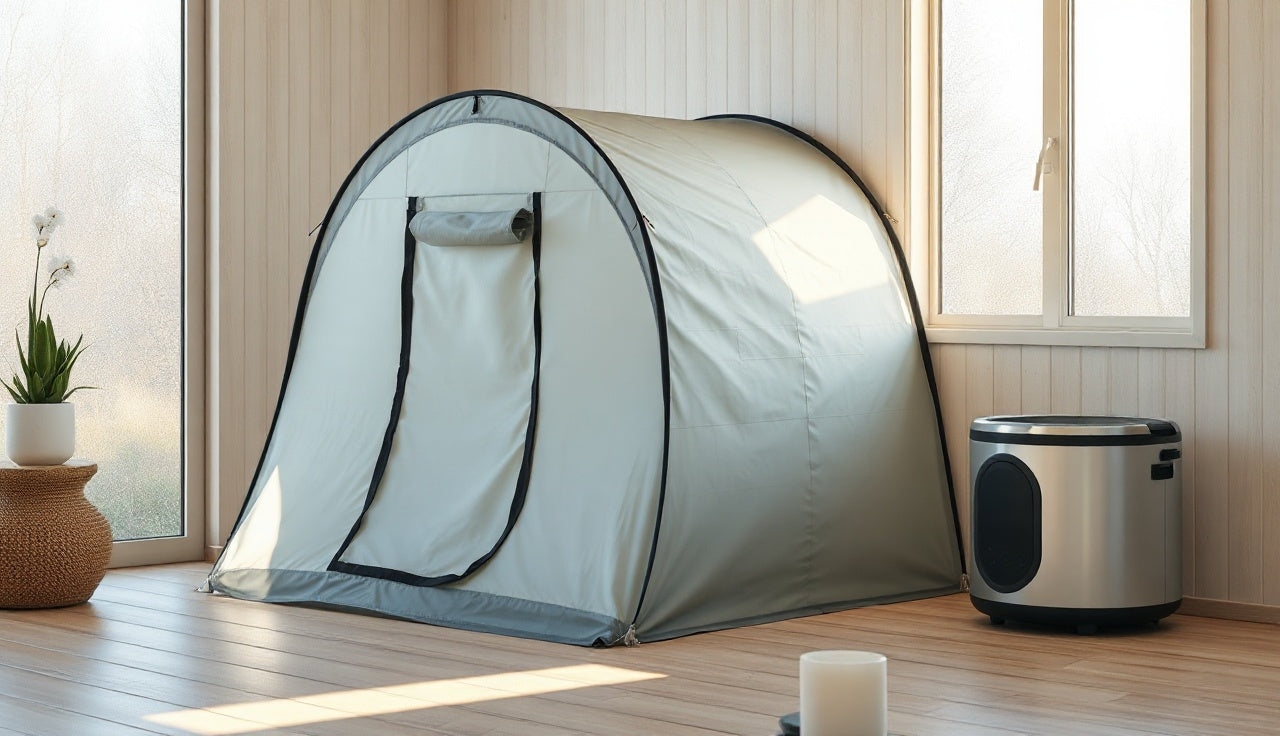
A SereneLife portable sauna is a fabric tent, roughly the size of a camping chair when folded, that you sit inside with your head poking out through a zippered collar. A separate steam generator, usually 1 to 2 liters in capacity, sits outside the tent and pumps wet steam through a hose into the interior. You plug the whole thing into a standard 110 to 120V household outlet. No plumber, no electrician, no permits.
The steam generator in most SereneLife models runs at 800 to 1000 watts. At that wattage it will heat the interior to roughly 115 to 140°F (46 to 60°C) within 5 to 10 minutes of startup, depending on room temperature and model. That is noticeably lower than a traditional Finnish sauna, which runs 160 to 195°F (71 to 90°C) [1]. But for someone who has never used any sauna before, 130°F still produces a serious sweat.
The tent body is usually a polyester oxford fabric, sometimes with a foil lining to trap radiant heat. The chair inside is a plastic folding stool. Most kits include a hand or foot hole so you can use your phone or read while sessioning. Total weight when packed is typically 7 to 10 pounds.
This is not a portable sauna in the sense of a barrel or cabin that gets trucked to your backyard. It is a personal steam tent for one person. Those are very different things, and a lot of buyer confusion comes from that name overlap.
What are the main SereneLife portable sauna models and how do they differ?
SereneLife sells under a few recurring product names, and the lineup shifts often enough that specific model numbers matter less than the two tiers they sit in. Learn the tiers and you can shop the changing listings without getting lost.
The entry-level units, often listed around $90 to $130, have a 1-liter steam pot, a single temperature dial, and a basic polyester tent. Session time is controlled by a simple timer, usually capped at 30 or 60 minutes. These work fine for occasional use.
The mid-range units, usually $140 to $200, step up to a 2-liter tank, a digital controller with more precise temperature and time settings, and a slightly roomier tent. Some versions add a remote control and a folding footbath basin. SereneLife brands these as a "full size portable sauna" in some listings, which means the tent is tall enough for most adults to sit comfortably without hunching.
Beyond that SereneLife does not make a traditional electric or infrared cabin. If you want a box-style unit, you are looking at a different product category entirely, closer to what is described in a home sauna guide.
| Model tier | Tank size | Wattage | Temp range | Approx. price |
|---|---|---|---|---|
| Entry | 1 L | 800W | 115 to 130°F | $90 to $130 |
| Mid-range | 2 L | 1000W | 120 to 140°F | $140 to $200 |
| Full-size tent | 2 L | 1000W | 120 to 140°F | $160 to $200 |
Prices pulled from Amazon and retailer listings as of mid-2025. They fluctuate significantly during sale events.
How hot does a SereneLife portable sauna actually get?
Most SereneLife models advertise a maximum temperature around 140°F (60°C). In real use, with a cold room and a small 1-liter tank, you will more often land in the 115 to 130°F range. That tracks with what users report across review forums and with the physical limits of an 800 to 1000W steam generator heating a fabric enclosure.
For comparison, the Finnish Sauna Society recommends 80 to 100°C (176 to 212°F) for a traditional sauna, and the steam humidity in a Finnish sauna stays deliberately low, around 10 to 20% [1]. A SereneLife tent runs much wetter, typically 40 to 60% humidity at operating temperature, which makes it feel hotter than the thermometer suggests. The moist heat is closer to a steam room than a dry sauna.
That matters for how you experience it. Wet steam raises skin surface temperature faster, so even 120°F in a humid tent can feel oppressive next to 150°F dry heat. Neither is better in an absolute sense. They are different stimuli. If you want to understand that distinction more fully, the sauna vs steam room breakdown covers it.
The short version for buyers: 130 to 140°F is warm enough to break a real sweat and raise core body temperature meaningfully. It is not the searing dry heat of a traditional sauna. Manage that expectation and you will not be disappointed.
| SereneLife tent (entry) | $120 |
| SereneLife tent (full-size) | $180 |
| Infrared cabin (entry) | $1,200 |
| Traditional electric (basic) | $2,500 |
| Outdoor sauna cabin | $8,000 |
Source: Consumer Reports home sauna guide + Finnish Sauna Society guidelines, 2024
What health benefits does a portable steam sauna offer?
The evidence base for sauna benefits comes almost entirely from studies on traditional Finnish dry saunas at temperatures well above what a portable tent reaches. Extrapolating directly is not clean science, and nobody should do it carelessly.
That said, the proposed mechanisms, elevated core body temperature, increased heart rate, and sweating, do activate at lower temperatures too, just less intensely. A 2018 review in Mayo Clinic Proceedings examined population data from the Kuopio Ischemic Heart Disease Risk Factor Study and found that frequent sauna use (4 to 7 sessions per week) was associated with significantly lower cardiovascular event risk compared to once-weekly use [2]. That study used Finnish saunas at 78 to 100°C. The authors did not study portable tent saunas.
Separately, a small 2021 study in the International Journal of Environmental Research and Public Health found that a single 20-minute sauna session at 80°C produced meaningful increases in growth hormone and a measurable reduction in cortisol in healthy adults [3]. Again, that is higher heat than a portable unit delivers.
For the more modest claims, like temporary relaxation, muscle loosening after exercise, and improved perceived recovery, the lower temperatures a SereneLife produces are probably sufficient. Nobody has good data on exactly what threshold of temperature and duration optimizes these softer outcomes. The closest the research gets is showing that any meaningful heat exposure that raises core temperature produces some of the acute effects.
Stay conservative. Use these units for what they reliably do: give you a regular sweating habit, warm you up after cold exposure, and make you feel looser and calmer. They are not a medical device. The sauna benefits article covers the research landscape in much more depth.
How do you set up and use a SereneLife portable sauna?
Setup takes about 5 minutes the first time. Unfold the tent, place the stool inside, snap or clip the steam hose through the access port near the floor, and fill the steam generator tank with distilled or filtered water. SereneLife's manual recommends distilled water to prevent mineral buildup, and that is worth following. Tap water leaves calcium deposits on the heating element and shortens tank life noticeably.
Set your temperature and timer. For first sessions, start at 115 to 120°F and 15 minutes. You can work up to 130 to 140°F for 20 to 30 minutes as you adapt. Most experienced sauna users land around 20 minutes per session.
Keep a water bottle within arm's reach. Hydration matters in any heat exposure. The American College of Sports Medicine recommends drinking 17 to 20 oz of water 2 hours before exercise and continuing fluid replacement during heat sessions, and there is no reason not to apply that logic here [4].
After your session, unzip and let the tent air dry completely before folding it up. Moisture trapped inside will promote mildew. Empty and dry the steam pot the same day.
A few things that save people trouble early on: do not use essential oils directly in the tank, it gunks the heating element. Use a separate diffuser near the tent opening if you want aromatherapy. And do not leave the unit running unattended. The tent fabric and the electrical components are both consumer-grade, not commercial.
Is a SereneLife portable sauna safe to use at home?
For healthy adults, yes, with normal precautions. The risks that apply to any sauna, dehydration, overheating, and fainting, apply here too, though the lower maximum temperature somewhat reduces the severity of overheating risk compared to a 190°F traditional sauna.
People who should talk to a doctor before using any sauna: those with cardiovascular conditions, those who are pregnant, people on medications that impair heat tolerance (some blood pressure drugs, diuretics, and psychiatric medications fall into this category), and anyone with a condition that affects sweating. The American Heart Association notes that sudden temperature changes can stress the cardiovascular system, and while the association does not specifically address portable saunas, its guidance on heat exposure generally applies [5].
From an electrical standpoint, the units draw 800 to 1000W through a standard 15-amp circuit. That is well within normal household capacity, though you should not daisy-chain extension cords or plug into an overloaded power strip. Use the unit on a GFCI-protected outlet if possible, especially in a bathroom or anywhere near water.
The fabric is not fireproof. Keep the tent away from space heaters, open flames, and any other heat sources while in use. That sounds obvious, but people combine gadgets in unexpected ways.
Children should not use these unsupervised. The zippered collar is designed for an adult neck, and the interior temperature is enough to harm a small child quickly.
How does a SereneLife portable sauna compare to infrared and traditional saunas?
This is the core decision point for most buyers, so it deserves an honest breakdown without softening the trade-offs.
A SereneLife portable tent costs $90 to $200. A decent entry-level indoor infrared sauna cabin starts around $800 to $1,500 [6]. A traditional electric sauna for a home, even a basic 2-person unit, runs $1,500 to $4,000 installed. An outdoor sauna barrel or cabin can push $5,000 to $15,000 with installation. The cost gap is real and substantial.
What you give up for that price: temperature ceiling, session feel, and durability. A portable tent maxes around 140°F with wet steam. An infrared cabin heats from radiant panels at 120 to 150°F dry, which feels very different. A traditional sauna runs 160 to 200°F dry, with the option to add löyly steam bursts for humidity. None of those three experiences are the same.
Durability is the bigger hidden cost. The steam generator heating element in a SereneLife unit typically lasts 1 to 3 years with regular use before mineral scaling or element failure becomes an issue. The fabric tent can last longer if cared for, but seams and zippers wear. A quality electric sauna heater from a Finnish manufacturer like Harvia or Tylö can last 15 to 20 years.
If you are genuinely unsure whether you will use a sauna regularly, starting with a $150 portable unit is a defensible experiment. Many people who do it consistently end up wanting something more substantial within a year or two. Think of it as a trial, not a final answer.
| Feature | SereneLife tent | Infrared cabin | Traditional sauna |
|---|---|---|---|
| Price | $90 to $200 | $800 to $4,000 | $1,500 to $15,000+ |
| Max temp | ~140°F | 130 to 150°F | 160 to 200°F |
| Heat type | Wet steam | Dry radiant | Dry + optional steam |
| Setup | 5 min, no install | 30 to 60 min, plug-in | Permanent install |
| Durability | 1 to 3 yrs typical | 5 to 10 yrs | 15 to 25 yrs |
| Persons | 1 | 1 to 4 | 1 to 8+ |
What do real users say about SereneLife portable saunas?
Looking across Amazon reviews and Reddit threads (r/sauna, r/homeimprovement) rather than manufacturer-selected testimonials gives a more honest picture.
The most common praise: it actually sweats you out, setup is genuinely easy, and the price makes it accessible for people who could not otherwise try sauna at home. Users in cold climates particularly like it for warming up after outdoor workouts.
The most common complaints: the steam generator runs dry faster than expected on the 1-liter models, forcing mid-session refills. The tent collar is not adjustable and can feel awkward for taller users. And the plastic stool is uncomfortable after about 15 minutes. Several reviewers replaced the stool with a folding wooden step or cushioned seat.
The durability complaints cluster around the 12 to 18 month mark. Heating elements fail, hose connections leak, or fabric seams separate. That matches what you would expect from a $100 to $150 consumer appliance under sustained heat and moisture. It is not a manufacturing defect. It is the product category.
One objective pattern worth noting: buyers who approach this as a temporary commitment or travel tool rate it much higher than buyers who expect it to replace a dedicated sauna room. Calibrate expectations to the price.
Can you use a SereneLife portable sauna for contrast therapy with cold plunging?
Yes, and this is actually one of the better use cases for a portable unit. The sauna-to-cold contrast protocol, heat for 10 to 20 minutes then cold immersion or shower for 1 to 3 minutes, repeated 2 to 4 times, is a real practice with a physiological rationale around cardiovascular conditioning and sympathetic/parasympathetic cycling.
The research here is thinner than the marketing suggests. A 2021 review in the International Journal of Circumpolar Health found that Finnish sauna bathing combined with cold exposure appears safe for healthy adults and may support autonomic nervous system regulation, though the authors noted that most studies are observational and sample sizes are small [7].
For practical at-home contrast therapy, the SereneLife tent pairs reasonably with a cold shower, a chest freezer converted to a cold plunge, or a purpose-built cold plunge tub. The sequence is: heat session, cold exposure, rest or repeat. If you want more on the cold side, the ice bath guide and cold plunge benefits articles both go into more detail on temperature targets and duration.
One practical note: do not move directly from the steam tent to a cold plunge without a moment of caution. The tent interior is humid and your skin will be extremely warm. Give yourself 30 seconds to stand and stabilize before stepping into cold water. Orthostatic dizziness is real after heat exposure.
SweatDecks carries a range of cold plunge options if you are building out a home contrast therapy setup and want to see what pairs well with a portable sauna.
Is a SereneLife portable sauna worth the money?
Depends entirely on what you are comparing it to and what you actually need.
If you have never used a sauna before and you want to find out whether a regular sweating habit does anything for how you feel, spending $150 to test that hypothesis is reasonable. The unit will work as advertised. You will sweat. If you stick with it, you can decide later whether to upgrade to something permanent.
If you travel frequently and want something that fits in a duffel bag, the portability is real and the price is hard to beat. Hotel gyms rarely have saunas, and a packed SereneLife tent plus its steam pot fits in a medium bag.
If you want a traditional sauna experience, high dry heat, the ability to add steam bursts, or a session with another person, a portable tent is not it. You would be better served saving for an entry-level cabin or looking at a costco sauna as a step up.
The honest answer is that most people who buy a SereneLife for daily use end up wanting to upgrade. That is not necessarily money wasted. It is a reasonable way to prove the habit to yourself before committing to a larger installation. Think of it like that.
For those exploring home setups and wanting to see how portable saunas fit into a broader sauna or recovery setup, SweatDecks has a selection of both portable units and full cabin options, including everything covered in the portable sauna guide.
What should you look for before buying any portable steam sauna?
A few concrete things to check before clicking buy, regardless of brand.
Tank capacity. A 1-liter tank lasts roughly 20 to 30 minutes per fill. A 2-liter tank extends to 40 to 60 minutes. If you want 30-minute sessions without interruption, get the larger tank.
Wattage. 800W is the practical floor. Below that the unit may struggle to hold temperature in a cool room. 1000 to 1200W is better.
Tent height and collar fit. Most full-size models are designed for users up to about 6'0". If you are taller, measure the seated height and check the collar opening. Some users over 6'2" find the collar sits on their shoulders.
UL or ETL listing. The unit should carry a Nationally Recognized Testing Laboratory (NRTL) mark, either UL (Underwriters Laboratories) or ETL (Intertek). That means the electrical components have been tested to U.S. safety standards. The OSHA NRTL program maintains the official list of recognized labs [8]. If a listing on Amazon or a third-party site does not mention any safety certification, that is worth knowing.
Warranty and replacement parts. SereneLife typically offers a 1-year warranty on their units. That is standard for this category. What matters more is whether replacement steam pots are available separately, because the heating element fails before the tent does. Confirm you can buy the steam generator independently before buying the kit.
Frequently asked questions
How long should I stay in a SereneLife portable sauna per session?
Start with 15 minutes at a lower temperature around 115°F and work up to 20 to 30 minutes at 130 to 140°F as you adapt. Most sauna research uses 15 to 30 minute sessions. Listen to your body. If you feel dizzy or unusually uncomfortable, get out. There is no benefit to pushing through heat stress.
Can I use essential oils in a SereneLife steam sauna?
Do not put essential oils directly into the steam generator tank. Oils foul the heating element and can clog the steam hose over time. Instead, place a few drops on a small towel inside the tent or use a separate ultrasonic diffuser near the tent opening. This gives you the scent benefit without damaging the unit.
Does a SereneLife portable sauna help with weight loss?
Any weight you lose during a sauna session is water weight from sweating, and it returns when you rehydrate. There is no credible evidence that sauna sessions produce meaningful fat loss independent of a calorie deficit. The cardiovascular effects of regular heat exposure are real but modest. Do not buy this as a weight loss tool.
Can I use a SereneLife portable sauna every day?
Daily use is fine for most healthy adults, as long as sessions stay under 30 minutes and you stay hydrated. The Kuopio study found that more frequent sessions, 4 to 7 per week, were associated with better cardiovascular outcomes than once weekly, though that was in a traditional sauna context. The unit itself will wear faster with daily use, so expect a shorter lifespan than occasional use.
What is the difference between a SereneLife portable sauna and an infrared sauna blanket?
A SereneLife tent uses wet steam from a separate generator. An infrared blanket uses far-infrared heating elements embedded in the blanket fabric and wraps around your body. Blankets run drier and can hit similar temperatures. Blankets are more compact but you lie down in them rather than sit up. Neither delivers the experience of a traditional dry sauna room.
How much electricity does a SereneLife portable sauna use?
A 1000W unit running for 30 minutes uses 0.5 kWh. At the U.S. average residential electricity rate of roughly $0.16 per kWh as of 2024, that is about 8 cents per session. Even daily use costs under $30 per year in electricity. It is not a meaningful addition to your power bill.
Can I use a SereneLife sauna if I have high blood pressure?
Talk to your doctor first. Heat exposure raises heart rate and can temporarily affect blood pressure. Some blood pressure medications also affect heat tolerance. The American Heart Association advises people with cardiovascular conditions to get medical clearance before using any sauna. This applies to portable steam units the same as traditional saunas.
How do I clean a SereneLife portable sauna?
Wipe down the tent interior with a damp cloth after sessions and leave it open to air dry completely before storing. Clean the steam generator tank monthly by filling it with a 50/50 mix of white vinegar and water, running it for 5 minutes, then emptying and rinsing twice. This removes mineral scale and extends heating element life. Use distilled water in regular sessions to slow scale buildup.
Is a SereneLife portable sauna the same as a traditional Finnish sauna?
No. A Finnish sauna runs 160 to 200°F at low humidity, around 10 to 20%, and uses a wood or electric heater to heat rocks that you pour water over for brief steam bursts. A SereneLife tent runs 115 to 140°F at 40 to 60% humidity using a continuous steam generator. They are different products producing different heat environments. The tent is closer to a steam room than a Finnish sauna.
Where can I buy a SereneLife portable sauna?
SereneLife units are available on Amazon, Walmart.com, and directly through some retailers. Prices range from around $90 for the basic 1-liter model to $200 for larger full-size tent versions. Buy from a seller that clearly displays the return policy and check whether the listing shows a UL or ETL safety certification before purchasing.
How long does it take to heat up a SereneLife portable sauna?
Most SereneLife models reach operating temperature in 5 to 10 minutes from a cold start. In a warm room, 5 minutes is typical. In a cold basement or garage in winter, plan for closer to 10. The 2-liter models take slightly longer to produce steam because there is more water to heat, but the larger tank means you can run a full 30-minute session without refilling.
What are the alternatives to a SereneLife portable sauna?
The main alternatives in the same price range are other tent-style steam saunas from brands like Durherm, Radiant Saunas, and Zonemel. Stepping up in price, you reach infrared sauna blankets ($200 to $600) and then entry-level infrared cabin saunas ($800 to $1,500). Traditional electric sauna kits start around $1,500. The choice depends on your budget, space, and how seriously you want to commit to regular sauna use.
Can two people use a SereneLife portable sauna at once?
No. SereneLife portable tents are single-person units. The tent interior holds one adult seated on the included stool, with the head outside the collar. If you want to sauna with a partner, you would need a larger format like a 2-person infrared cabin or a traditional sauna room.
Sources
- Finnish Sauna Society, sauna temperature and humidity guidelines: Traditional Finnish sauna temperatures of 80–100°C at 10–20% humidity, cited as the benchmark for comparison with portable steam saunas
- Mayo Clinic Proceedings, 2018 – Cardiovascular and Other Health Benefits of Sauna Bathing (Laukkanen et al.): Frequent sauna use (4–7 sessions/week) associated with significantly lower cardiovascular event risk in the Kuopio Ischemic Heart Disease Risk Factor Study
- International Journal of Environmental Research and Public Health, 2021 – Effects of a single sauna session on hormonal and biochemical responses: A single 20-minute sauna session at 80°C produced increases in growth hormone and reductions in cortisol in healthy adults
- American College of Sports Medicine, fluid replacement guidelines: ACSM recommends 17–20 oz of water 2 hours before exercise and continued fluid replacement during heat sessions
- American Heart Association, heat and cardiovascular health guidance: Sudden temperature changes can stress the cardiovascular system; people with cardiovascular conditions should seek medical clearance before sauna use
- Consumer Reports, home sauna buying guide (price ranges for infrared cabins): Entry-level indoor infrared sauna cabins start around $800–$1,500
- International Journal of Circumpolar Health, 2021 – Finnish sauna bathing and its association with health outcomes: Finnish sauna combined with cold exposure appears safe for healthy adults and may support autonomic nervous system regulation; most studies are observational with small samples
- U.S. Occupational Safety and Health Administration, Nationally Recognized Testing Laboratory (NRTL) Program: OSHA's NRTL program maintains the official list of recognized labs (including UL and Intertek/ETL) that test consumer electrical products to U.S. safety standards
- U.S. Energy Information Administration, average retail electricity prices 2024: U.S. average residential electricity rate was approximately $0.16 per kWh as of 2024

Share:
Portable dry sauna: what it is, what it costs, and whether it's worth it
Portable dry sauna: what it is, what it costs, and whether it's worth it